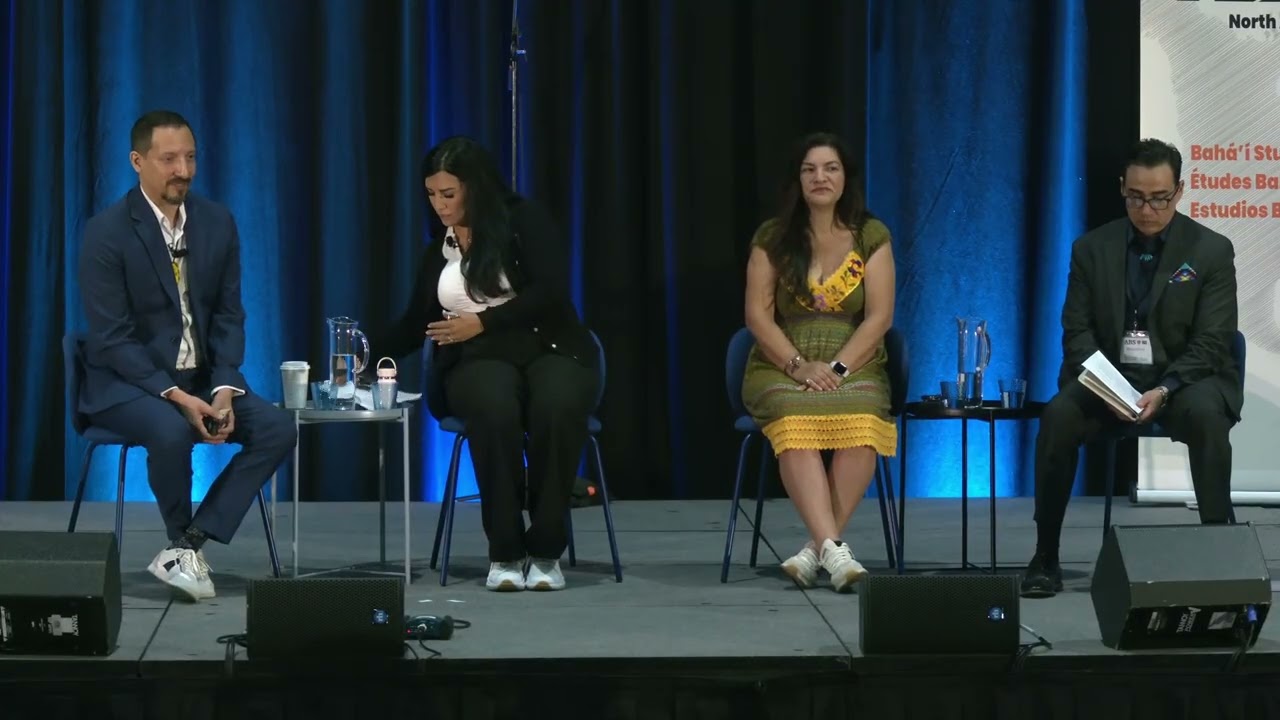
Video summary
The video explores Indigenous knowledge systems as complete, generative, relational, and collectively owned ways of knowing that challenge colonial hierarchies within academia, law, and governance. The panel features diverse speakers who highlight how these systems prioritize dignity, love, humility, and community well-being over abstract principles or forced assimilation. Ana White emphasizes the need for restorative justice solutions, such as caribou hunting, to break poverty-driven cycles among Indigenous peoples by reconnecting individuals with their elders and communities. Similarly, Dr. Imasumak Manong Davis frames indigenous knowledge through covenantal commitments to harmony with the land, advocating for a harmonization of diverse systems without hierarchy while celebrating human diversity.
Dr. Michael Orona presents three vital gifts from Indigenous peoples worldwide: intergenerational thinking exemplified by the Haudenosaunee seven-generation principle, peacebuilding methods like restorative circles and gacaca courts, and essential women's leadership in governance and conflict resolution. These contributions align with Bahá'í teachings on unity, justice, and the oneness of humanity, reinforcing a global perspective that includes voices from Turtle Island to South America. The session is enriched by stories shared by elders, such as Alex Half recounting how Hazam Bobby was welcomed despite being called a heretic, illustrating that the meek are often first to receive divine light. Additionally, Doris Mlan contrasts Bahá'í respect for identity with historical Christian mission schools that suppressed Indigenous languages and cultures, describing this shift in perspective as lifesaving.
The discussion extends beyond formal presentations to include various forms of communication among peoples, such as hand signals, eye contact, hugs, gifts, patience, and sacrifice. Mr. Razie's story illustrates the training required for individuals to give up their best interests for an enemy, fostering a relationship where those who arrived on this land are viewed not as adversaries but as partners in engagement with indigenous knowledge. This symbiotic approach suggests that embracing such perspectives could reveal new character traits across North America and lead it spiritually toward greater harmony. The panelists' insights collectively underscore the importance of retaining cultural identity while engaging globally, supported by teachings that encourage listening to elders and understanding systemic causes of offending among First Nations peoples.
The session concludes with a call for universal participation in these knowledge systems, ensuring diverse voices are included from various regions around the world. Following the presentations, which were preceded by medicine offered by Louise Prophet Leblanc, the host invites attendees to take a five-minute break to mingle near their chairs, greet friends, exchange hugs, and stay connected before returning at 10:30. This interlude reinforces the relational nature of indigenous knowledge systems, where personal connection and community building are integral to the practice itself. Ultimately, the panel demonstrates how integrating these ancient wisdoms with modern frameworks can foster truth reconciliation, improve governance, and create a more just society rooted in collective responsibility and mutual respect.
Read the full video transcript
I greet you this morning with two
feelings.
The first perhaps naturally and I
suspect many of us feel it is that um I
wish today was not the last day and it
came too soon.
Um but the second is that I'm also very
excited for this morning's program.
Uh we have two panels.
Uh the first one is titled indigenous
knowledge reading the landscape.
The second panel is titled cultivating
intellectual life contributing to
discourse in the biological sciences.
Both of today's panels are reflective of
the history and the direction of the
association over the past several years.
The panels will reflect rich and
profound perspectives on the
applicability of the revelation of
Bahala
to various facets of the intellectual
life of the Bahigh community.
So I would like to invite the panelists
up.
[applause]
Indigenous knowledge reading the
landscape will bring together scholars
and practitioners immersed in indigenous
knowledge to offer readings of the
academic,
professional, and related discourses
shaping the field today.
Each panelist will reflect on the
landscape of their particular area of
engagement,
examining the underlying assumptions at
play. the framing of prevailing
discourses and the key concepts and
questions currently being grappled with.
A thread of coherence running through
the panel is the principle of universal
participation.
Explored here in relation to indigenous
knowledge systems as one among many ways
of knowing and being in the world.
This includes embodied spirit
spiritually grounded modes of learning
that point towards a unity in diversity
of understanding.
The Bahigh community in a spirit of deep
listening stands to learn and contribute
much to this vital way of knowing.
Ana White is a 44year-old
cremate and Persian governance and
public policy professional
and founder of Firestone Policy Group.
Her family is from Edmonton, Alberta
with roots in Goodfish Lake First Nation
and the St. Paul de Matei settlement.
She holds a bachelor of commerce, a
jurist doctor, and is completing an
executive MBA.
Her work specializes in the use of
indigenous laws to develop strong legal
and policy frameworks governing lands,
resources, and justice systems grounded
in community consultation, research, and
contemporary governance tools to guide
to guide practical change.
She speaks conversational cre and Farsy
and her 15-year-old identical twins are
members of the Snoo First Nation.
She has been married to Doug White for
20 years. Both of her parents are Bahigh
and her parents met on pilgrimage in the
1970s.
Her Persian family names are Shirazi
and her cremate family names include
Todd, Cardinal, and Dejar.
Dr. Imasumak Manong Davis
is a Bahigh transdisciplinary scholar,
writer, and educator whose work explores
movements between ancestral knowings and
future understandings,
spirit-driven scholarship, and embodied
practice.
She stands in tremundos
between Ketwa ancestry and EnglishIrish
roots.
She is recipient of the Joyce Spencer
Champion dissertation award and a UN
delegate for the Bahigh International
Community at the UN permanent forum on
indigenous issues.
With a doctorate in education for social
change for social justice, her
scholarship is sustained by a central
question. How do we learn to live and
create in between?
Dr. Michael Orona has served in senior
level US foreign policy positions,
including as the White House director
for Africa affairs and senior adviser
for international indigenous issues,
co-leading the White House Committee on
International Indigenous Rights. He
holds a JD and an MS. He is Chihenn
Apachi and Yaki and is the author of the
brave ones.
And last but not least, the moderator of
our panel, Jordan Bigghorn.
Born in 1978 to Deloreia and Jacob
Bigghorn. Jordan is of Lakota heritage,
hailing from the Fort Peek, Aino, and
Sue tribes.
He currently serves as acting assistant
deputy minister for indigenous
excellence and education for the
Manitoba government.
He is a passionate laborer in the field
of truth and reconciliation
with particular focus on the emerging
landscape of community-based education.
Jordan, Melena, and their children also
serve in a focused neighborhood where
local youth gather on a weekly basis to
consider how service to humanity can
change the world.
Jordan also serves on the National
Spiritual Assembly of the Bahigh of
Canada.
Jordan,
[applause]
ready? Okay.
Testing, testing, testing. Oh, there we
go.
Thank you to our AV techs in the back.
That's what a thankless job, you know,
but such power. The push of a button as
we all know when we got used to Zoom and
Teams over uh COVID and then now most
recently in our daily affair, you're
muted. You're muted.
So this morning uh with these incredible
people on stage, these three to my left
in particular, we hope to express and
share uh some unmuted knowledge,
experience, story and most importantly
the interconnectedness of relationship
which as representatives of the first
peoples the stewards of this hemisphere
because I think what you'll see uh and
what you may have heard through some of
the introductions is that we do have
quite a representation
certainly from Turtle Mountain or uh
Turtle Island rather uh but then going
all the way into our South American
relatives.
Um and you know I don't think she's in
the room today. I I know that she just
had a young baby and so maybe needed to
rest some some more but uh Ukadu
uh is here. She brought her newborn um
and she is representing and brings her
ancestry of the Inuit far far north and
made it all the way down uh to be with
us. Um so north, south, east, west, we
got I think a lot of the bases covered
here. I just like would also acknowledge
in particular to what we would have
heard from uh just that incredible
address last night from our universal
house of justice member uh Mr. Razie in
acknowledging this call and opportunity
and invitation for all of us to be uh
practitioners of peace but that there
would be needed uh learning, engagement,
relationship and perhaps a blending and
mixing of such things to create uh new
chemistry, new idea, new reality, new
dream and quite frankly I think to me
when I hear of the mixing of our bloods
from both of these cradles, the cradle
of our First Nations and indigenous
peoples of this hemisphere and the
cradle of the blood of Iranian and
Persian relatives.
Um,
it gives access perhaps vision and long
sight of where we are going together now
that our two families have come together
in such a degree.
Without any further ado, we would like
to begin with words from elders.
It'll be a short video clip. I promised
Shabnam I wouldn't be showing any more
Disney movies, so don't worry.
[laughter]
But this first clip is from an Inishab
elder Alex Half who was sharing and
expressing how coming to Bahala
transformed him as of course as we know
that it that he does often.
But in the midst of this letter he was
reading about his experience and his in
his wishes for our community for growth
and healing he moved into this story and
it took me a moment to to click out of
it and realize he was he was recounting
a story from Adiphirday's book the
revelation of Bahala and he's talking
about an early babe who had recognized
the the message of the bo he was a
caravan driver and relates this story
that I could see and I hope you as Well,
can see Alex relating to this man as he
describes how the meek, the
impoverished, the ones laid low on the
land, as we know in God's way, are the
first to be welcomed into the cause, the
first believers.
And then it's followed by who needs no
introduction is our elder and
grandmother Doris Mlan, who of course is
with us and really over watching us now
from the other side camp. So we better
be on our best behavior because Doris
where she can really get after you.
>> He was commonly referred to as Hazam
Bobby. [clears throat]
The merchants and his family son Hazam
short the journey
they did not wish to associate with one
who in their estimation had embraced a
heretic fate.
On such long journeys, the party has to
stop two or three times a day for rest
and to feed the animals. On one occasion
when they're resting, the merchants
decided
to speak to Hazen to try to guide him
back to the f.
So we call him to come and join the
others. Having thank him for his
selfless
service and care, he began to converse
with Ham
and uh
and remarked,
"How is it that with all my knowledge I
have failed to appreciate the validity
of the Mesop
while you,
an almost illiterate person, claimed to
have
recognized the truth of his mission
has
took a handful of sand
in his hand and said people like me have
no merit in society.
They are like the sand in the desert
which has no value.
Yet when the sun rises in the morning,
the sand is the first to become
illumined by its ray.
[laughter]
>> Is that incredible?
>> Wow.
I think you know one of the things about
the Bahigh faith
>> uh is that uh for Bahigh our teachings
is that you retain your identity
and you you carry on with your own
language and you you your arts and your
crafts and this for the bahigh I'm
talking about Aboriginal Bahigh this is
a saving grace because
with Christianity and I will say
Christianity because that's who ran the
mission schools in my background was
that you were to lose your identity who
you were your language you were
forbidden to speak. You were uh you were
strapped. You were beaten. you were um
many horrible and horrific happenings
happened with our people. But when we
came upon the Bahigh faith through
visions, through dreams from the
teachings of Bahigh's that came up
there, Joan and Ted Anderson, the
Knights of Bahala,
it was a lifesaving.
The whole world opened up to us
and the possibilities of everything that
Bahala taught us and left for us to
read. The guardian saying to retain your
own identity
to be proud of who you are.
What a contrast. What a contrast.
And with that, we're going to send this
medicine. I'd like to acknowledge our
other relative and auntie, our
matriarch, Louise, Prophet Leblanc.
Thank you for bringing this medicine as
we can recognize as we have with our
elders that what we might share with
you, what you'll hear, we want, we would
want our entire communities and families
and our children with us. This is not
something that we would have achieved in
our own uh scholarship and our our own
academic our own endeavor. It truly is
how we have endeavored to be a good
relative and then we have been gifted
different knowledges and stories to
share. So with that I will send this
down to our first speaker
>> to me. Yes.
>> Thank you. Hi. Hi.
>> Hello everybody.
Greetings relatives. Ana White Nitson.
My name is Ana White and my CRE spirit
name that was gifted to me in a sweat
after many years side by side with Elder
Don Campbell from Norway House is
Wanchjac School, which interestingly
means Eastern Star Woman. And I just
like to give recognition and respect to
my mother Sholay Shirazi and um just
start off in a good way.
I'm grateful to be on an land.
I have a good feeling in my heart.
Um I want to acknowledge the association
for bahigh studies and I'm grateful for
the invitation to share a few words.
I'll try to make it short and sweet
and I'm really especially uh honored to
be on this panel with such incredible
speakers and thinkers and thought
leaders and knowledge keepers.
And I'd also like to expla express my
excitement that we're gathering here on
International Day of the World's
Indigenous People.
[applause]
Now, if you have been raised in a family
with a second language or first language
and English is your second, you'll know
how important language is.
And um I'd like to start with a prayer,
oh God, guide me, which uh I translated,
my cre language teacher and I work
together to translate it over many many
days, weeks. Um and I'd like to share
that. Oh God, guide me with you today.
Abdulah.
Our panel is called indigenous knowledge
reading the landscape
and that image that image of the land
really brings home a lot of memories for
me and it can't be understood from a
distance.
It must be approached in relationship
with land and water. And of course you
might have heard me say asi which is
land and water is nipp
and with the people languages stories
laws and responsibilities connected to
that place.
In my work, I've um come across a number
of in inspiring and beautiful people
and I've also drawn from the Bahigh
teachings in to help shape some of the
the thinking and the approaches that I
take in the justice space.
Currently, I'm working for a nation
called Lake by Nation and this is a
southern carrier nation based in British
Columbia. They're the third largest
first nation in British Columbia. We
have about 204 First Nations there
and I work as their justice technical
lead. And so what does that mean? It
means that I help implement the
agreements that they have with Canada
and British Columbia. And that also
means we're developing our own
restorative justice program and justice
model.
So I use the phrase indigenous knowledge
system knowledge systems in the plural
deliberately because I don't think that
there's one indigenous knowledge system
and I can only speak from my own point
of view. So for those wondering the the
neo or creled system is called the neo
mto
and what that means is it's the neo or
the cre way of thinking about the world
and it's about all the things that cre
people have known and that's the the the
knowledge system that I most uh connect
to because of my family and community
and these are complete coherent
comprehensive knowledge systems. They
are generative. They are relational.
They are iterative and they are
collectively owned.
And that challenged some of my thinking
in law school. I won't uh downplay that.
It's rooted in people's lands,
knowledge, thinking,
experiences. These stories of resilience
and of survival aren't just these
individual stories. They own they're
owned by families. They come get passed
down as as as
a a mode of thinking.
As you know, Canada has experienced the
uh ongoing and deliberate impacts of
colonial interference.
And this has really shaped a number of
communities and in fact continues to the
present day.
But let's talk about knowledge systems.
So the colonial project by its
definition will has imposed a hierarchy
of knowledge systems, right? And we see
that tension in academia. We see that
tension in fieldwork. We see that
tension in schools. We see that tension
in in media.
And they've pushed aside indigenous
laws. Again, I can only speak for my
own. And the term for cre laws are
migiwapa, which means the laws that come
from the law lodge. Migiwapa is lodge.
And it also interrupts the ceremonies
that would hold a lot of these pieces of
knowledge.
It displaces languages. It privileges
some languages in in terms of others. it
uh also interrupts the the way in which
memory is talked about. So we see a lot
of revisionist history when we think
about people writing books about
indigenous people which is great which
is association of beah high studies uh
essential goal is to create a different
conversation and to get there so this is
what we're doing
recent UN discussions put this clearly
for those who may be aware UNESCO
reported that dialogue participants
recognize indigenous knowledge systems
not as supplementary information but as
complete systems of governance, ethics
and environmental stewardship.
And this week in fact UN climate change
described them as living and evolving
and renewed the call to from citation to
application.
Indigenous peoples are to choose and to
share what kind of knowledge they wish
to share, but it must carry. And here's
here's the thing. It has to carry the
authority to shape the question, the
process, and the outcome.
And I've had to work on that in the last
20 years in the governance and law space
because I've had to make sure my
approach uh centers
uh d um naduen, which is the lakebin
people's culture. I've had to make sure
that that approach is sent is in the
center, not just defaulting to the
corrections model, the criminology
model, the the basic, you know, the
mainstream options out there
is the quote from the um okay,
very important. uh learned this first
was exposed to this uh quotation um when
I was a very young youth education for
peace program. We did a youth camp. This
was one of our early morning readings.
Um and I want to just reflect on this. I
hear a resonance here with Bahigh
teachings on justice, unity, and
consultation. And let's put a pin in the
consultation one because it helps us.
The purpose of justice is the appearance
of unity among men.
So we know that our bahigh view of of
consultation of unity doesn't mean sorry
of unity doesn't mean uniformity or
avoiding difficult truths. That's my
that's my personal take. And it has to
be strong enough to hold difference and
address unequal relationships. Now let's
turn to this message of the house of
justice, the beloved universal house of
justice where it states that um the
community is steering the trajectory of
its own development with creativity and
ingenuity and exploring how the
principles contained in Bahala's
revelation can be applied to the issues
that confront it within its immediate
reality.
Many of us here are in the helping
profession. It's quotes like this that
really prevent that professional burnout
that a lot of us understand and have
experienced because when you're armed
with this mindset, you can start to look
at things from the angle of how do we
get to the root cause of this issue and
how do we get to a place where the
nation's voice is is guiding things.
So, let's get to this next point. Um, I
don't know if many of you are aware, but
one of the things I've done in my career
is I've prepared a special specialized
type of presentence report for First
Nation Matey and Inuit and I've had the
honor of working for Nunovet Court of
Justice or sorry, Nunovet Legal Aid,
Ekyowit Legal Aid, BC's Legal Aid, BC
First Nation Justice Council, and
for a while the Canadian Armed Forces
when indigenous people who are accused
um and going through their justice
system, military system. And one of the
goals of that work is to um ensure that
the Supreme Court's
mandate and decision about how to treat
indigenous accused persons in courts um
is is realized. And so
you may or may not know this, but the
Canadian Supreme Court has asked and
required judges,
and I know this is heavy, but I'll
explain how this has shaped my thinking,
requires judges to consider the unique
systemic and background factors that may
have played a part in an individual's
offense cycle. So what does that mean?
So we know about povertybased crimes. We
know that nonviolent, non-serious
offenses are often leading to indigenous
people being imprisoned
and oftentimes is the lack of access to
good legal counsel that really pushes
them deeper and deeper into the system.
This is very concerning for me. This is
something that was brought up to me when
during my law school days and I could
never get away from it. I could never
explain why are our numbers so high.
I've worked in many prisons and I've
interviewed many individuals there and
I've noticed that the stories tend to be
the same. There's a consistent theme of
intergenerational trauma from
residential school. There's a lack of
economic opportunity, lower education.
We have the highest rates of the things
people don't want and the lowest rates
of things that people want, which is
education and and economic well-being.
So that was my experience for 12 years.
And as you can imagine, sitting in a
state of compassionate witnessing and
listening to survivors stories,
you start to understand that there are
some pieces there that were really,
really misplaced from the start and
communities didn't get an equal
opportunity and a chance to thrive.
So what I'm trying to say is that for me
as an indigenous person, [clears throat]
I have to look at what is the indigenous
knowledge system that can pull this
person back out of this out of the state
of difficulty
of of chronic, you know, reoffending and
and consistent challenges. How can we
put this person back together? So we
call it the whole human being theory.
And to do that, I do have to interview a
lot of elders and a lot of knowledge
keepers. And then I present that to the
judge or it's presented in a report.
It's not an advocacy report. It's a
piece of uh um it's an evidence-based
document to assist with what's called a
rehabilitation plan.
So, we're looking at all kinds of pieces
of there. So what I'm trying to get to
is that
this could include treatment,
counseling, education, restorative
justice, working with elders, and
ultimately this is often the most
powerful and transformative way of
assisting an indigenous accused person
uh to regain integration back into
society and to be able to um flourish.
But to do that, there's an element of
listening and of understanding. How did
we get here? How did this individual
come to be involved in the criminal
justice system?
And very Oh, I was told not to put my
hair in your ear.
There was an individual once that I was
interviewing and he was in his 40s and
he was at the Suriri North Fraser,
sorry, he was at the North Fraser
pre-trial center and he was from Dawson
Creek area and I said to him, "How are
you doing?" And he responded back, he
was like, "Duna, Dunce," which is very
of northern dialect. And I said, "How
are you?" So we started talking. I said,
"When was the first time that um because
he was in he was charged with assault, I
think, but I said to him, "When was the
first time that you ever I see a lot of
break and enters in your in your file?"
"When was the first time you did a break
and enter?"
And he leaned back, really warm, nice
guy, and he says, "I was about six." And
I said, "Six? Did you say 16 or six?"
And he said, "No, I was six." And I
said, "What happened?" So he used to
knock on doors in his community, like in
his in his neighborhood, and he would
ask for bottles and cans.
And he did this with his uncle. But the
times that they didn't have anyone
answer the door, he and his uncle would
essentially enter the home through a
small door, just the little guy, and
then he would open the front door. And I
said, "Really?" Now, here's where the
judgment could kick in. You know, you
can clutch pearls, you can sit back, and
you could say, "How could you do that?"
And I said, "Hey, what did you steal?
Just tell me like what does a
six-year-old steal?" And I was expecting
that it would be money, CDs, VHS,
whatever it was. And he says, "Oh, just
food. We just stole food from the fridge
or the from the cupboards." And I said,
"No money." And he's like, "Not really.
It just we just got the food when we
left." And so it occurred to me that
because of that piece of poverty really
shaping the socialization of that
individual, you could see how that
individual had grown into teenagehood
and adulthood
in this different sort of stream of
activity. Right? This is what I'm
talking about when I say about really
listening to how this individual got
here. It's the same musculature. It's
the same mindset when I think about how
to apply the Bahigh teachings in the
work of justice and building community
based justice.
Okay.
So I want to sort of land on this piece
and say that you know there these are
questions of how do we ensure fairness
for indigenous people in the justice
system. But it to me as a Bahigh person,
it's also important to consider the
question of love
and inclusion.
And so what that looks like for me is
that love isn't a sentiment. It's a
commitment to how a person's dignity is
addressed
through unfair conditions that may lead
them before a judge.
So um to to close this I want to share
with you that that different way of
knowing and of thinking about how to put
together a whole human being and take
them out of this constant cycle. It
really requires a degree of flexibility
of thinking about what solutions could
be attained. How do we move from um you
know that respectful encounter to have
that humility to sit and to think and to
bring together everyone's resources in
that nation to determine so whether it's
caribou hunting for several months as an
isolation from society versus jail
that can easily become an alternative
sentence for an indigenous person that
does help them reconnect back with their
elders or in our in our language we
would say kayak with elders
So finally our task is not to collect
indigenous knowledge as information.
It's to keep centering that indigenous
knowledge to develop that healing plan
to develop that opportunity for that
individual to thrive and to be um
approached with humility and love so
that justice may become more than an
abstract principle. It's my hope, it's
my belief, personal belief that it can
also help us to ensure that we see unity
in action as well and inclusion. So,
thank you for listening.
Thank you. [applause]
Thank you
for providing that centering for us with
the foundations of our elders to begin.
And now we move to Dr. Imma Sumak to
kind of broaden us further out to land
to family and relationship.
California.
My name is Imasumak Maron Davis.
I come from California in the United
States.
My father is from Bolivia of Ketwa
ancestry
from the Andes Mountains.
And my mother is of English and Irish
ancestry from those early pilgrims that
landed in New England and never left
that area.
And I was raised in a small village in
southern Mexico in Kintanro among the
Mayan community. So I always say soy
Mexicana deoras because that beautiful
country took care of me.
I want to offer deep gratitude to the
Anesnab people for this land. I just
kind of want to touch it, but you know,
I won't be really touching any have been
down. [laughter]
I'm just so grateful for the efforts of
those that come before us. And so, thank
you very much, Jordan, for opening up
with our elders,
for the medicine that is keeping us
grounded. Oh my goodness, so much
gratitude because, you know, we we we
aren't here unless those before us make
efforts. And God willing, our efforts
water the land before those who come
after
and even those who walk during, right?
That beautiful shoulderto-shoulder
concept that the Universal House of
Justice has gifted us with
and thank you of course for the
association
for considering this panel and these
thoughts to be shared with you this
morning.
I want to start with a poem. Poetry
grounds me, connects me to spirit.
So,
I'm going to start with a poem that
hopefully will help this conversation
begin with me.
I grew up entre and between
del
walking the red earth of the Andes
mountains on the cobblestone path from
Mama Crusa's home to El Park Central
Cochabanta
where my ancestors learned to be with
the land at over 8,000 ft above sea
level.
My father would direct me between
ceremonies and family, between
saludias.
My whole body engaged in the movement of
our community. All spaces filled up.
Then we board a plane,
fly across mountains, plains, oceans,
and arrive at the green emerald valleys
of Vermont. Drive through the New
England roads, forest, and trees on all
sides,
opening to a sweeping landscape of
rolling green hills,
white steeple churches, old farm houses,
colonial homes.
I would chat away with my aunt on her
New England porch overlooking the Green
Mountains, promptly stopped. Imasu, say
what you mean and mean what you say.
Ain't is not a word. My tongue would
stop. It knew.
When I think about language and I think
about indigenous knowledge systems,
these are all interrelated.
And for me, indigenous knowledge and
really any knowledge starts with a
commitment.
When you have a knowledge system, there
are commitments you are holding to
within that knowledge system.
And when I think about my mother's
community, their commitment was to me as
an individual. They wanted my individual
capacities to grow and develop. They
wanted to sharpen my tongue. They wanted
to make sure that I articulated well
because that would show a strong mind.
And so all their efforts were on my
individual capacities.
When I think about my father's
community, the commitment was to the
collective.
They wanted to ensure that the group was
well, that the family was good, that
people felt welcomed.
And so everything was directed outward
salen
make sure that they eat first.
I remember when I was little kind of
moving between these realities. My theas
always cooked so good and every time
they cooked I was so excited because I
was ready to eat and then they would say
and so the guests would come and they
would get the food and I would sit there
and I'm like don't take the big one.
Don't take the big one. I just did. I
wanted to make sure that the one I
wanted I could get.
And I think back and I'm like that's
good training.
It's good training for me, right? Hold
back. Wait. Let others fill up the
space.
To me, knowledge system is about
commitments. What are you committed to?
But it is also about a connection.
And this connection I learned primarily
through my father's community because
they kept that connection intact
within their knowledge system. Within my
mother's community, the roots were cut
off when they landed in the United
States.
But for my father, they refused to let
go of those roots. So let me explain
this a bit.
When I grew up, my father would tell me
stories of Mango Kapak and Mama Oklo.
They were the first holy ones to emerge
from Lagot Titikaka,
a holy lake, highest lake in the world
in the Andes Mountains.
And they came out of the lake to teach
the people.
And they taught them how to live,
how to live with each other, how to live
with the land, how to make clothes, how
to cook, right? They taught them how to
live together and build and create.
And the last of these holy ones was
Vidakocha.
And Widaocha said, "I come to teach you
how to build a civilization
because you will need to know how to do
this in the future.
when another teacher will come and all
the tribes of the world will come
together to build one civilization and
you will need to contribute towards that
and what the community did is they lived
out those teachings.
So when we talk about indigenous
knowledge,
it goes back to the holy ones
and that to me is a covenant. They are
keeping a covenant. So indigenous
knowledge when you hold to it, you are
keeping a covenant
with your holy ones, which is the same
seamless covenant
that leads us to Bahala.
And so when we ask indigenous people to
release that, you're asking them to
release a covenant and we can't do that.
Thankfully,
as my sister Ana has shared, we are not
asked to do that.
Bahala said, "We need it all to come
in."
You know, in a recent uh quote
from uh the Baja international community
that I was had an opportunity to study
with others, I was so excited to to
really not only that every member of the
human family has a right to benefit from
a material and spiritually prosperous
civilization, but an obligation to
contribute towards it.
But what we have to learn how to do is
how to harmonize
these knowledge systems. The one I
shared of my mother and my father. They
have both beautiful contributions. But I
believe we are still learning how to
harmonize these
because we come from a colonial pl past
that place these knowledge systems on a
hierarchy and we're not quite sure that
they all have something equally to
contribute.
However, Bahala's revelation has
dispelled that
and so we know that they do.
Now,
I also want to bring in
some other voices that have been really
thinking about these things as well.
And so this IA scholar Sylvia Rivera
Kusikanki,
she recognizes as well the times that we
are in. She says we are in the time ofi
and chishi means that there are two
distinct entities
that can coexist, can contribute
towards, can even create new
understandings, but they will never lose
their essence.
And I love that. But of course, we have
to learn how to do this, right? We don't
know yet how to do this. This is part of
our work today.
So, I wanted to bring in a little bit of
the beautiful communities that walked
the Americas, right? Because my father
told me indigenous people in the
Americas are one from Thier del Fuego
all the way up right to the to the
Arctic Alaskan circle, right? just that
mong right and so
maybe instead of just my voice I can
bring in a little bit of that community
so you can feel and sense you know who
we are with and so you're going to hear
a small snippet of lo ponchos ros and lo
ponchos ros um are aa group that have a
tradition of kind of protecting and
maintaining strength around the
community
And my father told me they would
traditionally
chant primarily in Iara which was one of
the second largest tribes of of uh
Bolivia along with the Ketwa. Uh but now
they go between and Spanish right which
is part of that inbetweeness that we're
talking about. We can just hear a little
of it.
>> [screaming]
>> You know, this is a way of being in the
world, right? What we're witnessing and
what we're seeing is a way of being in
the world.
And we want to learn how to be with
others, right? In their way of being
along with our own way of being.
And this beautiful dance I was able to
be a part of and see in my in my
father's community. That's Sakaba.
Sakaba is my father's birth town. And so
I just wanted to share that with you and
bring you a little bit closer as we
learn how to stand ini together.
Thank you. [applause]
just to see immediately those
connections and to begin with
representation and work from our co-ish
BC tribes to me if you know of those
tribes the reflection is so clear even
with the red uh blanket the poncho and
then the hat it's very of course
reflective of uh BC First Nations
culture so we will move to uh Dr. Arona
who will then take us a further step
perhaps as we might consider indigenous
peoples of this land crossing the ocean
a kind of reverse migration if you will
and what he has been able to uh observe
and serve and also bring back knowledge
to this continent. Thank you Jordan.
Good morning everyone.
Michael the
I bring you greetings from my people,
the indache nation of the southwestern
United States and from my mother's side,
the Yaki people of southern Arizona and
northern Mexico. And today I am here
because the man on the screen I am here
because of my late father, Dr. Joel V.
Orona who at the age of 16 dropped out
of school and went on to serve in the US
military in Vietnam and came back a
changed young man who wanted to work for
world peace and wanted a religion that
would work for world peace and was
searching for a religion that would
acknowledge his own indigenous beliefs
and traditions and he found that in the
Bahigh faith and that's why I'm here
today.
>> [applause]
>> I want to take a few moments as as
Jordan said, we're getting close on
time, but I want to take a few moments
to to look and examine universal
participation in ways of knowing through
an international indigenous perspective.
And let me start with a striking reality
and that is there are 500 million
indigenous peoples around the world
living in over 90 countries. Indigenous
peoples speak 4,000 of the world's 7,000
languages and we as indigenous peoples
are 5% of the global population.
Yet we steward 80%
of the Earth's biodiversity.
For centuries, indigenous communities
have served as a source of knowledge on
critical issues such as the environment,
food security, equitable governance,
gender equality, education, and global
peace building, just to name a few. And
for generations,
this wisdom
was not overlooked.
It was not overlooked.
It was targeted.
through boarding schools in the United
States and residential schools in
Canada,
Australia,
New Zealand,
Mexico,
Guatemala, and beyond. These schools
were designed to sever the transmission
of indigenous knowledge from one
generation to the next.
That these indigenous communities
survived is a testament to their amazing
resilience, one the world urgently needs
to understand.
The Bahigh writings state that the
diversity of humanity is not a problem
to be managed but a gift to be
celebrated.
Abdul Baha describes humanity as a
garden and I quote, "A garden is
beautiful because of the diversity of
its flowers."
The suppression of indigenous knowledge
diminished not only indigenous
communities, it diminished all of us.
It diminished the light and it narrowed
the garden.
Indigenous traditions worldwide offer
many gifts. But again, due to limited
time, I want to focus this morning on
three international indigenous gifts.
Each resonating deeply with the Bahigh
principles of unity, justice, and the
oneness of humanity.
The first gift, intergenerational
thinking.
The Hordesy Confederacy, one of the
world's oldest living democracies. The
people of the long house have been
governed
for over a thousand years
by a single principle and that is that
every decision must consider its impact
on the next seven generations.
The next seven generations, not this
quarter, not this election cycle but
seven generations forward.
The Bahigh principle of the oneness of
humanity extends across time as well as
space and seven generation thinking and
the Bahigh commitment to building a
civilization worthy of humanity's
highest aspirations
are at the core
that same moral claim.
The future is our responsibility.
Now
the second gift peace building
indigenous peaceuilding
conflict resolution and consultation
begins where most western legal systems
do not and my sisters knows that from
firsthand experience and that is that
harm damages relationship and healing
requires restoring them.
For example, indigenous peacemaking
circles throughout North and South
America bring together the person
harmed, the person responsible, and the
community to create healing.
In the African country of Rwanda after
the 1994 genocide, traditional gacha
courts were used to bring that same
level of indigenous consultation
and wisdom to heal a nation torn by
violence.
In 2024,
I was honored to be among one of the
most indigenous representatives from 30
countries that worked to produce an
international declaration on indigenous
peaceuilding that was adopted by the
United Nations.
Friends, this is not indigenous
knowledge just being consulted.
This is indigenous knowledge leading,
inviting, and co-designing.
The the Bahigh writings state
the consultation
honest humble and openhearted
consultation is the lamp that guides the
path of the community.
Indigenous peaceuilding embodies this
exactly.
Truth sought together, no single voice
dominating and the well-being of all is
the measure of success.
The third gift, the equality of women
and men.
For millennia across the indigenous
world, from the Sammy parliaments of the
Arctic to the highlands of Guatemala,
indigenous women's leadership has never
been ceremonial,
but essential.
For generations, indigenous women have
governed territories,
brokered peace, and served as knowledge
keepers. And the research in the
evidence agrees as international peace
agreements are 35% more likely to last
when women are actively involved.
>> [applause]
>> The Bahigh writings are explicit.
The world will not find peace until
women take their rightful place in all
human affairs.
Indigenous traditions that
institutionalize women's authority are
longstanding models of the very
architecture the Bahigh vision calls us
to build.
Now there's a phrase I use in my work
and that is epistemic justice. Epistemic
justice. The idea is very simple and
that is that every way of knowing
deserves to be heard on its own terms
and not only when it can be translated
into western science
among my own people, the Apache and the
Yaki people and across indigenous
communities worldwide.
Spirituality,
environmental knowledge and governance
are not separate domains.
They are one living system. So every
time a language disappears,
every time a ceremony is silenced and
every time an elder's voice dies
unshared,
the world loses something it desperately
needs.
This is why universal participation is
not simply a value.
It is a necessity.
A world facing climate change, conflict
and inequality is thirsty.
Thirsty for spiritual wisdom and
practical knowledge and cannot afford to
draw from only one well.
Abdul Baha taught that the independent
investigation of truth is a sacred
obligation,
urging all of us to seek reality free
from prejudice and recognize it wherever
it can be found.
And the Universal House of Justice has
written that indigenous communities are
a significant element in the
construction of a unified world. End
quote.
Friends, this is not charity. It is a
structural claim. The world we are
trying to build cannot be built without
indigenous peoples.
In closing,
among the D, the Navajo,
and among my own people, the Inde or the
Apache, we carry the belief of hoou
hoou, beauty, harmony, and balance. And
we say hog nashado hogo nashado. We walk
in beauty. We walk in beauty with one
another. We walk in beauty with the
earth. We walk in beauty with our
ancestors. And we walk in beauty with
those not yet born.
The pain of one is the pain of all. The
hope of one is the hope of all.
Bahala wrote, "The earth is but one
country and mankind its citizens."
Indigenous knowledge systems have been
teaching,
practicing, and living that truth for
millennia,
often at great cost with extraordinary
resilience.
For the Bahigh community, receiving this
wisdom is not the discovery of something
new.
It is a recognition of something
ancient, something it already believes
at its heart.
The question is,
are we prepared to receive it?
To sit together, indigenous and
non-indigenous,
and truly listen.
Truly listen, not to translate, not to
validate,
but to learn.
I believe this community can and I am
deeply grateful to walk in beauty with
you today.
>> Thank you.
[applause]
on behalf of u our speakers here and
just to offer the depth of what you
would have experienced would have kind
of washed over us through the music
through poem through case law through
international lens. We could also take
all of that into a on the hand over here
and say where is indigenous knowledge
and just do this
>> they laugh because they kind of know
what that means. I'm not trying to kiss
somebody or the air. [laughter] It's
over there.
>> That's right.
>> It's kind of indigenous ways that all
peoples have means to communicate. Hand
signals, eye looks, hugs, gifts,
patience, sacrifice to the point of Mr.
Razie's story of training one another
to give up our best to our enemy.
You are not our enemy who have come to
this land.
But through this relationship and
engagement of this knowledge,
this symbiosis of training, could we
reveal new character
>> of this continent which we know as was
mentioned last night should lead the
world spiritually.
>> Thank you.
[applause]
>> Thank you.
>> [applause]
>> standing.
[applause]
Let's give a very special thank you to
our panelists.
[applause]
Um friends, now I have the very
difficult task of inviting us into a
fiveinut stretch break. [laughter]
And maybe if I can suggest what that
might look like is uh we get up, we hang
around the three or four chairs around
us and say hi to the friends, maybe give
each other a hug and stay close by.
We'll be back sharply at 10:30.