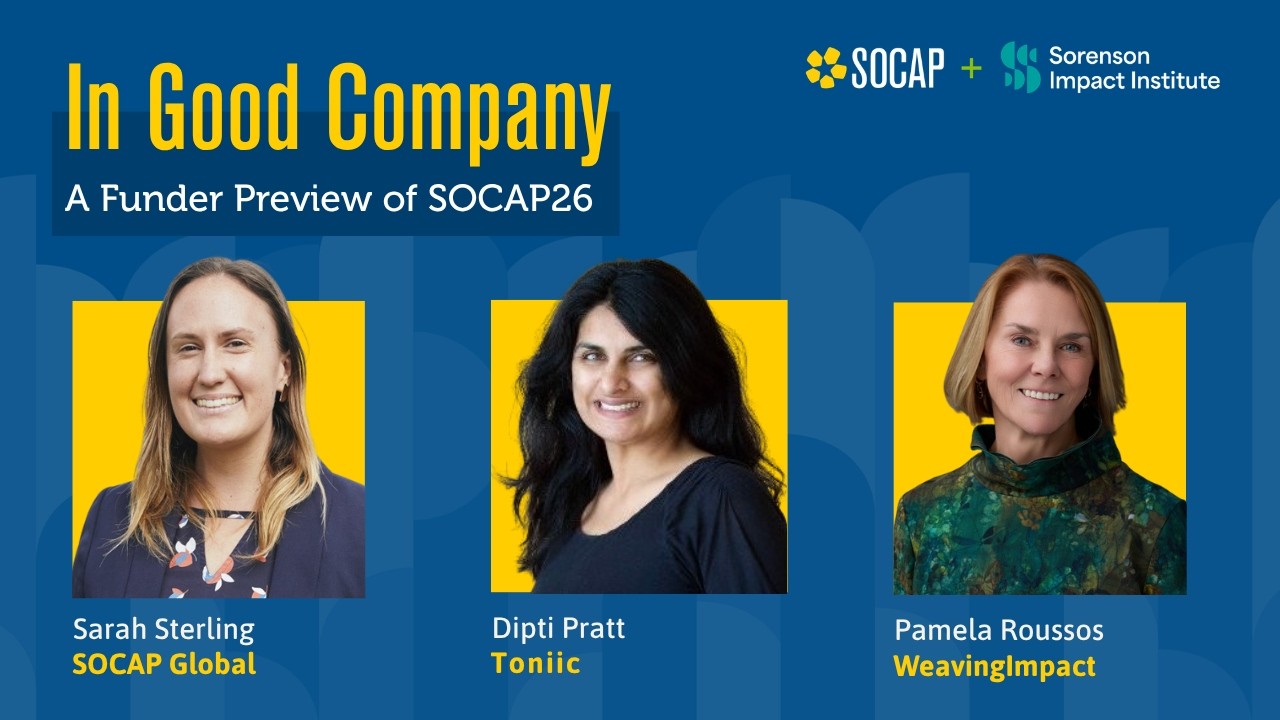
Video summary
The video introduces SOCAP26, an annual global convening for the impact investing ecosystem that is making its historic move from San Francisco to Chicago this year. Hosted by Sarah Sterling of Sorenson Impact Institute alongside partners Dipy Pratt and Pamela Russos, the event aims to drive capital into social change initiatives while spotlighting innovative work across different regions in the United States. The conference has grown significantly since its founding in 2008, evolving from a small gathering during the financial crisis into a major community of up to 4,000 attendees annually. This year, attendance is intentionally capped at 1,500 people to foster deeper connections and facilitate curated experiences like the Capital Provider Experience, which focuses specifically on allocators such as family offices, foundations, LPs, and institutional funds.
A central theme of the webinar is the strategic shift to Chicago, a city chosen for its vibrant impact ecosystem, strong neighborhood identities, and diverse landscape of institutions ranging from major universities to specialized co-working hubs like MHUB. The speakers emphasize that this move allows SOCAP to highlight change-makers in the Midwest while addressing current macroeconomic challenges by exploring new asset classes and blended finance structures. For capital providers specifically, the event offers a unique opportunity to step back from daily operations to collectively navigate market complexities, identify emerging investment vehicles, and build meaningful peer-to-peer relationships that can lead to co-investment opportunities rather than just transactional networking.
The Capital Provider Experience is designed as an intentional space for allocators to engage with fellow peers through interactive panels, workshops, mapping exercises, and exclusive off-site sessions like the Chicago Community Sessions at MHUB. Unlike general conference tracks which are open to all attendees including social entrepreneurs seeking funding, this specific experience focuses on creating a trusted environment where investors can discuss timely topics from an investor lens without expecting immediate transactions or guaranteed deals. The organizers clarify that while many mainstage conversations and networking opportunities remain open to the broader community, these curated sessions aim to shorten the distance between capital providers and those doing work on the ground, fostering proximity-based learning and long-term relationship building that extends well beyond the event itself.
In conclusion, SOCAP26 represents a maturing ecosystem where collaboration is key to overcoming fragmentation in funding pathways for social entrepreneurs. The speakers stress that while not every attendee will walk away with immediate capital commitments, the true value lies in starting conversations, understanding one's role along the capital ladder, and building a supportive community network. Whether you are an allocator looking for new investment thesis alignment or a nonprofit seeking to understand how to engage with funders, the conference offers diverse tracks covering everything from climate resilience and shared prosperity to culture of place and longevity economies. Ultimately, the event serves as a vital gathering where all parties—investors, entrepreneurs, intermediaries, and community leaders—come together to ensure that impact work is sustainable, scalable, and driven by genuine relationships rather than abstract transactions.
Read the full video transcript
Hello everyone.
How's everyone doing today? Feel free to
put it into the comments or the chat
function here. We're so excited to have
you all join us today. On behalf of the
SOCAP content team, welcome to our
capital provider experience webinar. My
name is Sarah Strerling. I'm the vice
president of content committing at SOAP.
Before we dive in, let's take a quick
look at what we're going to talk about
today. For those of you new to our
community, we'll start with a very brief
history of SOCAP and what this new year
and our move to Chicago entails,
followed by hearing from our partners at
Tonic and Weaving Impact about why the
capital provider experience is so
important for this year at SOCAP for
allocators. We'll then give some
examples of sessions that will be part
of this experience and we'll definitely
have time at the end to answer any and
all questions you may have. So please
please feel free to drop drop them in
the chat throughout the webinar. Joining
me today are Dipy Pratt from Tonic and
Pamela Russos from Weaving Impact.
>> Hi everyone.
>> Um thank you both so much for your time.
Um, so Dipy and Pamela, um, I would like
to take a minute to have you introduce
yourselves as well as mention how many
years you've been a part of the SOCAP
community and maybe a quick funny story
from one of your past years at Socap. I
know I have uh, one from like every
single year. [laughter]
Uh, maybe Pamela, you start.
>> Sure. So, I'm Pamela Russos. I'm the
founder of uh Weaving Impact CEO and
we're about helping close the racial
wealth gap uh for disinvested
communities by supporting social
entrepreneurs to help them build
economic um prosperity in their
communities and for the for themselves.
Um this is based on 25 years of work um
by Miller Center for Global Impact. Um
and then that's was taken into Baltimore
and made it into a placebased model by
Innovation Works and Weaving Impact is
taking that to other cities across the
US. Uh in in Chicago, we're actually
working with an organization called New
Life Centers and we're also working in
Gaithersburg, Maryland with cross
community. So to answer your question,
so there's been 17
uh SOCAP conferences and I can think of
four that I did not participate in and
so there might have been another one or
two. So I've been to most of the SOCAP
conferences and you know I was actually
at the very first SOAP conference in
October 2008. Um I had recently started
mentoring at Miller Center. I was still
in the tech industry. had a career in
the tech industry, was still working
leading ventureback companies um but
started mentoring these social
entrepreneurs and I had no idea what
social entrepreneurship is about impact
investing and so I thought well I should
know something about this and I don't
know how a SOCAP uh conference flyer
came across my radar but it did so I
registered for the conference so I could
just learn more and as I said this was
in October 2008 and um if you all
remember in 200 in September or
summer and early fall of 2008, the
financial markets were tanking. There
was no trust in the in the traditional
systems. And so, I don't know how many
people registered for that conference,
but so many more showed up day of to
attend because they were like, there's
got to be another way. And so, in that,
we were all just crammed into the spaces
to listen to these speakers and such.
were sweating, but there was still a mo
there was every a joy and a and hope
that there were alternative ways and
that we didn't need to just fall into
the same old systems that were failing
around us.
>> Amazing. Thank you, Pamela. And Dipy, go
for it.
>> Yes, I would love to share more. Um, for
those of you who don't know me, I'm Dipy
Pratt. I'm a managing director at Tonic.
Um, I've been at Tonic for about seven
years. And I was trying to think back
when was the first time I touched Soap
because I feel like I joined in the
early years right around 2010 but it was
already this larger than life
experience. It was like and you must
join Ton you must join SOCAP you must be
here you want to be here where everyone
else is. Um, I've had a really long
background of impact and have really
been privileged to touch impact from all
corners of the world from working with
tech and venture and to working with
philanthropists and now working with
impact investors. And for me, the thing
that makes Soap so special is it brings
and converges all of these individuals
in all different corners of my life and
brings them to one area and one space.
And so for me, the funniest moment I
think I've had is the awkward name tag
zoom in where you go, I know this
person, but where do I know this person
from? And so I feel like every Soap I
have this opportunity where it's like a
reunion of almost a high school reunion,
if you will, of people that have touched
different moments, different points of
your life, and yet bring you energy
because we're all in this journey
together. and I'm really excited to see
and kind of be part of this conversation
today and at SOCAP as we come closer.
>> Awesome. Thank you both. All right, so
really quickly just for people who are
like, I have no idea what SOCAP is. I've
never heard of this, but I joined this
webinar which welcome and thank you for
your time. Um, I'm going to go really
quickly over the history of SOCAP just
to get us all up to speed.
So SOCAP was founded back in 2008 as
Pamela mentioned. So, we're one of the
original movers and shakers in the
impact investing ecosystem. And since
then, we've grown into a global
community that has included anywhere
from 800 people to 4,000 people every
year. And even though our venues have
changed over the years and with this
this year, even our city, we still
maintain the same focus, which is
driving capital into the impact
ecosystem to create lasting change
around the world.
And this just gives you a few statistics
from last year, but basically um so that
you all know, we're capping attendance
intentionally at 1500 people this year.
And this is to really um try to increase
the number of intentional connections
that folks are looking to make and and
allowing us to help them make it through
experiences like the capital provider
experience. In past years, um and we
assume this trend will continue for this
year, we've seen about 60% of our
community overall um in this bucket of
funders and founders. So any type of
stage or type of capital and any legal
incorporation you can imagine but that
is sort of our core audience right um
and the other 40% is shared between uh a
variety of entities but the government
universities students consultants media
advocacy groups etc. So, we really are
the big tent of the impact ecosystem.
And since I mentioned it already and I
moved ahead a little bit to the tracks,
but I just want to make sure that
everyone knows that we're moving to
Chicago this year. Um, this is a really
historic moment for us as we've never
moved our global convening outside of
San Francisco. So, this decision was
made over a number of years um and a
number of conversations with our
long-standing partners and really was
deeply intentional. Um, we got feedback
from many of our community members and
it really became clear that SOCAP does
have a role in the community ecosystem
to bring our community together in other
places within the United States for now,
but US for now to spotlight the
innovative work that's being done there
on a global stage. Um, I also can attest
to this after visiting places like
Minneapolis and St. Paul and Chicago
this year that there are a lot of
incredible change makers doing our type
of work, the SOCAP community's work and
have been doing so for generations. So
we felt it was really time to share that
work with our community and also share
what our community is doing uh with the
Midwest. And this this all move also
enables us to do new things like Monday
where which is the first day October
12th of the event where we're going to
be hosting sessions in the afternoon all
around Chicago. So attendees can pick
one experience and really dive deep into
a specific community and work um by one
of our partners in Chicago. They're
called a Chicago community sessions. Um,
and so it's just to bring a lot of depth
and life into what we're doing in
Chicago. So for the tracks this year, we
brought back some favorites from
previous years as well as some
completely new tracks and we're really
excited to share them with you. The
capital provider experience lives across
most of these tracks. Uh, just as an
FYI. Um, I'll go through them really
quickly because we want to get to our
main focus of our time together today,
but you can feel free to learn more
about them on our website and the
intention behind each one. So track one
shaping capital systems which focuses on
catalytic capital institutional markets
private markets and philanthropy. Track
two is pathways to shared prosperity
which focuses on essential economy,
equity, equity and opportunity, policy,
government and social movements and
ownership. Track three is climate
capital which focuses on climate
resilience, nature-based solutions, and
the blue economy. Track four, which is
completely new for us and we're really
excited about it, is called a future
that works for everyone. And it's
focused on silver economy or the silver
tsunami, however, longevity economy.
There are many words for it. Um,
accessibility and inclusion and
dignitydriven innovation. And last but
not least, of track five, the value of
culture of place, which focuses on
place-based initiatives, media and
creative economy, as well as
communitydriven growth. So this time
before we get into, you know, what
specifically the capital provider
experience is, I'd like to talk about
purpose and intention. Um, I'm going to
pass the mic to my colleagues to talk
about why Chicago, why this timing, and
specifically like why is this so
important, this moment for capital
providers. And Pamela, maybe you can
start.
>> Yeah. So why Chicago? First of all, at
the risk of uh sounding like I work for
the tourist board, um Chicago is a
beautiful city. It's an amazing city.
I've lived in beautiful cities before in
Chicago. I live here in Chicago. It's a
beautiful city. Has so much to offer in
terms of architecture, great
restaurants, amazing arts and
entertainment scene. And if you just
want to do long walks along Lake
Michigan, it's it's gorgeous. And so I
encourage you to come before Soap, stay
after SoCap to be able to enjoy all the
city has to offer. and the fact that
it's got two airports um both O'Hare and
Midway make it really easy for air
travel uh both domestically and
internationally.
So, um I could go on and on about
Chicago, but I'll transition and talk
about why uh SOCAP in Chicago. So,
Chicago has a genuinely strong vibrant
impact investing and social enterprise
scene happening from it's got all these
institutions like uh MacArthur
McCormick, Coleman, Pritsker, Brown
Foundations, plus many many more family
uh family offices doing important
philanthropic work as well as some more
than others doing impact investing. So
investing out of their corpus
missionaligned investing. Um you also
see that so just so you know uh Chicago
is a as a city of neighborhoods. There
are 77 neighborhoods and they are all
very people identify with their
neighborhood. It was something very new
to me coming to Chicago. In fact, I was
um having lunch uh this week with a a
potential partner. Um and you know, it
makes so much sense for us to be working
together and they're working in West
Garfield Park and we're working in
Humble and Park and Little Village and
I'm like, "So, if we want a program in
one of our uh neighborhoods, were will
your constituents come?" and he's like,
"No." And it's like, it's not very long.
It's like two miles away from each
other, but there is such an identity
with space. And what that means then is
you've got thousands of nonprofits and
social enterprises working deep within a
neighborhood or a couple neighborhoods
um that that that have long history in
these neighborhoods are very much
trusted um by by their community. And
then there are citywide uh initiatives
too looking at specific things like uh
violence intervention and getting all
the violence intervention organizations
that are work doing work on the west
side and the south side together to work
together. So this work goes deep and
wide across across the city. You also
have institutions that are doing great
work. You have Lyola University with
their Balmheart Center and you have uh
uh University of Chicago with R Sandy
Center really focused on social
innovation, social entrepreneurship and
then some of the medical systems like
Rush that is had a longtime focus on
health equity. Um and then you have
aggregators like the impact house that
is co-working space for uh impact
organizations, foundations, social
enterprises, nonprofits, matter which is
a co-working space for healthcare
organizations
and MHUB which is a hub for hard tech
companies and actually you'll hear from
Sarah later on that through the capital
provider curated um experience there is
an event that's happening at MHUB. So,
you'll get to really experience uh
experience the work there. So, there's a
lot happening uh in Chicago. I'm super
excited the fact that there's going to
be these community um excursions um uh
which is a new thing for uh for SOCAP
and so you'll get be able to get out in
into the communities to learn and then
that you'll also see that everyone is
really wanting to learn from others too.
One of the things that I've really been
impressed with organizations here in
Chicago is that there is a willingness
and and a desire to learn from others.
And so all of that, I think, brings
together just this amazing ability to
have this conference here that really is
focused on on on connection and action
together.
>> Amazing. Thank you, Pamela. And Dipy,
I'm going to hand it to you to talk
about, you know, why why is this
important for capital providers,
especially with all of your experience
working in the impact investment and
ecosystem in general?
>> Yeah. No, absolutely. Thank you. I mean,
I think one obviously Chicago is such a
unique place to bring this convergence
of individuals together and you even see
it in kind of the actors and individuals
that make up the ecosystem. But even
taking it up a level as to why now and
why this moment, I think we're seeing
the impact investment ecosystem really
maturing, right? There's more actors
coming in, all of us that have been in
the space. We're also growing as
organizations and maturing as
organizations. And that's both an
opportunity because there are more
individuals around the table, but yet it
makes it more complex. And so with that
complexity, it's a beautiful moment and
an opportunity to understand how do we
take a step back? Taking a step back
from the day-to-day that we spend and
lean our energy into, but actually going
where is the market heading? What can we
do collectively? What can we do
together? And then also even just
thinking about obviously the larger
macroeconomic conditions, some of the
headwinds we're experiencing in the
ecosystem. Also because of the maturity,
we have this incredible opportunity to
see really new vehicles, new asset
classes, new blended finance structures.
And so how do we navigate those? What do
we think about those? And I think SOCAP
is a really beautiful opportunity in
place to do that and say there is
uncertainty, but what do we do with it?
And what do we do collectively?
>> Amazing. Thank you, Dipy. Um, and so
before we jump into some more of the
details of the capital provider
experience this year, um, and in talking
also with like Dipy and Pamela and
others as we were developing this out
and like what should we include, what
should we call this? Um, Dipy and Pamela
reminded me we should probably define
what capital providers experience
actually means. Um, and so I'll have a
slide up here in a second, but here we
go. Um, capital providers are any
organization or individual actively
making decisions about where and how to
deploy capital for impact. So, this
includes, but it's not limited to
because we didn't have enough space on
the slide to include everyone, uh, but
limited partners, LPs, general partners,
GPS, family offices, foundations, and
endowments, community development
finance institutions or CDFIs, corporate
impact investors, and sovereign or
institutional funds with impact
mandates. But all this to say, you know,
those of you who are actively doing the
work and are the decision makers within
your organizations of how and where to
deploy capital, this was created for
you. Um, we also of course have a lot of
other content at Soap for those of you
who are completely new to the space,
dipping your toe into the impact
investment ecosystem. Um, but
specifically for capital providers, I
think it's really important just to
clarify um that this is for people
actively doing the work. Um and so this
is the whole experience has been
designed by and for capital providers.
So all of the sessions are led by people
who have really deep knowledge in the
space whether it is academic or their
actual practitioners, investors, etc. Um
and it's really to create a trusted peer
environment where allocators can engage
with fellow peers and explore timely
topics through an investor lens and
build meaningful relationships. Again,
this is just one pathway that allocators
can choose to engage with. at SOCAP. In
terms of content, we have a lot of other
content about other topics. We wanted to
be really intentional about creating a
space and an experience flow throughout
the three days specifically for
allocators.
Um, and so we'll get to the specific
examples, but for now I want to pass the
conversation to Dip Dy first and then
Pamela to speak as to like why this
decision to have this experience matters
for capital providers now and
specifically this year at SOAP. And so,
uh, Dipy, take it away.
>> Yeah, absolutely. Happy to talk a little
bit about kind of the why. Now, um, I
think one of the first things that I
really see and I felt both as a
participant and as an observer is that
the investors who really get the most
out of SOCAP aren't those who are
looking for the now. What am I going to
get in this transactional moment? How
are we building something that's picked
up from either past events, past
moments, or ongoing conversations and or
taking their moments and carrying them
forward? Um, I think one of the things
that's really great about SOCAP is this
opportunity to really expand your
perspective and kind of think about what
else what do I long learn alongside
others and where and what can I learn
about where is the market where's the
impact investing markets heading in the
future. Um, what I'm really excited
about is I see these turn into really
partnerships. Um, they often become
co-investment opportunities. And so this
brief moment in time in Chicago builds
and creates both what we've built
already and also what is not yet here.
Um, so some of the things that I see
really are about what are the investment
opportunities, right? Why do investors
actually come together? So, does an
incredible job of bringing together some
really innovative fund managers as well
as brand new managers that are either
creating something new that we get to
get to have a firsthand look at to those
that are already existing managers that
are raising new vehicles and new
opportunities.
I think we also have this beautiful
opportunity to see really innovative
ideas. So whether that be from social
enterprises and social entrepreneurs,
whether that be in fund structures and
vehicles that are stood up and or
whether it is also really co-investment
opportunities that we can look at and
explore together. Um I know I come to
SOCAP with this intention and I'm always
surprised and outmatched as to what it
becomes. I leave with brand new
relationships that I'm like, how have I
not known you before? How have I not run
into you in this space? alongside
individuals where it's like I'm so glad
we're here and we're conference buddies
yet again at SOCAP. Um, and I also think
that really brings a nice thing that I
see SOCAP do so well is it's very much
around like you're learning from those
that are presenting but you're learning
from those alongside you and some of the
conversations that happen are really
around learning from peers and having
those very very intentional touch
points. And I think the thing that is so
special for this year is that
intentionality that's being put behind
the capital providers and how do we make
it so that those intentional points are
actually a bit more orchestrated so that
you can also get what you've come for
because we all come for an intention and
taking time away is such a gift and we
certainly recognize it. So how do we
lean into that? Um, a couple other
things I want to touch on that I think
is really beautiful um that I've also
experienced is SOCAP creates this
beautiful opportunity to build
relationships with a wide varied types
of individuals. Um, so that includes the
family offices, the foundations, the
fund managers, um some of the
institutional investors, the advisors
and some of the ecosystem builders like
Tonic. We love showing up because we get
a chance to be around so many different
types of individuals. Um the
collaborations I would say often begin
very informally. Um some of it you go to
some events and it's very very
intentional. This it's kind of organic
and it's because of the thoughtfully way
with which SOCAP brings the individuals
together. The cap that you alluded to
earlier Sarah because of that we're able
to bring this opportunity of being open
and seeing who you sit next to and the
privilege that comes from that. Um, this
year's capital provider experience, it's
really designed specifically for
allocators. And so I think some of the
benefits just to double click a little
bit more into what we're going to
experience is very much a curated peer
discussions. And so the chance to really
be alongside peers. Um, we're going to
have the opportunity to open up and have
really investor only networking
opportunities. So there is that
opportunity to be in community together
and have some of those closed door
peer-to-peer conversations. Um, we're
also exploring how we can bring together
some really facilitated introductions.
Um, organic is beautiful, but also that
intentionality and really leaning behind
and looking into that. Um, and then
finally, the opportunity to how do you
make sure that you're actually meeting
the managers that align with what your
thesis is so that you come exactly
expanding what you already hold rather
than going there so much. So, how do you
balance that organic with the
intentional? Um, we recognize how
incredibly busy everyone is. And so with
that, SOCAP really does what I believe
to be a beautiful job of bringing
together the ecosystem's most thoughtful
investors, um, the entrepreneurs, the
intermediaries and fund managers, just
having everyone in one place because we
have, as we were talking about earlier,
this ecosystem has matured. But the flip
side of that is how do you make a
choice? And so makes it a very easy
choice because doing such a beautiful
job of bringing the individuals
together. Um our intention and our hope
is that with this what ends up happening
is you realize and have the experience
to access new investment opportunities
potentially have new investors that you
can invest alongside. Um you have
further diligence beyond just the
diligence that you've held and done to
point and that you have new managers and
new frameworks and the startings of new
partnerships. Amazing.
Thank you so much, Dipy and Pamela.
>> Yeah, I mean Dipy covered a lot of the
things. I I'll just kind of dig into a
couple of specific points and you know
the funding market um is very fractured
and fragmented and this is an
opportunity for everyone for capital
providers to come together to understand
where they sit in the funding landscape
and understand who who comes before them
in supporting entrepreneurs through the
capital ladder who comes in after them
who they can be partnering with and who
you can be partnering with in order to
be successful. So we're all about
creating success for the social
entrepreneurs and and um and you know
speaking I spend a lot of time with with
the entrepreneurs and you know they
don't know where to go for funding and
so uh having all of us and help them
along the path is really important and
so we have to all together understand
what that pathway is. As I mentioned
earlier, I used to be in the tech
industry and I led ventureback tech
companies. And in the VC world, there
are well-worn pathways of funding. you
know as an entrepreneur that if you get
your series A from this firm that very
likely your series B is going to come
from that or that or that firm and you
as an entrepreneur are working and
building relationships with that with uh
the the managers of that firm the
investment um directors are helping you
manage those relationships and so you
there's just kind of it's not
frictionless obviously but it's frict
it's less friction um than in the impact
space those pathways are not well known
worn at all and so I think you know this
is an opportunity to come together to
have these discussions to learn about
what role we all can play in order for
the success of these entrepreneurs
um and and Dipy also mentioned about
learning from each other you all are
doing amazing interesting innovative
work and so why should we all be
reinventing wheels like so let's get in
rooms and let's share you know the goods
the bads and the uglies right and and
learn from each other in order again
just to then get to the next level and
next level of the work that we all want
to be doing. And then finally, I'd say
that you know SOCAP really does as we've
all shared um bring together social
entrepreneurs, community leaders,
investors, and other ecosystem members.
And and it's it's basically shortening
the distance between capital and the
community. It's hard to be abstract when
you're sitting across the table from a
community leader, from a social
entrepreneur, someone's doing the work.
That's a lived experience. And so having
those connections for you as capital
providers um with like you said, the
people that are kind of on the ground
doing the work, I think just makes it so
much better because proximity matters,
right? And so at the end of the day,
SOCAP is providing that environment for
proximity.
>> Amazing. I couldn't have said it better
myself. So, thank you. Thank you both so
much. Um, all right. So, now to wrap us
up before we get you your questions, and
please do feel free to start placing
them into the chat um for us to go over
at the end. I'm going to walk through
some specific examples of the capital
provider experience and what to expect
in terms of speakers and topics. Um and
then Dip Pamel will talk briefly about
what to expect for the inerson version
of this gathering at SOAP uh which is
the capital provider welcome session
taking place on Monday October 12th and
so I'm not going to go through these in
depth because again like we are it you
know even though we're less than 100
days to SOCAP we um which is so exciting
we we are still confirming a lot of the
speakers uh for these sessions as well
as additional sessions with uh potential
partners. So, I just wanted to give you
just a little taste of of at least the
titles and topics of ones that are at
least confirmed and are definitely
happening. Um, and I've tried to place
the lead organization name next to each
one if we do have a lead. Again, just to
give everyone a sense of some of some of
the topics that are already confirmed
for the capital provider experience. But
throughout all of these sessions, we
have a blend of thought leadership
focused interactive panels, hands-on
workshops, we have mapping exercises, we
have networking events, and as Pamela
mentioned, we even have developed an
off-site or a Chicago community session
taking place at MHUB for you all to
really learn about innovative ways that
financing has been used at the community
level. um when it comes to developing
that support as Pamela mentioned for
entrepreneurs and also some potential
pipeline opportunities for you all if
you're interested in investing in the
Chicago community and beyond. Um and so
they've these have all been designed
with you all in mind. It's been from
feedback that we have had um last year,
this year of where are the gaps, where
is the where are the knowledge gaps and
places where capital providers or
allocators really want to come together
and discuss um and ideate and partner
around. So again, as we get closer to
the event itself, you'll be able to see
all the details on the speaker and the
session and structure and in our
networking app. Um, but only if you're
registered for SOCAP. So please make
sure that you do so after this call. Um,
and now I'll just pass it to Pamelan
Dipy to just give us a really quick
overview of that in-person session. um
you know maybe dipy you want to talk a
little bit about it because you led a
similar one last year that was focused
more on specifically catalytic capital
this one will be more open to all
capital providers and it's and as you
can see we do have some of these
invitationon sessions which means it's
for you all so it is to create that peer
space of for connection and learning um
that's what it means for invitation only
so if you for some reason have
registered for OKAP you don't get that
invite email you reach out to me um but
through Hello. Global.com and I will get
you on that list. So, uh, Dipy, can you
just give us like super brief overview?
I know we're we're still developing it
out, but just to give people taste.
>> Yeah, absolutely. So, I think one of the
things that we find most beneficial is
the opportunity to be in pure community
and pair groups. And also stepping into
a larger event, whether it be SOCAP or
something else, it's always nicer to be
in a smaller group to say, what are
intentions? What is our hope? What is
the expectation of the event? Um, and so
what we're creating this year is going
to be this capital provider welcome
session. The intention is it's going to
be the first touch point for you to come
into the SOCAP experience. It's going to
be interactive pieces so that you're
able to meet one another and an
opportunity really to have your peers or
your tribe at the event so that as you
go through the course of the event and
you're in different moments, you'll have
already met individuals so you know who
to look out for when you're looking for
a friend you already met and also who
and how to start thinking about those
relationships. So the intention with
this session is twofold. One, so that
you can identify who your peers are and
colleagues are from the outset. and two
getting a chance to know one another.
And so the session will be dynamic and
interactive and the opportunity to kind
of have some really front of mind issues
and topics brought forth as well as kind
of a workshop approach. So it's
interactive versus sitting and
listening. So that's it at the highest
level.
>> Perfect. Thank you, Dipy. And now
moment maybe some of you have been
waiting for to answer any and all
questions that you have. We have about
10 minutes left in this call. Um, so as
you all put your questions into the
chat, my colleagues who are backstage
will pass them to me and I'll read them
out to review them.
And so far we have no questions. So now
is your time. I'll wait a few minutes to
let you guys type them in if you have
any questions.
And you know, again before we wrap, I
just want to thank Dipy and Pamela for
their time. I know that you both are
super busy, but we really appreciate
just all of your support over the years
and being part of our SOCAP community
and lending your voice to the
development of this whole experience.
So, thank you so much again.
And just to reiterate as well, um we are
recording this call. So after this call,
we will be sending out the recording and
a recap email um to everyone who
registered. So if there are some of you
who aren't able to join um we will be
sending that out to have for you all.
So it doesn't seem like there are any
questions which means we did an
incredible job um and answered any
potential questions that could have
arised. So we just want to thank all of
you who are listening in for your time
um and energy and participating in this
call. Um, oh, we have one we have one
question. Um, so I will answer that if
any more come in. Um, I I will address
them as well really quick now that now
that you guys think we're leaving now
all the questions are coming in. So,
uh, Nicole
has said from Piro Ramos, we deploy
capital specifically in Latin America.
What level of representation do you
typically see at SOCAP 26 from family
offices, foundations, and LPs actively
seeking Lat impact exposure? And so,
Pier, this is a great question. I I can
answer it and you know, Dipy Pamel can
chime in here. I'll answer just because
I am based in Latin America. I'm based
in Guatemala. I've been here for 11
years and I've worked a lot in the
ecosystem and the sort of a liaison wi
between SOAP and Latin America. But I
would say, you know, in terms of our
geographic presence at SOAP, and I do
want to note, you know, there are a lot
of travel, new travel restrictions in
place. But I will say outside of the
United States and Canada, Latin America
is one of our largest representations at
SOCAP. And even for those who are based
in the United States, there are a lot of
people in North America in general who
are looking to invest in Latin America.
So I do think that it is a very strong
present strong region of focus for us.
Dipy Pamela you want to add anything to
that?
>> Uh no but I definitely can say
anecdotally I've awesome often seen
folks from LATAM and run into so many
folks that I see at other LATAM
conferences. So agree you can feel the
presence. [laughter]
>> All right and then we have another
question from Laura Xander.
Um, okay. As a high impact nonprofit
seeking impact investment, what's the
best way to participate at SOCAP? And I
want to note um that again we have a lot
of content at SOAP and the capital
provider experience is just one
experience that's woven throughout the
three days. And a lot of the sessions
that I mentioned and I can go back to
the slide um if we want to pull the
slides back up really quick. A lot of
the topics that I mentioned are open to
all like the the intended audience is
for capital providers or allocators but
a lot of them are open to the entire
SOCAP community like the larger
mainstage conversations those
interactive panels that I mentioned and
so I would strongly suggest if there is
a topic of focus or speakers that you
really want to connect with go to those
sessions. We also have a lot of other
networking opportunities for the other
side of the capital provider spectrum.
Right? So those who are looking and
fundraising and looking for capital, we
have a lot of content and experiences as
part of the agenda that are not featured
here just because we are fe we are
focusing for this specific webinar more
on the allocator side. We will be having
um a newcomer welcome session in person
for everyone who's new to SOAP to get
together as well um on that Monday
separate from and and before the capital
provider welcome session.
>> Sarah, if I can chime in here a bit. Um
Laura, just to um set your expectations
um uh don't expect to walk away with
some funding from the from the
conference, right? Um that's not what
the conference is about. um it's not
it's not built on transactions, it's
built on relationship building. And so
this is an opportunity for you to start
conversations with people to learn more
about what they're looking for um etc.
But I just want to make sure that uh
because I know a lot of entrepreneurs
come expecting to walk away with dollars
and that just I mean that so rarely
rarely rarely happens. So I just want to
make sure that your expectations are
set. But it is a great place to be where
everyone is at the table. Um but you
know you you need to continue to set the
table after the conference.
>> Thank you Pamela. Yeah and I think
that's really key because we are a
relationships driven event. You really
do feel like you're part of a a larger
community when you step through those
doors the very first day. And as Dipy
mentioned those relationships do last
long after the event. I mean Pamela and
Dipy and I met at Soapath and here we
are many many years later. So, um, and
we hang out outside of work, so you
know. Um, all right. Andy Frank, we're
working with arts and cultural groups
expanding their real estate programs.
There are anchors and disadvantaged
communities. Would it make sense for
them to attend or is the focus on
allocators and investors? And again,
Andy, I think just just to reiterate the
the webinar here is just to talk about
what con content has been curated for
capital providers, but we have over 60
sessions taking place across the three
days. And so there are sessions around
um you know again like real estate,
housing, ownership, um you know uh what
like all of the tracks that I mentioned,
climate capital and financing, catalytic
capital. So we have a lot of other
sessions and content that are taking
place outside of this experience. And so
definitely I think any we are the big
10. So anyone and everyone should be
attending SOCAP because we can't do this
work alone. We have to have all parties
and voices represented at the table for
impact to really happen um and and be
sustainable and scale. Um and Dolly
Partic uh do you have a session like
this for social entrepreneurs? And yes,
again, like we have uh showcases for
entrepreneurs. We have networking
opportunities for entrepreneurs. Um we
even have a fellowship program that
supports sponsored cohorts of
entrepreneurs to help them meet
potential funders and partners leading
up to the conference. So if you're
interested in sponsoring a cohort,
there's still room and space for that.
But we have a lot of content as well
that features entrepreneur voices and
focuses um you know, opportunities for
them to connect. So again like lots of
content happening.
Okay. And Phillip um I believe I saw a
recent RFP from some funding from impact
institute. Will there be updates shared
on that effort or other efforts to have
funders explore co-unding opportunities
and so I can't speak to that specific
RFP? You are correct. It went out. Um
we're even though Saurin and Impact
Institute is our major funer, our major
investor in SOCAP um most of their
initiatives are housed within the
Sorenson impact institute. Um and so I
can't speak to that. Uh of course I'm
hoping that all of the sessions as part
of the capital provider experience will
provide that experience to connect with
others and create co-unding
opportunities. So I hope that answers
your question, Philip.
All right, thank you everyone so much
for your time. Um, hopefully we answered
on your all your questions. Feel free to
reach out afterwards at
helloscapglobal.com.
Again, thank you so much Dipy and Pamela
for your time and we hope to see you all
at the event. Have a wonderful rest of
your day everyone.
>> Thank you. to come to Chicago [laughter]
and Yay.