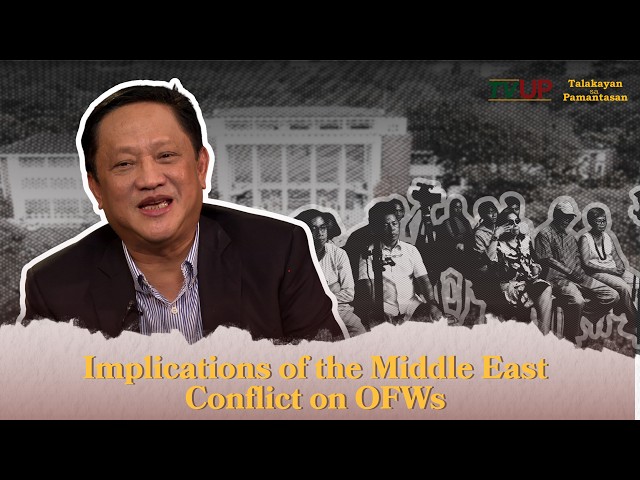
Video summary
The ongoing conflict in the Middle East poses significant risks to the millions of Overseas Filipino Workers (OFWs) residing in the region, a situation that is not unprecedented but has evolved into a more volatile scenario due to geopolitical shifts. Historically, crises such as the Gulf Wars and conflicts involving Hezbollah have resulted in localized violence and temporary disruptions, yet recent tensions threaten to escalate beyond specific borders, potentially impacting critical chokepoints like the Strait of Hormuz. This instability carries severe macroeconomic implications for the Philippines, as remittances from these workers constitute nearly 10% of the country's Gross Domestic Product and serve as a vital anchor for its external balance of payments. The uncertainty surrounding potential closures or attacks in key host countries creates an unpredictable environment where Filipinos face direct threats to their safety and livelihoods, necessitating immediate government intervention and contingency plans to assist those directly affected.
In response to these challenges, the University of the Philippines and relevant government agencies are adopting a multi-faceted strategy spanning short-term, medium-term, and long-term solutions. In the short term, the focus is on deploying personnel to protect OFWs in crisis zones and organizing them with specific safety protocols. Medium-term efforts involve preparing the domestic workforce to absorb returning migrants by addressing unemployment through retraining and entrepreneurship support, acknowledging that a sudden influx of workers could strain the local job market if not managed carefully. The long-term vision aims to transform overseas employment from a necessity into a choice by developing robust local industries in the Philippines, thereby reducing the dependence on foreign labor migration. This approach draws inspiration from nations like South Korea and Japan, which successfully transitioned from being major labor-sending countries to industrial powerhouses that now attract global talent.
Beyond immediate crisis management, the discussion highlights the urgent need for structural economic transformation through research, innovation, and creative industries to create sustainable domestic opportunities. The University of the Philippines is actively pursuing this by establishing new colleges in Mindanao, developing agricultural technologies to reduce reliance on imported fertilizers, and fostering a startup ecosystem akin to Silicon Valley. Furthermore, the institution is leveraging its global network to offer online degrees to OFWs working abroad, aiming to upskill them from lower-paying roles to supervisory or managerial positions with higher salaries. This initiative seeks to increase remittance value while simultaneously encouraging workers to invest in their communities rather than spending solely on consumption goods, ultimately contributing to a more resilient and diversified Philippine economy that can withstand external shocks without relying exclusively on overseas labor.
Read the full video transcript
[music]
Attorney Angelo Himenez.
Today we will be discussing the
implications of the Middle East conflict
on our overseas Filipino workers.
There are more than 2.4 million
Filipinos living and working in the
Middle East, making it one of the
largest concentrations of overseas
Filipino workers worldwide.
These workers financially support
millions of Filipino household through
remittances which continue to sustain
families across the Philippines for over
half a century now
ongoing conflicts of Middle East and
approximately
6.5 billion remittance.
You have to remember one important point
almost the total remittances of OFWs
almost composed 10% of our gross
domestic product. So these remittances
are so critical for our external balance
of payment and current accounts. Uh it
is actually an anchor of our
macroeconomic financial stability. So
this is very critical.
Security concerns around 80 to 85%
former dean up school of labor
industrializations
at former adex secretary Secretary of
the Department of Labor unemployment s
Dr. Renee Opreno sir
[applause]
he will help us better understand the
situation of our OFWs and the
government's response as well.
Forew
expert consultant
International Organization for
Migration.
So,
Middle East.
The short answer is this is not the
first time we have a war in the Middle
East that has affected our people there.
As a matter of fact, uh, in 2003, I was
the task force commanders in Kuwait, the
front line when in that so-called
operation Iraqi freedom or the second
Gulf War
and uh, I was assigned to Iraq as well
together with Kuwait right after the
fall of Saddam in 2003 and I stayed
there for two years and at the same time
when I was already the deputy
administrator of OA, I was the chair of
the crisis committee of the department
of labor cluster.
on the crisis during the Israeli
Hezbollah war in 2006.
So I can say this
expected direct hits. So they will come
east on and off on and off. So many
times we have offered in several crisis
in the past offered free free
repatriation home but many of them
will stay
off
assistance. So
but depend the Middle East has always
been
crisis prone
first of course 1970s and before the
1970s latest
recover fully after the fall of Gaddafi
Syria has fallen as well there's a new
government in Syria and the conflict
between Hezbollah that and Israel,
Lebanon and and Israel has always been
there. The conflict between Israel in
the Palestinian authority and then of
course the conflict with Israel and Iran
and the United States on particularly
centered on nuclear
uh the development of nuclear weapons
weapons of master shock in Iran.
anytime
they can be directly affected.
US
by Monday.
Yes sir.
ceasefire
Monday. Who knows?
Expected, but not like this. No,
conflict can exist in the Middle East at
any time,
>> except that most of the time
specific areas uncovered. This is the
first time
neighboring countries from Iran
>> usually localized Iraq even no matter
how bad the war is when Iraq it was
contained there in Syria is what
contained there of course
break out a few a few uh violence across
the borders but it has been contained in
specific regions so you know where to
escape where to run of course is the
uncertainty this is the new this is the
new element right now no
where they will strike Iran, hit
Bahrain, Kuwait, UAE, Qatar. No, and
this is where most Filipinos are. Of
course, the critical state of Hormus
where like almost 20% of oil from all
over the world passed through. No, not
very critical. So, right now, um it's
really unstable. It's going to be on, it
could be off. He need predict. The point
is nobody can afford an extended closure
of the street of Hormos. Maybe wars can
go on in those areas country but the
entire world and strategy Iran to make
sure that they can pressure the world to
pressure the United States to stop the
blockade or stop from attacking Iran
further. We don't have to to cover the
entire Iran US conflict and concern FWS.
So weaponize Iraq Iran pressure economic
pain by the world experienced by the
world today and we exp we all experience
high rising gas prices which affects
prices of all basic commodities. So Iran
is trying to weaponize it. So this is an
asymmetric kind of battle using its
control not it not it control but using
its power to harass ships going there.
Usually
insurance
right now no insurer will insure any
ship passing through the gate of Hormos
it's considered uninsurable that's what
makes it different today so weapon this
is the war as warfare
looking back
to prepare our Filipinos to protect the
Filipinos we can do shortterm
medium-term and longterm
we just have to go there
9,000 since May
having been there for almost a decade.
Yeah. 9,000 repented is a drop in the
bucket. That's not even 2.4
although I believe 2.4 million entire
Middle East
UAE 1 million Saudi about 1.1 or 1.2 two
600
300 Kuwait 600
3 million but even if you put it at 2.4
million today and 9,000 return this is
around 3.6%.
And there is a regular outflow and
inflow of workers there.
So at any rate, what you can do is
really assist them. There are
contingency plans since 20 years ago
that can be activated
personnel at labor offices
to protect Filipinos there. Of course,
you cannot protect those that can be
directly hit. No, that's the first step.
Go there, assist them, organize them,
and make sure they know what to do when
it when a particular crisis. It's very,
very specific.
ready for over 20 years.
The second one of course is
to prepare to absorb them for jobs here
and that is where the big problem is
unemployment they will add to the
unemployment in the country. So it's
going to be a big challenge because
um
competition are fresh graduates or or
new hires experience. Remember my
experience and these new hires they're
competing with in the Philippines are
willing to accept lower pay. That's
medium term. Prepare them for jobs,
place them in jobs or train them for new
jobs or support efforts at making them
entrepreneurs and livelihood which is
very small portion. The long-term talaga
is how to stop the further outflow in
large scale of Filipino workers going
abroad and that requires rearranging our
industrial system. We must be able to
create strong industries here so that
we will we will end our dependence on
foreign employment because we cannot
provide decent jobs to our people here.
So short-term, medium-term, long-term
dependence, migration at remittances
abroad,
migration hore
197
Middle East
1990s
South Korea became a labor receiving
rather than a labor sending country.
That's right.
transformation.
Well, before you go back though, uh just
a little bit of historical perspective,
we started our overseas employment
program in the mid70s right in the
middle of two great oil crisis. The 1973
uh
>> Yes.
>> Uh
war in Israel.
>> Yes. Yes. Uh the uh and then the 1979
>> oil
Iran Iraq war. No, those are two crisis
in between during this period
prices of oil and the effect was a
transfer of wealth from the industrial
west to the oil producing Middle East
countries
construction activities went there and
our overseas employment program was
essentially meant as a stop gap measure.
There was no intention to make it
longterm.
Billions are coming into the country,
dollars, hard currencies. So
that we need to really develop a strong
industry that will prevent or that will
give the Filipinos a better option of
staying in home at home to work.
>> Yes. And then
now we failed
example
indry another
because of AI
so dangerous
for employment opportunities or
employment generation initiatives
will always be there
external shock that is beyond our
affected
and affecting the other prices
possible displacement of a big sector
9 billion six 6.5 billion worth of
dollars that's that's very important to
our macroeconomic stability now
I mean we need to be able to come out
with a long-term plan to establish
industries in the Philippines to be able
to absorb or our labor force our excess
labor force right now we don't have it
and there is no way of saying simply we
just simply have to put it up and that I
would leave to the expert to industrial
policy strategy but the point is we must
make overseas employment a choice and
not a necessity
perhaps
industrial policy and political will how
narrow the industrial base in the
Philippines is
industrial base
migration
remittances
35 billion a year
uh racisms
Europe and America and then crisis
Middle East.
The other leg of the economy BO
sector
and then
Automate
School of Labor
segments or sector
upgrade industrial
domestic as well as export industry.
Talented
Creative
well initiative creative industries.
>> Yes. Yes.
Filipino artist
evenipino writers. So designers and so
on. So
yes, but before I I go into
mention South Korea, they were also a
labor country. Yes.
>> And then they were able to industrialize
and now they're returning to become I
think the 12th 11th strongest economy in
the world today.
>> Yes. And even a lot of people seem to
have forgotten Japan too before the war
people hardly any to eat there. And you
Jika before I studied Japan. I published
a paper on on Japan immigration before
Jaika was created. It was the Japan
immigration authority. They were
assisting many Japanese who could not
find employment employment abroad and
they sent many of them to South America
second generation Japanese and then they
were able
Japanese who did not return to Japan
right after the war
and uh yeah they were there as a matter
of fact
used to be Japanese [laughter] I think
somebody there was some Japanese
activity going there is going there per
now s up u we we are not the executive
arm of government we are the human
resource arm of the grand national
university um we one of the most
transformative thing we did in UP was to
create the vice president for research
and innovation and the purpose of here
is to not just to increase our PhD
through research but to come out with
research with geared towards
application. So impact missiondriven
research based on what we call now and
we're making this uh we're trying to
popularize the term client discovery
relevant
research we're going to innovate based
on proven and validated needs
communities and Filipino community. So
that's the direction we're going. We
have to cut it open from the powerful
vice president for academic affairs
which is historically
uh what we have focused on for the last
100 years. Today we're focusing on
research and innovation together with
enterprise development and uh and
partnership with the with the private
sector with the industry as well. Academ
industry closer tie up. Not just for
making sure that there is no mismatch
from the academ to the market, job
mismatch, but also to ensure that we can
help local industries develop further
technologically
uh and benefit the value chain but also
to to encourage more startups. goal is
to create ecosystems
will technohab will return back to UP in
a few years now. So we're thinking of
really a Silicon Valley kind of
development. Wow.
>> We're in the research in UP
and uh startups will go there and there
are so many other models there. So I'm
talking in advance about the future but
this is for the next president. No, but
what we're trying to do is really
develop this new vice uh vice president
for re research and innovation. Um we
were able to attract a lot of people to
to really be active and I think they're
very excited about this project. But
these are baby steps towards that. The
other one that we're trying to do is we
encourage I created on my first month
the president's committee on culture and
arts because we wanted to develop the
creative industries.
>> I see. and really encourage the
flowering of creative work, artistic
work inside university because I know
that we are a hotbed of creative talent
and you're right the the the new economy
will be knowledge based economy and it
will be creative economy. It's not going
to be industry content.
So we're riding that future with digital
technology, AI and soon we're talking
about AI but within the next few years
people will be talking about something a
greater wave that we call it quantum
computing. No anyway we're going to ride
into that information economy and that's
why we also created a vice president for
digital transformation. We're we are
preparing the university for the next
100 years.
>> Okay.
>> Yeah. based on our experience but
the University of Philippines was
created as a tool of US colonial policy.
>> No. Uh they wanted to produce leaders is
they introduced the Jefferson the
Jeffersonian democratic representative
democracy. This is a foreign implant.
No. And they a purpose was to develop
leaders to man this new bureaucracy and
and this new way of organizing life in
the Philippine Islands then.
But I think this time we have to
reestablish UP based
on our aspiration as a people.
Mr. President ecosystem
it's a it's a real estate developing
UPLB as well. were preparing as well
their their echosones as well
recent news very disturbing
hunger 23% according to social
That's why I really wanted to focus in
Mindanao considering that Mindadaw is
producing a large part of our exports on
agriculture.
So what's happening there? We're trying
to strengthen up Mindanao.
>> Okay.
>> That's one thing
innovation and they they already have
champions there. I see. uh by this
semester we're introducing the college
of medicine in UP Mindanao.
>> Okay.
>> By next year we'll have the college of
engineering. That's a plan. This this
year approved board engineering we will
borrow the curriculum from Dilliman and
Dilliman and UPLB has been so
cooperative and not only that we were a
UPLB was able to set up the uh the UP
school of agriculture entrepreneurship
in Panabo Davo.
>> Yes. Uh this is a five hector grant from
the from Tadeo.
>> Okay. Alson family Anflow Anflow city
and they gave us a building and we are
going to train this because
it's not just how to plant but to create
agriculture system systems
and we're all over Mindanao. No, we're
all over Mindanao. Second
crisis
bio we're able to extract bacteria that
is nitrogen fixing from talah I see
>> that's coarse grass Englishahib
and using this you can reduce the you
can reduce ura uh element and fertilizer
by 30 to 55% or 50% ura imported
[clears throat] ura as a matter a lot of
people don't realize that it's not just
oil but made of our fertilizer are all
based petroleum based. So we have trans
and second we have we're developing as
well battery powered battery technology
appropriate technology this is not a
high-tech battery but these are
batteries that can be used
river up technology
from the AA no electronics and
electrical engineering
we're also developing battery powered
banka if you go to the to totramurus
today me
bus battery powered. That's up
technology being tested right now. And
every now and then
is battery powered, solar powered that
we're trying to introduce to the rest of
the country. The point is our research
is making a difference because I'm just
mentioning a few things.
um we are responding and this is the
reason why we are trying to develop our
research and innovation muscle with
greater urgency. Now
maritime marine science fisheries
>> and hopefully [clears throat]
base at least physical base virtual
university that they call the
archipelagic university of the
Philippines the virtual archipelagic.
Uh another thing is uh is uh uploban
UT uploban
uh we were able to get an autonomous
college status. Now uh on May I will be
presenting to the board and hopefully it
will approve its full
constituent university status and we
have been preparing for this for two
years. But what with TLoban? Takloban
and vision will become will focus on
resilience and of course history and
culture. They have a very rich culture
and history there in eastern visayas
banko rebellion.
No people were so one thing even before
strengthening giving uploban autonomous
status
breakthrough
red tide
the moment
there's an economic crisis 300
million estimate cost because
are the artisanal fishermen the poorest
of the poor sers fisher folk
per they were able to come out extract
an element in the uh in in a tahome that
has been affected by red tide that can
be used for cosmetics and pharmaceutical
industries.
We already set up the laboratory to
scale this uh technology developed by UP
in the new campus site for uploban which
is Santa Elena 30 minutes away from the
city center
but we're preparing uploban upu of
course will be focusing on ICT internet
and creative industry
agriculture.
So these are just [snorts] some of the
developments that were to make sure that
the university can respond to to develop
a strong industry in the country based
on the unique features and strengths of
the of the Philippines as a as an island
nation
Mr. President.
Yeah, it was something I set up during
the first few months of my term because
I will always be a migrant advocate
global Filipino and as a matter of fact
before I was elected UB president I was
in
>> cartoon
>> in Sudan I was developing a the legal
framework for migrant protection in in
Sudan which is the worst case
>> in the world no funded by the UN of
course but anyway I returned it was a
state of civil war seems that wars
attract my career here. But anyway, I'm
still alive. But at any rate, envision
what we're trying to do is offer
degrees, undergraduate,
masters up to PhD for overseas Filipino
workers.
>> We're estimating there are well, there
are the stock estimates of Filipinos all
over the world is still about 10
million, but let's just say three 2.5 to
3 million would be overseas contract
workers. So target so we're offering
these degrees to them online. Um and we
are we we have really gained ground. We
want to offer this to them. Uh
undergrad Filipino citizen libri.
So we offer we open this in in the UAE
uh in Singapore,
Thailand, Japan, Taiwan,
and
Indonesia, even Vietnam in Cambodia. No.
So we're offering this course to them
online. online PhD graduate teaching
railroad engineering in Dubai
>> and just last year up one year after we
set it up because they wanted ano baong
PhD UP. So I work one year and it's
finally achieved recognition from the
Dubai Ministry of Education.
>> This is why why is it why is it a very
important development? There are 1
million Filipinos in Dubai. Not only
that, Dubai is part of the Gulf
Cooperating uh country
council for Gulf Cooperation, GCC.
Normally, Ministry of Education.
Now,
what is the idea? The idea
is to move
in large scale masses of Filipino
workers
from lower paying jobs to higher paying
jobs.
from higher risk jobs to lower risk
jobs.
You become supervisor to manager
>> less vulnerable
>> and finally
to to to increase in a very significant
way the remittance. Let me tell you
I met a
medtech a laborator technician in
Maryland in the US and he told me press
I failed in my nursing exam so I
immigrated to United States I didn't
become a nurse but I work as a
laboratory technician in the United
States especially in Washington they
have this category called scientist one
scientist two he wants to move from
scientist one to scientist two
chem M
>> basic camp. What if we can offer this
camp online because the United States
recognize our degrees?
>> Then his salary can increase by say 500
to even $1,000 depending on what
laboratories you're working on.
Can you imagine this happening? estimate
if we can capture 3% of the potential
market that's 4 to5 billion dollar extra
for what a program that cost us nothing
extra internet
no so we're trying to promote this idea
that Filipinos can get degrees from the
University of Philippines and instead of
sales lady you can learn supply chain
management short course and you can be a
sales supervisor or in charge of a
warehouse All of these can be increases
of 300, $400, $500 each. And remember,
we have PhDs.
>> They can take PhDs. And so, we're
strengthening the OU as a tool.
Uh it's it's what we call perhaps
development jiu-jitsu.
Libri, it's an online platform. You
don't have to set up schools.
>> Okay. And remember alo CAD academy one
teacher 1 million students.
>> I see. So
no vint because
and they probably got that idea of vint
because they know I'm from Mindanao.
>> Okay.
>> Thank you.
Thank you.
Thank you very much for being here. No,
I mean um I'm I'm very glad to be able
to discuss these things with you. We
would have invited Sana si my colleague
before no s secretary Hanskdak or
evensek Bernard Olalia who's the usek of
DMW but they're all so tied up with the
current crisis today but uh I'm still
very happy that we have this very lively
discussions but I I I came I miss my uh
because I operated in that region I know
the countries there
>> I've been there I mean Jordan Iraq
Kuwait, UAE, Qatar,
um anyway uh
we have a very interesting audience.
Yes.
Ano one of our professors, Professor Joe
Tabada who is also a Middle East. He
graduated from the American University
of Beirut. No.
and he has been I was in the circles of
migration researchers and I've been
meeting professor Joe in many of my
activities for the last two decades
>> and I'm very happy to join him in the
University of the Philippines and make
sure that he does not uh go to pasture
early in life professor Joe
>> uh good evening uh Mr. President and
good evening Dean of Reneo actually
question intervention
role up
in helping OFW's
repatriation and
reintegration.
Um studies have shown that uh most of
the remittances go into the purchase
either of luxury items or of uh
um some necessities consumption
consumption goods.
Barely Talibani goes into investment
and uh one reason for that is that OFWs
are not sensitive to
investment opportunities
Mr. president now enterprise development
is one possible uh opening for OFWs
university
actually institute for smallcale
industries I don't know what they are
doing now but I used to work for that
institute for maybe close to 15 20 years
ago before I retired
um
they started Ed teaching uh financial
literacy um and they I think they can
move from there to uh enterprise
development targeting OFWs
as students
uh who can potentially or who should
potentially be encouraged to go into
business.
I think the university probably can play
a bigger role in that uh uh
assistance tow
Mr. President and
well taken.
>> Yeah. But let me tell you something know
uh I've been OA I was a deputy
administrator of OA. Yeah. We did have
loans and training even to social
preparations for them but we realized
collection rate and we realize that
entpreneurship and business is not for
everyone. No, they they cannot manage
and then most of the problem
business preparations business plan
most of the problem is the market
they couldn't succeed but realize
business is not for everyone. So we
focusing on financial literacy.
We he goes there and make lectures of
financial literacy.
No. And then these are not business
assets. As a matter of fact,
these are liabilities.
So we're not saying
they really want literacy. They know how
to save. And then second, investment
opportunity. I remember when I was in
Japan uh then governor board of
investment governor of Bulaong I think
came there
and there are magazine warehouses there
is warehousing
they're going to invest
invest but it will be run by
professional managers so
We're talking about
1999.
So there was there is this excitement.
Can you imagine package
uh warehousing
because sub is going to be international
preforta?
Sure money. So but uh you know Arab was
ousted. So was
no because
the other thing is I was talking to this
person
our big industries can really help
they can invest for example poultry
shares market bonus chicken I don't know
how many hundreds of thousands chicken
they need it there sure market so
ISSI maybe they can help them with with
skill skills with setting up business
but
setting up the business itself.
How to place money where to invest is
better because
going into business is not for everyone.
It's not even for professors. [laughter]
Mr. President.
>> Yes.
Vice President
DFA Secretary
OFW bands but
the biggest buyers
from Japan because they have money
program.
President Ramos
1990s crisis
100% no repayment
we realize
returning
distress
if you are distressed you go into
business
capital to a certain extent
integrated approach in enterprise
development for the poor.
>> Yeah.
migration work now I'm now with anadem
let them stay there safely and let them
earn enough so they can save but the
long-term strategy is create industries
here so that less people will want to go
abroad as a matter of necessity
finally
second
OFWs go abroad not just because of the
money.
>> Some of them I've talked to so many I've
been here for three decades now
advocating their their their welfare.
Some of them left for abroad because of
the lifestyle.
>> They like the security. They like the
efficiency of governments. They they
live in Europe, in Japan, in Taiwan, in
Hong Kong. So Middle East most of the
time not for immigration. if they go to
Europe and United States, Canada
immigration track.
>> So it's not just the money. Second,
um I was talking about the shortage of
teachers here. Just an example of a
group of people
nurses. There is the world has an
insatiable demand for Filipino nurses.
But teachers
can teacher how much can you get paid
for sED?
No, maybe 40,000 is good. I mean grade
40,000 starting most. But if you're
offering the same teaching job in even
Vietnam, Cambodia, Indonesia, I was
talking to some of them. It's between
starting 100,000 to 200,000
>> and I was there.
>> I was there with the president in
Cambodia and I found that there's a lot
of Filipino teachers in Cambodia,
>> in Vietnam, in Indonesia. the teaching
there
>> earning that much earning.
So
nurses there is as I said insatiable
demand
nurses such that many of our nursing
schools are producing nurses not for
home domestic uh work but for foreign
employment we know them all so that's
why we have this response
because our school of health sciences
are producing nurses
yes ah pala
I'd like to welcome again uh my former
professor in sociology.
So good to see her again after all these
years. Uh we have here Dr. Joyad
discussion
although
can you imagine a Philippines that does
not send workers abroad?
>> Yeah. or destiny to be the laborers and
the teachers and the nurses of the
world.
>> Yes, we have been dreaming about it for
our OFW was was ours employment program
under Blasople just the time of the oil
crisis.
Our first labor office was in Jedha
early labor. We thought it will be
temporary
crisis non and there was a lot of jobs
in construction in the Middle East.
After 10 years this construction job
became service jobs
all over even general contractors EI was
there AG and P were there we built the
Middle East now
like many other countries in the world
did no best example of course I really
love this the example of Japan and Korea
so we just simply must not stop dreaming
and working towards that
large source of remittance that as I
have mentioned is practically almost 10%
of our gross domestic product that is
too critical
we are allowing people to have a dagger
about our neck that they can move we
cannot control it no uh so
um
Well, as the UP president, I must remain
hopeful and we are going to do
something. That's why we're trying,
that's why we created all these
initiatives in industry, innovation,
research plus partnership industries
which are just really starting to go in
earnest right now.
Uh, of course
uh to find uh
Miss Jojo Sanchez. You know Jojo is with
TV up but she used to be my welfare
officer when I was assigned in Tokyo,
Japan and
theater groups Japanto.
Uh Jojo is a veteran welfare officer of
OA. So actually
>> [laughter]
>> Mr. President
reintegration program
returning skilled professionals of
Thank you.
>> Yes, of course. Uh, of course you
returning um
depend of course on how old they're
returning retirement
maybe we can help them. No uh but we are
not really the agency. We are the human
resource arm of the government. We can
provide skills, retraining,
even help with business development. But
eventually the other source other
offices will be in charge of it. um
reintegration center
but if they want to go back to school
then they can possibly enroll in our
certificate courses
special courses including ISSI including
even you
short-term courses
but if they want to group together
invest then of course we have up
technologies that and we're waiting for
partners for that. No, but eventually
this is really something that we really
have to build a connection. No, cuz this
is now the University of the Philippines
directly engaging
in in activities
that goes beyond our normal research and
teaching function but goes into public
service. Now, uh you
training component tying them up and
introducing technology
You will be astounded
by the talent you will meet abroad who
have left the country. I was just going
around and I met this director of Mona
from the college of medicine. I told him
he's willing to help. No, I mean I found
scientists in Dubai, scientists doing
advanced research in London and of
course the US and
we want them to invite back here and we
have this balik scientist program
so they can really assist that's more up
our alley
for one thing
is this we cannot hire them
because there is an interpretation
that the UP professor
is part of the civil service and the
constitution says that only Filipino
citizens
can be hired in public offices
and I found out that even if you're dual
degree you cannot even be hired too
scientist
there are real experiences we we crafted
a new kind of employment for them a
professional
profess professorial uh chairs contract
I wanted to offer them tenure
but it's almost equivalent to tenure
except that there's no security
you will also be rehired one of them
brought their Italian wife with them
press I couldn't even take out a loan in
the bank when they see that I'm only a
contractual employee they want to
resettle back in the country raise their
family here from abroad but they can't
do that.
So
contractual professional professorial
chair
because they want to be here. So what we
did was that of course we uh I know uh
Congressman Mark go our regent has filed
a bill in Congress that will allow dual
citizens to work in government.
But
for foreigners and there are foreign
professors who want to teach
that requires constitutional change.
It cannot be cured by legislation.
So
nationalism university universities are
dedicated to the pursuit of knowledge
they are agnostic to to nationality.
If you really want to be in a university
the university has this universal
element. As a matter of fact everywhere
else in the world they will offer you
citizenship
if you're really good. We don't we don't
allow
our contribution to their human resource
development to their economic
development.
Yes. Yes.
I doubled the budget for for our
scientist program
up in collaboration with SU's
regions.
>> Very good.
>> Yeah. So I met this professor in Oakland
University. You know it's one of the top
university in the world not top 100
if you can get the tenure I wanted to
offer them
>> and many of these professors want to
study here for some personal reason.
They married a Filipina
but we really wanted to to to do this.
So, so we're working on on on ways on
how to get talent back, but
citizens
see they're all over. I mean, writers,
Michael,
College of Arts and Sciences or letters,
NYU, no, New York University. And there
are others I found out in Europe. You
know, they're they're all out there. And
every time I visit them and they they
become very nostalgic. They really want
to help the country but they were just
wondering whether the country wanted to
be helped.
No. So
we're we're we're coming out with this
message that we're opening up again and
we just have to do something otherwise.
Mr. Mr. President to your presidency.
>> Thank you. Let's [laughter]
we do our best. So anyway uh
We missed my colleague Secretary
Hamscott Dak my colleague from the
college of lawseek
Bernardia
topic we could have invited another
colleague from the college of law up the
current administrator of uh he's from
the UP law I mean
they I'm sure if they were here they
would love to visit their alma matter
again let's try that another time but in
the meantime u thank you very much for
the presence to everyone here our very
appreciative uh participants as well and
to you Dr.
for being here. You have always been a
stalwart of the labor group and so uh so
at this point uh I cannot let this
program pass without giving you
perhaps the last word or the penultimate
word. [laughter]
Mr. President
possible affirmative measures regarding
reintegration. But not only
reintegration,
uh revitalization
economy using
savings provided by our uh OFWs.
Thank you very much. Thank you very
much. Uh so
this first edition of this program
I'm still in contact with them and
um
the OFWP has been here with us formally
for almost for practically 50 years now.
Uh there will always be problems there.
We cannot solve all these problems
because it's a continuing problem. But
we are doing steps to bring light to
their experiences as a university at
least
uh to make their invisibility visible to
us so that we can appreciate them more
and actually do something. So uh it's
part of our client discovery.
What can we do research technology? What
can we do to assist them? So
we'd like to engage ours many of them
anyway are from our university. So
this is a part as a university of the
people. So
episode
Okay.
[applause]
[music]
>> [music]
>> Heat.
Heat.
[music]
>> [music]
[music]
>> Heat. Heat.
[music]
>> [music]
>> Heat. [music]
[music]