Video summary
The video introduces a project aimed at porting the Avro Interface Description Language (IDL) tool from Java to Rust, primarily to address the poor error messages and debugging difficulties inherent in the existing Java implementation. By leveraging Large Language Models (LLMs), specifically Claude, the developer seeks to eliminate the need for a Java runtime and Maven dependencies while improving the user experience with robust error reporting via the `miette` crate. Avro is described as a data exchange system similar to Protocol Buffers but featuring unique capabilities like "open containers" and native logical type support, with the goal of converting human-readable IDL files into machine-friendly JSON schemas. The development process involves setting up a new Rust crate, utilizing Antler to generate parser code from the existing grammar, and providing the LLM agent with comprehensive context including test suites, documentation, and examples to iteratively refine the logic until it matches the reference Java output exactly.
Technical implementation details reveal significant adaptations required when translating Java logic to Rust, such as replacing the listener pattern with a recursive tree-walking approach to satisfy Rust's strict lifetime constraints on mutable state. The agent manages complex tasks like extracting doc comments by walking token streams backwards and resolving imports relative to configured directories, while also addressing specific challenges like handling nullable types in unions and parsing large integer defaults. A key strategic decision was made to align the implementation strictly with Antler grammar rules rather than replicating Java's full decode functions, which helps avoid silent failures with unknown logical types or octal escapes. Although much of the generated parser code is considered boilerplate, the LLM successfully avoided manual writing of thousands of lines, though it required human guidance on Rust nuances like attribute placement and memory allocation optimization to ensure efficiency and correctness.
To manage the complexity of porting such a large codebase, the workflow evolves into a structured debugging process utilizing multiple sub-agents operating in isolated Git worktrees to prevent context dilution and agent conflicts. This approach involves spawning agents to systematically test the Rust implementation against Java golden files, triage discrepancies, and fix issues in parallel without modifying shared source code simultaneously. The developer emphasizes the importance of separating problem identification from solution fixing to maintain clarity, documenting known limitations in Markdown files, and managing token budgets carefully to avoid stream termination. Security is maintained through a sandbox environment that prompts for permission before executing commands outside an allowlist, avoiding blanket permissions that could lead to destructive actions like rewriting Git history or deleting temporary files.
The session concludes by highlighting the critical skills amplified by working with LLMs, including critical thinking to validate AI-generated plans, rigorous code review capabilities, and accelerated reading speeds to reason about generated code without writing it manually. The ultimate goal is to establish an autonomous development loop where agents alternate between finding issues, categorizing them by dependency order, fixing them in isolated branches, merging changes, and re-testing against a comprehensive suite of AVDL files. While acknowledging the high cost and safety concerns regarding internet access, the speaker validates this "power coding" approach as effective for well-defined tasks like code translation, noting that LLMs function best as powerful tools requiring human oversight rather than autonomous replacements. The project is prepared to be pushed to GitHub for continued iteration, aiming to create a self-correcting cycle that addresses a backlog of identified issues while adhering to the philosophy of decomposing problems into bite-sized chunks to mitigate skill atrophy and ensure high-quality output.
Read the full video transcript
Welcome back to another imple Rust
stream. Um where we take ideas and we
build Rust code out of them I guess is
the whole premise which uh feels like
most of programming in Rust but I guess
we do it on stream. So so hence it needs
to have a name. Um so in the stream
we're going to uh take a tool for the
Avro ecosystem. I'll explain what Avro
is in a second. Um that already exists.
It's written in Java. uh and I just want
a version that's not written in Java. Um
and then there there's really like one
main motivation for it um which is the
existing Java tool while it is
maintained by the official maintainers
of Avro um it does not do a great job of
giving good error messages and uh as
you'll see when I explain what Avro is
um bad error messages in this case can
be extremely timeconuming to debug uh
and so I wanted to make that better and
you probably can make this better in
Java but I don't know Java very well.
Um, not to mention I can think of like
another couple of things that I would
like to be different. Um, and so I'm
just going to try to port it. And and uh
uh I'm also going to use a decent amount
of LLMs for this one which uh some
people have like raised question marks
about. And the reason actually is
because this specific kind of task is
the kind of thing that I found LLMs to
be really good at. like I I've mentioned
in the past how you know I have a lot of
skepticism around LLMs but the
skepticism is uh I think I think has
become more refined maybe over time that
there I've sort of recognized that there
are some things that agent coding in
particular do really well at there are
many things it's terrible at uh and
there are some things where it's good
with enough guidance at and there are
some things it's really good at and this
is actually something where I think it
is really good at this kind of thing um
in particular the work we're about to do
has two properties that I think make
sort of set up the agentic LM4 um for
success. The first of them is that
there's an existing open source
implementation in a different language
uh that we just want to port, right? So
the existing code already exists and we
just want it in a different language. I
found LLMs to be very very good at that
kind of translating from one language to
another when you have the other as a
reference. Um especially I've used this
a lot going from bash to Python for
example as bash scripts try start to
grow too large and unwieldy uh turning
them to Python or potentially turning
them to rust. Uh it does really well for
that. And then the other and this is
another critical component to it is um
we have a reference implementation where
we can basically generate an infinite
number of examples of correct behavior.
Right? So, um, and this gets back to
what AVO is, but the tool we're building
is basically a sort of file format
converter, um, that takes, um, uh, it
takes one file format and turns it into
a different file format. They're both
textbased. Uh, and so if we have a given
input file, um, we can tell the LLM,
well, if you want to check whether your
implementation is correct, then pass it
through the the official tool, pass it
through yourself and check that the
outputs are exactly identical. Um, and
that kind of setup means that you can
kind of leave it to run on its own to
figure out its own problems until it
arrives at a solution that like fits the
fits the pattern exactly. Um, and this
is this becomes more more like um, you
know, it's almost like a semi-random
walk. It's almost like fuzzing to get
the right uh solution, but because you
have a good reference uh becomes more
like a you can almost do property based
testing over this thing. Um
so uh let's get into what Avro is. So
AVO is uh for those of you who have
heard of Protobuff, Avro is fairly
similar. So uh AVO is a um
system mechanism um concept combination
of the three a spec combination [snorts]
of the four maybe um that lets you
describe
um interfaces for both for data exchange
and for remote procedure calls like APIs
um in a particular format, a
standardized format and then you can
generate servers and clients based on
those definitions of data types and
potentially those definitions of of
service endpoints. Um, and you can
generate those in multiple different
languages. So, for example, you could
write a uh a schema that defines, you
know, here are my here are my various
data types and also here are the API
endpoints that I want and you could
autogenerate a client in Rust and a
server in Java, for example. And then
you obviously have to fill in the the
sort of business logic, but it can
generate the interface for you. it
generates the the the serialization and
des serialization protocol between the
two uh and brings you a bunch of tooling
to work with that as well. Um Protobuff
obviously is the the one I think most
people know about from from Google. So
this is Google protocol buffers. Um and
the there are a couple of differences
between Avro and and protocol buffers.
Um for me two of the ones that are most
relevant and the reason why I ended up
working with Avro in this particular uh
setting that I'm using it in is um uh
Avro has support for um these thing
they're called uh they're called uh open
containers which are basically this is
not to be confused with OCI images and
the like um but they have a mechanism to
say this is like a bite stream that
accompanies
the the data that's exchanged. Uh
Protobuff doesn't really have anything
equivalent where you can say this gRPC
does, but I don't want to use the RPC
part. I just want to use the the the
data interface definition language. Um
and so Abro has this mechanism for
saying here's like the data type that
you're going to send or receive like is
a definition of a message and this part
of the message is just a a bite stream
that where we might not know the length
in advance. Um the other thing Abro has
is this notion of logical types. So um
it's not like your schema has to be
constructed just of um you know objects
that have fields where the fields have
types that are either themselves objects
or they are primitives like booleans,
integers, floats etc. Um in in Avro you
can also define your own logical types
to say um this is an integer but it also
has to follow the following rules like
for example it's an integer but its
range is between x and y uh or it's a
string that has to match the following
set of patterns um and you can kind of
hack together something similar in
protobuff as well um but it it's um it
becomes much more ad hoc like in Avro
this kind of logical typing is is uh
directly supported by the spec itself.
It sort of has a a place where it goes.
Um so why do we need a tool for this?
Well, so Avro itself is a a pretty
vibrant ecosystem. Uh it's maintained by
Apache or rather it's an Apache project.
So it has a bunch of maintainers, a
bunch of users. Um there's an AVO
project on GitHub that's pretty active.
Um and it's all of the tooling there is
written in Java. um it can still
generate code in lots of different
languages. Um but the the implementation
of like the parser and the the code
generation code generator and all of
that stuff is in Java. Um and
that's fine as far as I'm concerned.
It's like uh I I don't necessarily want
to have to install all the Java stack to
run these things, but you know, so be
it. It's fine. Um but there is one
particular tool that is kind of unique
to AVO that doesn't exist in the Google
Google uh protocol buffers uh ecosystem,
which is that AVO doesn't just have one
file format for describing interfaces,
desri describing data types. Um it
actually has well let's let's say two.
Um so it has one that is called the IDL.
The IDL is an interface description
language and it looks very much like
protobuff. Um so if you look at the IDL
language as sort of example at the
bottom here um so here for example um
schema.avdl.
So you declare a namespace. Okay fine.
You declare a uh this is optional. Um
you declare an enum type. You declare um
some other type. you a record which is
sort of a me equivalent to message in um
in protocol buffers. Uh you give a name
to that record and then you say it has
the following fields of the following
types.
Um and you can include additional
attributes for those fields as well. Uh
you have unions, you have uh default
values and so on. You have arrays. So
you can say this is a list of things of
the following type. Um so this is a an
interface description language. This is
great for humans, right? So humans can
read and write here. You have comments
like you have all the the nicities of
being able to like nest um and like
write, you know, write the code and
format the code however you wish. Um and
it's fairly easy to read. Even if the
file gets large, you can sort of
logically separate into multiple files
and you know, whatever organization you
want to do. Um it's okay for machines,
but it's kind of annoying to parse
something like this, right? because it
it has its own grammar. It has its own
syntax. And so for that reason, AVO also
has a separate schema type um or or file
type really which is a JSON file type um
that is basically a JSON encoding of the
information that is in this file. So uh
if we go over to the the actual
specification for Abro, you'll see that
it says a schema is represented in JSON
by one of these um where it has type and
things and attributes. And if we go
down, they probably have examples near
the bottom here too. This is what a
schema looks like in uh like in the afro
JSONbased format. And so this ex can
express the same kinds of types, but it
does so in a way that's much easier for
machines to parse, process, do code
generation based on and so on. Uh but
you need something that converts from
the IDL to this kind of JSON
representation.
Right? So if you have this but all of
the tooling expects to be given this
then how do you go from this to that?
Well there's a uh a tool that ships in
the so there's an ARO tools Java package
that includes a bunch of various kind of
Abro tools and one of the ones that it
includes is this um IDL tool where you
give it an AVDL file. That's the IDL we
just looked at here, the the human
writable one. And it generates you an
AVPR or an AVSC
um which are the JSON representations.
The difference between APR and AVSC here
is that um AVPR is a protocol. So think
gRPC um like it's a mechanism for
describing service endpoints as well.
Whereas AVSC is just the data types and
not the the service endpoints. Um, and
so when you run this tool, it will take
this human readable thing and produce a
JSON readable thing. Um, and you can use
it for schemas and protocols and, uh,
whichever you prefer. Um,
and this tool itself uh, seems to be
maybe less well-maintained than the
other tools. It's not that it doesn't
work or that is broken or anything like
that. It's just that um, it seems to
have not gotten as much, you know, care,
love, and attention. Um, and I think
maybe I've been spoiled by Rust here,
but when you run this tool, um, if you
have an error in your IDL, you don't get
very good error messages. So, you will
often just say this file just failed to
compile or failed to be translated into
uh, JSON format and then not tell you
why. And this can be really frustrating.
So, imagine you have like a thousandline
IDL file and you like misplaced a comma.
It won't tell you where you did so. And
so you need to like you need to either
just look really carefully or it turns
out there are also people have built
like IDE integrations for this um like
an LSP among other things and that one
actually has a better parser that gives
you good errors. So you open it in your
editor, you look for where the editor
tells you the problem is and then you go
back and run the tool and that just
feels kind of silly. Um, not to mention
you also need to have Java installed and
you need to have this JAR in order to
run the tool and that makes me a little
sad, but you know, who am I to say? Um,
you know, part of this is also I don't
use Java very much, so I don't usually
have Java installed on my computers. Um,
like I will install it when I need to.
Um, it also means I need to like fuss
around with Maven in order to be able to
grab the jar or like you can also go to
the download page and then they have
like a mirror where you can look through
basically an FTP server where there's a
bunch of jars you can click to download
which I I don't love the the idea of.
And so I thought, well, can we just
write just this tool? Like I don't want
to port all of Abra tools. just want the
converter from the IDL format to the
JSON format in Rust so that I can just
run it in a Rust native project. Um,
so that's what we are aiming for. Um,
are we is it clear what this is for?
What we're doing? Um, I'll I'll demo the
tool in a second just because so we can
show that it actually does what I said
it does.
Okay, people see people seem to think
it's clear. Great. So then what we'll do
um is we'll do cargo new and we'll call
it AVDL which is the the file extension
type for um uh for the AroDL. We could
come up with a clever name here but I
don't think we need a clever name. Um
and then what I will actually do is I
will create a git subm module. that
brings in Abro. Um the reason for this
is just because
um we kind of want to reuse a lot of the
uh Oh, riddle is good.
Riddle is good.
Yeah, but then it doesn't have the A
because there are lots of IDL's, not
just Afro.
I don't hate Riddle, though.
Oh.
Fine.
Riddle [laughter]
[gasps]
riddle.
Riddler. Riddle.
Radvil. Radvil. No. No. I'll just keep
AVDL. Let's not go down this rabbit
hole. [laughter]
A riddle. So So now it's a riddle.
A riddle. No, no, we're just going to
stick with AVDL. Let's not make it
complicated. So the [snorts] reason I
want the Abro checkout in here is
because one of the things we want to do
is make use of all the test cases for
the existing codebase. So, um, if I CD
into Abro here and I search for AVDL
files, you'll see that, um, in the Abro
repo, there are a bunch of AVDL files
that are used as tests for the Abro tool
that they have. And we would at the very
least expect that our tool produces the
exact same output as the upstream tool
um, when run on these files. So, we
basically want to duplicate their test
suite and make sure that we also pass
the exact same test suite. Um, you'll
see there are a couple of other AVDL
files here that are also like um test
files for the compiler and stuff and we
can just run on all of them, right?
Because we we have the reference
implementation. Our goal is to produce
the same thing as the the the average
jar does. Um, and in fact, let's let's
look at what that looks like. So, first
we'll we'll grab um that's not the right
command.
That's not the right command either. Uh
because it is
uh it's like you need dash d
get dependencies
equals false.
No,
I [snorts] did this earlier.
Yeah, it's this. No.
No.
This.
Can you tell that I don't use Maven very
much?
What? No.
I was sure I had that. Fine. We'll do
the other one. So, you can also download
the jar directly from Apache. So, let's
do that instead. I don't want to fetch
all these dependencies from Maven. seems
annoying.
Anyway, we now have the jar. Hooray. Uh,
and so now we can run. In fact, if you
go back here, you'll see there's a usage
example. So, we can take this exact
usage example.
Uh, and we will run our Java tool. Uh,
this is going to be in /avrol
no what? Oh, I'm already in uh so it is
going to be
where was it?
Lang. Okay,
so it's in lang java IDL source test
this and then we'll call it we'll set
the output file to be namespaces.pr.
Uh it ran and now we open
namespaces.avpr.
Oh, that's annoying. Fine. I can I can
fix that.
Uh I'll fix that right away.
Config. Uh editor. No. Uh ne it.
Yes. Yes. Yes. Okay. It's very insistent
that I fix this right away. Yes. Yes. I
don't want you to bother me every single
time I
[sighs and gasps]
cool. the URL it told me to use instead
does not work.
There we go. Okay, great. Stop bothering
me. Cool. Uh so when we look at the um
uh when we look at the APR file that it
generated, you see in fact let's look at
the input file first. Uh you see this is
an AVDL file. It has a protocol defined
in here. So protocol is like a a service
like APIs and stuff. Um,
and you'll see it has a bunch of it has
types and records.
Uh, and then if we look at the generated
file, we should see the same types like
the fixed here, fixed in other namespace
and so on. Um, and the same records and
the nested fields and everything and
it's just in JSON format instead. So,
the tool works. Now, let's see what
happens if I try to change this and I
do, I don't know, remove this semicolon.
If I now run this
uh okay this one's not too bad actually.
So exception in schema parse exception
line 37 mismatched input record and
other name expecting semicolon or colon.
What happens if I put a comma here?
Ah great. Okay so I put a comma instead
of a semicolon. Exception in thread main
schema parse exception. no such element
exception when parsing
with no indication of which line the
problem is on or anything. And I mean
granted parser parser errors are
difficult, right? Because this might be
a completely valid syntax like the
grammar is is accurate in the file that
I wrote. Uh but when we parse it, we end
up with the like inability to parse what
was produced. So like there's some
amount of leniency here, but I would
like to see this error be better. And so
that is going to be the the primary
difference between the the Java version
of the tool and ours. Hopefully uh we
will find out. So let's return that to a
semicolon so the file remains valid. Um
and uh what else do I want to show here?
Ah there's one more thing to be aware
of. So the um the abro tools jar also
has uh IDL2
schema. No what's it called? Um,
so there's actually two
commands.
Um, if I can find the other one. Yeah.
So this IDL 2 schemata
uh
which is different from
the IDL tool and it's not entirely clear
how because these two tools are both
invoked through the um uh
through the AVO tools package. This one
says tool implementation of generating
avo schemata uh from ideal format file.
This one says extract the avo schemata
of the types of a protocol defined
through an IDL format file. The actual
difference is that this one if you pass
it a protocol file, so one that defines
like API endpoints and stuff, it will
parse the thing, extract just the the
type definitions but not the endpoints
and turn it into a schema file instead.
So in other words, this one will produce
a um
um an AVSC or an AVPR like the a proto
like it will produce everything that's
in the input file. This one will not
include the protocol bits. Um is at
least my memory of this. Uh
yeah, I'm pretty sure that's the
difference between them. I I don't end
up using this one very much. Um, okay.
So, now let's figure out how we start
doing this. Um, and the way we're going
to start doing this is we're going to
kick off Claude and see what we can get
to. Yes, I trust this folder. That's
fine.
U, we'll enter plan mode. And then what
we're going to tell it is uh I think
this is like it should be fairly easy to
get it started here. And then we're
going to have to vet a lot of what it
does because I suspect it will get quite
confused. Um, so what we're going to say
is I'm trying to um port and then we're
going to give the path to the tool. Uh,
which is going to be
this one.
Oh, uh, I want to copy this path GitHub.
Thank you very much. Um, trying to port
uh to Rust. Um I would like to reuse Oh,
there's here's a this is another
important part. So one of the reasons
why I think this is actually feasible is
because um the the grammar for the IDL
files is defined using something called
antler. Um Antler.
So, Antler or another tool for language
recognition uh is a um is a tool for
writing parsers. Um, so you basically it
uh if we open up the file for it here,
um, it's a a domain specific language
DSL that lets you write out the grammar
for some language you want to parse and
once you have that grammar, you can pass
it to antler and it will generate you a
parser for that grammar in whatever
language you choose. So um for example
you can and this is what um Avro does.
You can use Antler to generate Java code
for the Antler grammar. Um and now we
have the uh um now we have a Java
program that can parse that file. But
you can also use it to generate Rust
code. Um and so we can take the grammar
and just use that to generate a Rust
parser right off the bat. In fact, this
part we don't. Let's um wait to start
Claude here. Oh, you're right. I'm in
Abro. I don't need to be. Um so, let's
first get Antler to generate us the Rust
code that we want. And then we can build
on top of this. Um so,
uh I think I already have Antler. Yes, I
do. Um, and then let's see if the antler
I have builds with rust already or
whether I need to um uh whether I need
to
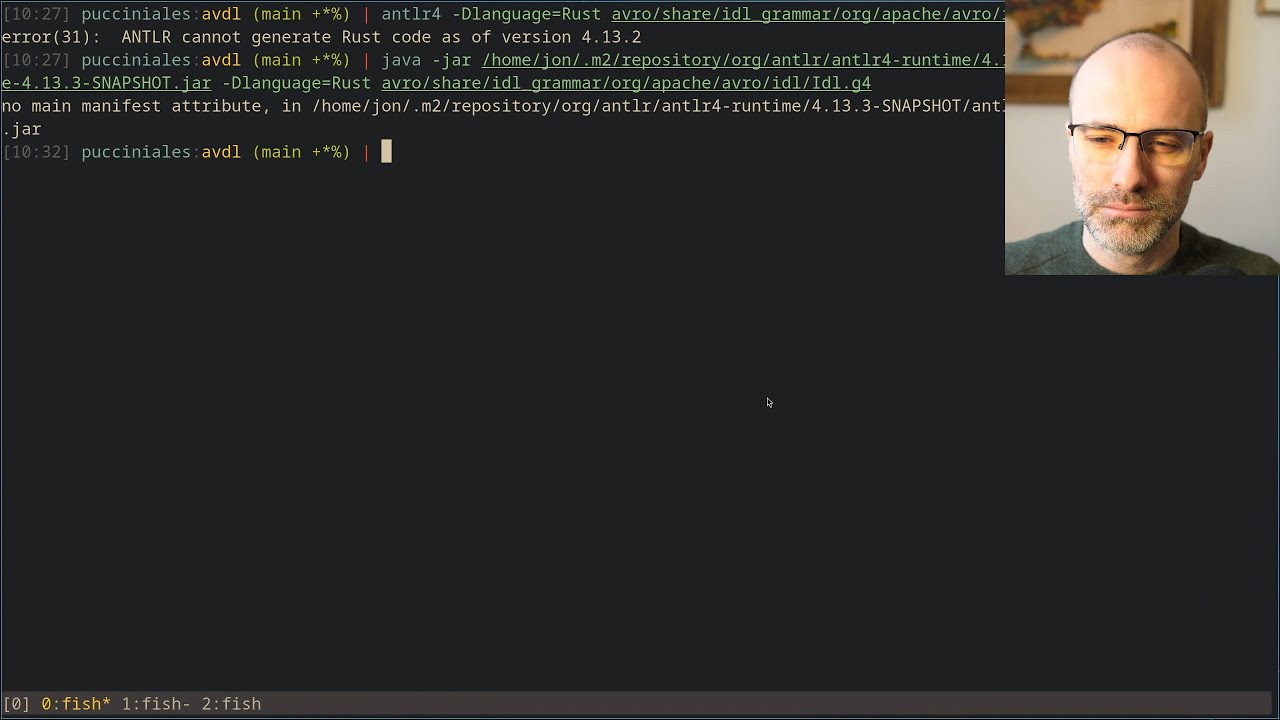
custom build it. So what I want to do is
this and see what happens. Antler cannot
generate. Okay, so the antler for rust
thing is uh yeah okay it's going on in
this repository.
This is the main repository. This readme
I think is out of date. Um, but I I
think this is not considered like it's
not upstreamed yet or it's not uh
enabled as a default distribution of
Antler the the Rust implementation. So,
we need to figure out how to get this
one. Uh, which I think is just going to
be a matter of us
Oh, I see. No, it is still in a fork.
Great. So, what we're going to do
Yeah, the rabbit hole begins. It's true.
Um, what we're actually going to do is
we're gonna CD. Do I want to do this
under us? Yeah, sure. Um, we'll go get
subm module
add this one.
Uh
such large projects to clone
come out.
All right.
So how do we build this thing? Read me.
Build.
How to build
doc. Building antler.
Most programmers do not need the
information on this page. Cool. Well,
that's not us sadly. Uh, okay. We have
the source. Yes. Check your environment.
I have Java. I have Maven.
Uh,
the current Maven build seems
complicated to me. Great. [laughter]
Okay.
Uh,
don't forget this on Linux. Okay. So,
this is going to be
But I do I want it to install? Can I
tell it to aha building?
Install sounds a lot like not not just
build, but okay. Um, fine. So, we're
going to run
uh Oops. We're going to run something
like
this.
Let's just see how that goes.
Yep, it's doing something.
This feels like the wrong logging level,
but we will find out.
[snorts]
Install will just drop it in your user
repo. Oh, build success.
Build success, you say? [laughter]
Uh, where did it put it? Oh, it put in
an M2.
Okay.
Uh, so I should now have
antler
files in here.
But that's the Oh, right. I don't want
the test suite. I want antler.
Uh, probably runtime.
Probably the 4133
snapshot.
Probably the
jar.
Cool. So if I now run uh here
this instead, what happens?
No main manifest attribute. I love
running Java code. Uh,
interesting.
So maybe it's not just runtime. Maybe I
need
master.
That sounds promising.
Oh, but there's no Java. There's no jar
there.
H.
uh run maven package to local build with
artifacts in target. Oh, see this is why
it's so handy to have Java experts in
the room. Um so I can do package
antler for tool.
You lied to me. There's no jar now
either. Uh where did it put it? Uh
building jar
ah
in
tool
target
antler snapshot. What's the difference
between complete and not complete?
Riddle me that. Okay. All right. I I'll
I'll bite. How about this?
What if I do the complete one? Is the
complete one better? Complete.
It did a thing. What did it do?
What? Actually, what did it do?
It ran successfully.
Clearly, I have not used uh antler
myself before.
Let's um let's go look at what this
says.
Okay. Yes. Yes.
Yeah. I Okay, I ran that. Now what
did it like
did it modify my source main? No,
it
what what
Hey tool tell me what you did.
D
okay what if I what if I here do like
Java? What happens?
I bet you it writes it near the file you
gave it or something. Yeah, there we go.
Okay. Okay, great. Um Okay, well, we
figured it out. So
uh let's seed into arro
and let's do
let's do get clean
in the subm module to remove those.
Um and then we'll run the rust version
again. Give us rust and then we'll ls
here. Actually, we'll then we'll do this
this and we'll do ls files. No, get ls.
Get no. Get status. It's too early in
the morning.
Now, the question is, do I need the
interp and tokens files or do I just
need the rust files?
I'm going to assume I only need the rust
files.
So, we're going to do
move star.rs RS to source.
Let's go look at what it generated. Um,
IDL parser
generated. Great.
It generated a whole lot of code.
Um, let's then see whether there's any
mention of interp in source.
Uh, it doesn't look like it. What about
tokens? No mention of tokens. Okay.
Cool. Uh so we have source files. What
what else does it tell us? Uh you can
also see builder as a one that rebuilds
the parser automatically.
Oh yeah, there is dash O. Great. Uh I
don't think I want this to be a build
RS. I think I want to check in the files
cuz I don't want consumers of this crate
to have to have the antler the antler
rust version built locally to be able to
run this. Uh so I think I actually want
to just check in the generated files. Um
yeah, that is what I want to do.
And this is just uh examples. That's
fine. Okay, great.
And then it says add rust to your
dependencies. Okay, that's fine. I can
do that.
And then
ah so they so they have an example build
RS. Do they also have an example like
source
lib?
Not trivially. Okay, fine. I was hoping
they would have a Oh, examples.
Do they have an examples file
in this directory? No, they do not.
Okay, then uh I think what we're going
to do is we need to figure out what the
end what the entry point here is, which
I wish they were documenting this read
me, but they did not. Okay, that's fine.
Um, what we'll do then is we'll go to
source.
Oops. Oh, I don't have a source lib
because I didn't tell it I wanted I told
it I wanted a binary, which is true. Um,
but I also want a library and I want
uh
I want
uh ls source.
I want mods for each of these.
Like so. Now, what happens if I run
cargo check?
Well, that's also interesting.
They tell me to take a dependency on
antler rust 0.5. Huh. Uh,
okay.
But
I think I see a problem.
Uh, anther rust02.
Do not use anthther rust03.
[gasps]
Interesting.
I wonder if it's this one they mean.
Yeah, I think it's this one they mean
because in fact if you look at the
generated code if we go into this for
example you see it's naming a dependency
called antler for rust which is not what
that one is. So I think this is supposed
to be that and that the readme is simply
out of date.
Well, that compiled.
Gave us some warnings, but that's fine.
Okay.
So, now we in theory have something that
looks like a parser.
Um,
so in fact, let's go ahead and do let's
cdient arrow first. Uh, get clean this.
I just want to commit
this
uh
in it plus generated grammar.
And now I think we can so so we can
either now go and try to figure out how
the parser works. And maybe we we
probably will have to cuz I I suspect
we're going to have to uh point um
Claude in the right direction for how to
use this. But I do actually think uh aha
for examples you can see here.
Yes. Okay. This is the corresponding
generated code. Yes, we've seen a lot of
that. And so this is what Okay. So it
generates
uh we you know we pointed it at a
grammar file called IDL and for each
file you point it at it generates four
files.
Uh sometimes maybe more than four files.
Ah that's visitor basic base. Visitor
basics. Let's uh look at maybe CSV.
It generated lexer listener parser and
visitor. And it also generated these
base. It didn't generate the base
ah IDL base listener IDL lexer listener
and parser. So we did not get a visitor
for whatever reason. Okay, that's fine.
Um so the generator files look like
they're about right. But now I want to
see
uh general tests.
So I'm hoping that this will actually
show me how to parse one. Yeah. Okay,
so this uses
from the lexer and listener that were
generated.
Here's a thing that it's supposed to be
able to parse. So I guess this is an XML
parser,
right? Okay, great. [snorts]
Yeah. So, this shows you how to do the
use the lexer,
how to use the parser.
Great.
So, we have now a reference file here. I
wonder what's in gen. Oh, the gen is
just the generated code. What's perf?
Cool. This This looks like maybe it
needs some cleanup. Um,
I see. So visitors are the ability to
have a parser that will
um let you write code for visiting stuff
in the a uh which I don't think is going
to be useful for us. This is where it's
useful also to go back to the um the
Java code. So if you look at because it
also uses antler, right? So uh in the
Java code they uh these files just
define the basically the equivalent of
like source main RS, right? for these
two binaries and both of them end up
just calling into
um they get an IDL parser by creating an
IDL over the input file and then they
from there
parse out the protocol
and they get name schemas and stuff.
Okay, so they just get things out of
there and the IDL is this kind of thing.
So IDL file which is an IDL reader. Uh
so IDL reader here presumably we should
see a bunch of the stuff
that comes out of the generated parser.
Aha. Uh Abro ideal
parser. Okay. So where's the generated
parser? Did they check that in
somewhere? IDL schema parser.
Aro parse context
avo schema.
No, that's for parsing a schema. That's
not what we want. We want the
IDL.
Where are these coming? Like where's the
IDL parser coming from? That sounds a
lot like the thing that's generated.
I just want to see if I can find
a sort of natural entry point here.
Yeah, this this looks a lot like using
the things that Antler generated.
Primitive type context.
I just want to see if I can if they
checked in the generated Java files or
not. So if we go to uh IDL source
main.org
Aro
IDL no they just have these.
So that makes me think that they might
not
check in the generated um
the generated parser unless it's under
here
utils
write schemas. is
no this is writing this is writing an
IDL this is not writing the JSON or
parsing the IDL so these are just like I
think these are actually helpers for the
llinter right so imagine you want to run
a formatter on your IDL schema the way
you do it is you parse the schema file
and then you write it back out in a
well- definfined way and I think it this
is the write it back out in the well-
definfined Okay.
And so this doesn't matter too much to
us. I mean, this could also be
interesting to port, but it's not the
main
focus I want to have. I'm just
like the IDL reader feels like it's the
right one. But this IDL parser,
where does the um this lives? Oh, they
list an IDL grammar. Okay. Does anything
else live here?
No. Okay. My guess is that this
generates an IDL parser and then that's
just what gets imported from these other
files eventually. Um, and so this is
just the use of the generated code.
Cool.
And so that's similar then to the
uh the Rust code that we saw earlier. So
like in general tests for example
um which also shows how to use the
parser in the like in rust we're not
going to get an ideal parser class
instead we're going to get these um
these listener visitor types and this is
the kind of stuff where um this mapping
if I were to sit down and understand
everything antler generates um and then
map what it does in Java to what it does
in Rust it would take me a huge amount
of time. it it might still be worth it
in the end, but this is where I suspect
Claude will be able to do very well if
we point it at the things we found so
far. Um, so this is where we're going to
start.
Yes. Um, okay. Now, one of the big sort
of ways to make these agents actually
work well for you is to be good at
describing the thing you want
implemented. Uh, so we're going to start
with a sort of highle description of
what I'm aiming for. Um, so I want to
and let's give it the um the path here
to the
uh this tool.
Uh I want to port
a slash
uh this
to rust in the current to a rust binary
in the current crate. Uh the grammar for
uh the AVO IDL is
uh described in
uh described using antler in slash this
um
which I have already generated
generated
Rust code for in source slash uh
idlar.rs
um
and then
I actually think this would be enough to
get it started but I want to guide it a
little bit more for how do we want ours
to be different. Um so what I will also
point it at is this. So the Java code is
not it's split kind of weird. So the
main binaries are in a different place
in the repo from where the libraries for
doing the actual processing is. So I'm
going to give it this path as well. The
actual logic for parsing for the uh Java
version lives in a slash this path uh
lives in
the files under here. Um, and then
what else? Um,
I'll also point it at this,
uh, which is really just runtime rust
test general.
So, I'm guessing that this will be here,
right? Yeah.
uh antler this
um
you can see example
rust code for interfacing
with antler generated bindings in this.
So this will be a good example for it.
Um and then we want to give it some
example input and output files.
Um, and those we want to use these for.
And then I also want to see whether
there's an outputs. Yes, there is. Um,
what else is in this directory?
Okay. Um
uh as test input and output files use
and
output
for any given AVDL file
uh
for any given set of AVDL files. You can
also execute the Java version yourself
using
um and this is where I need the Java
this one.
It's also very useful to give it um
example commands that it can use to run
things itself. Um
and then we can do here path to AVDL
path to output file.
>> [snorts]
>> Um,
you can also execute the Java version
yourself and generate an output file
using this.
Um,
cool. Let's start it there. And then
usually what will happen is it'll come
up with a mediocre plan initially and
then we're going to have to um oh is it
an output folder?
You can certainly give it just a what
happens if I just do dot slash
oh uh
right I deleted that file. Oh no.
Uh,
well, now that Maven command works. That
That's handy.
Uh, yeah, it doesn't like that. So, it
does need to be a file, I think. Oh,
maybe the maybe this one is the one that
can output a
folder.
Let's find out. Maybe that's the
difference. Yeah, this does say output
directory.
So, let's let's see what happens if I do
this.
What do I get? Aha.
Then I get one point. Then I get one
file for every type.
Uh
okay.
Uh
there is also
uh and then we'll give it the
uh path to this guy as well
which you can pass a output folder
stress folder uh to in order to generate
separate AVSC files for um
every
schemata defined in the input. Uh and
then the last thing I'll do is I'll
point it at the IDL language docs. Uh
you can find the documentation for AVOS
IDL format at this URL.
And now let's um let's kick it off and
see what plan it initially comes up
with. And then I'm expecting we're going
to have to do um a decent amount of um
finagling to this
[snorts]
context filled entirely by prompt. H I
don't think so. I think I think we'll be
okay. Uh yeah, you can run WC commands.
So that seems fine. [snorts] And then
initially, obviously, it's going to
prompt us a bunch for am I allowed to
use this tool? Am I allowed to use this
tool? And then pretty rapidly, we're
going to end up with like a a sane
enough set of [snorts] things that are
allowed that we don't need to approve
things all the time.
Um,
in the meantime, check the Rust parser
files generated by Antler if it has a
parser function. Sure.
uh parser.
In fact, we can do because it's Rust fn
parser in source. Nope. But there might
be a parse.
That's interesting. Didn't we see this?
Oh, no. It's um it's that you create a
uh it's like parser new. Well, that's
the lexer. Where's the
here parser test CSV
you create a lexer over the input stream
then you create a parser
uh over that token sort which is the
stream of tokens that comes out of the
lexer and then you add a listener to
that parser.
Um the other thing that's nice here is
so Antler is supposed to be pretty good
about keeping the parsing context and
revealing that to the callers so that
you can then give oh this is the last
thing I forgot to give it is I want to
use Miet um because Miet is really good
for giving you the ability to point to
specific parts of the input. Uh so let's
go ahead and do that here as well. Um I
would like to use Miiet as a way to keep
track of uh lexing and parser errors so
that we can give very good and helpful
back traces in the case of invalid input
files.
The by the way here I think is a clawed
feature where you can give a you can
give an additional prompt and it doesn't
interrupt what it's currently doing but
it we'll read it the next time it's like
in between instructions.
[snorts]
Um are you running cloud in a VM? How do
you defend against information leaking
out such as environment variables and so
on? Um I'm not running claude in a VM
here but I'm also not running it in YOLO
mode so it has to ask me for permissions
for things. Um, in general, the I mean
the the built-in sandboxing is not
great, but it's also not terrible. Like
the sort of obvious examples of it
trying to read outside of the directory
that I'm currently in, it tends to ask
me at least once. Um, environment
variables I'm not too worried about.
Like there there are no environment
variables in my current environment that
are actually sensitive.
Um,
do you use any advanced agent coding
capabilities like git work trees and
agent swarms? Um, so, uh,
why does it want to look in my cargo
register? Oh, I see. Because it wants to
look at the code of antler for rust. U,
sure, that's fine. Um,
yeah, so I use
that's also fine. That's also fine. Um I
do use git work trees especially when I
have um if I have multiple sort of you
what I'll usually do is I'll um as I
especially read through both the LLM
sort of talking to itself uh and the
code that it generates I sort of start
keeping track of a to-do list oftentimes
in an actual um to-do.md file. Um, and
I'll sort of write down the the things
that I want it to do in the future. And
um, then after I finished whatever my
current session is, I'll then point it
at my to-do file and say, I would like
to fix the following things. Um, break
them into semantically related changes,
then start an agent for each one in a
separate work tree. Um, and then that
tends to work pretty well.
Uh I did not enable team mode for this.
Um I don't even know that we're going to
need multiple agents for this initial
part. Um usually I found that for the
generation of the first sort of core of
the application, it doesn't work so well
to try to do it in parallel. Um it works
better for things like having them
review each other for example or if
you're working on multiple relatively
disjoint features for the we're trying
to write the initial version of a crate.
it usually doesn't work as well.
Um,
uh, Miet is really neat, but I've always
found the actual reporting a bit of a
pain to deal with. Very poorly
documented there. Yeah, but I think the
documentation of MATE itself is a little
mediocre. Um some of it is also that
like the the dynamic error types in Rust
can be a little annoying to deal with
because for example um Miet error cannot
implement the error trait and this is
sort of a limitation that's that's known
in Russ like anyhow and error have the
same problem. Um but if you specifically
want to get um the sort of errors where
you can point back to source code and
say like here [snorts]
uh then me works pretty well for that.
And you'll see it's still in the plan
phase, right? Because we gave it a
pretty involved set of things to look
at. Um, and so so far it didn't hasn't
generated any code. It's just trying to
come up with a plan that sort of
satisfies the inputs that I gave it. Um,
and I mean we could we could go in and
explore what it actually is thinking
about. But instead, what I want to do is
go back to the ideal language a little
bit. So the ideal language itself is
like not the translation to JSON is not
actually very complicated. So if you
look here like we have a record. So we
have type message. It has two fields
title and message. Uh both are string
typed but the title is allowed to be
optional and defaults to null. And
you'll see if you turn that into JSON it
it's a pretty straightforward
transliteration right you go from like
type is record. So that's from the first
keyword name as message and from the
second name space is grabbed from the
file. So you do need to keep some amount
of global state as you walk the file. Um
fields is just an array of the fields uh
for each field. You have the name of the
field, the type of the field and a
default if it has one. Um you'll see
this type here is an array and that's to
support unions of types. And so the way
that averro represents optional types is
that it's sort of a syntactic sugar for
a union of string or null. Uh and that
that's all there is to it. So so it's
not like there's a super complicated
resolver happening here. That resolver
lives in the the actual Avro compiler
which works on the JSON. So it's the
just the transliteration from the AVDL
format to the JSON format itself is kind
of dumb. And we can sort of see this
like if you go to the IDL reader like
there's a bunch of code in here but much
of it is just like invoking the parser
and the lexer and then defining a bunch
of types that we need. Um but there is
some right like um
here for example they're trying to
extract doc comments so that you can add
those into the JSON thing and then you
need to know when you have a doc comment
in the input file you need to know which
record to associate that documentation
comment with. So there is like some
amount of complexity here but it's not a
huge amount of complexity.
Uh there are also imports that you do
need to deal with. So it's like okay
there's a there's a little bit of
annoyance but like ultimately this whole
file is a thousand lines. It's a
thousand lines of Java which is not the
like it's not the most concise language
in the first place right so a thousand
lines of code for doing the reading and
the writing doesn't seem too bad to me
[snorts]
um
no that seems incorrect. You don't you
do not want to do this. Um, so
let's instead tell it you can find the
full source code for all the aro all the
antler for rust
uh stuff in
uh
antler for rust
runtime
rust.
source,
right? That's what we
Yeah.
source
so that it stops trying to look through
my registry, searching for things in my
entire registry.
>> [snorts]
>> Um,
I was writing a DSL for work a couple of
weeks ago and was surprised the nightly
trade allocator was not stabilized.
Would have made a lot easier.
Um, yeah, I mean allocator has been
unstable for quite some time. Um, I
don't actually know what the current
blocker to stabilization there is. Um,
yeah, there's a
I remember for a while it was trying to
figure out
uh things like whether dealloc needed to
be given the layout of the type that you
wanted to deallocate and stuff, but but
I'm sure they've moved past that now.
That was almost a leak. I'm not
concerned about leaking what's in my
cargo registry. That seems fine.
Um,
important finding. Common token stream
get is public and accesses the raw token
buffer including hidden channels. We
don't need to patch Edler for Rust for
do comment extraction. Okay, good. See,
this is where it sometimes it's funny to
like expand the internal dialogue Claude
has about itself because it it sometimes
it will like fret over how am I going to
possibly do this? I need this thing. Um
I think a big holdup is seeing if they
can avoid a huge explosion with
fallible.
Oh yeah,
this is basically like if allocation
fails, how do we propagate that
information?
And of course, someone came up with
another alternative. Yeah, of course.
And so then the the whole saga starts
again.
Yeah. I mean, it's the sort of the
eternal question of like when are you
done discussing, right? When are you
done looking at alternatives and you
should stabilize the thing you have? Uh
there's no right answer to it.
Do you think you're more or less
productive with agents in your
day-to-day? I feel like coding skills
atrophies but reading skill improves.
Um,
I think it's a mix. Um so I think
uh I do think that the more you use
agents the more your coding skill
atrophies
but at the same time um I think there's
sort of an upper limit to how much you
can use agents for your work and so
therefore there's an upper limit to the
atrophy. Um, and
what that upper limit is, I think,
depends a lot on the kind of code you
work with and the kind of projects you
work on. So there there are some parts
of the work that I do where like I just
realistically couldn't generate the code
like the agents would not be able to to
write that kind of stuff. And there's
other things like this where I'm pretty
sure that Claude will do very well at
this and it would take me a huge amount
of time that would not be particularly
well spent. Um, and so then I don't
really care that that
my coding doesn't learn from this coding
because I have other coding that fills
the gap.
Um,
should IDL and IDL2 schemata be
subcomands of a single binary or would
you prefer separate binaries? Uh, I
would like a single binary with
subcomands. I think
um the generated antler files have allow
inner attributes at the top which means
they must be crate roots or mod targets.
They can't simply be moved into a
subdirectory without removing those
inner attributes. Should I strip the
inner attributes or move them
to source generated
or leave them flat in source?
Uh,
I'm pretty sure they're fine as they
are.
Like, yes, it has allow non-ster
standard style, but that's that's fine.
I guess it would I see it would like
those files to be in a different place.
Um,
but why would that make you strip the
attributes though?
I'm I'm fine moving them to source
generator. That seems fine. Uh,
and then the other thing I was thinking
of is it's probably going to default to
using clap here. And I don't think we
need to. I think the input here is
straightforward enough that I think I
want to use um Lexop instead.
Maybe. No, it's fine. I'll leave it to
choose what it wants.
Okay, we have a plan. Let's look at
Let's look at its plan. Oh, it's a long
plan. Good. Um,
okay. Context. And this is where, uh,
well, one of the things that I found a
little interesting about using agents
is, um, it forces you to sort of read
through someone else's plan. uh which I
think can actually be really useful in
the sense of it makes me I think it it
has improved my ability to
um
sort of critique my own plans when I
come up with one but also when other
people pitch me a plan for what they
want to do it feels similar to reviewing
this plan and I actually think reviewing
these plans is really useful and teaches
you a bunch of things it's different
from like the the kind of teaching you
do by writing code yourself but it does
teach you something about planning and I
think it also forces you to think
through some of the implications ahead
of time which I think is a good practice
anyway.
Okay, the crate already has uh Rust
parsex code for the Abroad grammar but
no actual logic. The goal is to port the
Java tools those to Rust binder that can
parse ADL files and emit those things.
Yes. Um, core parser logic lives in a
IDL reader which uses a listener to walk
the parse tree and build a schema
protocol objects. We'll port this to
rust using a recursive tree walking
approach over the antler generated rust
parry. That seems fine. Now there is um
there is a really interesting
observation here already which is in the
Java code when they want to generate the
JSON
I expect that they use yeah exactly they
use this stuff so they already have
definitions for the the JSON
representation uh so we're actually
going to need Rust implementation of
those strcts and then derive serialize
for them so that we can produce the
JSON. Um, which I'm guessing it will
figure out. We'll find out.
Okay. Key design decisions.
Uh, recursive tree walk instead of an
listener. The Java version uses the
listener with enter exit methods and
maintains mutable stacks. In Rust, it's
awkward to implement the ideal listener
trait due to the lifetime constraints.
The listener methods receive borrowed
context that can't easily coexist with
mutable state on mute self.
Interesting. Is that true? Um
ideal listener
parse tree listener.
I see. So you're given
you're given references to the nodes as
the parser walks through them
and you can't easily store those
references in self as a stack because by
the time this function returns that
reference this reference uh is no longer
valid. this reference is, but that
reference is not.
Um
although that does make me wonder what's
in these leaf nodes
cuz I actually wonder if we could just
extract
these the tokens directly because
ultimately they should just be tied to
input and then be a little bit of
information around oh I guess data maybe
is the problem. Oh no. Or yeah,
interesting.
Okay. So, what does it want to do
instead?
Um, instead we parse with
build parser equals true and then walk
the resulting tree with recursive
functions. This gives us full control
over traversal order and state
threading.
Uh, I see. So this means that it's not
going to be a
streaming conversion. It's going to be a
parse the whole thing and only when the
whole thing is parsed do we walk it
recursively.
I think that's okay. It's a little
unfortunate but I think working around
it is going to be annoying. rather than
depending on the Apache Abber Rust crate
which lacks a protocol type and whose
schema serialization wouldn't match the
expected output format.
Why
actually is this the latest one? I
remember there's been a rename of one of
them.
Yeah, this is the latest one. Um all
right, what do we have in here?
Yeah, because this um
this crate
ah schema
and if I look at
schema and show me the source of schema.
Uh
interesting. It actually doesn't even
implement serialize.
So Apache Abro is the Rust crate you use
for interacting with uh Avro scheas. So
after you've generated the JSON, you do
you want to now use that JSON to
generate rust types and do the
serialization and des serialization in
Rust. The Abro the Apache Abro crate is
the one you use for that part of things.
Um and it obviously needs to parse the
JSON schema. So it must have rust
representations of the things that it's
going to parse. Oh, this derive what's
in derive.
Um and so the schema type here for
example is basically the um the type
used to represent the I think the top
level of the JSON file. So the question
is why can't we use that one?
Because this should have all of the
types you can have for fields and the
like
and it has a parse.
Does it might not have a serialize, but
this feels like ideally we would just
add the ability to serialize to this so
that it could use the same types. Um
although it's not the end of the world
like this is the the output schema is
not too complicated. Um with a
purpose-built domain model average
schema enum protocol strct that
serializes to start JSON value. This
gives full control of the JSON key
ordering and formatting. Yeah, that's
true. The JSON key ordering is the other
thing here because
because we're expecting this to generate
one to one equal output. That also means
that all of the JSON fields would need
to be in the same order.
The alternative would be that we tell it
we don't require that the JSON is bit
forbit identical. We just require that
it's semantically identical. So um like
if you parsed both as JSON objects and
then compared to them, they have to be
the same. Um,
I think for now I'm okay with
us just having these types ourselves and
then we might want to relax the
comparison logic down the line anyway.
Uh, but for now this seems fine.
uh doc extraction via token stream get
the Java coal code calls token stream
get hidden tokens to left which is
unimplemented in answer to rust however
common token stream get index is public
and access the raw token buffer
oh that's interesting
uh okay for rust
uh runtime rust source course
hidden.
It's not what I wanted. I want uh hidden
hidden tokens to right and hidden tokens
to left are indeed not implemented.
Cool.
I wonder if that is if we go to the
antler for rust thing.
Uh
oh, we should probably point it at this
uh differences with Java thing. I was
just curious whether there's
an issue for this.
No, it doesn't look like it. What about
pull requests?
No, none yet. Okay. Um, but I do think
we should actually point it at the
readme so that it's aware of the um
that be in here.
Yeah.
Uh, so I do want to point it at that in
a second. Um, so instead it's just going
to do the common token stream and then
walk backwards through the tokens. That
seems fine. Uh, meat for rich
diagnostics without source bands. Custom
handler error listeners will collect
errors as meat diagnostics. Perfect.
Module structure. It's going to generate
a CLI with clap that has the two
subcomands.
That's fine. Error types. The model.
This is going to be the model for the
output schema. So the JSON stuff that
seems fine.
Sure.
Okay. What do we have in schema?
Primitives name types with name
namespace doc fields.
Yeah, the these are basically the things
that come from the spec itself. So, if
we go up the spec, we should find
uh
oh, it's not open container. It's object
container. That's the thing I was
talking about earlier about arbitrary
bytes. Um,
yeah, I wanted to look for
Yeah. So, if we look at, for example,
record,
it's supposed to have name, type, and
fields. name, top, and fields. Although,
it's interesting because it seems to
declare more things in here. I wonder if
there's a
complete grammar at the bottom here. No.
Wonder. It's surprising to me that it
doesn't have everything in the spec.
name type doc fields
complex types
support the following attributes. So
where are the other attributes coming
from?
Okay. So we might have to point it at
this as well to say your schema
representation might be wrong
name because like for example the is
error
and aliases. So aliases is there
properties.
Yeah, properties doesn't seem like a
thing.
All metadata properties.
Oh, I see. So these might be additional
keys, but they're not known in advance.
So I'm guessing that properties is
actually a hashmap of those and when you
serialize you add those into the
serialization. Um don't know what is
error is going to be for.
Oh, this might have to do with if you
use it in a protocol.
That's fine. We'll we'll see what it
does here. Uh arrays are right. These
need to be
box
averro schema because uh we have a
recursive type and so they need to be
sized. In order to be sized they need to
be boxed. That's fine. Same for values.
Um
same for unions.
That's fine.
This is references to other types that
we may not have parsed yet. So, we need
to store the reference until we've
parsed them. Uh, logical types, it's
fine.
Yeah.
Name types serialized inline on the
first occurrence and as bare name
strings afterwards.
Sure.
Cycle permission for imports. That seems
fine.
All right. What are the errors like?
Yeah, we already have enter for rust.
We'll bring those in.
Uh, I do want snapshot testing. Thank
you very much. I think this is from my
um agents MD. I think I put in that I
like snapshot testing.
Um,
okay. First move all the stuff around,
then add the model, then hang construct
the tree. Serialize and compare,
then error types, then schema registry.
Yeah, the schema registry you need so
that as you're parsing types, you know,
um, imagine you have a, you know, a
record fu and a record bar and then you
have a record baz that has fields of
type fu and bar. You need to have a
registry where you store the definitions
for fu and bar so that when you get to
baz, you can inline the definition from
there or reference them to my name. Um,
that's what the registry is for here.
That seems fine.
uh core tree walker. This one I'm just
going to believe it because if it gets
it wrong, it will be very obvious in the
outputs. Um but it'll generate a top
level walk file. That seems fine. Um
test after each substep against
progressively more complex AVDL files.
That seems reasonable. Uh
yeah,
main is going to generate two
subcomands.
This will be similar to the existing
commands.
This iterates over all the name schemas.
Yep.
Run all 18 test cases. Yes, please.
Compare by parsing both expectant actual
JSON to JSON value for semantic equality
to avoid the formatting differences
between the Java and the Rust
serialization. Great. So, this is it's
already doing the thing we were saying
it would probably need to do. Um,
tricky parts.
Um,
nullable type reordering type creates a
union, but if the field default is
non-null, the union must be reordered to
t, null. The first type in a union must
match the default. The Java code uses an
internal marker property to track this.
We should use an internal flag on the
union variant instead. That seems okay.
JSON default value fixup. When it feels
default is parsed as an integer, but the
type is long. Java converts in node to
long node. Insert JSON numbers are
unified. So, this is a non-issue. But
nan and infinity are not valid JSON. The
Java code uses special string
representation. Of course, it does.
Cool. Okay. See, this is the kind of
stuff where like
I'm glad it picked up on this cuz this
seems like it's annoying to pick up on
otherwise. Um name type serialization in
protocol JSON output name types appear
inline
full definition on the first reference
in the types array then as bare string
names in subsequent references. The two
JSON must track known names to decide
which form to use. Some test files
reference class path resources.
We skip those provide the files
alongside. Okay. So we do need to tell
it then about um
uh
avo
let me just uh do this.
So there's also what its reference is to
the things that put on class path or
other things in here. So we have extra
and we have put on class path. Um, and
so these are other things where the Java
version will know to import these files
because they're on the Java class path.
That doesn't exist in Rust. And so we
need to track them separately. We should
probably point Claude at the um uh
we should probably point Claude at these
extra paths as well so that it's aware
of them.
Uh, antless string tokens include the
quotes and escape sequences. We need to
unescape them. Yeah, that's fine.
Uh,
great.
Okay. So, we have a couple of notes. Um,
read the differences.
What was it called? Differences with
Java. Uh, with Java section of
No, we don't need that. That's not a
URL. um in case that holds uh
differences relevant to your plan.
Um
also look at
uh extra comma put on class path. both
of which are probably useful when
using the AVDL files from
uh the testing AVDL files. Um,
and then let's also point it out the
spec. You can find the AVO
JSON specification here.
Um,
and I think that's all we really needed
to correct here so far.
Probably make a small adjustment to the
Yes, I'm fine fetching from Abro Apache
or in this repo.
>> [snorts]
>> It's imagining
um it might not adjust the plan very
much here, but it's also useful to give
it resources like this because what
we'll do is we'll clear the context and
then run it with just the plan. Uh and
then URLs like this will be included in
the plan so that later on if it's going
through the plan and it needs to
reference spec, it now still has the URL
and can go look at it.
Um
you also notice that like uh for example
I wrote um also look at this and I used
basically glob syntax for specifying the
paths and it understood what I meant by
those right because glob syntax is used
so widely that I guess the uh the sort
of the the model gets to learn what that
what that implies. So you can use a lot
of shorthands like technical shorthands
with this and it just kind of works. Um,
cool.
And then I think the next step now is
just kind of going to, you know, let it
cook. Um, because I think we need to
start looking at the code it produces,
not just the plan. Um, which we needed
to actually produce code first. Um, oh
there's one more thing I want to tell
it.
Uh, which is by the way, um, oh here,
um,
because it has these different steps in
its implementation plan. After each step
in your implementation plan, um, commit
the changes using the commit writer
skill. So, I have a a skill I've put
into Claude that um tells it how I want
commit messages to be written and what I
want them to contain.
And so, I want to make sure that it
actually does those commits as it goes
because otherwise we're just going to
end up with a a giant batch of diff at
the very end. Uh, cool. Clear context.
Auto accept edits. Let's see what it
makes.
doesn't it lose the context the more
data that's provided or more iterations
are done? So kind of um it it is true
that as you work more in a given session
it will start to um
its context will grow large and
therefore get kind of diluted. Um
what?
Sure. Um
and then then start to get a little
diluted, which is okay. Um
because whenever it has to compact the
context, it is refed the plan. And this
is why it's so important that the plan
is well structured and contains a lot of
the relevant details because you're as
the session progresses, it's going to
continue to refer back to that same plan
whenever it has to compact its context.
So the better you can make the plan, the
more continuity you will get as it works
through. The other thing I want to do
here is um uh make use of sub aents
actively for
self-contained tasks so that you don't
dilute your own context.
Um
sure that's fine. [snorts]
Uh which cloud model is it? This is uh
Opus. I think I'm on Opus 4.6 cuz I
because I did a full system update this
morning that also included the cloud
update that came out this morning which
includes uh Opus 4.6.
It claims it has a solid understanding
of the codebase now. I mean it it has a
solid understanding of the generated
code. I guess
actually how much code did it generate?
I mean so Antler did generate like 7,000
lines of code of parser. So I am glad we
didn't have to write that ourselves. And
I mean it's also like you know it's an
interesting question of if
the uh antler grammar and and generated
had not existed
would it have been feasible to do this
task? I don't know. I mean, it it
probably could eventually generate the
the correct parser and grammar, but I
think it would actually be a lot more
work, even though it's it's okay at
generating parsers and the like. Um, in
part because there are so many examples
available for it, but I I do think that
we'd probably run into a uh um a
situation pretty quickly where we would
not be able to do this in the in the
allotted time.
So, let's see what we got. Um,
oh yeah, I don't want
jar files to be checked in.
Don't check in jar files.
Uh, and then
this can go away. And now this is clean
again.
Okay, it wants to do a bunch of get
moves. That's fine.
Having used antler, the generate code is
mostly boilerplate though. Oh, I I
totally buy that. I mean, if if you look
at the uh right, it's moved to here now.
Uh so if we look at source generated IDL
parser
look through here like a lot of this is
pretty mechanical some of it is just
like be a parser right but it's like
this is just walking the the grammar.
Um,
but at the same time, this is also code
that it would kind of have to have
generated anyway, maybe in a slightly
different form. And maybe when you're
parsing a particular grammar, rather
than having to create a general purpose
grammar parser generator, you end up
being able to write much more efficient
code. That's certainly true. Um,
but even so, this is now a bunch of code
we didn't have to write.
Uh, I do want to cargo out all of those.
Yes, thank you very much.
[snorts]
Uh, telling it to the examples and to
generate a spec for it before generating
a parser would probably have worked
better.
Yeah, I mean if if I did have to make it
also generate the the parser, I think
what I would have done is not start with
the whole like we want to do the IDL
stuff, but just start with I want to
generate a parser for this language and
then give it a bunch of examples and the
Java code and everything. And then after
we had a parser, I would then go, okay,
new task. Now we're going to use this
parser that we've built to build the um
um the transpiler.
Uh, yes, that's fine.
That's fine.
Um, honestly, I kind of like writing
recursive descendant parsers manually.
Tokenizers are a bit more of a pain, but
not so much as you think. I know. I like
writing parsers. I' I've done a couple
of them. I think I did one or two on
stream and we did one on the um
uh there was a codec crafters writing an
interpreter for some language and there
we did write a a parser ourselves. Um we
write wrote one using like um I think we
wrote a prat parser if I remember
correctly that was a lot of fun. I've
written a separate parser for another
reason. Um and I do think it's really
fun. It's more that
and this sort of gets back to the what's
the point of coding, right? Like for me
there are there's some coding that's fun
and there's some coding that's annoying
and it's usually not so much about the
code that I write. Like for example,
sometimes writing a parser is really
fun. Sometimes writing a parser is
really annoying. And it depends on
whether the parser is blocking me from
doing the things I actually want to do.
Right? Right? So, if the thing I
actually want to do is, you know, uh
I don't know, uh
knit a sweater, uh but the task I end up
doing is shaving a yak, right? Then like
the shaving a yak is less satisfying
because I'm doing it, but it's blocking
me from doing the thing I actually
wanted to be doing. Even if normally
that yak shaving would have been fun to
me if I was just doing that in
isolation. Um
yeah, the interpreter for locks and I
think it's it's something exemp uh
similar for me here. Uh yes, cargo build
is fine. Um it's something similar for
me here where um I don't actually care
about writing a parser for a format.
Like that's not a thing that I want to
spend a bunch of time on. Uh what?
There's definitely a claude
skills commit writer. It is simply
lying. Uh
the skill is called commit writer. Um
so like here what I really want is to
just have this porting thing. Uh,
actually use the commit writer skill,
please. It's not always very good at uh
doing what it's told. There we go. Yes,
use commit writer. Um,
so so if I spent like most of today
writing a parser for Abroad, that would
not feel like a good use of my time,
even if I might have enjoyed it if that
was the task I'd set myself. But because
the task I've set myself is something
very different specifically I want to
just have this transpiler exist. Um then
you know that would be uh uh would not
feel like a good use of my time. Um
great. So now it's going to do steps
two, three, and four in parallel using
sub aents. And in theory they're all
independent of another. One of the
reasons why I want to use sub aents here
is because the sub aents get their own
context. And so they get to do a bunch
of thinking and stuff without polluting
the context of this main orchestrator.
Um, so it's going to kick those off now,
which is fine. Um, the one thing I want
to show here is also I had it generate
the commits using my commit writer
skill. So let's look at what commit it
actually generated because I think a lot
of autogenerated commits are pretty bad.
That's why I wrote a skill for it. Let's
see how this turned out. Um, move the
answer to generated files into generated
generated files. Previously used inner
allow attributes would only work at the
crate route. That's just false. Uh,
switching to outer attributes. It's
probably thinking of crate features. I
agree. Um, because they they work just
fine. Um but but one thing someone made
a point that um
uh it tends to be useful to like let the
LLM use its own taste rather than
forcibly using yours for some things
because otherwise
um the the LM will keep getting confused
down the line because it assume like
let's take um function naming like if it
proposes a name for a function then
that's sort of the the pattern match it
has done to the most likely name. If I
change that name, if I forcibly tell it
no, use this name instead, then when it
later writes code that relies on that
function, it will also infer the most
likely name and that name will not match
the one that was actually used. And so
you're introducing additional potential
for confusion for the model on multiple
points in the future. So sometimes it's
fine like it's useful to go with the
recommendation it comes with even if you
don't like it that much just so to
increase its iteration velocity down the
line and then the trick becomes at the
end you can change a bunch of these
things around but you don't want to do
it during because then you're slowing
down each subsequent phase of the of the
development.
Um created sub files for the planned
module layout add rundown dependencies.
Okay that's it's fine. It's a It's a
fine commit message. Um,
uh, the agents
don't commit because they will step on
each other's toes. Instead, you should
commit their resulting work at the end.
Um,
do you mind spending money slashtokens
on open source tools? Do you even have
it as a consideration or is CloudMax
enough that a project like this doesn't
usually too much use too much of your
quota? Um,
so the reality here is that I'm normally
on Claude Pro because I use it. Um, so
at work we have our own separate setup.
So at work I don't use my own tokens.
Um, and then for my personal work, I I
usually end up not going over the
like it sort of depends what I use it
for, but very often I'm able to stay on
the pro plan and just stay within within
budget, so to speak, whatever I use it
for because I use it for smaller tasks.
This is an example of a bigger task
where I would expect that I would very
quickly run out of the the pro sort of
token quota and so I upgraded to max
specifically for today uh because I
think I will would easily otherwise have
used like the tokens allotted to me and
I wouldn't want to like stop the stream
for 3 hours until the token limit reset
but I'm totally fine using tokens on
contributing to open source things. I'm
actually I would be more skeptical on
using it for my for something that was
only going to be private because it
feels like it's not even contributing to
something outside of myself.
Um
uh isn't it harder to go back and
refactor full system instead of doing it
on the spot? Um it's not so much about
refactoring a whole system. So for for
system architecture I will tell it to do
things differently. It's more for it's
actually more specifically for things
like naming or things where a construct
that it constantly gets confused by
where those you might be better off just
letting it do it. Like in this case with
the um
uh
with the sort of uh the allow
attributes, I suspect that if I left
those in the files, every time it would
open one of those files and go, "Oh,
this isn't allowed to be here." or if it
hit an error, it might go, "Oh, but that
might be because we have those here and
they're not allowed to be." And I kind
of just want to remove the distraction.
Like, you can kind of think of these
agentic agents as having like some
amount of ADHD, right? Like they they
see a thing and they can't really let it
go or they need to continue to focus on
it until it goes away. And so, I'd
rather just make it go away, make the
distraction go away.
Um, where do you host your commit skill?
It's I haven't um put it in the open yet
cuz I need to I need to do a little bit
more due diligence because before it's
useful to other people.
Uh moral of the story here is don't
nitpick. Yes and no. So So there are a
bunch of things I will nitpick on. Like
when we're in planning mode, for
example, I will nitpick on specific
parts of the plan that I think should be
different. But there's sort of a
difference here between being very
detail oriented and
trying to change things that the model
will
they're sort of misaligned with how the
model is likely to think about the code
in the future.
I feel like these models have more ADHD
than I do. I I think that could
certainly be true. Uh all right, let's
look at the log.
Oh, it committed all of them together.
That's not what I wanted, but okay. Um,
okay. Error. Do comment extraction.
Yeah. And see, now we're at we're about
to autoco compact in not too long. Um,
that's fine. This is the core tree
walker. So,
I'm trying to debate if I want to to
compact before it runs this. No, I think
this is okay. All right, let's let's
look at the code is generated so far.
So, we now have a bunch of code. Cool.
Uh generated code, I assume, is just
going to stay the same. And it's now put
all these allows on there. That's fine.
Um the doc comment stuff is the thing
that will
um allow you to extract the doc comment
before a record or a field.
Exactly. So it extracts a doc comment
associated with a parset tree node given
the token index of the start of the
record. For example, we scan backwards
until we find a docu comment. Um
so
we get a token stream.
We get a token index.
[snorts]
We keep walking the stream backwards
borrowing it getting the token type. If
the token type is doc comment, we grab
the do comment text and we break.
Otherwise, if it's whitespace, we keep
going. Otherwise, we hit something
that's not whitespace and not an empty
comment. Then we break and give up. Uh
then we return early. If the do comment
is not set, we strip the prefix and
suffix. This seems wrong.
Um,
ah, maybe not.
Maybe we're actually guaranteed that
these are This is an example of
something where I would probably prefer
a debugger here to check that that's
actually what's going on. So, let's um
start with one of my favorite things,
to-dos.m MD. Um,
and so this is, and part of this is
because I don't like sending all of
these nitpicks to the LM while it's
doing something else because it tends to
again get distracted by it. So instead,
I'll do I'll keep this to-dos file and
then at the end point it at this and be
like, here are a bunch of things to tidy
up. Um so
uh in this when stripping the and
add a debug assert to make sure that
what we stripped was actually those uh
uh those characters. Maybe use strip
prefix and
and friends.
If termed is empty, then return none.
Yeah. So an empty do comment is
equivalent to having no doc comment.
That seems fine. And then it strips the
indents.
This is matching the Java strip indents
behavior. So let's go look at the
JavaScript indents. [snorts]
Yeah. So, this is just when you have a
doc comment, the left side of every line
is going to have like space space space
star space and then text. But when you
generate the actual doc comment, you
want to strip those and instead like
rewrap the text to not have those spaces
and stars. And that's what this does.
That's also presumably what this one
does. Um,
does this bring in the regex crate? It
doesn't. It feel like it probably
should.
Yeah, let's um tell it to use regex for
this instead.
Uh to also to make it better match the
Java version. Um
uh let's prefer doing the stripping with
the reg x crate to match
uh the
what the Java
version of this code does.
It's still going in the background.
Yeah. While the tree walker agent works,
let me prepare the import resolution and
CLI modules in parallel since I can
write them independently. Cool. Sure. Go
ahead. Uh, and now it has to compact the
conversation. That's fine. Um,
okay. So, this is going to change
because we are going to switch it to
regex. So, no use in reviewing that
right now. Um,
and it has a bunch of smaller tests. I
think I'd actually prefer those tests to
be expanded. Um, also let's expand the
set of test cases for super indents.
Cover more odd combinations of
characters people might
might use in their source code.
AVDL source AVDL code.
Okay.
Uh so that's the docom and parsing
stuff. What else do we have? So next we
have the error types. What's an error?
Um
what's a named source?
So Mia this is new I think because it
used to be that you had to like
specifically include the
name source the whole source string
utility direct from your regular source
code type that doesn't implement name.
What do you mean doesn't implement name
interesting
because the source code is just like a
string but I'm guessing then
I'm hoping that what It does here is
dduplicate, right? So, oh maybe it
actually maybe the source code here ends
up being a oh no it is just over string.
Interesting. Okay. Um label message
span. Okay.
IDL error can parse
diagnostics IO other.
Yeah, this feels like it probably tidied
up.
Okay, so there's not very much logic in
there at the moment. Import resolution.
The import IDL case is not handled here
because it requires calling the IDL
reader/parsser.
Oh, I see. because these will actually
import the JSON files.
Whereas this imports and the IDL parses
it, turns it into JSON and then imports
that
interesting.
Yep, that's fine.
resolve import.
So it resolves relative to the current
directory.
Otherwise, it checks the configured
import directories which would be
equivalent to the Java class path.
Oh, interesting.
I wonder whether it's even necessary to
like because this basically has to parse
the JSON representations. But I guess
that's fine because we have we must have
types to produce the JSON
representations. So we're fine to just
derialize them as well. Doesn't mean we
need to understand their semantics
though.
So what does JSON schema do? converts a
JSON value to an Avro schema where Avro
schema is our wrapper type. Okay,
I see. So, we can't actually just uh we
can't just suralize into Avro schema
because why?
Uh because of things like name type
references
and we want to represent unions. Okay, I
see. So, we have a custom way to turn a
JSON value into uh
into a parsed schema. That seems fine.
And then for the name, we have the
references. We turn them into
references. Okay, that seems fine.
And I think um ASC and AVPR here are
actually very similar. So the AVPR
just pulls out the
types of messages.
AVSC.
I see. So they both just register the
schema. I see messages here are so in
the protocol messages are the API
endpoint and then the registry holds all
of the schema all the schema types. Um
so in the case of being given a protocol
file we have to parse out all the types
and list the messages. If we get an ABSC
all we have to do is pull out the types.
Um
so that makes me curious what register
does which I think just is going to go
to the registry which we haven't looked
at yet. Um,
okay. And a lot of this is just
parsing stuff. That seems fine.
It does allocations here that we
probably don't need it to do, but that's
okay.
Yeah. And a lot of this is like parsing
the complex types, not in the sense of
parsing the IDL representation or
parsing the JSON, but parsing the JSON
structure. Um
yeah,
logical type.
Yep, that seems also reasonable.
Whole object extra properties.
Yeah, I think I would definitely prefer
to handle. So, um you can define your
own logical types in ARO and when we get
those I would want that to be I would
want that logical type to be preserved
in the translation as well. So, um
handle the to-do around unknown logical
types in
uh source
imports.
Uh we should make sure to always
preserve uh custom logical types in
conversions.
Primitives with no logical types any
extra keys beyond type are custom
properties that we cannot currently
represent on bare primitives. Uh so
properties here are things like uh
annotations like uh amp% uh order for
example not amp% uh at order um where
you can say what ordering that field
type should have. I do think we want to
make sure that we keep track of uh
uh additional properties on primitives
to always preserve
additional properties.
Primitive for stir
This feels like it should return an
error, not hit unreachable.
Um,
should probably return an error rather
than panic.
Um, I assume the Apache Aroc crate
already has done the leg work
translating Abro concepts to Rust
concepts like types. Are we missing out
on free context and compatibility by not
referencing or integrating? Also, JSON
parsing and validation should already be
in Apache Avocrate as well. So, so kind
of the um there's two problems here. One
of them is that the Avocrate
the Apache Avocrate does not have
support for serializing the JSON only
deserializing because that's all it
cares about. Um the second is that
turning the um the JSON types into Rust
types. The need you have is a little
different when your goal is to produce
these files and be able to um like
combine them with a parsed input schema
for example like an IDL schema. Um, so
maybe there's a path where we could join
in with Apache AR here, but not off the
bat like because the their types are not
built for uh producing these JSON
schemas, only for consuming them and
then doing code generation based on
them.
Um,
okay.
This is parsing JSON messages.
Great.
Uh, how's this going? Status AU. That's
fine. Um,
let's go back up model. We already
Yeah. So this is then this is similar to
the code for serialization. So this is
the stuff that's not in Apache arrow,
right? taking a schema and turning it
back into the JSON representation. Uh
which is unfortunately not just asserti
serialize. Um because you need to do
things like preserve the name spaces
and you also need to do things like
after the first time you referred to a
name uh the first time you refer to a
name you must include as definition but
the subsequent times you refer to it you
just refer to them by reference.
Um,
okay.
This stuff feels like the structure is
about right. Well, when I'm reviewing
this code, I'm not so much reviewing
like every line to check that it's
correct because a lot of that will get
out of the testing. I'm reviewing
whether are there sort of obvious things
that don't seem to be handled. I'm
looking for are there um structural
things where I think I think the code
shouldn't be operating this way or
handling the inputs in this way. I'm
looking for things like uh error
handling, panics, unwraps. Um I'm
looking for um
yeah, I think those are sort of the main
things that I'm looking for here. You'll
also notice the way that it's writing
comments for me here um is a little bit
like literate programming. And that's on
purpose. That's also something I have in
my in my cloud MD in my user file is
that I I do I want comments to
specifically help me read the file top
to bottom um rather than commenting
completely useless things. Um
yeah. And this stuff too is like
non-trivial serialization, right? It's
like if you're in a file that's in the
same namespace as the namespace of the
type, then you just want to include the
the name. You don't need to repeat the
namespace.
Okay.
Uh these are just the definitions.
These are also just the definitions
reader.
Uh
that's fine.
Yeah, this is the core part of the
parser walks the parse tree to build our
domain model which is the abro schema
stuff.
That's funny. So, it does choose to use
module module level allows here and here
it thinks it's fine.
Uh, but this kind of comment is an
example of of very like literate
programming, right? Of um write out what
is about to happen. Um,
that's fine.
All right, this seems worth reading
through more carefully. So, this is the
the top level of parsing the ADL. So, we
get our
we get our
input, we pass it to an input stream.
new.
So this is the the antler generated
stuff. Um
give it to the lexer
create the
token stream from it and then a parser
from the token stream. We do build the
parse tree. This is the sort of
limitation. This is because we're not
using the listener pattern.
Uh
the input field holds the token stream
for do comet extraction. Yeah,
unfortunately.
And then we walk the IDL file. This is
the thing that starts the the recursive.
So remember we're basically doing a
recursive descent over the over the
parse tree here. um rather than using
the sort of visitor pattern
accumulated annotations from the pars
tree. So this is stuff we need to keep
track of. They are they're consumed by
the walker not passed through as custom
properties. All other annotations end up
in the property maps. I see. So um there
can be custom annotations and there can
be well-known annotations. So we want to
separate those. So that's this bit
and then
yeah so this is walking the list of all
the properties that annotate a given
field uh and for each property figured
out what the property is and extracting
the information.
Uh this feels like an error. Um so in
uh it should probably be an error if
there are multiple
namespace annotations on
the same item.
aliases is just pushing to the array.
That seems fine.
Error handling here is pretty decent.
Although it sort of depends what ends up
happening to this error, right? Because
we would want this error to be annotated
on the the part we're actually parsing
right now. So we'll have to look at that
call stack.
Uh so I want to find where is this
called from?
Uh that doesn't seem right. Okay. So
um we need to make sure that errors that
occur during parsing
uh
and interpretation
um end up with sufficient context
for the user to understand
where the uh error
originates. in their input files.
For example,
the
error cases in
this function
um
should probably also produce MIT errors
that point to the relevant to the um
tokens that triggered the error
condition. So this is going to be a
bigger challenge I think for it but find
out. And then we have walk idl file
which is the start of the recursive
descent.
Um
and then we either walk protocol
right. So protocol allows you to also
have messages defined.
Interesting. What is this looking for?
Ah this is looking for the
doc coming for the entire parry. So this
is the top level docs.
Interesting.
This doesn't seem like it'll be right
because this is looking for the the doc
comment at the top of the input file
and the
it's trying to get the token index for
the start of the file and then extract
doc comment. But get token index here
presumably will be zero. and extract doc
comment tries to find
tries to walk backwards
to find the previous the previous doc
comment but there won't be a previous I
think this needs to be handled specially
um
I think we'll end up doing uh the wrong
thing because it will call
this with an index of zero. Um,
and then that function will look earlier
in the file
for doc comments
but
not find any. Since there are no tokens
that precede
uh index zero,
uh we probably need to handle looking
for uh the top level
doc comment especially
Um, okay. And then it walks
properties.
I see. So for protocol the expectation
is and we can go back and look here at
the ideal language definition. So at the
bottom they have an example of
protocols, right? It's the expectation
is there's a doc comment at the top,
there's another doc comment and then um
properties for the protocol. They expect
the protocol to be the the only top
level thing and then inside of the
protocol you can have additional stuff.
Um and so that's what this is trying to
do, right? It's first trying to extract
the doc comment at the top then trying
to read the list of um schema properties
then trying to get the protocol name.
So something here is not right. Oh, this
might actually end up it could be that
start here is actually the
that do comments are considered hidden
tokens. And so when you ask for get
token index, you don't get the or start,
you don't get the first
hidden token, you get the first
non-hidden token. That could very well
be. Uh or is um ctx.st start going to
skip over the um
doc comments.
[snorts]
The header comment is not a doc comment.
Oh, that's not a doc comment.
You're right.
So in that case actually
this is kind of wrong in the first place
right because this this then is
extracting the doc comment for
for the protocol. But how can it
how can it do that here? Unless start
points at the protocol.
It must be the case then that the the
parser when you run it on something like
this file, the parser's first
token or item is going to be this.
And that's sort of where it's pointed.
And so when you then look here for uh
when you look here at start, that's
where it's pointed. And then this will
look for the first thing before that.
And so then and this is just a comment.
So this is not actually a doc comment at
all.
Um
so then let's rephrase this. Uh, will
this do the right thing?
Um,
won't it call this and then?
So, this is more of a hey, go check your
logic again.
Okay, what else do we have? Then it
walks the
properties,
gets the identifier.
But here's another example of like um
somewhere where it's not actually
preserving the error context. So let's
go back to this. Uh
a similar problem occurs in when it hits
uh
we need to be more rigorous about this
to try to indicate that there are other
places where this is needed. uh in fact
or more or missing protocol body
across the codebase.
Then it gets the protocol body, collects
the imports from the body,
collects the schemas,
[snorts] walk named schemas in the body.
So this is the this is these
right name schema decorations.
No
that's this is collecting the imports.
This is walking the name schema
decorations which are things like this.
Um, we collect the top level schemas
directly into types rather than pulling
them from the registry because the
registry flattens all named types
including those nested inside records.
The Java tools inline nested types at
their first reference point. Only top
level declarations appear in the types
array.
We collect the top level schemas
directly into types.
Ah, I think I see what it's saying. So
when walking these, we could have the
option of taking all of these and just
adding all of them to the registry and
then the list of types when we turn it
into JSON would just be all the types in
the registry. But that would be
incorrect because um whenever we put
something in a registry, we really put a
potentially nested type definition into
there and the registry will store all of
those by name flat in the list of
registry. So if we then later walked the
registry, we would end up with the
nested types as well. But the types
array of a of the JSON representation
should should only of the types array of
a protocol should only have the top
level names um named schemas from that
protocol.
That seems fine. and then walk the
messages which are uh these for example
like all the function calls
sort the messages produce the types
and then hopefully walk named schema is
very similar to what we do in the
not walk a protocol case.
So then we walk namespace declaration
collect the imports and then it also
calls walk name schemas. Yep.
In schema mode, we register them in the
registry but don't collect them into
types lists because there is no
protocol.
If there are name scheas but no main
schema declaration, return the first one
as the main schema.
That's fine. But uh so the third
argument here is the registry. What does
this pass?
Oh, I see. So, this also reads them into
the registry. It just stores the
information about the top level thing
that was walked. So, if we go to here,
presumably it returns
the top level schema that it parsed in
addition to adding it to the registry.
Okay, that's fine.
and then walking a record.
First thing we do is we walk backwards
in the parse context to get the doc
comment.
This bit is interesting like what is the
what is the use of is error.
So clearly there is an ideal error type.
Oh.
Aha. This says error instead of record.
So that's what we're keeping track of.
So error and record have the exact same
structure. So we don't want different
enum variants for it. Instead, we just
keep one enovariant for records and we
keep track of whether it was an error or
not as to how we reproduce it again.
That makes a lot of sense.
Uh
yeah, so this is just including the
fallback.
Save and set the current for field type
resolution inside the record body, then
restore it afterwards. Yeah. So this is
if you declare a namespace on a record
and inside of the record you declare new
types. Those new types should inherit
the namespace of the record not the
namespace of the file.
That seems fine. Restore the nameace.
These are variables. So these are
basically fields.
Um,
why are there default docs?
What is a def what is a default doc for
a field?
Default doc.
Oh, the doc com comment on the field
declaration acts as a default for
variables that don't have their own doc
comment.
What's the difference between a field
and a variable?
What what is a variable in this context?
A variable declaration context.
There's no mention of variable in the
idea language spec.
What?
But it's in the Java code, too. I'm just
confused. Um, yeah, a lot of these look
very similar.
This is the same of fall back.
This is the default symbol. Okay, that's
fine.
And these,
yeah, all of these so far seem they have
sort of roughly the same issues, right?
that they all lose the the parsing
context.
Uh
we may need a helper here
that should be widely
used.
Oh, and then there's a whole bunch of
parsing.
Curious why
Interesting.
I see this is like Okay, this is parsing
string literal.
Uh, well, isn't there a um
I'm pretty sure I saw something about
was it escape that was added
escape as
but I thought there was a there's an
inverse of this that was like
That was basically like parse string.
Oh boy. Oh boy. What have I gotten
myself into? This file is too long.
I guess not. I was pretty sure there was
a like a parse escaped ASKI in the
sender library as well, but it wouldn't
necessarily match what we have. [snorts]
Um,
yeah, I mean this is just parsing string
escapes.
Yeah. Okay. So, eventually we need full
octal escape handling. Sure. This feels
like something we could probably This
feels like it's not that Java specific
and it's actually just kind of standard
um escape string parsing.
I also don't know that
it's interesting. It's an interesting
question whether the expectation is that
the IDL spec is
string literal have Java string literal
semantics. That feels like not really a
sane thing for an IDL to to specify. Um
like if we go here is there a mention of
Java
apart from those
uh
all Java style comments are supported
Java style annotations.
I see here's an example of custom
properties, right? It's things like Java
class,
but I don't see any mention of strings.
Let's go to primitive types.
Uh why doesn't my Oh, right. Uh
primitive types
are the same ones supported by the JSON
format. Huh. I see.
uh
string. Oh, this is how they're encoded
on the wire. I don't care too much about
that.
JSON encoding.
Well, but this like it only applies to
the default thing. Uh
so what I want to find are
transforming into parsing canonical
form.
I think they just don't say.
What if I search for like
Yeah, [laughter] I think they're just
going to go Yeah, it's it's whatever
Java parses strings as.
Interesting. Okay, fine. Uh, we'll leave
this parsing in for now.
parsing integer literal.
Okay, so we're just reimplementing
Java's decode functions. And I mean, it
kind of makes sense why we ended up this
path, right? Because we told the LLM we
want to match the semantics of the Java
code. And furthermore, the spec doesn't
say how integer literal in the IDL are
encoded. It just says they're integer
literal. And then the the Java
implementation of Averro Tools
conversion of IDL to JSON schemas just
uses the the Java parser. And so the the
result is that the spec semantics are
what the Java parser is for for
literals. Uh and so we need to replicate
that here. That's not great. Um,
I'm a little tempted to just
like
sort of special case this and say
for for like for integers for example,
we're just going to parse it with the
Rust integer parser.
And
if they're a little different, they're
going to be a little different.
Well, for what it's worth, that is what
we're doing. Actually, we are using the
the integer parsing here. But I thought
the Rust integer parsing
maybe it doesn't accept like 0x and the
like.
Um,
okay. The rest here I think is going to
be test covered. And then going back up
from reader, where are we now? Resolve.
Right. So this is the registry. Registry
I'm not too interested in. Should be
straightforward and also should be well
tested.
Okay.
uh
for test scripts
uh create them as examples in examples
and run them with cargo run examples.
Um Claude for whatever reason really
likes creating like standalone RS files
and then running um like Rust C on them
and then building them rather than just
using examples and running them with
cargo run. Uh and it's pretty
frustrating.
So I keep having to tell it to not do
that.
[snorts]
Um
okay. What have has it generated any?
Yeah. Okay. So, it's generated a new
commit for us. Add ideal reader and
import resolution. Um,
it uses the listener. Yeah. This is the
repetition of this
covers all of the various parsing.
Known limitations.
Properties on primitive types is
silently dropped.
Unknown logical types are sly dropped.
Unescape Java only handles singledigit
octal escapes
and nullable union property targeting
doesn't account for reordering.
Um interesting. So session MD is
something I've um added to also my my
cloud MD that basically outlines
whenever you run across something
interesting, put it in this file. Um,
and so if we go look at this, it'll say,
yeah, like here's one example. Here's
another. Um,
yeah, many of these we already have
to-dos for.
This one's kind of interesting.
Walk record receiver register parameter
but does not use it in the Java
implementation. Records can contain
nested named schema declarations. This
is not yet handled.
Messages from import protocol statements
are not merged
in the current protocol.
types are registered correctly, but the
imported protocols messages are
discarded.
Yeah. So, certainly many of these are
going to be
to-dos.
Uh, source of full qualified name, but
should use a simple name of the
reference in the same name space.
This causes many integration test
failures. Good. Um,
messages without throws should not
include an errors key.
So, this is actually something where
um, that's fine. I'm going to copy
sessions to a uh recheck.mmd
um because it's going to keep modifying
sessions as it as it works. Um and so I
want it to make sure it goes back and
checks all the items from there. Um when
we when it finishes its first iteration
through here.
I don't see this workflow more
productive than the regular programming
know the speed at which you program. I I
actually think it is like um if we look
at
uh no source slash
like okay let's exclude the um the
generated code here. So the generated
code is about 7,000 lines. So it's
generated about 5,000 lines of code and
reading through what what we've done so
far. Like this is just me reading the
code, right? There's way more written
code than what I've read so far. And I
would not have written it faster. There
is just no way. Right? The the
interesting thing I think is is what
comes next. It's at the end of the sort
of first iteration here and then going
back over the to-dos. Um does it
actually get to a working
implementation? If it's the case that I
now need to spend the next, you know,
six hours uh basically redoing its
implementation, then I agree it would
not be more efficient. Um but I don't
think that's going to be the case.
You see it's already now doing uh it's
debugging its own implementation
already.
And this is where it's fun to go back
and read its own uh its own chats to
itself. It goes
uh wait let me check. Are they defined
as separate top level declarations or
are they forward references? Let me
check the input file. Oh, they are top
level record top level declarations. Uh
the issue is the ordering. But wait, are
they actually reference nodes? Let me
check. Um it's very entertaining to read
through.
But this is what I mean by um it's
really really useful to give it the
ability to test its own implementation
in a pretty rigorous way because now it
can go oh the Java parser handles this
um our parser needs to handle its case.
Let me see how it checks it. And now it
has the reference to the Java code and
the reference to the input and the
output and the difference in the error.
And it can print the the um the parser
representations, right? And so as a
result, it's
it gets to iterate without having to ask
me a bunch of things as it goes.
Um, and actually what I want to do here
is stop it.
Stop it more. Stop. Stop. Stop. Stop.
Stop. Um,
here's what I want to do. uh
resume the concurrent agents also spin
off agents for
do this debugging
in a sub agent. also spawn
sub agents to investigate
um
but not fix
the issues identified in
um what did I call this file recheck in
recheck.md
and uh to-dos.m MD um
when all the agents have concluded.
Um
uh
split the identified changes into um
those that can be worked on in parallel
without um
so so the the danger here is because
because we don't yet have a thing that
uh compiles and runs end to end. If I
tell it to have many agents that all try
to fix things at the same time, they're
going to step on each other's toes
either in the form of modifying the same
files or even if I tell it to split them
in that way, um those agents will like
if one introduces a syntax error in the
Rust code it generates, the other will
try to run its code and go, "Oh, it
doesn't compile because of a syntax
error." And then they start stepping on
each other. Um
uh concluded. Let me know the state of
affairs.
Uh because what I want to get to here is
for us to commit an implementation um
that has you know if we if we look back
here there are bunch of diffs in here
right? Um, and what I want to do is
commit them so that we end up with a a
clean git uh state and then we can start
issuing work trees for the different
agents to fix their individual sub u
issues.
Um,
how does it make you me feel that it's
more productive for me to not write the
code myself?
It's fine. it. But but the point and I
I've made this point in the past as
well, right, is um I
it's not as though I can have agents
just do all my work. That is just not
the case like empirically. Um, instead
there are some tasks like this one where
I can have uh like an agent do a lot of
the work for me because of the again
going back to the the start of the
stream, right? Like why I think this
particular problem is so well suited to
solving by an LLM because of that it
works really well here.
There are other things that it works
much less well for where it is
definitely not more time efficient than
me doing it.
Um and so
you know it it in a way it feels better
this way because the things that
I need to use my like active brain power
for um
end up being the the more interesting
things and then the things that are a
little more mechanical maybe or
boilerplate or something I can sort of
offload and not have to do myself or I
mean I at the same time, you know, if
you if you've observed the stream over
the past what uh 3 hours, right? It's
not as though this I just like started
it and then walked away, right? This
still requires me to walk in and look at
the code, leave these to-do comments,
guide the agents, come up with a plan.
So it's not like it's completely
handsoff, but there will be a point
probably pretty soon where we can just
have it sort of run wild and just debug
itself and then we'll have to do another
iteration of reviews of like okay what
does the code look like now? What kind
of insane workarounds does it come up
with? Um and so that is where it can be
really useful to like for example there
was a time when um I had to work on
something kind of similar and I kicked
off the agents and then I went and made
lunch and then I came back and then you
know it had done stuff while I was
having lunch. Uh and that is very
useful. Um it it only works for the
subset of problems where you get to have
this um
you you it has enough ability to iterate
on its own without your direct
involvement all the time.
Uh is this clawed code CLI with a pro
subscription? Um so so it's yesish. So,
it's with the max subscription right now
because this is going to be a decently
long stream and so if I had the pro
subscription, I would probably run out
of tokens. Um, but so I upgraded it to
max for the purposes of this stream.
Normally though, Pro is fine for me for
the stuff I do uh on my personal time.
On work time, when I use it, I will use
it in more this sort of relatively
intense fashion for for a subset of the
work that I do. Um and but at work we
have a separate setup where I it's not
pro or max or anything. It's like a
separate you know separately hosted
infrastructure and sometimes different
models and everything.
Why did it make [snorts] code edits? I
told it not to make code edits.
The debug agent is stuck in a loop. It's
being denied bash permission and keeps
retrying.
Yeah. Okay, great. Yeah, that's fine.
[snorts]
Why did it I told it not to try to fix
anything. I told it I told it.
Uh
yeah, but I don't want it to fix
anything.
>> [snorts]
>> And then my plan here is once this
finishes, I basically wanted to write
out a a documentation of all the um
now known issues that need to be
addressed. And then I wanted to commit
what we currently have. And then I want
to create a bunch of workspaces for
agents to try to solve each of those sub
things that need to be dealt with.
[snorts]
Don't try to fix the issues right now,
just identify them. Um the um this sort
of aligns actually with something that
I've I've thought about more broadly,
which is um my philosophy when it comes
to meetings. So for meetings, I tend to
have this philosophy that either you can
spend a meeting identifying many
problems or you can spend a meeting
solving one problem. You cannot do
anything else and you cannot do both and
you better do one of one or the other
because any other meeting is not going
to be useful. And I I actually have come
to the conclusion that I think this is
very similar to working with agents that
I think you can either have uh one agent
try to find many problems or you can
have one agent try to solve one problem
but you cannot have them do both and you
cannot have it crucially have an agent
try to solve multiple problems. it tends
to run out of context, get confused,
lose track of what we was doing. Um, and
so this is where the sub aents thing
works pretty well because you can
basically say I'm going to take I'm
going to spin up a bunch of agents and
each agent is going to um each agent is
going to
either do problem analysis and like be a
debugger and a problem identifier or
it's going to try to fix a specific
issue and nothing else.
The borrow checking rule of meetings.
Yeah, exactly. Um,
if you weren't as experienced as you
were, would you consider this work
you're doing now dangerous because of
the scrutiny you're applying would be
beyond a high percentage of users? Um,
maybe I think is the answer here because
the
and this gets back to why this is
actually a really good use case for LMS
is because we have such a
um
we have such a good reference point,
right? Like we know what a correct
implementation looks like. It looks like
something that exactly maps to this
other function. uh and we have a bunch
of test cases and can generate more and
so it's very difficult to end up with a
solution that's just incorrect but that
looks correct which is the normal
problem you have with LLMs. Um
okay so now it's identified a bunch of
issues.
Um
great. So here's what I'll do. Um
let's first commit the uh implement
the
uh
let's first commit the currently
uh pending changes.
use the commit writer skill and consider
splitting the changes into multiple
commits.
Um
actually no, let's first document each
of the
uh remaining issues into a
MD file.
uh
into
separate MD files in issues.
Then
uh I want to do that first because I
want to make sure we preserve the
context for it. Then
commit the currently pending changes.
And we're just going to do those two
first.
Because then I like having this sort of
directory where you keep track of the
issues because then you can say create
an agent for every file in this um in
this directory and tell each of them to
read their file to figure out what they
need to do. Um and then separately we
can and for each one create a git
workspace that that thing will be
operating in.
Can we assume the string lit uh the
string literal and integer literal
definitions in the G4 are okay reference
in place of the Java built-in parsers?
Um let's go see.
uh probably.
Well, although
if you look at integer literal
I I would assume that the the G4
grammar here is accurate. Um like I
don't think we actually need to support
everything the Java one does. I'm
guessing what they found actually is
that the
uh the Java one is a superset of the
rules that are in here. So in fact if we
look at this
um
there's no support for underscore for
example in the integer literal here. So
actually maybe we can simplify the um
the issue. So let's go here and say by
the way um for parsing the various kinds
of literals
check the G4 that's a good insight um
check the G4 file for the possible
syntax for such literal
we don't need to accept anything the Um,
Java built-in decode functions support
only what the grammar says is
legal.
file this as a
another
MD in issues for us to address later
because otherwise Claude tends to be
overly eager about going to try to fix
it right now.
[snorts]
So now we should start getting files and
issues here. So if we go to issues and
we look at number one for example
the enum status and status schema AVDL
has name space none and the parse model
the expected output is namespace system.
Yeah, great. So now we're going to start
to get a bunch of these that hopefully
can be handled relatively in parallel.
Uh, if you were inexperienced, would you
have exclusively used Claude for all
your personal projects? Would that have
made you learn programming on your own?
It's a difficult hypothetical because I
really like writing code. Like, I
wouldn't want my entire day to be
prompting agents and reading code. I
want to write code myself. Um, and that
especially applies to like the kind of
really tricky code that um I think
agents are pretty bad at writing still
like high like concurrent algorithms is
a good example of this. Um, and that's
the stuff that sort of motivated me for
why programming is fun in the first
place. Um, I do think though like for
example I I entered programming through
web development. Um, I wanted to have a
website and I wanted to like program
things in it and it seemed fun. Um, and
it could be that like that passion
hadn't been started if I could just
prompt LMS to build it for me because I
wouldn't have really known to dig into
the code. Um, so so I do think there's
maybe a danger there that fewer people
get exposed to writing code and writing
code could be something that they found
really fun. Um but but I don't think I
would
I think once you get a sort of um taste
of writing code and find that you enjoy
it, you you wouldn't then go to well now
I'm just going to use agents for
everything because sometimes you write
code because you enjoy writing code.
like the I do feel like the
the part of my brain or the brain
process I use for writing code is
different than what I use when prompting
and reviewing. Um they're related but
they are distinct and I wouldn't want to
not use the coding part at all. Do
agents perform worse in Rust if they
write unsafe code because the compiler
feedback is more limited. um
kind of so so you know the feedback
mechanism for unsafe code is worse but
Meri is pretty good these days so if you
give it instructions to run Merie Miri
will more often than not be able to tell
it oh but here you're doing something
illegal and then sometimes it can figure
it out it's more that the the domain of
problems where you use unsafe are also
domains that are harder for LM in
general um because they rely rely on
more sophisticated understanding which
they don't don't usually have. Um, so
not so much.
Uh, wouldn't that cause issues with
files that work with the Java parser but
fail with the Rust one? I can imagine
the causing compatibility problems with
non-spec compliant schemas. Um,
yeah. So if well maybe so I actually
think because Java also uses the antler
pars the antler generated parser. If you
had a literal that used a Java or Rust
specific parser thing, it wouldn't pass
the antler grammar parser. So you
wouldn't like it would fail to parse in
the first place in both Java and Rust
because it doesn't match the grammar.
Even if the if it had matched the
grammar, the parser would have parsed it
correctly. Uh so that I'm not too
concerned about.
[snorts]
All right. So now it's doing the
commits. So now we should have a bunch
of issues.
Uh aha. And now we have number 16. This
is the one that was pointed out in chat.
Literal parsing should match grammar,
not Java built-ins.
Currently tries to handle the full set
of JavaScript sequences. However, the
antler grammar defines the exact set of
legal literal syntaxes. We only need to
accept what the grammar permits, not
everything that Java's stream decode or
similar built-in support. Yeah, great.
Um, there's
one more thing I want to do in the in
Git is fine. You can run GitHad. Um,
there's one more thing I want to do in
the context of this claude session which
now has a lot of context from us working
with it a lot. Um, I want it to write a
cloud MD.
um because I think there's a lot of
context from it having built the first
implementation that should go into the
um into the cloud MD because they won't
be obvious to someone who just looks at
the code later on. Um, so once it
finishes this, I'll I'll have it
generate a cloud MD. And I'll also want
to make sure that it generates in the
cloud MD, it also includes references to
many of the most important files that we
gave in our initial context here, right?
So things like the um URL for the IDL
spec, um the the grammar file, like all
of these paths which would be pretty
annoying for or would be hard for cloud
to find later on.
>> [snorts]
>> Great. So, now we're getting closer to a
clean check-in.
It's also going to check in my to-dos MD
and my recheck MD and my session MD.
Probably don't need all of those. Um,
great.
compacted just after creating the git
commit message. That's what I like to
see. Did it actually run the commit?
Yes, it did. Okay. So, now I'm going to
get RM uh recheck MD and to-dos.
Actually, to-dos MD I want to keep
um because it's still a very handy way
for me to just keep notes as I review
that I can then later tell it to turn
into separate issues and the like. So,
I'm actually going to do this.
Uh, and then I'm going to amend that
into the previous one.
Uh, LM tend to have a kind of style they
write code in. And as someone with
strong opinions about the code, I find
it frustrating to pair program with
them. Um, so, so this is there's two
parts to this. One of them is you can
make it change how it writes code. Like
I've done this pretty aggressively. So,
um, uh, I don't have a fully up-to-date
one here, but like I have a cloud MD
that I spent a bunch of time on for how
I wanted to write Rust code, uh,
frameworks I want to make use as, how to
write compile fail tests, um, how to do
how to use git, how to write like
preferences for how to do code style and
comments, um, you know, things that I
wanted to avoid or make sure it uses
like I document the XY problem as
something that it should be aware of.
And so these things you can use to
actually make it better at writing and
reasoning about code in the way that you
want. Like literate programming is a big
one for me that I think makes it write
code in a way that's much more aligned
with how I think it should be written.
And then the other part is uh and this
was I made this comment earlier today
that
I
I try to not impose too much stylistic
preference on the LM especially when it
comes to things like naming and
locations of files because the
recommendation it makes is also what its
future self is going to predict and so
if you forcibly change what it does now
the future prediction will be wrong and
so will be slower in the future, it'll m
make more like mistakes in terms of
identifying functions, locations, files,
that kind of stuff. Um, and so it tends
to be a sort of I don't know if you have
this expression in English, but in
Norwegian it's called a bear favor. Uh,
to do yourself a bear favor is to uh do
something for yourself that's actually a
disadvantage to you in the future. You
just don't know it yet.
Um,
okay.
Here's what I now want. Um,
let's write a claude.md
for the current project. Uh,
incorporating
all the insights
you have accumulated
over this session. Make sure
to include
references to useful files and
directories
in Avro and uh and blur for rust. uh
such as and then I want to do
this one
and
this one
and that one's less interesting.
Uh
and
so these are both avo
uh enter for Russ this
um and
this
and
This
uh
also include links to relevant
online references.
Uh
we should also link to
and this
The reason for this is when I I'm going
to exit this cloud session and start a
new one with like fresh context and
everything and I want to then have a a
decent starting understanding of the
entire project so far rather than have
to discover it as it goes. And we're now
in a pretty good place for it to create
that initial documentation because it's
all it has been writing every all of the
code that we have in here.
Uh so let's see what we get out of that.
We should end up with the cloud MD. Uh
and then we can start to split the
remaining issues work here into separate
agents that can then uh figure out
what's wrong. We can also start a new
set of agents whose job it is to just
run the current one on various AVDL
files and
identify new issues that sort of get
added to the task queue. [snorts]
And in fact, that's something I might
start over here um after this one runs.
So after once we have the cloudmd file
to say start a bunch of agents that are
going to document new issues in the
issues subdirectory
[snorts]
it's uh to-do list is uh it's lost track
of its to-do list because I told it to
stop somewhere in the middle where it
started like debugging a particular
issue. I'm like, "This is not your job
right now." And then it uh lost track of
his to-do list.
Um do you already use Apache Abro? Can
you briefly talk about it? Um I
introduced what this was like, what what
Avro is for and stuff at the beginning
of the stream, so you can like rewind to
there to to look. Um but yes, I I am
using it for um for a couple of things
that work.
Isn't yielding to the LM's preference
causing maintenance issues downstream?
Like if you don't like the code you
read, you will probably have a bad time
debugging issues later. Um, yes and no.
So it it depends on how strong your
stylistic preference is, right? Is it
for a really good reason or is it just
you kind of like it better that way? Um,
and the other is you can always make the
change after all of the agent stuff is
done, right? It's just you shouldn't try
to correct during iteration because it
makes the subsequent iteration slower.
But after all the iteration has
happened, then you could feel free to
like go rename all your function calls
and everything. That might be okay. Um,
great. It seems to maybe have uh I think
it's identifi it's added mentions of
like
all of the issues maybe, which is like
kind of weird. Okay, great. I think
that's fine. Um,
add claw.md.
Okay, now I'm going to exit this one.
Uh, and then we're going to start one
here. And we're going to start one here.
this one. Um
start
many agents, many sub agents uh each of
which
should um
run the current implementation
of the IDL tool uh on known AVDL files
from
under AVO
uh
start menu sub aents each of which
should run the current implementation of
the idea tool on known AVDL files from
under Abro slash you can't see that part
because it's behind my face um um
and compare
the output to the expected
output when running the uh Java tool.
Oh, did it document how to run the Java
tool is the other question. Um,
yes, great. Um, and compare the out to
the expect when running the Java tool.
Uh if discrepancies
are found, the agent should um
do first level triage
of
the
observed bug and then file an issue
under issues.
The agent should not
um the agent should not attempt to fix
the issues uh and should prefer to debug
issues using uh Rust example files in
examples that are run with cargo
run example. Um
they should avoid changing the source
files as much the source files in source
as much as possible um to avoid
stepping on each other's toes.
Okay. And then for this claude, uh,
we're going to enter plan mode as well.
And we're going to say, um,
uh, Bradley, you you don't need to worry
too much. We're doing a lot of code
review in this as well. This is also
specifically because for this particular
problem, as explained earlier in the
stream, uh, I actually think agents work
really well. there are a lot of problems
that they do not work well for. So it's
not like my coding streams are going
away in the traditional form. Um,
okay. So, for this one, what I want to
do is uh for each issue identified
in issues, um, start a sub agent with
its own git work tree um to fix to debug
and fix that issue. Um,
now I think there's an interesting
question here of um, make sure
uh, run those agents all in blocking
mode. Um, the reason I want to run them
in blocking mode is otherwise they can't
prompt for permissions and they're going
to need permissions for things like
cargo check, cargo test, um, various
bash commands and they'll just fail and
then get nothing done. Um,
and then I want to include the same
thing I wrote here,
uh,
of using examples.
Um,
great.
Hey Dave. Um,
all right. So, let's see how what that
comes up with. So the the idea here is
basically the the current check out of
the repository like the the main one
we're in um is going to be the sort of
clean copy that we're doing analysis
over that we merge things into. Um and
that's also where we're running this set
of agents that are going to identify
more and more problems by running on
AVDL files running against the Java tool
comparing that kind of stuff. And then
for anything that's fixing the issues in
issue slash um those agents are all
going to get their own work tree where
they can go hog wild on you know moving
things around and uh you know changing
source code and without the risk of
stepping on each other's toes and
hopefully end up coming up with
solutions. Um, by the way, each agent
should uh commit its work at the end of
fixing the issue using the commit writer
skill.
[snorts]
It has a clear picture of all 16 issues.
Do you now? Do you now? They both claim
they have clear understandings of the
problems. I find that hard to believe. I
don't understand the Java class
annotation in the IDL docs. I don't see
a test case for it either. Does it have
an effect on the JSON? I believe that
what that is for is
uh I think all properties get propagated
to the JSON, but they don't have a
semantic meaning. they're just
additional fields in the JSON that the
generator can choose to make use of. So
for example, um I think if you have Java
class in there for example, it'll be
directly translated into the JSON as
like Java class colon and then some
string and then the Rust generator will
just like not care about that particular
annotation or property. Uh but the Java
generator will that that's my
understanding at least. Do you think it
gets represented in the JSON by just
getting copied over?
[snorts]
Um, okay. Let's see what we got. What
does this one think it's going to do? We
want to systematically test every AD
AVDL file in the average test suite
against our RS implementation. Compare
the JSON output against the Java tools
golden files. Triage any discrepancies.
File new issues under issues. This
parallels the existing integration tests
in test integrations. We use the CLI
tool directly and produces detailed bug
reports. Great. Uh yes,
seven agents. Why seven? Who knows? Uh
each with a pre-assigned issue number
range so they never collide on file
names and issues. I I don't want these
files to be numbered, but sure. Um
they're going to run that.
Uh check the 16 existing issues before
filing.
Yes. Although I would like
do I have UU uyu ID gen? Yes I do. Okay.
Um
the tool.
Okay. Um I have I have a couple of notes
here. Uh for the issues files, let's use
uh UID gen to give them unique names but
still include a short
but still also include a short
description in the name. Um,
uh, also test the IDL. What was the
other command?
Schemata.
No,
this
also check the mode where applicable.
It should also produce the same results.
Uh
make their temp um for any temporary
output files
uh that the sub agents need. Um use temp
um
use
dot slashtemp. Um this is so that it
they don't start generating those files
into slashtemp and then I need to grant
them permission to have access to
slashtemp. Um
gen
uh actually use mechtemp
inside do slashte
temp
uh run all the agents in blocking mode
so that they are able to prompt for
permissions.
All right. How's this guy doing? That's
fine.
Make me plans. Why do you need nroc?
I mean you sure
I guess it's trying to figure out how
many things to run in parallel. Uh
this is actually
there's a there's an instruction I
forgot to give it give it here. I told
it to start sub aents for all the issues
and I don't think that's quite right. I
actually want it to think about semantic
grouping of the issues and which ones
are likely to touch the same files and
which need which should be done in what
order. Um
uh
an uh analyze
the issues and check for which are
semantic
semantically related uh and which likely
require changing the same files. Also um
triage
triage them uh to understand
which are which likely need to be fixed
first because they will impact many of
the others
based on this analysis.
uh
choose the order and grouping of issues
to have the agents address.
Um
have you considered trying the new agent
team functionality? Um I saw that was
released like this morning. I I've not
wanted to enable it here because um well
both because they're in beta and because
I haven't used them myself so I don't
know how well they work and also because
they apparently run through token budget
really quickly and if if I run out of
token budget here I just have to end the
stream which is annoying. Um
is it possible for these program
assistant agent to actually do anything
destructive? Could they rewrite git
history for example? Um, so I mean they
can that in general.
So there's a sort of sandbox in claude
where it will sort of analyze every
command the agent wants to make and if
it's not on a an allow list that I can
help configure, it will prompt me, are
you willing to let the agent run this
command? And if you say yes, then it
sort of pattern matches on that and
goes, okay, um, in the future I won't
ask you for commands like this. It's not
perfect. So the agent can still choose
to come up with a command that like
matches the allow list but then
therefore doesn't prompt me but actually
has different semantic meaning. Find is
a good example of this where people will
often hit like yeah just allow the find
command but find has find-ex which is
you run arbitrary shell. So that's
probably not a great idea to to blanket
allow. Um so they certainly can do
destructive things and git writing
rewriting history is a is a good example
too. Although there you can usually
revert it. The problem is more if you
allow them accesses like slashtemp, they
can just delete everything in slashtemp
if they wanted to. Subject to your your
performance um stuff, right?
Um
oh yeah, I never run claude in yolo mode
or or any other uh agent either. I'm
happy for it to prompt me for uh prompt
me for permissions and then I'll I'll
I'll think about it. Thank you very
much. I think if you run it in VMs, this
is less of a problem. All right. How far
has this gotten? Um, okay.
Yep,
that's fine.
Great.
Uh,
yeah.
And UID gen has
I forget what UID gen is it seven that's
like the nice short one is it it's like
four or something but it's fine. Um yeah
that's fine. Go.
So that's going to hopefully find a
bunch of new issues. Uh, and then
ideally we can feed those into this one
later on. The plan agent produced an
excellent analysis. I love how it's
congratulating itself on how good of a
job it did. Uh, let me now verify some
key detail details. That's fine.
Incorporating your additional
instructions. Okay, we'll see what plan
it comes up with. Um,
yes, ls is fine. You're allowed to run
ls in this directory. Um
there's also a real sandbox in cloud
code via sandbox. There is the the thing
that's annoying about using the real
sandbox uh is that
um [snorts]
you end up then not being able to grant
it permissions outside of the current
directory which sometimes you really
want to do because you want to put work
trees there or you want to give it read
access some other repository you have or
like there's always like there are
reasons why you might want to allow it
outside and the sandboxing can be too
strict for that sometimes. It's a little
bit of a
I don't know. Um
the real problem is we don't have the
security granularity on the OS for this
kind of thing. Something a human could
do but won't might happen stocastically
by LM. Yeah, exactly. And I mean you you
can figure out what sandboxing level you
want, but the the the sandboxing level
they go for has tradeoffs, right? Uh
yes, that's fine. Uh yes, that's fine.
Yes, that's fine. This is the one where
it chooses to use like bash subcomands
and then it can't like analyze them well
enough to let you like go don't ask me
again. Uh this is another example where
like oh it just it wants to run Python 3
commands. I'm not going to blanket allow
Python 3. That seems like a terrible
idea. Um that seems fine. That seems
fine. But that also means that I have to
do this which is annoying. Uh
yes. Yes. Yes.
I'm a little sad that it decided to use
Python for all of this. Uh prefer using
Rust's
examples for paring the
Java code the JavaScript the the JSON
uh rather than
using
ah it's fine.
Yes. Yes. Yes. Yes. This is annoying. Um
here I what I should have done is first
have it write a compare JSON script that
they can all use. Um because instead
they're all going to come up with this
idea of oh I should probably have a JSON
comparison thing. Huh. Um
yeah, that was pretty annoying. Okay,
that was a mistake on my part.
Uh, all right. Let's look at this uh
fixing fixing problems thing.
Okay. So, it's
Yeah. So, it's sort of analyzed for the
different issues. Which files are they
likely to touch? Um,
I'll touch import
Yeah, I buy that
execution plan wave one independent
fixes.
Agent A is going to do the reference
restructure.
Agent B is going to do
import improvements.
C is going to do literal parsing.
D is going to do
this is our to-do on check that these
things are actually the doc comments and
also add reg x
is going to
fall back to namespaces. And these all
look like they're probably independent.
They're all going to have their own
branch. That seems fine.
After wave one completes and merges into
main, these agents branch from the
updated main. Yeah, great. Um,
okay. Now, where do I want these work
trees to be is the other question.
Um,
I actually think
so. The really annoying thing here is
that if I
[sighs]
uh the default is that the work trees
are created one level up from where you
are and then in a in a sibling
directory. The problem is if we do then
all of the permissions have to be
granted separately in that directory
from where we currently are. And so I
would need to regrant all the
permissions to all the agents. Uh which
is a little bit annoying. Um
but I guess that's okay.
Yeah, that's fine. Just do it. And then
let me go back to
saying yes to more of these Python
object comparisons.
That's fine. That's fine.
That's fine.
O,
luckily these are mostly for the initi
like each agent needs to do this once.
Um, but then after they're all running,
they shouldn't really need to do it
anymore. Um, and they're also these
commands they want to run are pretty
easy to pattern match on.
This is also why people run things in uh
yolo mode is so that they don't have to
do exactly what I'm doing right now,
which to be fair is pretty annoying.
Um
you can still have it fall back to the
regular permission system if it can't do
the thing within the sandbox. Oh, nice.
Yeah, then maybe that would be a good um
good alternative.
Oh, I really should have told it to
create a single uh a single like JSON
comparison tool before starting all of
these. I'm uh I'm real sad about it now.
Yeah, that's fine.
Yes, that's also fine. Um
um I don't know if you've answered this
already, but how much of your time on
average is spent dealing with cloud code
other than writing code yourself? Um
it really depends on what I'm doing.
Like I don't think there's a
I guess on average
it it like varies from week to week
because there's some weeks where I don't
use agenda coding at all and there are
some where the the thing I'm working on
happens to align well and so I use it a
lot. Um so so it's very hard to give you
a an an actually representative average.
Um,
I'd say if I'm in a very
like agenticheavy part of my work, I
could easily spend like
a third of the day to half of a day like
actively doing prompting. Um,
and then there will be other times when
the task I give it is sufficiently like
not oneshotty, but like I can kick it
off and then I can be in a meeting and
every now and again it'll prompt me for
something and I just hit yes and then
keep going. Um, and so it's it's fairly
uh sort of selfgoing in the background.
And so I'm not I it is do I'm doing a
lot of agentic stuff in the background,
but I'm not it's not foregrounded in my
brain very much. Um, but it's hard to
say what the average of those are across
the weeks. But again, there are there
are some periods of time where I'm only
doing things myself. Like I'm not really
using the agents at all. Uh, and of
course, there's also a lot of work that
I do that that is not even necessarily
about writing code. It's more about like
technical leadership and um you know uh
setting milestones, working with teams
to debug problems like uh personal
issues, uh dealing with uh you know
social planning in the context of work.
Like there's all sorts of other things
that come up that take up my time that
are not about writing code either.
Um,
[snorts] I have a standard Docker
container I run agents in. The source
code is the only external thing mounted
to it. Yeah, that's pretty common. Where
I find that gets really annoying is the
moment you actually want to give it
access to something that's outside.
I also love this. It's written a Python
program for itself where it goes,
[snorts] uh, actually wait. Looking at
it, this means the name space is set.
But then when the schema is registered
uh and then it Yeah, let me check why.
That's funny. And wait, so it's a it's a
Python. Look at this Python script. It's
a bunch of code comments ending with a
print of need to check.
Great. Love that. I'm very glad I had to
review and approve that Python file.
Uh yes, that's fine. You can you can
make dur that.
[snorts]
Um
uh do you use claude and AI for workdev
or only personal open source? No, we use
it at work as well. Um, but only in like
there's like very specific things where
it's okay to use it for and and uh
obviously we have a lot more like
reviews from actual other people about
the code you produce. Um, but no, we use
it at work as well.
Like for example, the other day there
was um
there's like a 1,500 PDF, 1500 page PDF
of a particular NATO standard for like
the bit patterns you use when
communicating with a um like a UAV
that's flying. And
the intent is to have a standard so that
you can have like um ground control
station for the UAV that's like written
by, you know, country X and a drone
written by country Y. And you want the
two to be able to interoperate because
they're all part of the same NATO
deployment. Um and the
Yes, that's fine. Um and uh that's all
well and good in theory. The problem is
that this the spec is 1500 pages of PDF
where like 500 of them are like PDFs
list with like reams and reams of tables
of like these bits have this type with
this semantic meaning 500 pages are
implementation guide on top of that and
another 500 pages are like spec
requirements over the implementation and
so it's just a a huge mess. Um,
and
uh,
this is something where it's actually
very useful to be able to point a set of
agents at this document and say you each
agent is going to own one of the tables
and implement the Rust equivalent of the
strct and then do all the testing to
make sure that the the bit patterns line
up. And you do that for all of them.
They're all parallel agents. Uh, and
then you run a separate parallel set
that will check all of those against the
implementation guide. check all of those
against the requirements and annotate
them and then you have a bunch of sort
of agents checking agents checking
agents and then you go over check at the
end and that checking is a lot easier
than writing and generating a lot of the
boiler code that's just like
transliterating PDF into rust strcts
um but obviously for the kind of work we
do there's a lot of this that ends up
being like sanity checking the stuff
that comes out you don't just want to
like uh
send the LLM off and just accept
whatever comes out of it. That's a real
bad idea. [snorts]
[snorts]
All right. So, this is now I'm curious
whether it's finding a bunch of things.
It's what? It's filed more issues, but
those issues are not using Yuyu IDs,
which is what I asked it for.
Oh, we're running into the fact that
Certi uses Bree maps for maps and so
therefore
the keys in things like properties get
reordered.
This is an interesting question of like
I kind of think we
Oh yeah, there's no accompanying test
suite or that there is supposedly an XML
schema that defines the valid messages
but is hosted on the web server that was
taken offline two years ago and there
are no other copies. So, you know, fun
times. Um
the the interesting bit here I think is
do we want to guarantee that our tool
generates bit exact JSON
and I think the answer to that is no.
I think there's an interesting question
about whether the ordering of keys
matters but it should not.
And so I think one thing we might want
to add here is a
um
maybe it's as easy as like modifying the
cloud MD here to say when comparing
output for equality ignore key ordering
for example. [snorts]
Uh in fact let's add that here.
uh consider if we should add to
claude.md
that when comparing output
between the Java tool and ours uh that
the ordering of JSON keys should not be
should not
be
should be ignored.
Multiple agents independently filed
issues with the same number prefixes. I
told you to use UU IDs.
[snorts]
Uh actually also want to get ignore uh
temp.
[snorts]
>> [snorts]
>> It is also so if you look at the session
MD here uh 21
test files reveal multiple compounding
import bugs missing messages qualified
uh names and wrong type ordering these
interact with existing issues one and
nine to produce heavily divergent
output. Oh no, not heavily divergent.
Uh, great.
Yeah. Okay.
Although interesting, there are some
that passed. Leading underscore passed.
Great.
[snorts]
Uh
I mean we could also set uh 30JSON's
preserve order but I don't think I care
about that. So preserve order there is
also um it just preserve order when you
parse compared to where you print and
for maps I think it keeps insertion
order. So that still wouldn't quite give
us what we would be after here. Um
because we don't have any guaranteed
about the ordering that the Java is
using. Um
so I'm actually inclined here to say
that for the order
um
[snorts]
yeah there we go. That's the actual
change that I want.
Uh, with the new guidance added to
Claude MD, uh, does this render some of
the issues irrelevant?
I'm skeptical whether these are actually
doing anything because they haven't
prompted me for any permissions. That
makes me skeptical.
>> [snorts]
>> Uh, is the issue for schema JSON
ordering or over the wire ordering? It
should only be for schema JSON ordering
because we're not doing anything about
the overthe-wire encoding here.
Uh
the order annotations
I think
um
you know that's a good question. Let's
go look.
sort order of a field within a record.
I think that actually ends up coming out
here.
See the sort order section below.
Note also that every binary encoded data
can be efficiently ordered without
deserializing to objects. So that's why
so I don't think it affects the
serialization. Um
but it does seem like it is an
annotation that has like meaning not
just in the Java implementation side.
Like what is what is happening in the
background here?
Like I'm not seeing any runs of cargo
which makes me worried.
Um
issue 17 key ordering is still a real
bug. We want our output to match the
Java tools key ordering.
Ah, no. Uh,
we're fine if our tool does not match
the Java tools key ordering.
Uh, it is a non goal to match the JSON
key order.
>> [snorts]
>> Oh,
I don't know if I believe that they're
still working. I think they're all stuck
asking for permissions is what I think
is going on.
Are the agents stuck waiting for
permissions? Maybe
it's a big problem with uh sub trees.
The the real solution to this is to
start claude in a directory where you
will have the work trees rather than so
I started it directly in the directory
for the main repo. If I started it one
like I created a a parent directory and
started it there um this problem would
go away because the permissions would be
associated with the um uh with a parent
directory which transcends or the which
um descends into all of the
subdirectories as well. There we go.
Agents are stuck because tool
permissions are being autodenied.
Okay. No, no, no, no. Stop stop.
Uh, okay,
great. This one's also done. Okay, let's
uh let's tidy up the structure here a
little bit. Uh, add issues. Um, add get
ignore, add claw. Um, find more issues.
I'm not living up to my own uh
checkout to my own standard when it
comes to uh commit messages. So here's
what we'll do. Uh we will actually here
uh we'll make deer
uh we'll moved to main. We'll make deer
AVDL. We'll move main and AVDL work
trees into AVDL.
We'll cd into AVDL.
Uh and then we will
uh ln
s main claude
claude here.
Um so that way we've we now have the
claude permissions in here. Um, and now
I can start
Claude.
In fact, I can also then move main. I
can move the jar into here.
Uh, that's the main one.
And now I can resume Claude here from
the directory that holds the work trees.
Uh, and now I should be um
try launching the agents again. Now,
make sure you launch them in blocking
mode so they can ask for permissions.
This is a a known bug in Claude that the
background agents are not able to ask
for permissions. Um, and it's it's very
frustrating.
Because I'm guessing if we go into any
of these.
Oops.
Stop. Uh, right. I broke the
I broke this cuz this now needs to be
main.
There we go.
Uh
and then I will said um
dash I substitute actually cat wtb
get
set- i substitute
um avdl.getit
with
um avdl
main.getit git
in wtar.git.
And now if I go into any of them.
Ooh,
what?
Oh, it's it's really unhappy with me.
Fine. I will remove the work trees.
and have them be recreated instead of
trying to do get surgery. Um,
uh, you'll have to recreate their work
trees.
Um,
oh, this is the other problem is that
the claude MD
uh is now different. So the cloud MD
here is going to say the main repository
for this
project is in main. Um, git work trees
for sub aents should be
created in um,
AVDL work trees.
You'll need to recreate the get work
trees.
Checkcloud.md.
Um, can you see how many tokens you've
burned since the stream starts? I think
so.
Uh,
today is the 6th,
so
75 million tokens or $53
if this tool is accurate.
Um
remember that the root of the git
repository is in main.
Yeah. So, this is why I was saying that
the um
this is why I was saying that I think
max makes sense for the stream because
I'm doing a lot of work here and a lot
of tokens and a lot of parallel work. Uh
and so, yeah, it gets really expensive.
Um at the same time, you know, the
amount of both code we've read and
generated here is pretty high um
compared to what I would normally do in
a in a session.
Um,
but yeah, I mean claw is pretty
expensive, but it also does its job very
very well.
All right, let's see if it uh
it's going to be able to um I think it
would save like 8x. I think they reverse
engineered the cost or something.
Uh, what do you mean? It would save me
8x.
I'm afraid if I use LM too often, my
brain/skills will rot away. Do you have
the same concern? Uh, or do you have
some strategy to protect against that
potential? Um,
so I don't think it rots away as long as
you're still also doing programming and
as long as you're reviewing the work
that comes out of the the agent. And
this is where I think um, you know, I
draw the distinction here between vibe
coding and power coding where vibe
coding is the uh, run the agent and then
don't look at what it produces. And
power coding is use it as a power tool.
So be really careful. Don't cut yourself
and like measure twice, cut once and
review the work. Um, and if you do that,
I think that that mitigates a lot. But
you do have to also write code yourself.
Like it is not sufficient to just have
the agents do everything. And there's
also a bunch of stuff they're really bad
at. And maybe you can identify that as
it happens, but much of the time it's
also useful just get working knowledge
with try it with the LLM. If it does a
bad job, then write it yourself. And
then over time you'll get better at
estimating where should I just do it
myself from the get-go.
Uh a friend reported about 30,000 euros
per year per employee in the IT
department for tokens alone. Um yeah I
could buy that. I mean it really depends
on how well they're using it as well,
right? So if you just try to use it for
everything and you are not principled
about how you use it, then they will end
up spending a lot of tokens because they
do go through a lot of churn that is
unnecessary. An example here again is
the um uh you deciding to change the
names and being very nitpicky where
you're causing later iterations to be
more expensive because the predictions
aren't going to match on the first get
first go. Um
and yeah, I think critical skill
thinking critical thinking skills wrong
way around. um are certainly very
important here to be able to get them to
do a good job. That is certainly true.
Why does each subm module here have to
clone from upstream rather than clone
from the main repo? That seems annoying.
Um
doesn't it make you sometimes feel
stupid like you know when you don't
remember simple stuff that you coded
used for years? Um I don't think so. At
least I haven't I haven't had that
experience. Um
but at the same time I also get that
experience sometimes without like before
starting to use LLMs I guess of like you
know 10 years ago I knew exactly how
this function works and that's I've
paged it out now and that seems natural
and I don't think that's really a bug
either, right? like it feels as though
if information is no longer relevant
then it should be paged out so you can
fit room for other things. Um, I don't
think that's inherently a problem. And I
do think that over time, you know, as we
find things that the LLM's like better
to to delegate the work to the LM for
for certain kinds of tasks, then the
relevant skills for those tasks will
also fade into the background. And it's
not clear to me that that's bad as long
as the things that should not be paged
out because ALMs are not good at it
remain front of your head.
Um,
uh, since the cat is out of the bag, do
you think we all have to allow
ourselves, even if we don't like it, to
integrate AI into our workflow, to not
get left behind?
I mean, I hear this a lot of like this
fear of or it's like fear-mongering more
so than actual fear, I think, of, well,
you better you better pick up LMS now,
otherwise the whole industry is going to
move on without you. I don't think
that's true. I do think that like
there's um
like this is a useful tool. There are
things that this makes more efficient
and I think not making use of that is um
uh
it do doing yourself a disservice in a
way, right? like
uh what happened when when sort of
aentic AI became a
became particularly you know this
actually works for stuff what I and I
was certainly very skeptical and I
remain skeptical for many uses of it um
I basically sat down and forced myself
to use it for everything for like a week
and a half and it was both in personal
and work development and the reason I
did that is because it made me it forced
me to see the places it did well and the
places it did poorly. If I hadn't gone
through that experience, I wouldn't even
have known when the tool was appropriate
and inappropriate to use. And I do think
it's very worthwhile to go through that
experience of like forcing yourself to
um
forcing yourself to do the um the the
due diligence here of at least learning
what the tool is
uh and how it works. I do also think
that when you go through that that
exercise um you come out the other end
with a new tool in your tool belt that
you can wield hopefully responsibly and
and know what to use for and it will
make you faster for some tasks.
Um there's also a good point here that
like it
um
some of the ways in which it makes us
think I is is very useful because I
think as programmers when we write code
we sometimes get lost in the details. Um
sometimes that's necessary but other
times it means we sort of lose the
forest for the trees. Um, and so it can
be really helpful sometimes to work
through an agent where you have to
actually describe the problem you're
trying to solve and the end state you're
trying to get to rather than being too
absorbed into the code to see that
you're actually building the wrong
thing. And so it forces you to take a
step back. uh again applies more so in
some cases than others but but even so
uh better pick up LLMs now but also the
model 3 months ago is outdated and you
must learn again. I don't think that the
learning changes that much. I just don't
think they're all that different. Like
sure they've gotten better at keeping
more context and what commands they can
execute and integrations and all of
that, but it's not like it's hugely
changed how how I interface with them
now versus a few months ago.
Um there was a really interesting um
thread by
uh what's her name?
Uh Leia Veru. She's like a big name in
the the sort of web spec web standards
uh space where she basically sort of
equated the
the increased use of LMS to the
invention of uh like the C programming
language
um where people suddenly stopped writing
assembly and started writing like
higher level code that was not assembly
and then the same kind of critiques came
up of like, well, but obviously um
what's happening here? Um obviously we
can't let some program just turn this
into assembly for us. It's going to
generate terrible assembly. And I don't
think the the argument quite holds just
because um I do think there's something
meaningfully different between a
deterministic program that turns like
syntax into into assembly and something
that is much more stochastic like an LM
is. But but the analogy is kind of apt,
right? That why are we saying you have
to write the code? Again, there are some
things where you do, but it's not clear
to me that in every case it's bad to uh
have a sort of higher level abstraction
to the writing of the code. It really
depends.
Um,
decomposing and formulating problems as
tiny bite-sized chunks is a skill that
I've developed during my career and it
feels like I haven't exercised it to the
same extent with the emergence of LMS.
Um, I actually think I use it quite a
lot with LM2 because I have to help it
decompose the problem.
I think that's actually one of the
things that LM are not that good at or
rather they might come up with a
decomposition that I think is the wrong
decomposition. Like it will lead it down
a bunch of incorrect paths and sometimes
it's useful for me to decompose the
problem for it and say no do it do these
things in these order this order first
and then you go and actually do the the
execution.
Uh what do you do in between waiting for
agents to do and work? Oh, I have enough
things to do that that I I don't
struggle to find other things to fill my
time. Um, it also means that I can work
on more things sort of in parallel. Um,
the trickiest part actually is keeping
the keeping enough context and working
memory that I can switch between them
because the agents obviously can because
they just have more RAM in each case,
right? Um, but me being able to in uh
meaningfully
review and reply to them, that becomes
the bottleneck eventually. Um, but
there's enough stuff of like interacting
with peers, making sure we build the
right thing, talking to customers,
talking to partners, like doing
research, like learning for myself, all
of those things that in a way I get to
spend more time on now.
Uh, are using any MCP servers like
Rusttos or memory MCPS for it to gather
and store knowledge? Um, I haven't
really been using MCP so far. I have um
I have the LSP MCP enabled. Um, and I
also have the um,
uh, I have an MCP I wrote for working
with large PDFs. This was for the that
NATO standard stuff. Um, but those are
the only two MCPs I've used so far. I do
know that people like them for things
like persisting knowledge so they can
fetch it back later or for accessing
Rust stocks, although there I think the
LSP integration is actually pretty
decent. Um
but uh but no I I wouldn't say I'm like
heavily making use of MCPS.
The flicker gives me a DJ. Yeah, I know.
The flicker is real bad. It's a It's a
known problem. One of the fixes actually
is to zoom out the terminal. But if I
zoom out the terminal as much as I
normally would, it would make it
impossible for you to see it. Uh maybe
not. Let's see. Like if I zoom out, it's
like this muchish, then the flickering
goes away, but it's also harder to read.
Uh, have you had any problems trying to
diagnose an error running an error
running service when no humans on the
team have mental ownership of the
details of the code implementation? um
not quite in that regard, but I have
ended up using LMS for
um I had um so there's a C library
called NNG, which is like a network
protocol implementation thing. Um and
I'd written Rust bindings on top of that
and then I'd written a
so that was like a CIS crate to NNG and
then I'd written an asynchronous wrapper
around that crate to be able to use it
from like Tokyo. Uh, and then I'd
written a Rust program on top of that
wrapper around the CIS crate around NNG.
Um, and I had the context for all the
Rust parts of that still pretty fresh in
mind. Um, but hadn't spent much time in
the NG codebase itself. And obviously
there's an NG maintainer I could like
talk to, but you know, they have their
own to deal with. Um, you know, I
don't want to disturb maintainers if I
can avoid it. So I didn't have any
context on the C codebase. But what
actually worked really well was telling
the LM, here's the here's the levels of
the stack. Uh here are the pointers to
the code for each of them. Um
there's this bug in the top level code.
Create MVPs that reproduce the bug at
every layer of the stack and keep going
until you cannot reproduce it anymore.
Like basically find me which layer in
the stack the bug is in and give me the
MVP for that layer. um the like the
minimal viable it's not MVP really it's
like the minimal reproducible example um
and did that great it ended up with like
a C reproducible example that found an
actual bug in NG and that would that
helped enormously because it meant I
didn't have to build the context on an
NG itself.
Uh so that was very very useful and it
was certainly something where I didn't
have mental ownership at all over that
codebase and yet the LM was able to give
me the insight that I needed for it.
Um,
my glasses need glasses for this font
size. I know. Yeah. I mean, it's just to
avoid the flickering. Although, I think
now it um now we can zoom back in here.
Uh, yeah. Let's do the merges. Bring him
back into Maine.
[snorts]
Uh, have you had a chance to try out
specd driven development?
I mean, arguably all LLMs are kind of
like that, right? Like if you work
diligently on the plan, then the plan
sort of becomes a spec for them to write
after, but not in the more formal sense.
No.
Yeah. So, what's interesting now is
you'll see what it it's been doing is
each of these separate agents are now
finished doing their fixes. And now it's
going through merging each of those
fixes into main. And then for each one,
it's running the test suite and it's
seeing, oh, we're still getting the same
test failures we got before. So, nothing
is regressed and that's fine. So, it's
not it's not being naive and going, oh,
it it failed now I must stop. but
instead realizing that's the same test
failure and just moving on which is what
we would want it to do. [snorts]
Um and so the hope now is um that you
know it's going to do this wave of the
first iteration of fixes and then it
will go into the second iteration of
fixes by again reusing the work trees.
Um, and from here on I would expect it
to basically be able to um, uh, continue
to drive its own development, right, of
uh, alternating between finding more
issues and then fixing them, finding
more issues and then fixing them. So,
uh, the the plan I would end up
constructing for it here is a plan that
specifically outlines that strategy of I
want you to alternate between these two
phases. Like don't run one and then the
other and then finish but run the first
which is identify the issues then run
the categorization and sort of ordering
and then run the agents to fix them and
then do the merging and then go back to
do the issue finding and that way once
you give it that loop it can execute
that loop relatively independently. Um
and so that's what I want us to get to
next.
Uh sort of for the persistent question
is there a reason as to why you're using
an LM to code from the stream? Uh, is
this stream meant to be about LMS for
development? Uh, no. I I've I've
answered this a couple of times over the
course of the stream. There's also a
mention in the description of the video
for why specifically we're using LMS
here. And the short of it is that this
is a a use case where I think LLM
actually can do this job really really
well um and really quickly where
like it's used the right tool for the
job. That doesn't mean that I use LLM
for everything.
How do newer engineers differentiate for
LLMs um from LLMs? Um
you know I think
one big difference is that more junior
engineers
learn and the LMS don't really learn. Um
you can kind of emulate it, right? So
you document each of the things that you
see them making mistakes of and then in
the future they make fewer of those
mistakes. But one of the big differences
is that the LLM doesn't really it
doesn't understand the guidance that you
give. It doesn't understand the problem
it really made. It just um it can sort
of emulate that understanding. But I
found that with junior engineers I feel
like I can make them better over time.
and the LM I can't make better or I can
steer it so that it makes fewer of the
dumb mistakes but it doesn't actually
grow into a senior engineer that has
better judgment and that I think is the
biggest difference.
Um, is there a huge difference between
XML and JSON? I've never worked with
them. That is a weird question. Uh
so
yes and no they have very different
syntax and very different standards.
JSON is a lot simpler than XML both in
terms of parsing and in terms of what
you can represent. Um XML is more used
in enterprise is a little more used in
older systems than newer ones. Um, JSON
is a very simple file format that was
sort of inspired by and and primarily
driven by JavaScript. Um,
yeah, I keep merging. I want to get to
the point where we write the plan. So,
it's self-going.
Yes. Yes.
It is interesting though that it's still
failing on the same two tests.
Oh, Clippy's going to be unhappy about
this codebase is my guess.
There's another um language for
sort of textual representation of data
that I really like called Cuddle KDL.
Uh and cuddle is a is a fun one where uh
it's sort of inspired by toml but toml
is really bad at recursion. Uh cuddle is
written to recurse a lot better. Um but
it's like
it's unclear that you would use cuddle
in place of JSON but you would use it in
place of toml. So it's like we've seen
this divergence now in things that are
used for data and things that are used
for configs and like maybe they should
actually have different languages which
is going back to what we used to have
with EDI files which are config only
format. You would never encode data in
EIE.
[snorts]
I am really curious how it ends up
fixing the um the error source location
stuff because in a way that's obviously
the the main thing we wanted here was
the ability or the main improvement over
the Java one apart from not being Java
is having it um uh
having it give much better errors when
either there's a parse error or when
there are um semantic errors on top of
the on top of the code. [snorts]
Have you ever joined a Rust codebase
with an architecture you disagreed with?
How do you influence change as the new
person? Um,
well, so I have been brought in to
basically do code review for code bases
that aren't mine. Um, and when doing
that,
there are certainly things where I go,
well, this doesn't make a whole lot of
sense to me. Sometimes that's because I
don't have enough context. like it's
actually a reasonable design. It's just
that it's not obvious from the outside
that that is the case. You kind of need
to get into the specific semantics and
use cases of the of what it's built for
to realize that it makes sense. Uh or
the constraints that they have when
building it. Um, I'd say I don't I don't
feel like I've usually run into cases of
uh I think it's completely wrong and the
team that built it think I am completely
wrong for thinking that it's wrong. Like
usually you sort of enter some amount of
alignment. Um, but this also depends on
how you approach conversations with
other people, right? If you approach
them as you've done this wrong, they're
going to enter a defensive posture
immediately, right? Whereas really what
should happen is a um can you help me
understand why it's done this way? And
then they explain and hopefully you can
go oh but doesn't that mean that or uh
you know have you run into problems with
and then you can sort of guide the
conversation so that you understand the
requirements and conditions they have
and they understand the insights or
experience you might have to bring and
you come up with a oh actually these
things should stay the same and these
things should change. Yeah. Empathy.
It's a weird word, huh?
>> [snorts]
>> Uh did you have the agents convert all
these issues into regression tests? No.
And part of the reason is because um for
some of these they're just like uh the
thing doesn't work. Uh and but for many
of them it's this AVDL file that we get
out of the AVO repo doesn't convert or
doesn't convert correctly. And those
will already be our test suite. Our test
suite is already running. Um, our test
suite is already running all the AVDL
files. So those are already regression
tests that we will continue to have.
Um,
have you figured out a good agendic
workflow for formatting clippy? No, I
have not. Uh, it's very annoying because
the LLMs tend to generate code that's
not quite formatted and not quite clippy
clean. Um, format is the the worst one.
Clippy is not so bad. But for [snorts]
format,
the moment it formats the code or I
format the code for it, then it needs to
read the whole source file again because
the source file caching claims that the
file is no longer up to date, which
makes sense because if it now tries to
edit the file, all the line numbers will
be wrong. So, its diffs will be wrong.
So like
it's correct that it needs to read the
file again, but I don't want to spend
context on keeping two copies of the
same file, one which is formatted and
one which is not. So what I tend to do
is just not do formatting as part of any
part of the LLM interaction. And then
when all of the LLM stuff is done, then
I'll do a a cargo format and commit. Um,
so I usually try to not do any of that
in the in the LLM sort of critical loop,
if you will. This is it's very similar
actually to the forcibly apply my style
to the LM while it's iterating of saying
no, rename this function to that where I
try to avoid doing that for the same
reason because it sort of it confuses
the LLM in in they're in two different
ways, right? The formatting confuses the
LM in that the file looks different. um
the renaming confuses it and that it's
in that its future predictions will be
wrong. But in either case, kind of just
like let it cook as sort of the
expression, right? And then after it's
done, then you can say, okay, now I'm
going to run cargo format and I'm going
to commit that or or then you stop the
session. You say I start a new session,
please fix all the clippy lints, end
that session, start a new uh and then
just run cargo format and then commit
the result. [snorts]
Uh does one need to learn the lingo?
What does claw doing spelunking mean?
No, this um the like the like blinking
thing in red here is usually filled with
a placeholder that's just a synonym of
the word thinking. And this is like a
it's entirely a humorous thing from
Claude or from the Claude team, right?
Of like we need to show that it's doing
stuff and we don't want to just say like
thinking. We want it to be a more fun
experience than that. So we're just
going to pick a random new word each
time. spelunking being one of them. Um,
and then, uh, what they've recently
changed over to is, um, sometimes it
will basically use another LLM to
summarize its own work and put that
summary of its work into the promp or
into the status bar here instead.
[snorts]
Uh, seeing using LLMs more, no more
lite.
It's like yes and no because I'm
uh
I still don't think LLMs understand and
this is sort of the and I don't think
they're on the path to understanding
either. I think I have a like this is
the sort of controversial statement from
me is that I don't think I've seen LLMs
get better over the course of the past
you know let's say year uh in the in the
axis of understanding they've gotten
better in other ways like being able to
use tools having more context uh being
able to recognize and repeat more
complex patterns and and combine them
but in terms of the like understand
what's happening
not
Um, and that I think is also why there
are a bunch of use cases I don't find
them useful for because they're just
they're not able to solve that kind of
problem. Um, and so I I remain a lite in
the sense that I don't think this is
coming to like replace all of the work
that we're doing. I don't think every
task is amendable to being solved by an
LLM now or in the near future. Um but I
also definitely agree that having used
them more now there are some use cases
that they are very good at or very
efficient at uh and for those it feels
like it's a very worthwhile tool to to
learn know and use
um
uh as AI takes over most of the coding
tasks. I don't agree with most uh but
some uh what skills become more
important. How would you suggest
improving on them? I I think the skills
that are that become
that I think actually are already
important but it becomes even more
visible that they are important is um
critical thinking like the ability to
take especially the plans but also the
solutions that come out of claude and
thinking through is this actually a good
idea? This is how the the decomposition
of the is this the correct decomposition
of the problem. Is it the correct
identification of the root cause? Is
this where the solution should be
implemented? This is how this solution
should be implemented. Um I think the
second is actually um like ability to
review. I think a lot of programmers are
actually pretty bad at doing code
review. Uh whether it's from LLMs or
from other people. Uh, and
that skill is even more important now
because there is a lot more to review
because you're also reviewing
incrementally as it goes. At least I
think that's the sane way to approach
doing so. Um, so like that that that
skill of getting good at reviews and
being good at giving actionable feedback
in reviews becomes very critical. Um,
and I think maybe a third is um just
like reading and understanding speed of
code. So traditionally because you wrote
all the code yourself um you were
understanding it as you were writing it.
So your understanding speed all only had
to be at the speed at which you can
write the code because you usually will
like understand it and write it
concurrently. Um, now there'll be a
bunch of code that gets presented to you
that you didn't write and now you need
to reason about it. And so this the
speed at which you can read and review
that code starts to become a bottleneck
for the the workflows that are
particularly LLMrone.
Um,
and so, uh, so I do think that that is
an example of like skills that they're
all three very useful from before, but
they become even more critical now.
[snorts]
Um,
adding correct context uh is also one of
the things that it's really important.
Yeah, it's true. And I think this is
another thing engineers are pretty bad
at is uh recognizing that the person you
talk to don't have the same context you
do. So you try to explain based on the
context you already have and the other
person doesn't understand because you
haven't conveyed that context to them.
NLMs struggle with the same thing. If
you try to give them a problem, but you
don't give them the context that's in
your head, they have no hope of being
able to solve the problem well. And so
it forces us to get better at that kind
of context transference. Um, but but
again, I think this is a skill that good
programmers and engineers
have anyway. And so it translates very
directly, but it this working with LMS
makes it even more obvious if that is a
skill that you still need to develop
further.
>> [snorts]
>> Um,
okay. I'm hoping this is
nearing done with its uh background task
because for once I actually have a hard
stop to the stream. So I have a I have a
thing at three which is in
40 minutes. So the stream will end
in, you know, 40 minutes minus epsilon.
Um,
and so I'm hoping we get to do one more
iteration of setting up this sort of uh
critical loop for the development so
that I can basically my hope right is
that I can kick that off, see it go
through one loop, and then uh end the
stream and then just leave it running
while I go do my things that happen
separately.
Um,
I've been learning to read code faster
from your videos. Uh, especially those
of the Decrusted series like the Axom
Crate. Those videos are real assets. I'm
glad to hear. I I do actually think that
like reading speed for code is like uh
is a superpower in a way. It is actually
really really useful to be able to just
like scan code quickly and know roughly
what it does and sort of spot the spot
the patterns and spot the the uh the
implications of the code pretty quickly.
I was trying to solve the error source
locations. I'm so interested to see what
that looks like.
Uh which one is doing that? This one.
I just want to see how it produces these
um diagnostics.
Yeah. See now. So now it has a make
diagnostic helper. You pointed out the
source and the property.
The star token uses a bite off of the
original source text. Yeah. So it
creates spans. Okay. Great.
Now we're getting that's going to give
us much better errors. I'm very curious
to see how those turn out.
Um I also this is actually another thing
that I would like it to make more use of
is um
see all these like question marks where
it just bubbles up errors. I wanted to
start using context to propagate
information not just about the lowest
level parsing error but what was it
doing while uh while doing that. So
let's go ahead and go back here.
Um move main.
Actually we'll just we'll do it here. Um
for every
consider
um we should be propagating additional
context. Uh I think miet
has context right or does it not? No too
big. Uh
yeah. Uh
uh
consider we should uh whether we should
be propagating additional context uh
that would be useful for users when the
uh error eventually bubbles
up to them.
For example, uh if A imports B and B has
a syntax error, uh it's valuable to be
able it's valuable for the error
to point to A's import of B.
[snorts]
I've used LMS in a more interactive way
like letting it work on a much smaller
scope and being able more in control
about each line of code it generates.
Yeah, if you look at the um the first
stream I did with LMS where we try to
implement um like a pretty non-trivial
change to the squaba library like it's a
spatial reasoning or um uh
it's a library that deals with sort of
coordinate systems and coordinate system
transforms and rigid body transforms.
That one was much more like that where I
was reviewing each thing it did because
the code was fairly intricate. Um, so
that yes, you could you could take a
look in for that one.
Um, all right, they finished with the
agents.
All 16 tests pass. Great. Uh, agent J.
This sounds like Men in Black. Not a
bug. Grammar limitation. Record body
rule only allows field decoration not
named schema decoration. Documented the
finding removed unused registry
parameter for walk record. Cool quote.
Uh, added source info.
Now merging. Yes.
[snorts]
Uh, do you let your agents use the
internet, especially at work with
sensitive information? I saw a CV where
malicious documentation could trick an
agent to expose a secret in a seemingly
innocuous curl. Um, so I I do let them
use the internet in limited capacities.
It really depends on what I'm trying to
do. Um, at work this is less of a
problem because we have a bunch of
sandboxing around the agents as well. So
there's not a whole lot that can go into
them. Uh, and the control over what
they're allowed to access externally is
also controlled. Um, so less of a
problem there. Um, but for for the work
that I do personally um, it sort of
depends like I will let it go to
documentation for things for example if
I think it is worthwhile. And this one's
tricky, right? Like if the owners of
like Docs RS decided to inject like bad
prompt injections into the source code
for Docs RS, that would be a problem.
Like that would make me sad. Um and I I
don't have a great solution for that. I
think the closest is probably to do
things like um grab it with like browser
automation instead and then using like
um extraction like use the browser to
extract only the visible text like this
is the path we would end up going down
which would make me very sad. Um,
[snorts]
do we actually, this is an interesting
question as well. Um, in main, do we
Oops. No. In source.
Yeah, that's what I thought.
Oh, no, we do. Great. So, we already
have a test that um grabs the AVDL files
from
inside of Abro.
So, that' be AVO slash.
Yeah, great.
So that actually means that if the if
the tests now all pass, it actually
means that we now are able to uh parse
all the all the AVDL files and produce
the same result as what um uh as what
AVO itself would have done.
Neat.
And I mean we could test it, right? So
let's do cargo run. Um,
actually let's do the Java one first.
Let's do the other the IDL. And I want
this to be let's do another the name
spaces. Let's do
baseball
to baseball uh assec.
Oh, right.
Uh, and then we do cargo r
um IDL. And then I want
baseball
to delvsc.
And if I do um jq
to base point
and then I diff these, what do I get?
Yeah. So, the fields are in different
orders. That's fine.
Fields are in different orders.
Uh, fields are in different orders.
Yeah. So, it actually produces the same
resulting JSON.
Okay. So, that's that's not bad.
So, we now pass all of the same um tests
that the Java code has.
And this is what I mean. Okay, we we've
been doing this now for what, four and a
half hours. What we have now is a
relatively complete parser that passes
the same input tests. Obviously, there's
more tests that needs to be done here,
right? Because just because it works on
the particular test cases they have does
not mean that it works for arbitrary
AVDL files. But it is a pretty damn good
start.
Uh so now here's what I want to do.
[snorts]
Uh
that was fine.
Actually, let's leave the work trees.
uh for later reuse.
Uh document that in
um yep.
Oh, jq-s
did not know about jq-s to sort the
keys.
All right. And now see now let's see if
we can go one step further.
Uh, do we still have the issues
directory? Okay, great.
Um,
triage the issues directory. Triage
issues for which of them can now be
removed as they are fixed.
just have it also do that. Um, the other
thing that I want out of this is you'll
see there are a bunch of Clippy
warnings. Uh, what if I run Clippy? What
do I get?
Okay. Let's um let's then do Hey,
Claude.
Yes, that's fine.
um
address all the clippy lints.
Just have it do that in the background.
Um and then streams AVDL. The next thing
I want now is as follows. And this is
where we're going to get into a um bit
of a combining prompts game. So remember
we have this prompt
which is the one we set for uh starting
testing. Um we have this prompt
which was a continuation of that prompt.
Um, we have Oops, no. We have this,
which was a continuation of that prompt.
Um,
and then where's our
4MD?
Because what I'm aiming to do here is
build a um
I want to build the sort of self-fix and
find problems loop. Um,
but what's missing is
Yeah, I think we now have all of those
prompts and now we got to put them
together.
Great.
Uh
adjust the files and issues accordingly.
Did it not?
Yeah, it did not do that.
Um and so now what I want to do is
combine these prompts. So, catprompt
star uh MD into prompt MD.
And now we're going to try to see if we
can make this be a um
a single loop. So,
um,
uh, we're aiming to create a self, uh,
reinforce a selfcorrecting
loop of development. to set up a
self-corting loop of development. Um,
do the following
phases in order.
Then when the last phase is completed,
return to the first phase. Again, only
exit this loop uh when
um
the first phase finds no new issues.
Phase one
uh is going to be this one. Start many
sub aents each of which should run uh
start many sub aents
in main.
uh
each of which should run the current
implementation of the IDL tool on the
known AVDL files and compare the output
to the expected output running the Java
tool. If discrepancies are found, the
agent to do a first level triage of the
observed bug and then file an issue
under issues. Um
file name should be uh
UUID gen plus short description.
The agents should not attempt to fix
issues and prefer to debug issues uh
using Rust example files and examples
that are run with cargo run-amples. They
should avoid changing the source files
and source as much as possible to avoid
stepping on each other's toes. Um
uh
run all the agents
in blocking mode so that they can
request
permissions if needed. Um, if agents
need to compare JSON outputs,
use uh jq-s
to get sorted keys.
Uh, to get sorted formatted
JSON that can then be compared for
equality.
Phase two.
Um
well then I guess uh commit all the new
issues
new entries
and issues using the commit writer
skill. Phase two for each issue
identified in issues. Uh this is where
we want this thing to be first. So we
changed that last time. uh analyze
the analyze issues and check
which are semantically related and which
likely require changing the same files.
Also triage to understand which likely
need to be uh fixed first because it
will impact many others. Based on this
analysis uh come up with the order and
grouping of issues
uh to have sub agents address
uh for each such grouping
um run a sub aent in one of the
workspaces
uh sorry work
trees in
AVDL work trees
um
in one of the pre-existing
work trees.
Check out a new branch that branches
from main.
Um
check out new branch that branches from
main. Um,
run a sub agent to debug and fix that
issue.
And again, run those agents all in
blocking mode so they can request
permissions.
And again to debug issues, you address
example files that are run with cargo
run example. Um each agent should commit
its work. At the end of fixing the issue
using the commit writer skill, uh you
should then merge
uh all the fixes back into main after
the agents after each wave of agents has
finished.
Uh is there a phase three?
Phase three is maybe cargo format and
cargo clippy. Phase three, uh, fix all
cargo clippy warnings
and commit.
Uh, run cargo format and commit.
And then go back to
go to phase one.
If there are no new entries,
do not
do not go to phase two.
Now, this will be interesting to see.
Oh,
what is this?
Expand macros in the error module to
understand the warning source. Uh, no,
ignore that warning.
And this is still doing stuff.
So [snorts] this is the prompt we're
going to try to give Claude and see if
it's able to sort of create that
self-reinforcement loop. Um I do want to
change phase one a little bit more. um
start each of which should uh attempt to
identify
uh issues with the IDL or I keep
forgetting the name of the other tool
IDL IDL2 schemata
uh and IDL2 schemata
subcomands
uh they can do so by
investigate creating the tests in
um and this is where I want to look at
what's in main avo.
Yeah.
Um
because there's also Java tests in
there. That's what I wanted to check.
Um,
you can do so by investigating the tests
that exist for the Java implementation
in Abro/
this
including running on known AVDL files
uh the Java unit tests etc.
Uh and compare.
Great. This finished.
So that can that can go. This finished.
What is cargo clippy unhappy about?
Ah, that's fine. I don't care about
these. I actually don't think I wanted
to try to fix all Clippy,
but cargo format. I don't want it to
cargo format either.
phase three go to phase one because um
this will still happen in the same
context and so I don't want it to
pollute its context using um by have
being forced to reread the same source
files. So I will actually leave that as
is. Uh that's fine.
Yeah. Why does why is it wanting to
change the status of all these um
mark issues uh update issue status
and then this is
fix clippy warnings.
Uh how do you navigate in Teemos quite
quickly? Is it the default set of
shortcuts? Uh, mostly. So, um, I have my
prefix set to control A instead of B, so
it's closer. Uh, and then it's just, um,
and then I can use B to go back by page
and control D to go down by page.
I don't understand why it's
wanting to check the diff for all these
files. Just stop. Stop. Stop. Okay. Um,
so now let's see how this prompt fares.
So we're going to
rm0
uh rm prompt
uh 1 2 3 4.md but not our main prompt.
Uh
and then here's what we'll do. Uh start
cla
and then we will paste this.
Um
and then I will say by the way uh also a
first issue to introduce
in
uh is the one outlined in to-dos.md
and then we shall see if it comes up
with a plan that can uh selfiterate.
Are we initiating the singularity?
Maybe but uh I don't I don't think so.
Uh, is that the default clawed banner?
Mine takes up more space and shows my
email. Um,
I don't think I have any particular
settings there that would make it
smaller than usual.
Uh, I don't understand how multiple
agents are working simultaneously. Are
there issues with syncing? Yeah, that's
what the work trees are for.
Um
and then the interesting thing bit now
will be what kind of plan does it turn
our prompt here into? I think it should
come up with something fairly
reasonable. Like this is arguably
already a plan. Um, but it is useful to
have it turn it into a more formal plan
because that gives usually a little bit
more detail and that getting that detail
right can be really important to get the
loop to actually start spinning.
Oh yeah, don't forget to tell them to
have mercy on you. There's actually I um
there's a really cool uh brutal review.
So this thing I'll I'll put it in in
chat as well. Um so this one this person
wrote a uh a prompt to make uh well any
agent really give you a really critical
code review um for the latest git commit
and it's actually really useful. It
tends to come up with pretty good
insights. It's always a little bit too
much. Um, but it's a really good
starting point. Um, and so I I don't
want to tell the LM to use that when it
makes changes because it it tends to be
that review skill tends to be overly
pedantic and I don't want it to be stuck
on the pedantics. Um,
uh, but it it can be really useful for
when you write code and you want someone
else to check it before you actually
submit a PR um to your own project.
The other thing we should probably add
here is uh another should start with uh
add to the initial plan. Uh how can we
improve the uh Rust test suite for the
crate to catch even to have a more
robust
test suite natively.
I should arguably tell it to check
to-dos.md on each iteration of the loop
so that I could keep adding things to
it. Um, but given that the stream is
about to end, uh, I will probably not do
that. I just want to see it sort of get
to the the first start of the iteration.
All right, let's see.
Okay, context
ports the average tools IDL and scanner.
Well, several tests several inputs are
untested. There are four known issues
and the to-dos M&D identifies a missing
error context propagation concern. Um
the goal you can't see this behind here.
Um
the goal is a self-correcting loop. Find
issues fix them. Verify repeatable
clean.
Launch six sub agents in parallel. All
blocking all in main. Each agent
investigates a specific area by running
the rest tool via cargo run-ample and
comparing as Java golden files using
jq-s. Uh agents file issues under issues
but do not fix the source code.
Um
so one problem I can already see is that
for phase one it is outlining what the
current issues are but the intent is
that it should over time find new
issues. Um
read all issues triage by dependency
order
group issues work on the same files
assigned to a work tree merge and
return. Okay. So um
um on subsequent iterations
um
we'll need agents to identify new issues
uh rather than just recheck the same
ones you've listed in the plan. uh you
can think of the current phase one
issues as
uh a seed for the first iteration but on
subsequent iterations
phase one becomes
uh becomes a more open-ended
discovery exploration phase for finding
new ones.
No matter if this works, I still think
the fact that we can think of it to work
in a few hours is fascinating, right? Um
and this is what I mean by this feels
like the kind of thing where and I think
this is you know turning out to be true
a thing where um the LLM is really good
at this kind of task because it's a lot
of it is transliteration of code from
one language to another. Uh and we have
a a good reference we have a spec we
have a large number of test suites where
it can uh test files where it can
actually check another tool for exactly
what the output should be. Um, and so it
has this ability to drive itself. And so
even though you know, you know, would it
be faster than if I wrote this code
myself? I I genuinely think so. Um, I
also think it's fine if the code is
slightly suboptimal compared to what I
would have written because it also meant
that I got to spend 5 hours to build
this tool rather than spending a week to
build this tool. Uh, and that that that
difference matters if the end result is
they both produce the right output. um
first iteration
subsequent iterations on each re-entry
to phase one after the face has been
merged the inhip to open in an
exploration rather than rechecking the
same areas. Strategies include
um
yeah fuss stress test with handcrafted
AVDL files. Great
clear context. Auto accept edits run.
And then now we'll we'll see it run and
hopefully uh yeah, it's a very well-
definfined problem and one that has a a
very good um it has a very like
um on rails iteration loop. Like you
kind of know what to do each time. you
know where you went wrong. Uh and that
it gets really good at.
Oh, I forgot one thing in the plan which
is that did I write that they should
commit.
Yes. Okay, I did. Good. [snorts]
All right. I want to I just want to see
it. Uh, this is a this is one that I'm
like I don't know whether I want to
allow cargo run because cargo run means
it could in theory
build a program that does something bad
and then just run it and I've given
approval for it. So I tend to not allow
cargo run but the same problem exists
for um uh for cargo tests as well,
right? You can put armory code in in the
tests. All right, fine. We'll just allow
cargo run.
Um,
I'm looking at what plans like Claude
Code Max cost currently and what the
corresponding tokens over the time of
month cost in the real world. I'm still
questioning the future physibility. I
know I think this one of the big
questions here is whether we'll get
inference to get significantly cheaper,
ideally local. Um, and I don't know yet.
Like this feels like a it feels like it
should be doable, but I I couldn't tell
you. Um,
and it's also true that as someone
pointed out in the chat, like there are
a lot of problems that are not as well
defined as this one. And in those LLMs
can maybe have help with p part of the
task, but not the whole task. Or they
can help you iterate on the task like by
doing reviews or or uh helping you
generate tests, but again, you can't
just trust their tests to be sufficient
on their own. Um, and so use them in an
intelligent way. Use them as you would a
power tool. Don't use them as a I'm only
using this thing from now on. It does
not work that way.
Um yeah, let's check what CC usage ended
up at.
Okay, so today
$73.
So actually max was not worth it
according to this measure.
Max was not worth it
because I've used less than the the max
thing. It will be worth it if I use LVM
uh LLM's more over the course of the
coming month, which I probably will be.
So, but like the for this session alone,
Max is not worth it.
Uh let's see what is it. Why did it
decide to run them in non-blocking mode
when I told it to run them in blocking
mode?
agents just
stuck waiting on
permissions.
I told you
to run them in blocking mode.
Make sure that's reflected in the plan
going forward.
Why?
Why? Why?
I was very explicit. Oh, but maybe it
didn't make it into the plan.
Well, I think I think the I've at least
conveyed the idea, right, of the the
next step now that we have a command
that we've we've seen actually produces
the same JSON for at least some of the
AVDL files is now to just keep letting
that loop iterate. Uh, and then
reviewing what's coming comes out of it.
Uh, making sure it iterates again and
then gathering more and more of those
input test files. Um,
and given we're now at four minutes to
my next meeting, I have to actually stop
the stream. Um, but what I'll do is I'll
I'll push this to to GitHub. Um, I'll
upload the video to YouTube as always.
And then, you know, if you're watching
this after the fact, you should be able
to now go to see the the GitHub page and
see what changes have happened since
this last commit. Uh, last commit is
rev parse head that commit. Um, so you
should be able to see what what has
changed since the stream and where the
agents got to, uh, and what commits have
been contributed. And hopefully it'll
actually be a useful tool by the time
you go look at it. Um, cool. Thank you
everyone. Uh, I hope that was
interesting. I hope it was fun. Uh, I
promise not all my streams will be
prompting LMS. We will also do like
writing code ourselves. It's just that
this was a good example of somewhere
where LMS are actually really useful.
Uh, and then there are others where they
are not. And we will see some of those
too. Uh, thanks for coming out. Thanks
for watching and I'll see you next time.