IHE Delft 💧Alumni online seminar Rights of Nature: Reflections of Possibilities
Watch on YouTubeVideo summary
The IHE Delft alumni seminar on the Rights of Nature explored a transformative legal paradigm that shifts nature from being viewed as a resource owned by humans to recognizing it as a living relative with inherent rights. This concept emerged globally in response to environmental degradation and the limitations of anthropocentric laws rooted in capitalism, which often regulate pollution within a growth-oriented framework rather than addressing ecological balance. By granting nature judicial personhood similar to corporations or establishing specific rights within bylaws, this movement seeks to foster an eco-centric worldview where humanity must practice humility and relational care. The discussion emphasized that successfully repositioning human existence requires understanding Indigenous ontologies, where nature is seen as a subject of rights rather than an object, fundamentally changing the relationship between people and the planet.
The presentation highlighted four distinct case studies illustrating the diverse applications and challenges of this legal framework. Ecuador was the first nation to enshrine these rights in its 2008 Constitution following Indigenous movements, yet it continues to face tensions between constitutional recognition and ongoing extractivist activities like mining. In New Zealand, over a century and a half of struggle culminated in the Te Awa Tupua Act, which granted legal personhood to the Whanganui River by integrating Māori spiritual connections and establishing decentralized guardianship roles supported by law. Colombia followed this model with the Constitutional Court granting personhood to the Atrato River, incorporating Indigenous and Afro-Colombian perspectives despite implementation hurdles. Finally, Spain's recognition of the Marsà Lagoon in 2024 marked Europe's first such case, though it encountered legitimacy concerns due to overlapping institutions and a lack of local cultural familiarity with the concept.
A critical theme throughout the seminar was the necessity of avoiding "elite capture," where powerful individuals might exploit marginalized resources for selfish gain, a risk observed across various social movements. To mitigate this, the speakers pointed to New Zealand's approach as a model for creating specific spaces that legitimize community voices and integrate Indigenous worldviews into guardianship roles, ensuring that local cultures lead rather than being dominated by external forces. The session concluded with a strong warning against simply copying these legal ideas without grasping their deep Indigenous roots or adapting them to local contexts, as doing so can undermine the movement's integrity. Ultimately, the seminar reinforced that the goal is not to generate profit from nature but to shift the economic entry point entirely, arguing that without healthy ecosystems like clean water, long-term economic survival is impossible.
Read the full video transcript
Welcome everybody to this IH Delumni
online seminar that is created thinking
in our alumni but open to all interested
public. Today it will be my pleasure to
give the floor or the mic to Gabriela
Guadrad Cesada who is my colleague. She
works at Taiichi Del as associate
professor of water rights and justice
and she will address this important
topic rights of nature reflections of
possibilities
but after go giving the mic to her I
would like to introduce myself I'm Maria
Sentino and alumni relations advisor I
organize with my team this type of
seminars and I would like to give you
some important tips. Please during the
seminar keep your microphone muted and
your camera so that not to have
disturbance
and of course there will be time for
questions after the presentation of
Gabriella. So write during the seminar
all the questions that comes to your
mind in the chat and at the end of the
seminars I will read it for her to
answer. Another important scene is that
the seminar will be recorded. All the
persons who have registered will get it
by email and please it will be just for
free access at IH Del YouTube and don't
hesitate to share it to all the persons
who can be interested in the topic and
without further ado I would like to give
the mic to our speaker of today
Gabriella CuadraD Casada. Gabriella the
mic is yours.
>> Hello everyone. Marila asked me to
present some of the recent work that I
have been doing. So I told her let's
take the opportunity to discuss rights
of nature which is I would say one of
the most interesting topics at the
moment when you are talking with legal
scholars right so this is a still an
ongoing research that I'm doing with
some colleagues here in IG but also in
many different universities and also
with collective with social movements in
many different parts of of the world. So
today I will be presenting what we have
done so far, what have we learned and
what are we expecting
also to continue to learn and do with
this with this topic. So that's why the
title of the presentation is night
rights of nature reflections on
possibilities. So as you will see there
is still a lot of things that we don't
know what are they or how they can be
implement enforced or how can they have
an impact in addressing some of our
socioecological
problems. But we think some of us who
are working on this topic that they can
be possibilities to really re-engage
with nature using the the learnings from
rights of nature.
So today's seminar is structured as
follows
four parts. So first I will present an
introduction to rights of nature. Well I
want to explain two things. The first
one is to bring to the discussion
indigenous worldviews, indigenous
ontologies, indigenous epistemologies,
ways to way to explain or engage with
ways that many indigenous communities
around the world
have used for millennia to deal with
with nature and how rights of nature is
interlin or interconnected with these
indigenous worldview. view then I will
start talking about more from a western
perspective. So what are rights of
nature? How are we using them? How are
we refraraming them in as I said in the
more western context? And then the
second part we will start analyzing
rights of nature. So who has rights?
What rights do they have? How can we
enforce them? How can we implement them?
and how can we really use them to have
an impact or what is the impact so far
of rights of nature and to do that we
will go to the third part where I will
mention this with some concrete examples
from Ecuador, New Zealand, Colombia and
Spain as I will present later on. There
are many many different examples and the
movement is growing and growing. So we
have many different examples in many
different countries around the world but
I will focus on those four. So I can
give a little bit of more detail
explanation or discussion of how are we
using implementing framing rights of
nature and the last part I will hope
that you have questions or reflection or
maybe experiences working with this. So
I'm also very looking forward to hear
from everybody in the room your yeah
your approaches to this or your
experiences with this topic.
So as I said first of all I wanted to
start this seminar or this discussion on
rights of nature bringing the the the
pro the importance and the prominence of
indigenous world's views indigenous
ontologies indigenous epistemologies
indigenous practices right because even
though for us in the western world and I
just mentioned that it's a very [snorts]
yeah it's very I would say nowadays
rights of nature is becoming more and
more prominent and more and more popular
and we are all talking about that and if
you look at legal academic publications
we have more and more legal academic
publications on rise of nature maybe
more than anything else at the moment so
it's becoming a very very popular topic
however when we talk about where what is
the background of these ideas of of indi
of rights of nature. We will see that
through indigenous peoples
they have long practice
different understanding of nature that
are related to rights of nature. So
through their customs and legal
knowledge systems, they have been
already discussing that nature is not an
object as we have it since always in
western legal systems, right? That
nature is an object that we can manage,
that we can govern, that we can own,
that we can sell in the market. So for
these communities the nature has always
been a living being and that means that
their understanding or their relations
with nature has been always very very
different. So many indigenous peoples
and cultures even though they are
diverse because we will see that that is
also one of the complexity complexities
of these topics that we will have as
many indigenous people as we can think
of. There are many different ones and
they are all diverse. However, they
share an understanding that humans and
nature are part of a family that shares
ancestry and origins. So, if you see
here on my on my slide, I have um uh a
photo that is a very common say in many
of the Mauies, the New Zealand
indigenous people, they're saying I am
the river, the river is me. So that
means that for them this connection
between us humans and nature is very
very very
prominent is is very much there to say
I'm the river the river is me or
treating rivers or other
elements of nature as yeah ancestry as
your mother as your grandmother as your
sister. So that is all and as I said
that many different communities have
this in different ways but they all or
most of them they share this ancestry
and origins that we never had or we
never got used to that when we are
talking about western culture western
ontologies or western epistemologies and
from there from that part we have in our
legal system conceptualize nature as
something that is an object that we can
as I said before we can manage we can
govern we can sell in the market. So
maybe the last thing that I would like
to say about indigenous world views is
that even though this interesting
concept of rights of rights of nature is
coming and is very interlinkable
indigenous world views, they have been
also certain instances where rights of
nature have been used to reproduce
colonial dynamics by simplifying
indigenous worldviews or indigenous
epistemologies or ontologies. So that's
why we also need to be careful how we
frame this. And also in some cases where
indigenous people are actually not
claiming or not demanding for rights of
nature but other r other different
different rights for example collective
rights and they are more interested in
having access to rights of land.
[snorts] Right? So that is let's say
some of the complexities that we have
around
indigenous worldviews and rights of
nature. So now if I go back to what is
rights of nature now more into how
scholars from western universities,
western legal systems are engaging with
we see many different definitions here.
Here I just have a few of them but of
course there are many more of these and
as I said now it's becoming a very
popular topic that a lot of researchers
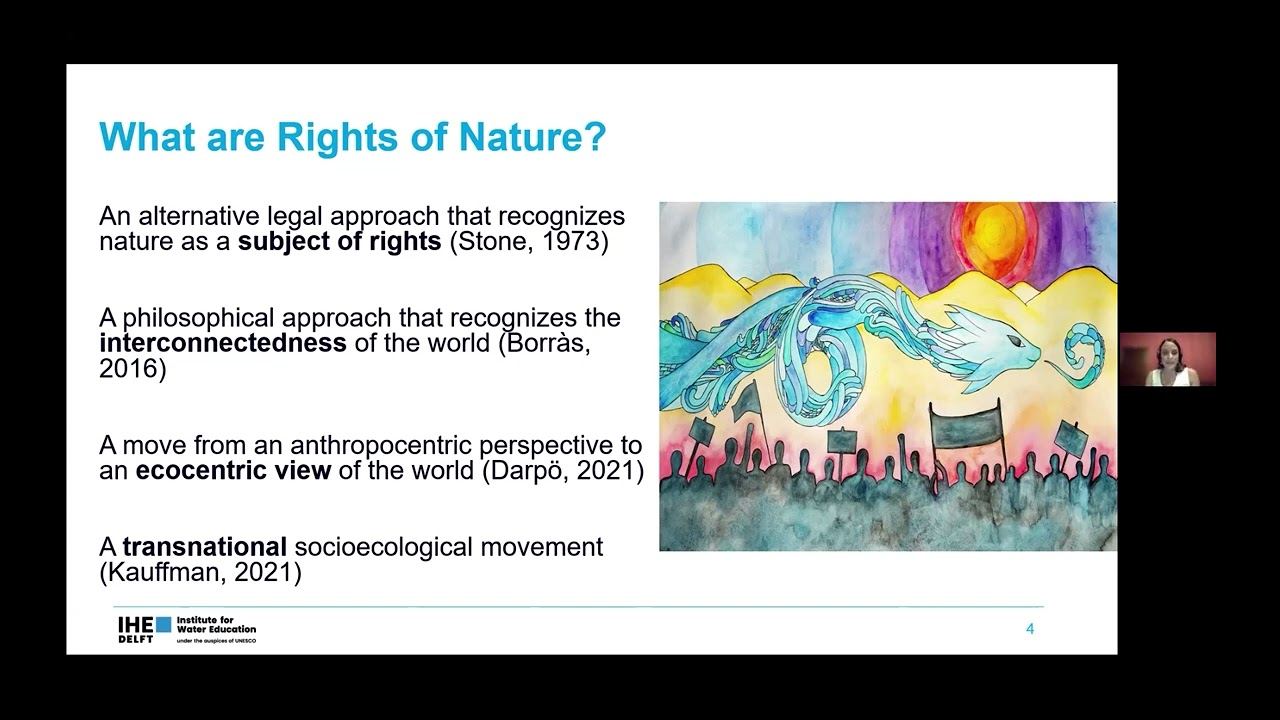
are looking and exploring. So one of the
definition of rights of nature is that
is an alternative legal approach that
recognizes nature as a subject of
rights. So that is coming from stone
from 1973 that is one of the most
prominent let's say legalist scholars
who has written on the topic of rights
of nature. Then we also have from other
fields of knowledge. So we have for
philosophical approach that they say
that rights of nature is a way of
recognizing the interconnectedness of
the world. So that we humans are
completely interconnected with nature.
So with rivers, with the air, with the
oceans. So if we are damaging rivers or
we are damaging nature, we are also
damaging ourself. Right? So that's why
we also need to have a relationship with
nature in a very very different way that
what we have been doing let's say
historically again from a more western
point of view. Then for many others is
also a move from an anthropocentric
perspective to a more echocentric view
of the world. Right? So again to say
instead of putting us humans in the
center of the of the of the universe try
to say okay the universe is very complex
and we humans are just part of that and
everything else is as important as as
and the one of the the other views that
I wanted to to discuss or present here
is Calfman 2021 that for him when we
talk about rise of nature. We are also
talking about a transnational
socological movement that here we
include the work not only from
researchers or legal scholars like in
the other ones but it's more about the
communities about organized movements
about people artists
women indigenous communities all that
convening together as a transnational
social ecological movement that are
pushing for different ways to again
engage with with nature.
So now if we look at
again coming back to rights of nature
from a more legal perspective and how
this movement as I say is growing and
growing. This is just a research that I
did with a student and and some
colleagues where we try to trace okay
where are where these rights of na
nature have emerged. So we try to map
and if you can see here we have many
different countries like everywhere in
the world. So we see in the Americas, we
see in Europe, we see in Asia, we see in
Africa, in Australia, more and more
countries are recognizing this new
paradigm, new legal paradigm of rights
of nature. So that was the first
question that we had. Okay, who is well
first what or where where are these na
these rights of nature being created?
That was the first question. Then the
second one is like okay how are they
being created. So then we went to
different
countries that we trace and we wanted to
understand okay how are they being
created in all these different
countries. So we found that the first or
the most prominent way of creating
rights of nature was by local
legislation. That's the primary means of
formalizing rights of nature. Then we
found that the second one was through
case law or court decisions where again
here is a very important to mention the
what I mentioned before the
transnational movement that is pushing
for this. So a lot of organized
communities have gone to different
courts in different parts of the world
and they have said we want the
recognition of nature as living beings.
So that was the second one that we found
through court decision. Then the third
one was through national laws. So in
some countries they have also done this.
And the last one that we found was by
constitutional reforms. Right? So in the
constitutional reform one of the
prominent case is the case of Ecuador
that I will mention when we go to the
cases.
But that was a very and here is a photo
of the constitution of Ecuador where
they were recognizing and I will tell
you a little bit of the story how they
got they got there.
So then the next question that we had is
okay why are so many countries creating
them? why they are becoming so popular.
And then we realized that in many
different cases it was just
people trying different things
because there is well something that all
of you know there is a current
deterioration of nature that is just
being very very problematic and that
where the legal systems that we have in
place haven't been able to address these
problems right so I try to also
illustrate there with some photos. So
all of these environmental problems that
we have
many people in different ways expressing
in different shapes or forms they have
said okay maybe rights of nature can
help us to re-engage with the
environmental disasters and we will try
to use this this approach. So here again
I I bring the sociological movement to
the discussion because in so many cases
I mentioned the the core cases was
pushed for them but also at the local
level the the different
local ordinances or at the national
level the the national laws that have
been also very much pushed by these
socological movements right to say in
governments or to private companies or
to many others that they need to
re-engage with nature in different ways
and in the end it's about rethinking the
role of people and nature on planet
earth. Right? So that is why of the many
reasons that we found that many
different countries around the world are
engaging with with these rights of
nature. So the next question that we
asked of course what okay is this a
possibility for rethinking environmental
law and governance. And then we started
thinking okay how this new approach of
rights of nature is different to what we
have because of course in so many or in
some places not maybe not many but in
some places when we were doing this
research and try to understand why
people are trying to develop and use and
push for rights of nature we found that
people were saying okay if we all if we
already have good and sound
environmental law we don't need this but
And we started also seeing that even
though we have a lot of environmental
law first the environmental law is not
working properly but also we started
analyzing
how environmental law was created and is
very very different that the idea let's
say of the origins of rights of nature.
So environmental law just to start it
was always very human- centric and then
it was created within this progrowth
movement and this idea already of
private property ideas and always
embedded in a capitalist modes of
economic and social organization. Right?
So from that the we can say the
backgrounds of both are very very
different. So that we realize that that
matters. So environmental law just to
briefly mention emerged in 1970s as the
poor causing I will call it of the very
wellestablished private law right and
natural resources management law that
again it was how we see nature and
nature elements like river or forest as
something that we can manage that we can
govern that we can cut and we can put in
the market and and sell it. That was
let's say the main an environmental law
was a little bit to regulate okay let's
not cut too much so let's cut a little
bit less or let's not pollute too much
let's put caps to pollution but it was a
very very different logic right so in
the end we concluded that yeah there is
the need for a new legal approach to
relate with nature and again rights of
nature presents this possibility
So then we started engaging more okay
what is rights of nature. So we wanted
to understand at least four key question
who and what has rights? So what rights
does it have? How can these rights be
enforced be implemented?
And then so far what has been the impact
right because that was another let's say
criticism that we found along the way
when we started doing this that they say
well this is very nice it's a nice
academic exercise or intellectual
exercise but they have had zero impact.
So we wanted to see if that was the case
or not or if there are yeah there more
nuances to to the answer of this
question.
So basically what we found that is like
rights of nature again is a new paradigm
and a new again coming from a western
point of view a western legal system. So
in in this photo what I want to
illustrate is you know we have like a
tree. So we can say that the the base of
of the tree is that yes legal rights of
nature represent this new legal status
of nature in western law but there are
different branches different ways of
understanding this right so in some
places we have rights of nature
recognized in the in the entire
jurisdiction so everything we will see
in the case of Ecuador right so we have
the the entire
jurisdiction recognizing rights of
nature. Then we have rights of nature to
ecosystem more broadly. So to all rivers
or to
yeah more broadly and then we have
rights of nature to a particular
ecosystem. So that will be a cases where
they wanted to protect a specific river.
For example, we will see it in in the
case of
Colombia, the Atrata River that it was
to give particular rights of nature to a
particular ecosystem. And then the the
more let's say common one that we found
is the particular
to a particular ecosystem and a
particular right that it was the right
of legal personhood. Right? So with
legal personhood what I mean is that the
the nature element the river or the
mountain will have legal personhood like
the same rights that I have as a as a
human being. Right?
And then there were different ways to to
do that. Right? So this again is the
four main ones that we have found so
far. So in some cases we have as a
living being or entity. So that is a
little bit more broad. Maybe there are
not a specific rights attached but it's
just saying okay they are living beings
so we need to respect them and we need
to take care of that. Then we have a
judicial person. So that means let's say
putting it in the same category as a
private company. I don't know let's
think about Coca-Cola. A Coca-Cola has
judicial is a judicial person. So they
wanted to have something like that or
subject of rights but they don't know
they don't say in the law what rights so
those rights need to be defined it and
then they have laws or bylaws where they
define that. And the last one is what I
mentioned the legal personhood that that
is just having all the rights as a human
being has for example or including also
that the river could sue somebody
because somebody is polluting it. And of
course then that also raised question
okay maybe if the river
h floods the community around along the
river so then the community can sue the
river. So of course that is also some of
the discussions that we are still trying
to find some answers to.
So now in the rest of the time that I
have I want to briefly discuss these
four examples that I mentioned. So the
first was is Ecuador where I have also
worked with some colleagues there with
some lawyers and some indigenous
communities to try to understand what
happened in in Ecuador. So Ecuador was
the the first country in the world to
recognize legally rights of nature and
they did it through as I mentioned
before the a new constitution that they
created in 2008. So that was the first
legal instrument worldwide that
recognized rights of nature. And there
is let's say it is well known that all
these paths to the new constitution was
pushed by indigenous movement activists,
artists and so on support also from
international networks. So that's why
they they managed to do that. And of
course there was also a very good
political moment that it was happening
in Ecuador when they was having a a
leftwing
uh president. So they started to to
support that and then in the end they
managed to pass this new constitution.
However, while I was working with these
indigenous
communities from Ecuador, they were
saying and mentioning once and again
that rights of nature were not their
primary concern. They actually were more
concerned about collective rights and
autonomy
more than this idea of of rights of
nature. Right? So for example, land
rights was one of the primary concerns
that they have and that was not really
resolved in the in the constitution.
And then another thing that we found
that even though it was super important
to have this in Ecuador as the first
yeah legal instrument worldwide to
recognize rights of nature, there were a
lot of contradictions because at the
same time they were saying okay we have
rights of nature and we are going to
engage with this. They were also
continue with the way that Ecuador deals
with natural resources or nature or
rivers or with the same language as
again not nature but natural resources
and also with the same idea of
extractives activities extractivism. So
there was let's say a a very clear
tension there between what they were
doing as I said as country that works a
lot in with destructivist
activities like mining or oil and these
ideas coming from indigenous ontologies
and epistemologist that is more about
bobbed inside. So those were some of the
interesting thing that on one hand it
was very positive but on the other hand
they were also showing some some
important tensions and there what it
says in in Ecuador here on article 71
you can see they have the the the word
of nature of Patchamama that it has the
legal right to exist.
So its existence should be fully
respected and the maintenance and
regeneration of its life cycles. And
then they also granted to all person it
doesn't say citizens or anything. It
says all persons can call upon public
authorities to enforce the rights of
nature. So again this is just one of the
let's say examples that I wanted to
briefly mention. Then another very
interesting example is the case of New
Zealand. I had the opportunity to to to
be there in New Zealand when I was doing
my my PhD and in New Zealand uh a lot of
interesting things were were happening
and some of the the communities
were saying that for them they have two
laws that they have passed recognizing
rights of of nature. they have had for
more than 150 years of a struggles to
pass this law. So they were saying since
the the colonization of New Zealand
these people the Maui people the
indigenous people of New Zealand they
have been trying to push to have their
world visions again their ontologies and
epistemologies somehow
incorporated in legal system. So it was
until 20 2014 that it was the first law
that passed the two ura act that
recognized the rainforest the the ura
rainforest as the first legal ecosystem
in New Zealand to have legal personhood.
And few years after that they did the
same thing with now recognizing as a
legal personhood the Wang Ganui River.
and not just the legal personhood but I
also brought the idea that the river for
them is indivisible and it's a living
hole. So when I was there and I had the
chance to talk to some of the indigenous
aboriginal they call it in Australia and
New Zealand aboriginals they were saying
that for them and this is a direct quote
from one of the leaders there. They're
saying we are not just talking about the
physical dislocations or the destruction
that they were doing with the forest or
the pollution of the river but also a
spiritual emotional and intellectual
disconnection. Livelihood, language,
cuisine, poetry, music, dance, dreams,
names, everything about being to that is
the their their
ethnicity springs from the forest. So
for them everything that they were
destroying with the forest it was not
just the physical destruction of the
forest it was everything else right and
and the interesting thing
in my opinion in the case of New Zealand
is that when they passed the law they
not also passed the law but they also
managed to establish certain
legal instruments more than the law like
plans and strategic
erh yeah strategic plans and strategic
ordinances and so on. So all these legal
frameworks could really incorporate and
try to embed all these
yeah different ways that the Mori the
indigenous people of New Zealand see in
their customs and their practices and
they managed to move this to mobilize
this to the law. Right? So another
important thing was that implementation
of these acts were also supported by the
allocation of funds. So there were also
a public apology from the crown from the
from the let's say yeah white western
government that they were saying okay we
are also apologized for all the wrongs
that we did in the past and then they
also allocated important amount of money
so they could start working on these
plans and these different strategies and
they also created different
decentralized decision makings with
different roles and different
responsibilities. So they could actually
involve many of the mauies in decision
making. Right? So they created a
interesting figure that is called the
guardians of the of the river the
Wanganu River. So these guardians are
now also responsible for the yeah for
everything that needs to be done within
the the river. And as they say for us
the most important is to care for the
river. caring about the river. So they
are there to to do this.
Then I would like to move now to the
case of of Colombia and Colombia was
also a a nice way because it was a
different so I have talked about the
constitutional reform. I have talked
about laws that they have been you know
in the making for many many years and
now in the case of Colombia was through
a
constitutional decision. So many
different communities, indigenous
communities but also AfroColian people
came together and they were very
concerned and very worried about what
was happening with the Atrat River. So
they took the case to the constitutional
court in Colombia. And interesting
enough, when I was also having the
opportunity to talk to different judges
in in Colombia from the constitutional
court, they explained that the
communities were actually not asking for
the figure of the rights of nature in
this case. They were just actually
asking for protection, for stop the
pollution, for
really try to yeah protect and conserve
and manage in different ways in better
ways the the the Atra River and try to
stop all the differentist
activities that they were happening
along the the river. However, the
constitutional court in their
discussions and as I said this is
through interviews that I have done with
with some of the judges there they were
saying that inspired by the case of New
Zealand that it was just a few few years
before that they thought okay why don't
we try to engage with this idea of
rights of nature giving legal personhood
and maybe that will help to have a
better relationship with the river. We
can try to help the river to yeah to
protect the river and to conserve the
river. Right. And in doing all that the
constitutional court also found support
in the ontologies and epistemologist
from indigenous and Afrooian Colombian
people. So again, this is this is a very
interesting case in the sense that even
though that was not something that it
was requested by the plaintiffs in this
specific process, the judges inspired by
what was going on around this topic,
they decided to do that. And here is a
quote from one of the judges, Achilles
Arieta, that he said, "The court
intended to bring justice and protection
to the Atrata River while recognizing
the culturally important connection that
the river has with the people living
along the river." Right? So that's how a
little bit how how things went. And I
mentioned before the the the
figure of the guardians. So they also
copy the figure of of what they did in
New Zealand of the Guardians and try to
implement it in Colombia. Of course the
context is different, the situation is
different. So I will have to say that
some of the things that we found in New
Zealand that they have been working,
let's say to some extent in a good way
in Colombia was was much more
challenging, much more difficult, right?
And then I would like to have to the the
last case move to the last case. And
this one is a also very interesting case
in the sense that it was the first case
in Europe that it was granted the the
were recognized as a subject of rights.
So that was the case of Marmen Lagoon in
Morsium
and that happened in well in 2022.
However, then there was a lot of
discussion and then it went to the
constitutional court. Some people said
no, this is unconstitutional
and in the end the constitutional court
resolved like many years after that.
That was in 2024.
Finally they say no we are going to
recognize the marmenor as yeah that is a
subject of rights and we are going also
to grant the legal personhood to the
lagoon. And it was interesting because
in reading what the what the
constitutional court was saying they
said that because some people were
saying okay this is unconstitutional
because and that is also related to in
the three other cases that I presented
they were let's say well particularly in
Ecuador and in New Zealand they were
indigenous communities and they were
activists and there was a social
movement behind that already familiar
with the idea of rights of nature and
they were pushing for that. Right? In
the case of Spain, they don't have this
and they have never had this and there
is no really um direct connection or
learning or understanding of what this
idea of rights of nature is. So some
people were saying, okay, this is
unconstitutional and this is not what we
want to do and this is not something
this is an idea that it was used in
other places and we want to just put it
and it just won't work. However, the and
in the end the judges say that even
though it's true that they didn't have
any of this, it was a way to reframe
environmental protection as a dynamic
constitutional value and situates
personhood within the framework of
ecological constitutionalism. So in the
end it was constitutional and they could
do it. However, that was the case and
they said okay we are going to to have
this. However, it is still very
contested because in the end what they
try to do is again borrow or copy these
ideas of rights of nature that in the
culture and in the daytoday experience
of people in in Morsia in Spain they
just they just didn't have right. So it
was also trying to yeah copy a cosmo
vision that they didn't have. So in the
end they were really struggling okay
what is this this doesn't make sense for
us and they really
engage let's say the communities the
people with this with this idea. So this
whole structure has faced legitimacy
concerns and also the way that they
created the let's say the structure for
the attrator river it was very confusing
and they had a lot of overlapping
institutions that they already existed
and they created new ones with the same
roles. So there were there was also a
lot of confusion here and there's a lot
of people saying that of course that
will undermine the effectiveness of
whatever they wanted to achieve with
this with this law. So in that one I
also we have managed to to publish with
one of my PhD students and he was
actually found that he's also from Spain
and he was yeah doing trying to
understand why people
supported that and then we realized that
a lot of people really didn't have clear
what was the idea of rice of nature. So
the importance of really trying to
understand when you use a concept borrow
from other places to really try to
explain it what it is where is it coming
from and what do we want to achieve with
this right because then if not we will
have problems to try to implement it in
a place where it's completely different.
So in in summary like context matters.
So that's why in Spain even though again
it is constitutional but there is a lot
of problems with the implementation of
of that law and the idea of rights of
nature.
So now I would like to as I said have
these last 15 minutes to hear from
questions and answer but maybe the the
last thing that I would like to say is
that in the end with this and that's how
I frame it rights of nature um
reflections on possibilities because I
think rights of nature can help us to
have more democratic and inclusive
societies but also make law more
democratic inclusive and sustainable
right in the way that we can include and
learn
different worldviews and knowledge
system. However, as I said, the
indigenous communities are very diverse
and they are very complex and just
copying an idea and putting it is very
tricky is very complex. So we really
need to understand more and study more
what exactly do we want to borrow and
how can we borrow borrow and how can we
really use it for
improve or rethink or re-engage with our
western legal system. Right? So and also
some of the cases brought to the courts
has advanced legal knowledge connecting
the idea of rights of nature with
indigenous social and cultural rights.
So we thought that is also encouraging
and there is some hope there to improve
and move towards more yeah the social um
inclusive societies and this is a big
question but we hope that that is the
case that these new laws with the ideas
or the insights or the yeah reflections
of rights of nature can support a new
governance environment mental and water
governance paradigm.
Thank you very much.
>> Well, thank you very much Gabriela for
your dissertation on this important
topic and uh now we are going to start
with the questions. So please you are
welcome to write the questions in the
chat. And the first comment was from Joy
Theman that uh she says that through
UNESCO there is a forum called
intangible cultural heritage
NGO forum and they prepare a document
which may be interesting for the group
and she shared that and I would like to
ask to Gabriella if you would like to
comment on that.
>> Yeah. I don't know. I would like just to
say thank you. I I know the document and
yeah, I think is is there's as I said
there's so many things going on at the
moment around this topic from different
people and different points of view. So
it's yeah it's very interesting to keep
reading and keep learning and that's
what I again mentioned this and at the
beginning of the presentation and frame
the presentation as this you know like
the reflections on possibilities because
I think there's a lot of things that we
can do with this and yes thank you for
sharing that and I think we need to yeah
read more and try to
yeah see if with all these we can really
improve not just our legal system but
actually engage in different ways or
learn to engage in different ways with
nature right the way that we use nature
the way that we conserve nature the way
that we protect nature so I think that
is in the end what this is all about
right engage in that in that process
>> thank you Gabriella Anthony Yagman from
Nigeria. He says, "We are working
towards the establishment of the African
River rights civil society action
network.
The aim is uh to create a crossborder
coalition of civil society dedicated to
securing legal personhood and
fundamental rights for Africa's river
system. We want to ensure their
ecological health and protect the
communities that rely on them. The
objectives legal advocacy. We aim to
push for the adoption of the universal
declaration of river rights within the
national and regional legal frameworks
throughout Africa. Capacity building. We
will empower local civil society
organizations and indigenous guardians
with the legal tools they need to
advocate
for rivers interests in courts and
policy discussions. Knowledge sharing.
Our plan includes establishing a
centralized hub for research on river
health, climate impacts and successful
legal precedent presidents and such as
the river Ethiop rights act regional
integration. We want to encourage
collaboration among SCOs
in various repairarian estates to manage
transboundary river basins with a share
rightsbased vision. Thank you Anthony.
The mic is yours Gabriella.
>> Yeah well that that was more a comment
right? I yeah
it was more a comment. I don't know if
you want to comment on that.
Yeah. No, if you want maybe we can give
the floor to to to the person. I think
it's also nice to see other faces and
hear other voices. So, if you want to
explain a little bit where is what what
is this coming from or tell us a little
bit more and I can react on
>> on whatever the the person says.
>> Thank you very much. Can you hear me?
Can you hear me?
Yes. So, thank you very much for the
presentation. In fact, I find it very uh
interesting and we've been um following
this movement of the rights to nature to
enhance a um comprehensive conservation
and respect for nature, you know, taking
nature as a person, you know, and that's
why I I I I ke to to participate in this
webinar. So we've been trying to drive
this uh the African continent generally
and uh we've come up with this uh
concept or a proposal uh which if I have
your email I can also share with you. So
we are seeking collaboration and
partnership you know support to see how
we can further um drive and advocate for
these uh rights of nature and
particularly rights of rivers on the
African continent. So I will be
interested in collaborating and working
with you and others to promote this more
in Africa. Thank you very much. Yeah,
thank you very much for the comment and
yes, I will put the my email on the chat
box because yeah, anybody that wants to
and as I said this is an ongoing process
and we have been working with many
different people in New Zealand, in
Australia, in Ecuador, in Colombia, now
also in Ireland, in Spain through this
brilliant PhD that I have. And all this
is again a people trying to see okay how
can we push from different ways from
academia but also from legal practice
but also from social movement from
artists to try to engage in different
ways with the way that we position
ourselves in nature but also the way
that we treat nature. Right? And also
having these values that nature is not
something that again we can just control
and
govern and cut in pieces and put in the
market and sell but is much more than
that right is having and and I'm not
claiming that I feel like okay the river
is my ancestor is my mother or my sister
but really trying to see that it's also
a living being and if I polluted it the
river suffers And if the river is
suffering and is polluted, I will also
get sick because I'm drinking the water
of the river. So trying just to have a
more yeah relational
understanding of how we are yeah
connected and
maybe with that we can move towards yeah
different ways of development and
different ways of dealing and governing.
Thank you.
Thank you Gabriella and Anthony always
active and I have a question of Aean
Bashir.
Okay. How can right of nature develops
in a business model and generate
profits? What are the profits add to the
nature?
Yeah, I I think that question is complex
in the sense that
the idea is to have a different entry
point from nature, right? So the idea
that the first thing nature equal profit
that's what exactly we want to change
right the idea of rights of nature and
that's what I tried to explain how this
even though in the western world is very
new concept and we are all excited about
this and we are trying to make sense of
this it has been practiced for millennia
for many from many different indigenous
communities where profit was not the
main questions that they were having
right there were other question like
harmony and relationship and
I don't know health of
respect. Exactly. So yeah, maybe we need
to I don't know re address or
think about a different ways of asking
that question and again where profit is
not the entry point but it's something
more important than than profit right
because yeah we can have a lot of profit
but in the end if we don't have rivers
what are you going to do with the money
right if you don't have water to drink
there's very little that you can do with
money. So I think yeah again it's a
different way of
a a different entry point.
Thank you very much Gabriella. And yes
sometimes in many countries people are
so
yeah devastated when they realize that
there are a lot of people that do not
understand the concept of nature and
that they can do whatever. Yesterday,
for example, there was in a newspaper of
Argentina that in a priesting zone,
well, there was a very well educated
person with a pickup getting into a
place that it was forbidden and he was
well informed that it was forbidden
everywhere. He didn't care. And now the
damage will be there for hundred years.
And people feel really yeah devastated
with this type of scene. And one of the
question could be how we can help to
start to to to have another mentality in
the common of the person. So nature is
respect it.
Do you have some comment for that? How
we can help from our little space to do
that?
It's a question for you Gabriela. How we
can help? Yeah, that is I think that
that is the question right that we want
to to address and I think
one of the answers that I can give you
is that with this paradigm we can at
least allow ourself to think differently
and again with the question that it was
before and the prophet so let's try to
think at something that is not that
let's try to think about in the example
that you gave right of course that
person should have done that, right? I I
think everybody should know that that
why are you going to do something that's
silly as that that can cause so much
damage
and the only answer that I have is you
do that because you don't care, right?
So, we need to start rethinking our
relationship with nature and start being
or stop sorry being so arrogant and
think okay we are at the center of the
universe. We are everything is for us
and it's not we are sharing the planet
we are sharing planet earth with other
species with with many other living
beings and we need to to find in our
minds and our brains and our hearts I
don't know a more humble position there
and say okay we need to indeed become
part of of that and not thinking that
everything that is there is for us and
for us to make profits and you know in
the end buy things that probably we
don't need and just to create more
garbage and there's more problem and you
know questioning our consumption
patterns I think is very important too
so I think that's what this approach of
rights of nature give us I write a
different entry point of how to position
ourself our existence and that's what I
talk about the ontologies of indigenous
communities how do we understand who we
are and where we are located in these
you know planets on planet earth and and
how can we be a little bit more humble
we are part of it Francisco Periso thank
you Gabriela s your present for your
presentation and he said that as we
already discussed for me the most
valuable aspect of right of nature is
the capacity to refrain our relation
with nature in western legal system.
However, is important to acknowledge
where these ideas and movements come
from because without that is really
difficulties
to implement. Would you like to comment
Gabriella?
Well, Francisco is the PhD that I was
mentioning before. So maybe he can
explain a little bit more his comment
and contribute to the discussion because
I'm sure I know Francisco has a lot of
things to to say about this topic. So
Francisco, please share your thoughts
with us.
Are you still around Francisco?
Otherwise I go to the other question and
you take the boys after. And Moses says
indeed rights of nature are continually
getting more global recognition.
However, elite capture is becoming an
inherent challenge. Powerful individuals
within communities end up taking
advantage of the marginalized indigenous
resources users for their own selfish
benefit. How can it be addressed under
that legal
I got lost?
I got lost.
Yes, Gabriella. I
>> Yes. No, I think I I totally agree with
with that comment and I think that is
unfortunately not only happening with
Rise of Nature that happens with
absolutely everything. We have
almost all the time some powerful
individuals that they want to capture
the not just the discussions and the
discourses but also the benefits that we
can get from this. So I agree that that
is happening that that is a problem but
again I think there are different ways
that we can that we can address that. So
in trying to answer your question how
can it be addressed under the legal
personhood framework I think with that
what we can really try to do and again I
would like to go back to the example
that I gave from from New Zealand. So in
now these legal frameworks that they
have for legal personhood for the Wang
Ganui River they have a very let's say
people from their communities very
important leaders now having a say
having their voice their authority their
expertise the indigenous the yeah the mi
worldview put there and they are really
trying to make sense of that and the law
is backing them up. So they are really
trying to yeah address some of the
problems from there. So I think the the
legal frameworks can if you create
spaces for having these people that they
should be there and not others, right?
So we can try again to get inspired by
what happened in in in
New Zealand and the figure under the
figure of the guardians of the river try
to put these people and not others to
take advantage of of that.
Thank you very much Gabriella. I don't
know if Francisco Oh, he's traveling so
he has a bad connection. Thank you very
much Francisco. So I will have to say
thank you to Gabriella for this really
important conversation and presentation
that we had had today. Thanks to all the
attendees that will receive the video of
Gabriella in the in the coming days and
please do not hesitate to share it as
with [snorts] all the people that you
think that is interesting in this topic
and not interested in this topic too.
Hoping to welcome you in another online
alumni online seminar. The next one will
be on the 3 September and it will be
announced in the coming days. Thank you
very much and I hope all of you have
enjoyed this session of today. See you
next time. Thank you everyone.
>> Thank you. Thank you everyone for
joining. Bye.
>> Bye.