Video summary
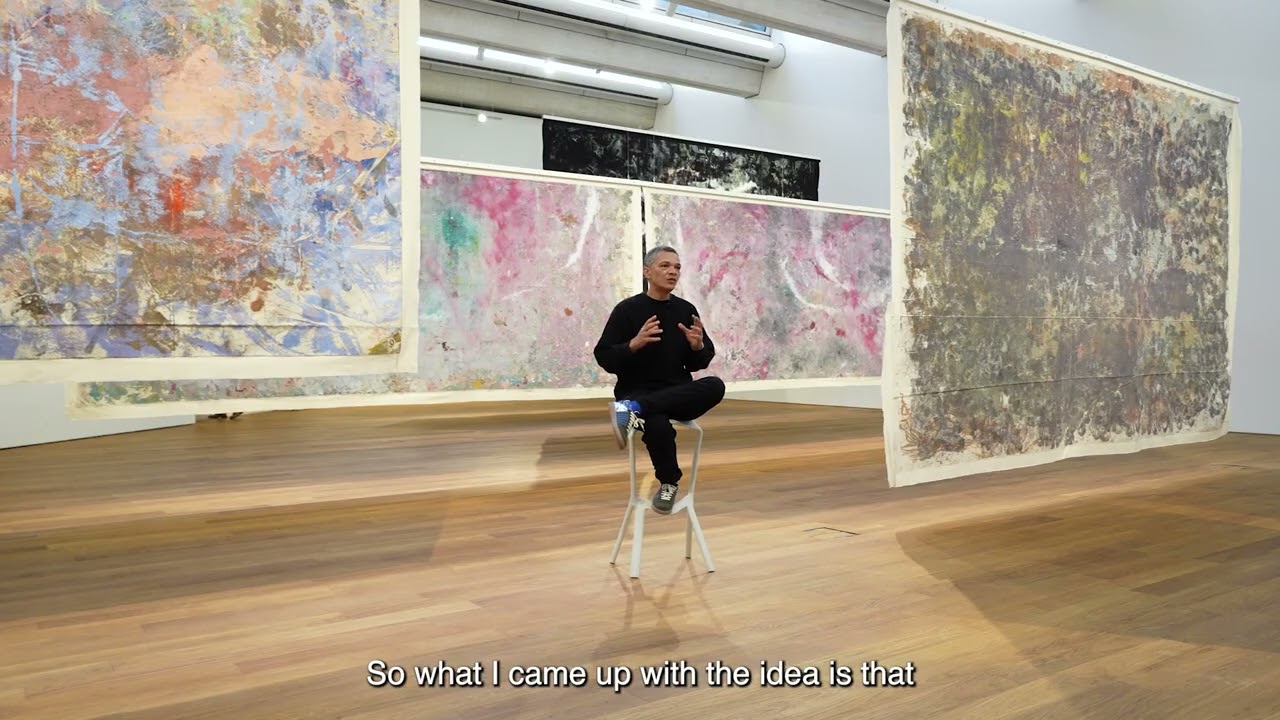
In the exhibition 'Between Then and Now' at Mudam Luxembourg, artist Igshaan Adams presents an extensive timeline documenting the evolution of his weaving practice through a curated archive he describes as "failures." The display traces his journey from early experiments using simple rope to weave across a loom in basic planes, progressing into complex techniques developed through persistent experimentation. This visual history is laid out within the museum's corridor and features unique pieces known for the first time as dance prints, marking a significant milestone where Adams integrates movement directly into his textile work. By utilizing performance-based installations, he allows his body to express subconscious needs and release experiences held physically, effectively translating bodily language into tangible woven forms that bridge the gap between internal emotional states and external artistic output.
A central theme of the exhibition is the artist's exploration of how one can use an external domestic or public environment to gain access to their inner world, a concept deeply rooted in his personal history growing up in Cape Town under apartheid-era racial tensions. Adams addresses the lingering social divisions that lead him to feel profiled and reflects on how society often fills information gaps based solely on skin color and dress rather than engaging with individuals directly. He posits that these darker experiences were instrumental in discovering lighter, joyful aspects of life, arguing that without confronting such hardship, he might never have accessed his own capacity for joy, love, and care. The work serves as a testament to transforming painful memories into sources of light, demonstrating how adversity can ultimately foster the ability to spread positivity and empathy to others.
To counteract the intimidating nature of the museum's grand architecture, Adams intentionally designed an interactive experience that invites visitors, including himself, to touch, lift, and engage physically with his woven installations. This approach aims to dismantle barriers between the audience and the art by transforming a potentially daunting space into one of shared connection and tactile exploration. By encouraging direct physical contact with the pieces, he expands on his earlier ideas about movement and presence, making the exhibition more inclusive and accessible. Ultimately, this strategy not only humanizes the artwork but also fosters a communal environment where visitors can collectively bridge social divides through simple acts of engagement and mutual understanding within the beautiful yet challenging setting of the museum corridor.
Read the full video transcript
I wanted desperately to show the process
of how my weaving practice has evolved
over time. So, I've been digging into my
own archive, what I call my archive of
failures.
>> [music]
>> Here, we were able to really lay out a
timeline of that evolution of the
weaving. Where [music] it started simply
by using rope and you and weaving in a
very simple plane from one side of the
the the loom to the other. And over
time, through experimentation,
I was able to incorporate new materials
and nearly stumble upon my own
techniques of weaving. And so, the title
refers to this timeline of the evolution
of the weaving that we've laid out
within the corridor of the museum.
>> [music]
>> This is the first time ever that I've
shown these what we call dance prints.
And
I think even if I focus on an external
domestic environment, the point was
always to use the external space in
order to gain access to my internal
world. Because this is the space that I
felt like I needed to fix. I needed to
restructure so that it serves me better
as an individual. So, what I came up
with the idea is that I wanted to use
movement because I believe movement is
the language of the body. And I thought
maybe through movement if I set up a
performance in a way
>> [music]
>> that and give my body the opportunity to
express and say what it needs to say
with the intention of then releasing or
letting go because I think my body is
holding on to things that I'm not always
conscious of. And those experiences that
remains within the physical body.
>> [music]
>> What I was trying to point towards with
this show titled Vierhout, loosely
translates to withheld, was the
information that is not at hand. I think
in my personal experience,
unfortunately, having grown up in Cape
Town, of course, we have all of this
kind of racial tension that still exists
between the different categories of race
that was created during the apartheid
government. And unfortunately, I get the
brunt of this
>> [music]
>> because I get profiled. And I always
wonder how I do the same to others. I
think if I look at you and I look at how
you dress, the color of your skin, I
feel my own mind
insists that it knows things about you,
that it assumes things about you, that
it fills in those gaps in of the
information that is not at hand, that
has been withheld. How these darker
experiences of my earlier life has
really helped me to find
the the lighter parts, the joyful parts
of life, you know, I I feel like without
those
darker experience, I would never have
been introduced to my own joy, my own
light, my own ability to love and to
care and to spread a bit of that.
>> [music]
>> I think the work also just invites
people to touch the work, including
myself, you know, and what was nice in
this exhibition,
>> [music]
>> we've been able to really expand on this
idea and make it a little bit more
important. Um that the the whole
corridor then
>> [music]
>> uh people are able to engage with and
touch and lift up the work. This very
intimidating space, it's such an
incredible, beautiful building. And I
think this is a really simple way of
[music] um
bridging that that that barrier.
>> [music]
>> Mhm.