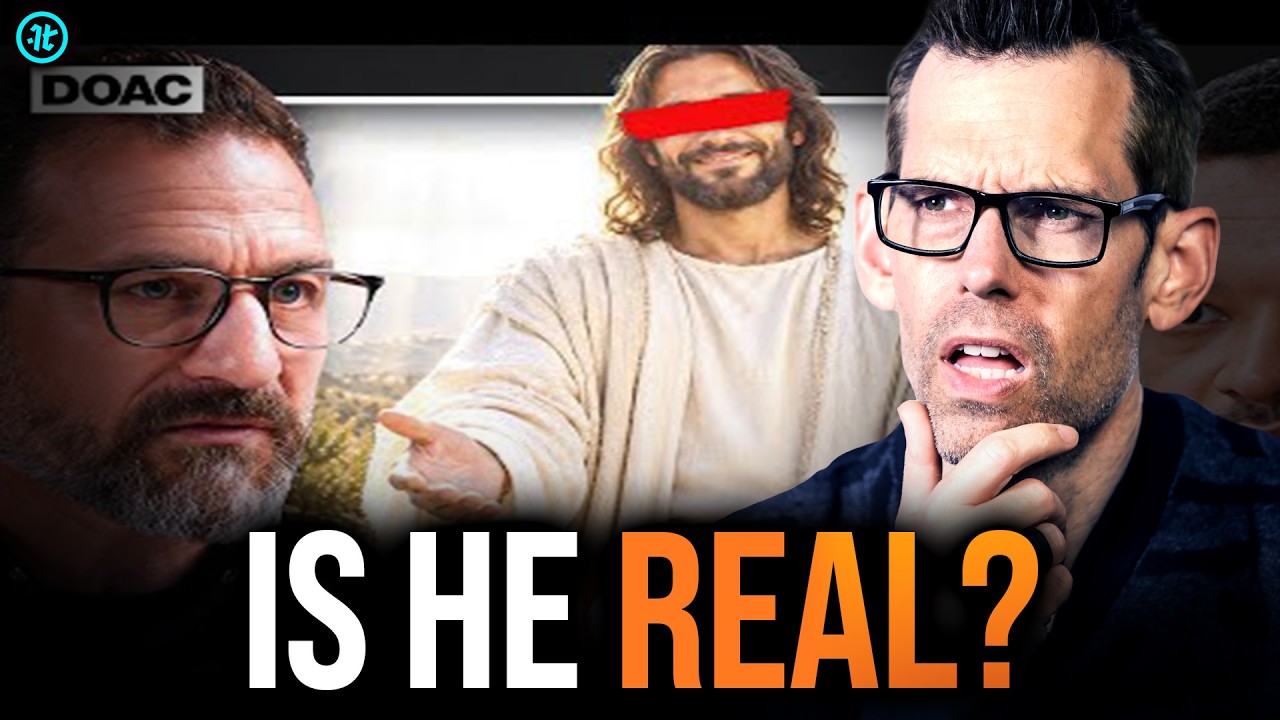
Video summary
The video explores the tension between viewing life through a strictly biological lens and recognizing the profound role of faith, arguing that while neurochemistry and physics accurately describe our physical existence, ignoring higher powers leads to a diminished perspective. The speaker uses personal experiences with psychedelics like DMT to illustrate that even when reality seems altered, these events remain biological processes within the brain; interpreting them as proof of transcending biology is logically flawed. This biological limitation often causes emotions and subjective truths to be mistaken for objective facts, which can result in poor decision-making in critical areas such as politics and economics. Consequently, the speaker suggests that while we operate under deterministic laws, humans possess the unique agency to choose their "frame of reference," deciding whether to view the universe as friendly or hostile, a choice that significantly impacts one's quality of life and inner peace.
Religion is examined evolutionarily as a mechanism that facilitated social cooperation, where early humans filled a "god-shaped hole" by interpreting natural forces to create shared values and stable societies. Although feelings of awe have evolutionary utility, the speaker warns against divorcing these experiences from their biological roots, which can lead to rigid dogmas found in ancient texts. Furthermore, the concept of miracles is redefined not as violations of physical laws but as chemical or biological processes that science has yet to fully understand. The discussion extends to the nature of free will, using sexual attraction as an example to show that conscious thought alone cannot override biological predispositions; changing such deep-seated traits requires a biological process of reinforcement and neural rewiring, particularly during early development.
The narrative also addresses the inherent biases within human biology, noting that our subconscious mind constructs an internal simulation of reality based on sensory input, often connecting unrelated stimuli to solve problems or interpret events. This construction can be mistaken for objective truth, a phenomenon the speaker suggests is increasingly being weaponized in modern times, yet understanding this allows individuals to control their interpretations and choose beneficial paths. Biology predisposes humans to appreciate beauty but also to horrific traits like dehumanizing out-groups, highlighting the complexity of our nature. When addressing the debate between a Grand Designer and natural evolution, the speaker rejects the notion of an all-knowing God by pointing to biological inefficiencies, such as the pain and danger of childbirth, which would not exist if a perfect designer were involved.
Ultimately, the video concludes that belief in God influences biology itself, serving as a critical factor for life outcomes rather than merely providing material benefits. The speaker cautions against fundamentalist ideologies that impose religious views on others while emphasizing that the existence of God cannot be proven mathematically. Instead, the focus shifts to how individuals can consciously decide to embrace faith or a higher power to improve their peace and decision-making capabilities. By understanding that we are reactive beings who construct our reality through biological filters, people can navigate the world with greater awareness, choosing paths that align with their values rather than being blindly driven by unexamined instincts or dogmatic constraints.
Read the full video transcript
What is the right frame of reference
that you should have if you want to live
your life well? Uh is God real? What
does it mean the way that life brings us
these miracles, these surprises? Uh what
does it mean to all of us? And if you
fail to understand that, you will live
your life in a lost perspective. And I
feel that a lot of people look at the
things that life serve them and they
have a very confused response. And so
we're going to take a look at this one.
I uh I had a pretty strong reaction.
took DMT in a far away land where it was
very legal because you know I sit here
and talk about these things and
psychedelics and I actually did work in
a psychedelics company for about a year
but it was deeply deeply fascinating and
I the reason I was compelled by it is
the efficacy as it relates to mental
health and the studies being done out of
London around things like you know
psilocybin and I gain and DMT treatments
and I just thought wow you know it's
unbelievable some of the clinical data
I'd love to learn more so I did a
psilocybin and then I did DMT and it was
really Just
>> I've not done DMT.
>> You've never done DMT?
>> No. No. I've I've done um clinical um
MDMA and psilocybin. I think I'm done
with that. Not because I had a negative
experience, but I got what I wanted out
of it.
>> Right. Everybody needs to be uh very
cautious with taking any substance that
alters your mind. First of all, what I
find is people take said substance with
total disregard for what it might be
doing to your brain. But let's just say
for a second that it's perfectly safe
from a health perspective. people get to
the point where they're not able to
replicate the insights and the arguably
the most important part of this is they
somehow believe that they have
transcended their biology. So you're
doing a thing that is that is
interrupting changing your biology and
the interpretation of that is actually
there's a realm beyond my biology. That
to me is the weirdest interpretation of
this. Now I understand everybody's going
to say it's because I have not done
this. I've micro dosed psilocybin so
fair enough. I've never done a macro
dose and it is entirely possible that on
the other side of this I somehow have an
experience that is so profound that I
too become convinced that I've
transcended my biology but I seriously
doubt it from a cause and effect
perspective what you're doing is
manipulating your neurochemistry. So I
don't know why people manipulate their
neurochemistry only to come out the
other side and say neurochemistry
doesn't matter. It's super wild to me.
>> Tom, would you ever do psychedelics? DMT
mushrooms. Have you? What's your drug
use?
>> I would consider it. I've resisted it up
to this point because you're doing
something extreme to your brain and I do
have certain fears. But yeah, I could
see I think it's probably more likely
that I do it at some point than I don't.
Um but I'm not rushing out to do it.
>> And when I say like psychedelics, I'm
talking like heroic doses. You
>> because I've already done um micro
dosing.
>> Got it. U DMT is extreme. What you do
not psyched
>> DMT is probably the one that I would be
the most likely to do because it's so
shortlived. Yeah. cuz it's like 15
minutes.
>> Um, so yeah, my bigger thing would be
being stuck in some trip that is not fun
for 9 hours. I know somebody that did
either LSD or acid. I don't know if
those are one and the same, but they
they did one of those, dude. He felt for
like a week. He said, "Life doesn't feel
real." And he was like, "If I feel like
this forever," he's like, "This is a
real problem." Now, thankfully, it wore
off. But I remember thinking, "Yo,
that's scary." And so he was like it
altered something so profoundly and he
was like for the first 72 hours there
was no declination. And so he's like if
I feel like this forever man this is
he's like I'm 100% nihilistic now. This
is just nothing matters. Nothing is
real.
>> And I was like yo that that is not
something I want to play with. And given
that you can people can have psychotic
breaks if they're on you know like in
risk of it at risk of it from like too
much marijuana. So, I'm just like the
thing that we consider like ultra safe
safe um can do that. I was like
something that people are like listen
profound useful in a lot of
circumstances but don't treat it like
candy because it can you know have some
really negative consequences. I'm pretty
hesitant to just run out and do it.
>> Got you. Ter McKenna always said like
set and setting are important. How you
take it and where you take it is the
matter.
>> You know why?
>> Why?
>> Because you're having a biological
experience and if the neurochemistry you
have pumping, you're already in a bad
mood. you're already feeling negative.
It's not like the drugs just completely
wash that away. It can be the context
that informs that instead of a good
trip, this is a bad trip. Which is why
people started mixing MDMA, which is s
it it just pumps the feel-good chemistry
that it meant you were more likely to
have a positive trip. So if I did it, I
would probably also do something like
that to just
>> bias it towards something positive.
typically good
>> be going in therapy during and therapy
coming out of of combination MDMAs
psilocybin.
>> Do you know what it it's one of the
things that made me think a lot about
religion?
>> Mhm.
>> Was having a DMT experience where what I
experienced felt indistinguishable from
this reality in terms of the vividness
and the the realness of it and me just
pondering this this concept that a tiny
little inhale of smoke could completely
change my material reality. So therefore
I concluded that my material reality is
is literally but I mean tell me if my
logic's wrong is a small amount of
chemicals.
>> Yes. Literally your entire reality is a
small amount of it's not just chemicals
but it's neurochemical electrical
combination. Your biology it's the wet
works that exist between all of our mind
all of our ears. So if you think about
the um reality of what's going on inside
of your brain you live in the matrix.
Whether you live in the matrix simply
because the brain exists and it is
creating a representation of the world
out there. It is not seeing accurately
what is out there. Remember we only see
0.0035%
of the entire electromagnetic spectrum.
So we are living life by a bunch of
shortcuts known as uristics. We're using
algorithmic approaches to the world. We
are not interfacing with the world as it
is. And this is one of the things that I
think really messes people up. the the
thing that I want on my tombstone.
Literally, if I'm gonna offer the world
any idea or help popularize any idea, it
is you are having a biological
experience. And when people start trying
to divorce themselves from that, they
make their life entirely impossible to
navigate. And this is one of the biggest
problems that I see people having is for
instance in a populous moment, what
people end up doing is they mistake
their emotions, which are merely the
neurochemical firings in their brain.
They mistake it for a representation of
truth. I feel badly about this thing.
Therefore, it must be bad. There's
nothing you can say to convince me
because I feel a type of way. And so,
why would I even listen to this? It's
obviously bad. I feel bad. It destroys
relationships. It destroys people's
ability to think through a political
problem. It destroys people's ability to
think through economic problems. $5,000
check feels good today. It must be good.
and instead of thinking through the
rational cause and effect of what's
actually happening, they forget that
they're having a biological experience.
This is going to rub people the wrong
way. This is not a spiritual thing. This
is a biological thing. Now, it doesn't
mean that there isn't some elevated um
realizations that we can have. It is
utterly fascinating to me that we all
have the need to kneel before something
that religion obviously plays an
evolutionary role. Those things are
utterly fascinating. when you look at
them through the lens of biology, it is
far more profound, far more miraculous
than when you try to divorce yourself
from it and say what DMT showed me is
that uh there's actually a plane beyond
this. That's where I think people start
breaking down in terms of their
worldview is nonsensical quite literally
>> being uninterrupted. Does that does that
make logical sense?
>> Yeah. So I I think about this way too
much. I guess we are going to talk about
psychedelics, reality and religion. Um
couple short statements about this.
you're I fascinated by this, so I'd love
to hear you talk more about it. But here
are a couple ways that I think about it
in a non um dismissive way.
Most all of biology is just
compartmentalized chemistry. So whether
or not it's the flow of electricity
along neural circuits to generate
tenacity for instance or learning,
you're just guiding chemistry in
particular ways. Okay, that's not a way
to trivialize it. It's kind of a way to
think about it. Now, there's a lot that
gets lost in that you're guiding because
the reality is that your mind influences
itself. This was a big part of what my
whole mindset uh era was about was
getting people to understand that you
can dramatically influence the way that
you feel by the thoughts that you think.
And so, making sure that you're taking
control of that process, not letting it
just happen to you, that you're actually
making a very conscious decision. Uh the
way that I say it is I can't stop myself
from having the first thought that's
just going to come. But what I can do is
stop what I repeat. And so taking
conscious control of your psychology is
critically important.
>> There are two ways that you can change
brain function, behavior, and chemistry.
One is mechanical.
I can breathe differently. I can get a
massage. Right?
>> By the way, taking control of your
breath is one of the most um
life-changing things that you can do.
Learning to breathe from your diaphragm
is utterly fascinating. This is what I
think a huge portion of the benefit that
people get from meditation is simply
learning to breathe from your diaphragm.
as um Huberman is intimating there. What
you're doing is it's a mechanical
process that has like um stimulatory
effects in the body that over the long
periods of time of evolution have been
designed to allow us to uh reduce our
excited state to move out of the
sympathetic nervous system fight and
flight to the parasympathetic nervous
system where it's rest and digest. You
can mechanically move yourself from one
to the other simply by breathing from
your diaphragm, interrupting negative
thoughts, and just breathing. It's it is
utterly fascinating. And when you learn
how to do it, if you're anything like
me, you will end up thanking evolution,
the universe, whatever, for creating
that hook that you can leverage just by
breathing from down low in your belly by
by uh drawing the air into your lungs
using your diaphragm instead of
breathing high up in your chest. It has
a neurochemical effect. It is utterly
fascinating.
>> I could poke myself with a knife. Okay,
so there are mechanical forces that
change our physiology and then there are
chemical forces, pharmarmacology, things
we eat and chemicals within us,
serotonin, etc. That's really it.
There's no other thing in many ways.
You're absolutely
>> preach brother. Preach. There's no other
thing. Your life is impacted by what you
eat, how you sleep, how you're
breathing, your exercise. Um,
get those things wrong and your entire
life goes off the rails. get them right
and everything gets better.
>> Absolutely right. It's compartmentalized
chemistry and mechanics and other
chemicals are what control that
chemistry. And
I think organizing one's thoughts
sometimes in that way can be helpful
because you realize the stress response
is really just a bunch of chemicals
happening in certain places and so on. I
personally am intrigued about the idea
of things outside of our conscious
understanding in biology that maybe
things like DMT give us access to or
maybe just prayer gives us access to or
faith gives us access to. And it comes
from my recognition both as a
neuroscientist and just a human who's
been alive for 50 years and some change
that our biology and psychology, let's
mold those together, are
extraordinarily good at accomplishing
certain things.
But there are certain things that are
outside the abilities of our psychology
and biology. And if we are asking our
psychology and biology to satisfy
something that our psychology and
biology simply cannot satisfy, we're
going to miss out on a lot of potential
meaning. Okay. So, what I think he's
getting to here is one, he's making a
cognitive error, and he's seeing this as
something that's outside of our biology
and psychology, which quite literally
nothing exists outside of your biology
and psychology. uh not for you in terms
of being able to experience the world.
But there is I think an evolutionary um
answer to a question of how you get
humans to cooperate in large groups
flexibly. And that answer is what we
call religion. Um and that has placed
inside of us this tremendous reward for
communing with that thing that we see
that's beyond ourselves. So the people
that did that who could share that sense
of awe that could connect over I mean in
the early days obviously it was not a
monotheistic god it was you know things
around you the sun the moon the changing
of the seasons the hunt whatever and so
you have this entire pantheon of gods
this it just felt like there's got to be
some force that's causing these things
to act and I mean in some ways there is
it's basically physics but as you try as
you experience physics you experience it
as these individ idual relationships. I
have a relationship to water. I have a
relationship to the sun. I have a
relationship to the crops or to the
animals. And so all of that then feels
like, oh, these are individual forces
because you don't understand chemistry
yet. You don't understand physics. And
so, um, that from an evolutionary
standpoint, the people that had that big
response and shared that response and
started doing things like, "No, there's
a right time to go on a hunt because
that's when the god of the hunt wants us
to go on that." Or, um, love is an
important thing. there's a God of love
that's trying to drive us together and
so it's worth like overcoming the
difficulties that come from that and
those created more stable societies and
so we're literally selecting for people
that are able to bond over that to
transmit values using that proxy and we
all now in a monotheistic world we all
look back at people that believed in you
know the pantheon of gods the pagans and
we think aaha how ridiculous that all is
not realizing It's the same evolutionary
mechanism that makes us interpret the
world through this shortcut which is I
know there's something bigger than me
because I can feel it. Now I will say I
know there's something bigger than me
because I don't understand physics. And
so at a minimum, physics, the universe,
whatever you want to call it, there is a
process that was put in place that it
works in a way that when you learn it,
you actually unlock powers of the
universe and you could do things that
you couldn't do before. So it it is a
very real thing. Now,
when people hold that frame, I think
that they're less likely to get
themselves in trouble than when they
take the shortcut and they take a
religious frame because then eventually
somebody writes it down in a book and
then people start saying, "Well, you can
only do this this way because that's
what God said." And when that book was
written a couple thousand years ago and
just offhand happens to mention slavery
and it's all good, no worries. You start
getting or stone somebody to death or
whatever, uh, it starts to derange a
little bit and so we start running into
problems. We'll get right back to the
show in a second, but right now I want
to tell you about a $6 million
government problem. The Department of
Defense needs soldiers to perform at
their cognitive peak, even under extreme
conditions. Sleep deprivation, high
stress, life or death decisions. They
needed a solution that wasn't stimulants
because stimulants create a crash, also
can be very jittery. So, they funded a
$6 million research contract to find
something better. What they found was
ketones. That research became Ketone IQ
and now anyone [music] can use it. Your
brain runs on ketones more efficiently
than anything else. They cross the
bloodb brain barrier and fuel your
neurons directly. It's not caffeine.
There's no sugar and so there's no
crash. I take half a shot before
interviews to stay sharp and locked in
longer. Go to ketone.com/impact
for 30% off your subscription order or
visit your local Target to get your
first shot free. That's
ketone.com/impact.
We'll get right back to the show in a
second, but first let's talk about what
it means to actually be visible in
today's day and age. When you build
something public, whether it's a
business or an audience, anything on
social media, you become a target. This
is something that legitimately keeps me
up at night because our data isn't just
on the obvious broker sites. It's on old
news portals, public forums, obscure
directories, places you would never
think to look. That's where Incogn's
exposure scanner comes in. It hunts down
your personal information across the
wider web, not just the 420 plus broker
sites Incogn already removes your data
from automatically. They can't harm you
if they can't find [music] you. Go to
incogn.com/impact
and use code impact for 60% [music]
off an annual plan. Try it risk-f free
for 30 days. That's incogni.comimpact
and use code impact. All right, now
let's get back to the show. But if you
come back to wait a second, there is
this thing that allows me to access a
druglike quality, a sense of awe and
wonder, but I realize what it's coming
from. And so there are things that I
need to align myself with in order to
experience that. Whether that's being
calm, whether that's doing something
like um a a loving meditation where
you're imagining like a a bubble of love
and acceptance expanding out from you to
your family, to your friends, and then
to everybody in the world. And and that
really gives you this sense of expansion
and calm and peace and joy. Hey, love
it. But understanding it's a
physiological process that you're
putting yourself through to tap into
something that is evolutionarily gifted
to you. I for one am somebody who likes
to know how the magic is done. When I
see how the magic is done, it's more
interesting to me, not less. I get that
for a lot of people that they're going
to hate the way that I approach this.
But I think it saves us from certain
derangements that we are captured in
right now. Thinking that there really is
this thing beyond you and that these
emotions are essentially being given to
you as a source of truth or something
from an all powerful being outside of
yourself is how we end up in a populous
moment going, we need revolution.
>> I really want to get to how do you
explain miracles? things that aren't in
the physiological, things that aren't in
the biological, things that defy
science. There aren't any.
>> There's never been a miracle in life.
>> Never once.
>> Really?
>> Never ever,
>> man. Okay, that's a
mind shock to me. Okay, cool.
>> The only quote unquote miracle is why is
there something instead of nothing?
>> That's it. Everything else is a law of
physics we don't yet understand.
>> Why is there something instead of
nothing?
>> Yes, that question is truly perplexing
and is the thing that reminds me I do
not understand what this is. And so, um,
if Jesus like walled up in the room and
was like, "Bro, you know that there's
something you don't understand and
miracle, miracle right before your
eyes," I'd be like, "Oh [ __ ] crazy."
>> Um, now that would obviously have to
like be the most extreme thing cuz my
first assumption would be, "Oh, I'm
schizophrenic."
>> But
>> yeah,
>> assuming you could somehow get me on the
other side of that. Um, but these like
one-off cases of like people dying,
coming back, cancer disappearing, all
those things, they're just secret
medicine that people don't realize.
Biolog bio biology we don't understand.
That is correct.
>> Chemistry that hasn't been explained
yet. There's always something that comes
out. Nothing has ever happened outside
the physical that I can't outside of.
That is correct. Well, that you can't
see, measure, test. Many things happen
that you can't see, measure, or test.
But I'm saying in the fullness of time,
you'll be able to assuming that we
continue to grow more intelligent, get
better tools. Yes. What I'm saying is
life operate. Life is deterministic.
>> It operates on a set of principles.
Nothing ever violates those principles.
Now, there are things we don't
understand about those principles and
they act in some pretty crazy ways that
we just don't get.
>> Um, but yes, there are no such thing as
miracles.
>> Oh, in life. And what I to be very
direct about it like at the point where
I decide to really embrace the idea of
faith of a god, right? That there are
powers outside of human understanding.
>> Yes, that is true.
>> That can be very useful.
>> Everything got better.
>> But just to be clear, there's a
difference between outside of human
understanding and outside the laws of
physics.
>> It it relieved me of the pressure to
control everything internally and
externally. And I find it not just
intriguing but absolutely
captivating that
a force outside of us, some people call
it God, the universe, right? Some people
might think it's Jesus. Some people
might think it's something else. Might
actually hold some power in how we could
potentially behave, be better, be
Wouldn't it be wonderful if there's this
thing planted in us or some of us, which
is a question about things outside of us
that if we were to embrace
could allow us to get to a better place
as a species? Why would we think that a
a technology like AI would do that? AI
is wonderful, but why would we think
that it would come from computers?
That's of
>> Okay, so I love Andrew Huberman more
than you can know Andrew. You know, I
love you. This is the wacky thing that
you say in all of this. Why do we think
that it could come from a computer? Let
me give you the answer. Because this is
somebody overindexing again on the
artificial and not the intelligence
side. The reality is once you get to the
intelligence side and you can actually
just start understanding what the laws
of the universe actually are, not our
shortcuts, not our it's roughly
something like but like actually
understand then the intelligence is the
very thing that allows us to begin to
develop a better understanding of this.
Now ultimately the understanding of it
is only useful in as much as it makes
the experience of it better and more
interesting. So, at the end of the day,
you're having a biological experience.
So, you're going to go on an emotional
roller coaster. If as we understand the
laws of the universe, it simply allows
us to kill each other, that would be
wholly uninteresting. If it opens us up
to a deeper sense of awe, a deeper sense
of connection, um, if it helps us
navigate some of the trickinesses of the
world, um, then that would be awesome.
But here's where I think people start
really disconnecting. Okay,
the world is very very complicated and
some of the discrepancies that we have
with people are not going to be solved
by somebody waking up to oh the world
doesn't work the way that I thought it
did. The discrepancies for instance when
they're theological I find that that's
an easier conflict to talk about. So if
people believe in different gods they
believe in different oughts. So they
believe from a moral standpoint that
things ought to be and they believe that
they believe diametrically opposed
things. So they're not arguing about
what is. They're just saying what ought
to be. They say, "I understand your
position. I understand you believe it
ought to be that way, but this is my
position and I believe it ought to be
this way." Understanding the fundamental
physics of the world is not going to
help people out of that scenario. The
only thing that will help people out of
that scenario is if you can change the
fundamental way that that feels for them
as they think about it. Now, some of
this is just where they were raised. So,
they're going to if they're prone to an
increased level of religiosity,
um, and they're raised in a
fundamentalist household, you put that
together and it's, you know, sort of
weaponsgrade religion, if you will. And
when two weapons religion people see
different things, they're going to end
up colliding. So the only way that those
two people are not going to collide is
if you go in and edit their genome such
that they are less likely. They're less
prone to the religious. So no matter
what, because if we all have a
god-shaped hole in our heart and that
person is prone to religiosity, they
don't have to believe in a god. They can
believe in communism and Marxism,
whatever. And you see people get just as
fundamentally religious about that. Or
it can be climate science. They get
fundamentally religious about that. or
the economy. They can get fundamentally
religious about that. But you have to
diffuse that tendency towards
religiosity.
It isn't about like, oh, I finally
understand something from outside
myself. You're having a biological
experience. That new understanding is
still going to be interpreted through
the way that you as a biological
creature process that information. And
it's going to drive you to behave in
certain ways. And this is, I think, a
fallacy that people make of like, no,
no, no. If you just understood, you
would respond differently. This is where
I'll say, go and find a spider sexually
attractive. You're not going to be able
to do it. And you're not going to be
able to do it because you're trapped
inside your biology and you are
hardwired to find them repulsive. So,
it just is what it is. And what I think
he's getting at here is he is a person
that has a very expansive sort of loving
welcoming personality. And if other
people felt what he feels when he kneels
before this thing or encounters this
sense of awe or recognizes that there's
something bigger than himself. If
everyone felt what he feels, the world
would be a better place. That is almost
certainly true. But the question is, how
do you actually get everybody to feel
that? You don't. Unfortunately, what
evolution has learned is you can't have
everybody be the same. You need these
competing different personalities that
hold each other in dynamic tension that
unfortunately sometimes explode into
cataclysmic violence.
>> There's going to be one person that
[ __ ] spiders. That's going to blow up
your whole assession. Because listen,
it's an actual thing. It's paraphilia.
[laughter]
>> Okay. So, it's just going to be somebody
that like, I love spiders, Tom. What do
you mean? Free will exist.
>> No, no, no. If you said to me, "Hey,
Tom, I have an 11-year-old and you've
got to get them to only be able to have
an orgasm when spiders are crawling on
their legs," that we could do. But if
you bring me a 40-year-old who right now
hates spiders, I'm not going to be able
to get you to the other side where
they're suddenly like, "Oh my god, like
this is the hottest thing ever. I only
want to marry a spider." So, uh, and
look, will there be exceptions at the
edge? Probably. But then that would be
that, um, human sexuality is more
complex than I'm giving it credit for.
It is not free will. So, that's where I
just want to make sure to to give you an
idea. What I would do with a 14-year-old
is begin to associate neuronal
connections between sexual arousal and
introduce the spider. So, I'm doing a
biological act. The same thing with the
40-year-old. What I'm saying is somebody
can't just go, I'm now going to decide
to find the spider attractive. What they
would have to do is walk down a
biological process of reinforcement and
then you're just proving my point.
>> But I feel like women decide they want
to be lesbians. I've seen people change
sexuality and stuff later on in life. So
nobody wants to be
>> true now
>> sexual to a spider. So that's why I'm
like you you can use that existence but
that's a 0.1% of people who even want to
do that.
>> I will happily go down that path if you
want. What I'm saying is that is not
stepping outside of biology. There is an
evolutionary reason. It's a hypothesis.
I don't think anybody would say it's a
thesis, but there's a biological
hypothesis about why women are more
likely to be um bisexual than men. And
if you think about it, um women are far
more um tied to um communal needs. So
they've got to like group up as women,
raise the kids. Uh so they um are not
interacting with the world through a
physical dominance lens. They uh express
their dominance, their aggression, their
violence through um social means. Okay?
So you've got a creature then that's got
to be able to have these ways to self
soothe. Don't think about humans for a
second. Think about um us coming up, you
know, over millions of years of
evolution. The fact that the the
clitoris is on the outside is utterly
fascinating because the only way to get
them pregnant is to penetrate them as
deeply as possible to be up against the
cervix, which is why men have the
evolutionary impulse to thrust as deeply
as possible at the moment of orgasm.
Okay, so you've got I need to make this
thing have a baby. And then there's the
weird twist of but the clitoris is on
the outside. Why on earth would we do
that? And one hypothesis is that women
can actually smooth over social
frustrations with other women by um
accessing the clitoris and soothing each
other in either a sexual or sort of
pseudosexual way. And you see this in
the animal kingdom.
>> So it from that perspective, the fact
that a woman would be like there are no
men left in the village. They all just
got killed in war, but I need somebody
to help me raise this kid. Thank god my
clitoris is on the outside. I don't need
a penis. I can group up with another
woman. We can have a more deep
connection. We can have the sexual
bonding and raise this kid together. And
so it would make sense for a woman to
just have a deeper degree of flexibility
in the first place. And then on top of
that, that it could express later in
life in the way that for a man it's
typically by the time he's 14, his
sexual fetishes are on lock. And so, and
this is where I expect this debate to
kind of rage. I think people are going
to find that even male sexuality is
malleable to some degree, but it's
really an early life phenomenon thing.
So it does matter sort of what way you
nudge your kid uh in early age. Debate,
debate, debate. That is not me saying
this is true and I know it to be. I'm
just saying I'd be a little surprised if
they don't find that to be true. So, but
it does appear that male sexual um
proclivities get locked in around the
age of 14. So they're then going to
carry that into adulthood and they won't
show flexibility as an adult that they
didn't have uh at the time they were 14.
So if at 14 they're like, "Hey, I feel
bisexual." That's probably going to
carry with them their whole life. But if
at 14 they're, you know, pegged over
onto the straight spectrum, that's
probably where they're going to be
forever in a way that women might find
themselves surprised to actually, no, I
do find that women attract. Anyway, that
was a real [ __ ] tangent. But, uh,
>> I got I got there because you said we
can't change what we're sexually
attracted to. I immediately went, well,
people want to be sexually attracted to
other people.
>> Clear clear clear on what I'm saying.
You aren't going to be able to exit
biology to change what you're attracted
to. If you're going to make a change of
any kind, you going to have to do it
through a biological process. I'm saying
you can't use quote unquote free will to
just suddenly be attracted to spiders.
It won't work. You'd have to like go
down this super loopy process of trying
to like reinforce reinforce reinforce
hijack certain biological processes in
order to get there.
>> Why do why is the male G-spot in the
butt then? What's the evolutionary
explanation for that? Um, I have a
feeling that that is probably rightly
contested as being a G-spot. Uh, having
had a procal exam, I'm not like, "Yo,
this is dope." Um, so
>> was his hands not moisturized enough?
>> I mean, maybe that's part of it. Maybe
his hands were too big or too small. I
guess it's all possible.
>> Welcome to the news show, guys.
>> Yeah. [laughter]
So that I listen you can't rule it out
but I have uh so at one point I mean
this is way TMI but at one point I had a
prostate infection which you can
actually get which are not fun by the
way. Uh and so they have to like palpate
your prostate. It is not
>> what does palpate mean?
>> It's a touch. Uh and it it is not it was
not an enjoyable experience for me. Now,
that could be pure context and maybe in
the right context it'd be lovely, but
I've never found myself with that
impulse. So, I have a feeling that this
is probably Okay, so this gets into
something called lordosis. Um, so there
is God these are these are better
understood as hypotheses because I've
not looked far enough to know if there
are actual thesis but at one point I
read a study whether this was um really
studied well or not I I cannot say but
so women have um a it feels good for
them to arch their lower back. Now, the
reason that that would feel good is in a
in certain sexual positions, arching
your back gives the man the ability to
penetrate the deepest. And so, you would
understand why evolution would
essentially reward or hardwire women
that have the desire to arch their back.
The study said, again, whether this was
well researched or not, I I can't tell
you, but the study said that gay men
have the same um impulse to arch their
back, their lower back. So it could be
like cross-wiring that there's something
given that men pass through the female
before they become uh expressly male. So
at first you develop a vagina and a
clitoris and then it it develops into
the male genitalia uh which is how you
can get cross- sex people. So anyway, it
could just be like sort of crosswiring
with that that there's some sort of
remnant of that. I I have no idea
though. That one I haven't um explored
deeply enough, but my gut instinct is it
would be something like that. That one
it would be contested that most people
aren't going to be like, "Yeah, that's
my favorite thing." Um and that for the
people that are, it could be some
remnant of that, but I don't know,
right? Why would we think it would come
from anything that humans and only
humans could do? To me the embracing the
notion of a god and having faith which
by the way is about having doubt but
still doing the the things the practices
prayer is like to me one of the most
liberating and educating
thing not just about stuff of God in the
universe but about the human brain.
>> Okay. I've got some questions.
>> Yeah. I mean it's like we're not meant
to solve this on our own.
>> Do you believe in God?
>> Absolutely. When did God come into your
life?
>> I really want to know what God dust thou
believe in?
>> Very early, but I was very
good at suppressing the notion that it
was real. Like I would pray in private.
I would hide it and um and not just in
bad times. And then I think I lived
enough and observed enough hardship.
We've talked about some of this on a
previous podcast. I talk a little bit
about that in the book, but but I
observed it out there too, not just in
my own life that I I started to realize,
especially if you stick your hands in
enough brains and you see my good friend
Eddie Chang record from the brain of a
awake human and remove a tumor and save
that person's life. And you also realize
that brain areas are controlling things
cuz when they're stimulated, that person
feels and responds in a certain way. You
realize that we're not all meat and
potatoes in there. There's what? That is
literally a direct contradiction. He's
saying once you realize that the brain
is in control, once you realize you can
poke this and you get a given response,
once you realize that there is a tumor,
a bad thing growing in the head and you
remove it and that saves our life, that
you realize that it isn't all biology.
What uh those are literally exact
opposites. You don't think that there's
like because everything is so
deterministic and something is so real
said and something is so deliberate that
it couldn't just be accident or random
or spontaneous cuz accident random and
spontaneous usually doesn't create
systems as complex and as detailed as
what we see in the world today. the the
only argument that you could make is
that okay everything is good and proper
random like there's there is nothing but
randomness but in the randomness in this
local pocket of the multiverse um the
what we call the laws of physics are
simply random distribution and so this
is the most likely universe that we see
around us and so humans are most likely
to respond in this way if they have
brain matter that's structured that way
but they're actually not tied And it's
all correlation.
Okay. But that is like the least AAMS
razor thing I've ever seen in my life.
That is adding a layer of bizarre
complication to something that we have
no evidence for whatsoever. Um so yeah,
what we see is cause and effect as far
as the eye can see. And so to take from
that, oh, but really this could just be
even though I can directly predict that
if I remove somebody's brain, they die
instantly, that the brain wasn't
actually keeping them alive. It's like
that's super weird. Something
else, but I'm not sure that it all comes
from us. It's It's sort of hard to
explain. The the best way I kind of
wriggle out of this is that I I brought
my dad on my podcast. My dad and I for
many years had a choppy relationship. We
have a great relationship now. He's 83
years old. He's super vigorous. He loves
ideas. He's into quantum, you know,
quantum computing and he he's
theoretical physicist, right? And I
asked him to explain quantum mechanics.
I go, "Okay, like tell my audience how
relativity works." He worked on chaos
theory. Okay, tell us how chaos works.
And he said, I I'll do that. But you
have to understand that one of the most
important things about understanding
quantum mechanics is that early on you
are told and you learn that the human
brain can't wrap its head around quantum
mechanics with logic with the with human
understanding you have to rely on the
math. And he says anyone who talks about
the quantum field who can't show you the
math, can't show you the proofs, is
lying. He loves it when people are like,
"Oh, the quantum this and the quantum
that." It's often as in like the
meditative communities.
>> Agreed, man. It drives me nuts when
people say quantum as if it means
magical or it's some sort of proof.
That's wild.
>> Others too. And he goes, "People throw
this word around because very few people
actually understand quantum biology.
There's gaps in there's some logic, but
there's gaps in their logic that the
math doesn't line up with. And the math
doesn't lie." So what he was saying and
we were having a discussion about God
and he said yeah at some point if you're
going to have faith in a higher power
God you have to depart this notion that
your logical brain can go from A to B to
C and boom you're there I I will grant
him that there again why something
instead of nothing I cannot do a logical
track to that I cannot find any answer
that doesn't require some sort of like
just logic completely lets go and I just
have to accept that it is um so Yeah,
totally agree.
>> But in quantum mechanics, it's the same
thing. But on the basis of quantum
mechanics, you can build stuff. You can
engineer stuff in the real world like
that red light or a rocket.
>> Are you saying but you don't know all of
this?
>> There's no math to prove this thing that
I call my the existence of God. There's
no math and it's not worth torturing
yourself over.
>> The math either exists or it's not real.
So math is the computation of the
universe running itself. If you have
something sitting outside the universe,
which you almost certainly have to
because why something instead of
nothing, um then it's just a all bets
are off at that point. There's no way
for us to grapple or even interact with
what that thing is. We can only interact
with the um output of the system. What I
believe is worth torturing yourself over
and there's also great beauty in there
is embracing the practice of prayer,
embracing the questions and the like
opening the aperture of your beliefs
just for a moment going maybe I'm going
to just believe in God for 10 seconds.
>> See what that's like. And I started to
experience beauty and experience um
peace around not trying to control
things that obviously were not under my
control, not just within me, but in
other people.
>> All right, here's what I love. He's got
a he's changing his frame of reference.
And merely by changing his frame of
reference of deciding to believe in God,
it makes his life better. Now, there's
something incredibly important to take
away from that, which is how you decide
to look at the world is going to
determine the quality of your life.
Einstein is whether it's apocryphal or
not he's often quoted as saying um the
most important decision any person will
ever make is whether they live in a
friendly or a hostile universe. Now
what's brilliant about that is he's
saying it's a decision. You decide.
There's evidence for both. So you decide
whether this is a universe that's
working for you or a universe that's
working against you. So please don't
think that I'm saying that believing in
God may not make your life better. may
like may make your life materially
better. What I don't want people to lose
sight of is that ultimately that you
what you're doing is with that belief
you're having an influence on your
biology and ultimately the influence on
your biology is the part that matters so
that people can stop themselves from
getting swept away by fundamentalist
ideology which can take people into some
pretty dark directions that has to do
with broadcasting my religion onto other
people. And that's where I think we run
into real problems.
>> And I really started to see what I could
only describe as miracles. And by
miracles, I mean, I would pray for some
indication of what the right path might
be on something where it wasn't clear to
me. And then 2 or 3 days later,
something would happen which would like
seem almost completely unrelated and the
answer would come in that thing. All
these kinds of things are absolutely
true and wonderful and need nothing more
as an explanation other than that's how
the subconscious mind works. It is
processing things in the background. And
so when it sees something that triggers
that um cascade of thoughts and gives it
the thing to interact with that it needs
in order to um put the final piece
together of the puzzle. It feels like oh
my god this completely unrelated thing.
It was sent to me by God. But the
reality is what's happening in the
subconscious mind is we are a um action
reaction species. Something happens and
then we react to it. And that's why I
say we have no free will. There's no way
to extract yourself, extricate yourself
from that sequence of cause and effect.
And so um your brain often times needs
to see some sort of new stimulus in
order to come up with the answer. And
that's why talking about something can
be really helpful. Reading a book about
something can be really helpful. People
will often say that some of the greatest
solutions to problems come from
polymaths because they have multiple um
things to draw from. So in architecture,
you might draw from your art background.
Your art will draw from what you
understand about um architecture and
same with medicine, right? Artists also
being um learning so much from
dissecting a cadaavver. It's like you're
taking in these different disciplines
and they feed into each other. This
happened to me when I went from uh Quest
Nutrition into the world of comic books
because I could see that the
distribution method in comic books was
so ridiculous it was bound to fail. And
that's why I ended up getting out of
comics because I was like until you guys
solve the distribution problem, this
whole industry is just going to be a
mess. And um I wouldn't have known or
understood that had I not just come from
an industry that had extraordinary
advancements in distribution that were I
mean 50 years more advanced than what
was going on in comics. It was insane.
So having those different points of
interaction will feel like oh my god
I've been handed this thing from out of
nowhere. But it's really that's what
your brain does. It connects these
far-flung ideas. It's actually one of
the reasons that people like to meditate
is you get in a calm creative state
where literally you can map what's going
on in the brain. What's going on in the
brain is areas of the brain that don't
normally talk to each other start
talking to each other. So it's not a
silencing of activity in the brain. It's
actually an increase. It's pretty
fascinating. Just locked in. I'm like,
listen, I'm a disciplined guy when I
really want to be. I'm going to pray
every night before I go to sleep. If I
fall asleep, I'll get out of bed and
pray when I if I wake up in the middle
of the night. I've not missed a night in
nearly 3 years. I was recently invited
up to Stanford to give a talk with
Arthur Brooks who's a lifetime Catholic.
He's in mass every morning. You know, he
and I have very different experiences of
God and religion. My family was mixed
religion. I got to sit up there and just
say, "Listen, I'm going to tell you that
I for sure am the person who's least
knowledgeable, least versed in this
room. But what I can tell you is my
experience with prayer. What I can tell
you is what I've observed in myself when
I open the aperture for faith. The
reason I did that talk is because our
former director of neurosciences at
Stanford um had written to me and said,
"I think you should consider talking to
this group and he did some of the most
important experiments in the history of
neuroscience linking neuronal activity
to perception." You really show that if
you stimulate certain brain areas,
people perceive things a certain way
regardless of what's happening out in
>> So, you're saying that you're having a
biological experience?
>> The world.
>> Like, there's a brain area I could
trigger right now and I could show you a
movie of a bunch of dots moving up and
everyone here would be like, "They're
moving up." And if I tickled the right
neuron in your brain, you'd say,
"They're going down."
>> Like, that's wild. And I turn it off and
you say, "Oh, yeah, of course they're
going up." Your understanding of the
world is an abstraction
that occurs inside your skull on the
basis of photons that come in through
your eyes, sound waves that hit your
ears, mechanical forces that hit your
skin, and chemicals that go in your
nostrils and in your mouth. And then you
create, you abstract reality in here.
>> That is such a brilliant description of
exactly what's going on. When I'm
talking about you're having a biological
experience, this is what I'm trying to
convey. Once you understand that, then
you can begin to parse your reality a
little bit better because you understand
that this is an approximation that
you're constructing this world. And just
like in the matrix, it's very easy to
get lied to. It's very easy to see
something that isn't really there. This
is exactly what happens to people. And
I'm I'm going to wrap this up by saying
this. The reason that I wanted to go
through and show this is we are living
in a time right now where everybody is
convinced that that matrix, that
simulation that's going on inside their
brain is real. And they're mistaking a
simulation. They're mistaking
interpretation. They're mistaking frame
of reference for objective reality. And
it is being weaponized against them. And
people that understand that know how to
control that approximation, that
simulation that plays in their brain and
point them at something that benefits
that person. And all of us have a
responsibility to ourselves to be able
to get outside of that as much as
possible and actually see things for how
they really are, which is that I'm
interpreting the world. I'm not seeing
it directly. And if one interpretation
takes me to a better place, then it's
wise to lean on that interpretation
because it's actually going somewhere
more honorable that it's taking the
world in a better place if we head in
that direction. But if I think that
because I feel something, it is real and
I'm losing sight of what's actually
happening, which is I am trapped inside
of my biology. And my biology controls
not most of what I see, it controls all
of what I see. And even if you believe
that there is a God, God built it that
way for whatever reason. And so that is
the reality that we face and it has
upsides and it has downsides. The human
experience is incredibly beautiful and
incredibly tragic in equal measure. And
so understanding that we are prone to
beauty and we are prone to uh the
horrific and each of us as I say the
line between good and evil runs through
every human heart because such is the
nature of biology. It paints things like
in-group, outgroup. It makes you
prepared to be violent and to other
people that are in the out groupoup to
dehumanize them. All of those things are
in your biology. And unless we start
altering that biology, we have to deal
with the way that that really works. And
if we can do that, we've got a much
better shot of getting to the other side
of this populist moment. But if we don't
realize that and we don't start actively
broadcasting hope, seeing hope inside of
ourselves, saying this is where I want
to go and turning it into a plan. They
say that hope is not a plan. Yes, but
hope is necessary to get you up, to get
you to say, okay, cool. This is where I
want to go. Map out exactly how we're
going to get there and then get there
and hopefully not succumb to a lot of
the traps.
>> Got it. Cool.
>> All right, we have any super chats? Are
we good?
>> We've got one super chat left.
>> Let's hear it. Harmonious Reason says,
"Where do you sit in regards to Grand
Designer versus Natural Evolution?"
>> And that's $50 super chat.
>> Thank you for the $50 super chat.
>> Thank you.
>> Very generous. Uh grand design versus
what?
>> Natural evolution.
>> Oh. Uh well, so if grand design is like
basically God did this, so we're a
product of evolution. Yes. But we're a
product of a designer. I would say
there's no evidence for that. So either
God is a horrible engineer or um we are
just made by the blind watchmaker. And
if you want but one example, if we were
designed by God, the vagina would open
painlessly like a trunk door to let the
baby out rather than [ __ ] torture the
woman. It is uh ridiculous that that
thing has to like squeeze down to deal
with a penis that a man can't.
>> We're not supposed to be giving birth on
our backs. That was some creek dude in
the 20s that made that normal. If you
when women take have birth like
squatting and standing up, there's no
ripping. I
>> I don't think anybody No, if you stand
up like this is easy. I don't think
anybody's saying that. Given that child
birth is one of the most dangerous
things you could do from a historical
perspective, like that's pretty bad
engineering. Like, hey ladies, the only
way to push the uh survival of the
species forward is to have kids, but by
the way, I'm going to kill 50% of you
that do it. What? So, like, let me roll
up my sleeve, guys. I got this. I I
could do this better. I could do this
better. Come here. Give me
>> Here's the thing. I couldn't do it
better because there would be unintended
consequences that I would create. But if
there was really a all knowing God,
could an all- knowing god do better?
Yes, an all- knowing god can do better
than 50% mortality rate before uh modern
medicine.
>> Who's the guy from the Odyssey? Uh
what's his name? Uh the main character
from the Odyssey.
>> Odysius.
>> Odysius. That was real Odysius. Odysius
of you. No, I just said the [laughter]
humility because I'm saying I don't I
don't think I can do it. I'm saying an
all knowing
>> you messed this up, bro. Go do it over.
Do it over. Start over.
>> I'm saying he doesn't exist.
>> I need uh trunk keys on vaginas. I need
to be on the inside. I need men not to
check my a-hole just to make sure I
don't have cancer. I have notes. God,
>> it it Well, so [laughter] one, if we
could make the anal checking far more
enjoyable, that would be lovely. Uh as
that unfortunately becomes [laughter] a
thing. Drew has not accurately
represented my beliefs. I would just
like the record to reflect here. Uh, but
yeah, this stuff is important. It
matters, boys and girls. So, make sure
you're thinking through it well. If you
like this conversation, check out this
episode to learn more. Let's find out
what young people think about AI and
whether it's going to kill us all.
>> The next topic was one almost everybody
worried about, including Bernie.
>> There are now robots working in
restaurant.