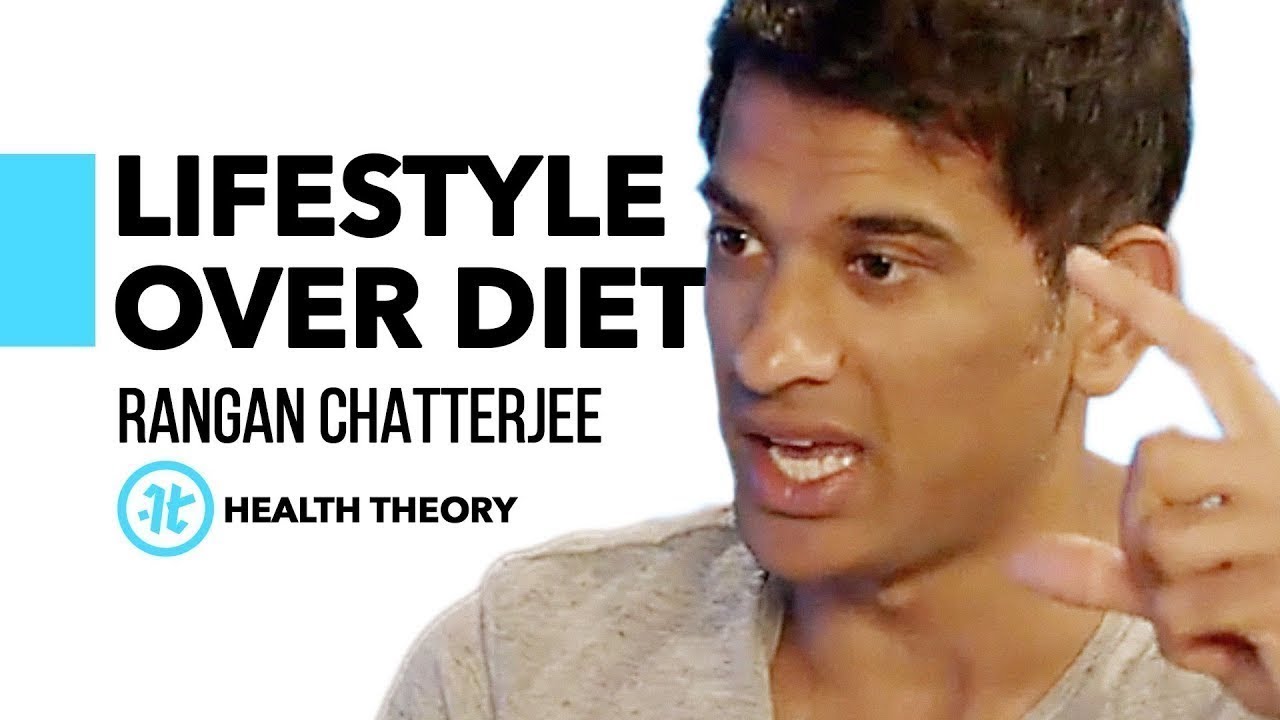
If You Feel STRESSED & STUCK In Life, WATCH THIS! | Dr. Rangan Chatterjee
Watch on YouTubeVideo summary
Dr. Rangan Chatterjee, a physician and television presenter known for his BBC show *Doctor in the House*, argues that modern medicine has become overly reliant on treating acute symptoms with pharmaceuticals rather than addressing the root causes of chronic disease. He highlights a disturbing trend where life expectancy is decreasing because current medical models are ill-equipped to handle lifestyle-driven conditions like type 2 diabetes, mental health issues, and Alzheimer's. Chatterjee emphasizes the concept of epigenetics, explaining that while individuals may have genetic predispositions to certain illnesses, their environment and daily habits determine whether those genes are activated or suppressed. This perspective shifts the focus from a "one pill for every ill" approach to understanding how lifestyle choices shape health outcomes over time. Central to Chatterjee's methodology is the idea of personal thresholds and balance across four key pillars: food, movement, sleep, and relaxation. He illustrates this with a case study of a successful businessman suffering from type 2 diabetes who became obsessed with extreme low-carb diets but saw no further improvement because his stress levels and poor sleep were undermining his progress. Chatterjee explains that humans can handle multiple lifestyle insults until they cross their personal threshold; once crossed, simply removing one factor is often insufficient. Instead of perfection in a single area like diet, he advocates for balance across all four pillars to lower the overall burden on the body, making health changes sustainable and accessible rather than overwhelming. The discussion also delves into specific actionable strategies within each pillar that Dr. Chatterjee has found transformative. Regarding food, he suggests focusing not just on what is eaten but when it is consumed, recommending a 12-hour eating window to trigger autophagy, the body's natural cleaning process. For movement, he stresses the importance of strength training over mere cardio to combat muscle loss that accelerates after age thirty. Sleep hygiene involves getting outside in the morning for at least twenty minutes to expose oneself to high levels of light (up to 30,000 lux), which regulates circadian rhythms better than bright indoor lighting. Finally, relaxation is addressed through dedicated "me time" and practices like meditation or breathing exercises such as the 4-5 breath technique, designed to reduce stress without requiring significant commitment from busy individuals. Chatterjee further explores the psychological aspects of health, noting that many unhealthy food choices are driven by emotional needs rather than hunger alone. He shares an anecdote about a family who felt guilty eating fast food despite knowing it was bad for them; he realized they were using comfort foods to soothe stress and reward themselves emotionally. To counteract this, he recommends controlling one's environment by not keeping tempting processed snacks at home, thereby reducing the need for willpower when tired or stressed. Additionally, he promotes the social connection of eating meals together without distractions like phones or television, which helps prevent mindless overeating and fosters better mental well-being. Ultimately, his message is that health is a holistic system where simplicity, balance, and addressing root causes lead to making disease disappear rather than just managing symptoms.
Read the full video transcript
On today's episode of Health Theory with
Rangan Chatterjee, we discuss why low
carb isn't the answer, the reason our
life expectancy is decreasing, and how
he's making disease disappear.
Everybody, welcome to Health Theory.
Today's guest is Dr. Rangan Chatterjee.
He's a physician with a simple, albeit
radical, new approach to medicine that
he believes can make disease disappear.
He has a hit TV show in the UK called
Doctor in the House, where he has
demonstrated the powerful effects of his
approach in case after case. Now, what I
want to know is how on earth can you
make such a bold claim that you're
making disease disappear? What's the the
like basis behind it? Yeah, Tom, I think
it's a great question. I think
you know, when people first hear that,
it sounds a little bit controversial.
You know, how can you make disease
disappear, right?
Um
but I think it really goes to what is
our definition of disease. So, I've been
a medical doctor now for, you know,
almost 20 years. And I can tell you that
the bulk of what I see, I'd say probably
80% of what I see, is in some way driven
by our collective modern lifestyles. And
when we change our lifestyles in the in
the right way, I have seen so many of
these so-called diseases
disappear.
That's what I managed to demonstrate on
my BBC show that's been shown now in 70
countries around the world.
I've shown things like type 2 diabetes,
uh you know, vanished within 30 days. A
change that has proved sustainable two
or three years later.
Uh panic attacks, anxiety gone down by
70-80%
in just 6 weeks by making these changes.
Chronic back pain for 30 years, right?
Once we started addressing the cause,
completely gone. Okay, and and and the
list goes on. And I realized that no
matter who they were, no matter what the
name of their disease was,
you know what? When you make simple
changes in four key areas to your
lifestyle, it is amazing how many of
those symptoms just start to vanish.
You've said that this is the first
generation being born now that has a
shorter life expectancy than the
generation before them, which is pretty
terrifying. Yeah, you know, in the
United States and I think in the UK now
as well, the current generation that are
being born, you know, have got a lower
life expectancy
than any previous generation before them
or certainly in the in in our recent
history.
And that's pretty worrying actually.
Now, I've got two young kids at home
myself and and that makes me worry is
what sort of world are they being born
into, you know, are
are there now issues with health that
are going to mean they're going to be
less well-off than the generation before
them? And I think this
this really sort of plays into why
there's such disillusionment at the
moment with the way medicine is
practiced. In the 20th century, right,
even 30, 40 years ago, the bulk of what
we were seeing as doctors, the bulk of
what was coming in and people what
people were complaining of
were what we call the acute problems.
They responded very well to the sort of
pharmaceutical model, the the one pill
for every ill model. So, let's say
you have a pneumonia, for example, okay?
This is where modern medicine is
brilliant. So, a pneumonia, the
overgrowth of a bug in your lung, right?
You come in to see the doctor, the
doctor says, "Yeah, this is the issue,
right? I'm going to give you a pill to
get rid of that bug. And then within a
week, within 2 weeks, you know, your
your problem's gone, right? The model of
medicine we have now responds, you know,
was set up in that era.
What we're seeing today in the 21st
century
is chronic disease, whether it's type 2
diabetes, okay, which
is like a modern epidemic, whether it's
mental health problems, right? In the in
the UK, right, one in four people in any
given year are going to have a mental
health problem. Um whether it's
Alzheimer's disease, which you know, as
we're living longer, people are now
worrying, you know, as I get older,
you know, how am I going to be? Am I
going to be able to function? Am I going
to be able to talk to my family or am I
going to start losing my brain health
and my and my memory? Um so,
these sort of conditions require a
different approach. And that's why life
expectancy is going down because
we're we're
we're not really well equipped to tackle
these problems cuz these problems don't
respond to a one pill for every ill
model. You've got to change multiple
things, right? You've got to understand,
and a lot of people still don't
understand, including a lot of the
profession, that these are conditions.
There may be a genetic tendency, right?
You may have a genetic predisposition.
That is not your destiny, though. It
doesn't mean you're going to get that
condition, right? We know there's a um
the the field is called epigenetics,
uh which is basically this whole idea
that, you know, you're born with some
genes, but your environments, how you
live your life, that shapes and that
determines whether those genes are
switched on, if they're switched off,
how those genes are expressed. And
that's a big shift, actually, and that's
exciting
because that means that we've in in a
huge part we've got control over what
happens to us.
I think that's incredibly exciting. So,
we need to start
teaching our children. We need to teach
our doctors. We need to educate the
public. We need to change the ethos in
schools, in institutions, to to sort of
helping us foster a community where
health is absolutely valued at the top
because if it isn't, right, we're going
to struggle in our lives. So, you know,
I've I've watched many of your your your
videos, Tom, and um
you know, when we talk about trying to
make a difference, trying to live a
meaningful and purposeful life, right?
Health is an ingredient of that. When we
feel better, we live more.
So much of the time, the problems people
are telling me about, that the
disagreements they're having, the family
disharmony they're having,
often it's cuz they don't feel good.
Right? They're putting the wrong things
into their body, whether it's food,
they're not sleeping enough. That's
changing their hormones, that's making
them moody. That's causing them to have
tension with their children, with their
partner, with their work colleagues, and
all starts to add up. And I've realized
that often my training has taught me to
suppress that downstream symptom, right,
with a pill.
Without actually going upstream and
figuring out, well, what's causing this
in the first place?
And the approach I try and take on my TV
show, with my patients,
with my book, it's really about saying
we've overcomplicated health, right? I
want to simplify it.
And we've overly focused on one area.
So, obviously everyone talks about food
when we talk about health. And food's
important, right? But it's not the only
thing.
There are There are other factors that I
would say are equally important,
that even if you'd asked me 5 years ago,
I wouldn't have known that. You know, 5,
6 years ago, I thought it was all about
food, right? But I've changed my mind
now. You might be better off saying your
diet is good enough. Maybe the fact that
you're on Netflix or YouTube till 1:00
a.m. every night, and you're only
sleeping 5 hours a night, actually, if
you go to bed 1 hour earlier, you will
find you get more bang for your buck
than trying to cut out a little bit more
sugar in your diet. Yeah, one of the
most interesting things about your
approach is this whole notion of
lifestyle over diet. As in, it's it's
more important than that. And I thought,
"Whoa, that's pretty radical." And 5
years ago, I would have said the same
thing. I was at the height of building
Quest Nutrition. All I I thought the
answer to everything was what you were
eating 100%.
Me too. Right? And then my wife ends up
having this catastrophic problem with
her microbiome and it came on like that.
It went from
no sense of we have a problem to
our life got put on hold for a year
because she just couldn't eat and she
was malnutrition. It was it really
actually got scary at one point and I
thought my wife's diet is perfect. So
clearly there's something going on here
that I don't fully understand. Part of
it was my definition of perfect was
totally screwed up. And then the other
part was that there are so many other
lifestyle factors. Talk about this
notion of the threshold effect which I
think is so important for people to
understand.
Yeah, it's it's an idea that we've all
got our personal threshold, okay? So
the way I explain it, if you were
in my clinic with me right now, I pretty
much go through this with every patient.
I say, "Well, let's say you were born in
perfect health here."
But we've got this sort of personal
we've got a threshold, right? So we can
deal with multiple insults up to a
point. So that could be, you know, poor
diet, the fact that we don't move very
much. We might have had a relationship
breakup which is a stress on our body.
We may have a job we don't like, right?
And it's all building us up building up
building up getting closer to our
threshold. That's when they get sick,
right? What I mean by that is often a
patient will come in to see me
and they'll say, "You know, doc, I was
fine. Everything was going fine and
then, you know, I changed my job, I
don't like my new boss and then, you
know, they they come down with an
autoimmune illness." Right? But when you
go into their history, you see things
were not fine at all.
They, you know, we're very resilient as
humans. We can deal with lots of
stresses, right? But something is like
the straw that breaks the camel's back
and and you can sort of
you can find the last stressor that tips
you up and pushes you over, right? But
when you've gone over your threshold,
often it's not a case anymore of taking
off that last stressor, right? Often you
have to go back to basics and build from
scratch. Again, it's like, you know, if
we were juggling balls, I often say, you
know, in your life when things get busy,
you can juggle one ball, two balls,
three balls, four balls, and then
someone chucks a fifth one in, and what
happens? Everything falls down. And, you
know, we we always look for what's that
one thing that it is. Can I give you a a
case story, right? Right? This is
a very typical patient of mine, but this
is a It was a It was a guy in his 50s.
He's a 52-year-old guy, right? He's got
type 2 diabetes. Now, he's a successful
businessman. He's go, go, go all the
time, right? He's, you know, working
hard, working weekends. He's always on
his email, right?
And,
he got diagnosed with type 2 diabetes.
So, he saw on TV in the UK, he saw my
BBC show, the first series, and he saw
what I did with that type 2 diabetic
patient. So, he
drastically reduced the refined and
processed carbs in his diet, okay? And
then he read some other blogs, and he
really got obsessed with low carb.
And he
was getting some changes, right? His
blood sugar was coming down, but then it
plateaued. And he was getting frustrated
cuz he kept reading more and more blogs.
He kept lowering his carb intake. And
and he just wasn't getting anywhere. So,
he he, you know, he ends up on my
waiting list. He comes in to see me.
And I'm going through everything with
him, and I thought to myself, this is
not a dietary issue anymore,
right? Because he didn't realize, like
many people don't, that your stress
levels contribute to your blood sugar
levels. Your sleep quality contributes
to your blood sugar levels. It's not
just your diet. Even though diet is
something we can We get it, you know, we
we eat a bit of sugar, that's going to
put the sugar up in our blood. We get
that. But, we don't get, right? And
there's some really good studies on
this, that if you only sleep 4 to 5
hours a night for 6 nights,
okay? You are 40% less good at managing
your blood sugar.
Right? You become pre-diabetic
after 5 to 6 days.
Just from the lack of sleep. Just from a
lack of sleep.
It's It's incredible. When you start
understanding that, you think, well, of
course we need a more balanced, holistic
approach to helping these people. So,
this this chap, so what I did with him,
I said, "Look,
your diet is brill, okay? It arguably,
it's too good. Arguably, you're you're
you're you're almost you're trying too
hard now and it's stressing you out."
I said, "It's sleep and stress you." So,
I I talk about these four pillars, all
right? I talk about food, movement,
sleep, and relaxation. That it's not
about perfection
in any one pillar, but it's about
balance across all four. This approach
takes the pressure off people. It's not
about the perfect diet or the perfect
gym routine.
It's about making sure your diet is good
enough, making sure you're moving
enough, making sure you're doing
something for your sleep and something
for your stress levels. It's It's
approach that works in the short term,
but it's also going to be working 6
months down the line, 12 months down the
line. So, this this chap with diabetes
with type 2 diabetes,
we came up with a with a system. I said,
"Look, ideally, you'd have a 90-minute
switch off before bed where you don't
look at work emails, you don't go on
your computer." He goes, "I can't do
that, 90 minutes, no way." I said, "All
right, what about 30 minutes?" So, he
goes, "Okay." So, we started with 30
minutes.
Okay?
We also We agreed in the consultation, I
spoke to him about meditation.
Again, he was a bit skeptical on
meditation.
I said, "Okay, look, hear me out here.
I'll tell you what, let's get an app,
right? So, we downloaded an app in the
clinic, right? I said, 'Okay, this is a
free We download this. All I want you to
do is commit to 5 minutes a day. That's
it.'" Okay? So, all we agreed on was 30
minutes before bed, he'd switch off his
computer and his tech and his work
emails, and he'd do 5 minutes meditation
per day with this app. Okay, that was
it.
And he starts with it. He comes back in
4 weeks and he says, "Okay,
I'm already starting to feel
feel better." You know, he's sleeping
better. He feels less
anxious and stressed the whole time. So,
that was my way in. Then we got to
increase it, so it was an hour in the
evening, okay? It was uh he only stuck
to 5 minutes meditation, but we then
introduced something that I call the 3 4
5 breath. When you breathe in for three,
you hold for four and breathe out for
five.
And he did that a few times throughout
the week. And bit by bit he started to
introduce these practices. He increased
his carb intake cuz I said, "You're
being too aggressive. You don't need to
be that aggressive with your carbs,
okay?" Six months later, the guy's blood
sugar is no longer in the type 2
diabetic range. Okay? So, he puts his
carbs up, he improves his sleep, he gets
his stress levels down, and his blood
sugar starts to come down. And that's
why I'm so passionate, Tom, that when we
take this rounded 360° approach to
health, not only does it yield fantastic
results, okay? But it's just it feels
more accessible. It feels more
achievable for people. Um I've got
countless more case studies like that,
but that that's I think rather
counterintuitive because
you know, 5 6 years ago
I had I was using that what is called a
low-carb approach
a lot with my patients.
Um
and
I can't I'm not a huge fan of the term
low-carb. I think the beaut- the
beautiful thing about it is that it it
simplifies the concept. So, you know, so
clearly that people get it.
Um but I think, you know, we have
unfairly demonized fats for 30 40 years.
I I worry we're going to do the same uh
with another food group in the same way.
And I think, you know, ultimately you
look at these blue zones around the
world, these areas around the world
where people are
have got high rates of longevity.
They're living to a ripe old age in good
health.
And you look at what they're doing.
And I find it really interesting cuz a
lot of a lot of them are having high
carb diets. Like in Okinawa
in Japan, they're having an 80%
carbohydrate diets.
But the carbs are not the refined and
processed carbs that we're having here
in the West, right? They're they're
local sweet potatoes, right? Which is
very nourishing. You mentioned the gut
microbiome. Sweet potatoes and those
sort of
colorful vegetables are fantastic for
our gut health. Absolutely fantastic.
And I actually think that's what holds
all the diets around the world which
work well.
Right?
I think the commonality is not the carb
content or the fat content. The
commonality is they're all
uh a local, minimally processed food
that nourishes our microbiome. That's
what I think is the unifying factor.
And and the other thing I think when we
look at these blue zones like Okinawa
and we try and figure out, well, why are
they why are they doing so well? We're
trying to figure out, what is it in
their diet that's the magic? But it
ain't just the diet, it's the whole
lifestyle, right?
These guys have low stress levels. They
sleep well, right? They're physically
active every day. They prioritize
community, right? That's why those guys
are healthy, right? It's not just the
one thing. And I think, why is it that
this low carb approach seems to have
such a fantastically beneficial role for
so many people in the West? Well, I
think
what's going on here in the West, we are
physically inactive.
We are under-slept. We're over-stressed.
We're having highly processed food.
Okay?
Maybe it's an And all those things make
you insulin resistant, which is what
actually leads to type 2 diabetes and is
behind a lot of cases of obesity. Maybe
it's in this environment in our highly
stressed out, under-slept Western
environment, maybe it's in this
environment that that low-carb approach
has such a beneficial role. Maybe those
guys, they stay under that threshold in
a different way. They don't need to be
as aggressive with their carbs, let's
say, because they're you know, they're
getting all that sleep, they're getting
their stress levels down. I think food
is much more than fat versus carbs, but
good health is much more than food.
Right? Wow. That's really strong, yeah.
I've always been interested as a doctor
is to
what works in real life.
Right? I I love the research papers, I
love the science,
but I'm more interested
in how do you convert that into
real-life action for that person sitting
in front of me.
I I I could tell you, you know, one of
one of my um
one one One of the most popular things
from this book is what I call the
5-minute kitchen workouts. And this This
again came out of a need that I saw from
my patients, right? So, you know,
strength training is very much
undervalued in society. You know, when
we talk about activity and movement and
exercise, right? We're always talking
about, you know, walking more or, you
know, doing more cardio. Well, there's
nothing wrong with that necessarily,
but we neglect strength. And once we hit
30, right? Once we get above the age of
30, we can lose 3 to 5% of our muscle
mass every decade.
Woah. It can be even more above the age
of 50.
And you know, your muscle mass
independently predicts your mortality.
It's one of the strongest factors to
determine how well you're going to be
when you get older. So,
I was
seeing all the research on this about 5
or 6 years ago,
and I remember patients were coming in
and I'd say to them, "Okay, guys,
uh you know, strength training's really
important. You know, I want you to work
out for about 30, 40 minutes three times
a week, you know, maybe get to the gym
if you can.
And I thought, okay, right, I've told
them. I've told them about the research.
Come back 6 weeks later, said, "Hey
guys, how are you getting on?"
I doc, you know, it's
been busy, you know, the gym's bit
expensive. It's not on the way back from
work. I've not really done it much.
Thought, okay, I'm clearly not giving
them advice
in a way that they feel is practical for
them, that they feel they can do in the
context of their lives. I've got to do
something better. And in that in that
moment in my consultation room, that
5-minute kitchen workout was born. I
said, "All right, I'll tell you what,
let's forget about the gym, let's forget
about gym memberships, forget about
buying equipment.
I'm going to show you a workout you can
do right here, right now,
in your kitchen. I've got 20-year-old
patients doing it. I've got 70-year-old
patients doing it. You can modify it for
any ability level. And you know, I find
that by setting the bar low with people,
right? And they achieve that, they feel
good about themselves, they start to do
more. It's about simple approaches that
work in real life. Yeah, the science is
all in there, but the science interests
me, but it doesn't dictate what I do.
I've got to convert that into what's
going to really help my patients,
real-life people with busy jobs, with
busy lives, right? Who want to be
healthy.
I want to talk about the show for a
second because being with people, living
with them for 4 to 6 weeks and getting
in there, what are you seeing that are
patterns of um I'll call it bad
behavior, but I'm I don't mean that in
like the moral sense. I just mean it has
an unintended consequence
um that they may not even realize. And
then, what are some of the fixes that
are the simple things? So, like in the
movement pillar, you've got that,
something simple they can do in the
kitchen. Um but, what are things that
you see over and over and over that
people do wrong that have a really
simple fix?
So, I'll tell you a few things. Yeah,
food was food It a big one, there's no
question, you know, when you open
people's cupboards, you open their
drawers, and you see what's in there.
You see the naughty drawers, and you see
the stuff that's in there.
And then you also not only look at
what's in there, which is basically all
the highly processed food, it's all the
sugary treats that live inside the
house, right?
But it's then as you're looking there,
you see the family dynamic. You you see
like the wife go, "Oh, you know, that's
not mine. That's it. He always brings
that in. I tell him not to bring that
in." Cuz no, no, the the husband's like,
"No, no, that's not the case at all. I
bring them in cuz you like them." Right?
You see that in every house. So, there's
obviously this
dynamic that um
you know, who's responsible for it? You
know, everyone's putting the blame
without realizing it on other people.
It's not me. It's, you know, I'm doing
it for the family. So, I find that quite
interesting. So, one of the fixes there
is to control the environment you can
control. Right? If you're trying to make
healthy, let's say, food choices, right?
Don't keep that stuff in your house.
Right? So, I say to them, "When you walk
outside your front door these days, you
are having to exercise your willpower
every step of the way.
You go to a gas station, right? And you
go to pay,
you're walking past all the chocolates,
all the bags of chips, everything,
right? You're having to exert your
willpower there. If you want to buy a
coffee in a coffee shop, right?
You stand in line, you order, you you're
walking past the muffins, the pastries,
the croissants. You constantly have to
use the willpower when you step outside
your house. I'm saying don't use it
inside your house. Right? If you're
serious about making those choices, and
you want a sugary treat, you know what?
Have it. Once a week, once every 2 weeks
when you go out and meet your buddies,
and you sit in a cafe and have it have
it there.
Don't bring it in your house, because
what will happen is that you will come
back tired, you'll come back stressed
one day from work, you'll feel a bit
low, and you will start gorging on
what's in the house.
You know, a few months ago I came I was
going through a very stressful time at
work, and all kinds of things were going
on, and I was sitting at home in the
evening with my wife, and I thought
you know, I fancy something sweet.
But, I I looked in the cupboards. There
was nuts, there was olives. I was like,
you know, I don't feel like those. You
know, I want something sweet, but there
was nothing there. And you know what? 10
minutes later,
that craving goes. It's what I call an
itchy mouth. Right?
I'm not hungry. It's just, you know, I
fancy something to put in my mouth. So,
you know, controlling the environment
you can't control, I think it's a very
important thing that I taught all of
those families to do. And they really,
although they were resistant at first,
they really saw the benefit. Right. Two
things I want to dive a little deeper
there. So, number one, do you ever get
into the psychology of like, "Oh, I got
this for you. No, you got it for you.
What are you talking about?" Do you ever
just like put a finger on it and say,
"Hey, let's talk about what's driving
that?"
Yeah, absolutely. And more more these
days than I even used to do, because
I've realized that
people have got very powerful emotional
attachments as to why they do certain
things. I'm going to tell you about the
very first day I ever filmed for this
documentary series, right? This is the
first family. This is as I I rock up
into this town called Shrewsbury in the
UK.
And, you know, a little bit nervous, cuz
I'm there's a whole camera crew that's
going to watch me be a doctor and try
and help these guys, right? First time
I've done that.
And
I meet the family, lovely family. That's
been struggling with their health, whole
variety of health issues. And they I
say, "Guys, what would you typically
eat?"
Right? So, that the father
says to the says to the family, "Hey
guys, you know, just the usual tonight?"
They said, "Yeah, Dad, just the usual,
please." He says, "Come on, Doc, come
with me." So, I go sit in the car.
Right? We drive 15 minutes
out of town to go to a McDonald's
drive-thru. On the way there,
the guy says to me, he says, "Doc, you
know what?
I know this stuff isn't good for us, and
it's really, really embarrassing for me
to actually be taking you here, but this
is what we do. Mhm.
Right? And I don't think I quite got it
back then, but I reflected on this a lot
since then, which is
these guys knew that these weren't
healthy choices. He knew that. But it
was only when this
third party comes in, someone who's got
no emotional
uh attachment to this family, he starts
to feel really guilty. And he feels,
you know, he feels he has to apologize
to me for the choices he's making, which
he which first of all, he doesn't need
to apologize.
But I found that really interesting.
What's going on there? Why do people
make choices
that
you know, are not serving them?
Right? Why do you think they do it, for
real?
Because I think those choices,
you know, I think those choices on some
level
nourish them. You know, they they if
they're lacking something in some
aspects of their life, they're getting
that they're feeding their reward
pathways. You know, so many people will
eat to make themselves feel better. You
know, if they've had a stressful day at
work, or they're feeling a bit low,
food is a comfort for them. Food helps
them feel better about themselves,
albeit for a short period of time. You
know, we all know that feeling. If we
have a sugary treat,
you know, we can feel good. Yeah. You
know, we So, we know intuitively
that food can change our mood. Right?
There's a lot of science now behind all
of that. But I think it's because on a
deep emotional level, maybe when they
were a kid, they were conditioned that
you know, you're not feeling so good,
you're feeling well, oh, should we have
some nice sweet treats? And this
particular family, for example,
again, you know, the the the the dad
would say that I
buy this stuff cuz it makes my wife
happy. Mhm. She really likes it. So, in
some way, he felt
that he was doing a really nice thing
for his wife. You know, his wife
really enjoyed that sort of food. So, he
felt as a loving husband, I'm going to
give it to her. Right. You know, so I
feel on some level he felt that was him
helping,
you know, his his part of being a good
husband.
Um but I'll tell you on that on that
with that particular family, that as as
we went to McDonald's and he ordered the
food. And what was incredible for me is
that he ordered
it was about it was £48. It was that
figure is locked into my head. So that's
about
$65, $70 maybe, something like that.
Just for one meal for a family of four.
But then we got back to the house with
the food, right? And check this.
We got there and in the kitchen
they've got trays,
right? So they've got McDonald's trays
in their kitchen.
So they dish up onto the trays and they
serve them.
So this is what happened then.
The son is sitting at the dining table
eating by himself while sort of uh
scrolling his phone at the same time.
Okay?
The mom I think was watching television,
okay? And she was eating watching
television.
I think the daughter might have been on
her phone at a different part of the the
living room and I can't remember where
the dad was. The point is is that
they're a family of four. The food is
all ready at the same time.
Yet they weren't eating together, okay?
They were mindlessly eating whilst also,
you know, doing their emails, sending
text messages, doing their social media
updates, whatever.
And so the intervention I made with
them, and I made it with a lots of those
families, is to have one meal a day
with someone else if possible sitting
around a table. And I'm telling you Tom,
that was transformative. That whole
social connection piece,
when and one of the recommendations I
make in the Relax Pill is that eat round
a dinner table for at least one meal a
day with someone else if you can. You
eat less when you do that, right?
Why? Because you're not mindlessly
eating. We can easily overeat when we're
doing something else. There are studies
showing that if you eat whilst watching
television,
you eat much more.
Right? We know the feeling. I know when
I used to watch a lot of sports games on
on on TV with my buddies, and there'd be
like a a bowl of crisps there, or
tortilla chips. How many of those things
can you do whilst you're whilst you're
watching the game? Yeah, it's super
interesting the way that people deal
with food. When you were talking about
sitting there with your friends,
watching a show, or probably watching a
sporting event on TV, and and just
munching. And I thought, I a wave of
like, I want to do that right now washed
over me, because it is so deeply
pleasurable. And one of the things that
I think is so hard when you're trying to
make these sort of
global changes to people is we optimize
for short-term pleasure with total
disregard for long-term consequence.
Yeah. And even in the story when you
were telling about the husband, oh, it
makes my wife happy, and I want to bring
it home. But at the same time, it's
I've seen some of your episodes. The
knock-on effect of things like that is
also, oh, she doesn't feel well. She has
fibromyalgia. She's in constant pain.
She's got a box of like supplements
she's taking to try to mitigate some of
just the lethargy or, you know, whatever
symptoms she's having. And so, it's
like, yes, in the short term you're
giving her a drug-like effect, and it
does change her mood, but then it starts
back in this whole cycle again, which
without dealing with that entire
relationship to food as essentially a
drug,
I don't see how people long-term get on
the other side of this. So, let's go
through the four pillars really fast.
Give me the
I know there are no universals, but I
just want to like get a sense of what is
a problem that you think is sort of the
biggest, most, um,
readily seen problem in each of the
pillars, and then as we go, like, what's
one quick thing that you want to see
people do by pillar?
Okay.
I'll tell you what, let's start with
food. We've just been talking about
food. I would say for people who are
struggling
with their diets and they're struggling
with what to eat, I would say, why don't
you focus on when you eat? Interesting.
There's very powerful research now. A
lot of it's coming out of California,
the Salk Institute,
where they're showing that when you eat
is arguably as important, or certainly
of critical importance,
as well as what you eat. So, a lot of
research has been done, particularly in
animals initially, that's showing that
if you restrict your food intake to
about 10 to 12 hours, okay? Right? You
can eat whatever you want 10 to 12
hours, right? You get improvements in
your weight, improvements in your blood
sugar, improvements in your immune
system function, just from changing the
hours that you eat. Because what happens
when you
when you go through a period of time
where you're not eating. So, once you've
not put food in your body for about 12
hours, we think that a process called
autophagy has kicked in. Autophagy is
like housecleaning for your body. So,
just as if in your kitchen, if you
didn't clean up every day, if the
dishes, the plates were starting to
stack up, by the end of the week it
wouldn't be a very pleasant kitchen to
walk into.
When we don't eat for 12 hours, that
that process autophagy starts to clean
up the mess that's built up. And is that
the magic number, roughly 12 hours?
Look, for different people it would be
different things, but, you know, 12
hours a day where you don't eat, for
most of us autophagy will have kicked
in. Okay. So, and the reason I stick to
12 hours is that it's achievable. My
approach is not about perfection in any
one area. It's about doing a whole array
of different things, and that's what
It's the synergy. That's where the magic
happens. That's where you start to get
all all different pathways in the body
kicking in.
Sure, if you think you're going to get
more benefit from 10 hours or 8 hours,
fine, go for it. But, I'd much rather
people go, "Yeah, I've got a tick there.
I'm going to move on to another one."
Okay, so we have our tick there, and
that was cool cuz it was not what I
expected you to say. So, that's food
done. What are we going to do next?
Okay,
um I think if we go with movement, I
would say do not neglect strength
training.
Okay?
And I would say do a strength training
workout, whether it's body weight,
whether it's my 5-minute workout, or
your own favorite one, at least twice a
week. But,
my approach, whether it's the food
recommendation I just made, whether it's
the movement recommendation I I just
made, or the sleep or relaxation ones,
it's about simplicity. Mhm. Okay, so
that's what I'd say in move. Okay, so
that's food and movement. Okay.
Sleep.
Okay, I think this is arguably the most
undervalued pillar of health, okay,
because in 2018,
if you're not prioritizing sleep, you're
probably not getting enough. There's
just infinite distractions, right? We
all know that feeling where we're still
sat up late watching more and more
content. And again,
a lot of great content out there, but it
could be having a consequence.
So,
I can tell you that the majority of
people
who are having sleep problems
are doing something in their everyday
lifestyle that they do not realize is
impacting their ability to sleep at
night.
Okay? So, my top two tips there would be
a no tech 90. Try and have 90 minutes
before bed with no tech.
Right? But, the counterintuitive one is
get outside in the morning. Mhm. Right?
A lot of you don't realize that these
daily rhythms
are set by light.
Right? You In order to sleep at night,
okay, you need a differential between
your maximum light exposure
and your minimum light exposure. So, a
dark room, right, has something called
zero lux in it. Lux is a unit of light.
If you go outside on a sunny day
for about 20 minutes, you get about
30,000 lux.
Brilliant. So, that's a really big
differential.
If you go outside on a cloudy day,
you're getting about 10,000, 15,000 lux,
right?
If you go into a brightly lit office, a
modern brightly lit office, you're
getting about 500, maybe 1,000 lux
maximum.
Right? So, everyone's thinking about
what they do before they go to bed in
the evening, but a life-changing tip,
and I This has transformed the lives of
so many of my patients, is get outside
in the morning for half an hour.
Even that will help you sleep in the
evening. Okay. What if I live somewhere
super cold, and that sounds like pain?
Is sitting next to a window going to
work? No. You've got to get outside.
Okay. Okay? And I go through There's so
many ways you can do this. You know, in
the UK, in January, it's not that easy
to to want to go outside. It's dark.
It's often dark till 8:00 a.m. It gets
dark again at 3:30 p.m. I will sometimes
put my fleece on, right? And I'll sit
outside and have my coffee in the
morning outside just so I get that light
exposure. Cuz it's that fundamental to
how we are as human beings. We need
natural light.
Okay. And last but not least, relax.
Okay, relax. Again, there's a ton of
suggestions, but I think the one I'm
going to choose
is 15 minutes of me time every day.
Okay? Something for you and you alone.
Something that does not involve your
smartphone.
Okay?
And you're not allowed to feel guilty
about it.
It could be anything. It's important. It
could be literally sitting in a cafe
and enjoying your cup of coffee, but not
rushing and taking it and trying to do a
million things. Just sit there and
people watch. Or just sit and read a
book. Write something. We have lost
stillness from our modern lives, and we
need to get it back. That's incredible.
All right, before I ask my last
question, where can these guys find more
about you online? Where can they get the
book?
Yeah, so I'm pretty active on Facebook
and Instagram and it's at Dr.
Chatterjee. Uh, the book is available
in all, you know, usual bookstores. It's
How to Make Disease Disappear. I've also
got a podcast called Feel Better, Live
More, which is uh
you know, a great way to sort of find
out a bit more about me. Awesome. And
then my last question, if people were
going to only change one thing that
would have the biggest impact on their
life, their health, what change would
you have to make?
Go to bed 1 hour earlier each night.
Wow, nice and simple.
Awesome. Rangan, thank you so much for
being on the show, man. This is
absolutely incredible. Guys, his
approach I I can't get behind it any
harder, any more aggressively. It is
absolutely fantastic. As you guys know,
in the journey that Lisa and I have been
going on of trying to get her microbiome
back in order, learning about functional
medicine, hearing him call it root cause
medicine, which which I think is so much
more powerful in terms of understanding
what it's really about. As you watch his
TV show, which is great, by the way, you
guys are going to want to watch that.
It's a great way to be entertained at
the same time that you are deeply
educated into some of the mistakes that
we all make. I think you will see
yourselves reflected in these people a
lot more than you may think. That's
amazing. The book is incredible and it
really does, as he said, keep it simple
down to those four pillars. He gives
them equal weight. They are literally
given equal page count in the book so
that you understand that health is
better than just diet. I thought that
was so good. That diet alone is not the
sum total of health. I think that's
incredibly important. We didn't get a
chance to talk about um HIIT,
high-intensity interval training. He
goes into all of this stuff, but in a
way that makes it very accessible. This
is very much a man who understands you
have to enjoy your life, that it's
really about finding something that
works for you and something that you're
going to stick with for the long haul.
And the results that he's gotten with
his patients are astonishing.
So, dive in, try it for yourself. I
think you will be blown away. I think
this guy is really going to become the
face of a really big movement because of
the way that he puts it together and the
way that he's always looking for root
causes.
And do yourself a favor. I intentionally
didn't go into it here because he's
talked about it so profoundly elsewhere.
Just look up why he started all of this
and what happened with his son and how
he addressed it and how it changed his
life. I think you guys be impacted by
that. All right, if you haven't already,
be sure to subscribe. Until next time,
my friends, be legendary. Take care.
Thank you guys so much for watching and
being a part of this community. If you
haven't already, be sure to subscribe.
You're going to get weekly videos on
building a growth mindset, cultivating
grit, and unlocking your full potential.