Video summary
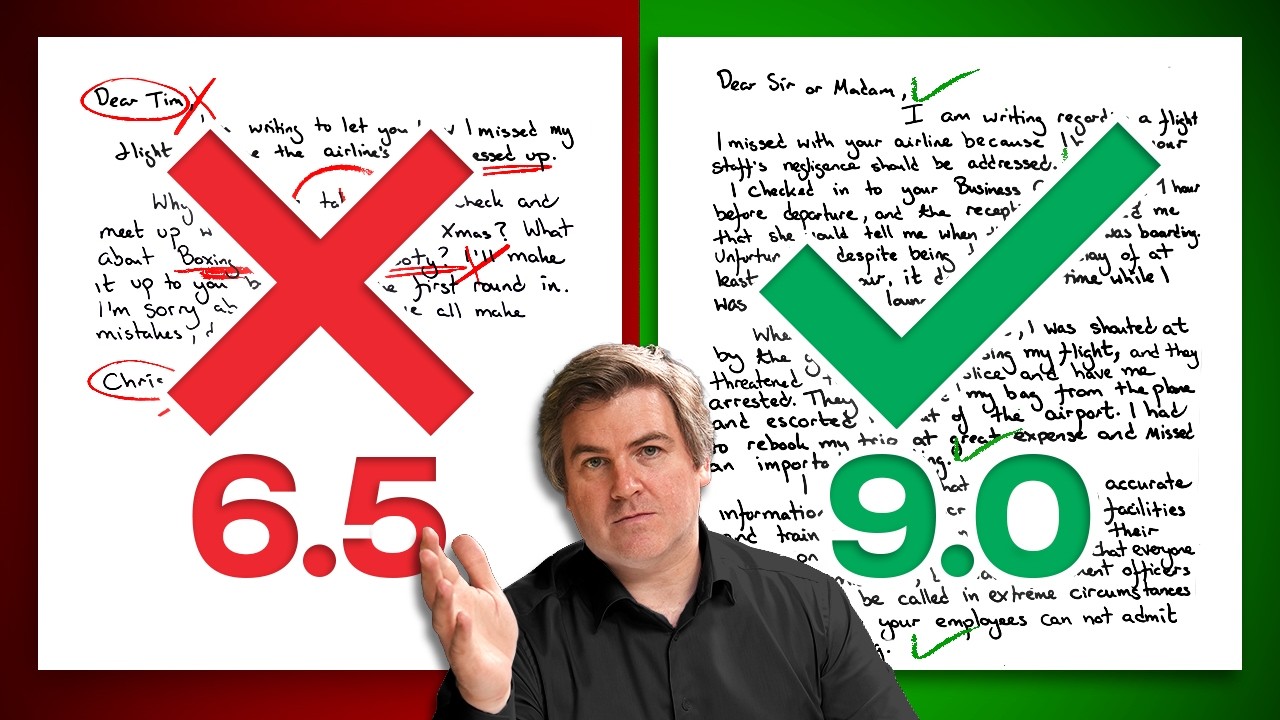
The IELTS Writing Task 1 for General Training often presents a significant challenge to candidates, but mastering it requires understanding that letters fall strictly into two categories: formal or informal, with no middle ground known as semiformal. The decision between these styles depends entirely on the recipient; if you are writing to someone who is not your friend, such as an employer or official body, the letter must be formal using specific salutations like "Dear Sir/Madam" and sign-offs like "Yours faithfully." Conversely, letters written to friends should use first names and casual closings like "All the best," while maintaining a tone that reflects real-life experiences rather than fabricated scenarios.
To achieve high band scores within the strict 20-minute time limit, writers must adhere to specific structural guidelines without getting bogged down in excessive word counting during the exam. A standard approach involves writing approximately five hundred words total across four body paragraphs: one introducing the reason for writing and three addressing each bullet point with sufficient detail, aiming for around fifty words per section. It is crucial to avoid run-on sentences by using shorter, clearly punctuated statements to prevent grammar errors that could cost marks, while confidently expanding on ideas even if some details need inventing as long as they remain relevant to the prompt.
While it may be tempting to incorporate slang, contractions like "I'm," idiomatic expressions, or abbreviations such as LOL and ASAP to sound more native-like, this strategy is risky for General Training candidates who are unsure of their audience's familiarity with these terms. The safest path to a high score involves avoiding informal elements entirely when in doubt, ensuring that any acronyms used would be understood by even the least tech-savvy recipients like grandparents. Ultimately, because Task 2 carries double the weight of Task 1 in the overall scoring system, it is strategically advisable for students to practice completing this higher-value task first during their preparation sessions before returning to refine their letter writing skills.
Read the full video transcript
More people fail IELTS writing because
of task one than task two. So what we
decided to do was create an ultimate
guide for you to show you how simple it
is to get a band seven, eight or nine by
following the steps that we teach our
VIP students and following the exact
strategies we share with them that has
led to their success. So first we're
going to show you how to use the
question to structure your answer and
then we're going to transform a formal
letter into an informal letter to show
you the difference between those two.
And then at the end, we're going to show
you real students and how they used the
exact steps and structures from this
lesson to write a full task one answer
both for formal and informal. So without
further ado, let's get into it. So the
first thing we're going to do is look at
the similarities and differences between
a formal question and an informal
question. There's one thing that tells
you exactly whether it's informal or
formal. So every question starts with
this question statement at the start
where it gives you the context. It gives
you the scenario that you need to
understand what to write about and then
it will say write a letter or write an
email to and tell you who you are
writing to. Now this is very very
important. The one word you want to look
for is the word friend. If it says write
a letter to a friend or write an email
to a friend, if you see that word, then
it is an informal letter. Anybody else,
anything else, so if it's asking you to
write to a business or a boss or someone
that you met, anything apart from a
friend is formal. Now, anytime I teach
this in the classroom, a few hands go up
and say, "Well, what about semiformal?"
Within the IELTS context for writing
task one general training, there's
actually no such thing as semiformal and
it just makes things way more
complicated. If you have to remember
three different styles, just keep it
super simple. If it says friend, write
an informal letter. Anything else, write
a formal letter. Then below that, it
will always have these three bullet
points. And this is crucial. This really
really helps us because when we're
writing this is going to show us the
exact structure to use by using these
bullet points in the question and I'll
show you that in detail in the rest of
the lesson. Then it says write at least
150 words. So try to go over 150 words.
I'd recommend the sweet spot is between
160 and 200. Anything below 160 you kind
of run the risk of going below 150.
Anything over 200 then you might be
writing about things that are not
necessary and it wastes a little bit of
time. So try to get in that 160 to 200
sweet spot. So this one doesn't say
friend. So this is a formal letter. So
let's start off with the formal letter.
So how do you start that? So you start
that by saying dear sir or madam.
Informal will be slightly different but
for formal just start it off dear sir or
madam. just memorize that and use that
at the beginning of every formal letter
or email. So the structure we're going
to use, we're going to use four main
body paragraphs in our letter. So the
first paragraph is the most important
and this will be our purpose. So after
dear sir or madam, we're going to skip a
line and we're going to write the first
paragraph which is our purpose. So how
do we know what to write? Where is this?
So if we look at the question above the
bullet points here, it will tell you
exactly what to write about. So if we
have here, you recently missed a flight
you think was the fault of the airline.
So that is the purpose. That is why I'm
writing the letter. So all you have to
do is just look at that part of the
question and you know exactly what to
write in your first paragraph. So I'm
going to start my letter off by saying I
am writing regarding. So this is a very
formal way to start a formal letter. You
don't have to use this. I just use this.
I think it's super simple and it's easy
to remember. And then just put in why
you are writing. So, I'm writing
regarding a flight. I missed with your
airline. So, this sets the context. The
person reading it will know what it's
about. A good way to always think about
writing, but especially letters, is just
put yourself in the shoes of the person
reading it. If you actually sent this to
an airline and an airline employee is
opening your letter or your email and
reading it, would they actually
understand what you're writing about?
This is a letter of complaint. So now
I'm going to state the problem because I
believe your staff's negligence should
be addressed. So someone reading this
would know, okay, this person took a
flight with us and there was a problem
with the staff. They were negligent.
They did something wrong. Now, you don't
have to use a fancy word like negligent
if you don't know how to use that. Uh,
the best thing to do with vocabulary is
to use the word you're 100% sure about.
So, don't look at this and think you
have to memorize uh anything fancy or
complicated that you see in here. And
that's us done. The first paragraph is
done. So, what I can do is go over to
the question here, give that bit a big
tick, and I know that I've stated my
purpose, which is the first part of the
structure. So remember we talked about
using the question to structure our
answer. So if we look here, this is our
first paragraph, our purpose. And then
if we move down, you will see the next
bullet point. This is going to be our
next paragraph. So we take that first
bullet point and we write about it. The
common question that many people ask at
this stage is, well, how many words
should I write for that paragraph? So
you're going to write three bullet point
paragraphs. So you have your first
paragraph, which is your purpose, and
then you're going to write a paragraph
about bullet point number one. Then a
paragraph about bullet point number two,
and then a paragraph about bullet point
number three. For the three bullet point
paragraphs, what I generally suggest is
that around 50 words, if you're slightly
under that or slightly over that, don't
panic. I would really encourage you to
focus on writing a good quality
paragraph rather than counting the
number of words. So a little trick that
I teach a lot of students is when you
are practicing try to get used to what
does 50 words look like or how many
sentences does around 50 words look
like. If you practice in that way you
will start to kind of be able to eyeball
it to what eyeball it means is you can
look at it quickly and think like okay
that's in and around 50 words. But if
you do that for all three uh bullet
point paragraphs, you don't have to
worry about word count because if
they're all in and around 50, you'll be
absolutely fine. Okay. So, I checked in
to your business class lounge 1 hour
before departure and the receptionist
assured me that she would tell me when
the aircraft was boarding. This is a
true story. I'm not saying I checked
into a business class lounge to flex or
anything like that. Business class
lounges are not as fancy as you would
think. But all we're doing is just
taking that first bullet point and
adding detail. And the reason why I said
this really happened to me is that's the
strategy that you should try to use.
Always try and write about something
related to that that has actually
happened to you in your real life. It
could be like me this really happened to
me and I haven't changed anything or it
could be something adjacent to what you
have experienced. as long as you are
answering the question or it could be
something that you know your mom or your
dad or your sister or your brother or
your cousin experienced and you're just
writing that as if it happened to you.
Most of the questions if you look at the
official like if you get these books I'm
not affiliated with Cambridge but these
are the best practice question books. I
would only use these ones. If you
actually get those and you look at the
task one questions, they design them
intentionally so that 99% of the world
will be able to look at that and think,
"Yeah, that's easy for me to write about
it." So, use the real books. Okay. So,
always look at the question again. So,
explain why you believe the airline was
at fault. So, let's continue. So
unfortunately, despite being told of a
delay of at least half an hour, it
departed on time while I was in the
lounge. Looking back at the first bullet
point and looking at our paragraph, it's
in and around 50 words. And does it
actually relate to that bullet point?
And always be thinking if somebody from
the airline or whoever is reading um the
letter in the context that your question
will be in, would they be able to
understand you? So I'm happy with that
one. So let's move on to bullet point
number two. And as you guessed the
structure that we use is we then make
that our next main body paragraph. So
just skip a line, make it super easy for
the examiner to be able to look at your
letter and understand where one
paragraph ends and the next begins and
begin your next paragraph, which is all
about bullet point number two. So when I
went to the gate, I was shouted at by
the gate staff for missing my flight,
and they threatened to call the police
and have me arrested. Yes, that actually
happened. They removed my bag from the
plane and escorted me out of the
airport. I had to rebook my trip at
great expense. I missed an important
meeting. So if we look again at the
second bullet point, I'm describing the
impact that that had exactly what the
bullet point is about. So again, I look
at that. Is it around 50 words? Is it
about the bullet point? Would somebody
understand me if they were reading this?
I'm happy with that. So I can move on to
bullet point number three now. So now we
have to say what we want the airline to
do. I recommend that you display
accurate information on the screens in
your facilities and train your team not
to blame their errors on your customers.
I accept that everyone can make
mistakes, but law enforcement officers
should only be called in extreme
circumstances, not because your
employees cannot admit they are wrong.
Okay, so just mentally do that check
again. Is it around 50 words? Is it
about specifically the thing in the
bullet point? And would someone
understand this? I'm happy with that. We
are nearly done. We just need to finish
off our letter in a very specific way.
So for formal letters, we want to write
yours faithfully. So a little trick that
I teach students is formal faithfully.
FF and write that yours faithfully. And
then write a name. It could be your
name. It could be someone else's name.
Don't write Chris Pel. That would be
weird. Just pick any name. It doesn't
really matter, but as long as there's a
name at the bottom. Okay. So, now we're
going to move on to the informal letter.
This is the one that students mess up
more. I think it's quite I wouldn't say
easy, but more straightforward to write
a formal letter because it's something
that a lot of people are taught to do
and a lot of people do that in their
day-to-day lives or they've been taught
how to write that in school. But
students really struggle, I think, uh,
more with informal, like what language
to use, what style to use. So, we're
going to transform this formal letter
into an informal letter so that you can
see exactly what to do. And we'll also
show you that when we take you through
the students essays as well or students
letters, not essays. Okay. So, let's
look at the difference between these two
questions again. So, you recently missed
a flight. You think this was the fault
of the airline. You recently agreed to
meet a friend but missed the meeting.
So, as you can see, for the purposes of
this video, it's pretty much exactly the
same question, same context, just one is
formal, one is informal. It's exactly
the same structure, but with different
language, a different tone, a more
informal tone and a slightly different
way of doing it so that you can
understand how to do both. Okay. So, the
first key difference is how you start
your letter. So instead of dear sir or
madam, you're just going to write dear
plus the name of the person. Doesn't
matter what the name is. Just make sure
that it is a name. So dear name. So
we're going to use exactly the same
structure. So if you look above the
bullet points at the question, the
context, we're going to write our
purpose in the very first paragraph. So
in the formal one, I started that
purpose paragraph by saying I am
writing. I'm going to change that when
we're writing informally to I'm writing.
So, one of the simplest ways you can
take formal writing and make it more
informal is to use what is called a
contraction. So, instead of I am, we're
saying I'm that's a contraction or we
will
or I would I'. Contractions are a much
more informal way of writing because
it's how we speak to someone. Think of
about how you would talk to someone. How
you would speak to someone about this.
What language would you use? You would
probably not meet someone in a coffee
shop and say, "I am here to talk to
you." You would say like, "Hey, I'm I'm
here. I want to talk about this." So, if
you think about the difference between
writing and speaking, there are far more
contractions when somebody speaks. Okay?
So, we're going to change regarding to
let you know. Regarding is very formal.
Let you know is more informal, more
relaxed way of writing something. Let
you know I missed my flight because the
airlines staff messed up. So if you look
at that sentence, you'll notice that
like not every word is informal. There
will be words within every sentence that
aren't informal words. What you're just
trying to do is add in as much informal
language as you can that is accurate and
appropriate. So if we actually look at
that sentence, I'm is informal. Writing
neither formal or informal. Let you know
a little bit more relaxed, a little bit
more informal than regarding. I missed
my flight. There's no real informal or
formal way of saying that. Just say it.
Because the airline staff, again,
there's no real formal or informal way
of saying that, but messed up. Instead
of saying they were negligent, we say
they messed up. Messed up is a phrasal
verb. Phrasal verbs are in general more
informal. So if you look at something
and you think, "Oh, I know a phrasal
verb." Instead of a more formal way of
saying that, that will make your writing
more informal. So we have contractions
so far and we have phrasal verbs. I know
I'm repeating myself now, but I really
want to hit home is a lot of students
will try and change every single word
and make every single thing more
informal. You don't have to do that. You
just have to slightly change it if you
can. If you can't think of any way to
make it informal, it's better to not
change it to something more informal um
than to change it to something that's
wrong. Okay, so we're done with our
purpose paragraph. We can now tick that
off and we can go to our first bullet
point. And that is our next paragraph. I
checked in to the business class lounge
1 hour before departure. And the
receptionist told me she'd give me a
shout when the aircraft was boarding.
Alas, even though they told me I could
chill out for half an hour, it left on
time while I was still in the lounge.
So, I checked into the business class
lounge 1 hour before departure. It's
basically exactly the same as the formal
one. Again, showing you that you don't
need to change every single thing. So,
as you can see, there's another
contraction in here. She would. We've
changed that to sheed. So instead of
tell me the aircraft was boarding, we'll
change that to give me a shout. So give
me a shout. It's not really slang. It's
more an idiomatic way of saying let me
know. I don't know whether it's comes
from the UK or Ireland, but it is very
common here in Northern Ireland. But the
more idiomatic language you use for
informal letters, the better. So
idiomatic doesn't mean use lots of
idioms. Idiomatic language means
language that native speakers would use.
One of the biggest complaints when I was
teaching general English to students in
Vietnam and they would go to London or
Toronto or New York or wherever and
they'd be like I didn't understand
anything. And these were people that got
a really really high score really high
level of English but they only learned
English from a textbook. Textbook
English is very different from idiomatic
English which is colloquialisms, slang.
It does include idioms, phrasal verbs.
This is the language that native
speakers use all the time. If you have
picked up any of that either through
living in an English-speaking country or
through listening to podcasts and things
like that, try to use that but only
accurately and appropriately. And this
is one of the reasons if you're thinking
like why are they getting us to to write
informal letters? One of the hallmarks
of a really highlevel English learner,
so someone at a band 8, 8.5, 9 and
beyond that, is someone that can use
idiomatic language. The more informal
your language, if you're using it
correctly, the higher level you are.
Okay? So, alas, even though they told me
I could chill out for half an hour, it
left on time while I was still in the
lounge. So, chill out instead of relax,
they instead of they would. But most of
the words in that sentence are actually,
you know, neither formal or informal.
All I'm doing again is just peppering.
You know, think of the informal language
as you. So you have your your meal and
you're adding salt and pepper. You're
not covering it in salt and pepper. That
would be insane. You're just adding a
little bit, sprinkling that in. So
that's our first bullet point. Did we
answer it? Is it around 50 words? Would
someone understand it? Let's move on to
our second bullet point. When I went to
the gate, I was shouted at by the gate
staff for missing the flight and they
threatened to call the cops and have me
thrown in the slammer. They removed my
bag from the plane and chucked me out of
the airport. So, can you spot the
informal language there? So, cops is a
more informal, maybe a slang word for
police. I'm sure that you can think of
lots of other um slang words for police.
Some rude, some not so rude, but you
know, as you can see, you're just adding
that more informal slang words there. if
you can and then thrown in the slammer.
The slammer is an informal way of saying
jail or prison. Chucked me out of the
airport instead of they escorted me out.
Again, a little bit more informal. And
this is what the examiner is doing when
they're actually reading your letter.
They're not looking at, you know, is
every single word informal? They are
just scanning and picking out, okay,
here's something that is informal. Did
they use this appropriately? Did they
use this accurately? And then they're
thinking about okay how many instances
of this are there are there enough for
this to be
on aggregate a informal letter. Okay so
let's finish off with our final bullet
point suggest how you can meet up in the
future. Why don't we take a rain check
and meet up when you're home for exmas.
So it's just a shortened way more
informal way of saying Christmas. What
about Boxing Day for the footy? Foodie
is football. I'll make it up to you by
getting the first round in. Getting the
first round in in Ireland means buying
the first drink. So, very very
importantly, a lot of people when I show
them something like this are like, I
don't know anything about Boxing Day.
What is Boxing Day or Foodie or getting
the round? Like, I don't know anything
about that. You don't have to write
this. You just have to write in an
informal way based on your own life.
This is why it's really important to
pick something you know something about
and then add in those informal ways of
saying this. It doesn't have to be at
this level. Most of you only need a band
seven, maybe eight. Very few of you
actually need a band nine. Doesn't have
to be at this level. So don't, you know,
panic and think I'll never be able to
write this. So we can tick off all of
our bullet points. We're nearly done,
but not quite yet. We need to finish it
off properly. So we're not going to put
yours faithfully. I like to just keep it
simple and teach my students to write
all the best. All the best, your name
can be any name, doesn't really matter.
Probably just don't write Chris Pel. I
would be a bit weird again. The reason
why I keep saying like don't write Chris
is like some students have got confused
in the past and they say like uh dear
Chris Pel and then like yours faithfully
Chris Pal. Like I'm sure many of you
will agree one Chris Pel in the world is
more than enough. So you know just use
your own name. Okay. So that was the
theory behind the structure and
everything. What I'm going to show you
now is two real students actually using
it in practice. And you'll be able to
see the mistakes that they make, the
confusions that they have, and me
talking them through step by step
exactly what to do for an informal
letter and a formal letter. So the first
thing that we need to understand about
writing task one general training is the
format that it always comes in. So the
format will always be you should spend
about 20 minutes on this task. I would
recommend that you do task two first.
Spend about 40 minutes on task two and
then do this one at the end. Um what
tends to happen if it is people who do
task one first, they can overrun and it
means that they don't spend enough time
on task two. So do task two first and
then we'll do this one. What it will do
is it will always ask you to write a
letter. It never changes. So it will say
write a letter to and it will tell you
the type of person or who to write it
to. And then there will always be three
bullet points and it will give you a
scenario here. So it never changes. And
being aware of this format will help us
later on when I show you how to
structure everything cuz we're going to
use the format to structure our entire
letter. The next thing we need to
understand is what type of letter you're
going to write. So there are two main
types of letter. There are formal
letters. So, for example, if you're
writing a letter of complaint to to
something or let's say you lost a bag at
the airport and you're writing to
reclaim your baggage or something like
that or a applying for a job or
something like that. The other type is
an informal letter where you are writing
to a friend. So, some people online
teach that there are three types of
letters. There are formal, informal, and
semiformal. We never teach semiformal.
We don't think it exists and we think it
is a bit of a waste of time for you to
spend time worrying about it. The only
thing that you need to think about is
who are they asking you to write to? And
the key word here is friend. If it says
the word friend in it, it is an informal
letter. You're going to write
informally.
>> Mhm.
>> Anything else? Formal.
>> Really?
>> Yeah. Some people get caught up in,
well, what if it's someone who I kind of
know, but I don't know that well. And
you do not have time to be thinking
about all of this on test day. And you
don't really have time to be preparing
three different types of letters. Just
>> do two and it cuts your preparation by a
third. So, we're going to be focusing on
an informal letter. Don't worry about
informal formal right now. We're going
to focus on the structure first and then
um we'll write the letter and then we'll
talk about um how to make it more
informal. So we always start it with
dear name because it is an informal
letter. We just make up a name, right?
Don't over complicate it. Pick a name.
But for informal, we just go first name.
Formal, you could use Mr. or Mrs. or
something like that. Um but first name
for informal. Then paragraph one why
you're writing or the reason why you're
writing. So dear name why I'm writing.
Then paragraph 2 bullet point one. So
this one. Paragraph 3 bullet point two.
So it'll be this one. And then paragraph
4 bullet point three. Okay. And then
you're finishing it off kind regards.
Kind regards is because a lot of people
get mixed up with like oh should I write
yours faithfully or yours sincerely?
What is like the friendly informal one?
Kind regards you can use for both formal
and informal cuz friendly it it does
sound friendly. Kind regards and it does
sound kind of formal as well. So just
that and then your name.
>> Just jumping in to say we have a really
cool PDF with over 100 band seven 8 and
9 samples for task one. It's for both
academic and general training but
there's about 50 letters in there that
you can use. maybe try the questions
first and compare your answer with the
samples from our students. If you want
that, go to the description, click on
the link and you can download it for
free. So that's the structure that we're
going to use and it means that you can't
go wrong. All right, in terms of number
of words, the total number of words is
you need to write at least 150 words.
So, what we tend to do is this should be
about 50. This should be about 50. This
should be about 50. And this is quite
shorter. It's normally like 10 to 20
words, something like that. Now, you're
not going to count the number of words
um because you just don't have time. But
what you should get used to is like what
does 50 of your words look like on a
page or generally what does that feel
like when you're writing it. So if you
get used to that, it guarantees that
here you will write at least 150 words
and then this will put you over the
line. If you are unsure, always go for
more than less. We'll see when you start
writing, but generally it is about two
or three sentences
>> is is about 50 words. Um maybe a little
bit more. Sometimes it depends on how
long your sentences are, but generally
two, three, four sentences, something
like that should get you over the line
there. So let's just read the question
and think about what it actually means.
>> It has been around 10 years since you
finished your studies. You are thinking
about arranging a get together to mark
this milestone with people you studied
with.
>> Okay. So this is the background.
>> This is what we're going to put in here.
The reason we are writing to them is
that. So you're basically taking that
and paraphrasing it.
>> So you're not going to copy it exactly.
You're going to state how would you say
this in your own words.
>> Okay. So continue. Write a letter to a
former college friend. In your letter,
number one, explain what kind of event
you would like to organize.
>> Okay. So, any questions about that? What
kind of event do you think that you
would organize for that
>> for a 10ear reunion?
>> Mhm.
>> And pick the thing that's easy for you
to write about. So probably if you
imagine you are doing this or if you've
experienced this yourself doesn't have
to be a college reunion but it could be
something very similar like a family
reunion or even something like
>> a you don't have to call it a wedding
but like getting together for drinks and
dancing and you know or and a meal and
stuff like that you know or it could be
>> something completely different. But what
do you think?
>> Um probably like food, drinks and like a
game night of some sort. Mhm.
>> Like an evening of playing
fun games.
>> So the thing to remember is for this it
should be one thing.
>> Uh it should just be one thing.
>> Yeah. So if you say like drinks and
dinner and games, you could start off
with like would you like to meet for
dinner and then if you're running out of
things to say, we could also play some
games at the end. Could add that in. But
I would try and keep it to one thing.
What do you think is the most obvious
thing?
>> Dinner.
>> Okay. So, we'll put that down in our
plan. Next one.
>> Number two, give reasons why this would
be a good way to mark the occasion.
>> Okay. Why would dinner be good instead
of something else?
You can make something up completely.
>> Uh, it would be dinner at a particular
restaurant. That is where we used to
have all of our dinners when we were
back in college.
>> Old restaurant.
>> Should I read the third one?
>> Mhm.
>> Number three, say what assistance you
would like from your friend in planning
the event. Um, probably
contacting everybody, making like a
group chat with all the numbers that I
don't have, suggesting a date and a
time, kind of coordinating with
everybody, seeing what day works.
>> Excellent. So, there's two things you
could do now. One is you could just go
straight into writing it if you have the
confidence to talk about that or you
could add a little bit more detail. Uh,
normally I suggest thinking of two to
three things. So, for example, explain
what kind of event you would like to
organize dinner. So, you're going to say
it's at this old restaurant.
>> What other things could you say about
the dinner? Or what other things could
you be doing at the dinner?
>> Going through the college yearbook and
looking at pictures and seeing how
everyone has had their glow up.
>> Okay. Anything else?
>> Just specifically about the dinner. What
do we normally do before dinner or after
dinner? Or
>> what do we do before dinner?
>> Maybe it's different in where you're
from, but we do something. We have
drinks.
>> Oh, yeah. I'm not Irish.
>> We call them pranks.
>> Pranks.
>> Pre-drinks. Pranks.
>> My sister called it that the other day.
>> Pranks.
>> That's cute. Yeah, we could do uh
drinks.
>> Drinks. Cocktails. That type of thing.
>> Take photos. So, it's good to have some
ideas. What we want to avoid is writing
just a list of stuff. So, you don't want
to say, "Let's go for dinner. We'll look
at the yearbook. Then we'll have some
drinks. Could even have cocktails. Then
we'll we'll take some photos." So, it's
just like a shopping list of stuff. So,
it's better to like make sure that it's
related to the dinner. So, what I was
thinking of of I'll not tell you what to
write, but just tell you what not to
write rather than tell you what to
write. So, why are we going to this old
restaurant? What happened there? What
are the good memories and things that
were due there?
>> Um, this old restaurant is where we all
met together after our final exams.
>> Mhm.
>> And it was a like goodbye farewell
dinner.
>> Mhm.
>> So, it's just nostalgia.
>> So, it's good to put some nice
vocabulary in there.
>> Nostalgia
and contacting everyone, setting up a
group chat. I think that's probably
enough. Yeah,
>> I think that's enough. Okay,
>> so we've done our plan in the real test.
This will take cuz you know the
structure. This will take like 2 minutes
>> just like but always use this structure
and just put P1, P2, P3, P4, couple of
bullet points, but just make sure they
actually are answering the things that
they actually ask you to do there. The
next thing we need to think about is are
we using informal language? So what type
of language might we use which is
informal?
>> Um slangs,
>> good
>> short forms,
>> abbreviations like LOL and LO. What
other language is considered informal?
>> Phrasal verbs.
>> Mhm.
>> Colloialisms maybe like from your local
like really local slang. Maybe avoid
anything too rude. Um most examiners
won't care, but you might get a prudish
examiner who's like, "Oh my god, I can't
believe they said that." Try and avoid
it making it all text speak like making
it all look like a text message. But the
biggest one that will so instead of I am
writing to you, it'll be
>> I'm
>> I'm okay.
>> Do not
>> don't. So as many of them as as you can
add in. Um and then just write like you
speak
>> is a good is a good like overall thing.
So if you were talking into like I'd say
a WhatsApp WhatsApp message and you were
just saying
>> voice
>> and then little things like hey you have
to start it with dear
>> you have to
>> dot dot dot dot yes so it says begin
your letter as follows
>> in general in the IELTS test if you
don't follow the instructions they mark
you down and that's a lot of people lose
things but I always start it with I'm
writing to let you know dot dot dot
>> and then why you're writing and then
just continue one. You want to try it?
>> Yeah.
>> Okay. So, I'm writing to you to to
organize a 10year
reunion at
>> Eric's Chicken Palace with all of our
classmates from 2016. Very good start.
That's perfect. You could make it a
little bit more informal. Um, you could
say something like all of the gang from
back in the day or all of the gang from
2016, something like that. But that's a
little bit more of a creative
uh touch rather than it would depend on
what the rest of your your letter looks
like. It's not formal or informal at the
moment. But if the rest of it was like
this where it's quite contained, there's
no really informality about it apart
from here, then I would be concerned.
I'm not concerned at the moment, but
let's see how the rest of it goes. But
feel free to use more
slang in formal words like that. You
know what I mean?
>> Yes. Okay.
>> More like a
say speaking into a WhatsApp message
rather than
>> a letter.
>> Yeah.
>> Copy.
>> Okay. So, next one. Explain what kind of
event you would like.
>> What did your sister call it? Sprinks.
>> H.
>> Pranks.
>> Don't copy me.
>> No. No. I just thought it was cute.
Pranks. If it's something that you're
unsure, like is this a real word? Like
that for example, um you can put it in
quotation marks
>> and then that shows like I'm aware that
this is not a a dictionary, a word in
the dictionary. It's kind of a new word.
Um and that lets the examiner know that
you haven't just misspelled drinks for
example. So yeah, throw it in there. Can
I?
>> Yeah. Yeah. Yeah.
>> Oh, great.
>> We got to hit 50 words. Ju just write it
normally and then count it at the end.
Is that the end?
>> How many words is it?
>> Just under 40 probably.
>> Yep. I'd probably add a little bit an
extra thing on. That's where you know
cocktails photos.
>> So in in the in the real test, it's
better to spend, you know, 20 seconds
thinking of these than to get to the
end, what do I have to what can I write
about extend this answer? Mhm.
Okay. So, can you read it for me?
>> We can start off with our infamous
pranks session. Lol.
>> Okay.
>> Then maybe go through our embarrassing
yearbook photos while we soak up uh
drinks with some spicy hot chicken like
we did on our last day of college.
>> Excellent. And then the last one.
>> If we're able to stand on our feet by
the end of it, we can take more photos
to look back at another 10 years from
now.
>> Yeah. It's a informal language. You've
developed it enough and you've stuck to
the main point which is explain the kind
of event. So, it's drinks and then
dinner and then maybe some photos. Good.
So, next reasons why this would be a
good way to mark the occasion. So, just
be careful. Sometimes you get here and
you're like, I've actually wrote about
that a little bit here like and and then
you look at it and think, oh, that that
would be a bit repetitive. Always you
can always change like a plan is not set
in stone. You can change things. So if
you want to go with that, that's fine.
But if you want to change it slightly to
talk about why, and just note that it
says give reasons. So you should give
more than one reason just to be on the
safe side or give two reasons at least.
>> Two.
>> Yeah.
>> Okay.
>> Okay. Can you read it, please? Mike,
Jasmine, and Ros are all moving to
Australia this year, and it got me
thinking about how we desperately need
to meet up again, altogether, in our
favorite place before life inevitably
flashes by. Plus, I think it would be a
fantastic way to hear all about what
everyone has been up to this entire
decade. P.S., I heard Kevin and Alli
eloped last November. I need all the
details ASAP. I'm engrossed in this
story.
>> So, P.S. Would we put PS at the end in
the middle of a of a paragraph or could
we put that would PS be at the end?
Technically
>> PS.
>> Mhm. So PS is normally after you sign
your name. I haven't seen a PS in the
middle of a I might be completely wrong
guys in the comments. Am I being too
picky or should PS be after?
>> I've never seen that before.
>> Interesting.
>> And I've been teaching a long time. But
why do do you is that a normal thing for
you?
>> Maybe I'm using it incorrectly, but I
would just say PS. Like as like a I
would say it in a text message.
>> But is this a text message? No.
>> In general, people watching, I would not
do anything
>> that is risky. That is that is um
>> taking a chance.
>> Yeah, that is not
>> what what we would normally do. Don't
take too many chances. So
>> PS, I heard Kevin and Alli eloped last
November. I need all the details ASAP.
>> Good. I would probably just You could
just change that to also
>> switch out the PS.
>> I I don't leave it in. But if you wanted
to be super duper safe,
>> we have an option of saying
>> put that also. So,
>> or BTW,
>> by the way,
>> but that's two in the same sentence. Is
that too much to say?
>> Not really. Not really. And you don't
want to be again under time pressure.
You don't want to be saying, "Oh, what
should I do? Should I do this? Should I
do that?" That's why you hear me say at
nauseium, keep it simple. What is the
simplest way to do it? Also,
>> like, yeah,
>> do that now.
>> I'll leave it in cuz I'm I'm being
interested to hear what people have to
say about that. But
>> me, too.
>> So, always once you finish, go back and
check the bullet point. Give reasons why
this would be a good way to mark the
occasion. Is every sentence about that?
Is the PS about that?
>> Mhm.
>> Yeah. Good. Also, how many words was
this?
>> Almost 60. like 55.
>> Okay, so we know that in general 1 2 3 4
5 six lines. So it's about 10 words per
line. 1 2 3 4 5 6 7. So 60 70. You're
well above it. So that's a good way to
kind of ballpark it cuz you don't want
to be going in the middle. 1 2 3 4 5.
Just be like, "Okay, well generally what
is one line on this piece of paper or on
the screen? What does that look like?"
And then you know have a margin of
safety. So you'll be looking at the
clock and you need time to check at the
end. So if you a bunch of time left, you
could fully develop this. But if it was
if you had five minutes left, I would
just go four lines,
>> kind regard your name, and then spend
the rest of the time checking it. So
just be a little bit strategic on test
day because time can be a factor for
even someone like yourself.
>> So off you go.
Can you read it, please?
>> I don't have everyone's contact
information like you do, so I would need
you to make a WhatsApp group chat with
everyone. Also, I'm thinking we can take
photos with your camera since you're the
only professional photographer friend we
have.
>> Very good. Just be careful
that doesn't to me and to lots of
examiners, that doesn't look like a full
stop cuz it's just an extension. Yeah,
>> I do that like every time.
>> Sorry.
Okay,
>> but this is an example of how someone
who very high level of English if you
did that for most or half the sentences
um you could get a quite a low mark for
grammar because they see
>> you're not putting in periods
>> because it is called a systematic error.
Every time you use that system of
punctuation then you are making a
mistake like that. So the way the
grammar is is scored is on the number of
error-free sentences. they literally
will count the number of errors. So if
let's say half your sentences have that
punctuation error and then maybe you
made a little uh article error or
preposition error that could bring you
you should be getting a bad nine that
could bring you down to a six or a
seven. So it's, you know, an easy way to
to really boost your score is to
identify those common mistakes and fix
them. Even though like you should
probably do the test on the computer. So
you'll be typing so it wouldn't be an
issue. But, you know, there might be a
test center where there isn't the
computer based test, you'll be doing it
on this. So something to be aware of.
I'm being very, very picky, though.
If you'd prefer to go through all of
this one-on-one with me giving you the
strategies, feedback on your own work,
and mock tests, that's what our VIP
course is for. It covers everything,
listening, reading, speaking, and
writing. So, if you want that, just
click the link in the description, and
you can get 10% off. So, how would you
finish this? Very nice.
>> Without the heart.
>> Now, what you would do is you would
check three things. Um, number one,
vocabulary. Is there any vocabulary that
you've repeated too many times? Or is
there some simple vocabulary that you
could um maybe make a little bit more
advanced? You don't have to do that. It
is only if you can 100% sure like if I
change it to this, it is going to be
correct and it's good. Second thing is,
are there any small grammatical errors?
You're aware of that little thing with
with punctuation. So I would definitely
check at the end of every sentence
>> for you or if there's anything else. And
the third thing is is there any way that
we could make it more informal. So if
for example uh do not, you could change
that to don't. I am, you could change it
to I'm or if often there's an adjective
in there or a phrasal verb or something
you could add in. Is there anything that
you would like to change?
>> Classmates, the gang. Okay, good.
>> Yeah.
Okay, happy with that. Mhm.
>> All right. So on the abbreviations like
ASAP, LOL, only use them if they are
widely known and widely accepted. So
LOL, everybody knows what that means,
ASAP. But I wouldn't start using less
common ones. I'm in my 40s, so I don't
really know what people use these days,
but I'm sure there are some that people
use that, you know, some people would
know them, most people wouldn't know
them. I would just be careful with them.
So, a good rule of thumb would be like,
if your grandmother would know it or
not, if she would, that's okay to use
it. Or my I'm older, so would my mom, my
80-year-old mom, understand what LOL or
ASAP means?
>> That would be okay. If in doubt, don't
use them. All right? cuz um a lot of
people will spend a huge amount of
mental energy worrying about stuff like
that like should I use them, should I
not? It's not adding anything really to
to your to your your letter. It's not
like the examiner is going to see LOL
ASAP and think like this person um is
being really informal. Let's give them a
high score. So if unsure for anything
like that, just don't use it. So that
was how to write an informal letter. If
you want to know how to write a formal
letter, keep watching and we'll do that
with the next student. So, first thing
that we need to do is help you
understand uh the format of writing task
one general training because it never
changes and we're going to use this
format to help us plan and structure our
answer before we start writing. So, it's
really really important that we do that.
So, it always says you should spend
about 20 minutes on this task. I would
recommend that you do the writing task
two first, okay? And then writing task
one last. Writing task one only takes 20
minutes. Uh but students often spend too
much time on it and that means they have
less time to do task two. So when you're
practicing, try to get task two done in
40 minutes and then move on to task one.
What it does is it always gives you the
kind of context of the background first.
Then it will tell you to write a letter
and who to write the letter to which
we'll come back to that in a second.
It's important. And then it will give
you three bullet points and it will tell
you how to start your letter. Okay. So
before we get on to planning and the
structure, what we first need to decide
is is this a formal letter or an
informal letter. So there's only two
types of letter on IELTS writing task
one. There's no semiformal.
If you want to decide if it is formal or
informal, look at the bit where it asks
or tells you who to write to. So for
this one, it's write a letter to the
moving company. The rule is if it says
write a letter to a friend, if it says
the word friend, it is informal. Anybody
else it is formal. All right? Now you
people at home don't start saying well
what if I know a person at the moving
company or what if my brother works the
>> forget all of that friend informal not
friend formal just keep it simple. So is
this formal or informal?
>> Formal because it is to the moving
company.
>> Okay. Do you know anybody at the moving
company? No. So are they your friends?
>> No.
>> No. So formal. Now we know it's a formal
letter. We'll go into what makes a
letter formal. I'll show you what
language to use um later on when we
start writing. But next, I want to show
you how to plan and structure your your
answer.
>> Okay?
>> So, start off here. Dear sir or madam,
just always do exactly what they tell
you. They'll always tell you to do that.
Then paragraph one is reason why you're
writing letter. So, you just say I'm
writing to you because of this reason.
Okay? Then we're going to take bullet
point number one, which is going to be
paragraph 2. Bullet point number two.
Paragraph 4 is going to be bullet point
number three. So this forces you to do
exactly what they're asking you to do.
>> All right? Takes all the guesswork out
of it. We want to reduce thinking as
much as possible. You just want to make
everything as automatic as possible. And
then we want to end it with sign off. I
always do kind regards because kind
regards is appropriate for both informal
and formal. So kind regards is fine and
then your name. So this is the
structure. You have to write at least
150 words.
>> So what we tend to do is tell our
students to write around 50 for this
one, this one, this one. You probably
won't have time to count your words. So,
what we'll do is we'll count this
paragraph, make sure that it's over 50,
and then we'll be able to ballpark the
rest of them because the others, as long
as it's 50 words.
>> 50 50. And then this one is just one
sentence or two sentences telling them
the reason why. Any questions about
that?
>> Um, can I just name the moving firm if I
want to rephrase?
>> You can make anything up. What I would
like you to do next is for these bullet
points to add some detail to plan them
out. Start off with just one clear idea
>> that definitely answers this and then
add a little bit more detail to get you
up. 50 words is going to be three to
four sentences, something like that. It
differs from from person to person, but
generally around that. So look at the
whole thing
>> and then for each bullet point just add
a couple of points that you could expand
on when you're writing. So,
>> okay,
>> take a few minutes to do that.
>> Handling and packaging. Do you think
you'll be able to write three or four
sentences about that?
>> I think so. Yeah, I would say. Yeah,
like
>> I mean, this is not set in stone. So,
when you start writing, if if you get to
like two sentences, you're like, "Oh,
this is around 25 words. I need to You
can add a few other things, but just
pick things that you feel confident
writing about." If you'd like to see
lots of samples of task one, both formal
and informal letters, I have put lots of
task one samples into one PDF, more than
a hundred for you. These are all real
students at a band 7, 8 or 9. They got
7, eight or nine in the real test. All
of those are in one PDF that you can
download. Just go to the description,
click on the link, and you can download
for free as our gift to you. So I think
I can start off by talking about the
whole team and then go like but this
specific member was exceptionally
helpful.
>> And don't worry about specific names or
like just pick literally anything.
>> So I could make something up over here
like um during the transportation
um the car had some problems and the
replacement took too long or something
like that. Literally it does the content
doesn't matter as long as it is relevant
to the bullet point. So relevancy is
very very important but there are a
million things that could be relevant
there. So pick the thing that is easy
for you to write about. So that could be
something that has actually happened to
you before
>> or it could be something that you know a
friend or family member told you about
or it could just be some like we have a
lot of doctors and nurses.
>> So they often will add medical stuff in
for if if they can cuz they can use very
advanced vocabulary that they know is
correct.
>> Um not everybody can do that but yeah.
>> Wow. Okay.
Okay.
>> So, car ran into troubles with the tire
and replacement took too long to arrive.
That's the dissatisfied part.
>> Mhm. Good. So, this is a formal letter.
So, we need to think about what is
formal language. The thing I find most
useful is to tell students what not to
put in.
>> So, what is informal language that we do
not want to put in? So, for example,
slang. We wouldn't put that in. One that
probably need to become aware of is
contractions. So for example, I'm
instead of I am. So I'm would be
informal. I am would be formal,
>> right?
>> Things like phrasal verbs, idioms.
>> Ah, yeah. Idioms are a big one.
>> Abbreviations.
So things like LOL, ASAP, things like
that. You wouldn't have any emojis
>> or Jenzie language. uh no no hearts or
anything like that or kisses or anything
like that. You know, you want to keep it
very very formal. But what I think you
should do is use this to write your
letter and just write it here and take
it paragraph by paragraph. Okay?
>> And then I'll give you feedback after
every paragraph. Always have the
question with you.
>> Always be focused on the question.
>> So dear sir or madam, so you started it
off correctly. I'm writing this letter
because I recently hired Advantage
Moving Services to move my belongings to
my new house.
>> And then I go with I am mainly writing
this to express.
>> Okay. So big thing is you need to skip a
paragraph.
>> Okay.
>> So paragraphing is important and it's
just easy marks that that you're
throwing away.
>> So that is why we have the structure and
we follow that. See one sentence. Let's
just focus on this. I'm writing this
letter because All right, that's a good
way to start it. Very formal way to
start it. I recently hired a Brandish
Moving Services to move my belongings to
my new house. I would say something
about requesting cuz they requested
>> a Did Did you cover that year or
>> I was thinking that I would cover that
in conclusion maybe at the end.
>> So there's no conclusion cuz it's not an
essay.
>> Okay. So it's a letter. So you could put
PS at the end or whatever, but you're
making it more complicated than it needs
to be. So that is why we have this. So I
would just add in here something. Um I'm
writing this letter because I recently
hired Advantage Moving Services to move
belongings to my house
>> and they uh and I was requested um
review
>> and I would like to leave a review as
requested.
>> Okay.
>> Something like that. All right. So I am
mainly writing this to express my
gratitude. Describe what went smoothly.
Good
>> and my satisfaction.
Good. With the companies
>> exceptional service.
>> So companies would be
>> Ys, right?
>> Y apostrophe s. All right. So companies
is many is plural.
>> Many companies.
>> Sure.
>> With the companies exceptional service
especially. Is that a capital letter or
is that just your handwriting? No, it's
capital.
>> Capital letter. So, we wouldn't have a
capital letter after a comma.
Especially, is that a capital letter?
>> Yeah.
>> Um, handling of my belongings.
>> I feel like I can definitely change that
cuz I repeated it twice.
>> So, you're you you have a extremely long
sentence there and there could be a
problem
>> with punctuation
um
>> if you keep doing that throughout the
whole the whole essay. So why don't we I
would use remove that. Put a full stop
here. Delete this. Capitalize this. The
handling of my belongings was done very
well. Everything was handled with
complete care and precaution.
>> Unpackage.
>> So you got and and and unpackaged
extremely well. Okay. So you see we're
having a few issues with punctuation.
Don't worry too much about this, but if
you can, it is better to write shorter,
simpler sentences that are correct than
very, very long, complex, run-on
sentences that could have multiple
punctuation issues. So, in the next
paragraph, let's just try and you don't
have to write like super short
sentences. Um, but try and have it just
maybe one or two ideas per sentence.
>> Mhm.
>> Um, let's see. How many words is this?
>> 38.
>> 38. So, how many do we need?
>> 50.
>> Yeah. So, how many? Probably one more
sentence.
>> So, could we add a little bit more
detail?
>> Sure.
>> Remember, we're describing something
that went smoothly.
>> Mhm.
>> So, overall, that took a lot of stress
away from me, and it's something I
appreciate. Good. Is this a full stop or
a comma? full stop.
>> Okay. Make it look like a full stop
because it's a straight line. It looks
like a straight line.
>> Yeah. So, we're going to delete that.
>> Okay.
>> And then overall,
>> that took a lot of stress away from me,
comma, and it's something I appreciate.
Okay. Good. So, we're saying that the
reason why
>> you might have got 6.5 in your previous
um attempts is not because you don't
know how to write properly. It is just
small mistakes like punctuation for
example and a lot of the time you are
actually adding in the correct
punctuation but it's not clear because
if you had one big massive paragraph
>> again you're throwing away those marks
where it's just easy to show the
examiner
>> here are my paragraphs um by following
the structure. So we're getting there.
We're improving bit by bit.
>> Don't panic. You're improving. All
right. So the next bullet point is going
to be this one. Commend a member of
staff who provided excellent service. So
start with here, show the examiner, have
a bit of space, pick a member of staff
or overall and then go into detail about
a member of staff.
>> So the entire team was energetic and
friendly which made a task like moving
smooth and easy. Okay, again make it
really obvious that this is the full
stop. So this is where someone like you
who is getting a ben nine in speaking
>> can struggle with writing. It's not
because you're there's anything wrong
with your English per se. It is just
you're being a little bit careless
sometimes. Your English is great. It's
just carelessness and it's difficult
because you're on camera.
>> Someone is staring at you. You're right.
So it's you're tired because we've been
working all day. You know it's easy to
make these mistakes. But on test day
you'll be under the same amount of
stress. Okay,
>> if not more,
>> you'll feel tired.
>> Uh you'll be doing, you know, the
listening test and the reading test and
then the writing test. So, it is good to
make these mistakes now and be aware of
them. So, one person in particular
provided exceptional service named
Chris.
>> I Why would you write an I like that?
>> Yeah, you're right. Cuz I wrote an I,
capital I here, but then I wrote it like
this here.
>> But when do you ever write an I on its
own like that? Ever. I is always
capitalized. Yeah, I did it here. Look,
>> I know
>> you were so right about the silly
mistakes.
>> I would
>> definitely be recommending this company
>> to my friends and family if they are
ever looking for
>> an easy to work with. Sorry.
>> An easy to work with team. Good. So,
what what have we learned so far?
>> That horrible in punctuation.
>> You're not horrible in punctuation. You
just make it you don't make it clear.
All right.
>> So, think about the reader. Think about
>> the person reading it. They need to
understand when one sentence ends and
the next finishes.
>> Okay.
>> So, we've improved
making our sentences a little bit
shorter,
>> making them
clearer.
>> Mhm.
>> Now, we just need to tidy up the
punctuation a little bit.
>> Okay. So, this is the dissatisfied
paragraph, Rick.
>> Yep.
All right. So, if there was one thing
that was bothersome, good. If there was
one thing that was bothersome,
>> was that
>> it was that?
>> Oh,
>> so
comma, it it was that the car
transporting all my property ran into a
>> short but fixable
>> but fixable trouble. Would we use the
word trouble? It ran into tran
>> because it's formal, right?
>> Yeah. So, it ran into a short but
fixable problem instead of trouble with
the tire. Is that a full stop?
>> No, it's a comma.
>> And so, you put comma and then
>> however, you're right. However,
>> they didn't have a spare tire on hand
and had to call in another truck to
replace the one with that tire. So,
Down, down, down, down, down, dust.
>> Yeah.
>> Okay. So, if there was one thing that
was bothersome, it was that the car
transporting all my property ran into a
short but fixable problem.
>> Mhm.
>> With the tire. Full stop. So, try and
think of the the first sentence as like
a topic sentence. You're just saying
here here's the main the main point. So,
however, they didn't have a spare tire
on hand and had to call in another truck
to replace the one with the flat tire.
That took 3 hours, which was an
inconvenience as time was
>> very essential
>> was essential that day. So, either
something is essential or it's not
essential. It would be very essential.
It's either one or the other, you know.
Which was an inconvenience as time was
essential that day. All right. Good. So,
we just put kind regards is this is good
because you're making the same mistakes
again and you only have really
>> two mistakes.
>> Mhm.
>> Punctuation and run-on sentences. You
just you keep going. So, you're doing a
lot of things right. But if you
submitted this essay
>> on test day with that number of errors
in it, you wouldn't be getting one of
the higher scores. So, we need to fix
those two errors and then we'll be able
to move on and help you with that. So,
that's how to do task one, but you
probably also need help with task two.
Task two is worth double task one. So,
if you need lots of help with that, this
video will help you out with task