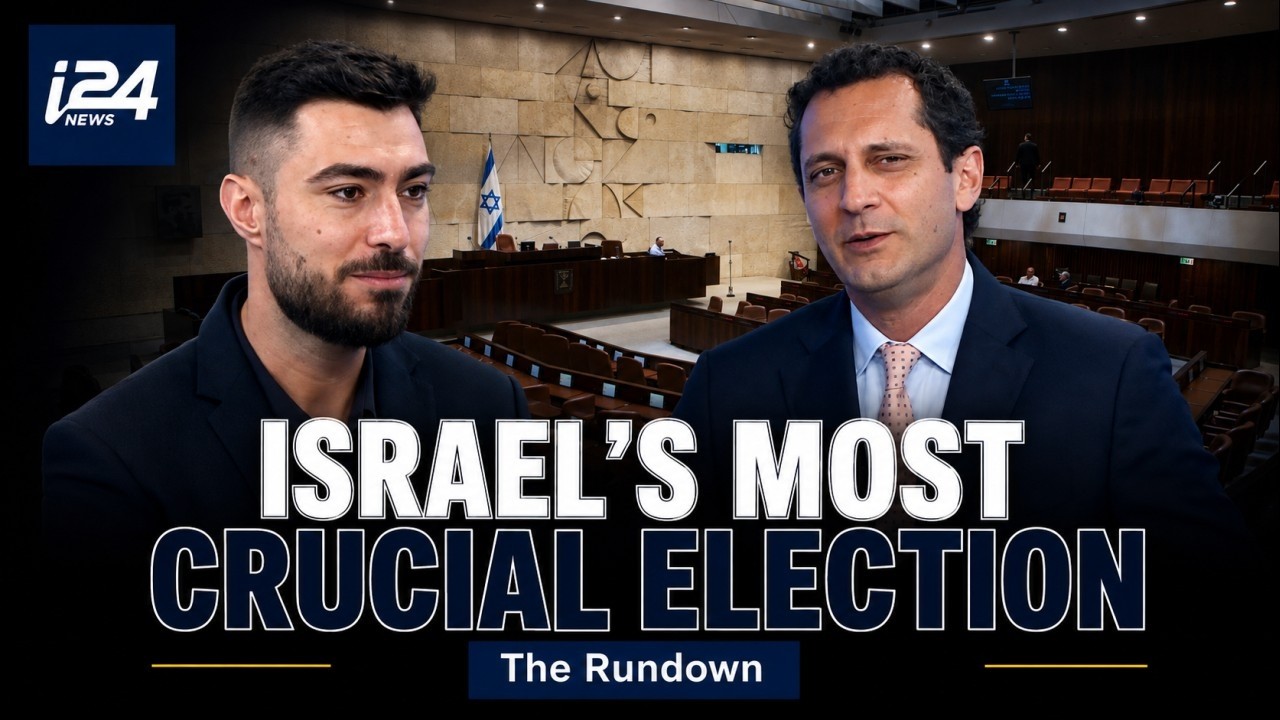
i24NEWS correspondent Balig Sladeen to breaks down the consequential October 27th Israeli elections
Watch on YouTubeVideo summary
The upcoming Israeli elections on October 27th represent a critical juncture in the nation's political history, occurring amidst three years of war and deep internal crises. A significant portion of this discourse focuses on the Democratic Party led by Yair Golan, who represents the left wing but faces substantial challenges regarding their rhetoric and platform. The party has reportedly instructed its candidates to avoid discussing security matters related to Judea and Samaria due to controversies that have alienated many members and voters disappointed with the current Netanyahu coalition. Consequently, figures like Golan are carefully navigating a path between expressing radical positions on issues such as draft equality—claims supported by approximately 85% of citizens—and avoiding statements deemed extreme or controversial by segments of the Israeli public, particularly regarding terminology for territories in the West Bank.
Beyond these internal constraints within the left-wing movement, there is a developing and intriguing political realignment involving Yoav Sigalov, a former lawmaker from Yesh Atid who recently departed his party to seek an alliance with Mansour Abbas's Ra'am party. This potential merger marks a significant shift as it involves bringing together a secular Israeli politician with an Islamist-led Arab party that previously held government seats. The proposal includes demands for the recognition of Israel as a Jewish democratic state and the implementation of national service for Arab citizens, aiming to create a broader coalition that transcends traditional ethnic divides while addressing crime rates within the Arab community through Sigalov's past experience in internal security.
The strategic implications of this potential union are profound, as it challenges existing paradigms about who can collaborate in Israeli politics and seeks to legitimize Ra'am for inclusion in Zionist-led coalitions led by figures like Bennett or Lapid. While Mansour Abbas has faced criticism from some quarters for his past rhetoric regarding national service, his popularity remains high enough to secure five to six seats, outperforming other established Arab parties like Hadash. This movement suggests a pragmatic effort to consolidate support across the spectrum of Israeli society, moving away from purely identity-based politics toward a more inclusive approach that could reshape the electoral landscape ahead of the October elections. Ultimately, these developments highlight how internal party struggles and external geopolitical pressures are forcing Israeli political actors to redefine alliances and priorities in an increasingly volatile environment.
Read the full video transcript
With elections set for October 27th this
year, it's arguably one of, if not, the
most pivotal moment in the history of
Israeli politics. We've all been through
3 years of war with all the internal
crises, the hostage nightmare, and the
expectations, or perhaps lack thereof,
for change is on everyone's mind.
On that note, we're joined in the studio
by correspondent from the Sadi and I
think we start with the Democrats party
led by Yair Golan here who are the
representing the left. Supposedly the
Jewish left it appears increasingly by
the rhetoric
kind of declaring they won't weigh in or
that they're going to structure how they
discuss what used to be really pivotal
subjects for the left. What's going on
with this party right now?
>> Yes, well they have been instructed. I
mean the candidates in this party they
have been instructed not to talk about
security matters, especially those that
happened in Judea and Samaria / West
Bank and they need to seek approval from
the party's leadership because of that
because of very serious of controversies
that lately many members did say things
that have you know drove away from this
party many of the people that are
disappointed of the current coalition of
the Netanyahu coalition. But they're not
willing to actually go for some party
that thinks the way that many of the
candidates and members of this party
actually think. Let's take a listen to
how Yair Golan just tonight tried to
dodge this
problem talking about you know extremism
and he tried to talk about more things
that the party believes in that are in
consensus in Israel. Let's take a
listen.
>> Shalom lekhem.
>> Hello everyone. In recent weeks I have
heard over and over again that the
Democrats and I are extremists. Today I
want to put things on the table and
present to the public the plan for
Israel that it deserves. I warn you you
will hear some super radical things
here. First, as someone who chose to
spend most of his life as a commander
and soldier in the IDF. I radically
support turning off the financial tap
for the draft evader scheme, and I
support equalizing the draft for
everyone.
By the way, this extremist position is
supported by about 85% of Israeli
citizens.
>> It's a 3-minute long video. He's talking
about several issues that I think that
the vast majority of Israelis believe in
the issue of equality in the draft law,
the other issues that could be
considered liberal, you know, not the
American sense maybe, but more the
European sense that, you know, most
Israelis are actually liberal. That's
what he's talking about. What he's What
he is actually taking out of
you know, his speech here are
controversies by Moshe Edelman, for
example, that sent condolences for the
Israeli that was killed, and also the
Palestinian that killed him. And you
know,
this by itself was, you know,
controversial issue back then. Who
killed who? Who is to blame here? Also,
Gabby Lasky, some maybe not see this as
something that is extreme, but many, you
know, Israelis on the right think that
when you ask someone
what is it Judean Samaria or West Bank,
you should say Judean Samaria not West
Bank. So, this is something that we see
even Yair Golan saying that
Israel is a country that kills babies as
a hobby during the last couple of years.
Also, before the war, he did call for
disobedience when it was, you know, the
protest about the judicial
reforms. So, these are many
controversies that he's not mentioning
here, of course, but he knows what's the
problem here. He needs to contain many
of the Israelis that would actually vote
for someone like Yair Golan, but some
you know,
statements, let's call them, are not you
know, are driving people out, and
they need to be fixed in this.
>> I mean, it's a fascinating, you know,
snapshot on the state of the current
Israeli left. So, I you know, great to
to detail this and Yair Golan at the
head of this right now. But, there's
another really intriguing story I want
to get your thoughts on for our viewers
who may not even be aware of this that
uh Yoav Sigalov
he was with the Yesh Atid a lawmaker
with the Yesh Atid for these last years.
He just left the party and he's making
an appeal to Ra'am um under Mansour
Abbas here the the Islamist party that
once was in a coalition the only Arab
party to ever be in an Israeli governing
coalition just a few years ago.
He's talking about joining that party
and he's got a list of demands about um
he wants the party to recognize Israel
as a Jewish democratic state. He wants
to talk about national service for uh
Arab citizens in the country. He's
breaking a lot of sort of barriers with
this one. It got my attention. You know,
what should we be thinking? What
happened in this meeting today between
these two?
>> Well, first of all, um it wasn't, you
know, 100% sure that this is going to
happen actually that Sigalov will join
Mansour Abbas, but it looks like from
today's uh statement it is uh proceeding
into that direction. And um Mansour
Abbas as as you just mentioned he went
too far, you know, um to that extent
that he's calling for, you know, service
for the Arabs maybe not military
service, but you know, national service.
>> Yeah.
>> Um when he talked last coalition, uh you
know, um he was talking in front of the
Israeli flag something that also was
noted
in the Israeli community. So, he went
too far I would say from the Israeli the
Arab-Israeli perspective and he's still
getting five to six seats. This is of
course from his um point of view
definitely very very impressive even
more than the Arab parties that are, you
know, the his competitors.
>> he's very popular.
>> about Hadash here um well-known party
very old still they are not even getting
close to him and now he wants to
legitimize his party for the Zionist
coalition and brings in um Yoav Sigalov.
Yoav Sigalov he was a deputy um for the
internal security minister in the past
uh government. He wants to bring him to
deal with the crime scenes and the crime
rate that we have in the Arab community
and by doing that he hopes we don't know
whether that's going to work for him or
not. He hopes that these Arab parties
Eisenkot, Bennett, others will
will find it like
This is not an Arab party.
>> It's a fascinating moment.
>> It's an Israeli party that maybe some of
its members are Arabs.
>> And and it's great seeing Liberman,
yeah, not a softy, not not a living in a
fantasy. He's trying to sort of change
the paradigm around who can work
together in this. It's an interesting
one. Good for our viewers to pay
attention to. Thanks for shedding light
on all of that.