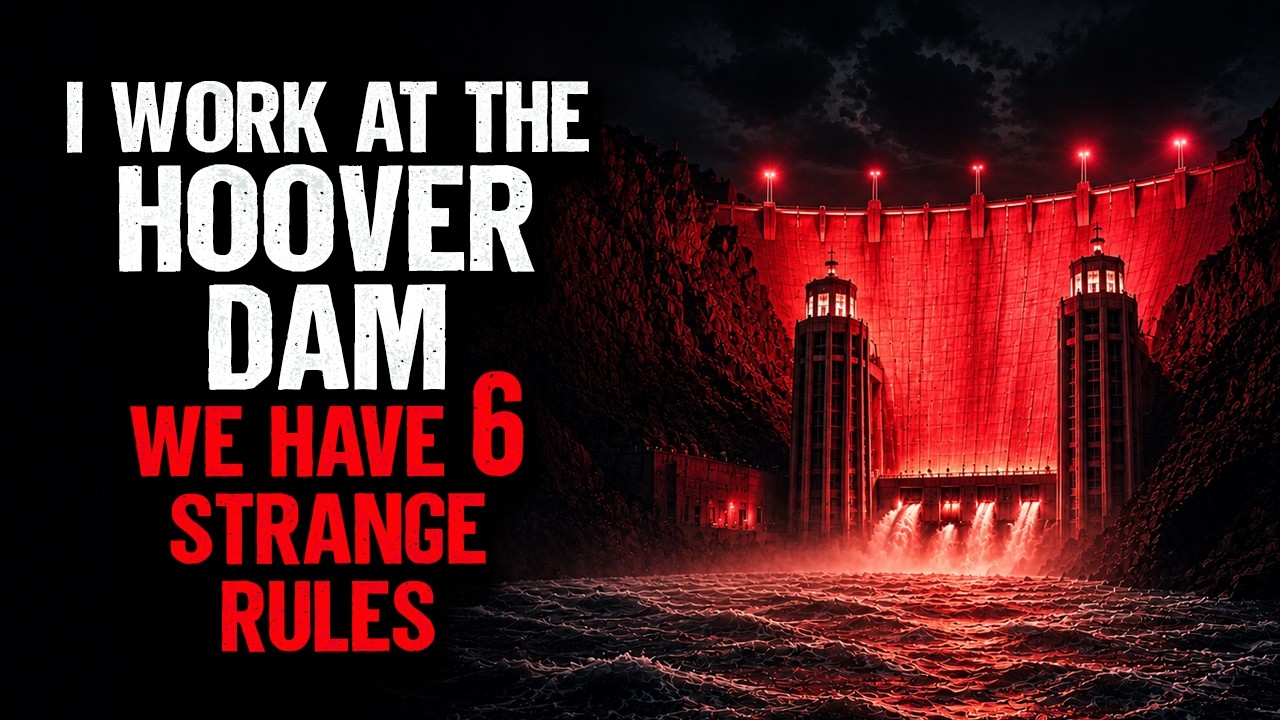
Video summary
The narrator, Andre Williams, shares his nearly nine-year experience working the night shift at Hoover Dam, describing it not merely as guarding a massive concrete wall but as maintaining a small city built inside tunnels and generator rooms. While daytime operations are chaotic with tourists climbing railings for photos, the nights bring an eerie quiet punctuated only by the constant hum of generators, rushing water in pipes larger than houses, and ventilation fans. The job involves routine tasks like checking doors, replacing lights, and inspecting fences, but it is governed by a set of unspoken rules passed down from veteran employees rather than written in any official handbook. These traditions exist because the sheer scale and age of the dam create an environment where standard safety protocols are insufficient to explain every anomaly encountered during long hours alone in the dark.
The most striking rule concerns drinking water between midnight and 1:00 a.m., which was instilled after a colleague named Joel Bailey fell ill with a metallic taste that doctors could not diagnose before he quit. Another terrifying story involves Christian Black, a maintenance worker who vanished mid-shift while inspecting warning lights; security footage showed him stopping to listen to something in the sky and then disappearing without a trace, leaving only his flashlight behind despite witnesses hearing giant wings beating above them years later. A third rule warns against standing too close to the dam's edge at night due to deceptive wind conditions and dizzying drops of over 700 feet, enforced by unofficial yellow lines painted on the concrete that experienced workers strictly obey regardless of official maps or explanations.
The final two rules involve even more supernatural phenomena: never answering a child calling for help from the reservoir at exactly 3:33 a.m., as the voice eventually transforms into something ancient and laughing before vanishing, and immediately running if red balloons are seen floating out of drainage tunnels in the dark. The narrator recounts an incident where he saw these red balloons rise silently until two yellow eyes stared up from below, prompting him and his supervisor to flee without looking back. Over time, the staff accepts that some mysteries have no logical explanation, such as missing security footage or footsteps heard in empty corridors, leading them to simply follow the rules out of necessity rather than curiosity about why they exist.
Ultimately, life on the night shift settles into a strange normalcy where ordinary tasks like drinking coffee and filling out paperwork coexist with these bizarre occurrences that only happen occasionally but leave lasting impressions. The narrator reflects that while most nights are quiet and safe, moments when reality bends—like faucets dripping red water or voices calling from stillness—are enough to remind everyone why they must adhere strictly to the unwritten laws of their workplace. He concludes by emphasizing that these rules are not just superstitions but essential survival mechanisms passed down through generations of workers who have survived long enough to warn others, urging anyone working in such an old and massive structure to listen closely even when what is said sounds impossible.
Read the full video transcript
You ever see Jeepers Creepers? The old
one. If you have, good. If you haven't,
then don't worry. It'll make sense
later. Anyway, my name is Andre
Williams, and I've worked the night
shift at Hoover Dam for almost 9 years.
Honestly, it's a pretty good job. The
pay is great, the benefits are solid,
most nights are quiet. That's why I took
it. Before this, I'd worked security in
warehouses, office buildings, and a
natural gas plant outside Las Vegas.
Nothing exciting, just 12-hour shifts, a
flashlight, a radio, and enough coffee
to stay awake until sunrise. When the
opening at Hoover Dam popped up online,
I applied the same day. A week later,
they called me. Another week after that,
I was standing on top of one of the most
famous structures in America. Most
people think Hoover Dam is just a giant
wall holding back Lake me.
It isn't. It's basically a small city
built inside concrete. There are miles
of tunnels running through the dam,
generator rooms bigger than basketball
courts, maintenance passages that seem
to go on forever, elevators, stairwells,
control rooms, pump rooms, catwalks
hanging hundreds of feet above spinning
turbines. He could work here for years
and still never see every part of it.
During the day, the place is packed.
Tour buses, families, school field
trips, people taking selfies. You'd
never believe how many tourists try
climbing over railings just to get a
better picture. Every now and then,
somebody drops a phone over the edge.
Sometimes a hat. One guy somehow managed
to drop both. By 6:00 every evening,
though, almost all of them are gone. The
gates close, the tour elevators stop
running, the gift shop shuts down, and
the dam becomes quiet,
not silent. A place like Hoover Dam is
never silent. You can always hear the
generators humming somewhere below your
feet. You can hear water moving through
pipes bigger than houses. You can hear
ventilation fans pushing air through
tunnels carved into concrete almost 90
years ago. After a while, you stop
noticing those sounds. They just kind of
become part of the job. There are
usually only a few dozen of us working
nights. Maintenance crews, engineers,
electricians, security. Everyone pretty
much knows everybody else. My shifts
were simple enough. Walk the property,
check secured doors, replace lights when
maintenance needed an extra hand,
inspect fences, respond if an alarm went
off. Most nights nothing happened.
Honestly, I preferred it that way. If I
wanted excitement, I would have become a
cop or a firefighter.
Instead, I got paid to walk around one
of the biggest engineering projects ever
built. Hard to complain. The first week
was mostly training, generator safety,
electrical hazards, heat exhaustion,
emergency evacuation rounds, what to do
if someone fell into a restricted area.
The instructors covered everything you'd
expect. Nothing more. Nobody mentioned
[clears throat] hearing children. Nobody
mentioned red water or balloons. If they
had, [music] I probably would have
assumed they were messing with the new
guy. Instead, my first real shift
started at exactly 7:00 on a Tuesday
night. My supervisor, Scott Jackson, met
me inside the employee entrance with a
flashlight in one hand and a ring of
keys hanging from his belt.
He looked at me for a second and then he
asked me the strangest question I've
ever heard at a job. You ever see
Jeepers creepers?
Rule one, never drink the water between
midnight and 1:00 a.m. Scott didn't tell
me the first rule on my first night or
my second. Honestly, he let me work for
almost 2 weeks before he ever brought it
up. By then, I'd settled into a routine.
I'd clock in around 7, grab my radio,
check the maintenance board to see if
anything needed attention, then start my
rounds. Most nights, I'd spend a few
hours walking the tunnels inside the
dam, checking locked doors, replacing
burned out lights, or escorting
contractors into restricted areas.
Around 10, I'd usually take my lunch in
the employee break room before finishing
the rest of my shift. It was easy work,
you know, quiet, exactly what I wanted.
The break room wasn't anything special.
Few vending machines, a fridge that was
probably older than I was, a microwave
that sounded like it was about to
explode every time somebody used it.
There was also a sink, and one of those
bottle filling stations people always
use nowadays. I probably filled my water
bottle three or four times every shift.
The water came straight from Lake Me
after being treated. It was cold and
clean. Tasted fine, at least during the
day.
The first time Scott mentioned the rule.
It was completely out of nowhere. It was
a little before midnight. We just
finished helping maintenance replace a
light fixture near one of the generator
rooms. By the time we got back upstairs,
I realized my water bottle was empty. I
walked over to the bottle station. Scott
cleared his throat behind me. Don't I
looked back at him. Don't what?
Don't feel it.
I laughed. It's empty.
I know.
So
he checked his watch. 11:58.
Then he looked back at me. Wait an hour.
I stared at him for a second before
laughing again. Seriously?
He nodded.
I figured he was messing with me. I
shrugged and reached for the button.
Anyway, Scott grabbed my wrist before I
could press it. Not hard, just enough to
stop me. I'm not joking, Andre.
Something in his voice made me stop
smiling. He let go of my wrist and
pointed at the clock on the wall. Come
back at 1. Why?
You'll see.
Neither of us said another word. We sat
down at one of the tables in the break
room. Scott drank coffee and I sat there
wondering what kind of joke he was
setting up. The clock slowly rolled over
midnight. Nothing happened. I looked at
Scott and he didn't say anything. And
about 30 seconds later, I heard it.
We both looked toward the sink. A faucet
that had been turned off all night had
started dripping by itself. One drop,
then another, then another. Scott stood
up.
We walked into the hallway. Every
employee sink we passed was doing the
same thing, slow dripping.
One of the electricians walked by
carrying a toolbox. He didn't even look
surprised, just kept walking. When we
reached the next water fountain, Scott
nodded toward it. Go ahead.
I leaned down and the water wasn't clear
anymore.
It was red, almost like rust, except it
wasn't rust. The entire stream had
changed color. I remember just standing
there staring at it. What the hell?
Scott interrupted me. Don't drink it.
We walked to another fountain. Same
thing, then another. Same thing again.
We checked a sink inside one of the
maintenance rooms. read every faucet,
fountain, bottle station, every pipe
carrying drinking water through Hoover
Dam. From exactly midnight until 1:00 in
the morning, the water turned red. At
exactly 1:00, it went back to normal,
just like somebody had flipped a switch.
Clear, cold, perfectly clean. I spent
the next week trying to come up with a
logical explanation. Maybe it was
sediment. Maybe some strange mineral
from Lake me. Maybe maintenance flushed
the pipes every night. But none of those
explanations made sense. If it were
sediment wouldn't happen at the exact
same minute every single night. If it
were maintenance, somebody would have
mentioned it. Eventually, I stopped
asking questions. Everyone on the night
shift already knew. They'd known for
years. Scott finally told me where the
rule came from. About 12 years ago,
before I started working there, a new
maintenance worker named Joel Bailey
decided the older guys were full of it.
He waited until 12:15,
walked over to a fountain, filled an
entire paper cup, then drank in while
everyone watched. He smiled, held up the
empty cup, and asked if that was all
they had.
Well, nothing happened. Then Joel
finished the rest of his shift and went
home. The next day he called in sick.
Scott said Joel told his supervisor he
couldn't get the taste of blood out of
his mouth. Didn't matter what he ate or
drank. Everything tasted like blood.
His doctor couldn't find anything wrong.
Dentist couldn't find anything wrong.
And a week later, Joel quit. Nobody at
Hoover Dam ever saw him again.
Now, maybe it was all in his head. Maybe
there was another explanation.
I honestly don't know. What I do know is
that I've worked here for almost 9
years, and I have never taken a single
drink of water between midnight and
1:00.
Not once.
Rule two. If you hear wings flying above
you, go inside immediately.
You ever see Jeepers Creepers? The old
one. The guy in the trench coat, big
hat, even bigger wings. I remember
watching it years before I ever worked
at Hoover Dam. I thought it was creepy.
Sure, but still just a movie. And then I
started working nights here. The first
time Scott Jackson brought it up, I
laughed. The movie? I asked. Scott
nodded.
Do you remember the wings?
Yeah,
good.
That was all he said. He didn't explain
what he meant. He just kept walking down
the inspection tunnel like we'd been
talking about the weather. I figured he
was just another older guy trying to
mess with a new employee. Every
workplace has stories, you know.
Construction workers have ghost stories.
Truck drivers have haunted highways.
Security guards swear abandoned
buildings aren't really abandoned. I
figured Hoover Dam was no different.
I was wrong.
The story everyone tells new hires
starts with a man named Christian Black.
Nobody agrees on exactly how old the
story is anymore. Some guys say it
happened in 2014. Others swear it was
2016. Scott always said the exact year
it didn't matter. The only part that
matters, he'd tell people, is what
happened after he looked up.
Christian worked the night maintenance
crew. From everything I heard, he was a
good worker. Showed up early, never
complained, never cut corners, kind of
guy everyone wanted on their shift.
Well, one August night, he was assigned
to inspect the warning lights that run
across the top of the dam. Simple job,
really. Walk the roadway. Make sure
every light is working. Replace bulbs if
needed. Report any damage. You spend
most of the shift completely alone. By
that point, the tourists are gone. The
traffic is stopped. Even the wind
usually dies down after midnight. It's
surprisingly peaceful up there.
Christian liked listening to music while
he worked. Technically, you weren't
supposed to wear earbuds during
inspections. Too many safety risks. But
people did it anyway. One ear butt in,
one ear open. That was usually enough.
The security cameras followed most of
his route across the dam. Scott showed
me the footage during my first month.
Not officially. He wasn't supposed to
have a copy. He just told me to sit down
in the security office after lunch one
night. I want you to see something.
The video looked completely normal.
Christian walked across the roadway with
a flashlight in one hand and a clipboard
tucked under one arm. Every few seconds,
he'd stop beside another light, write
something down, then keep moving.
Nothing unusual, nothing scary, nothing
that would have made anyone remember
that night. But then Christian stopped
walking. Not suddenly, almost like he'd
heard something. He reached up, pulled
one earbud out, tilted his head,
listened.
Scott paused the video. "What do you
hear?"
I shrugged. "Nothing."
"Exactly."
He pressed play again. Christian slowly
looked up toward the night sky. Not
straight up, just enough to follow
something moving over him. The security
camera flickered once.
Then again, the screen filled with
static for maybe 3 seconds. And when the
picture came back,
Christian was gone.
His flashlight was lying on the
concrete. One white earbud rested a few
feet away. That was it. No blood, no
signs of a struggle, no damaged railing,
nothing.
I remember staring at the monitor for a
long time before finally speaking.
So, he fell?" I asked. Scott shook his
head. "No, no." Search team spent 3 days
looking.
I watched the last few seconds of the
footage again. There wasn't enough time.
Even if Christian had somehow climbed
the barrier and jumped, he couldn't have
disappeared that fast. Not in 3 seconds.
I looked over at Scott and then he said
something that stuck with me.
The report also leaves something out.
There were four other workers on shift
that night. They were all inside
different parts of the dam and they all
reported hearing the same thing.
I felt a knot form in my stomach. He
looked toward the office window for a
few seconds before speaking.
wings,
big ones.
Now, nobody saw anything. By the time
they reached where Christian stopped
answering his radio, he was already
gone. The official investigation blamed
an accidental fall. Case closed. This
guy told me nobody in the night crew
believed that. Not a single one. After
hearing the story, I started paying
attention whenever I worked outside. Not
because I believed all of it, because
stories like that, they've got a way of
getting into your head. Every owl
suddenly sounded louder. Every gust of
wind made me glance upward. Sometimes
bats flew around the lights near the
intake towers, and I catch myself
watching them longer than I should. And
then almost 3 years later, I heard it. I
was walking back toward the employee
entrance after checking a security gate
on the Arizona side. It's around 2:00 in
the morning. Perfectly clear night. No
wind or traffic, nothing. And then I
stopped walking.
Something else slower this time. It
didn't sound mechanical.
It sounded alive.
Huge. like something with wings was
moving through the darkness above me. I
remember then exactly what Scott had
said years earlier. If you ever hear
wings, don't stop to figure out who they
belong. Do don't look. Just get inside.
For one second,
I almost stopped and looked. Human
curiosity. It's a funny thing. Part of
me wanted to know, you know, wanted
proof.
wanted to see whatever had made
Christian stop and look all those years
before.
Instead, I lowered my head, grabbed my
radio, and I started running toward the
nearest security door. The sound came
once more, closer, this time. Then it
stopped.
I slammed the steel door behind me so
hard the windows rattled. The hallway
was empty. Only the steady hum of the
generators echoed through the concrete.
While I stood there for almost a full
minute trying to catch my breath, Scott
happened to walk around the corner and
carrying a toolbox and one look at my
face told him everything.
You heard him. It wasn't a question.
I nodded.
He looked toward the closed door behind
me, then back at me. You look up. I
shook my head.
No.
And for the first time since I had met
him, Scott smiled.
Good, he said quietly.
That's why you're still here.
The next morning, I couldn't stop
thinking about it. Not because I
believed I'd almost been carried off by
some giant flying creature, cuz I I
didn't. At least not yet. I kept telling
myself there had to be another
explanation. Maybe a large bird. Maybe
some strange echo bouncing off the
canyon walls.
Every explanation sounded reasonable at
first.
Scott never brought it up again. That
was another thing about the night crew.
Nobody liked talking about the rules
once you learned them. It wasn't some
secret club. It was more like everybody
had already accepted there wasn't an
answer. You learned the rule, you
followed it, then you moved on.
A few nights later, I asked one of the
electricians if he'd ever heard the
wings. He looked at me for a couple
seconds before answering
>> once.
What'd you do?
>> Exactly what Scott told you.
Did you look?
He shook his head no and walked away.
Over the next few years, I worked
hundreds of night shifts on top of that
dam. Sometimes I'd spend three or four
hours outside. Summer or winter, didn't
matter. I'd walk the same inspection
routes Christian Black once had, check
the same lights, unlock the same gates,
sign the same inspection sheets. Every
now and then, I'd catch myself looking
up into the night sky. Not because I'd
heard anything, just because I I was
thinking about him. Thinking about those
three seconds.
It's amazing how much your imagination
can do with three missing seconds. Maybe
he really did fall. Maybe the camera
really did fail at exactly the wrong
moment. Maybe everyone inside the dam
imagined hearing wings because they'd
already convinced themselves something
strange had happened. All of those
explanations, they they are possible.
They're also a lot easier to live with.
Still, there's one thing I've never been
able to explain.
Every security camera on Hoover Dam
stores its footage for years.
Maintenance videos, traffic cameras,
inspection recordings, everything except
that one. Christian's recording
disappears right after the static. I've
asked around more than once. The
official answer is that the file was
corrupted. Maybe it was. Or maybe
someone decided nobody needed to keep
watching those three seconds over and
over again.
I honestly don't know. What I do know is
this. I've heard the wings once. Scott
heard them twice. The electrician heard
them once and none of us looked.
Christian Black did. And whether you
believe the old stories or not, he is
the only one who never came back. So, if
you're ever working the night shift at
Hoover Dam and everything suddenly goes
quiet and you hear something enormous
beating the air above your head, don't
try to figure out what it is. Don't
convince yourself it's just a bird.
Don't tell yourself you're being
paranoid.
Don't look up,
just run.
Rule three, never stand too close to the
edge. Now, not every rule at Hoover Dam
exists because of something
supernatural.
Some of them exist because this place is
dangerous enough all by itself. People
forget how massive Hoover Dam really is.
Pictures don't do it justice. Standing
on top of it doesn't either. It's only
when you walk the maintenance routes at
night that your brain finally
understands the scale of the place. The
top of the dam sits more than 700 ft
above the Colorado River. The concrete
curves away beneath your feet until it
almost disappears into the darkness
below. During the day, tourists lean
over the railings to take pictures
without thinking twice about it. At
night, it's different. There are fewer
lights. The canyon below becomes one
giant black shadow. You can still hear
the river, but you can't always see it.
Sometimes all you can make out is a
faint strip of moonlight reflecting off
the water hundreds of feet below.
It's enough to remind you that one
mistake is all it would take. Most of
the inspections we do are routine.
Checking warning lines, looking for
damage along the railings, making sure
gates are locked, verifying cameras are
still online. The kind of work that gets
repetitive after a while. And that's
exactly when people become careless.
Scott used to tell me the same thing
every week. Don't let the routine fool
you.
One windy night during my second year,
maintenance called us out because one of
the warning lights near the Arizona side
had stopped working. Wasn't urgent, just
another burned out bulb. Scott and I
grabbed a replacement and headed out.
The weather had changed since sunset.
The wind coming through Black Canyon was
stronger than usual. Not enough to shut
down work, just enough that you noticed.
Every few minutes, it would whistle
across the top of the dam before it
disappearing into the darkness below.
The Scott walked ahead of me, carrying
the toolbox.
I looked over the side for a second. Big
mistake. Even after working there for 2
years, looking straight down still made
my stomach tighten. The river looked
impossibly small. Cars crossing the
bridge in the distance look like toys.
The wind suddenly picked up. Not much,
just enough to make me instinctively
shift my weight.
Well, we replaced the light in less than
10 minutes. On the walk back, we passed
one of the maintenance pullouts
overlooking the canyon. There wasn't
much there, just a short section where
crews could stage equipment during
larger repairs. Scott stopped walking.
Come here for a second. I walked over.
Painted on the concrete, almost faded
away after years in the sun, was a
yellow line about 3 ft from the edge.
I'd walked past it dozens of times.
Never paid attention to it. What is it?
I asked. Scott shrugged. Nobody really
knows.
What do you mean? It was already here
when I started. So why not repaint it?
We do, he said. He looked toward the
edge. To remind people.
Remind them of what? I asked.
How? Somebody thought it needed painting
in the first place.
Over the next few weeks, I started
noticing the same yellow line in several
places across the dam. Always near
maintenance areas, always a few feet
back from the edge. Never mentioned on
any official map, never discussed during
training, just there. One night, I asked
one of the engineers about it. He looked
where I was pointing. Oh, that
stay behind it.
That's all he said. And then he walked
away. Nobody ever gave me a better
answer. Eventually, I stopped asking.
Instead, I started paying attention.
Whenever I worked outside, I'd noticed
that every experienced employee
naturally stayed behind those yellow
lines.
One night, a contractor stepped right
over one while carrying a coil of cable.
Scott called him back immediately.
Behind the line. The contractor laughed.
I'm still 10 ft from the edge. I know.
So, what's the problem?
Scott didn't answer. He just kept
staring until the contractor finally
stepped back. The rest of us never
crossed it. Maybe it was only a safety
tradition. Maybe the line meant
absolutely nothing. Or maybe after
working Hoover Dam long enough, you stop
ignoring the little habits the older
guys have because every single one of
them started for a reason. So that's
rule three. Never stand too close to the
edge. Maybe it's just because the drop
is over 700 ft. Maybe it's because the
wind through Black Canyon can surprise
you. Or maybe
some rules don't need an explanation.
Rule four. If you hear a child calling
from the water at 3:33 a.m., don't
answer.
The first time Scott told me about rule
4. We were sitting in the maintenance
office finishing paperwork after a
12-hour shift. It was almost sunrise and
everyone else had already gone home.
Scott was signing inspection sheets
while I cleaned out my locker. Without
looking up, he asked me a strange
question. You got kids? I shook my head.
No nieces, nephews.
Uh, my sister's got two, I said. Scott
nodded.
If you uh if you ever hear one of them
calling for help out on the reservoir.
Don't answer.
Scott slid the clipboard into a filing
cabinet and locked it. I'm serious,
Andre.
That was the entire conversation,
and for almost a year, I forgot about
it. Unlike the red water or the stories
about wings, rule four almost never came
up. Nobody talked about it in the
breakroom. Nobody joked about it during
inspections. Even the older guys avoided
the subject. It was almost like saying
too much about it somehow made it worse.
The reservoir above the dam, it's
enormous. During the day, it's full of
boats, fishermen, kayaks, and tourists.
At night, it's empty. That's one of the
strangest things about working there.
You can stand on top of the dam at 2 in
the morning and look across miles of
perfectly still water without seeing a
single light. No boats, no voices, no
engines,
just darkness.
Sometimes the moon reflects off the
surface so perfectly it looks like
polished glass. Other nights you can't
tell where the water ends and the sky
begins.
My job took me up there a few times
every month. Usually was something
simple. Checking security fences,
inspecting flood lights, walking the
shoreline near the intake structures.
Nothing exciting. One October night, I
was doing exactly that. It had been
unusually quiet. No wind or insects.
Even the water looked frozen. I remember
checking my watch while walking along
the access road. 3:31 a.m. I still had
one more gate to inspect before heading
back inside. And that's when I heard it.
Mister.
The voice was quiet. So quiet I honestly
thought I'd imagined it. I stopped
walking. The flashlight hung loosely at
my side. Nothing. No movement or boats
or people. I started walking again.
Mister.
This time it was clearer. A little girl,
maybe maybe six or seven years old. She
sounded scared. Not screaming or crying,
just scared.
I slowly turned my flashlight toward the
shoreline.
Nothing. The beam stretched across the
water without finding anything. And then
I remembered what time it was. 3:33.
Every hair on my arm stood up. The voice
came again.
I'm cold.
It wasn't far away, maybe 50 yards.
Somewhere out in the water. My first
instinct was exactly what you'd expect.
Somebody needed help. A child was out
there. People don't stop to analyze
things like that. You just react. I took
one step toward the shoreline, then
another. The rocks shifted under my
boots. The voice sounded stronger now.
Please, I can't get out.
>> I grabbed my radio. This is Andre. Is
anybody working the north access road?
Static. Then Scott's voice.
>> I'm here.
>> Yeah, I think there's somebody in the
water.
>> No,
>> I hear a little girl.
>> No, you don't.
>> His answer caught me completely off
guard.
What?
>> You stay where you are.
I'm telling you, Scott, there's Andre.
>> His voice had changed. Wasn't loud, but
it was the most serious I ever heard
him.
>> Do not go any closer.
>> I looked back toward the reservoir. The
surface hadn't changed, still perfectly
calm and empty. And then the little girl
spoke. This time she used my name.
Andre.
I felt my stomach drop. I'd never
reported my location over the radio. I'd
never answered whoever or whatever was
out there. Yet somehow it knew my name.
I took another step backward. Scott was
still talking through the radio.
>> Keep walking toward the access gate.
>> What is it?
>> Just walk.
The little girl's voice became more
desperate then. Please, my daddy left
me. I don't want to die.
And then the crying stopped.
Complete silence for maybe 5 seconds.
When the voice returned, it wasn't a
little girl anymore. The words were the
same, but the voice wasn't.
Andre,
come play with me.
The sound rolled across the water like
thunder.
I didn't wait for Scott to tell me
again. I turned around and I started
running as fast as I could. Behind me,
the voice laughed. Not a child's laugh,
not even close.
Every few seconds, it would almost get
it right before slipping back into
something much older.
By the time I reached the security gate,
Scott was already waiting for me. He
didn't ask what I'd heard. He didn't
need to. One look at my face was enough.
We stood there for almost a minute
without speaking. Finally, I asked him
the question I'd been thinking ever
since the radio call.
Has anyone ever gone looking?
Scott stared out across the black water.
A long time ago.
What happened?
They never found anybody.
The child? I asked. He slowly shook his
head.
There wasn't one.
Neither of us spoke after that. We
locked the gate, finished the rest of
our inspections, and watched the clock.
The reservoir looked completely normal
again. Just miles of silent water
reflecting the moon.
I don't know what calls from that
reservoir,
but if you ever find yourself working
the night shift at the dam and you hear
a frightened child calling for help from
the middle of a perfectly still
reservoir at exactly 3:33 in the
morning, don't answer.
Rule five, never enter an unassigned
maintenance tunnel alone.
By the time you make it to rule five,
you've usually stopped asking why the
rules exist. You just follow them. Some
make sense, some don't. Either way, they
keep you alive. The fifth rule is
surprisingly ordinary compared to the
others. At least that's what I thought.
Never enter an unassigned maintenance
tunnel alone. Sounded like standard
workplace safety. Buddy system, confined
spaces, nothing unusual. And then I
actually started working inside the
tunnels. From the outside, the dam
doesn't look all that complicated. It's
one giant wall of concrete holding back
an enormous reservoir. Simple enough.
Inside, it's a maze.
There are maintenance galleries,
drainage galleries, electrical
corridors, ventilation passages,
equipment rooms, inspection shafts, and
stairwells connecting levels that seem
to go on forever. Some tunnels are wide
enough to drive a pickup truck through.
Others barely let two people squeeze
past each other. Almost every hallway
looks the same. gray concrete, steel
doors, yellow safety rails, rows of
pipes disappearing into the darkness.
After a few hours underground, you
completely lose your sense of direction.
There aren't any windows. You can't see
the sun. You can't hear traffic. The
only constant is the low vibration from
the generators.
Eventually, every corridor starts
looking identical. Scott warned me about
that during training. Never trust your
memory down here. I've got the maps, I
said. You might not when the power goes
out, he said.
Every employee carried a radio, a
flashlight, and a laminated map of the
tunnel system. That sounds reassuring
until you realize there are hundreds of
intersections. A wrong turn doesn't
usually put you in danger. It just
wastes time. Most nights, that's all it
is.
most nights.
Well, one winter evening, maintenance
reported a pressure sensor that had
stopped responding. Wasn't a major
repair. Someone just needed to confirm
the wiring hadn't been damaged.
Scott was busy helping another crew, so
we pointed toward the maintenance
office. Grab the blueprints. I'll meet
you down there. No problem, I said. I
picked up the map, checked the tunnel
number, and headed downstairs. The first
10 minutes were completely normal.
Concrete corridor, left turn, steel
door, another corridor, exactly like
every other inspection. And then I
reached a four-way intersection.
According to the map, I needed to go
left. Except there wasn't left. The
hallway shown on the blueprint simply
didn't exist.
Instead, there were three identical
corridors stretching away into the
darkness.
I checked the map again. Same result,
wrong layout. I figured I'd counted
intersections incorrectly. Easy mistake.
So, I picked the center hallway. 5
minutes later, I found another
intersection. And again, it didn't match
the map. I stopped walking, pulled out
my radio. Yeah, this is Andre. Static.
Scott, you copy?
Nothing. I tried again. Still nothing.
The radio had worked perfectly upstairs
and now just silence.
That was the first time I realized how
quiet those tunnels could become.
Without the radio chatter, without
footsteps, without anyone talking,
all I could hear was the distant hum of
machinery somewhere inside the concrete.
It almost sounded like breathing.
I told myself not to be ridiculous. This
place was nearly 100 years old. Old
buildings make noise. Pipes expand. Fans
cycle on and off. Concrete settles.
There was a logical explanation for
everything.
I took another hallway, then another.
Nothing looked familiar. Every door had
the same paint. Every light fixture
looked identical. Every corridor
stretched into another corridor. I
checked my watch. Almost 40 minutes had
passed. The repair should have taken 10.
And for one of the first times since
starting the job, I felt genuinely
uncomfortable.
I had absolutely no idea where I was. I
stopped again and listened. Somewhere
far ahead, I heard footsteps.
Finally, somebody else was down here.
Hello?
No answer.
The footsteps continued, heavy work
boots by the side of them. I started
walking toward them, and the strange
thing was, I never got closer. No matter
how fast I walked, they stayed exactly
the same distance away. Always around
the next corner, always just out of
sight. I called out again. Nothing, just
footsteps.
By then, I wasn't even thinking about
the broken pressure sensor anymore. I
just wanted another human being, another
radio, another voice. I turned another
corner, empty hallway. I heard the
footsteps behind me. Then I spun around.
Nothing. The corridor I just walked
through was completely empty.
The footsteps [music] stopped. Then
every instinct I had told me to start
running.
Instead, I forced myself to stand still,
take a breath, think. As Scott always
said, panic was the quickest way to get
lost.
I closed my eyes for a second, listened.
The generators, the ventilation fans,
water moving somewhere inside the
structure, and then faintly a radio.
Andre
>> Scott. I couldn't make out the words,
only my name. I answered immediately.
This is Andre.
Static. Then
>> don't move.
>> The transmission was broken, but it was
enough. I stayed exactly where I was.
Less than 2 minutes later, Scott rounded
the corner carrying another flashlight.
You all right? I got turned around. I
know. How'd you find me? He held up a
small tracking receiver clipped to his
belt. Your radio.
On the way back, I asked him about the
footsteps. He didn't even look at me.
What footsteps?
The ones I kept hearing.
Scott was quiet for several seconds.
Finally, he shrugged.
Yeah, I've heard them, too.
You ever figure out what they were? No.
Were they another worker? I never found
anybody.
That was all he said. We finished the
repair together. Took less than 5
minutes. As we climbed back into the
main access corridor, I looked over my
shoulder one last time. The tunnel was
empty, completely still. Nothing chasing
us, nothing standing in the darkness.
Just another stretch of gray concrete
disappearing underground.
Now, maybe I imagine the footsteps.
Maybe stress and isolation got the
better of me. Maybe old tunnels play
tricks on your ears.
But I don't think so.
Rule six. If you ever see red balloons
floating out of one of the drains, run.
By the time I learned the sixth rule,
I'd stopped trying to decide which
stories were real and which ones
weren't. I had seen enough strange
things to understand one simple fact.
You don't have to understand a rule to
follow it. You just have to survive long
enough to learn why it exists. The sixth
rule wasn't written anywhere. Wasn't in
the employee handbook. Wasn't posted on
a bulletin board. Scott didn't even tell
me himself. I overheard it. It was just
after 2:00 in the morning and a water
mane had burst inside one of the lower
maintenance galleries. Half the night
crew had been called in to help shut off
valves before the flooding reached an
electrical room. For almost 3 hours,
everyone was busy. Maintenance,
security, engineers.
Even supervisors were carrying pumps and
hoses. By the time we finally finished,
everybody was exhausted. A few of us
ended up sitting outside one of the
service buildings drinking bad coffee
from paper cups while we waited for the
maintenance report to be finished.
Nobody was talking much. And then one of
the older mechanics looked toward a
storm drain near the edge of the
roadway.
Been about 9 years, he muttered. Another
guy nodded.
Closer to 10.
Scott looked up immediately.
Don't start.
I'm just saying
we're do.
Nobody laughed. Nobody asked what he
meant. The conversation simply died.
About 5 minutes later, everyone stood
up, threw away their empty cups, and
went back to work. I caught up with
Scott before we headed inside. "What was
that about?" "What?"
"The balloons," I said. He frowned. I
didn't say anything about balloons.
No, no, the mechanic did that. I
overheard him talking about it. Scott
stopped walking for a second. I thought
he wasn't going to answer. And then
finally, he said, "Forget you heard it."
"So there are balloons." "No, you
literally just there are no balloons."
He interrupted.
He unlocked the security door and
stepped inside. The conversation was
over. That should have been enough, but
it wasn't. The problem with telling
someone to forget something is that it's
almost impossible to do. Over the next
few weeks, I started asking around, not
directly, just little questions. Nobody
gave me a straight answer. Some people
pretended they had no idea what I was
talking about. Others simply changed the
subject. One maintenance worker actually
walked away in the middle of our
conversation. That was unusual. The
night crew talked about everything.
Equipment failures, paychecks, sports,
ghost stories. They never walked away
unless the subject was balloons.
About a month later, I finally got an
answer, or at least part of one. Scott
and I were inspecting one of the lower
drainage galleries after a heavy
rainstorm. Most people don't realize how
much water moves through a dam besides
the reservoir itself. Rainwater,
groundwater, runoff, all has to go
somewhere. The drainage system
underneath the structure stretches for
miles. Most of it is concrete tunnels
just large enough for two people to walk
side by side. Cold, wet, always echoing.
We were checking for debris that might
have blocked one of the grates.
Scott stopped beside a rust cover drain
cover and shined his flashlight inside.
Clear. I checked the other one. Also
clear. And then something caught my eye
farther down the tunnel, maybe 50 yards
away, something bright red.
At first I thought it was a warning flag
somebody had dropped. And then it moved
slowly,
floating.
I narrowed my flashlight beam. It wasn't
a flag. It was a balloon,
bright red.
It drifted upward from the darkness
beneath a drain tunnel, as if someone
below had just let go of the string.
It simply floated there, silent, turning
slowly in the stale air.
I stared at it for several seconds
before speaking.
Scott.
He was already looking. The color
drained from his face. For the first
time since I met him, I saw genuine
fear.
He grabbed my arm hard enough to make me
stumble.
We're leaving right now. He didn't raise
his voice, but there was something in
his eyes I'd never seen before. the kind
of look people get when they've
recognized something that they hoped
they would never see again. He pulled me
toward the tunnel entrance and I looked
back one last time. There were two
balloons now, then three, all of them
rising silently from the darkness below.
Scott grabbed my arm before I could take
another step. And for just a split
second, I looked back.
Two yellow eyes were staring up at me
from the darkness below.
We didn't wait to see anything else. The
steel door slammed shut and a single
heavy impact echoed from the other side
while we finished out the rest of our
shift and went home that morning.
But I have never forgotten that night.
The strange thing is life eventually
settled back into something that almost
felt normal. Not normal by anyone else's
standards, obviously, but normal for us.
The water still turned red every night
between midnight and 1. Every new
employee still got warned about wearing
earbuds outside after dark. The yellow
lines were still repainted every few
years. Nobody answered voices coming
from the reservoir. Nobody entered
maintenance tunnels alone.
And nobody ever mentioned the balloons.
You stop asking why after a while. You
stop trying to solve every mystery.
Instead, you learn the rules. You follow
them. Then you go home.
I think that surprises people. They
imagine working somewhere like this
would feel terrifying every single
night. It doesn't. Most nights are
completely ordinary. You check doors,
replace light bulbs, walk your route,
fill out paperwork, drink coffee, and
watch the sun come up. And then you
drive home like anyone else after a long
shift.
Sometimes months go by without anything
unusual. Long enough that you almost
convince yourself the older guys were
just telling stories. Long enough that
you start wondering if maybe you
imagined some of it yourself.
And then something happens. A faucet
starts dripping just before midnight. A
sound echoes across the top of the dam
that shouldn't exist. A voice calls your
name from the water. Footsteps follow
you through an empty tunnel. Or you
catch a flash of red just out of the
corner of your eye. And suddenly every
story you've ever been told comes
rushing back.
People ask me all the time if I'd ever
take another job. Maybe someday. I've
thought about it more than once. But
then I ask myself a simple question. If
I left, who would warn the next guy?
Because nobody puts those rules in the
employee handbook. You only hear them
from the people who've survived long
enough to pass them on. Maybe that's why
they're still around.
So, if you ever find yourself working
the night shift somewhere old, somewhere
built out of thousands of tons of
concrete, somewhere with endless tunnels
beneath your feet and miles of black
water behind your back, listen to the
old guy training you, even if what he
says [music] sounds impossible.
Especially then
because every rule
has a story. [music]
[music]