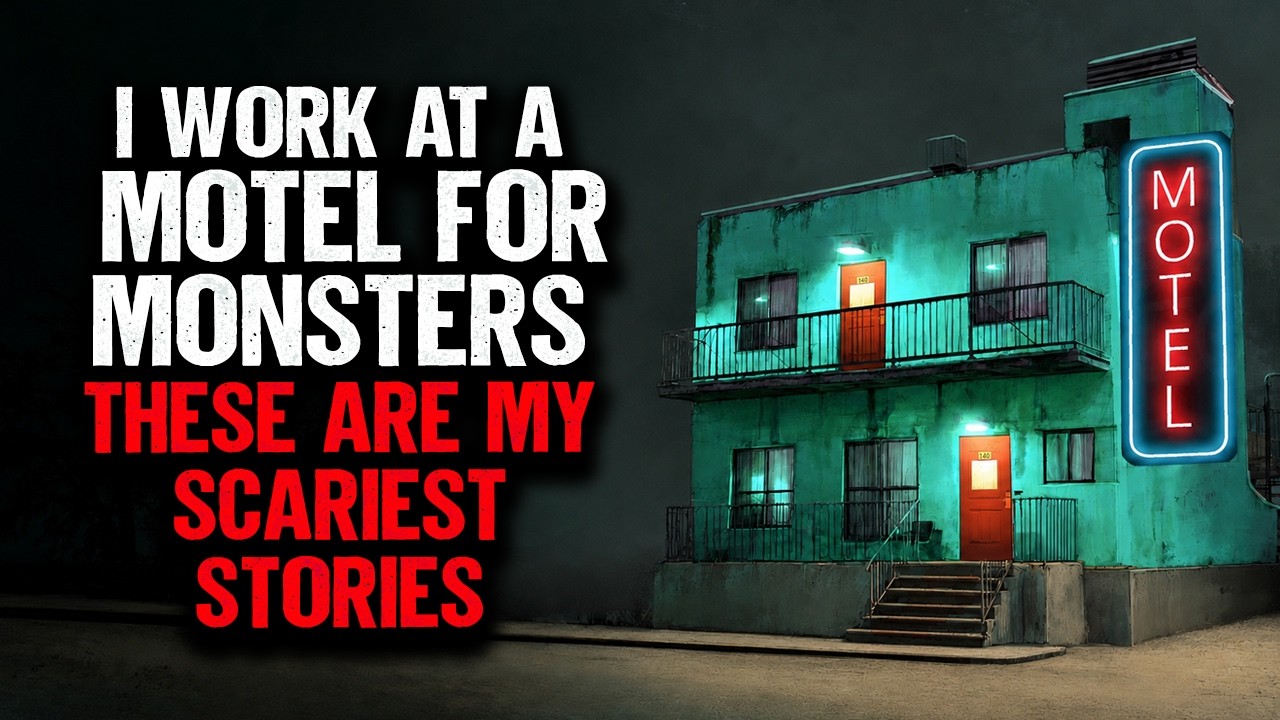
Video summary
Evan Hol works the night shift at the secluded Shelter Ridge Motel in West Virginia, a unique establishment that serves as neutral ground for various supernatural creatures after midnight. The motel operates under strict rules enforced by an unseen entity residing in the attic, which intervenes to remove aggressors if guests violate them, such as attacking others or crossing the desk's symbolic boundary. Guests are explicitly instructed to retrieve any dropped objects themselves and must never step beyond the old stone markers, as doing so leaves them entirely on their own with dangerous entities following behind.
The motel hosts a diverse array of supernatural residents, including a pale, floating child who is polite but hungry for travelers willing to leave protected areas, and a pack of six golden retrievers that act as vampires at night while adhering strictly to the rules inside the property line. Other notable guests include the annual Haskins family of zombies who require raw meat and have been known to eat pillows or leave behind body parts despite their generally polite demeanor, as well as underground lizard people who seek warmth in winter and tolerate no theft from them. Additionally, a tall, vampire-like figure resembling Count Orlok rents the basement, where his patient presence causes other monsters to avoid the area, though he rarely speaks and tests boundaries by asking Evan to cross the desk line or retrieve items from behind it.
While many of these monsters remain harmless as long as the rules are followed, the true danger lies in complacency and forgetting one's surroundings. The motel provides a layer of safety through its enforced regulations, but guests must remain vigilant to avoid becoming careless. A tragic example occurred when a human guest named Daryl Kemp was dragged away by the vampire dogs after throwing objects across the property line, illustrating that once the boundaries are crossed, there is no protection. Ultimately, the narrator concludes that maintaining awareness and respecting the specific limits of this neutral ground is essential for survival in a place where violence is forbidden within the property but reigns without restriction outside it.
Read the full video transcript
My name is Evan Hol and for the past
four years I've worked a night shift in
a motel for monsters. The place is
called Shelter Ridge Motel. It sits at
the top of a mountain pass in West
Virginia, 12 mi from the nearest town
and far enough above the valley that
clouds sometimes settle beneath a
parking lot. If you arrive during the
day, looks like an ordinary roadside
motel that should have closed decades
ago. There are 12 rooms with faded green
doors, [music] rusted railings, and
yellow lights that buzz beneath a second
floor hallway. A red vacancy sign stands
beside the road, although the V goes
dark whenever it rains. The building is
old, but clean and well-maintained. It
simply belongs to another time when
travelers still cross the mountains on
two-lane roads, and a glowing sign in
the fog was enough to make a person stop
for the night.
The interstate now carries almost
everyone 6 mi south, so we see few
ordinary guests after dark. The guests
we [music] do see are why Shelter Ridge
remains open. I found the job through a
notice taped inside a diner near
Charleston.
It offered good pay, a free room, and
four nights off every week. I just left
a warehouse job and my lease was ending.
So, I called the number at the bottom
and spoke to Natalie Shaw. Natalie owned
the motel. She was in her early 60s and
spoke with a calm of someone who had
already considered every possible
emergency. She asked whether I drank at
work, whether I frightened easily, and
whether I could follow instructions
before I understood them. Then she asked
if I'd ever seen anything I could not
explain. I said no. And she told me that
would change. I assumed she was joking
until I arrived at Shelter Ridge and saw
the front desk. The desk itself is dark
wood with a low swinging gate at one
end. Around it, carved into the tile, is
a circle of symbols filled with nearly
black metal. The same markings run along
the counter and across the gate. They
resemble hooks, eyes, antlers, and
circles crossed by uneven lines. Set
into the counter is a sliding brass tray
for money, registration cards, and keys.
Natalie told me that after midnight, I
was to remain behind those symbols until
sunrise. I could use the bank office or
the cot beside the security monitors,
but no part of my body could cross that
line. If a guest dropped something, the
guest could [music] pick it up. If
someone needed help in the parking lot,
I could call the sheriff or an
ambulance. I was never to go out there
myself.
Then she showed me the brass plaque on
the wall behind the desk.
It lists five rules.
No violence is allowed on motel
property. No one may hunt or feed on
another guest. Every guest [music] is
protected until checkout. No guest may
cross the desk markings. Behind the
stone property markers, the motel is not
responsible.
I don't know if you guys are like me,
but I am really good at putting off
doctor's appointments. I've definitely
had times when I knew I should make an
appointment, but I kept telling myself,
"I'll do it tomorrow. Then tomorrow
turns into next week and suddenly I've
put it off way longer than I meant to."
And honestly, part of that is just the
hassle of booking one. You have to
figure out who to call, whether they
take your insurance, when they're
available, and sometimes you finally
make the call only to find out you can't
even get an appointment for weeks. So,
if you've been doing the same thing,
don't keep putting it off. Zachdoc is
sponsoring today's video and they make
finding and booking a doctor a lot
easier. With ZacDoc, you can search and
compare local in-et network doctors,
read reviews from real patients, look
through detailed doctor profiles, and
see actual appointment openings right
online. They have more than 150,000
providers across more than 200
specialties in all 50 states.
Appointments are often available within
24 to 72 hours. And sometimes you can
even find same day appointments, and
Zachdoc is completely free to use. So,
if there's an appointment you've been
putting off, take the first step and go
to zakdoc.com/lighthousehor.
The link is also at the top of the
description. Again, that's
zakdock.com/lousehor.
Taking care of your health just got
easier. So, click the link and check
that appointment off your to-do list.
I asked what kind of motel needed to
forbid guests from hunting one another.
And Natalie told me the truth. During
the day, Shelter Ridge belongs to
people. After midnight, it is neutral
ground for things that cannot safely
stay anywhere else. Some like human.
Others make no effort to. Vampires pass
through the mountains. Shape shifters
use our rooms during the full moon, and
underground creatures arrive when the
mountain freezes. We also have hosted
things Natalie cannot name. Many carry
feuds older than the motel. Werewolves
growl at vampires. Forest creatures
avoid anything that smells of deep
earth. Nearly every living guest
complains about zombies. When ordinary
travelers check in, I catch other guests
staring at their throats or breathing in
[music] their scent.
They are allowed to stare. They are
allowed to hate one another. They are
not allowed to attack.
I asked Natalie what prevented them from
breaking the rules, and she pointed
toward the ceiling. There's an attic
above the lobby and the first six rooms.
No employee uses it for storage. The
hatches kept shut, although there's no
lock on it, [music] and slow dragging
noises crossed the ceiling at all hours
of the night. Natalie said the thing up
there had already been in the building
when her father bought Shelter Ridge in
1973.
Whatever it is, it protects the motel.
If one guest attacks another, the attic
opens.
Something comes down [music] and takes
the guest who broke the rule. It does
not ask who started the argument. It
doesn't care whether the victim deserved
it. It recognizes violence and it
removes the source.
Natalie warned me not to mistake
punishment for protection. A monster
could still hurt me before the thing
upstairs reached it. That's why the
symbols around the desk mattered. They
were the only part of Shelter Ridge
where the rules could not be broken.
On my first night of training, two
guests began arguing near the vending
machines. One was a thin woman with
white eyes. The other had short black
horns hidden beneath a baseball cap. I
never learned what the disagreement was
about. The horned guest reached out and
caught the woman by the throat. The
motel became silent.
The light stayed on, but their buzzing
stopped. Even the woman ceased
struggling. A heavy step pressed into
the ceiling, followed by the scrape of
something moving toward the attic hatch.
Natalie told me to look down. I did,
although not quickly enough. I saw the
hatch lift and a gray hand fold around
its edge. The arm behind it was longer
than my entire body. I kept my eyes on
the desk after that. Something enormous
passed close enough for me to smell wet
stone and old dust. The horned guest,
made one brief sound. Then the hatch
closed, and every ordinary noise
returned. The woman with the white eyes
straightened her coat, thanked Natalie,
and went back to her room. A deep scrape
remained in the tile where the horned
guest had been standing.
And that was my introduction to Shelter
Ridge.
The following night, I worked alone for
the first time. A little after 2:00 in
the morning, a thirsty child appeared
outside the lobby.
It had been raining since sunset. Not a
hard storm, just the steady mountain
rain that turns the parking lot black
and hides the trees behind a wall of
mist. I hadn't seen a car for more than
an hour when I noticed a boy standing
beneath a red light of the vacancy sign.
looked seven or eight years old. His
dark hair was plastered against his
forehead, and he wore a white shirt with
a narrow collar, brown shorts, and
suspenders. The clothing made him look
as if he'd stepped out of an old school
photograph. He had no coat or shoes. I
watched him through the window for
several seconds, expecting an adult to
appear. When no one did, I used the
intercom to ask whether he needed help.
The boy came to the unlocked lobby
entrance but stopped at the threshold as
though a sheet of glass blocked his way.
He said he was thirsty.
There was a small refrigerator behind
the desk, so I took out a bottle of
water and held it up. The boy looked at
the bottle, then at me, but he did not
enter. He asked if he was allowed
inside.
That should have warned me. Instead, I
remembered Natalie saying the motel was
meant to shelter creatures that had
nowhere else to go. I assumed the boy
was one of them, although I had no idea
what kind. I told him he could come in.
The moment I invited him, he crossed the
threshold. He did not run from the rain
or shake the water from his clothes. He
simply moved toward the desk and stopped
on the far side of the symbols. His face
was pale and completely calm. I placed
the bottle in the brass tray and slid it
toward him. He didn't take it. He said
the cap was too tight.
I pulled the tray back, opened the
water, and returned it. The boy still
did not touch the bottle. He explained
that his hands were cold and asked if I
could bring it around the counter.
By then, I understood what he wanted.
The request was small enough to sound
reasonable, but fulfilling it would
require me to cross the symbols. I told
him the tray was as far as I would go.
He accepted this without complaint and
began making gentle suggestions. I could
place the bottle on the floor or step
outside for only a second, he said. When
those failed, he said his mother was
injured near the road and asked me to
help her. From where I sat, I could see
the entire stretch of pavement between
the lobby and the vacancy sign. There
was no one there. The longer he remained
under the lights, the more I noticed. He
never blinked. Despite his soaked
clothing, not a drop fell onto the
floor. His eyes looked almost brown when
he watched my face, then turned a cloudy
red when his attention moved to my
throat.
His feet were the worst part. At first,
I thought he was standing on his toes.
Then he drifted sideways without taking
a step, and I saw that his bare souls
were several inches above the floor.
The boy slowly circled the desk,
studying the markings and leaning close
to the invisible boundary. At the
swinging door, he asked whether I was
frightened of him. I told him I was not.
He smiled as if we both knew I was
lying.
Around 3, a truck pulled in. [music] The
driver, Cal, hauled furniture between
Ohio and North Carolina. He'd missed the
interstate, lost his phone signal, and
followed our red sign through the fog.
The moment Cal entered, the child
changed. He didn't move toward him. He
merely watched with an attention more
disturbing than open hunger, nostrils
widening as his tongue passed over his
upper lip. Cal asked whether the boy's
parents were around. I said they were
elsewhere on the property and pushed a
registration card through the tray.
Until Cal signed it and received a key,
he was only a visitor. Once his name
entered our book, the rules applied to
him.
The boy understood. His gaze moved from
Cal to the register, and his polite
expression disappeared.
Cal signed, took the key to room 5, and
listened while I warned him not to open
the door before daylight. As he crossed
the parking lot, the child remained in
the lobby. Something heavy shifted in
the attic.
Dust slipped from the ceiling above the
coffee machine.
The boy glanced up, then folded his
hands in front of him and stepped away
from the door. Whatever he had intended
to do, he no longer considered it worth
the risk. For the rest of the night, he
concentrated on me. He asked whether the
symbols protected the back office and
what would happen if one were scratched
away. He claimed to have dropped a
button beside my chair, although there
was nothing there. His excuses became
less convincing as sunrise approached.
Shortly before 5, he floated close to
the boundary and opened his mouth. There
were no ordinary child's teeth inside
it.
He stayed that way only for a moment.
A slow dragging sound crossed the attic
above us and his mouth closed again.
I wrote child in the register and pushed
on the key to room three. He thanked me
for the untouched water and drifted
across the parking lot.
After sunrise, Natalie arrived and said
the child had visited since she was
young. He never attacked registered
guests or cross the desk markings. He
searched [music] for people who would
leave protected areas willingly because
the rules could not protect someone who
followed him beyond the property line.
He still visits two or three times each
year. He always arrives alone. He's
always barefoot and he's always thirsty.
I no longer invite him into the lobby.
That does not keep him away. He simply
stands outside the open door watching me
until another traveler arrives.
Over time, I learned that the worst
guests were rarely the ones who looked
frightening. Some creatures were
harmless. Others seemed friendly,
provided you remembered what they were.
The best example is the pack of golden
retrievers that rents room two whenever
there is a thunderstorm.
The first dog appeared near the end of
my second month at the hotel. He was a
large golden retriever with muddy paws
and a faded blue collar. Five others
waited behind him in the rain. None wore
tags and I couldn't see an owner
anywhere in the parking lot.
The largest dog approached the desk with
an old coin held gently between his
teeth. He placed it in the brass tray,
sat down, and looked toward where the
keys were. I called Natalie because I
didn't know whether we allowed animals
to rent rooms. She asked how many there
were, what kind, and whether the largest
had brought payment. When I answered,
she told me to give them room two and
leave six towels outside the door.
The dogs became regular guests after
that. They're strange even by Shelter
Ridge standards, although it took me
several visits to understand exactly
why. They behave like ordinary golden
retrievers most of the time. They wag
their tails when I green them. They sit
patiently while I fill out the register
on their behalf. They bring sticks into
the lobby and leave them beside the
symbols in the hope that I will throw
one. I never do. The markings might stop
their teeth, but the stick would land
outside the desk, and I have learned not
to create reasons to cross the line.
They stay together in room two, piled
across both beds. They leave fur on
everything, drink from the sink, and
once chewed television remote into
pieces. Those are the worst problems
they've caused inside the motel.
Their condition becomes obvious only
after dark.
They have no reflections in the lobby
mirror. Their eyes shine a deep red even
when no light is hitting them and their
canine teeth are much longer than they
should be. When they become excited,
their paws lift several inches off the
floor. The first time I saw the entire
pack floating around the lobby with
their tails wagging. I had no idea how I
was supposed to react. Beyond the
property they hunt. Deer occasionally
turn up pale and bloodless with tracks
leading toward room two that disappear
long before reaching it. I do not know
how six golden retrievers became
vampires. Natalie does not know either.
They were already using the motel when
she took over from her father. According
to the old registers, they've been
arriving in the same group since at
least 1986,
and none of them have aged.
Despite that, they are among our easiest
guests. Vampires seem offended by their
existence, as if turning a dog into one
of them broke some private law.
Werewolves growl when they enter. The
dogs respond by wagging their tails,
which only makes the werewolves angrier.
They've never attacked anyone on the
property, but there was Daryl Kemp.
Daryl arrived one summer night after his
pickup overheated on the mountain road.
He was already angry when he entered the
lobby, and seeing six wet dogs stretched
across the floor did not improve his
mood. He complained about the smell,
demanded that I remove them, and asked
whether the motel was some kind of
animal shelter. You got dogs in this
hotel. Great. Just great, he said.
One of the younger dogs stood and walked
over to greet him. Daryl drew back his
boot, but the dog moved before he could
kick it. The other five stood at the
same time. Their tail stopped moving,
and their eyes slowly brightened from
brown to red. I warned Daryl that they
were registered guests. He laughed,
removed his belt, and snapped the buckle
against the tile, inches from the
younger dog's paws.
A single footstep sounded in the attic.
Then it was not especially loud, but
everything in the lobby reacted. A woman
sitting beside a vending machine closed
her pale inner eyelids. Something under
a heavy coat near the door folded itself
smaller. The dog sat down immediately
and kept their teeth hidden.
Daryl looked around, confused by the
sudden silence. He'd not actually
touched a guest, so the hatch remained
closed. I told him to leave before that
changed. He must have heard enough fear
in my voice to believe me. He returned
to his truck and drove down the
mountain, shouting through the open
window as he went. The dogs watched
until his tail lights disappeared.
And that should have been the end of it.
Instead, Daryl came back the following
night. He'd been drinking. He stopped
his truck on the road beside the motel
and stood just beyond one of the old
stone markers that define the property.
From there, he threw empty cans and
small rocks toward the parking lot. He'd
apparently decided that whatever was in
the attic could not reach him if he
stayed outside Shelter Ridge.
And he was right. What he did not
understand was that the motel rules no
longer protected him either.
The six dogs were lying beneath the
walkway when he arrived. For several
minutes, they ignored him. Daryl
continued yelling. He threw a bottle
that shattered on the pavement near
them. The bottle crossed the property
line. He did not. The dog stood and
quietly walked toward the road. There
was no chase that I could see. Daryl
backed into the fog and the pack
followed him beyond the marker. A few
seconds later, all six rose above the
trees with Daryl suspended by his jacket
and pant legs. The mountain swallowed
his shouts as they carried him away.
The entire thing lasted less than a
minute, maybe. The attic remained silent
because nothing had happened on motel
property. The dogs did not return that
night. Three evenings later, the largest
appeared in the lobby carrying Daryl's
belt. He placed it in the brass tray and
sat down with a patient expression of an
animal waiting to be praised.
I left the belt where it was until
sunrise.
Daryl, he was reported missing, but his
truck was found abandoned several miles
away, and no one connected him to
Shelter Ridge. I never asked the dogs
what happened. And even if they could
answer, I'm not sure I would want to
know. They still rent room, too during
storms.
They still leave sticks beside my desk
and float slightly whenever I scratch
their ears with the end of a broom. I
like them, although I never confuse
affection with safety. They are friendly
because they choose to be. Outside the
motel, they are still a pack of
predators that does not age and can
carry a grown man into the clouds. That
distinction matters at Shelter Ridge. A
creature can be polite, even pleasant,
without becoming anything less than a
monster.
The Haskins family proves the opposite
point. They are dangerous, even though
none of them wants to be.
Leonard and Beth Haskins have been
bringing their children to Shelter Ridge
every summer for nearly 20 years. They
arrive in the same Brown station wagon,
usually in the middle of July, with
suitcases tied to the roof and a paper
road map spread across the dashboard.
Leonard is the father. Beth is his wife.
Their son Owen appears to be about 16,
and their daughter Lucy looks 9 or 10.
Those ages have not changed since their
first visit.
All four of them are dead. Their [music]
skin has the dull gray color of old
newspaper, and they smell faintly of
damp soil. Beth wears floral dresses and
keeps a silk scarf tied around her neck
to hide a dark line circling it. Leonard
speaks very little because most of his
lower jaw is missing. Owen has cloudy
eyes and spends most of his time wearing
headphones that are not connected to
anything.
Lucy carries a stuffed rabbit with one
ear. In every other way, they behave
like an ordinary family on vacation. The
children argue over the bed near the TV.
Leonard studies tourist brochures for
places too crowded for them to visit in
daylight. They complain about gas prices
and take a family photograph beneath the
vacancy sign every year. Beth, well,
Beth is one of the kindest guests I
know. She's also constantly apologizing.
The problem is that they do not
completely control their hunger. A
cooler of raw meat keeps them calm.
Without it, they begin [music] reaching
towards anything warm.
Checking them in requires care, even
when they've eaten. I keep both hands
behind the markings and pass each item
through the brass tray. Owen has snapped
at the pen more than once. Lucy likes to
drop the room key close to the desk and
wait to see if I'll reach down for it.
Beth always pulls her away and reminds
her that eating the night manager would
be rude as well as forbidden.
The year I came closest to seeing them
lose control, Leonard had left their
cooler at a rest stop in Kentucky. They
didn't realize it until they reached the
motel. By then, the family had been
traveling for most of the day. Their
movements were slower than usual, but
their attention was sharper. Owen
watched my hands each time I moved him.
Lucy stood with her small nose pressed
close to the invisible boundary and
breathed in deeply whenever I leaned
forward.
Beth explained the problem and asked
whether we had anything they could use
until morning. I checked the office
freezer. It contained two microwave
dinners, a bag of ice, and several
pieces of bread. None of that would
help. While I was looking, two college
students entered on their way home from
a concert. The woman had scraped her
knee and a patch of dried blood showed
through her torn jeans.
Every member of the Haskins family
turned toward her. Leonard's remaining
jaw worked soundlessly.
Bridge. [groaning]
Owen removed his useless headphones.
flat.
Lucy stared at the woman's knee and
asked in a quiet, hopeful voice if they
would be staying overnight.
Beth put herself between her children
and the door. I began registering the
couple immediately. The young man tried
to ask about the rate in breakfast, and
I told him the rate was whatever cash he
had, but both of them needed to sign
first. As soon as they did, they became
protected guests. The Haskins family
knew it. Their hunger did not disappear,
but something in their posture changed.
They remained near the vending machines
while I gave the couple a key and told
them to stay inside room 8 until
morning. The woman smiled at Lucy. Lucy
smiled back, showing gums darkened by
decay.
After the couple left, Beth apologized.
I believed her, but good intentions are
not always enough.
Owen took one slow step toward the door,
and a dragging sound moved through the
attic.
He stopped.
The ceiling gave a soft creek as the
creature above us settled directly over
the lobby. Beth placed a hand on her
son's shoulder and guided him back
toward the counter. For several
uncomfortable minutes, the zombies stood
beneath the lights while something much
larger waited overhead.
And then I remember the emergency
stakes.
After a shape shifter came in during
deer season, Natalie had put a second
freezer at the rear of the protected
office. It held six stakes, frozen
solid, and badly freezer burnt. To the
Haskins family, they looked like a
feast. I passed the packages across the
tray one at a time. Beth thanked me,
Leonard nodded, and the children
followed the food to room six. The heavy
shape in the attic, moved away only
after their door closed completely.
The family stayed three nights, chewed
through four pillows, and left one of
Leonard's fingers in the sink. Beth left
a generous tip and an apology.
I wrapped the finger, labeled it with
Leonard's name, and placed it in the
office freezer. When the family returned
the following summer, he attached it
with black thread while sitting in the
lobby. It has remained in place ever
since, although it points in the wrong
direction.
The Haskins family is easy to fear when
you first see them. After a few visits,
it becomes easy to think of them as
harmless. Neither reaction is completely
accurate. They are decent people, I
guess, with an indecent [music] hunger.
And the rules of Shelter Ridge help them
remain decent without surrendering to
it.
That is what the motel does at its best.
It provides a few quiet hours when
monsters do not have [music] to hunt,
hide, or defend themselves. Even
creatures that despise one another can
sleep a few doors apart because they
know the same rule protects them all. Of
course, some guests see protection as
something to exploit.
Wade Keller tried to use it to steal
from the people beneath the mountain.
The creatures beneath Shelter Ridge
usually arrive during the coldest part
of winter. According to Natalie, tunnels
run through the entire mountain, some
left by old coal mines and others far
older. When the ground freezes, the
things leaving in the deepest passages
come to the surface looking for warmth.
We call them lizard people because we do
not know what they call themselves. They
are roughly human in shape, but shorter
and thinner. Gray green scales hide
beneath heavy coats worn awkwardly with
long sleeves and mismatched buttons.
Their fingers are worn flat from
digging.
Transparent inner lids slide across
their large black eyes whenever the
lobby becomes too bright. They always
smell of red clay.
Other monsters dislike them. Vampires
complain that they bring insects inside
and forest creatures hate their smell.
The feeling is mutual. The underground
guest stare at anything warm-blooded and
hiss whenever a vampire dog floats too
close.
The hostility rarely becomes more than
that. Everyone knows what waits in the
attic.
The lizard people are excellent
customers. They rent several rooms at a
time, cause little damage, and keep to
themselves. They turn every heater to
its highest setting, and spend most of
the day lying beneath events. They also
pay well, although never with modern
money. Most use old silver coins. Others
bring raw gold from the mountain, which
Natalie exchanges through a dealer who
has learned not to ask questions. One
January night, three underground guests
arrived shortly after midnight. The
smallest carried a leather pouch tied
with a cord. It opened the pouch,
removed two pieces of raw gold, and
placed them on the brass tray. What
remained inside was enough to pay for
every room in the motel several times
over. The lobby wasn't empty. A human
guest named Wade Keller had been sitting
near the coffee machine, waiting for the
snow to weaken before continuing east.
He saw the gold. Wade claimed to sell
farm equipment, although the unmarked
boxes in his truck never left his sight.
He'd already asked questions about our
unusual customers, but until he saw the
pouch, I thought he was merely curious.
After the lizard people went to their
rooms, Wade approached the desk and
asked whether they had found the gold
nearby. I told him their business was
private. He wondered aloud how much more
might be under the mountain and whether
the tunnels appeared on any map.
I warned him not to bother them. The
rules might protect him while he was
registered, but they would not make the
creatures forget an insult after he
left. "Oh, sure, sure, I understand,"
he said.
The pouch disappeared less than an hour
later. The underground guest had left it
on the walkway for less than a minute
while carrying their belongings into
room 11. They considered Shelter Ridge
neutral ground and apparently assumed
that made theft unthinkable.
By the time they noticed it was gone,
Wade was no longer beside the coffee
machine. He came back to the lobby
around 3. Snow covered his boots, but
the rest of him was dry. He sat near the
entrance and repeatedly glanced through
the window toward the stairs. After
several minutes, he asked how long a
registered guest remained protected.
I told him until checkout. He asked
whether that protection applied to human
beings. I said it applied to everyone.
The three lizard people entered before
he could ask anything else. They stood
across the lobby and watched, their
inner eyelids moving slowly as soft
clicks passed between them. Wade tried
to ignore them, but his hand kept
touching the heavy pocket of his coat.
The largest creature eventually opened
its mouth and said, "Turn [sighs]
it."
Wade denied stealing anything. The
lizard person glanced toward his pocket
and said that beneath a mountain,
thieves were carried below and never
brought back. More creatures appeared
from the snow near the retaining wall
and beneath the stairs. Some wore coats,
others had only mud and scraps of cloth
across their narrow bodies.
Within half an hour, more than 20
surrounded the building. None touched
Wade. They didn't need to. Dark eyes
watched through every window.
Several creatures sat outside room 10
while others waited near his truck. They
did not intend to break the rules. They
intended to let them expire.
Wade came to the desk and asked me to
make them leave. I explained that they
had paid for their rooms and had done
nothing wrong. He suggested that I let
him come behind the counter until
sunrise.
I refused. The symbols protected the
employee on duty and opening the
boundary for someone else could weaken
it for both of us.
above us. The attic remained quiet. The
standoff contained no violence. That
made it perfectly acceptable to whatever
lived upstairs.
Wade finally admitted taking the pouch.
He removed it from his coat and placed
it on the floor between himself and the
lizard people. The largest creature
opened it, counted the gold, and said
one piece was missing. Wade insisted
that he'd returned everything.
The creatures settled in to wait.
Wade had assumed the rules would force
them to forgive him. Instead, the rules
merely required patience. He could
remain while he paid for his room, but
so could they. They had more gold,
needed less food, and were content
beneath our heaters.
And for 4 days, the quiet siege
continued. Wade renewed room 10 each
morning. The underground guests renewed
the rooms beside him and followed him at
a respectful distance. They never
threatened him again. They simply
watched him drink coffee and study the
snowy road. He asked how long they lived
and whether they slept. I didn't know.
On the third night, he offered me $500
to drive him away. I reminded him that I
couldn't leave the desk and the rules
did not require them to ignore my car.
By the fourth morning, Wade looked worse
than any monster in the building. He
hadn't slept. He jumped whenever the
pipes clicked, and he refused to enter
his room unless every underground guest
was visible in the lobby. Just before
noon, he pulled the final piece from
beneath the sole of his shoe, placed it
with the others, and apologized. "I'm
sorry." Okay, I'm sorry, he said.
The largest lizard person examined,
closed the pouch, and said, "The debt is
settled."
The other creatures accepted that
decision immediately. They stopped
following Wade. Those beside his truck
moved away. By early afternoon, most had
returned to their rooms or disappeared
into openings along the mountain. Wade
did not trust their forgiveness. He
remained at Shelter Ridge until daylight
the following morning, checked every
side of his truck, and drove away
without finishing his coffee. He never
returned.
Before leaving at the end of the week,
the lizard people's leader placed a
separate piece of gold in the brass
tray. It was a tip for keeping the
dispute from spilling blood inside the
motel.
I asked what would have happened if Wade
had tried to keep it.
The creature looked toward the stone
marker at the edge of the parking lot,
its inner eyelids closed, then opened
again.
It did not answer.
That incident taught me that the rules
of Shelter Ridge do not create peace.
They create time. Most guests use that
time to rest. Some use it to settle
arguments without violence. Others spend
it searching for a technicality that
will let them satisfy their hunger.
And no one understands technicalities
better than the man who rents our
basement.
Now, I should say first that I cannot
prove the man is a vampire. He has never
provided a name or admitted to being
anything at all. He simply looks exactly
like Count Orlock in Naseratu.
The first time I saw him, a long black
car arrived less than an hour before
sunrise. It looked older than the motel
with narrow windows and no license
plate. An impossibly tall man stepped
out. He was bald with pointed ears and a
skull too long from front to back. A
black coat hung almost to the ground.
His eyes were buried beneath a bony
forehead. His fingers reached halfway to
his knees and two thin [music] teeth
rested against his lower lip. He
approached the open lobby door and
stopped. Like the thirsty child, he
waited to be invited.
By then, I knew better than to offer an
invitation casually. I asked whether he
intended to rent a room and whether he
agreed to obey the rules of Shelter
Ridge. The man looked past me toward the
basement door and then he answered with
a single drawn out word.
Yes,
he said.
Okay, you can come in, I replied.
Every other guest in the lobby became
quiet. A werewolf sitting near the
window drew back its lips and released a
low growl. The tall man turned toward it
and showed his teeth.
Something shifted in the attic. The
warning was barely louder than a person
rolling over in bed, but both creatures
recognized it. The werewolf looked away.
The tall man closed his mouth and
approached the desk. He did not want one
of our 12 rooms. Instead, he pointed
toward the basement. Now, the basement
is not normally rented. It holds laundry
machines, old furniture, and the
furnace. A few window wells open near
the ceiling, but little daylight reaches
them because the level is cut into the
mountain. I asked whether he wanted the
whole level. He just replied with,
"Yes."
The reservation book was open in front
of me. Across that night's date, someone
had drawn a black symbol shaped like a
narrow doorway. I hadn't put it there,
and the mark had not been present when
my shift began.
The man paid with antique coins, none of
which were silver, I noticed. He
requested that every basement window be
covered before noon, then waited while I
found the old key. When I pushed it
toward him in a brass tray, he left it
untouched. He asked me to bring it
around the desk, [music] and I refused.
For several seconds, he stared at me.
His face did not change, but I had the
clear sense that I had passed some small
test. He finally [music] lifted the key
with one long fingernail
and went downstairs.
Each visit follows the same pattern. The
symbol appears in the book. The black
car arrives and the basement windows are
covered. For three or four nights,
Shelter Ridge feels like a different
place. Rats gather around the retaining
wall. Scratching travels beneath rooms
built on solid concrete. Lobby mirrors
develop dark stains that cannot be
cleaned until he leaves. Other monsters
avoid the laundry room, and even the
lizard people stay away from our
foundation. The man rarely speaks. He
spends the day below ground and appears
in the lobby after midnight. Sometimes I
look up from the register and I find him
standing on the far side of the symbols
close enough for his coat to brush the
boundary.
I never hear him approach.
During each visit, he asks, "Would you
please step outside of that desk? It's
rude."
He drops the basement key and asks me to
retrieve it. He leaves an enormous trunk
near the entrance and requests help
carrying it. Once he said, "A pipe has
burst. It's very bad."
Another time I heard Natalie calling
from the bottom of the steps while she
was visiting Virginia. He doesn't become
angry when I refuse. He gives a small
smile, returns to the basement, and
tries something different the following
night. And that patience frightens me
more than a threat would. The thirsty
child behaves like a hungry animal. The
man in the basement, well, he behaves
like someone performing an experiment
that can continue indefinitely.
During his second visit, Miles and Jenna
Cross checked into room 7.
Freezing rain closed the road, trapping
them with us for three nights. The tall
man noticed Jenna immediately.
"Welcome,
beautiful,"
he said as he waved slowly.
He watched from the basement doorway as
she crossed the lobby. His nostrils
widened when she passed and his fingers
tightened around the edge of his coat. I
reminded him that Miles and Jenna were
registered guests and he looked toward
the attic.
Jenna began dreaming about him. On the
second night, she said someone beneath
the floor kept calling her downstairs.
In the dreams, the basement became a
stone passage descending so deep that
she heard water below it. A man waited
at the bottom, but she never saw his
face.
I advised them to stay inside after
midnight, explaining only that an
unstable guest was wandering. Miles took
the warning seriously, and Jenna
promised to lock the door. A little
after 3 that night, I looked at the
security monitor and I saw their door
standing open. Jenna was in the lobby,
barefoot in the white sleep shirt. She
stood near the basement with unfocused
eyes, listening to a voice I could not
hear.
The tall man waited at the bottom of the
stairs.
Only his face and one pale hand were
visible. He beckoned and Jenna moved
closer.
He hadn't touched her or threatened her.
As far as the motel was concerned, no
violence had occurred. The attic
remained silent.
I couldn't leave the symbols. Calling
her name had no effect. The telephone
was the only useful thing I could reach.
So I called room 7. The ringing woke
Miles and I told him Jenna was
downstairs and not to approach the
basement. He arrived half asleep and
found her at the top of the steps. The
tall man kept beckoning. Miles turned
Jenna away and for a moment she
resisted, still staring into the
darkness, her mouth moving as if she
were answering someone.
And then a tremendous weight settled
into the ceiling above the lobby.
The plaster cracked, dust drifted out of
the counter, and the attic hatch lifted
less than an inch. The tall man's hand
disappeared.
Jenna woke as if surfacing from deep
water. "Where am I?" she asked.
Miles took her back to room 7, and I
watched their door remain closed until
well after sunrise. The attic hatch
settled into place. No creature came
down because no rule had technically
been broken, but the warning had been
understood.
Before sunrise, the man returned to the
lobby, then went back downstairs.
And after sunrise, the basement was
empty. The wooden trunk was gone. The
rats had disappeared and the black car
was no longer in the parking lot. Miles
and Jenna left without asking for a
refund. Jenna remembered leaving her
room, but couldn't explain why.
Later that morning, I told Natalie what
had happened. She listened without
surprise, then unlocked a cabinet in the
back office and removed a box of old
motel photographs.
One picture showed Shelter Ridge shortly
after it opened in 1954.
The original owner stood beneath a
vacancy sign with his wife and two
employees.
At the edge of the group was the man
from the basement. He wore the same coat
and looked exactly as he had across from
me. On the back, someone had written,
"Opening winter. Keep lower windows
covered."
Natalie said her father received the
photograph from the previous owner. The
man had already been a regular guest by
then. No one knew when his visits began
or what he kept in the wooden trunk.
He still reserves the basement several
times each year. Two months ago, he
tried the leaking pipe story again, then
spent the night outside the symbols
without speaking. Before sunrise, he
asked whether I ever became tired of
being careful.
and I told him no.
He smiled.
Anyone can be careful for a night. The
danger is repetition. After hundreds of
quiet shifts, the impossible becomes
familiar. You stop looking closely at
the child outside, forget that the
friendly dogs hunt, and think of the
Haskins family as harmless zombie
tourist or something.
And that is when a dropped key starts to
look like only a dropped key.
Well, I have worked at Shelter Ridge for
over 4 years now. Most nights are quiet.
I read behind the desk and listen to
impossible creatures move between their
rooms. The motel has taught me that
monsters are not always violent, and
violence is not the only thing that
makes someone dangerous.
The thirsty child still waits in the
rain. The Golden Retrievers rent room
two during storms. The Haskins family
returns each summer, and in winter, dark
eyes appear beyond the retaining wall as
old coins collect in the tray.
Several times a year, a narrow doorway
appears in the reservation book. Soon
afterward, the black car arrives, and
the man with the long fingers asks for
the basement key.
Above all of them, something enormous
continues dragging itself through the
attic.
I do not know what it is, but everything
here fears it.
If you see a red vacancy sign shining
through the West Virginia fog, Shelter
Ridge may have a room for you. Once your
name is in the register, every other
guest is forbidden from harming you, no
matter how hungry they become or how
long they watch your door. Do not let
that protection [music] make you
careless.
Stay in your room until sunrise. Ignore
anyone who asks to [music] be invited
inside. If you see something staring at
you from across the parking lot, do not
follow it. If a guest drops an object
near your feet, let the guest retrieve
it. Most importantly, do not step beyond
the old stone markers with anything
following behind you.
Inside Shelter Ridge, violence is
forbidden.
But outside the property line,
you're on your own.
>> [music]
[music]