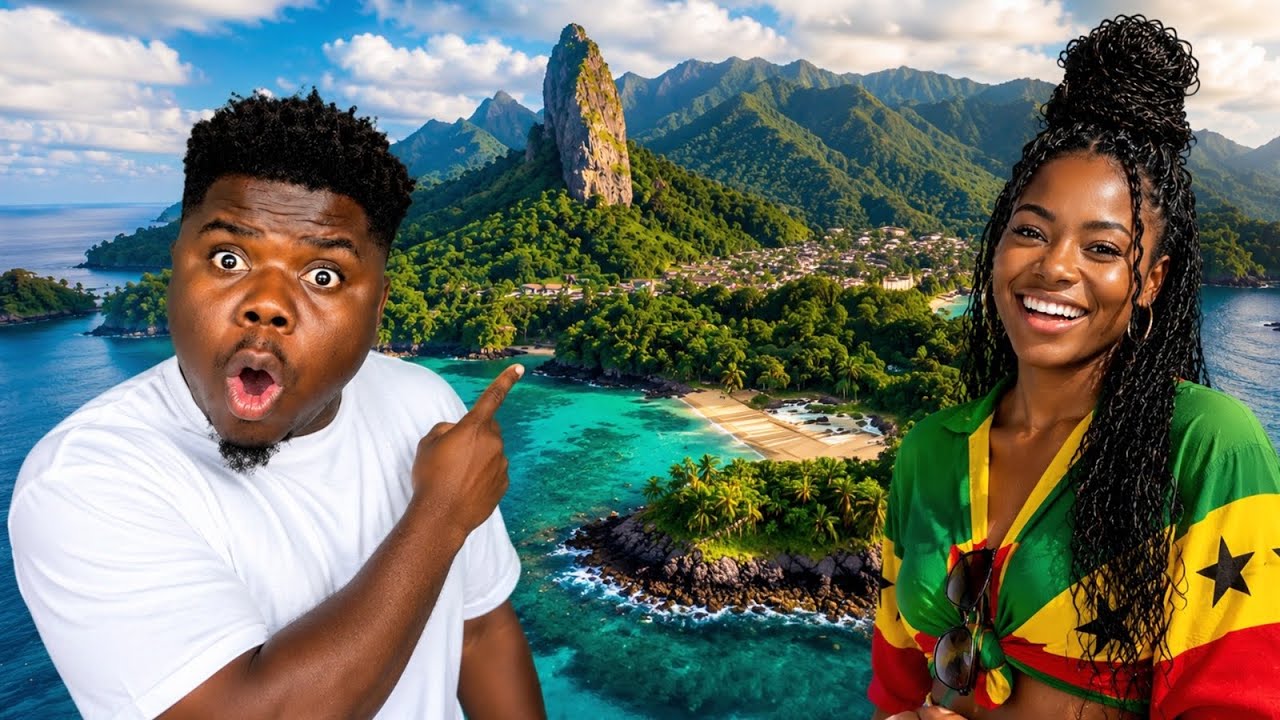
I Visited the African Country You've Never Heard Of 🇸🇹 (São Tomé & Príncipe)
Watch on YouTubeVideo summary
São Tomé and Príncipe stands as Africa's second-smallest nation, composed of two islands that host a population of approximately 200,000 people in an unspoiled tropical paradise often likened to the Galapagos Islands. This unique destination features virgin forests teeming with endemic species and fertile soil capable of sustaining life even amidst economic challenges, offering abundant natural food sources like jackfruit known locally as safu. The landscape is defined by its location on the equator line, crystal-clear waters that rival those of the Caribbean, and iconic landmarks such as Pico de São Tomé and the distinctive "Mama" mountain formation. Visitors can also experience unique cultural elements, including beer sold without labels in Nevis, while enjoying a cuisine deeply rooted in local traditions like calulu, which is prepared using over 60 different leaves alongside fried flying fish that highlights shared culinary ties with Caribbean nations.
The narrative delves into the complex history of this island nation, tracing its origins to Portuguese colonization beginning in 1470 and the subsequent establishment of sugar plantations fueled by enslaved Africans from West and Central Africa. The legacy of slavery remains visible today through abandoned estates marked by royal palm trees that once served as navigational guides for escaping slaves known as Angoladish, while historical accounts also recount the brutal Batepá massacre of over 2,000 people in 1873 following resistance against forced labor contracts after abolition attempts. Despite this painful past and a history marked by external exploitation, the country gained independence in 1975 and is now celebrated for its friendly locals who go out of their way to assist visitors, creating an atmosphere where authentic African stories are shared with pride rather than shame.
Beyond its natural beauty and historical depth, the video emphasizes a pressing need to change Africa's global narrative by recognizing that the continent was intentionally created for Africans by God, regardless of current political borders or visa restrictions that hinder free movement between nations like Namibia, Botswana, Ghana, Nigeria, and Kenya. The narrator argues that before European arrival, modern countries such as Ghana and Nigeria did not exist in their present forms, urging African leaders to prioritize borderless discussions at forums in Addis Ababa to facilitate greater unity and freedom for all people across the continent. This call to action extends directly to youth who are encouraged to explore Africa freely without fear—whether marrying in one city or investing in another—and to pursue their dreams while waking up to a reality where they can travel, invest, and build futures that honor their ancestral heritage rather than repeating historical mistakes.
Read the full video transcript
There's something special about this
island, you know.
>> [music]
>> I started the moment that I landed.
>> Ladies and gentlemen
>> I'm living my [music] best life.
This is definitely the most authentic
island that I've ever visited.
>> Bem-vindo a São Tomé e Príncipe.
>> [music]
[music]
>> The entire island of São Tomé should be
declared as the eighth natural wonder
[music]
of this world.
Because when it comes to natural beauty,
trust me,
no country touches this beautiful
[music] island.
>> [music]
>> Listen, I have traveled and I've never
seen a country that has gone through
slavery, colonization, and still remains
virgin, bro.
>> [music]
[music]
>> Welcome to São Tomé and Príncipe, a
two-islands country, the second smallest
nation in Africa.
>> I mean it, São Tomé, one of the most
beautiful [music] countries.
>> [music]
>> São Tomé [music] and Príncipe, two
islands in one, with a population around
200,000 people. Príncipe island has less
than 10,000 people.
Um it was once known as the [music]
island which exploit one of the best um
cocoas and coffee as well.
Um it's an island where not many people
know of,
but the community is rich.
Um
we have our land is fertile. We have
amazing um [music] climate. Our food is
natural.
>> You know what? I feel like crying, man,
because this is definitely one of the
best days of my life.
>> São Tomé and Príncipe, we could consider
it the second Galapagos of the world. We
at the moment are the only country in
the entire world which is considered
100% biosphere reserve.
We are also crossed by the equator line.
>> It's roughly
20 minutes walk
to the equator. I can't believe that.
I'm about to touch
the center
of the world. Oh, wow.
>> [music]
>> I'm literally in the center
of this beautiful planet.
Besides that, we are unique in terms of
endemic species, flora, and fauna, and
we have amazing people and amazing food.
>> I like the fact that we have virgin
forests.
And
uh we still have
beautiful culture that I believe should
be put out to the community.
>> São Tomé and Príncipe might be the only
country in the world where people never
died of starvation. Why? Because we are
so rich in nutrition that food literally
grows in abundance everywhere.
>> Uh can be poor by poor in terms of
money. People don't have money to buy
expensive thing like modern thing like
iPhone 7 thing stuff like that, but not
hungry because we have a 9 months of
rain season. The soil is very fertile.
The things grow.
>> Where I am is a thick forest and
everything actually grows in the forest.
I see bananas. I see jackfruit, bro.
Give me the biggest one.
>> [laughter]
>> A beggar got no choice,
>> [music]
>> but in Africa, I got a choice, man. And
this is not for anyone. It's just in the
forest, bro.
>> I love São Tomé because [music] of
mostly because of the people.
Cuz even though we have like a
great country, beautiful beaches,
but people
are you know, awesome people. We are
[music] welcome people. So,
that's the things that I like the most.
>> [music]
>> You see, one thing that I love about
this country is that everybody wants to
help you without even knowing you.
Literally, I just saw him
going somewhere and I'm like, I need
some jackfruit. I look at him climbing
the tree just to get me a jackfruit,
man.
>> [music]
>> A big shout out to the people of São
Tomé for being nice because indeed this
is one of the most friendliest countries
that I've ever been.
>> São Tomé and Príncipe is the perfect hub
for those who want to unwind and switch
off from the busy lifestyle. [music]
This is the lively lively culture as I
mentioned in the beginning. You have the
nature around you. This is a true hub
for nature lovers.
>> In São Tomé and Príncipe, we know for
our [music] beautiful nature, our
beautiful beaches. We've got Pico de Sao
Tome, which is the highest in the
island. We've got Pico de Cao Grande,
Pico de Cao Pequeno, e Pico Papagaio.
So, I see Sao Tome and Principe as the
promised lands.
Um especially Pico Cao Grande, which is
one of the most popular attraction that
we have in the island. I see that as the
heartbeat of the island.
>> The landmark right behind me is the most
iconic landmark in the entire Africa. To
me, this is the representation of Sao
Tome.
>> [music]
>> What does it look like?
>> [music]
>> God's sense of humor is actually
mind-blowing, man. I feel like when God
was creating the world, he decided to be
very funny with the world because how
can you tell me that mama is sitting
right next to daddy?
Can you see what I see? Those are two
breasts and they call it the mama
mountain because mama got two.
>> [laughter]
>> And right behind me is daddy and the son
because this one is smaller and daddy
got a biggest one. So, that's Pico Cao
Grande and then this one is small one.
Pico Cao Pique. Pique is the smallest.
Which one are you?
>> This is the land of waterfalls, palm
trees, cocoa beans, chocolate, pretty
faces, vibrant culture, and with a level
level lifestyle.
>> [music]
>> Sao Tome indeed is a tropical paradise
because I have traveled to the length
and breadth of this beautiful [music]
country and indeed this is definitely
the most beautiful country that I've
ever been.
>> Our hearts belong to the ocean. Our
lungs breathe from the trees and the
greenery around us. This island is so
peaceful because it's one of the least
known countries in Africa. I remember
when I was traveling around China,
people at the airport thought I had a
fake passport. Literally, they had to
Google Sao Tome Principe because they
thought it was a fake country.
>> Ladies and gentlemen, allow me to
introduce you to a country that you've
never heard of, Sao Tome and Principe.
It is a two-island nation located in the
Gulf of Guinea, about 250 km off the
coast of Gabon, which means that Sao
Tome and Principe is made up of two
different islands that comes together to
form one country. [music]
>> This is Anambó and this is the exact
same location where this beautiful
island got its name from. You know why?
Because on the 21st of December, 1470,
the Portuguese arrived at the shores of
Anambó and they arrived on Saint Thomas
Day, which Saint Thomas in Portuguese is
what? Sao Tome. Hence, the name Sao Tome
on this beautiful island.
>> And Principe was named by the same
Portuguese that claimed they discovered
the island as Santo Antão
and later changed the name to Principe,
which simply means prince in honor to
the prince of Portugal.
>> [music]
>> Can I ask a very thought-provoking
question and we can all debate in the
comment section. Are you trying to tell
me that the Portuguese discovered this
island because Ghana is right here,
Gabon is right here, and our people have
been fishing in the past. Are you trying
to tell me that none of our fishermen
got lost and landed on these beautiful
shores?
Portuguese is the official language of
the island.
>> Speaking is mas mas not very good
in English. Mas mas
mis speaking.
>> Fala Portuguese?
>> Portuguese, yes. Yes, Portuguese.
>> No, no,
no Portuguese. Only English.
>> [music]
>> The island is predominantly a Christian
country [music] heavily influenced by
its colonial past as a Portuguese
colony.
The local currency of Sao Tome and
Principe is dobra, simply short STD, but
they've changed it to SDN, but even if
you have euros, you still qualify to use
[music] it in this beautiful island.
If you have a a message for Africans,
what would that message be?
>> Visit Africa.
>> [music]
>> Cuz there there are a lot of things to
to see, to explore
in our motherland.
Come quickly, quickly, quickly. We have
a continent to build.
>> It's time for us to change Sao Tome as
the least known country in Africa to the
most popular country in Africa. So, it's
time for you to visit Sao Tome.
>> [music]
>> Welcome to the twin island of Africa,
Sao Tome and Principe. And after
exploring this island for the past 6
days,
>> [music]
>> I will say that indeed this is a perfect
tropical paradise in the world. I am
Maya. Welcome to Sao Tome and Principe.
I am traveling to one country that
[music] I've always wanted to travel to.
I mean the least known country in
Africa, [music]
Sao Tome to be precise. Have you heard
of Sao Tome?
>> No.
>> I have heard of
>> You have heard of Sao Tome. What about
you?
>> never.
>> Never?
>> Is it an African country like
>> What do you mean?
>> I don't know.
Is it
>> Where are you from?
>> Tanzania.
>> I'm a Ghanaian.
>> You're a Ghanaian?
>> Yes.
>> Sao [music] Tome is just 2 hours away
from here.
>> Yes. Ah.
>> You You have heard of Sao Tome?
>> Yes, please. I even got a chocolate from
a customer the last time.
>> Ghanaian chocolate or Sao Tome
chocolate?
>> [music]
>> one is the best?
>> I prefer Sao Tome chocolate. They don't
really do
uh sweet chocolate like the milk
chocolate. It was a dark chocolate and
[music] it really nice.
>> It's really shocking to [music] know
that people that are from Africa
the continent don't even know where Sao
Tome is. I mean some people have not
even heard of Sao Tome. Where are the
people of Sao Tome? Why you can't we
hear from you guys, man? But anyway,
this is why I'm traveling. We're going
to uncover the beautiful island to show
to the rest of the world. So come along
with me. Let's go.
>> [music]
>> Safely landed in Sao Tome and I just
can't wait to see what this beautiful
island got to offer.
Let me tell you guys [music] my first
impression about Sao Tome and Principe.
When I landed,
the immigration officer was super nice
with me.
>> [music]
>> You know what? As a Ghanaian, I was
expecting him to ask me, "Hey, give me
something."
>> [music]
>> But, he just stamped the passport, and
he said, "Enjoy Sao Tome." So, I'm here
to enjoy this beautiful island.
>> [music]
>> So, my first day out here in Sao Tome,
and I can't wait to see what this
beautiful island got to offer, bro. This
is definitely the biggest chalet that
I've ever stayed in [music] in my whole
travel. Look at the entire stretch, and
it belongs to myself and the team.
[music]
>> Okay, it's a great great [music] great
pleasure to have you here with us. Thank
you so much. Yes.
>> Thank you.
>> with us, yeah.
>> Yeah, are you are you Sao Tomean?
>> No, I'm not Sao Tomean. I'm from
Cameroon.
>> Cameroon?
>> And I fell in love
in Sao Tome in 2000 and yeah, in 2000. I
came here for the first time.
>> Oh, wow.
>> all these beauties, you know,
all the beach empties. Nobody's there.
Then, I say, you know, I
I need to buy some, you know, a land and
build a house here, you know.
>> Wow.
>> my first idea, have a house in the
middle
of the world and in the middle of
Africa.
>> What do you love about Sao Tome?
>> The safety. It's a safe country, and the
people is very warm, you know.
>> A gift for me? That's why I was so
shocked. I was like, "Huh? What?"
>> I'm shocked to see I'm shocked to see
you here.
>> goodness.
>> Let me just Can I open it?
>> Yeah, you can. You can. Definitely.
>> Oh, wow. Is it an entire island?
>> Exactly.
And a taste of our own produce here in
the island.
>> Thank you.
>> You're welcome.
>> Thank you. I've got another chocolate
gift.
>> Yes.
>> This is a chocolate island, definitely.
>> [music]
>> I made it to [music] the capital city of
Sao Tome, which is also known to be Sao
Tome. So, no, from Ghana.
>> Ah, Ghana.
>> You know Ghana?
>> Speak English.
>> Yes.
>> Very good.
>> Okay.
>> You're from Sao Tome?
>> Sao Tome, okay, yes.
>> Oh, wow.
>> Beautiful.
>> Very beautiful, man.
>> Beautiful Sao Tome.
>> Yeah.
>> [laughter]
>> Okay, bye-o.
>> Bye, nice to meet you. Where are you
from? Sao Tome?
>> I'm from Sao Tome.
>> You're from Sao Tome?
>> Sao Tome.
>> Nice to meet you, too.
>> You're very nice, man.
>> Thank you.
>> Welcome to our Sao Tome.
>> Thank you.
>> Okay, yeah.
>> Thank you.
>> [music]
>> The city is more vibrant, even though
I mean, a little bit laid-back. People
are just just doing their own thing,
minding their own business. They have a
saying in this country called leve leve.
So, it's like slowly. So, everybody's
just taking everything in slowly, man.
This is so cool.
>> Oh my goodness. [music]
>> Walking in the beautiful street of Sao
Tome makes me feel like I'm living in
the colonial time. Because almost every
building that you see within the capital
city is something that was built during
the colonial time. I don't know, man.
Look look look behind me.
>> [music]
>> So, as you can see in this present
moment, this is rush hour. It's vibrant,
it's live, everyone's running up and
down, getting home because normally
people here have 2-hour break.
>> 2-hour break?
>> Yes.
>> To do what?
>> To have lunch, to pick up their children
at school, go home, go to either a cafe,
eat some nice pastries, etc. or a a nice
couscous.
>> And it's all happened from what time to
what time?
>> So, from 12:00 till 2:00 in the
afternoon.
>> [music]
>> Walking on the busy bustling city of Sao
Tome makes me feel like I'm walking
somewhere in Lagos because look at these
public buses. Have you been to Nigeria?
It's exactly the same, same colors, same
way of life.
>> [music]
>> And what even surprises me is the market
that they have in this beautiful island.
It feels so much like home.
>> [music]
>> Like coming in here feels like I'm back
again in the Milan Africa.
>> Yeah. Okay. Because that's
[clears throat] exactly how our market
is. Again, we have just some products
that you don't have there.
>> Which product is that?
>> For example, here we have Yeah, this are
jackfruit. Do you know jackfruit?
>> This is jackfruit, yes?
>> Yeah. This is we call safu.
>> Safu?
>> Yes. I know that in mean Africa we have
it in Gabon as well. They call it
atanga.
>> Okay.
>> Yeah.
>> I've never seen this in Ghana though.
>> Yeah, we boil it. It's a little bit sour
but very nice. We eat it normally with
the bread.
>> It grows everywhere.
>> Yeah, everyone here Southman, they love
safu.
>> Oh, wow.
What is this fruit?
>> So, this is called safu.
>> Safu?
>> Safu.
>> It's roasted?
>> Yes, it is.
>> Can I?
>> Yes.
>> How do you eat it?
>> You eat it just like this. It's boiled.
It's literally boiled and yeah, you can
give it a try.
>> Do you want me to try some first? Ooh.
It It looks It's um sweet potato.
Right? And I just hope it tastes like
sweet potato, by the way.
>> If you want to, [music] you can in the
morning
>> It's sour.
Ah.
Okay.
What is that one fruit you think you
have here that we don't have it? For
sure, I'm going to show you that.
For example, we have these ones we call
casamanga.
>> casamanja
>> casamanga is a sweet Yeah, sweet and
sour at the same time. So, casamanga
because it's a mix of a cashew fruit and
mango. Mango is sweet. Cashew fruit
Cashew fruit fruit is sour. That's why
we call casamanga.
>> Can I Can I buy casamanga?
Yeah.
She said that to give energy.
>> [laughter]
>> Can I get this one?
>> Yeah, take it. Take it and eat.
>> [music]
>> And the island of Sao Tome is made up of
two distinct regions, which is the north
and the south. So, why not you all come
along with me as we explore the northern
part of this beautiful island together.
>> [music]
>> Sao Tome is an incredibly beautiful
country, man. And whenever you visit
this country, I would encourage you all
to hire a car, drive through the north
because that's what I'm doing right now
because all you see is driving in
between the beautiful green mountains
together with the ocean, man. Don't tell
me the view that you see is not
breathtaking. You can actually get this
view out here in the northern part of
Sao Tome. My brothers and sisters, this
is indeed one of the most beautiful
countries that I've ever been, and I'm
going to encourage you all to come see
this country for yourself.
>> [music]
>> One of the famous [music] iconic tunnels
in Africa is right here in Sao Tome.
[music] Look right behind me. This
tunnel is actually carved within that
rocky mountain overlooking the beautiful
sea, man. Isn't this gorgeous? But
anyway, if you know who built this, let
me know in the comment section.
>> [music]
>> Oh my goodness.
>> [music]
>> Definitely one of the best days of my
life, man. Can you believe it? I mean,
there's nothing like a dolphin show, but
our dolphins decided to give me one of
the best shows in the world. I don't
know whether the camera can show you
what my naked eyes have seen.
>> [music]
>> My goodness.
Wow.
You know what?
This country will forever stay in my
heart because all the things that I'm
doing were never planned, but everything
fall in place naturally. This is to show
you that indeed the best comes from Sao
Tome. Wow.
How come nobody TOLD ME THERE'S A
dolphin show in here?
>> [music]
>> Incredible stuff, man.
>> [music]
[music]
>> Sao Tome is definitely the definition
for the word paradise. My goodness.
>> [music]
>> Listen, this country's virginity has
never been broken because it was so
perfect, unexploited. Like I just can't
believe it. I mean it reminds me of
Portland, Jamaica.
Wow.
>> [music]
>> Listen, I don't even know the kind of
words I should use to describe
>> [music]
>> this beautiful island, bro. It's
absolutely perfect and I can't believe
that this place is unknown to Africans.
>> [music]
>> I can't believe this place actually
exists. It's absolutely unreal, man.
I mean, what makes it so unique? The
fact that you can have the mountain view
plus the ocean view and the entire
mountains are covered with greenery,
bro. My goodness, this is indeed a
perfect paradise destination in Africa
and I'm encouraging you all to just come
and see. It's unbelievable, bro.
Woo.
Driving in the beautiful island of
[music] Sao Tome is absolutely
refreshing, man. Like I don't even know
how to explain it, but have you ever
driven on a road that is carved in a
lush greenery before?
You haven't, right? That is what I'm
talking about. I mean, driving in this
lush green alone is so therapeutic and
you get to drive and I didn't even day
you come across a beautiful ocean right
up in front of you, man. Like,
literally, the views that you get while
driving in this country
>> [music]
>> is absolutely mind-blowing, man. And I
can't wait
to drive more in this beautiful island.
>> [music]
>> This is the only African country that
I've visited that I see food being grown
in abundance to the extent that when you
go to certain areas, you will see fruits
being hanged.
I mean, I've been eating this forgetting
that I had to record. This is the last
one. I don't think I even wanted it.
That's why it's still there. But,
anyway, a very beautiful morning from
the southern part of this beautiful
island. This is where I stayed and it's
owned by a young Saotomean and he's a
super big fan of Wadamyah.
Love it. You know, I love being here, by
the way. I mean, with the sounds of the
ocean every morning, it feels so
therapeutic living in here. But, I just
want to know, you own this place, you're
so young, man.
>> Yes.
>> Oh, wow.
>> actually, you know, I believe in your
words. You said
Africa belongs to the Africans.
>> Oh, wow.
>> And we I've been watching your videos,
you know, for so long.
Since you were in China.
Yeah, so
it's because of you.
>> [laughter]
>> It's because of you, you know.
>> [music]
>> That's amazing, man.
>> Yes.
>> I Listen, if you come to Saotome, if you
find yourself in the south, it's about
time for us to support our own.
So, [music] I'm telling you that this is
the best place in the whole of the
South. So, when you come here, this is
where you have to leave. Listen, I don't
even know the name of the place, but I
know
>> Yeah, in Gamboa. Gamboa.
>> Yes. [music]
>> It means a bed.
>> Yes.
>> It's good to see that they got roasted
corn on the island.
Woo!
>> [music]
>> You cannot come to Sao Tome without
taking one of the most viral
Instagrammable video. And that is why I
had to jump on the boat just to go to an
island. I thought it was just somewhere
on the main island, but unfortunately,
it's an island on its own. And you know
how I do it? Just to inspire you to come
and take such videos, such photos. We
have to jump on the boat just to go and
say it. But listen, you know that I'm an
Olympic swimmer, but my feet does not
touch water, but I just have to make
sure that I'm holding everything tight.
You see it? Life jacket on. Let's go,
baby.
>> [screaming]
>> SLOW DOWN. SLOW DOWN.
WHAT A RIDE, BRO. HEY.
I HATE it when I'm on a small boat like
this and the water is rough. No way.
It's not fun. And I always thank God for
being with me throughout this whole
journey because I've been on water, I've
been in planes, I've been to so many
places that like sometimes I ask myself,
"How did I get here?" It's all God's.
And may he continue to protect [music]
me so that I'll be able to bring more
authentic African stories to your
doorstep.
We finally made it, and as you can
[music] see, what we see on Instagram
and what I'm seeing in reality is a
whole different story. But guess what?
I'm here to take that Instagram video
for you all.
I really can't believe [music] that I
made it out here. I mean, I've seen all
the Instagram videos, and I told myself
that one day I will stop my foot in
here. Here I am, living my best life,
dream come true, and I'm here to
encourage you, yeah?
I know you're living in your house right
now,
and you're seeing a village boy like me
living such a dream. Whatever you're
doing, do it from your heart, work hard,
and believe me or not, your dream will
surely come to pass someday.
I love the fact [music] that every part
of this island
showcase the Caribbean, man,
>> [music]
>> because where I am feels like I'm
somewhere in Tobago.
The first connection [music] between Sao
Tome and the Caribbean is the fact that
Sao Tome is a twin nation, just like
Trinidad and Tobago.
>> [music]
>> Look at that water, man. You can
literally see what is happening down
there.
>> [music]
>> I can't remember when I was going to the
Nylon Pool in Tobago, the water was
[music] crystal clear, just like this.
You can see
under the water.
This place crystal clear, man. I don't
know about it.
This is insane, man.
I feel like
Sao Tome got the entire Caribbean in
one. So, you find
>> [music]
>> every piece of the Caribbean
in Sao Tome.
And it's interesting to see that some of
the towns on this island got the same
name as the countries in the Caribbean.
Break the leg.
>> Yeah, break your leg.
Now, put that [music] kiss on the
>> This one?
>> The Yeah. Now, break it.
>> This Break it.
>> Break it.
Yeah, now open it.
>> Can I tell you a fun fact?
This is the only country that I've been
that they sell beer without label.
So, I don't even know the name of the
beer, but you find it at every corner of
this beautiful island. And it's produced
[music] right here in Nevis, where I am.
Once again, St. Kitts and Nevis
representing.
You can definitely take an African out
of Africa, but what makes him an
African, you can definitely not take it
away from him. This is one common thing
that I found in the Caribbean and Sao
Tome.
This part of the interior really reminds
me of my time in Suriname. It's
beautiful for to see houses within the
interior. I mean, some of them are like
individual houses right in the forest.
And it's built with wood, man. Exactly
like in Suriname.
>> [music]
>> I mean, when I was in the Caribbean,
most of the Caribbean countries were
building with wood. And I found myself
in Sao Tome, which is also an island
that um slave trade actually happened in
here and they are also building with
wood.
So, my question is, what is the
connection?
What do you call this meal?
>> We call it calulu. It is our main staple
plate.
>> Are you kidding me?
>> No, I'm not.
>> The name is calulu.
>> Calulu, yeah.
>> Do you know that in the Caribbean they
have the same meal called calulu?
>> Yeah,
yes, I heard about.
>> What is the ingredient in here?
>> Oh, the one that our mothers they used
to do
it has at minimum 60 different [music]
leaves and vegetables.
>> Wow.
>> And we we have dried fish also and this
super medicinal.
>> Made of red oil?
>> Yeah, it's
it's a bit of palm oil also, yeah.
>> Bro.
>> How you How you feel about it?
>> It just took me back to the Caribbean.
>> Yeah.
>> [music]
>> Like since from Angola
>> Yeah.
>> and Congo
>> Yeah.
>> and going all the way until Bahia,
Brazil.
So
>> Yes, even Brazil. They eat this and they
call it cal
>> calulu
>> cal
>> And one of my biggest dream is to one
day to taste calulu
because
>> In Brazil?
>> Yeah. You will close this circle, you
see?
I already had
calulu from Angola.
>> Mhm.
>> Which is a fight between us. The same as
as
>> Ghana jollof and Nigeria
>> And I need to have calulu
to close this circle, the brotherhood
circle, you see?
>> [music]
>> Have you tasted flying fish before?
>> This is flying fish?
>> Yes, this is fried flying fish.
>> You eat flying fish here?
>> Yes, we love fried fish.
>> That's a lot of fish, man. This is the
flying fish.
Ooh.
That's
fresh from the boat.
If I tell you that there is a bit and
pieces of Caribbean all combined in this
island, will you believe me? Because
flying fish is more like one of the
national meals of Barbados.
>> Oh, yeah?
>> So, we have uh from June until
mid-August
the those are the months of flying fish
where we have an abundance. During these
months it's like street food here.
>> Really?
>> [music]
>> Right behind me is where the main
trading between the men and women really
happens. So, more like the women are
actually buying in wholesale [music]
and then they're just going to go out
and resell to people within the city.
>> [music]
>> But, it's exciting to see what is
happening behind me, man. The
negotiations that are happening, I wish
I can also learn it.
Wait, can you believe it?
Flying fish in Sao Tome.
Oh my goodness.
Wow.
So, it's like Barbados?
But, let's not start this war, yeah?
>> [laughter]
>> Yeah. Let's Let's leave it like that.
>> [music]
>> You see the tree behind me? That's
breadfruit. And you can actually find
breadfruit tree in every corner of this
island, especially household. I see
breadfruit almost everywhere.
>> Yeah, there's almost everywhere because
it is our country's [music] staple food.
>> Oh, wow.
Breadfruit.
Every corner of this island, every
household, you will see breadfruit.
Breadfruit is so common
in here.
>> Mhm.
>> Why is it so?
>> Well, the story that we were told is
that the breadfruit was brought from
[music] Tahiti by a Captain William
Bligh. So, it was brought here to to
feed the populations here.
>> The enslaved Africans.
>> Yes.
>> Do you know the reason why breadfruit
came to this island?
>> Yeah, it was brought in the 15th century
by the Portuguese.
>> Why?
>> To feed the black slaves and the animal
production that they had here.
>> This is to let you know that
anywhere you see breadfruit, it means
[music] slavery happened apart from
where this tree actually comes from.
One thing [snorts] that I've come across
on the island of Sao Tome, wherever you
see
estates, [music] I mean, abandoned
estate like this one, you get to see
royal palm trees built around it. And I
keep asking myself, what is the
connection between
the royal palm that is being planted in
here with the royal palms that were
planted
>> [music]
>> in Barbados as more of a form of GPS.
So, whenever you're looking for a
plantation, you got to look for
royal palms like this to know that this
is where I work.
>> So, basically, these trees that we are
looking at there are called royal palm
trees. But these trees they are back to
our pre-colonial
era in terms of slavery and the slave
trade. When the slaves
actually went out into the fields, they
used these trees as markers to make
their way back onto the sugar
plantation. I often uh
refer to these trees as GPS.
>> To the extent that some of them are even
falling off. I wish
this palm
can tell me the history of what happened
here in the past.
>> The history of Sao Tome and Principe
begins with the Portuguese who claim to
have discovered it.
>> They were traveling around Africa
to discover more lands and then they
discovered Sao Tome and in December
21st, [music]
1470.
>> Do you believe that they discovered the
island?
>> Well, about that we have two histories.
The main history is that they say that
they didn't see people here, but we have
second history that says that they saw
local people here. But like we we we
don't have how or we didn't have how to
prove that. So the main history is that
they [music] didn't see people here in
this island.
>> It's time for us to rewrite our own
history and that is why I am doing this.
You know what? The Portuguese indeed
arrived here in the 1470s, but if you
ever ask me,
they are not the first people to arrive
on this land.
In the late 1400s, [music]
the island became a Portuguese colony
serving as an important stopover in the
Atlantic slave trade.
Sugar plantations were established using
enslaved Africans brought mainly from
West and Central Africa.
And because of the hard labor conditions
on the plantations, some fled into the
bushes.
>> Well, we have we have a lot of history
about people that run away. And for
that,
uh also exist [music] the
bush cap- bush cap- captains. So, bush
captains were were the guys that went
[music]
to
rescue
uh to hunt people that would run away.
>> Those were they
Africans, too?
>> Uh
>> Yes, they were Africans.
>> Almost all Africans.
>> Most of them, yes.
Uh a lot of them run away, as I said.
And yeah, they went to to to the bushes,
and then they would come back and steal
the woman's from the sugar
uh engines and to take with them,
because they did
had woman's there on on the bushes.
>> Okay, so behind us we have uh Rei
Amador, who is the leader of revolted
slaves.
Um he was associated with a community
called the Angoladish, which is located
in the south of Santo Me.
>> Uh and what's the special um
uh group because they were uh force of
uh resistance. Because they
didn't work in the
process. [snorts]
>> Okay.
>> They are fishermans, and they are a
symbol of resistance.
>> Angoladish, you know,
is a kind of a controversy story, as
well. That they say like is like a
people that
came from Angola. Came with their
culture and keep their culture.
>> [music]
>> The first guy that we call the week we
see like our
hero that is our money and our notes
call
King Amador.
>> Mhm.
>> And then he was Angolar. He was the
first guy that
create like a kind of rebellion here.
Because against colonialism. It was a
kind of it was a slavery that escaped to
the forest with the other guys.
>> Um initially he freed captivated slaves
[music]
and he told them to be a part of his
movement um to fight against the
colonizers.
>> And then create some instruments like
with a stone with a machete stuff like
that. And then during the night attack
the Portuguese plantation. They burn the
machine that the Portuguese people used
to make a sugar cane in that time.
>> Um however, he one of [music] his
friends went against him and
led him to the colonizers which he was
then assassinated. [music]
>> When the Portuguese people found him,
they brought him to the main square uh
hung him with a string on the neck in
front of everyone and cut his body in
small pieces in front of all slave
everyone to see like lesson for all the
people don't do the same [music] that he
did. If you people
do thing that they did, will have the
same hand.
>> In the late [music] 1700s and early
1800s, competition from Brazil caused
the sugar industry in Sao Tome to
decline. [music]
As a result, Portugal shifted its focus
to coffee and cocoa cultivation.
The small island was once the largest
producer of cocoa. You know why? Because
they went to mainland Africa, captured
Africans, brought them to those island
to enslave them just to work on cocoa
plantations like this. And then at the
day, they were exporting cocoa beans,
making all the money without thinking
about the Africans that are working on
the plantation.
And whenever you drive the entire
island, you see cocoa plant literally
[music]
everywhere.
Also, to prove to you that this country
was once the largest producers [music]
of cocoa.
>> During the 19th century, the Portuguese
developed large plantation estates known
as the roças, which became the
foundation of the island's economy and
made São Tomé one of the largest
producers of cocoa.
>> [music]
>> We are on Roça Central.
Uh it was a
a old roça before. The main production
was cocoa, yeah.
>> [music]
>> Since 1908, yeah. So, this roça was on
on a group of 17 roças, yeah. On that
time
>> [music]
>> uh see on on the beginning of 20th
century, was more than 600 roças, more
than 600 roças. This island was one of
the one of the biggest cocoa producers
on the beginning of 20th century.
[music]
The most of people that work on the
plantation were from Cape Verde, from
Angola, from Mozambique.
>> I love the fact that there is [music] a
trace to every little thing that
happened on this island. This is a
coffee plantation. It's to prove to you
that indeed, once upon a time, this
country was one of the major producers
of coffee.
>> This [music] is Monte Café, one of the
ancient roças of São Tomé. Because the
weather here is so special, different,
[music]
more cold and um
humid, [music] so the
it it's allowed to produce
a great coffee.
So,
so this [music] roça is known mostly for
coffee. This is why the the name is
Monte Café.
>> [music]
>> So, roça will be a typical example of
estate
>> [music]
>> in the Caribbean because right behind me
is where the processing happened. The
plantation is right on the mountains
because, you know, coffee grows in
mountainous area. If I have to compare
this place with Blue Mountains of
Jamaica where coffee grows, it's exactly
the same thing that happened in [music]
here. So, hey, you see the building
right over there? That is where the
patron used to stay because they lived
their best life where the people that
they've enslaved
lived the most horrible life
in here.
These harsh [music] treatment on the
plantations led to tensions and
resistance between the locals and the
Portuguese, which led to a brutal
massacre on this beautiful island.
São Tomé is a beautiful small island
with a very painful history. Where I am
is Batepá where the massacre of Batepá
actually began. And the monument right
behind me
shows that indeed this town represent
[music]
or is a symbol of resistance and
suffering under colonial rule because at
the end of the day, over 2,000 people
were killed on this island.
Why did the massacre happen?
>> Uh well, um
it's happened because
uh in around uh 1868, we had a more or
less kind of a
slavery abolition here. So we stopped
Portuguese production down and then they
wanted the local people [music] to work
with them for them but by contract more
or less like that. Some local people
knew that the contract was like only in
the paper and they really should be the
slavery in the same
>> [music]
>> so many of them refused to sign the
contract. So with that the Portuguese
people start become very angry with
local people [music] and then they just
accused local people that they are
organizing kind of a rebellion against
the Portuguese [music] government. So
had a governor here called Carlos
Gorgulho that authorized the massacre.
So the Portuguese military went to a
village called Batepa and start to
arrest people,
burn their houses and torture them.
>> I want to know what happened in here.
>> [music]
>> Okay so during the massacre in 1953
this [music] was once used as a place
where water was stored and then it was
transformed formed to become a prison
[music]
where locals who resisted to work in the
plantations would have been kept [music]
inside here and most of them eventually
died.
Due to the conditions.
>> Cuz there's no fresh air in here.
>> No.
>> Was this closed?
I just put my legs in here
and I can
>> [music]
>> feel the heat from down there.
And at the end of the day it's not even
closed yet.
I really want [music] to go inside. Oh
my goodness.
Woo, you're taking so long.
Oh my goodness.
>> Just let me know.
>> Like
>> When?
>> No.
Oh my goodness. Can't believe that
our sisters went through this.
Like it it's extremely dark. I can't see
the next person [music] next to me. I
mean
I'm here alone and I can't see anything.
Like stuck in the dark.
But imagine hundreds of people were kept
in here.
Yo, CAN YOU GUYS GET ME OUT?
PLEASE.
NO, NO, NO, NO, NO. I'm sweating
already.
PLEASE. HEY, NO.
PLEASE OPEN.
OH MY GOODNESS.
I'm sweating already.
Can you imagine it?
Bro, just less than a minute and I'm
sweating.
Imagine how long
our sisters were kept in here. That's
some of the punishment that the
Portuguese gave to the [music] people
who that were rebellious.
>> Okay, they gave they put people to chain
in the feet, gave them like a recipients
to have [music] the sea, to
bring water from the sea to the land,
put them like in
a jail a lot of people without enough
space to breathe. A lot of them died
there. It was was so sad this history
here.
>> [music]
[music]
>> So it looks like
their number [music]
The people that were killed
put your number there. I mean
this happened in the year 1953.
So it's just recent.
I don't know if we have [music] to
forgive and forget.
And that is why reparation
is very important.
These guys were paid because they lost
[music] their plantations.
And the people that worked on the
plantations were never paid. Like
sometimes I don't understand it, bro.
>> We don't have to how to delete the past.
We don't have how to delete it. [music]
Even
we don't we we we we didn't forget it.
So, it's very It was very sad history.
[music]
It It marked the house we not forget it.
>> You know what?
This whole journey is more personal to
me than even you.
So, I told myself not to do
videos relating to slave trade because
the more I do such videos, the more
I grow a lot of hatred in my heart.
So, I decided to stay away.
But, I feel like I have to be the one to
tell the stories.
Hence, the reason why I came to Sao Tome
without even knowing
about the atrocities that happened on
this island.
But, I'm here to let you all know,
especially young Africans,
it's about time
for you to know your history. In order
to know where you're going, you
definitely need to know
your history. And I'll encourage all the
youth of Africa to start learning about
history [snorts]
of our continent. I mean, from one
country to another so that we don't
repeat the same mistakes that our
ancestors did because this continent
[music]
belongs to you and I
and our children. So, it's about time to
transfer knowledge
to our children
so that our children don't become slaves
[music]
in their own continent. May
all the souls that got lost in here
rest in perfect peace. I wish I had a
a schnapps. I would have poured libation
for the ancestors.
And in the year 1975,
Sao Tome gained its independence.
[music]
>> [music]
>> Whatever you find yourself in a
Lusophone country, there's one juice
that you definitely have to try. That is
a sugarcane juice. I mean, I've been to
almost five different countries. I don't
know where this concept of sugarcane
juice came from. But at the end of the
day, almost Mozambique, Cabo Verde, and
now Sao Tome, all got sugarcane juice,
man.
Ah, oh my goodness. With this heat,
this is refreshing, man.
If you're looking for peace,
peace lives in this country.
Sao Tome got a lot to offer the world,
man.
Like,
just look at me
sitting beautifully on a canoe.
Just cruising on a mangrove
with beautiful wildlife right behind me.
I don't know if you guys can see the
monkeys.
It looks like Mona monkeys. Look at
that.
Sitting right over there.
Bro,
I don't know what else that I need to
show you
for you to agree with me that this is
definitely the most beautiful country in
Africa.
I mean, natural beauty. Let's Let's
Let's just sing this song all together.
Row, row, row your boat gently down the
stream.
It's [music] so therapeutic out here.
The fact that
no engines, we just us paddling,
and just listening
to the sounds in the forest.
>> [music]
>> I mean, the monkeys are making a lot of
noise today.
Look at that. This are Mona monkeys.
Ooh.
Ooh. Oh, wow. Look at that.
God bless Sao Tome and Principe. God
bless Africa. God bless Water May.
I have to go and dance.
>> This is dance of Congo.
>> Dance of Congo.
>> Dance of Congo. Dance of the captain of
Congo.
Uh it's one of the most traditional
performances in
of Sao Tome.
>> You don't know the origin of the dance?
>> We are studying this, me and my wife.
I'm Jose, I'm photographer, and my wife
is anthropologist, Magdalena San Bell.
>> Okay.
>> And we are studying the dance of Congo
from about 10 years.
>> With the traces that you've done for the
past 10 years, have you done any
connection with this dance with any
other country?
>> We don't know yet.
>> Which African country are you from? Is
there a traditional dance similar to
this? Let me know in the comment section
because they can't they don't know why,
and I also don't know. So, I believe you
can help us find out.
>> [music]
>> What names do you guys have in here?
>> African names.
>> African [music] names?
>> Yes.
Like Congolo, Chongo.
>> Wow.
>> Yeah.
>> Do you guys have the
Portuguese surnames?
>> We have also a Portuguese name.
>> Like from Angolash?
>> From Angolash, yes.
>> So, you you grew up in the city.
>> Yeah, man.
>> How many names do you have?
>> I have five.
>> And you grew up here. How many names do
you have?
>> I have three names. [music]
>> Three names?
Why do you have five?
>> My Well, I have my my mom names,
my
my father names, my grandfather [music]
names also. And all of those names come
from the Portuguese.
>> What is your name?
>> [laughter]
>> My name is Enelito Franco Lagos da Costa
Soares.
Man, no
>> You you are not an African, brah.
>> João.
>> How many names do you have?
>> I have a three.
>> Three? No Portuguese, right?
>> No Portuguese.
>> How many How many do you have?
>> Enelito.
>> Enelito?
>> Fernandes.
>> Fernandes?
>> Pereira.
>> All the three are Portuguese?
>> Yeah, Portuguese.
>> Three of them?
>> Uh
and now my name is Mionga.
>> Six names.
>> [screaming]
>> YOU HAVE SIX NAMES? THIS ONE WHAT'S YOUR
NAME?
>> NO, because I'm
>> What's your name? What's your name?
>> [laughter]
>> I'm
>> Who is your father? Like it's a white
guy.
>> [laughter]
[music]
>> One of my favorite things to do when I
travel is to chase waterfalls. But one
of the most spectacular waterfalls that
I've ever seen in my life was in a book,
not online. So, I had to look for the
author, who is from São Tomé. So, the
moment I visited this country, he says
that, "Hey, Maya, to see this waterfall,
you have to stay in a boat for an hour."
Hence the reason why I want a boat
with the author himself. So, we are on
our way to see that special waterfall. I
mean, we're going to be on this boat for
1 good hour just to see this spectacular
waterfall and trust me, you won't be
disappointed.
Listen.
>> We made it.
>> Have you ever seen a waterfall kissing
the ocean?
>> [music]
[music]
>> This is it. This is history. I mean, I
saw this waterfall [music] from a book
and I'm like, I just have to see this
waterfall with my naked eyes and guess
where I am. Oh my goodness.
Oh my goodness, history.
History.
Wow.
Wow,
man.
Ah.
Oh my god.
Yo.
This country
is definitely a paradise and I'm here to
let you all know that I simply can't
understand why Sao Tome is the least
known country in Africa. I think that
[music] narrative needs to change.
Listen, look at that.
Bro.
Oh, just look at that. Oh my goodness.
Wow.
You know, I just love chasing waterfalls
but indeed, this
is the [music] best waterfall I've ever
seen. I mean, look at the waterfall,
just dropping majestically
into the ocean, bro.
>> [music]
>> Anytime I see natural wonders whenever I
travel in Africa, I keep wondering why
are Africans not exploring this
beautiful continent because this was
intentionally created by God for
Africans.
And it's about time for Africans to
explore it. But my biggest worry is the
fact that
>> [music]
>> there is visa restrictions among
Africans. There's no free movement for
Africans within their own continent.
It's so expensive to travel from one
country to another within Africa, and
I'm just telling African leaders,
[music]
when you meet in Addis Ababa,
one of the biggest thing [music] that
you all need to start talking about is
borderless Africa conversation because
this natural wonders within our own
continent, it's about time for Africans
to explore this beautiful continent just
to see the natural wonders within their
own continent. Listen, Africa is home
for Africans. If you are from Namibia,
Botswana, Ghana, Nigeria, Tunisia,
Egypt, know that Africa [music] is home
for you because whatever you play on
home grounds, you score more goals.
>> [music]
>> So, to the youth of Africa,
if you want to marry from Addis Ababa,
go for it. If you want to invest in
Kenya, go for it. If you want to build
your house in Sao [music] Tome, go for
it because Africa was built for you.
Before the Europeans visited this
continent, [music]
there was nothing like Ghana, Nigeria,
Togo.
Africa is your home, man. Look at this.
Look at this.
Like I feel like crying because
I have been to 39 countries in Africa
and I've never come across [music]
anything like this.
>> [music]
>> The world is indeed a very beautiful
place
>> [music]
>> and I'm here to tell you that go out
there, go live your life, go explore the
world, and make your dreams come true.
Don't be scared, yeah? Wake up and
travel.
>> [music]
>> Think about those dreams and make it a
reality. [music]
I love you all and don't forget to like
this video, subscribe, and follow this
awesome channel. Hey, have you
subscribed yet?
Come on, man. You've been watching these
videos for years. YouTube told me that
65% of the people that watch my videos
are unsubscribed.
Don't be part of the 65%. Subscribe to
this channel and I'll see you all in the
[music] next beautiful video from the
motherland, Africa.
>> [music]