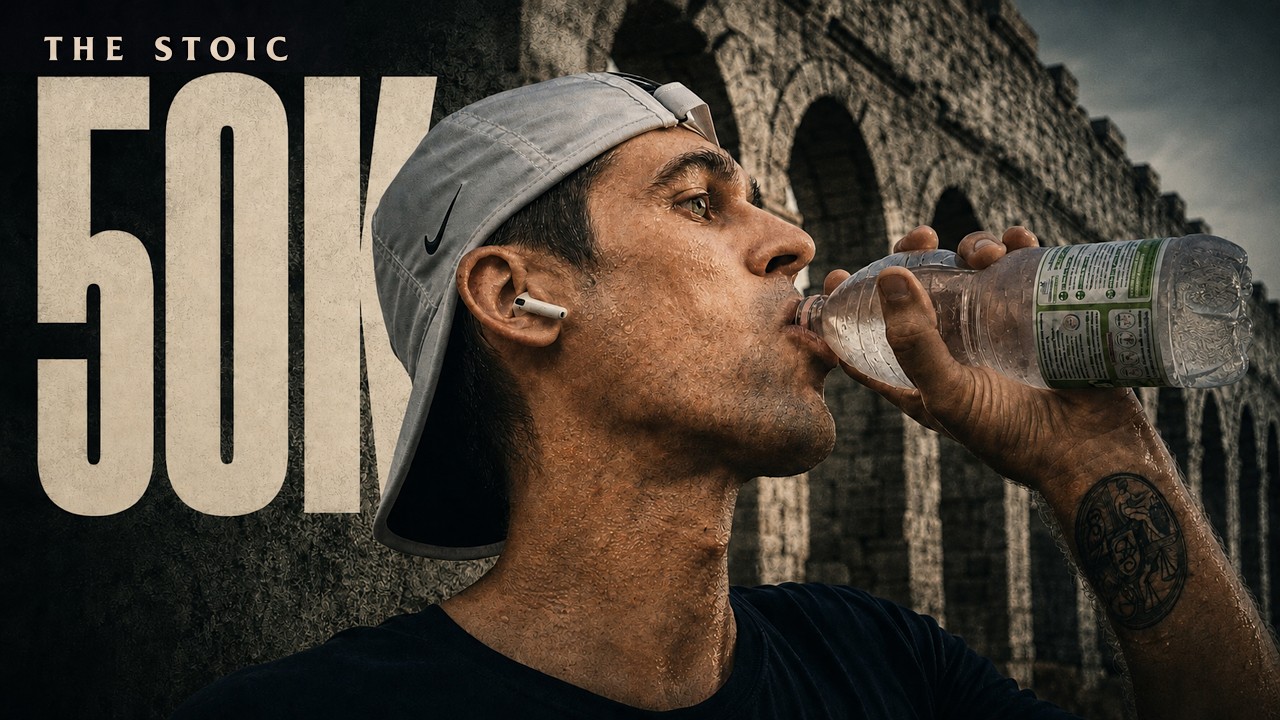
Video summary
The narrator embarks on an ambitious 50-kilometer run through Rome, aiming to visit significant sites associated with Stoic philosophy while testing the limits of his endurance. The central theme of the journey is the Stoic belief that engaging in difficult challenges is inherently beneficial for personal growth, rather than being done merely to impress others or win competitions. By pushing himself physically, the runner reinforces what the Stoics call the "inner citadel," a metaphorical fortress of mental strength and resilience that protects one from external chaos. This internal fortitude is cultivated through discipline and the willingness to endure hardship, serving as a reservoir of power that can be drawn upon when facing life's inevitable difficulties.
Throughout the run, the narrator reflects on historical landmarks that illustrate Stoic virtues, such as Hadrian's Tomb, which represents the concept of an inner stronghold, and the Column of Marcus Aurelius, which stands as a testament to enduring accomplishment rather than seeking glory. He visits the Circus Maximus to contemplate the virtue of *sophrosyne*, or moderation, drawing parallels between the charioteer who must balance speed and control to navigate tight turns and the individual who must pace themselves in life to avoid burnout. The journey also touches upon the Via Appia, where ancient stones worn by emperors and modern vehicles alike serve as a reminder of the relentless flow of time and the transient nature of human existence, echoing Seneca's reflections on aging and the inevitability of change.
As the run progresses, the narrator encounters setbacks like getting lost and running behind schedule, which he uses to demonstrate the Stoic practice of preparing for the unexpected. He emphasizes that true courage involves not just a single moment of bravery but also the day-to-day commitment to persist even when things go wrong or do not match one's original plan. Reaching the turnaround point and eventually completing the race despite physical exhaustion, he realizes that the most significant growth often occurs in the final stages of a challenge when one must rely on accumulated momentum and willpower rather than initial enthusiasm.
Upon returning to his starting point, the narrator reflects on how taking this risk enabled him to transition from a corporate career to becoming a writer, proving that life's best opportunities lie beyond the comfort zone. He observes the tombstones along the Via Appia as reminders of people who thought they had more time but failed to act, contrasting their hesitation with his own decision to embrace uncertainty. Ultimately, the experience provides him with a clearer understanding of his own capabilities and reinforces the Stoic lesson that by doing hard things and accepting risks, one builds the resilience necessary to navigate life's challenges with grace and fortitude.
Read the full video transcript
I'm going to run the furthest I've ever
run in my life. I'm going to run 50
kilometers through the streets of Rome,
the eternal city. And I'm going to pass
some of the most important stoic sites
in the world as I do it. But why? That's
the question. Why? Why am I going to run
50k? Because it's hard. That's the whole
point. The Stoics said that doing hard
things was good for you.
Along the run, I'm going to stop at a
dozen or so places that are not just
significant in terms of the history of
Stoic philosophy, but illustrative of
this idea of why we do hard things, what
those hard things [music] can teach us.
I'm starting at this place we booked on
Airbnb here in the center of Rome and
I'm going to be finishing there roughly
50 km or 31 miles later. So now it's
just a question and this is ultimately
what stoicism is is am I going to do it?
[music]
>> [music]
[music]
>> So Mark Celius was buried in there. This
is known as Hrien's tomb. But I think
fittingly a a after Marcus and
Antonyinus and Hadrien are buried there
becomes a castle. It's a castle here on
the Tyber River protecting Rome from
invasion becomes a citadel which is
actually one of the most powerful images
in Stoke philosophy. the idea of the
inner citadel. Yeah, it's great to have
fortresses like this, but the real
fortress has to be inside, right? The
toughness inside that the thing you
retreat to, the thing that protects you.
And and and when we do hard things,
[music] when we train, when we push
ourselves physically, that's what we're
doing. We're we're reinforcing, we are
building that inner citadel. And that
that inner citadel is what you draw,
that inner reservoir of strength.
[music] What Thomas Payne said of George
Washington that it it was this cabinet
of fortitude. That's what protects us
from the things that are happening
outside. that that's what we draw on
when things are really hard. So when
we're doing hard things, that's what
we're doing. We're developing that inner
citadel.
Look, do do we do hard things cuz we
want to impress people? Do we do hard
things cuz we want to beat other people?
Do we do hard things cuz we want
trophies? No, that is not why. Behind me
is one of the great trophies of history.
It's Marcus Aurelius's victory [music]
column. It's what they put up in honor
of his victories in the Marcomomanic
Wars. It's 400 feet of carvings. It's
stretches almost 200 feet in the air.
It's uh it's it's a towering feat of
accomplishment literally carved in
stone. You know what? He wasn't around
to enjoy it. He died before it finished.
[music] And then in the 15th century, a
pope knocked him off and put St. Paul up
on top. and they they put a new uh a new
inscription at the bottom and they
wrongly attributed the victory to
someone else, which is the point.
Trophies are not for you. You do hard
things because doing hard things is good
for you. The benefit is baked in in
having done them. That's why I like
doing challenges like this, not races,
not [music] competitions. I like doing
challenges where the victory is what I
get out of it. [music]
So the great line about this statue from
the Soviet dissident Joseph to Bradzky.
He walked up here one early morning and
he said, "If Marcus Aurelius is
antiquity, it is we who are the ruins."
I think he's just sort of marveling at
this great man who 2,000 years ago in
the pages of his
journal
he was writing notes to himself about
controlling his temper, about getting up
early, quenching his desires, his urges,
about being kind to people, about
working hard. And he says fight to be
the person that philosophy tried to make
you. He didn't want to be imperialized.
He didn't want to be stained purple by
all the accutrama of of power, the
sycophants around him,
people worshiping him as a god. He
wanted to be good. He wanted to be
decent, which is ultimately like the
hardest thing to do in the world. Uh
especially when you are the most
powerful person in the world. I I love I
love the statue. It's worth a run
anytime you're in Rome. You come up
these big gradual steps and then
suddenly you're uh you're at the top.
There's also a quirk. This statue that's
not the original. The original's inside
the capital line museum right there. But
it's a quirk of history that had even
survived. The Christians who who had
good reason not to like Marcus Res. They
would have destroyed this had they
known. They thought it was Constantine,
the first Christian emperor. So they
didn't destroy it. So they kept it. So,
there were something like 25 equestrian
statues in antiquity that we know of.
All of them are gone except for this
one. This one endures,
and it's totally by accident. There's a
little bit of gallows humor in this,
too, because uh I still have the
furthest that I've ever run to go.
There's a stoic name of Griffinus who's
banished from Rome by the emperor for
running a foul of him. He's banished by
Nero. And uh when he's told he's he's
gonna he's going to have to leave, he
just says, "Okay, we'll have her lunch
on the road." So that's kind of stoicism
is like
he take it all with a shrug
or a smile because what are you going to
do?
You got to be prepared for things to go
wrong. And they they just did. I just
got lost. I did a onem loop in the wrong
direction. I not only knew something
like this would happen, I figured it
would happen right here. When we do hard
things, we are prepared for them to be
harder than even than we are
anticipating. It's like Eisenhower said,
how plans are worthless, but planning is
everything. for the STS. If you're like,
"This is all the gas I have in the tank.
This is all I'm capable of doing. I need
everything to go right." You're in a
real vulnerable position. But if you're
ready for everything to go wrong,
everything to go sideways, well, you'll
be pleasantly surprised when that
doesn't happen. And you won't be
unpleasantly surprised if it does
happen. That's what Senica was saying,
that the unexpected blow lands heaviest.
If I was lost and disoriented and mad at
myself right now, this would be harder
than it is. But it's not so bad. I just
got to go down here, go here, and uh
we'll be good to go.
>> [music]
>> So, one thing we know about the Stokes
is that they hated the coliseum. They
hated the violence. They hated the the
mob mentality of it. They hated the
brutality, the the mindlessness of it.
Senica talks about how degrading and
gory and disgusting what happened on the
floor of the coliseum was. Marcus really
supposedly would read his philosophy or
write in meditations in his in his box.
He was obligated to be there for work,
but he didn't like it. That's not to say
that they didn't understand the power of
a good sports metaphor. Mark said, "Life
isn't a dance. It's more like a
wrestling match. You have to be dug in
and ready for sudden attacks." In
another passage of meditations, he talks
about being like those gladiators who
are torn apart,
bloody, begging to come back the next
day. He he didn't actually mean that as
a positive. He he meant like they needed
to change that there were that that life
was telling them something. It was it
was beating them up. It was destroying
them and and they weren't going in the
right direction. The the point is I
think they would have liked the
Roosevelt's idea of the man in the
arena. They didn't actually like the
arena, but they liked being the man in
the arena. They understood that life was
tough, that life was difficult, that it
was always challenging us.
So this is Circus Maximus. The Colosseum
is obviously what people think of when
they think of Rome, but this is where
the sports happened. This was the center
of Roman athletic life. Something like
250,000
spectators could fit in here. These
chariots would come zipping and zipping
zipping by. And and one of the most
powerful images in the stoic virtues
comes from here from circus maximus. The
idea of soprina that the chariot racer
sometimes you're pulling the horse back
reigning them in. Sometimes you're
getting them to go faster and faster and
faster. And then the art of steering
this rickety chariot trying to make the
tight turns. It's an incredibly
difficult sport. And so the the image of
the charioteer was emblematic for the
stoics of the the art of the good life
of temperance of moderation of
sophracina which you know any kind of
challenge requires of you. You have to
train but you can't train too hard
overtraining causes injury. You can't
push yourself too hard. You have to pace
yourself to be able to hit your your
marks, your benchmarks, all of which I'm
thinking about right now. And now I get
to run a little bit on the actual track
cuz you can come down and do it which is
pretty incredible.
>> [music]
>> All right, now the pavers on the uh Aian
way start. These are rough, man.
But it's hard to complain about the fact
that you're running on a road that is
thousands of years old. The stones have
been here so long, they have grooves of
wagon wheels in them.
That could have been
from Marcus Aurelius. Could have been
from every emperor ever. Could have been
Senica. Could have been Epictitus. Look,
these stones were also worn down by
Allied jeeps and tanks and they retook
Italy town by town. And then uh you
know, here we go. We get to run along
them ourselves. It's still here.
kind of gives you the sense [music] that
Marcus really is talked to back just the
rhythms of history. Just one generation
leading seamlessly into the next one
after another
somewhere around here. I have a vague
sense memory of it. I was riding my bike
with my wife along the Abian way. I
pulled over on the side. I hadn't
planned it. We're just hanging [music]
out. We've been together a long time.
And I just I just said, "Hey,
you think we should get married at some
point?" This isn't a formal ask, but are
you seeing this go the same direction
I'm I am? [music]
And uh we've been married uh 11 years
now. You know, when we talk about doing
hard things when we talk about courage,
it's not just physical stuff, but
[music] also the moral courage to put
yourself out there. Most of the things
you want in life, most of the good
things in your life, the best [music]
things in your life are on the other
side of some little bit of moral
courage. It's like that movie where Matt
Damon says, "All it takes is 20 seconds
of courage." [music] 20 seconds of
insane bravery to change the course of
your life. You know, it's the decision
to walk across the room and say hi to
someone. It's the decision to raise your
hand and volunteer for something. It's
the decision to hit publish on
something. It's the decision to go out
for something, to ask for that
promotion, to put your hat in the ring.
It's the decision to tell someone that
you love them, that you want to be with
them. [music]
It's the decision also the
day-to-dayness of sticking with it even
when it's hard, even when you go, "What
am I doing?" Even when it's not totally
what you imagined, right? There's the
doing the hard things. There's the 20
seconds of of insane bravery and
commitment, the leap. Then there's also
the day-to-dayness of it. And I [music]
do think that's why exercise and
physical challenges and you know doing
big scary things is is a great metaphor.
All growth is a leap in the dark.
So supposedly this is Senica's tomb. We
don't know for certain. It's got no
inscriptions and uh it's here on the
Aion way. I am almost 13 mi in. Feeling
pretty good. The last time I was here
was I don't know almost 12 13 years ago.
One of my favorite lines from Senica is
he talks about how he comes back to the
house that he grew up at and uh the
trees are starting to die around it and
he wants to criticize the caretaker for
not taking care of them and the the
caretaker says, "What are you talking
about? These trees were planted when
you're born. [music] They're dying cuz
they're old." And this is when Senica
realizes that he's old. that we can see
sometimes in nature the passing of time
that is uh invisible to us because we
see ourselves in the in the mirror each
day. Uh I was looking at a picture of
myself that I took here 12 13 years ago
whenever I was here last and you know I
feel the same. I feel great. I feel
better than I did then. But but you look
at it and you go oh there's more gray
hairs. There's more wrinkles. You could
see the the last 10 years. I wouldn't
say they've been hard, but they've been
a lot. They've been a lot for all of us,
right? And so sometimes coming back to a
place that you've [music] been is a
really good reminder of that momentum
more. There's another stoic concept
there how we never step in the same
river twice. But the point is the river
is passing us by that. Mark talks about
time being this vicious unrelenting
ceaseless almost merciless flow of
events faster and faster and faster and
it's taking [music] us with us. So
that's what I'm thinking about here at
Senica's tomb. I wonder if he knew that
his plays would still be read 2,000
years later. I wonder if he knew that
his grave would get worn down by events
and eventually forgotten. I don't know.
These are great stoic things to think
about. Here
[music]
I am 15.64
in. So this is basically the turnaround
point. [music] I'm feeling pretty good.
Feel hydrated. The shade has been nice.
It's getting hot. I'm way behind
schedule load. It's 8:40 already, so I'm
already 3 hours and 40 minutes into
this. I will say the the the stopping
and filming. I didn't quite budget for
how much time this is going to take. But
I got some really good advice from
someone who did a run like this before.
He said, just let it take however long
it takes. You're you're not going to be
glad you rushed through it. He said,
"Take your time. Stop. Admire the
sights. Soak it in. If you have to walk,
you have to walk. The point isn't to win
at your hobbies. The point is to do it,
to have fun doing it, to to to
experience it, to be there for it. You
don't rush through other things that are
pleasurable. And then for some reason,
physical activity, we try to get done as
fast as possible. So, uh, almost 16 mi
in, taking a little bit of a pause, and
then, uh, I'm going to turn around and
go back.
>> [music]
[music]
>> You know you're doing something crazy
when when you think only seven miles
left. But that's where I am. 7 miles
left. But that's kind of the good thing.
When you train, you push yourself.
You raise your threshold higher and
higher
until what used to seem like a lot now
only seems like a little. Mark talks
about practice even what seems
impossible. He talks about, you know,
putting the l the reins of the horse in
the opposite hands, getting practice,
doing it the hard way, doing hard
things. So then when you uh are in the
middle of a hard thing, things that you
used to think were too hard, they
actually look forward to
I've officially done a marathon.
So, I have fiveish or so miles left. My
final thought as I get through the home
stretch is this idea from Epic Jetus.
says um you know whatever difficulties
you face understand what resources you
have inside you mark maybe he was
ripping on that exact passage you would
talk about this in meditations he says
like what are you going to meet the
problems of tomorrow with the same thing
you met the problems with yesterday with
the same weapons the same tools how am I
going to get through the last six miles
I mean the same willpower and strength
and training that I got through the
first 26 miles and and honestly this is
my this is my favorite part First off,
because you know they say it's not
really pushing yourself and do you get
to your limits. It's really [music]
after you get tired and that point that
you keep going. That's where the sort of
the muscle and the strength and the
fortitude is earned. But like when I'm
working on a book, it's like the first
two/3 I say even the first, you know,
80% of it. That's the really hard part.
It's the last 20%, the last third, when
it's downhill, when you know that you're
going to make it as long as you don't
quit. Like, you now know that you're
you're operating under some momentum.
You've crossed most of the difficulties
off. Now, it's just like some some
people say, you know, the last 10%
[music] takes 40% out of you. And that's
true. But I also think you're in a
rhythm. You you have this sense of what
you're capable because of what you've
just done. And uh you just got to see it
through, which is where I got to go now.
took the turn.
Well, I did it just barely. I was
dying at the end. That was a
limp across the finish line. I'll tell
you what, the limit is about 29.
The limit's about
30 exactly 29 and a half. That's where I
lost it. You know they say um it always
takes longer than you expect even when
you take this law into account. [music]
I don't I mean it took much longer than
I thought. So it is much hotter than I
thought. Thus the intersection of
it all. My son ran the last quarter mile
with me. She's just the [music]
best. To think I asked my wife if she
wanted to get married somewhere along
the Aian way. And then all these years
later, I'm finishing a run on
partly on that road, my son is finishing
with me.
I'm a very lucky person. And now I have
a slightly better sense of what I'm
capable of and what I got in the tank.
And now uh now I got to rest.
>> Hey Sam,
>> I'm dying.
>> Yeah.
>> How does this take 6 and 1/2 hours?
>> Well, that's not a very nice question,
is it?
>> So, we started this apartment. We uh
booked on Airbnb this morning and here
we are. 31 miles
back where we started.
It's actually pretty incredible. Look at
this. Um
was built like 500 years ago. These are
all tombstones. It's kind of a memorial.
The Stoics would say just like the
people on the uh on the Aion way, every
single one of these monuments is for
someone who thought they had more time,
put things off,
who maybe left something on the table.
Anyways, that's what I'm that's what
I've been thinking as I walk through
this every day. But it's really been an
incredible place to stay. And it's funny
because I actually started my writing
career. first house my wife and I
bought. We would host it on Airbnb when
we would travel. And it kind of is what
helped me transition from being a
corporate person to a writer is we
bought this house and then list it while
we were gone and then I'd work there
during the week and we rent it out on
the weekends. That was like how we paid
for it. And that's what helped me take
the risk, the jump to do the obstacles
the way. And my publisher was not super
excited about a book about an obscure
school of ancient philosophy, but I
thought life's too short. They're going
to pay me something. and so I might as
well do it. I'll figure out a way to
make it work financially. And I did. And
all this everything that's happened
since is on the other side of taking
that that risk.