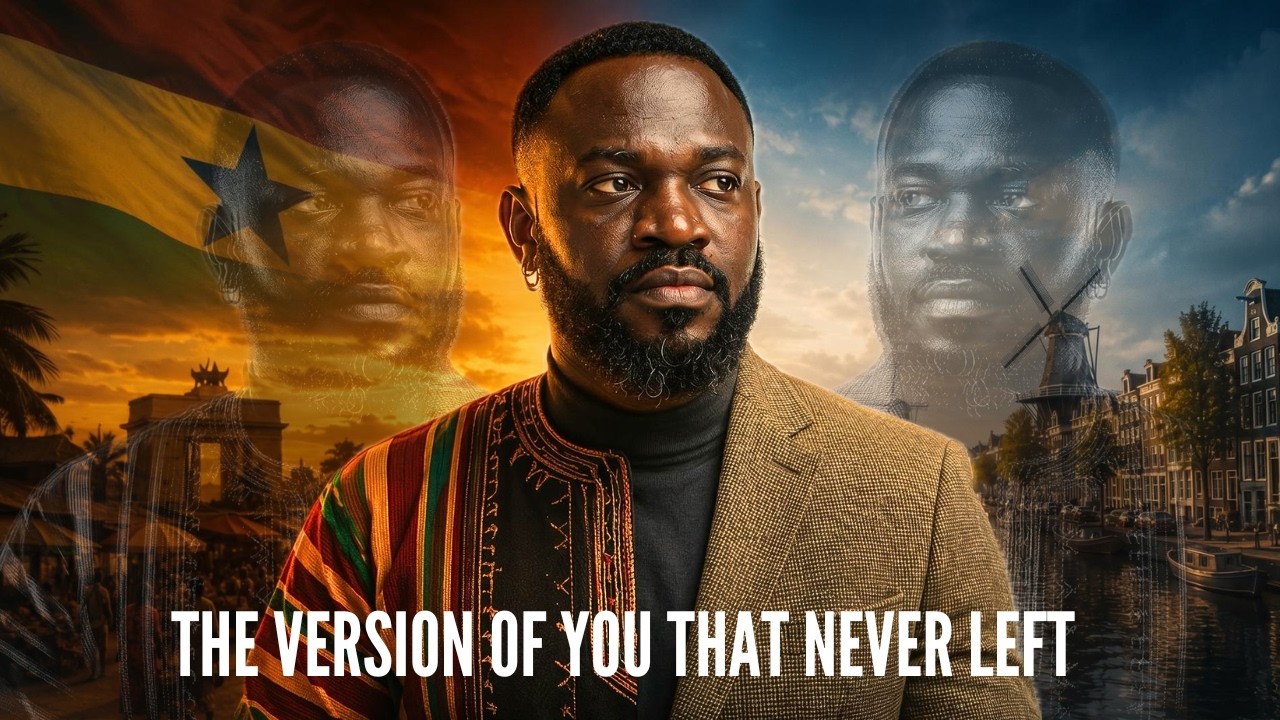
Video summary
In September 2025, upon returning to Ghana after moving to the Netherlands, the narrator felt a profound sense of disorientation that revealed how much both he and his home had changed since his departure. He realized that making such a significant life decision effectively splits one's identity into two distinct versions: the self that stayed behind in familiar territory and the self that ventured into the unknown with uncertain plans. The version of him who remained was well-established, having spent ten years building a reputation as a radio host before transitioning to voiceover work and documentary filmmaking. This individual enjoyed an effortless existence where opportunities found him naturally, allowing him to take his comfort and social trust for granted without ever questioning whether that success truly reflected his own values or simply mirrored the expectations of his environment.
The narrator contrasts this ease with the reality he now faces as a stranger in both countries, having traded belonging for perspective. While staying would have meant continuing within a script where everyone agreed on what success looked like, moving allowed him to question whether that definition was truly his own. He acknowledges that while the version of himself who stayed wasn't failing or unhappy by local standards, he left because he needed distance to see the shape of his life clearly and determine if it actually fit him. This shift created a state where he feels partially at home in neither Accra nor Amsterdam, experiencing a quiet discomfort from not fully belonging anywhere but gaining a unique vantage point on both cultures that those born into them do not possess.
Ultimately, the narrator concludes that looking back with regret would be doing a disservice to his own journey and the choices made along the way. He recognizes that choosing one path inherently means accepting the death of other possibilities, which is not a tragedy but simply what it means to make serious decisions. Although he sometimes feels a strong pull toward imagining an easier life where trust was given freely without him having to prove himself, he understands that he cannot go back or treat his former self as a threat. Both versions of him are real and valid, yet only one can continue moving forward in time. He invites viewers to reflect on their own parallel selves and consider what looking at the lives they didn't choose has taught them about why they made the decisions they did.
Read the full video transcript
In September of 2025, I was feeling a
bit homesick, so I [music] traveled back
to Ghana for a short trip. And while I
was ecstatic [music] to be back home, I
noticed something that I hadn't
expected. Upon arrival in Accra, it felt
quite [music] odd in a way that I had
never thought of before. It was either
that home had changed [music] or I had
or both.
But I couldn't quite tell which one it
was or whether or not it even mattered
which one it was.
But that feeling made me very aware in a
way that I hadn't thought of before.
That is of the full weight of the
decision that my wife and I had [music]
made when we chose to move
uh
to the Netherlands. And the change
wasn't only felt by me, [music] my
family felt it, and my friends also felt
it in their own ways. And so today, what
I'm trying to do is explore [music]
that.
The conversation around the version of
me that stayed [music] home and whether
in this exploration that I will find an
answer to a question that I've been
sitting with for a while.
Whether that version of me is [music]
happier in all of this. And the concept
that I'm trying to or I'm going to try
to explain here may sound like something
out of a fiction writing exercise, but I
think it's the easiest way that I can
make sense of what I've been feeling.
When you finally come to the decision to
well, and eventually the action to move
countries,
something happens. I think a major
decision like that splits you into two.
Well, technically all the choices we
make have that effect, but for the sake
of this video, let's stick to this one.
There is a version of you that stays.
That one that would have just gone about
continuing in all the things they have
always known, being comfortable in, and
even to some extent very complacent. The
one that never had to rebuild anything
because nothing was ever dismantled in
the first place. And then there's the
version of you that walks into the
unknown with all these plans and dreams
that will not materialize in the way
that you have ever imagined, but still
got on the plane with everything and
left
>> [music]
>> anyway. So, those or that is in very
simple terms the conversation that I
want to explore [music] today.
Back home in Ghana, the version of me
that stayed was a very
No, [music] fairly well-known, not very.
Fairly well-known guy who had spent
about 10 years in radio. He left [music]
that to pursue a career in voiceover and
documentary filmmaking. He had managed
to build a reputation that certain
things came to him without so much
[music] effort, without him having to
work so much for it. Opportunities
found him without him having to chase it
down. [music]
There was a particular sense of ease in
how he moved through his professional
life that made him take some privileges
for [music] granted
in the way that you can only do so when
things have always just been there,
[music]
you know? Not having to translate
himself every day, the level [music] of
trust that was extended to him simply
because of who he was and what he had
built. [music] And I think that's a
shorthand that comes from being known in
a place. [music]
And I also remember my wife would
jokingly say that she was a little
jealous of how work found me back then
and how I didn't have to go looking for
things because of who I was, at least in
our crowd where we lived. The guy who
had nothing to [music] prove to anyone
in the room.
That version of me had never once
wondered how difficult it would be to
find community, let alone build [music]
it. And if anything, I'd say there were
aspects of my own preferences that
sometimes worked against deeper
connections even when the environment
was offering it freely. [music] Me
personally, I preferred being alone in
my own cocoon, sitting with my ideas,
daydreaming while work arrived on its
own schedule. So, [music] it was fun.
But
the question I find myself asking now is
how long was that version of me supposed
to [music] exist before something
eventually shifted? That effortlessness
started to [music] cost him something he
hadn't accounted for. And would he have
recognized it when it came? [music]
Would he have accepted it or he would
have kept renegotiating until it was too
late [music] to do anything meaningful
about it? That is what I want to find
out. But honestly, I think the question
that actually matters isn't [music]
which version of me is happier. think
that's even a question that could have a
straightforward answer.
>> [music]
>> And I'm not sure that's the right
question to be asking in the first
place. The question that matters is
[music]
what does his existence tell me about
why I left Ghana? And the part that's a
little uncomfortable to admit is this.
The version of me that stayed [music]
wasn't failing. He was doing well, at
least on his own terms, which is what I
had always wanted. And honestly,
>> [music]
>> that remains a running theme in how I
think about how a good life should be.
But there was a kind of certainty
available to him that he can only really
access [music]
when you've never had to question the
script that you were handed.
He [snorts] knew what success looks like
because everyone around him agreed on
[music] what success looked like. He
never had to ask whether the definition
of what he was actually getting was his
own or whether he was simply absorbing
it from the environment that was around
him. But
>> [music]
>> I did. And I started to ask questions.
And it's something that I think I'll be
probably doing for the rest of my life
in one form or another. [music] And I
think that's the real difference between
the two of us. That version of me never
had to find out whether the Ghanaian
script actually fit him because he never
stepped out of it long enough to see it
clearly. He stayed inside of it. The
comfort was real, [music] and the
comfort itself prevented the question
from ever fully forming. And I'm not
saying this was a flaw, necessarily. I'm
just saying it's a function of distance.
When you can't see a script when you're
standing inside it, you [music] need to
step out. You need to become a stranger,
at least temporarily, to see the shape
of the thing that you are living inside.
And that, more than anything, is what
moving countries
>> [music]
>> does to you. You're not just relocating
geographically, you become a stranger to
everything that you used to take
completely [music]
for granted. The way ambition is talked
about, the weight of family
expectations, the timeline that you're
supposed to follow, [music]
what a good life is supposed to look
like, and what it's supposed to cost
you. The trade-offs that are considered
acceptable, and the ones that are
considered non-acceptable. So, when I
compare my life to his, I try [music] to
stop asking whether I am happier,
because I've come to believe that that's
the wrong question. The right question
is whether I left because I was wanting
more, or whether I left because that
script didn't fit me, or I couldn't
quite breathe [music] inside it, and
leaving was the only way that I knew
that I could find out who I actually was
outside of it. And honestly, I don't
have a clean answer to that. Maybe both
things are true. Maybe ambition and
escape are the same thing when you are
young enough that you haven't learned to
tell the [music] difference between the
two of them. But,
here's what I do know now.
The other self gave me something by
existing. He gave me a mirror. Every
time I wonder whether I made a right
call, I can look back at what could have
been,
and see clearly what I have traded. And
there are a few things that I've traded.
I've traded belonging, at least the
easy, effortless kind, for perspective.
I've traded the comfort of being fully
inside something for the clarity of
being able to see it from the outside. I
became someone who doesn't fully belong
in Accra anymore, and doesn't fully
belong here [music] either. And I think
that's the real cost. It's neither a
failure nor a mistake. It's [music] just
the honest cost
of the choice. And the interesting thing
is that I started seeing this new
version of myself in small fragments
even before the move was fully decided.
Even though I didn't fully recognize it
at the time, more and more questions
about what could be started [music]
surfacing whenever my wife and I visited
Netherlands in the years before we
finally moved.
Something was already shifting even
[music] then. So, after 2 years of
living here, I can look back on a
journey so far with a little more
clarity and see the actual cost of
moving. [music]
I've gained and I've lost in both
directions, and it's the kind of balance
that takes some time to sit comfortably
with, maybe longer than the 2 years that
I've been [music] here.
And in other conversations or other
videos I've made in trying to understand
the full weight of what living abroad
does [music] to a person, I have used
Heraclitus's philosophy that you can't
[music]
you can't ever step in the same river
twice, and that framework made it easier
[music] for me to understand why my
visit to Ghana last year felt so
unsettling [music] in a way that I had
not anticipated. I don't feel like I
have fully settled here in the
Netherlands, and when [music] I went
back home, it also felt like a foreign
place.
Yes, it's more familiar, but it had also
changed and changed in a way that had
nothing to do with me, but everything to
do with the fact that rivers keep
flowing whether you are in them or not.
On one hand, I've gained a new
perspective on how adaptable I can be
when the situation requires it. I've
gained ability or the ability to see my
own culture from the outside, which
is strange and sometimes disorienting.
And I can see this new culture that I
currently live in from a certain
distance, too, which gives me a vantage
point that people who are born in it
don't necessarily have.
But, that kind of vantage point doesn't
always feel like an advantage
or the advantage that it sounds like on
paper because there's something quietly
uncomfortable about belonging neither
here nor there.
And I have a confession to make, one
that I've been sitting with for a while
now. So, lately I've been feeling a
strong pull toward the version of me
that stayed [music] home.
I find myself imagining sometimes, quite
vividly, all the things that that
version of me could have been doing in
an environment that offered effortless
belonging, where he didn't have to build
trust from nothing or explain himself or
even prove himself in rooms where nobody
had any reason yet to believe in him.
I don't know if this is one of those
phases that living abroad puts you
through, where you cycle back to
questioning what life would have looked
like if you had never left. The things
that I might have done differently in
the years before I moved if I had known
what the move would actually cost,
whether there was a version of
this particular move that would have
been easier or whether the difficulty
was always going to be there and waiting
on the other side,
regardless of how prepared I was for it.
[music] But, I do know that I can't go
back and become that person who stayed.
And, as [music] much as that doesn't
always feel comforting, I also know that
I can't afford to treat his existence as
a threat to what I currently am.
That would be doing a serious disservice
to both versions of the story. [music] I
didn't drift into this life. I made a
choice, and choosing by its very nature
means that accepting the death of other
possibilities.
That in itself is not a tragedy. It's
what choosing actually means when
[music] you take it seriously.
So, I can look at the parallel version
of myself with curiosity and maybe even
with tenderness, but [music] not with
regret.
He would have been fine, and I will be
fine, too, with every decision that I
can continue [music]
or continue making from here.
The split happened, and both halves are
real, but only one of them gets to keep
moving forward. All of this is to say
that ever since uploading my previous
video the invisible wall I've had
several interactions via my social media
DMs and the running theme has been
connection to the story as well as
curiosity.
And the curious ones have been asking
[music] why I do this, why I make such
videos and this is the why.
I make such videos [music] as an outlet
to speak out and make sense of something
that is still in motion while it's still
tied to
a lot of equally important things that
have already [music] happened. So if
this one resonated with you, if you
found yourself thinking about the
version of yourself that stayed, the
life that exists somewhere in the
background of the one you actually chose
I'd love to hear about it from you in
the comments. Not just whether you think
you made the right call, but what
looking at that parallel version of
yourself has taught you about why you
left in the first place.