Video summary
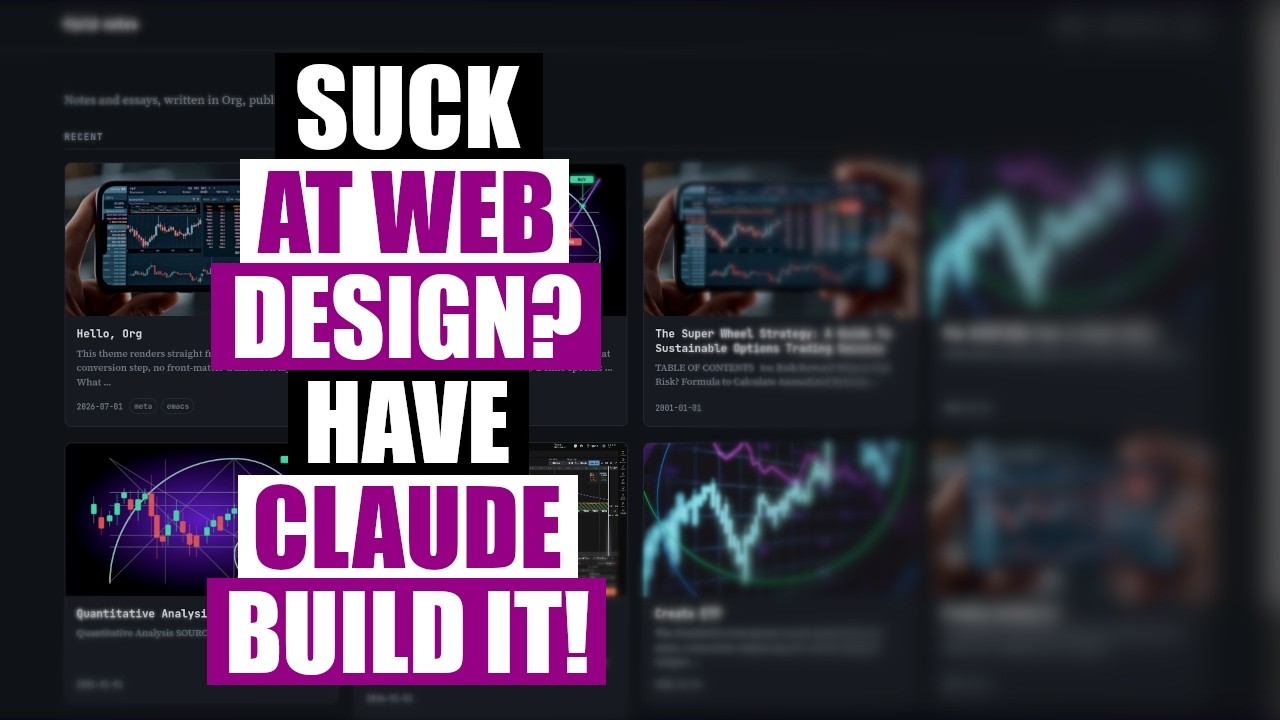
The video creator shares his impressive experience using Claude, a large language model AI tool, to design and build a custom website for his financial channel, DT Options. While he previously utilized Python Flask scripts generated by Claude to create dynamic data visualizations and charts, his recent goal was to develop a blog-style site written entirely in Emacs Org mode. Recognizing that existing Hugo themes did not meet his specific needs, the creator decided instead of modifying an off-the-shelf template, they would collaborate with Claude from scratch to build a unique theme tailored exactly to his workflow.
The collaboration began when the creator asked Claude to generate a base Hugo theme supporting Org documents, which resulted in a fully functional site within just five minutes. Over subsequent days, the pair iterated on the design by adjusting spacing, column layouts, and color schemes to create a dark-themed blog that displayed posts in a card-style grid. The AI also successfully implemented features such as image cropping for headers, table of contents navigation within Org files, and tag-based search functionality, demonstrating its ability to handle complex structural requirements without needing deep web development expertise from the user.
Looking ahead, the creator plans to integrate this new blog with his existing Flask-based data visualization site by dynamically embedding daily generated charts into specific articles. He highlights how Claude excels not only in Python but also in languages like Rust and Emacs Lisp, making it a versatile tool for various programming tasks. Ultimately, he concludes that these AI tools save significant time compared to traditional development methods, allowing non-developers to build sophisticated websites efficiently while leveraging their existing subscriptions effectively rather than paying for proprietary plugins or spending months on manual coding.
Read the full video transcript
So, I continue to be impressed with some
of these AI tools, especially the large
language models like Claude. I spent a
lot of time in the last few months with
Claude, especially building certain
applications and websites, having it
write a lot of custom Python scripts
that generate a lot of data for me. And
the last several weeks I've been working
on this particular website, the DT
Options website. You guys know I have a
financial channel dedicated to trading
options. It's called DT Options. I built
this website around it for members of my
Discord. It's a private website that
they have access to a bunch of different
information. I've got a lot going on in
here, custom indicators that I helped
build with Claude as far as scripts that
generate, you know, some interesting
information here. So, one of the things
with using Claude to build this site,
though, this is a Python Flask site. And
it's perfect for generating graphs and
charts and things like that, generating
tables of data.
But, here lately I wanted to also create
a site that was more of a blog style
site, something I can just post blogs,
you know, articles to. And I wanted to
write it using Emacs org mode because
Emacs is what I write everything in. I
live in Emacs and I write all of my
documents typically in org format. So,
naturally I thought about Hugo because
Hugo does support writing both markdown
and org. So, you write everything in
either markdown or org and then you just
put those files in a folder on your Hugo
server and it creates a website for you.
And I was looking at some Hugo themes. I
was like, "I'll create a simple little
Hugo site, you know." And looking at
some of the available themes here. And I
realized something. I realized I didn't
like any of their themes. So, what I
ended up doing is I was like, "You know
what? I bet Claude can create a simple
base Hugo theme that, you know, over a
few days or a few weeks we can build our
own custom theme instead of trying to
take a pre-designed website and try to
basically force it into what I want it
to be. Let's just start from scratch
with Claude. So, I told Claude,
"Question, I use Emacs org for all of my
writing. Thus, I would like to be able
to use org documents for creating a
website. I know Hugo supports org, but
the problem with Hugo is all of the
publicly available themes kind of suck.
Would you be able to create a Hugo theme
from scratch?" And Claude answered,
"Yes, definitely." And it goes on to
explain what Hugo is, how the layout is,
how the org support works. You know,
which most of this stuff, I mean, I
already know how Hugo works. I've built
Hugo sites before, but, you know, if you
didn't know, it's nice that he posts
this information. And then, he wanted to
know more about what I wanted. I said,
you know, I want a a mix of blog and
static pages, and I wanted a dark theme
out of the box. I didn't give him any
real specifics. I just let him go do his
thing. He said, "Okay, we're going to
use this color scheme, yada yada yada."
And, you know, if you're paying
attention to as he's building the site.
Finally, I get a zip file with comes
complete with all the Hugo stuff. You
just unzip it, and you've got your Hugo
site with the theme. And this was what
it looked like, you know, pretty early
on. Now, we did adjust it a little bit.
We played with some spacing and stuff,
but it was a pretty simple theme. He
even created a default post, "Hello
org." Right in, [laughter]
you know, and I like the color scheme. I
like, you know,
I may play around with the color scheme
at some point, but this was really cool
that he created this example Hugo site,
Hugo theme
uh with the post, and then one about
page as far as like a static about page
or contact page. You could use this for
practically anything. And the very first
iteration of this site, you know, with
just the one example post and the basic
layout and theme took Claude all of, I
don't know, maybe 5 minutes, right, to
generate the very first site. And then,
we started playing around with it,
right? Me and Claude went back and forth
a few times over a couple of days. You
know, I was like, "Hey, this layout
looks pretty good, but I'd rather have
the spacing be this. I'd want the number
of columns to be that." You know, I just
tell it exactly what I wanted. And in
the end, what me and Claude ended up
with Well, I won't say in the end
because we're still working on it.
Still, basically, this is just an
example site. This is what it looks like
right now. And I've got these example
posts. These are not real posts. They're
going to be part of the website, but I
had I've got hundreds of org documents.
I have uh several uh folders that have
org documents related to trading. So, I
just threw a bunch of those in the
content folder so I could have some
stuff. And yeah, this is pretty neat.
So, I also put some test images in there
so we could have uh images with our
posts. Uh I also asked Claude, "Hey, I
need table of contents as far as like
headers so, you know, I can click on a
header and go to that header inside the
org document itself." He also added the
tags uh to navigate between tags for
posts because in Hugo, you can give post
tags. That way you can search via tags
on your posts. And this is stuff, you
know, I'm not a web developer, but it
would take me weeks, if not months, to
actually do some of this stuff, right?
It would take me a long time to create
the theme, create the layout. And you
know, I specified, you know, I give gave
Claude some pretty specifics, you know.
I didn't want to throw a bunch of it
initially. I let him create the theme,
and then we tweaked it, you know, tweak
it small uh one at a time. I was like,
"Hey, I want a card-style layout where,
you know, it fits about four posts um
you know, wide on a 1080 kind of
resolution." He created that for me.
Initially, he didn't have images as part
of the post. I said, "Hey, every post
I'm going to have an image." So, we
added image support. And then I wanted
the image also to be part of the post.
But, I didn't want the full 1920 by 1080
image, right? It'd be too big. I was
like, "Yeah, chop off the top and
bottom, you know, and just crop the
image a little bit so we get part of a
image as a header for each post here."
And, you know, again, I'm going to keep
working with Claude. At some point, I'm
probably going to work with Claude
adding some kind of search functionality
to this. I may also add a categories,
you know, which are very similar to tags
also in Hugo. We may have other stuff in
the side columns here as in the the
actual articles themselves. I may work
on a a contact page. We got to do about
page, which is just a placeholder right
now. All of this is placeholders, but if
I needed a contact page that include in
that included some way to actually email
me, some of that stuff would take some
work, but it's going to take Claude mere
minutes. So, I see a lot of people that
really fear AI, throw a lot of shade on
these large language models like Claude
and ChatGPT.
But, man, these tools are so
unbelievably impressive, and they save
so much time. Like, if you have a Claude
subscription, and you're trying to build
a Hugo website or any website, whether
it be static websites like a Hugo or
something more dynamic, maybe you need a
a WordPress theme, whatever whatever it
is. Maybe you need to add some
functionality to a WordPress site, and
there's just something that hey, there's
no plugins out there available for you,
or maybe there's some plugins out there,
but you know, you don't want to have to
go pay for some proprietary plugin. It's
like, "Hey, Claude, here's what I need.
I need this plugin in WordPress that
does this. Can you help me create it?" I
bet Claude can do it. Matter of fact, I
I know Claude can do it without even
asking cuz I've created so much stuff
over the last several months with
Claude. Some really complicated tasks.
And with Claude, especially, I can say
Claude's really good with Python cuz
that's what I mostly do with Claude is
write a lot of Python code, especially
for a lot of like the financial and
trading scripts that that I have him
write. Most of that kind of space is
dominated by Python code, so that's what
I stick with for most of those kinds of
financial scripts. But, Claude's really
good at Rust because Rust is the hot new
language these days. A lot of times, if
you're unsure about a language, you
don't know any language, and you're
creating whatever application, a lot of
times Claude and ChatGPT, a lot of these
large language models will say, "Hey,
why don't we do it in Rust?" And if
you're good with that, then he can
create some pretty cool Rust
applications as well. I've actually
created a Python applications, Rust
applications. And of course, Claude's
really good with Emacs Lisp. I mean,
anything I can imagine that I want to do
inside Emacs, and I need some kind of
extension written for Emacs, Claude
really good with Emacs Lisp. And at some
point, what I'm going to end up doing, I
think, is I'm going to take this simple
website
that I'm having Claude build, this
simple Hugo site where I can just throw
some basic plain text, you know, org
documents into a folder and have my
blog-style articles, you know, all of
that, my blog website, right? But, I
also will have my website that has all
the charts and stuff that are generated
from those various Python scripts, the
Flask-based website. At some point,
we're going to integrate the two sites
together. I'm going to need some help
with Claude, and I bet Claude is going
to pull that off fantastically. In fact,
one of the things I might do, you know,
some of these charts that are generated,
the Python-related charts here, you
know, some of the graphs and stuff, I
would like to incorporate that into
certain blog posts. And I'm just going
to get Claude here. What we're going to
do is I'm just going to tell Claude,
"Hey, I need the ability, when I write
some of these articles, sometimes I want
to, you know, reference some of these
dynamically generated graphs because
these graphs and charts are
on a cron job. They get generated daily
because, you know, each day passes by,
new candlestick in the chart, you know,
the chart will change over time. But not
necessarily the text of the article will
change over time. You know, so I've got
some ideas that, again, would be
complicated would be a complicated site
for somebody to build on their own,
especially somebody like me that is not
necessarily into web dev. I mean, I know
a little bit about it and I certainly
could do it if I wanted to do a deep
dive, but it'd take me a long time and
time is money
where I could pay I mean, I've got my
Claude subscription. I pay Claude
whatever $20 a month. You know, I might
as well get my money's worth. So, that's
it for today's video. Before I go, I
need to thank a few special people. I
need to thank the producers of this
video, Matt, Steve, George, Darloff,
Lee, Mark, Mythos, Aryan, Pete Archer,
Fedora, Reality Tsurlas, Roland Warjito,
Nabuntu, and Willie. These guys they're
my highest tiered patrons over on
Patreon. Without these guys, this quick
look at how Claude can build a Hugo
site, it wouldn't have been possible.
The show is also brought to you by each
and every one of these fine ladies and
gentlemen. All these names you're seeing
on the screen right now. These are all
my supporters over on Patreon cuz I
don't have any corporate sponsors. I'm
sponsored by you guys, the community. If
you like my work and want to see more
videos about Linux and free and open
source software, subscribe to DistroTube
over on Patreon. Peace, guys.