Video summary
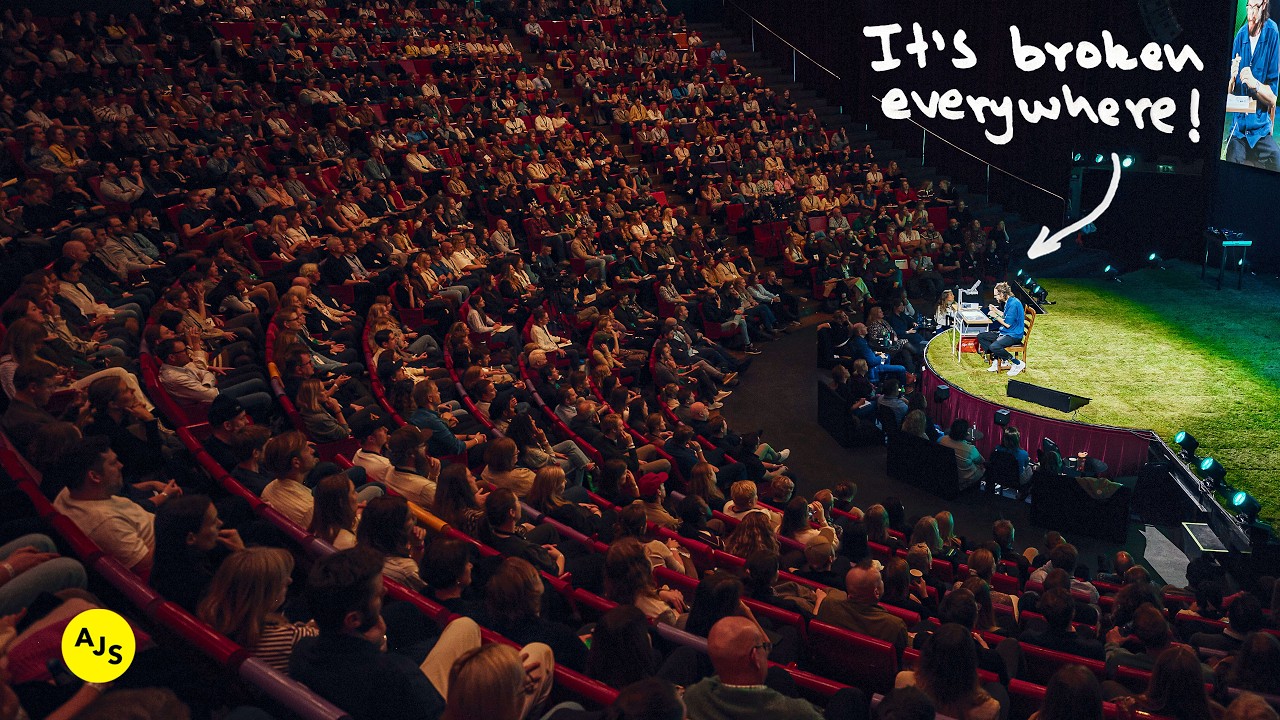
Jonathan from AJ & Smart challenges the common aversion to meetings by reframing facilitation as a simple method for improving collaboration rather than relying on complex jargon. He argues that while artificial intelligence will eventually automate execution tasks, significant strategic decisions still require human interaction within groups, making the quality of these gatherings critical for success. Drawing from an interactive session with 950 people in Oslo, he highlights frequent pain points such as frustration, missing agendas, the dominance of the Highest Paid Person's Opinion, and passive aggression, which often lead to unstructured chaos where multiple threads derail the main objective.
To address these issues, he introduces a robust four-phase structure known as the "Four C's," designed to function effectively even in chaotic environments. The process begins with **Collect**, where all challenges and questions are gathered without making immediate decisions or starting new conversations. This is followed by **Choose**, where the group selects one specific focus for the session while parking other topics, such as technical issues like a laptop problem, to be addressed later so that everyone feels heard. The third phase, **Create**, involves brainstorming ideas specifically for the chosen topic to maintain a focused flow state, and the final step is **Commit**, where concrete next steps or dates are decided upon to avoid the common trap of ending meetings without actionable outcomes.
The central conclusion emphasizes that teams benefit greatly from having a designated facilitator who takes the burden of running the meeting off the participants, allowing everyone to focus on their actual work. By accepting that human nature makes meetings inherently messy and applying this simple structure, companies can transform meetings from a mere tax into a productive space for creativity and strategy, ultimately improving both outcomes and employee satisfaction. Jonathan encourages viewers to move beyond the mindset of hating meetings by learning these free facilitation techniques to help their teams produce results rather than getting stuck in unproductive loops, noting that even drawing on an overhead projector during a chaotic presentation can be an effective way to pitch these ideas to skeptical large groups.
Read the full video transcript
Hey, Jonathan here from AJ and Smart.
And if it's looking a bit chaotic around
here, it's not our usual like film set.
It's because I just got back from doing
a talk in Oslo. And actually, the talk
itself might be interesting to you
because it is essentially me going on
stage and trying to pitch to 950 people,
pitch facilitation to them, pitch
workshopping to them. And I know a lot
of you guys in the comments ask all the
time like, "How do you explain the value
of facilitation? How do you explain the
value of a workshop? How do you sell
this stuff to clients? It's so broad.
It's so general. Well, you what you'll
see in the couple of clips coming up
from me speaking in this uh conference
in Oslo is there's a very specific way
that we do it at AJSmart and it's that
we focus on the concept of just
improving meetings. So, we keep it super
simple. We don't try to like flood
people with too much information about
workshops or facilitation. In fact, I
rarely even talk about facilitation when
I'm doing this sort of thing. And so, if
you're wondering how do the guys at AJ
and Smart talk about facilitation to
people who are maybe not super aware or
even necessarily interested in
facilitation. Well, this video is
exactly that. I hope you enjoy it. Let's
go to Jonathan from two days ago.
>> Hey everybody.
>> How's it going?
They told me you weren't going to
respond.
I've never come to a country where I've
gotten so many warnings about the people
not being like, Jonathan, they're not
going to do anything. They're not going
to smile. They're not going to say
anything.
This is great. Okay, maybe they were
just lowering my expectations. So, I've
got a question for you guys. I've got a
task for you guys. First thing I want
you to do, just think for yourself, just
in your own head. If you got a piece of
paper, you can write something down.
Think of the first thing that comes to
your head when I say the worst meeting
experience you've ever had. Just a
random bad meeting experience that
you've had in your life. Could even be
some sort of messy collaboration system
that happened with you and your friends,
maybe trying to organize something in a
WhatsApp group. Um, I'm going to
give you a minute to think about it
while I try to figure out how to make
music work on my laptop here. So, think
about that by yourself. I'm just going
to give you a minute of awkward silence.
Oh, nice.
Now, I'm going to get you to do
something that they warn me Norwegians
don't want to do. I'm going to ask you
to look at the people next to you. I'm
sorry. And pair up into little groups of
three. So, just can be the people behind
you. It doesn't matter. Two or three,
that's fine. And all I want you to do is
tell the people in your mini group about
the experience, about your terrible
meeting experience. I'm going to give
you about 3 minutes to do that in total.
Let's go. Let's go.
Thank you.
So, what did you guys notice? What are
some of the things you noticed when
talking about meetings? What are some of
the bad meetings? What are some of the
things that came up? Shout it.
>> Frustration.
>> Frustration. agenda.
>> Lack of agenda.
>> Waste of time.
>> Too much talking. Waste of time.
>> Why am I here?
>> Why am I here? That's what I'm asking.
>> Just about life in general.
>> Say that again.
>> Bad connections.
>> Bad connections. All right.
>> People not being present.
>> Too many hippo.
>> What did you say?
>> Hippo.
>> Oh, there's a hippo. Was it the highest
>> paid person's opinion?
>> What was it? Highest paid person's
opinion. Uh-huh. Or a real hippo, which
actually makes meetings fun.
Anything else?
>> Could have been an email.
>> No decision makers.
>> Uh-huh.
>> Say that one more time.
>> Passive aggressiveness.
>> Passive aggressiveness. I heard that in
your voice as well, actually.
So,
and and we all know we get through all
of that pain, right? We get through all
of that frustration, but at least at the
end of a meeting, we've got a decision,
right? Like everything's solved, right?
What's the most common thing that
happens at the end of a meeting?
>> More meetings, right? Okay. So today
over the next while
I have uh what I want to do what I want
you to leave here with today is an
understanding of why this happens like
why meetings are so incredibly
frustrating.
How a couple of ways to make them a lot
less frustrating.
But before I get into that I think the
most important thing to understand is
that
a question for you guys. How do the
biggest decisions actually get made in
companies? Like strategic decisions, how
do they get made?
People coming together, talking to each
other chaotically, and eventually
something out the bottom of it. And now
that's the strategy. It is chaos. And
with a lot of the stuff that's happening
with all of these amazing AI tools that
we're, you know, using at the moment
that are making the execution of our
work easier and easier, I think hating
meetings and, you know, the meme of
meeting suck could have been an email is
actually going to hurt us because the
people who are able to have good
meetings, the people who are making
decisions, all of the big strategic
decisions are still going to happen when
a bunch of people come together, talk to
each No matter how chaotic it is, that's
still where the big decisions are
getting made. It's not in my Figma file.
It's not, you know, in whatever software
we're using. That's the real work. I
know that I also say that I wish this
meeting. How many of you have said how
how many of you have thought I wish this
meeting would end so I can go back to my
real work.
Unfortunately, what if meetings end up
being the real work? Guys, it
actually might happen that so much of
the real work we do is going to get
automated. I think a lot of us know
that. And even though there will still
of course be plenty to do, I do think
that like just fully deciding that we're
not going to to be part of meetings and
we're just going to like, you know, it's
just the tax that I have to pay to get
my real work done probably
at least won't make your life enjoyable
in the long run because you're still
going to be in a lot of meetings. So,
let me show you with my incredible high
technology device here. Going to turn
this on for you guys.
Check that out.
Let me show you in let let me start
things off by showing you why meetings
are incredibly broken in the first
place. And it's not what you might
think. So let's think about
let's think about your average meeting.
So we have kind of a goal at the start
kind of, right? Usually the goal is like
whatever the meeting invite is called
like let's say it's design
the team
retreat.
I can't spell by the way. So at least
you got you know not native English.
It's fine. Whatever it's all correct
guys. Okay. Um so you can see it. Can
you guys see that? Okay.
>> I really am not a big fan of making
slides cuz I'm way too lazy. And so I
really appreciate that they gave me this
thing. Okay. So, it's like being back in
school. So, you have your goal at the
start. You've got like a bunch of
people. That's us in a meeting,
whatever. There's like, you know, maybe
four people in the room, some people on
Zoom, whatever. And then we've got our,
this could be like, you know, this is
the thing we want to actually do or the
challenge, whatever. It's the starting
point. And at the end we ideally want to
have our outcome,
our kind of tasks,
our answer,
our decisions. Oops.
And here's where the problem comes in.
When we
go to a meeting,
we think that this is how meetings are
supposed to work. We think it's a linear
journey from meetings start with that
there's a thing we're going to talk
about and then meetings end with the
answers and the things that we're going
to do. Is this what happens in real
life?
>> Everyone's like, "Yes, goodbye."
So, let's play it out a little bit.
Okay. So, we start the meeting. Hey, we
want to have this retreat. So, it's
going to be happening in a couple of
months. Um, what we're looking for here
today is to figure out the location of
the retreat, how many people are coming,
and the budget. So, we're talking about
that. So, what where, you know, where
could we go? Where could we go on the
retreat? And we're just asking the group
of people. Okay. Maybe a pizza,
whatever. Okay. Maybe Oslo. All right.
Well, whatever. We'll see about we'll
think about that. Maybe we'll go to um
Spain. Maybe we'll go here. We'll go
here. Okay. So, people are starting to
talk about it, right? There's something
something is happening in a generally
kind of productive direction. It's not
structured, but that's fine. It doesn't
have to be super structured. Right. Now
Dave comes in 10 minutes late into the
Zoom call. He's like, "When are we
getting our new laptops?"
Okay.
All right. New thread. Oh, yeah. Yeah.
Okay. Look, Dave, we're talking about
the retreat thing. Yeah, but like if we
don't have our new laptops at the
retreat and then another person jumps
in. Yeah. You said we were going to have
the laptops by next week. All right.
Let's, you know, Okay. Here's what we'll
do. I'll open up Slack right now and
I'll message uh James and then we'll
figure out the laptop thing. Okay, cool.
Laptop thing, whatever. Okay, so I think
we should have the retreat in in like
summer instead of the winter. Oh, yeah.
Okay. So, well, we can we can talk about
that. So, we're opening up a new thread
now. We're talking about when the wear
thing is over here. And, you know, we've
kind of like got maybe maybe like Spain,
maybe like warm a warm place is the
thing that people have decided that they
want to do. And then it's like, yeah,
it. You know what? We'll let's say
Spain for now. Okay, so that one has
jumped right to the end of the meeting.
That one's just got checked off. We
still don't know when we're going, how
many people are going, what the budget
is, and we're on this little laptop
journey over here. Now, two employees
are on Slack talking about the laptop
situation while three of them are over
here trying to decide when. But then
they and and they're talking to each
other and they've decided we're going to
do it in July. And you know, 20 minutes
goes on looking for the time. And then
these guys join back in. Oh, I'm on
paternity leave at that time.
So, oh yeah, whatever. That's fine. And
also, I don't have a visa to go to
Spain. So, we can whatever. We can we'll
bring this back here. So, now the the
whole thing is playing out and the
meeting is coming. We're 15 minutes
before the end of the meeting. We've got
a lot of different threads open. We've
got another thread open about like the
cafeteria. We've got another thread open
about like onboarding new employees and
the meeting is going to end not because
we have an answer but because
>> time's up.
>> Time's up. And this is one of the many
reasons that the only way to solve this
problem is to have
>> lots more meetings. One meeting has
essentially spawned loads more meetings.
So the problem is I mean the the the
thing is we work in a company and this
frustrates us every single time as if
it's the first time and after a while
what happens is we start to es like I'm
you know I started my career as a
designer first 10 years of my career was
a UX designer and at a certain point of
going through these meetings over and
over and over again I just sort of lost
interest in participating and so what I
would do is try to wait them out the pro
How many of you try to wait out
meetings?
Exactly.
So, the problem with it or the the thing
that I realized because I also thought
someone else was going to come fix it.
Well, you know what? I thought two
things. I thought number one, this
company is just really stupid and they
never get anything done. That was the
first thing I would think because it was
like my, you know, first or second job.
I was like, this company just cannot get
anything done. It's a super chaotic
place to work and if I go somewhere else
it will be much better. And I went to a
lot of different companies, ended up
working at the tech companies, all of
the companies that apparently have
everything working fine. The exact same
thing was happening everywhere except
maybe in a nicer looking meter meeting
meeting room uh and people were getting
paid a lot more. So for me, the thing
that I started, my decision in my mind
was I'm just going to check out and I'm
just going to like let other people deal
with that stupid stuff and then I'm
going to do my I'm going to wait. I'm
going to show up to the meeting just to
show that I'm still part of the company
just to show that I care and also
because maybe I need a bit of
information and then I'm going to go and
back, you know, do my own work. The
thing I figured out though was that a
lot of the really important decisions
that I ended up having to work on were
getting made in these shitow rooms of
people talking over each other. And I
had a weird mixture of really not
wanting to be part of these things but
also really wanting to be part of making
the decisions so that I just wasn't
executing work for people. I wanted to
be part of the creating creation of the
concept.
And for me, these meetings, they were
these things that were just constantly
stopping me doing my work. And the the
thing that I said I said there was two
things. One is the companies I thought
the companies would improve as I moved
to a different company. They're all the
same. The second thing is I thought
someone else was going to get hired to
solve this problem. I was like, they're
bringing in a scrum master. This is
going to solve it. Didn't solve it. You
know, okay, now we're doing a big design
thinking thing. This is going to solve
it. Didn't solve it. And I kept waiting
on someone else to solve this problem.
And eventually I came to the conclusion
that probably if I am the one who's the
most annoyed about it and I'm the one
who's getting the most irritated, I
should probably think about trying to
solve this myself. And that's how I
ended up figuring out the term and I
probably will spell it wrong even though
it's my company name.
That's how I ended up uh figuring out
the term facilitator. Uh the most boring
thing of all time. It ended up being
like the most boring research of my
life. Uh but I actually ended up getting
very excited about it. There is a job of
a person who actually goes into meetings
and helps the meetings run. Well, that
part's not exciting. The exciting part
is that if this person is doing their
job well then everyone else can just
focus on what they actually want to do
because teams if they have to focus on
how the meeting is going to work like
you're paying you know some companies
are paying designers like extremely high
salaries and then that designer is stuck
just trying to figure out when is my
turn to talk in this meeting like who's
taking the notes like is this going to
be remembered in the next session and
the idea of the fact that someone could
come into the room and I and they could
like take the burden of the meeting off
of the team so we could actually do the
work we're being paid to do was like it
just like blew my mind. The idea that
this even could exist.
And the cool thing about it is there's
not a whole lot to it. being a
facilitator besides just realizing that
having one of those people in a room
when you have to make decisions when you
have to solve big problems just makes
meetings work better which for me was a
really cool idea. So myself and my team
set out on trying to figure out how to
do this. Also really big part of that
was discovering the sprint book from
Jake over here. Come on Jake everybody.
Yay.
So, in Jake's book, I was reading Jake's
book because we were looking for a way
for my company to like what I was trying
to figure out was how do we still do the
design work and get paid for it, but not
have to just do the execution? How do we
get more into strategy and further away
from just pure execution? And the design
sprint was one of those things where we
were able to have a facilitated
step-by-step process for the clients to
start projects. And that led me to
realizing, oh, like facilitation just as
a base skill is something I want my team
to have so that we can decide what we
want to work on. If I fall off this
chair, it'll be so embarrassing.
So, let me show you you some of you
might have seen this model for a meeting
just to just to give you a feeling.
Let's add some uh let's add some like
structure to this. And some of you might
have seen how many of you you've seen
the like double diamond something like
that from design thinking. Great. How
many of you have know how many of you
how many of you know like Sam Kainer's
model?
Okay, that's nice. Nice.
It's actually good for me that not
everyone knows it because then it's like
everyone will be like, "Oh my god,
Jonathan's so smart." I'm just Yeah. So,
okay. So, I'm going to show you um when
people look into meeting theory and
solving meetings, I want to show you and
if you start like for some reason
weirdly getting into this later, um I'll
show you what a lot of people talk about
when it comes to well here's how you
solve it. I don't think this is how you
solve it, but it's good to understand
this step just to kind of get the
feeling for it. So an ideal session like
an ideal like collaboration session um
when you look at these theories ideally
starts with this idea of divergence like
divergent thinking. Oh no d
is that right?
yeah it's probably right. So the
idea here is that you're creating loads
of ideas as a team. You're the ideas are
diverging. There's lots of different
ideas being thrown into the into the
pool and we're not like stopping any
ideas necessarily and we're just
creating like a volume of ideas at the
end of a meeting or at the end of a
collaborative session. What we generally
want is
>> I'm trying to make this as weirdly like
a classroom as possible. Convergence.
Exactly. Oh, it's shining into my eye.
Here we go. Convergence. So this is
where now we're taking, you know, we
have all of these ideas and they we
start whittling them down to a few and
saying that's what we're going to work
on. And Sam Kirner calls this bit in the
middle here, it's kind of a funny name,
the groan zone,
uh where you're kind of like battling
out the ideas against each other and it
starts to feel quite tense. So this is
like the uh this is essentially a model
of collaboration, a model of how a
meeting kind of should work. It and it's
not even in the best case scenario. It's
like in the scenario where you
understand how meetings work as a model,
but I still think it's broken. And I
think how meetings really work is
exactly how I showed you. It's pure
chaos. It's like all over the place.
People are jumping in and out of the
meeting. Someone will turn up late. You
never really know what's going to
happen. Someone just might be in a bad
mood. Like literally, someone being in a
bad mood could completely throw off the
results of a session. And so, like, how
many of you been in a meeting and
someone being in a bad mood probably
changed the outcome dramatically? Yeah.
Well, I mean that like think about that.
Think about the fact that your entire
career might be decided by someone just
being kind of grumpy.
Like that's the thing I didn't want.
That's why I wanted to have some control
over these sessions. Like I don't want,
you know, six months of design work just
destroyed and thrown out because someone
didn't eat enough before the meeting,
you know, or ate too much. And so for
me, when I look at
just add more there for detail, guys.
When I look at beatings, I think that we
need to first of all accept that it's
human nature for these types of sessions
where we're coming together, sharing
ideas, kind of, you know, banging things
together to figure out what to do. We
accept that those things are just kind
of messy. And if we accept that those
things are kind of messy, then we don't
need to fight against it. That's a first
the first part of what we call emergent
facilitation where we accept that even
though we'd love if people would stick
to this, you know, divergent convergence
system, it's not realistic because every
person coming into the room is a new
vector for making it weirder or or kind
of messing something up. And as you
know, you can have the best workshop or
meeting of all time and then someone
just doesn't turn up because they're
sick. someone turns up two hours late
because they just felt like it and then
everything has to be reset. So what
we're trying to design at my company is
systems so that we can go into any
company with any topic, any challenge
and I can send one of my employees there
and it doesn't matter how chaotic it is,
we can help them get to an outcome. And
a big huge part of that is just
understanding that meetings inherently
are chaotic and that that's actually
okay. That's not it doesn't mean the
company is broken. The amount of
companies that I hear saying like we go
into a company, I'll talk to them about
meetings and they're like, "No,
Jonathan, like this company's
Like nothing works here. Nothing ever
gets done here. Everyone's always
fighting. Like it's just so political."
Everyone always says it's so political.
I'm like literally you're telling me
what every other company is telling me
on the planet. That's just called a
bunch of people coming together to do
stuff. And what I really what I actually
want you guys to leave here with today
is
it kind of kills the tension when I have
to sit back down, doesn't it? Instead of
like changing a slide. So like where a
lot of us are today is you know meetings
suck or meetings
are the tax I have to pay to get my real
work done to I
love
meetings
because this is where I get to be human,
right? This is where you actually get to
bring in your creativity.
Talk about the thing you're actually
being paid to do. Maybe you're a
designer, developer, whatever it is. And
if you take ownership of meetings
instead of just being a participant
dragged along by a meeting, you can
actually make it so that the team you're
working in and the the the meeting
itself that you're in helps the team to
unlock their superpowers, helps the team
to do the things they actually want to
do instead of just getting in the way of
things. Do you guys know what I'm
talking about?
Kind of.
>> Yeah.
>> Kind of.
>> Yeah. You guys know what I'm talking
about?
>> Okay. All right. So, let's take a little
break. I have a question for you guys.
So,
Norway,
I'm trying to figure out what makes
Norway special. Okay. I've only been
here one day and I know you guys have
like a lot of rivalry between Sweden and
Denmark. I've been hearing stuff. Okay.
I spent a lot of time in Sweden. I spent
a lot of time in Denmark. I've been
hearing the stories. I've been hearing
what you guys say about them as well.
And I want to bring an objective truth
to all of this. I think you guys have
the best snack game. Okay, best snack
game. And so what I want to do, so I've
been asking around what I want to do
here. This is this is important. This is
part of this is totally relevant to what
I'm talking about, right? We're getting
distracted, but we're okay, right? So,
what I want to do is review
some Nordic snacks or Norwegian snacks
for you guys, and I'm going to I'm going
to decide which ones are the best
between the ones that you guys who I've
been talking to just in the halls have
told me are the absolute best ones,
right? So, we've got here Smash. Who
likes Smash? Who get Okay. All right.
Okay. I'm going to be trying Sm. By the
way, I'm gluten intolerant. I'm going to
be up after eating these things
for you guys. Okay.
>> So, we got Smash. All right. What else
we got? We've got Melkiss Jockalad.
Okay. Okay. All right. We've got Milkus
Joelad here. How does that look on
there? Just black. Okay. Great. And
we've got the one that I think has
created the most excitement amongst the
people, which is Kik. And And
just in case I was wrong, I also brought
the small one because I couldn't get a
straight answer as to whether it's the
big one or the small one. It's a big
one. That's a lot. And like so for this
one, are you supposed to like put the
bits of orange around the chocolate? You
just eat them separately. All right.
Like but like not completely separately.
Not this first and then this completely
separately.
Wait, you eat this and then you stop you
finish this and then you start eating
this. Oh, there's some Okay, there's a
little bit of tension around this topic
here. Okay, so throughout this talk, the
rest of this talk, I'm really trying to
figure out which one of these is the
absolute best. But I can tell you when I
arrive at the airport, I haven't tried
any of these ones yet. When I arrived at
the airport, what are they called? This
bag I got?
What animals? There's like a big bag
full of different chocolates. I like
devour the whole thing at the duty free
airport. I feel so sick afterwards.
>> Okay. Should we actually figure out how
to fix the meetings problem? Cool.
>> All right. You guys kept asking me about
chocolate, so I couldn't do the thing I
was here to do. Okay. So,
actually, before we do that, I've got a
question for you guys.
What was a meeting or a gathering,
whether or not you were running it or
not, whether you were just a member of
the group, where
it just felt great. It just felt good.
It felt enjoyable. I want you to think
about that for a minute and then I'm
going to get back to you. It just felt
great. A meeting, a gathering, some sort
of collaboration that felt great. Think
about it by yourself for a minute and
I'll get back to you.
A lot of people eating those chocolates.
It's making its way up. I'm impressed.
Look how far the smash has gone.
Those happy faces.
I'm learning so much from Jonathan.
He's very smart.
If your company paid for you to come
here, this would be the screenshot for
what you learned just to show them that
it was worth their money.
All right. So, I'm going to ask you to
do the same thing again. Just find one
or two people around you and tell them
about a positive hell yeah experience
you had in a collaboration and I'll give
you about three minutes to do that.
All right.
Okay.
What did you guys notice about the
positive ones?
>> What was different?
>> Structure.
>> More
>> more engaging.
>> More engaging.
>> Common goal.
>> Common goal. What was the
>> I was the decision maker.
>> Human connection.
>> Laughing
>> and laughing. human connection laughing.
That's
>> user tested.
>> Flow. It feels like it's flowing. It's
not just stopping the whole time.
>> Being prepared.
>> Open-mindedness. That's a big one,
actually.
>> Fewer people.
>> Fewer people. Yeah.
>> Being concise.
>> In concise. Very difficult for some like
me.
>> Chocolate. Hell yeah. Come on, you got
it. That's what I was waiting for.
Chocolate. We go back to another full
review. Um, I asked them for a lot of
time, so you know. Um, okay. So, the
some of the things that you guys said
there that I really enjoyed. One was
just like laughing like the the being in
a meeting where people are actually
laughing when it's in flow. That the
just like how you feel in a meeting is
just as important as the outcome itself.
But uh you also mentioned structure
being prepared. Being prepared I
wouldn't rely on. So that's one of the
things it's you know if you own the
company and you can guarantee how
everyone works at that company then you
can like maybe like demand it. But for
myself and my team or for people working
in companies where there's maybe
turnover or you're a consultant, you
can't really expect the same thing to
happen in each environment. And so what
I want to show you guys uh today in the
last 15 minutes here is a structure that
you can use in any type of environment
that just takes a little bit of the
tension and the stress off a session so
that it does feel like it's flowing more
and it doesn't feel so kind of chaotic
in a bad way. It could be chaotic in a
good way. So, let me show you something
that we came up with to help our
internal facilitators at AJ and Smart uh
design sessions for clients even though
we can't really tell what the client is
going to be like before we get there and
we don't really necessarily know the
topic they want to work on. And so, this
is something that's very robust and
works in pretty much any scenario.
The only catch is that there does need
to be someone in the group, someone in
the team who says I want to run the
session or I'll take responsibility for
doing this. And this is something that
almost no team has. So most teams that
we go to, the person who's running the
meeting is the person who sent the
calendar invite. But then this person
who sent the calendar invite is
responsible for both keeping the meeting
on track and actually coming up with
ideas and and and and and
whereas if there's someone in the room
even if they are taking part in it who
takes the role of hey I'll facilitate
this like I'll bring us through this and
the reason I'm going to do this is so
that you guys can focus on what your
actual actual work is and I'll take some
of that burden off. It's a game changer.
So let me show you something that will
really make this much easier if you take
that role and you decide to go into a
meeting. So this is the super chaotic
meeting. This is generally what a lot of
meetings feel like and it's not a
problem. It they they are like that in
many situations and people people try to
solve this by doing a lot of preparation
by making meetings shorter. That's
another thing that uh people try to do
or companies try to do. if we have
shorter meetings or if we have less
meetings. That's another thing. We'll
solve bad meetings by just having less
meetings and then decisions still need
to be made anyway. They just get made
like in different ways. And so what I
want to show you is if the company
you're working at changes nothing, this
still works. If everybody on your team
is still chaotic and doesn't play by the
rules of meetings, it still works
because actually that's what being a
human is. It's not something wrong with
the team. It's not something wrong with
your company. This is just how people
work together. So, one of the things
that we did was we created a very simple
structure for meetings that goes through
four phases of a meeting. So instead of
trying to figure out when the divergence
is happening and when the messy middle
is happening and when the closing is
happening with the convergence, we just
came up with a structure that shows us
the four most common phases of a
meeting. So that we as the facilitator
or you as the person maybe helping
running this meeting can actually in
your head you know where the team is.
You know where this the meeting is at
and you can help bring people back to
where they should be to to help them get
stuff done. And we call this the four
C's. And actually I'm going to have to
draw it on a new thing because look at
look at what I've done here. So oh
there's a fresh one here. So the four
C's. So we have the start of the
meeting, we have the end of the meeting
and what the four C's does is just adds
a very very simple structure. First you
have the collect phase.
So instead of starting a meeting with
like the previous way where at the start
of the meeting you're both starting and
closing topics meaning you're you know
making decisions in the in between
starting new conversations. What you're
saying here is at the start of the
meeting we're not trying to make any
decisions. Let's take the stress off the
start of a meeting. We're just trying to
collect all the challenges that are
associated with what this meeting is
about. And in this case, if it was about
the retreat, it would just be
collecting, okay, what are all the
questions we have about this retreat?
What are all the like broad kind of
directions and things that challenges
and and whatever like do we have some
like data from last year's retreat?
Whatever it is, it's a very low stakes
couple of minutes, maybe 15 minutes
depending on how long the meeting is.
We're just collecting stuff that we can
work with. The next phase is called
choose. So we're going to choose as a
group what we're going to focus on in
this meeting. And so maybe in this case
the laptop thing would have come up
still, but it wouldn't have been a
problem because the facilitator could
have asked the person who set up the
meeting, do you want to park that for
later?
And the cool thing is the person who has
the laptop problem now feels seen
because they're think the reason people
freak out in meetings is because they're
like if I don't say my thing that I've
been holding on to for the last 3 weeks
it'll never get done like my thing will
never happen. So that's why they have to
like put their thing into any type of
meeting. What you're doing here is
you're saying we're collecting all the
stuff. You're either visualizing it in
person, on some post-its, on a
whiteboard, on a mirror board, on a
Google doc, it doesn't matter. And you
as the facilitator can say, "Hey Dave,
your laptop thing, what I'm going to do
is we're going to talk about this at the
end of the session." And that sounds
like that could be a different meeting.
Let's stay on track for the retreat
thing. And maybe in the retreat section
here, in the choose section, instead of
trying to choose everything, instead of
trying to choose where we're going to do
it, when it's going to happen, all of
these things, maybe you guys as a team
get realistic and you say, "We have 45
minutes for this meeting. Maybe we
should just choose the dates. Maybe
that's the only thing we need to do this
time." And so the choose phase might
simply be having a conversation about
which other things don't have to happen
today and which one thing can we focus
on today.
Because the next phase where which we
call create
will take the you know let's say we're
talking about the location we'll just
focus on the location. Now in the create
phase we can just talk about where we
want to do the retreat and brainstorm
and you know open up our laptops and
look at ideas of where we want to do the
retreat without Dave being like yeah but
what about my laptop? I think a MacBook
would be nice and and the you know the
paternity leave thing coming up and then
actually I think we should increase
paternity leave in our company because
you know the these things they can still
come in because again we're human. We
don't want to be regimented as
facilitators want to allow these things
to happen but it's like oh Dave that's a
really Dave that's a really great great
point about your laptop. uh do you mind
if you know earlier I said do you mind
if we talk about that after and it's
like visualized and I won't forget it
whereas if you were just like Dave
that's not not now then he's lock he's
going to hold on to that to the rest of
the meeting and he's not going to have
the time and space that's he's dragging
that laptop thing around with him the
whole time into every meeting and he
can't he might have the best idea for
the location of anyone on the team but
he can't think about it cuz his laptop
is covered in hair and he needs a new
one. Okay, how did it get covered in
hair? That's the next phase. So, in the
create phase, we're brainstorming. We're
coming up with ideas for one thing. Not
all these things at the same time. We're
coming up with ideas for one thing. And
at the very end, we have a ton of ideas.
We have a ton of different directions.
And we spend time deciding on what we're
going to commit to which commit often
missing in meetings because the
commitment is usually we're going to
have another meeting. And the cool thing
is we're not the what makes this very I
guess robust is that we're not trying to
solve everything. We're training teams
at companies that it's better to get one
thing done than nothing done every time.
It's better to have a little bit of
progress every time than essentially
just constant frustration. And once
teams start to not feel like meetings
are this big irritating timewasting
thing, but actually a place where useful
things can get done, then it doesn't
feel so bad if you're not do not talking
about certain things that the team wants
to bring into the meeting because they
know meetings are low stakes, easy to
start, easy to finish, and it's not this
big scary thing. So the commit phase is
really just about saying
these are all the things we could do. I
think as a team or we as a team we're
going to do January this month to this
month whatever or we've got two
different dates and we're going to bring
them to the person who's the sponsor
who's going to pay for the whole thing
and then in the next meeting we can
decide on the loc on the like um country
or something. And so a meeting when you
have phases like this in a meeting you
as the facilitator and I think it's
always good to just have one person
who's designated as keeping of keeping
track of what's going on in the meeting.
It's not a meet it's not a someone who's
documenting the meeting. By the way I
think sometimes facilitators are
confused for hey this person documents
the meeting. We have AI for that. We
don't need that anymore. The
facilitator is like a conductor of the
meeting. They're trying to make the
whole thing feel smooth, feel like it's
in a flow, constant flow state, helping
people understand, hey, we're going to
get to that. We're going to come back to
this. We're going to come we're going to
we're we're here right now in the map.
And the cool thing is the facilitator
also knows I should check the time, too.
Oh it's only 3. So the facilitator
also knows, hey, we're 10 minutes out
from the end of the meeting and we
haven't gotten to the commit stage yet.
And so a facilitator knows it's time to
transition us into that direction into
this stage instead of the usual thing
that happens is we're all talking up
until the last second and then someone
says my next meeting is about to start
and then it's like whatever whatever
we'll just you know we'll we'll talk
about it later and things get dragged on
forever. So meetings this this is just
like one super simple structure you can
use if you want to bring people through
any type of meeting. Obviously, there's
some nuances to how you can do it.
There's lots of different workshops.
Jake has a ton of amazing workshops in
his books on our YouTube channel. It's
free. You can find like 600 hours of
free stuff on there. But the main point
here is that the main two things I want
you to take away with today is it's
maybe it's going to be three, four, or
five things. I'm just going to say two
so it sounds like easy to digest and
then I'll lie. So number one is that
meetings the the meme about meetings
suck. The general sentiment about that
meetings are a waste of time. Meetings
are taking you away from doing the thing
you actually want to do. This is fun and
it's also kind of brings us together.
Our hatred of meetings kind of brings
people together in a company. But if you
can be the person in your company who
changes this I hate meetings. they're
the tax to actually meetings are maybe
where the most human interactions are
happening in this company. If you can
even slightly change the mood around
meetings in your team, it can
dramatically change the outcomes for
what you're trying to create. And
especially if you can take that role of
taking the burden of running a meeting
off of your team or just use someone on
your team and assign them as the person
who takes takes that burden off the team
and you can swap around each time,
whatever it is. Then every time you go
into a meeting, you know that everyone
on the team and especially for company
owners or team people running teams
here, if you're if you're working with
like if you have like seven people in a
room, you know how expensive that is. Do
you know how expensive it is when nobody
actually gets to do what they're being
paid to do and their entire job is just
learning how to talk and when is my turn
to talk and like do I take notes now and
how does this work? like people. It's
it's a massive waste of time to have
really talented tech employees,
designers, like developers, whatever in
a room not even barely paying attention
because they're just waiting to get out
of the room. And what we've seen is if
you can actually change that vibe in a
company, change that entire perception
of meetings as you know it's in the way
to actually it's a place where I get to
be creative it can completely change the
outcomes of the teams can make people
much more excited to work at a company
can also just let people do the thing
that they were hired to do which makes
people pretty excited and I genuinely
think I I don't see so many other
options for how this is going to go. I
genuinely think that a large amount of
the tasks that like I said the real
work, the execution work we do will be
automated. And I don't necessarily think
that's always a bad thing. I think that
there's the possibility now for us to
move for a lot of us to move away from
pure execution work more into strategy,
creative work. And sometimes that's the
thing that's the most exciting to do at
companies. But the f the higher you go
or the the closer you go to strategy,
the closer you go to like creative work,
the more vague it gets, the more blurry
it gets, and the more likely it is that
you're going to be in groups of people
talking about things that are unclear.
And I think I'll leave you with this. I
wasn't this is not like some poignant
point or something. It's just going to
end at some point here. I'll leave you
with this. Like you know the things the
things we're trying to do in meetings
today are not what our brains are made
to do. You know we're our brains are
probably made to plan very simple
shelters and like how to find food
whatever. Now we're now seven of us are
sitting around in like six different
time zones planning a three-year project
where people are moving in and out of
it. completely abstract and it's really
hard to just be like this is what we're
doing. So we should give ourselves like
a little bit of you know it's okay that
these things are difficult. We should
let ourselves off the hook for finding
meetings irritating. But I do hope that
there's a couple of people in this room
today who will move from the meeting
meme of I hate meetings to meetings suck
and all of this stuff to taking that at
least some of that burden off of their
team. maybe uh deciding to you know
there learn some facilitation techniques
all of which are free online for the
last like 100 years and just helping
their teams get the best out of
themselves and honestly for me nothing
has been more satisfying as going into a
team who's super burdened by their
meetings who has this kind of like
helplessness around nothing ever gets
done here to we actually are making
stuff again cuz People want to make
things. People don't want to be sitting
around stuck in some sort of loop of
just talking about nothing. People want
to make things and you can be the people
who help them make things. Thank you
very much.
All right, there we go. You got to see
me on stage talking about facilitation.
Did you notice that little weird thing
that I was drawing on the overhead
projector? That's a whole other story.
By the way, the reason everything is so
chaotic here, I already said that. So
yeah, that's one of the ways I pitch uh
facilitation to large groups of people
who might not yet be really excited
about it or interested in it. And
hopefully it gave you a couple of ideas
of how you could talk about it, too. If
you're one of the people who's watching
this and wants to actually deliver
workshops to clients or to your teams,
I've made a one-hour video down below on
how to sort of transition from what
you're doing to being able to do that
full-time if you like or even just if
you're doing it already, how you can
increase the day rate for that. And that
is a link down below here somewhere in
the description. I hope you like that.
And if you like this video, you know,
we've got a lot of other stuff like this
on our channel. and uh hit the like
button, hit the subscribe button and
YouTube will show you more of that when
we have new stuff. We have new videos
almost every 2 weeks and you know when I
I'm not traveling. And uh yeah, I never
know how to end these videos so I'm just
going to like stop talking now. Goodbye.
Bye.
Oh, you're still filming.
I'm done.