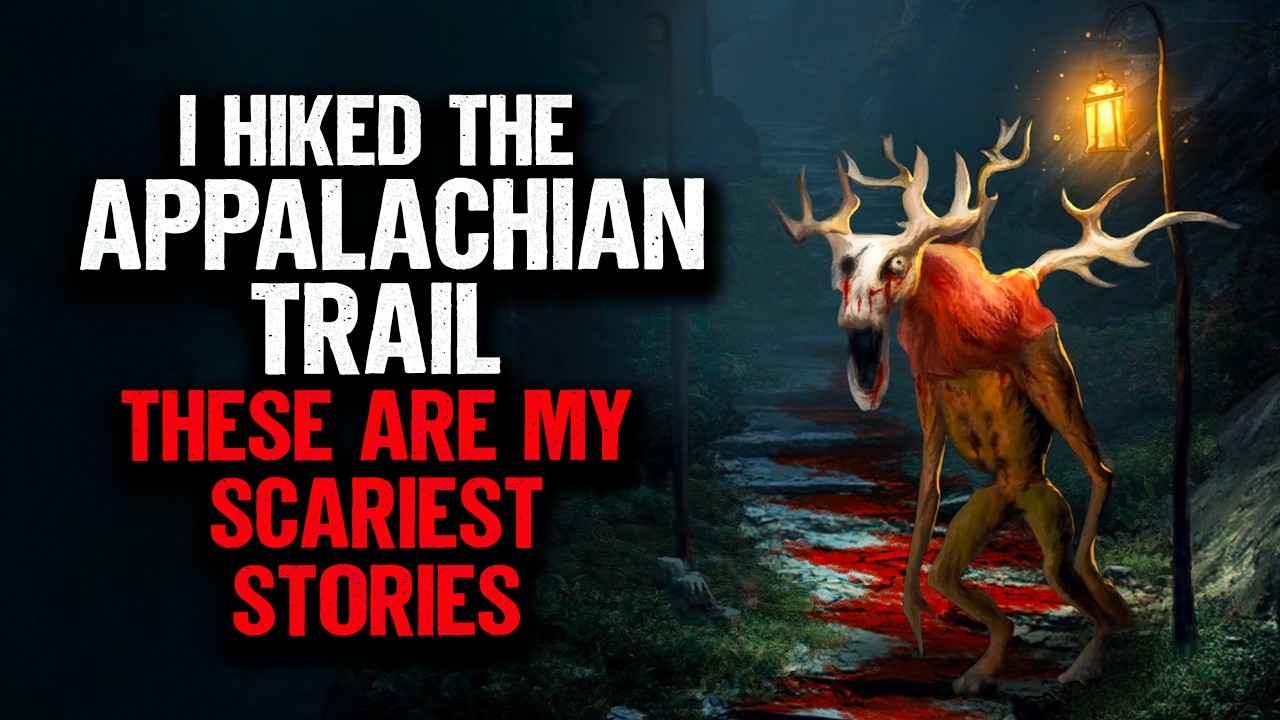
Video summary
The narrator shares the harrowing experience of hiking the Appalachian Trail as an attempt to confront deep-seated fears rooted in his father's mysterious disappearance from a national park when he was eleven years old. Despite rigorous training and preparation, five terrifying supernatural encounters disrupted his journey: first, two scaled humanoid creatures without facial features appeared near a creek campsite; second, an entity performed impossible backflips through dense forest while maintaining intense eye contact despite facing away; third, the narrator discovered a spiral staircase suspended in mid-air that emitted voices of his family before being approached by unseen weight descending from above.
The horror escalated further when he found himself inside a massive oval crop circle containing tall, pale figures that hovered over him with overwhelming pressure and silence, followed by an ordeal where he stayed alone in a cabin during a storm only to hear his father's voice sharing intimate childhood memories until the entity outside revealed cold frost on the door latch and heavy breathing. The narrator realized these entities knew private details shared exclusively between himself and his deceased father, suggesting they either accessed his mind or met him twenty-six years prior at the time of the tragedy.
After packing up without opening the cabin door to a final request from "his" father, he completed the hike but continues hiking cautiously with others due to lingering fear of the unknown presence that claimed responsibility for his family's tragedy while offering false comfort about his father's fate. Although the transcript includes brief moments regarding ignoring external sounds accompanied by musical cues, these do not alter the central narrative of a hiker haunted by entities connected to his past trauma who blend terror with deceptive familiarity. Ultimately, the journey left him scarred, realizing that some mysteries remain unresolved and that comfort can sometimes mask something far more sinister than death itself.
Read the full video transcript
I was 11 years old when my father
disappeared in a national park. He'd
gone away for what was supposed to be a
3-day hiking trip, something he'd done
many times before.
When the third day passed without a
call, my mother contacted the park.
By the following morning, people were
already searching for him.
They searched for almost 2 weeks.
Rangers walked the trails, volunteers
checked ravines and creek beds, and
helicopters flew whenever the weather
allowed it. They found a few footprints
that might have belonged to him, but
none led anywhere.
His backpack, tent, and clothing were
never recovered.
It was as though he'd entered the woods
and simply stopped existing.
For most of my childhood, I believed he
would come home.
No one could tell me he was dead because
nobody knew that for certain, and words
like missing and lost left just enough
room for hope.
Even years later, when I knew better,
part of me still imagined that he was
alive somewhere and trying to return to
us.
Almost every good memory I had of him
involved being outside.
We camped in the backyard, fished at a
lake near our house, and we spent entire
Saturdays walking through the woods with
our dog, Duke.
After he vanished,
I wanted nothing to do with any of it.
I stopped going into the woods unless I
absolutely had to.
That changed when I was in my 30s.
I think I'd grown tired of allowing one
terrible thing to own such a large part
of my life.
I began taking short hikes, then longer
ones.
Eventually, I spent a night alone in a
tent, and when nothing happened, I did
it again.
A few years later, I decided to hike the
Appalachian Trail.
I wasn't trying to find my father. The
trail didn't pass through the park where
he disappeared. I did it because it was
the biggest thing I could imagine doing,
>> [music]
>> and because I wanted to know whether I
could spend months in the woods without
feeling like that frightened 11-year-old
boy.
I trained for nearly a year, saved
enough money to live without working,
and began in Georgia feeling as prepared
as anyone could reasonably be.
Most of the hike was exactly what I
expected. It was exhausting, but it was
also beautiful.
I met kind people, slept beneath clear
skies, and watched spring slowly move
north with me.
Once you spend enough time outside, the
sounds that frighten you during your
first few nights, they become familiar.
You learn which noises come from deer,
which come from raccoons, and which are
only branches rubbing together in the
wind.
You also learn that the forest is rarely
silent. There's usually something
moving, calling, scratching, or feeding
nearby, which is why the silence at my
first campsite stood out so sharply.
But not every encounter announced itself
that way.
Some happened in broad daylight, and
several were clear enough that I
couldn't blame darkness or exhaustion.
Now, I don't expect everyone to believe
me. If someone else told me these
stories, I might not believe them
either.
But I know what bears look like, and I
know what frightened people can imagine
in poor light.
Some of the things I saw were standing
only a few yards away from me in clear
view.
The first happened less than 3 weeks
after I began.
The creek.
I had planned to reach a shelter that
evening, but during my first weeks on
the trail, I was still carrying too much
weight and covering fewer miles than I
expected.
Late that afternoon, I accepted that I
wouldn't make it before dark, and I
found a used campsite beside a shallow
creek.
It felt protected and private, and after
a long day of walking, that was all I
cared about.
I set up my tent, filtered water, and
ate dinner on a fallen log while frogs
called near the creek.
Nothing seemed unusual until over the
course of perhaps a minute, every sound
around me stopped.
As I sat there trying to understand what
had changed, something disturbed the
water upstream.
It sounded like someone slowly placing a
foot between the rocks,
pausing,
and doing it again a little closer.
I called out, but no one answered.
And then a dark shape passed between two
trees on the opposite bank.
At first, I thought it was a person
bending down near the water. I could see
a narrow back, two shoulders, and one
arm reaching toward the creek.
Whoever it was seemed to be crouching on
a large flat rock.
The shape was partly hidden by branches,
and the fading light had drained most of
the colors from the woods,
so I couldn't make out any clothing.
I stood and called out again.
The figure didn't move.
I took my flashlight from the side
pocket of my pack and pointed it across
the creek.
When the beam reached the rock, the
figure turned its head toward me.
What I remember most clearly are the
eyes.
They were large, black, and wet-looking,
with no white around them.
They sat in a smooth face with no hair,
no visible ears, and almost no nose.
The creature rested on its hands and
feet, its long fingers spread across the
rock.
Fine, gray-green scales covered its
narrow body.
My mind tried to turn it into a bear, a
man in a suit, or an animal seen from a
bad angle, but each explanation failed
as soon as I noticed another part of it.
It stood then.
It rose slowly, placing one foot flat
against the rock and straightening its
legs.
Fully upright, it was at least 6 and 1/2
ft tall, but it couldn't have weighed
more much than I did. Its chest was
narrow, and its stomach pulled inward
between its ribs.
The arms hung almost to its knees.
Between its legs, a thick tail lowered
to the rock and curved behind it.
That was the moment I understood that I
was not looking at a deformed person.
Whatever stood across the creek had
never been human.
It watched me with its head tilted
slightly to one side. Its mouth opened
just enough for me to see several small,
pale teeth.
Now, I I don't think it was threatening
me.
If anything, it appeared curious.
That should have made me feel better,
but it didn't.
Curiosity suggested intelligence, and
intelligence [music] meant it was making
a choice not to come closer.
I began backing toward my tent.
The creature's eyes followed me, but the
rest of its body remained perfectly
still.
I'd taken only two steps when the leaves
behind my tent moved.
The second creature was smaller.
I might never have seen it if it hadn't
raised its head above the ferns.
It was crouched less than 15 ft from
where I'd been eating.
The same gray-green scales covered its
face, although its eyes were smaller and
set farther apart.
One hand rested on the back corner of my
tent. Its dark fingers curved around the
fabric without tearing it.
The first creature might have wandered
into my campsite, but the second had
approached from behind without making a
sound.
I didn't know whether they were hunting
me or studying me.
I only knew that I was between them.
I moved slowly toward my backpack,
picked it up, and left my tent and
sleeping bag where they were.
As I reached the trail, the smaller
creature crossed behind the tent and
appeared beside a tree so quickly that I
barely saw move.
For the next several minutes, something
followed through the woods to my right.
Once, I saw a pale body between the
trees.
Another time, I caught the reflection of
black eyes close to the ground.
I reached the shelter after dark. Three
hikers were already there, and none
believed my explanation. One suggested
that I'd seen a black bear.
Once I was surrounded by people in
firelight, I even began wondering
whether exhaustion had done the rest.
We went to sleep without resolving it.
The shelter was open at the front, and
raised about 2 ft above the ground.
Sometime after midnight, I woke to a
light scraping beneath me.
At first, I thought a mouse had gotten
under the shelter. And then the scraping
moved slowly across the underside of the
floor, following the length of my
sleeping bag.
It stopped right beneath my chest.
A moment later, five separate points
pressed against the wooden boards from
below.
The man beside me sat up. He'd heard it,
too.
He reached for his flashlight, leaned
over the edge of the platform, and aimed
the beam underneath.
Something moved away so quickly that he
dropped the light.
All four of us heard it cross the dry
leaves on its hands and feet.
Before anyone could speak, a second set
of movements began on the other side of
the shelter.
The two creatures circled once in the
darkness, then disappeared into the
woods.
No one slept after that.
The next morning, the three hikers
returned to my campsite with me. My tent
had been pulled flat, but it hadn't been
torn. My food was exactly where I'd left
it.
The creatures had not taken anything or
eaten anything. Instead, they'd removed
my sleeping bag from the tent, and
spread it carefully across the ground.
Several pieces of thin, translucent
material lay on top of it. One was
shaped like part of an arm. Another
extended in five long fingers.
It it looked exactly like skin shed by a
snake.
None of us touched it. I left the tent,
the sleeping bag, and everything else at
the campsite. I told myself I did it
because I didn't want to carry weight
damaged equipment back to town, but that
was not the truth.
The truth was that those things had
chosen my sleeping bag for a reason.
And I never wanted to place my body
inside it again.
The man in the woods.
Have you ever read the original search
and rescue stories posted online years
ago?
They were supposedly told by someone who
worked in national parks, and they
described the strange things that
sometimes happen during search and
The one I had the most trouble believing
involved a man doing backflips through
the forest. I remember laughing when I
read it. The image sounded almost silly,
like a random detail someone invented
after running out of real ideas.
And then I saw him.
It happened in North Carolina several
weeks after the creatures of the creek.
By then I'd replaced my equipment and
stopped telling people what happened in
Georgia.
That afternoon was warm and bright, and
I had not encountered another hiker for
several hours.
It was one of those easy stretches where
the ground was soft and walking required
almost no thought.
The first impact came from somewhere
below the trail.
It was a low, heavy thump, like a bag of
sand being dropped. I heard it again
several seconds later. Then I spotted a
shirtless, barefoot man about 50 yards
down the slope.
I thought he might be exercising or
showing off or someone I couldn't see.
And then he bent his knees,
performed a backflip,
and landed on both feet.
Without pausing to balance himself, he
did it again and traveled through the
woods in a straight line, completing one
perfect backflip after another.
I stopped on the trail and watched.
The longer I stood there,
the less amusing it became.
The ground below him was covered with
roots, fallen limbs, and loose stones.
Even an experienced gymnast would have
struggled to land one flip safely.
Yet the man never looked at the ground.
He made no adjustments and showed no
sign of fatigue.
His movements were identical each time,
as though the same few seconds were
being repeated.
Bend, swing, turn, land.
He completed at least 10 while I watched
him.
I began wondering whether I should call
out. A person behaving that way alone in
the forest might have been injured,
intoxicated, or in need of help.
Before I decided though,
he landed from another flip and remained
standing.
His back was toward me.
I hadn't made a sound,
but
somehow he knew I was there.
His head turned first.
He looked over his right shoulder until
I could see part of his face.
Then, it continued turning.
The movement was slow enough for me to
understand exactly what I was seeing.
His shoulders remained pointed away from
me, while his face turned farther and
farther around,
well beyond the point where a human neck
should have stopped.
When he was looking directly at me,
he smiled.
His face was streaked with dirt and
there was dried blood around his nose,
but the smile was clean and bright.
He held it for several seconds without
blinking.
And then,
with his body still facing away and his
head turned toward me,
he began doing back flips in my
direction.
Each time his body rotated, his head
seemed to adjust just enough to keep his
eyes on me.
He passed between trees and landed on
rocks without looking where he was
going.
The smile remained on his face through
every turn.
I started quickly along the trail, but
the impacts followed and gradually came
closer.
When I saw him keeping with me through
the trees, still traveling entirely
through back flips, I ran.
When I eventually slowed to look back,
the impact slowed with me.
When I moved faster, they came more
quickly.
It felt as though he was allowing me to
choose the pace while he waited to see
how long it would take me to panic.
At one point, he landed with one bare
foot across a fallen branch.
I heard the wood crack and saw his ankle
fold beneath him.
Any normal person would have gone down,
but he bent his knees,
pushed off again,
and the foot appeared to settle back
into place during the next rotation.
The impacts drew close enough that I
could hear his bare feet striking the
ground.
When I looked back, he landed near the
trail and rose into another flip without
taking a breath.
His feet were badly damaged with missing
nails and torn skin and several fingers
bent in directions they shouldn't have,
but none of it slowed him.
He kept smiling through each rotation.
I left the marked trail where the slope
opened below me, and moved downhill
toward a road I could see through the
trees.
The impacts followed for part of the
descent, stopping only when I reached
the shoulder.
Less than a minute later,
an old pickup appeared, and I waved
until the driver stopped. I told him I'd
become separated from another hiker and
needed a ride down.
As we pulled away,
I looked back toward the trees.
The man stood at the edge of the woods.
From that distance, he could have passed
for an ordinary person until he leaned
backward.
He kept leaning until his hands touched
the ground behind his heels and the top
of his head nearly rested between his
feet.
He remained folded there, watching the
truck leave through the space between
his arms.
When I had internet service again,
I found the old search and rescue story.
It described the same impossible
movement and the same sense that the man
was performing for whoever watched him.
Before that day,
I thought someone online had invented
the backflip man.
Afterward, I began wondering if the
original writer had seen him, too.
The staircase.
The third incident happened in Virginia,
and it was the quietest of the five.
Nothing chased me, and I never saw a
creature.
Even so, this may be the one I think
about most often, because I could have
made one small decision and discovered
what was waiting above the trees.
One morning,
I noticed something dark and metallic
between the trees.
It stood perhaps 100 ft from the trail,
partly hidden by young leaves.
I assumed it was part of an old fire
tower or piece of logging equipment.
Ruins are not unusual in the mountains,
so I stepped off the trail to look.
As I came closer, the shape resolved
into a spiral staircase.
It was made of iron and stood by itself
in a small clearing. The first step
rested directly on the soil.
There was no concrete base, no broken
wall, and no sign that a building had
ever surrounded it. The stairs turned
around a central column and rose through
an opening in the tree canopy.
I couldn't see the top from where I
stood. It simply continued into the
branches until leaves blocked my view.
Dark rust covered the edges of the
steps, while the center of each one had
been worn smooth.
It looked like something removed from an
old apartment building, except there
were no tire tracks, cut stumps, or
paths showing how anyone could have
brought it there.
I knew immediately what it reminded me
of.
The same search and rescue stories that
mentioned the backflip man also
described staircases standing far from
buildings or roads.
Those stories always gave the same
warning.
Never climb them.
Until that moment, I thought the
staircases were invented, too.
I stopped near the bottom and looked up
through the center.
The staircase narrowed as it rose,
turning around and around until it
disappeared into a circle of green.
The view made me slightly dizzy.
For a moment, I thought I could see
daylight beyond the leaves, as though
there were an open space at the top.
And then I heard people talking above
me.
The sound didn't come from the
surrounding forest. It came directly
from the top of the staircase.
At first, the words were too faint to
understand, but the voices had the
relaxed tone of a family speaking inside
a house.
I heard a woman say something, followed
by a man answering her.
A child laughed.
There was the scrape of a chair against
a wooden floor and the soft clatter of
dishes being placed on the table.
I stepped back
and looked above the trees.
There was nothing there.
No house stood on the hill, and there
was no platform among the branches.
The staircase rose into empty air.
The conversation continued.
It was so ordinary that for a few
seconds I wondered if sound might be
carrying from a home on the other side
of the ridge.
And then the woman said something I
heard clearly.
"Is he coming up?"
A man answered,
"No, not yet. He's still at the bottom."
Every muscle in my body tightened.
I looked around the clearing, half
expecting [music] to find another person
behind me,
but I was alone.
The voices above became quiet.
I had a strong sense that everyone up
there was listening for my answer,
although no one asked me direct
question.
The bottom step was less than 3 ft away.
If I had reached out,
I could have touched the railing.
Now, part of me wanted to climb. After
months of wondering whether I could
trust my own senses, the chance to find
a clear answer was tempting.
I moved close enough to place my boot
beside the first step.
Fresh scratches showed through the rust
on the center column, exactly where
someone might hold it while climbing.
Above me, the child laughed again
and then asked why I wasn't coming up.
The woman answered,
"He knows better."
For a moment, no one said anything.
And then the man replied,
"Then we'll have to go down."
The conversation stopped.
Several chairs scraped across the wooden
floor above me, followed by the sound of
more than one person walking toward the
staircase.
The noises ended together at the point
where the iron disappeared into the
leaves.
A fine dust of rust drifted from the
upper steps, and the railing gave a
small shake that traveled all the way to
the bottom.
Until then, part of me had still been
trying to imagine a distant house or a
trick of the landscape, but those
footsteps had crossed a rung that could
not have been there,
and stopped directly over my head.
I backed toward the trees.
One of the iron steps creaked.
The sound came from high above me.
A moment later, the step beneath it made
the same noise.
Then the next one did.
Something I could not see had placed its
weight on the staircase and begun
walking down.
Each step bent very slightly as the
weight reached it.
The movement traveled around the spiral
at an unhurried pace.
There was no figure, no shadow, and no
body blocking the light. I could follow
its descent only by watching the iron
flex and hearing the slow creak move
closer.
I returned to the trail and kept
walking.
I walked at a steady pace, afraid that
running would make whatever was
descending respond.
Behind me, the lowest step finally
moved, and leaves compressed beneath
something heavy.
A second set of footsteps then joined
mine on the trail.
They copied my pace for several minutes
before leaving the path and passing into
the woods.
I kept walking until late that evening.
I never reported the staircase.
Anyone I told would either laugh or go
looking for it, and I didn't want to be
responsible for someone else placing a
foot on that first step.
I've often wondered what would have
happened if I had climbed high enough to
see above the trees,
but I have never wondered enough to go
back.
The field.
The fourth incident happened weeks later
in Pennsylvania. By then, I'd stopped
wearing myself out searching for
explanations.
Most days I walked, ate, slept, and
tried to enjoy the experience I'd spent
so long preparing for.
And then late one evening, the trail
brought me to a field.
The trail ran along the tree line beside
high yellow-green grass.
I noticed a dark patch in the middle of
the field, but it took me a while to
understand what I was seeing.
As I continued along the edge, its shape
became clear.
An enormous oval had been pressed into
the field.
It was at least 100 ft long
and maybe half as wide.
The border was sharp. Nothing had been
cut.
The grass had been bent and woven into
broad curves that followed the shape of
an oval.
Several smaller circles appeared inside
it, connected by narrow lines.
I'd always assumed crop circles were
made by people using boards and rope.
This one had no tire tracks, footprints,
or crushed path leading toward it.
I walked around the outside and found
that the stalks had been woven into
smooth layers curving in different
directions without being broken.
The soil beneath them was warm.
The day had been hot, but the difference
was obvious.
Outside the oval, the dirt felt cool and
damp.
Inside, heat rose from it as though the
ground had been covered by something
large.
There was also a faint smell I couldn't
identify. It was metallic with a
sharpness that reminded me of the air
near electrical equipment.
I stepped into the oval.
My phone turned off immediately. The
screen went black even though the
battery had been more than half full.
I pressed the power button, and I felt a
small vibration, but nothing appeared.
When I checked my compass, the needle
rotated slowly without settling toward
north.
Now, I should have left,
but instead I continued toward the
center.
The air grew cooler while the ground
remained warm and pressure filled my
ears.
Nothing dramatic happened.
Yet I felt completely exposed as though
I'd walked onto a stage while something
beyond my sight watched from above.
I returned to the tree line and decided
to camp farther down the trail.
By then, the sun was touching the hills
and the fields had begun filling with
shadow.
I sat beneath the trees for a few
minutes to drink water and try my phone
again.
It remained dead.
As the sky darkened, the first stars
appeared.
There was a section directly above the
field where none were visible.
At first,
I thought a cloud had moved overhead.
And then I noticed that its edge was
perfectly smooth and curved like the
oval below.
When I changed position, the shape
shifted against the stars.
It wasn't part of the sky.
Something enormous was hovering above
the field.
There were no engines, lights, or
visible details on its surface.
It was simply darker than the night
behind it. A solid oval large enough to
cover most of the flattened grass.
I lowered myself behind a fallen tree
and watched through the branches.
A pale light appeared beneath the
object.
It began as a dim gray glow in the
center of the oval, then spread outward
until the crushed grass was visible.
The light did not cast normal shadows.
It seemed to rise through the grass as
much as shine down upon it.
Several figures stood inside the glow.
One moment the oval was empty, and the
next four figures stood in the center.
They were tall and extremely narrow with
pale skin, long arms, and smooth
enlarged heads.
Unlike the creatures at the creek, these
figures barely moved. They stood facing
inward as though examining something on
the ground.
And then all four turned toward me at
the same time.
There was no chance they'd heard me. I
was too far away and I hadn't made a
sound.
They simply turned until their
featureless faces pointed directly at
the fallen tree where I was hiding.
One of them began walking across the
field.
Its steps were slow and measured. The
grass didn't appear to move beneath its
feet.
As it came closer, the pressure in my
ears became painful and a deep trembling
passed through my arms and legs.
It felt like standing near powerful
machinery except the night remained
completely still.
The figure stopped near the tree line.
From behind the fog, I could see its
pale legs, much too thin to support its
height.
It remained there for several minutes
looking down at me.
There was nowhere sensible to run, so I
pressed my face against my sleeve,
breathed quietly,
and I waited.
The pressure vanished all at once.
When I looked again, the figure was
walking back toward the center of the
field. It joined the other three and the
pale light narrowed around them.
For a moment, their bodies appeared
stretched and indistinct.
And then the light went out.
The dark object rose into the sky.
I could track it only because stars
reappeared beneath it as it climbed. It
moved without tilting and without
disturbing the trees.
Within a few seconds, its outline became
too small to follow. And then the entire
sky was visible again.
I stayed behind the fallen tree until
sunrise.
In the morning, the crop circle remained
exactly as I'd found it.
My phone turned on as soon as I carried
it back into the field, and the battery
showed nearly the same charge as before.
The compass worked normally.
Apart from the flattened grass, there
was nothing to prove that anything had
happened.
I took several photographs before
leaving. Most looked ordinary.
In the final picture, however, there was
a dark shape at the edge of the woods.
It stood right next to the exact spot
where I'd been hiding.
The cabin.
The last incident happened near the end
of my hike in Maine.
By then, I'd been on the trail for
nearly half a year. My clothes were
worn, my body hurt in places I hadn't
known could hurt, and I'd begun thinking
constantly about home.
Now, I was proud of what I'd done, but I
was also ready for it to end.
The final part of any long journey is
strange that way.
The thing you have worked toward for
months is suddenly close enough to
touch, yet every remaining day seems
longer than the ones before it.
I'd also become tired of being afraid.
After the field in Pennsylvania, I
considered leaving the trail.
I stayed in a motel for two nights and
looked at bus schedules.
In the end, though, I decided that if I
went home, the strange things I'd seen
would become the only part of the hike
that mattered.
I didn't want to give them that.
I returned to the trail and continued
north.
For several weeks, nothing else
happened.
The cabin was marked on my map as a
place where hikers could stay.
It was more enclosed than the typical
three-sided shelters along the trail,
but it was not comfortable in any normal
sense.
There was one room, a wooden bunk, a
narrow window, and a heavy door secured
by a simple metal latch.
Someone had left a broom in the corner
and several pieces of dry wood beside a
small stove.
There was no electricity, no plumbing,
and no lock.
I reached it late in the afternoon under
a darkening sky.
Rain had been threatening all day and I
could hear distant thunder by the time I
stepped inside.
I expected other hikers to arrive, but
the storm began before anyone did.
The rain became so heavy that I could
barely see the trees through the window.
Within minutes, water was running down
the trail and dripping from every edge
of the roof.
I was relieved to be alone.
After months of sleeping near strangers,
privacy felt like a luxury.
I changed into dry clothes, made dinner,
and listened to the rain while darkness
filled the room.
The cabin smelled of wet wood and old
smoke.
It wasn't warm, but it was dry, and at
that point in the journey, that was
enough.
Before going to sleep,
I thought about my father.
I'd thought about him throughout the
hike, of course, but that night felt
different.
I was nearing the end of something he
would have understood better than anyone
else in my family.
If he had been alive, he would have
wanted to hear every detail.
He would have asked about my equipment,
the weather, the people I met, and all
the small moments that would have meant
nothing to anyone else, you know?
I wondered whether he would have been
proud of me.
That question stayed with me as I laid
on on the bunk.
For years, I'd been angry with him for
going into the woods alone.
Part of me believed he'd chosen the trip
over us.
As I hiked the trail, though, that anger
had softened.
I understood how a person could love his
family and still need to go somewhere
alone for a while.
I also understood how quickly an
ordinary trip could become something
else.
I fell asleep listening to rain strike
the roof.
Sometime during the night,
three soft knocks woke me.
They were so quiet that I remained
still, unsure whether I had dreamed
them.
The cabin was completely dark.
Rain continued against the roof,
although the storm had weakened.
I reached for my flashlight, but I
didn't turn it on.
The knocks came again.
Someone was standing outside the door.
At first, that didn't frighten me. A
hiker caught in the storm could easily
have arrived after I went to sleep. The
cabin was open to everyone, and there
was plenty of space on the floor.
I sat up and started to search for my
boots.
And then a man outside said,
"Sam, it's me.
Let me in."
I stopped moving.
The voice belonged to my father.
People sometimes say they forget the
voices of those they've lost.
I understand what they mean.
Before that night, I could never
recreated my father's voice in my mind.
I remembered phrases he used and the
general way he spoke, but not the exact
sound.
Hearing it outside the cabin,
it brought everything back at once.
It was not merely similar, it was his
voice as I known it at 11 years old,
strong and familiar, with a slight
roughness left over from years of
smoking.
For a moment, I I forgot where I was.
I felt like a child who'd fallen asleep
somewhere unfamiliar and awakened to
hear his father waiting nearby.
He spoke again.
Sam,
open the door.
I turned on my flashlight.
The beam moved across the empty cabin
and settled on the latch.
Nothing pushed against the door.
No shadow across the thin gap at the
bottom.
I looked toward the window, but it
showed only the reflection of my light.
Outside was completely dark.
The glass was old and uneven, and rain
covered the other side.
I couldn't see the porch or the person
standing on it.
My first clear thought was that another
hiker had somehow learned my name and
was playing a cruel joke.
That explanation fell apart as soon as I
considered it.
I had told very few people about my
father,
and no one on the trail had ever heard a
recording of him.
Most of the hikers I knew were well
ahead of me or had already gone home.
Even if someone did want to frighten me,
there was no reason to travel through a
storm and wait outside a remote cabin in
total darkness.
I asked who was there.
The answer came gently.
You know who it is.
I did know.
That was the problem.
I kept the flashlight pointed at the
door and asked him to say his name.
There was a short pause before he gave
it.
He said my father's full name, including
the middle name he rarely used.
Then he named my mother.
He told me the address of the house
where we'd lived when I was a child.
None of that proved anything. Names and
addresses can be found, and grief can
make almost any coincidence feel
meaningful.
I told myself to remain where I was.
The voice outside seemed to sense my
doubt.
It began speaking about our old house.
My father described the small crack in
the kitchen ceiling and the loose board
on the the steps.
He remembered the blue bicycle I
received for my ninth birthday and the
time I rode it into a hedge because he
let go without telling me.
He spoke calmly with a quiet amusement
that felt exactly right.
These were not broad details taken from
a record.
They were pieces of a shared life.
I moved from the bunk and sat on the
edge of it.
I was no longer thinking clearly.
The sensible part of my mind knew that
my father could not be standing outside
unchanged after 26 years.
Another part kept offering
possibilities.
Maybe he'd survived.
Maybe he'd been unable to return. Maybe
the world was stranger than I
understood, but not always cruel.
"Where have you been?"
I asked.
He didn't answer directly.
He said he'd been trying to find his way
back for a very long time.
He said the woods were different where
he'd gone and that roads never led where
he expected.
He told me he'd heard about my hike and
had been following my progress.
I felt a wave of sadness so strong that
I had to lower my head.
I pictured my father lost for 26 years
moving from one unfamiliar place to
another and knowing that his family
believed he was dead.
I imagined him finally finding me only
to stand outside while his only son
refused to open the door.
He knocked again very softly.
"Please, Sam, it's cold."
I stood and took one step toward the
door,
but something stopped me.
I cannot call it instinct because it was
more specific than that.
The memories he'd shared were correct,
but they were the kind of memories a
person might see from the outside.
He remembered the bicycle in the hedge.
He remembered the house.
I needed something smaller. Something
that belonged only to the two of us.
I thought of Duke.
Duke was a brown mutt my father brought
home when I was six.
He had one white foot and ears that were
too large for his head.
Most afternoons, when my father came
home from work, the three of us walked
through the neighborhood and into a
small wooded park behind our school.
Duke had been dead for more than 20
years.
I hadn't mentioned him to anyone during
the hike.
I moved closer to the door,
but not close enough to touch it.
"You remember Duke?"
I asked.
"We used to always go for walks
together, the three of us after school."
There was a pause outside.
And then my father laughed.
It wasn't loud or frightening. It was
exactly the short breath he laughed I
remembered.
Hearing it nearly broke whatever caution
I had left.
"Of course I remember Duke. You always
wanted to hold the leash even when he
was strong enough to pull you down the
street."
He said.
I closed my eyes.
He continued before I could ask anything
else.
He reminded me of an afternoon when Duke
chased a squirrel into a shallow creek.
I followed him and lost one of my shoes
in the mud.
My father carried me home on his
shoulders while Duke ran ahead of us.
And we hid the shoe in the garage
because I was afraid my mom would be
angry.
No one else knew that story.
My mother learned that the shoe was
missing, of course, but she never knew
where it gone or how I lost it.
My father and I had kept that part
between us.
I began crying before he finished.
I hadn't cried over my father in years.
Grief changes as you get older, but it
never disappears.
It settles into places you stop
visiting.
That voice opened every one of them at
once.
He told me he was sorry.
He said he never meant to leave us and
had spent every day trying to come home.
He said he knew how much his
disappearance had hurt my mother.
And then he said something I had wanted
to hear since I was 11 years old.
It wasn't your fault, Sam.
I put my hand against the door.
It was cold, but the cabin was cold and
I didn't think much of it.
Less than an inch of wood separated me
from the person I had spent most of my
life wishing I could see again.
I could open the door,
turn on my flashlight, and finally know
what had happened to him.
I asked him that then.
What happened to you?
The voice outside remained quiet and
patient.
I'll tell you as soon as you open the
door.
I asked him why he couldn't tell me
first.
Because I need to come inside.
I should have noticed the change then.
It wasn't the sound of his voice, which
remained perfect. It was in the answer.
My father had been missing for 26 years.
If he had truly returned,
he would have had a thousand things to
say.
Yet every part of the conversation led
back to the same request.
Open the door.
I moved my hand toward the latch.
The metal was covered in frost.
At first, I thought the pale layer was
dust.
When my fingertips touched it,
pain shot through them.
The latch was so cold that my skin
briefly stuck to it.
I pulled back and stared.
Thin, white crystals had formed around
the metal
and spread several inches into the wood.
The night outside was cold, but nowhere
near freezing.
My father stopped speaking.
For several seconds, there was only the
sound of rain.
And then I heard breathing on the other
side of the door.
It was deep,
rough, and uneven.
Every breath entered slowly, caught
somewhere in the chest,
and left with a wet vibration.
It didn't sound like a tired man.
It sounded like something much larger.
I stood perfectly still with my hand
above the latch.
The breathing came again.
This time, I understood that it'd been
there throughout the conversation,
hidden beneath the rain and the voice.
Whatever stood outside had its face very
close to the door.
I could hear moisture moving in its
throat.
"Open it, Sam."
The voice said again.
The rough breathing continued underneath
the words.
I stepped away from the door.
The voice didn't become angry. It
remained warm and familiar, speaking to
me with a patience my father had used
when teaching me to tie my shoes or cast
a fishing line.
It told me not to be frightened.
It said it understood why I had doubts.
It reminded me again of the walk with
Duke and the missing shoe.
The breathing grew louder.
Something touched the outside of the
door.
I heard a light scraping move from the
top of the wood to the middle.
It was not someone knocking with a hand.
Several hard points dragged downward
together, paused near the latch,
and then lifted away.
I returned to the bunk and picked up my
hiking knife.
The blade was little more than a tool,
and holding it did not make me feel
safer, but I needed something in my
hand.
I sat with my back against the far wall,
and I kept the flashlight on the door.
My father continued talking.
For the next several hours, he told me
stories from my childhood.
Every one of them was true.
He remembered my first day of school,
the night I was sick and slept beside my
parents, and the model airplane we never
finished building.
Sometimes he sounded sad.
Sometimes he laughed.
Between each memory,
he asked me to open the door.
I stopped answering.
At some point, the breathing moved away
from the entrance.
I followed its path around the outside
wall until it reached the window.
The glass darkened as though something
large had leaned close to it.
I couldn't see a face.
I saw only my own reflection and the
flashlight trembling in my hand.
Something tapped the window once.
The sound came from near the top of the
frame, more than 7 ft above the ground.
After a while,
the darkness moved away.
The cabin boards creaked as weight
passed along the outer wall,
and then the entire roof gave a low
groan.
Dust fell from between the rafters.
Whatever was outside, it climbed onto
the cabin.
It moved slowly above me.
One step pressed into the roof near the
window. Another settled over the center
of the room.
The distance between them was too great
for a person walking on two legs.
The weight stopped directly above the
bunk where I had been sleeping.
My father's voice came through the roof.
You came all this way to find me.
I never told anyone that
cuz I didn't believe it was true.
I had chosen the Appalachian Trail for
myself.
It didn't pass through the park where my
father disappeared, and I had never
searched for him during the hike.
Yet, as I sat beneath that roof,
I wondered whether some part of me had
been looking for him the entire time.
The thing above me seemed to know that,
too.
It remained on the roof for nearly an
hour, shifting its weight whenever I
moved.
Eventually, it returned to the ground
and came back to the door.
The frost had spread across the wood in
branching white lines.
The breathing resumed on the other side.
Shortly before dawn,
my father asked one final question.
"Don't you want to know what happened to
me?"
I wanted to answer.
I wanted to scream at it, threaten it,
or demand that it tell me where it had
learned those memories.
Instead, I remained silent.
The thing waited.
The breathing stopped.
I remained against the wall until gray
morning light appeared in the window.
Even then, I waited.
The cabin slowly returned to normal
around me.
The frost melted from the latch, birds
began calling in the trees, and
somewhere nearby, I heard water moving
over rocks.
When full sunlight reached the window, I
opened the door.
And no one stood outside.
The ground was soaked and soft enough to
hold a clear footprint,
but there was no tracks leading toward
or away from the cabin.
But five long scratches ran down the
outside of the door.
They began near the top,
well above my head, and ended beside the
latch.
I packed quietly and left.
I completed the hike several days later.
There was no dramatic final incident,
and no creature waiting for me at the
end.
I took a photograph, called my mother,
and I went home.
For a while, I tried to treat the entire
experience as something finished.
I put away my equipment, returned to
work, and told people only the normal
stories.
But I have never stopped thinking about
the thing outside that cabin.
It knew my father's voice.
It knew the address of our old house and
details of my childhood that were never
written down.
It knew about Duke,
the lost shoe,
and the secret my father and I had kept
from my mother.
It even knew what I had needed to hear,
that my father's disappearance
was not my fault.
There are only two explanations I can
imagine.
The first is that the thing could
somehow reach into my mind and use my
own memories against me.
The second
is that it had met my father in the
woods 26 years ago.
I still hike,
although I no longer go alone.
I stay in busy campgrounds, carry more
equipment than I need, and make sure
someone always knows where I am.
When darkness comes,
I keep the door or tent closed until
morning,
no matter what I hear outside.
>> [music]
[music]