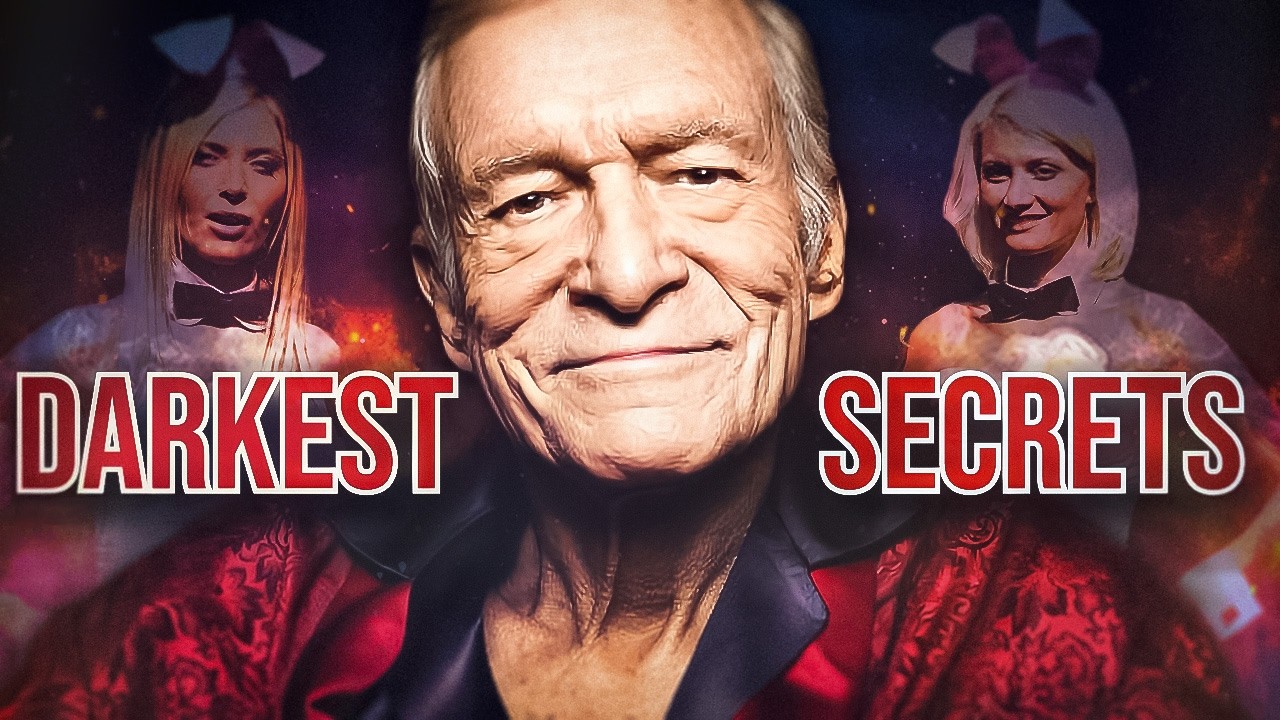
Video summary
Hugh Hefner's rise to building an empire centered on *Playboy* magazine was fueled by his repressed Puritan upbringing and a desire to rebel against societal norms, yet this legacy is now framed as deeply rooted in exploitation and psychological manipulation. After reading Alfred Kinsey's revolutionary report on human sexuality, Hefner launched the magazine in 1953 using Marilyn Monroe's nude photos without her consent, capitalizing on the repressed desires of isolated men. While the brand successfully expanded into nightclubs and resorts, its foundation relied on the vulnerability of women who were often treated as accessories rather than human beings. Former girlfriends describe an environment of cult-like control where financial manipulation and strict rules replaced genuine empowerment, leading to a decline in the magazine's relevance by the 2000s as internet pornography better served its target demographic.
The Playboy Mansion, once marketed as a glamorous sanctuary, is now revealed as a "house of horrors" where women lived under constant surveillance with hidden cameras and microphones used for blackmail against both the women and powerful figures like Don Cornelius and Bill Cosby. The reality TV show *The Girls Next Door* initially rebranded this lifestyle as desirable, masking the underlying abuse that included drugging victims with Quaaludes to lower their guards, forced sexual encounters, and physical assaults. Former residents reported severe emotional damage, financial dependency through controlled allowances, and isolation enforced by curfews and security teams, while allegations from Hefner's daughter point to a predatory inner circle involving "shadow mansions" and the manipulation of young women within his social circle.
Following Hefner's death in 2017, the dark reality of his legacy came to light as former employees spoke out against systemic abuse, revealing that the mansion operated under strict rules designed to homogenize appearances through forced plastic surgery and hide drugs that allegedly affected even his pets. Conflicting testimonies emerged between Crystal Hefner, who described a controlling environment leading to Stockholm syndrome dynamics, and others who defended the portrayal or claimed ignorance of the worst abuses, though accounts of specific tragedies like Dorothy Stratten's brutalization and Paige Young's suicide underscore the severity of the situation. Ultimately, despite the brand's official disassociation from its founder's history, *Playboy* continues to be worn by the unaware, serving as a cautionary tale about how abuse can mask itself as liberation and the critical importance of recognizing red flags in power dynamics.
Read the full video transcript
Is there anything do you ever think of
that you're at least in the position
where there's almost nothing you can't
have and ever feel frustrated by that?
>> No.
>> Did that come across as a bad question?
>> No.
>> I mean if if you could have if you could
make a wish if Hefner could have his
wish for something he doesn't have, do
you have any idea what it would be?
It wouldn't be related to me personally.
I think it would be a you know, a better
society probably for all of us to live
in.
>> What defines femininity, sexuality in
the public eye? Well, for decades it's
been men.
>> [music]
>> My name is Hugh Hefner. I'm 35 years of
age and I'm editor publisher of Playboy
magazine. In 8 years I've built an
empire worth 20 million.
>> Men have decided the beauty standard for
women, what's appropriate for women to
wear, how they should be sexy and
feminine and fit.
>> There were a lot of platinum blondes in
the movies in the 1930s and since my
marriage all my girlfriends have looked
like they stepped right out of a Busby
Berkeley musical.
>> Someone would say most of the playmates
in the magazine have looked
>> I could be accused of that, yes. We do
seem to lean in the direction of
blondes.
>> How they should look, act, what they
should say, when they should speak and
when they should fade into the
background.
>> [music]
>> Well there.
Glad you could join us this evening.
I'm Hugh Hefner, editor publisher of
Playboy magazine and your host.
>> Men have always decided such things. But
within this ambiguous concept of men
dominating over the beauty standard,
there has been one victor who presided
over women dictating what is and isn't
sexy and distributing this information
to the rest of the men of the world as
he kept tight control on the industry
and tight control over his circle of
women. And that man is Hugh Hefner.
>> Welcome to the Playboy Mansion. I just
can't turn this down and go back to work
on Monday.
>> Mystery illness [music] that may have
sickened guests at the Playboy Mansion.
>> childhood fantasy till it [music] all
came crashing down.
>> In the little more than 20 years since
the Playboy bunny became an artifact of
American culture, he's parlayed his
magazine into a far-flung [music]
enterprise that now includes two
magazines, more than 15 nightclubs, a
series of resort hotels, books, records,
occasional motion picture productions,
[music]
and several theaters.
And with it all has come a steady
assault [music]
on the Puritan ethic.
>> But the crown wears heavy, and in order
to stay in power and keep his control,
Hugh Hefner stooped lower and lower into
depravity never seen or heard of before,
until the most recent news in
circulation, that is. It seems like
nowadays men in power are constantly
utilizing a circle of vulnerable women
to control a circle of powerful men as
they blackmail and manipulate everyone
around them to climb the ladder of
success while everyone slides further
and further into the pits of hell.
>> Gigantic names.
My next guest has created an empire. In
fact, the London Times said they always
refer to Hefner as one of the great
empire builders, and they said that he
is as well known a symbol of American
life as Coca-Cola.
>> Hugh Hefner is the epitome of this now
unfortunate archetype, and maybe many
things can be gleaned from his story.
How one strives for power and control,
believing themselves to be the victor
when in reality they are the villain.
>> Hefner died of natural causes
>> [music]
>> surrounded by family.
>> Let me tell you the story of a pathetic
truly one of the most pathetic men in
history.
>> Hugh Hefner must be rolling in his grave
right now.
>> widow [music] is speaking out.
>> 10,000 women passed through its doors.
>> Being in a prison.
>> Former girlfriends describe him as a
vampire who sucked the life [music] out
of young girls.
>> In a way I felt sorry for him. It was
partly Stockholm Syndrome.
>> She compares her decade-long stay at the
mansion to being in a cult.
>> [music]
[music]
>> Hugh Hefner became known as, well, the
ultimate playboy who founded Playboy
magazine, rich and living a life
surrounded by women. But before this
happened, he was an awkward kid who
lived a quiet life during a very
conservative era.
>> You say that you've been poor and you've
been rich and rich is better. Did you
grow up
>> My folks were farm people, came from
Nebraska. My father
They're both still living. My father's
an accountant.
Uh
but I was raised during the depression.
>> [music]
>> And we never wanted for anything.
But we were not wealthy, you know,
middle class.
>> Hugh Marston Hefner had a strict
upbringing. Born in Chicago, Illinois to
devout Methodist parents, [music]
Hefner's household was described as
conservative and emotionally reserved
with little to no discussion of sex or
physical affection. Our family was
prohibitionist, Puritan in a very real
sense. Never smoked, swore, drank,
[music] danced, or hugged. There was
absolutely no hugging or kissing in my
family, Hefner recalled. You wonder how
growing up starved for love and
affection would affect someone. There
was a point in time when my mother,
later in my life, apologized to me for
[music] not being able to show
affection, Hefner recalled. That was, of
course, the way she was raised. I said
to her, "Mom, you couldn't have done it
any better." And because of the things
you were able to do, it set me on a
course that changed my life and the
world. Hugh Hefner believed he changed
the world and that his [music] childhood
lack of love set him up for his destiny
in doing so. Why would a childhood of no
love bring about someone like Hugh
Hefner, who creates Playboy magazine, a
magazine [music] showcasing women's
bodies with notably still a complete
lack of emotional connection?
>> Came from a strong Methodist
rather almost fundamentalist Methodist
background. A lot of that idealism
stuck, but a lot of the the trappings
[music] didn't.
>> As a child, Hugh liked to write and draw
from an early age. At 9 years old, Hugh
created and sold a small neighborhood
newspaper for a penny per copy. This
reminds me of every single successful
businessman interview, where they always
seem to say, "I was an entrepreneur from
an early age." And then being an
entrepreneur from an early age was like
selling Girl Scout cookies.
>> Leave a message.
Beep.
>> Hefner also spent time drawing cartoons
and reading magazines, including
Esquire. Which, isn't that a fairly
adult magazine for a child to be
reading, especially one with such a
strict upbringing? Hugh Hefner was said
to have a high intelligence, but [music]
had his head in the clouds. His tendency
to daydream made him fall behind on
schoolwork.
>> You were described as a rather shy,
introverted adolescent.
>> There was a period in which I withdrew.
And that's when I was quite young. What
I withdrew into was a lot of my own
dreams and fantasies, and that's what
led me to to writing.
>> His mother took him to a psychologist
who tested his IQ, maybe believing he
had intelligence issues. But allegedly,
it was the opposite. Hefner supposedly
had an IQ of 152, if you take IQ tests
seriously, which was far above the
average. But Hugh Hefner was very
emotionally immature, which I think is
something often undervalued. You can be
someone who's seen to have a high IQ,
but still have a low emotional
intelligence. And because of that, you
can do things that are very damaging to
others. There are many people in society
currently who are seen as geniuses
[music] or valued for their work, when I
would argue they have a very low
emotional intelligence. And because of
that, produce damaging outcomes. Their
effect on the world and overall net
negative.
>> What about girls when you were young?
>> I used to be very interested in animals
[music] when I was when I was a kid and
then I discovered girls and kind of lost
interest in the animals and really
moved, I think
into a more extroverted outgoing
personality in the last two years of
high school.
>> Hugh Hefner's low emotional intelligence
showed through the most when he handled
heartbreak. And heartbreak came about
early on in his life. In his junior year
of high school, a girl named Betty
Conklin rejected him. And Hugh Hefner
seemingly couldn't handle it. So, Hugh
reinvented himself.
>> And at home, they created a rigid moral
environment that Hefner found stifling.
An early rejection from a girl at school
would begin the metamorphosis that would
change his life.
>> I was not only crushed, I reinvented
myself for the first time and started
referring to myself for the first time
as Hef instead of Hugh.
>> I started referring to myself as Hef
instead of Hugh. Instead of wearing
clothes chosen by my parents, I started
wearing yellow cords, saddle shoes, and
red flannel shirts that I didn't tuck
in.
>> I had done the same thing once before
when I was a kid. [music] When I was in
high school, I was rejected by a
girlfriend that I had a crush on and I
reinvented myself and started referring
to myself as [music] Hef instead of
Hugh.
>> You were Hep Hef at the time.
>> Hep I signed a little I would I did a a
record column for the school paper
called Platter Patter and signed it Hep
Hef. We're handed a life by our our
uh family and peers and by society at
large. And if you were smart enough, you
[music] know
you know, you
take a hold of your life and and try to
turn it into who you want to be and that
certainly in the most dramatic way is
what my life was all about.
>> How scandalous. Hugh was determined to
be the cool nonchalant guy who didn't
care about things like heartbreak.
>> Hugh Hefner attended Steinmetz High
School in Chicago. He was one of the
most popular kids in his class.
>> It seems like there are still many such
cases that mirror that sort of behavior
today. After graduating from Steinmetz
High School and making it to the top
quarter of his class and served as a
non-commissioned officer and infantry
clerk and newspaper writer cartoonist
from 1944 to 1946.
>> After uh high school he went into the uh
drafted into the army and spent some
time in the army then came out and went
through University of Illinois with a
degree in psychology.
>> According to nj.com, Hugh's drawing
skills were questioned by his colleague
and future Popeye cartoonist Will Eisner
Eiseman who warned him that he better
have a job lined up after the war. Hugh
Hefner then attended the University of
Illinois majoring in psychology.
Interesting choice. While contributing
articles and cartoons to the campus
paper.
>> They had a special school at Illinois
for war veterans and so instead of going
into journalism school, I took a variety
of courses and majored in psychology and
minored in creative writing and art
specifically because I was interested in
magazine work.
>> One of the pieces Hugh wrote for the
University of Illinois paper was a
review of the 1948 Kinsey Report which
some of you may know about.
>> What is this thing about [music] sexual
arousal that we are so ashamed of? It's
one of the most attractive things in
life. It It It makes for a great many
people a rather tedious existence more
pleasurable.
>> The Kinsey Report was a mid-20th century
study of human sexual behavior by Alfred
Kinsey. The first report, Sexual
Behavior in the Human Male, examined
male sexuality followed by a report on
female sexuality in 1953.
>> Often described as the father of the
sexual revolution, Alfred Kinsey was an
American biologist who authored a
pioneering study on human [music]
sexuality in the late 1940s. Released in
the form of two massive books, each
focusing on male and female behavior
respectively, [music] the study became
known as the Kinsey Report. A few
scientific books have caused a bigger
cultural stir than the Kinsey Report. In
its time, it triggered a cyclone of
controversy, uproar, and even a few
congressional inquiries. But, it also
forever changed the way that Americans
thought, talked, and legislated about
Drawing on data from 18,000 [music]
interview subjects, Kinsey compiled an
exhaustive report on the lives of
ordinary Americans. In black and white,
[music] with tables and graphs and
annotations, he showed that people were
having more and different kinds of
than what traditional Christian morality
dictated.
>> Kinsey's findings challenged assumptions
about sexual behavior at the time,
showing that behaviors that were
considered rare or deviant are actually
common for that [music] time. The study
also introduced the Kinsey scale, which
measured sexual orientation on a
continuum rather than a strict binary.
While all of this seems pretty obvious
now, though some still deny this reality
even to this day, at the time this
report was pretty revolutionary and
unheard of for the culture. Hefner wrote
that Dr. Kinsey's book disturbed him. It
disturbed him because of how many people
lie to themselves. He wrote, "This study
makes obvious the lack of understanding
and realistic thinking gone into the
formation of standards and laws." And it
seems like this report and reading this
report was a pretty pivotal moment in
Hefner's life. He realized that the
strict and almost suffocating childhood
that he had, that he felt restricted by,
many others may have felt restricted by
as well. It seemed like Hefner became
convinced that he wasn't an outlier, but
that many others felt the same as him
when it came to sexual behavior and just
in general going against the cultural
norms. And he felt so strongly about
that that he dedicated his entire life
to that. But, he almost became too
focused on this concept. It consumed him
and destroyed the lives of those around
him. That being said, the path to hell
is led with good intentions. This was at
a time that people were noticing that
repression was leading to people acting
out or just being in general unhappy.
But, this doesn't necessarily mean that
Hefner's solution to this was correct.
As it seems that Hefner intended to tear
down an oppressive system so that he
himself could build back up a system
that worked for him and those like him
but continued to oppress everyone else.
>> I think the two big hang-ups in our
society are money and
and when you put them together,
particularly difficult.
>> While Hugh's biggest dream was to become
a cartoonist, [music] he was unable to
sell his comic strips to newspapers and
he lacked the money needed to start his
own magazine. To support himself, he
worked in the personnel department of a
cartoon printing company in Chicago,
[music] but he quit after objecting to
its policy of rejecting applicants who
were black, Jewish, [music] or had
ethnic-sounding names. In 1951, Hugh
Hefner was hired as a promotional
copywriter at Esquire magazine earning
$40 a week. It seems [music] like
Hefner's dreams had come full circle all
the way back from when he was a child
reading [music] Esquire and drawing
cartoons, but this was not enough for
Hefner. When the magazine moved most of
its operations to New York City, he left
and took a sales job at Publishers
Development Corporation, a company that
produced trade and nude magazines.
>> on a number of jobs and then left
Esquire.
>> His colleague, Vince Tajiri, who would
become Playboy's photo editor, described
Hugh as very immature for his age. Vince
recalled he was totally unsophisticated,
but he had this obsession with sex. When
he had nothing [music] else to do, he
would draw graphic cartoons of Blondie
and Dagwood. Hefner later moved into a
higher-paying role as a circulation
promotion director for Children's
Activities [music] magazine.
>> Hefner worked a series of magazine jobs
in Chicago, first in the promotion
department for Esquire magazine, then as
a circulation manager for a children's
magazine.
It was 1953
and his wife had just had their first
child, Christie.
>> During this period, Hefner was married
to Mildred Williams, his college
sweetheart. They got married in 1949.
>> You you were married one time. That's is
not very
often known about you. Right out of
college before the magazine began.
>> Mhm.
>> Yeah. Have two children and
she's happily remarried and I'm happily
unmarried. Whatever. Yeah.
>> But sweet Mildred was another person
that [music] caused Hugh great
heartbreak. As during their engagement,
Mildred had an affair with another man,
something that deeply hurt Hugh Hefner,
but didn't stop him from marrying her.
>> Now, in between the engagement in
December and the marriage in June,
my fiance told me that she been having
an affair and uh
it devastated me. I didn't get the
message that maybe there was some
question in terms of the relationship.
The magic was gone from the very
beginning.
>> I got married at 22. In retrospect, that
was a mistake, Hefner said, noting how
he stopped drawing his comic book school
days at the time. I was putting away
childhood [music] things. I was putting
away my dreams.
>> I think one thing is he didn't like
change and it's a pattern I've noticed
with him over the years. Even, you know,
he used to tell a story about how when
he got married in the '50s, you know,
he'd been seeing this woman and he'd
been in the military and he came back
and she confessed that she had cheated
on him, but that made him want to marry
her more cuz he had to win. Look at, you
know, the story of like him dating
Barbie Benton or, you know, the woman he
dated right before me. Like when they
wanted to leave, he would always chase
after them. You know, he was a creature
of habit. If he felt comfortable with
somebody and they one day, you know, out
of the blue in his mind say they want to
leave, you know, he doesn't want that
and that kind of activates him to chase
more.
>> The couple's first child, Christie Ann,
was born in 1952. And their second,
David, arrived in 1955. Despite
appearing to have achieved the American
dream, Hefner, burdened by family
responsibilities and adult job, fell
into depression. "I remember standing on
a bridge, looking out at Lake Michigan
and thinking my life was not going
anywhere. I felt as if I had
successfully become my parents. Tears
filled my eyes," Hefner [music] recalled
in an interview with Time magazine.
>> And I remember a specific day where I
stood on the Michigan Avenue [music]
bridge looking out at Lake Michigan with
tears in my eyes.
>> In the months that followed, Hefner
started developing plans for a magazine
of his own.
>> I went to my family and asked my told my
father what I was doing and asked him
whether or not he would invest or loan
me some money. And he, being a
conservative accountant,
felt it was not a good business deal and
declined. And as I was leaving, my
mother took me aside
>> [music]
>> and said that she had some money of her
own cuz she had worked during the war
and she gave me a check for a thousand
[music] dollars.
>> The entire incident on the bridge pushed
him to launch HMH Publishing Company. He
used $600 borrowed from two banks and
$3,000 from friends and family.
>> Okay.
>> [cheering and applause]
>> Let's let's talk about the the magazine
you borrowed. How much from your folks
to start the magazine?
>> I borrowed $600 of my own money and
about 6,000 from various friends and and
relatives. They had mixed emotions when
I began.
>> Yeah.
>> "I worked on the idea with everything I
had and for the first time in my life, I
felt truly free. It was like a mission
to publish a magazine that would thumb
its nose at all the phony Puritan values
of the world in which I had grown up,"
he said. To Hefner, he was pushing back
at his parents and further validating
the Kinsey report findings that only
confirmed what he already believed, that
his upbringing and those like it all
around the country were a complete lie,
that everyone was living out a reality
with which they didn't truly embody or
believe. And because of that, people
were deeply sexually repressed and
acting out. Hugh Hefner's solution
wasn't to lean towards activism, but
instead to put a mirror to their faces
to show them their hypocrisy in a bold
and brash way, but predominantly in a
way that benefited him first and
foremost to highlight [music] his comics
and make his dreams of a magazine come
to life surrounded by the people he
wanted to be surrounded with put up on a
pedestal the king of the castle.
>> And with it all has come a steady
assault on the Puritan ethic, a series
of disquisitions called the Playboy
philosophy. [music] Girls galore, a
bunny equipped private jet, and a home
with all the accoutrements of a satyr's
daydream.
>> By 1953, the Kinsey report on female
sexuality had been published. Its
findings, which suggested [music] that
premarital and extramarital sex were far
more common than people openly admitted,
seemed to confirm Hefner's established
beliefs. [music]
Added to it the belief that women were
becoming more comfortable with their own
sexuality. From his apartment, Hefner
and [music] a small team, including art
director Art Paul and sales manager
Eldon Sellers, worked around the clock
to assemble the first issue, which
infamously featured actress Marilyn
Monroe on the cover unconsensually.
>> Well, the very first playmate, but in
the very beginning, the first uh for the
first year, the uh playmates were
calendar pictures. The very first one
was Marilyn Monroe.
>> Yeah.
>> [music]
>> So, how did Playboy become a massive
breakout success? At first, Hefner
considered calling his magazine Stag
Party. Why? But they ended up going with
Eldon Sellers' idea of the name Playboy.
Hefner proposed the idea of the logo
with the tuxedoed rabbit. "We want to
make clear from the very start we aren't
a family magazine," Hefner wrote in the
first editorial, "If you're somebody's
sister, wife, or mother-in-law, aka a
woman viewing the magazine, and picked
us up by mistake, please pass us along
to the man in your life, and get back to
your ladies' home companion. This
magazine is for the boys. No girls
allowed." It seems Hefner's
open-mindedness didn't include women
loving women, I guess. The main part of
Hefner's budget for his first issue,
which was tiny, [music] went to,
unsurprisingly, the imagery used in the
first Playboy issue.
>> A lot of the girls that I've fallen in
love with look like the girls I saw in
those movies. There were a lot of
platinum blondes in the movies in the
1930s.
>> And this is something so wild to me, how
much this was normalized in the past. As
despite Marilyn Monroe appearing on the
cover of the very first Playboy
magazine, Marilyn Monroe never
officially consented whatsoever to being
a part of Playboy magazine. This is
something that happens a lot in the
modeling entertainment industry, mainly
due to ownership over the rights of a
work. If someone takes nude photos of
you and they're professional
photographer, they pay you for your work
and you sign your rights away, that
photographer then owns that work, even
if that work is your nudes, and they can
distribute it however they want after
the fact. You might have only been paid
$20 for that, but then that photographer
can distribute the photographs however
they please and make an endless amount
off of it. If you end up becoming
famous, the price of that photograph
skyrockets, and you still only got paid
$20. But wait, this is a photo, and you
might have consented to the original
photo, but did you consent to that photo
being showcased in like a museum 10
years later, or being sold for hundreds
of thousands of dollars? That's where
the issue gets murky. The photos of
Marilyn Monroe were shot in 1949, when
Monroe, who was still an aspiring
actress [music] at the time and
desperate for cash, posed a nude for
photographer Tom Kelly in exchange for
$50. Tom Kelly sold his photographs of
Monroe to Western Lithograph Company who
turned them into calendars. Then in
1953, Hefner paid that Chicago calendar
maker $500 for the photos of Monroe and
put them in the first issue of Playboy
making the magazine seem much more
legitimate than it actually was at the
time.
>> I learned that a calendar company out on
the west side of Chicago, very close to
where I grew up,
owned the rights to
the already famous
Marilyn Monroe nude
that everybody heard about but very few
people had seen. And the reason very few
people had seen it is because the post
office
wouldn't let them send it through the
mail. I'm the kid who
didn't think they had that right.
>> [music]
>> We sold
over 50,000 copies.
>> So, the December 1953 issue had nude
photos of Monroe that Hugh Hefner found
and purchased off of an obscure company.
It also contained a cartoon made by
Hefner himself, a few party jokes, black
and white pictures of sunbathers in
California, articles on football and the
Dorsey brothers, and fiction by Sir
Arthur Conan Doyle, the British author
best known for creating the fictional
detective Sherlock Holmes. But that work
actually cost Hefner nothing since their
work already entered the public domain.
All of this combined into a magazine
ended up being an immediate success, the
perfect bachelor dude bro magazine.
Hefner quickly sold out the complete run
of 70,000 copies. Apparently, Hugh
Hefner had identified an untapped market
and was able to quickly profit off of
speaking to them. Why was that? Maybe
because this untapped market ended up
being men that were exactly like Hugh
Hefner himself, repressed, lonely, and
wanting to feel like the coolest guy in
the room.
>> What was the secret of his success? Why
did it catch on so quickly?
>> That I did not imagine before the fact.
It was a matter of being in the right
place at the right time, you know, with
a point of view
whose time had come. And what I didn't
know was that there were a great many
other guys out there who,
you know, had these same views, and they
weren't being expressed anyplace else.
>> Mhm.
>> So that from the very beginning, from
the first few truly amateurish issues,
because in the beginning we were really
just learning what we were doing. I had
never worked professionally in an
editorial capacity for any other
publication when I started the magazine.
So I had to learn what I was doing while
I did it.
And we had no money at all, literally no
money. So the first few issues were
really,
you know, almost a local
kind of publication in in quality.
And the initial reaction was
phenomenal. People saw
the spirit of the book and what we were
trying to do, and responded to that even
before the the quality was there.
>> By the fourth issue of Playboy,
production had outgrown Hugh Hefner's
apartment and moved into a small rented
office across the street from a Catholic
cathedral. Hefner put a bed in the
office, since he claimed he was working
for 36 hours straight, and at the time
was also having an affair with a nurse
from a nearby hospital. After the first
year, Playboy's circulation was 175,000
copies. By its fifth anniversary, the
magazine surpassed Esquire, the very
magazine Hefner looked up to as a child,
and sold nearly 900,000 copies every
month.
>> idea behind Playboy was to try to put
back into the total fabric
of the interests of man.
>> regard this as
exploitation.
>> No, I think exploitation is a much
misused word. The magazine grew from
that first 52,000
to over a million copies a month by the
fifth anniversary.
>> How did they do this? Hefner claimed he
tried to create a magazine for the
indoor guy that focused specifically on
the single life. In other words, the
period of bachelorhood before you settle
down. [music]
>> With the success of those first issues
of Playboy magazine, Hefner had tapped
into an undercurrent of cultural change
taking place in America in the late
1950s. Soon Hefner would become the
personification of that change.
>> Before Playboy, men's magazines were
mostly outdoor adventure books. So, it
was guys hanging out with guys and the
women were staying at home.
Well, that was not what I had in mind.
>> Hefner describing his target market
reminds me quite a bit of the modern-day
incel culture. He made explicit content
for the indoor guy focused on single
life. And now, this niche of men has
become a more ostracized group in
society and uses online content and
material, as well as online forums, to
further isolate themselves. Did Hefner
simply notice this pattern, this group
of men he could appeal to, maybe even
being one himself, or was he an early
contributor to the rise of the incel,
creating the monster that we now know
today?
>> You created, I suppose, a kind of image
of the modern American male. Do you feel
any compulsion to live that image
yourself?
>> Man doesn't work for bread alone.
>> Mhm.
>> One of the things you try to buy,
whether it's with money or fame or
whatever, is time. I mean, time is one
of the most precious things of all. So,
that
>> feel pressed for time? Do you feel it's
passing very rapidly for you?
>> Yes.
>> In July 1955, an issue featured one of
Hefner's girlfriends, a 20-year-old
Playboy subscription department employee
named Charlene Corliss. For publication
purposes, Hefner called her Janet
Pilgrim.
>> The very first one was Marilyn Monroe.
Yeah.
>> And there was a But wasn't there also
one of your employees working
>> In the second year, our subscription
fulfillment,
uh
>> [laughter]
>> our lady in charge of subscription
fulfillment was named Janet Pilgrim. And
she agreed,
uh
in return for a piece of subscription
fulfillment uh equipment, to pose in the
magazine. And that was quite literally
>> Wait a minute.
>> Wait a minute. That was the beginning of
the girl next door. No clothes
>> You You approached this woman. Where was
this? Back in Chicago? Yes. And very
probably a very nice woman from a nice
Midwestern upbringing. You said, "You
take off your clothes, we'll give you a
mimeograph machine or something like
that?"
>> In effect, a postage meter or something
like that.
>> Yes, in effect.
>> She posed at a dressing table wearing
lingerie. Beside the photo was a story
that introduced her as an office worker.
The [music] intent was to portray the
playmate as the girl next door.
Unthreatening, but frolicsome, and
suggest that the world was full of such
appealing women, wrote the LA Times.
They could be, Hefner wrote in the
magazine, "The new secretary at your
office, the doe-eyed beauty who sat
opposite you at lunch yesterday, the
girl who sells you shirts and ties at
your favorite [music] store." The plan
was to sell a dream to the ordinary man,
and it worked like a charm.
>> Playboy
takes the fig leaf off the genitals and
puts it over the face. Faces of
these lovely girls
have no expression. They are
withdrawn, detached. The aim is to play
it cool. Do not to commit yourself.
Don't get caught. Love without
commitment. Love without responsibility.
I do agree that society, you know, and
that our total Judeo-Christian heritage
has established women as sexual object.
>> At the same time, some saw Hugh Hefner's
success as built on the exploitation of
desperate women.
>> wondered whether a middle-aged man can
find happiness with millions of dollars,
all the creature comforts the money can
buy, and what seems to be an
inexhaustible supply of dazzling female
playmates.
>> Uh it's possible.
>> Again, it kind of feels like this
phenomenon has only snowballed in recent
times. [music] Lonely men have become an
epidemic in the eyes of many. The
incels, a dangerous but prolific
pipeline. The exploitation of women to
feed content specifically targeted
towards lonely men is no different as
well. The growth of the porn industry
and other platforms like OF, which are
seen as more ethical than their
alternatives, but have still become a
beast of their own making. The lonely
men incel demographic and this industry
for women are almost two sides of the
same coin, stuck in an endless loop that
feeds one another. Lonely men need to
have content available to them to feed
their loneliness, and the explicit
content industry needs to have a large
group of lonely men to market to. Hefner
seems to be one of the first people to
identify this and capitalize off of it
greatly. And while he marketed being a
Playboy bunny as a very empowering
thing, behind the scenes [music] we now
know harm and abuse happened behind the
scenes. Or he simply did something like
use their images without their consent,
like in the case of Marilyn Monroe.
>> [music]
>> I've never been in it for the money.
Never was Playboy in the business for
me.
It has been from the very beginning a
labor of love. That's pretty easy to say
because
because if you don't love
all of this,
then you're a fool.
>> With the expansion of the Playboy brand
quickly came trouble. As Hugh Hefner
lacked any understanding of boundaries
[music]
and was bumping up against the culture
at the time. Was he a necessary evil as
he seemed to believe himself to be, or
were his methods downright evil? From
1959 to 1960, Hefner hosted Playboy's
Penthouse, [music] a late-night
television show that was designed to
look like a stylish bachelor party.
>> Well, there. [music]
Glad you could join us this evening.
>> Black and white performers did not
socialize in that kind of a setting.
This was clearly, conceptually,
my apartment. And black and white were
hanging out together, drinking together.
>> But the show ultimately only lasted a
year. A decade later, Hefner tried again
with another late-night show called
Playboy After Dark, which aired from
1969 to 1970, again only a [music] year.
Playboy After Dark had a more energetic
and modern feel, but both shows would be
canceled for low ratings.
>> [applause]
>> Well, hi. I'm sorry, I didn't see you
come in. I'm Hugh Hefner, [music] your
host. And you really arrived just in
time, cuz it's going to be a wild and
swinging evening.
>> In an effort to continually [music]
expand the Playboy brand, Hefner moved
on to something that his readers could
actively participate in. Inspired by
other themed nightlife venues, like the
Gaslight Clubs themed around
Victorian-era [music]
London, Hefner and his team created
their own version as Playboy grew. The
first themed club opened in Chicago in
1960 and quickly became a success.
[music] The club was intended to be
exclusive and stylish, where guests
could come and experience the Playboy
lifestyle, whatever that means.
>> a Chicago mansion and expanded the
Playboy brand, opening the first Playboy
Club in Chicago. The club franchise
spread to cities throughout the United
States and around the world and made the
Playboy lifestyle widely available.
>> These venues combined dining, cocktails,
and live entertainment in a setting
designed to reflect the sophisticated
image promoted in the magazine.
Remember, this was the 1960s, back when
Playboy was still seen as somewhat
sophisticated and desirable, especially
by young bachelors at the time. What
particularly set the Playboy Club
[music] apart was the presence of the
Playboy Bunnies, waitresses who wore the
brand's known costume and were trained
to follow strict rules, having to speak
and interact a certain way to guests and
serve [music] and entertain in a
particular fashion. Membership was also
exclusive, adding to the experience.
[music]
Guests typically needed to buy a
membership key to enter. While this all
sounds a little bit like larping, paying
an exorbitant amount of money so that
you can larp the experience of being a
hot, attractive, rich bachelor, [music]
well, it was a huge success. Apparently,
that's a desirable larping experience.
Go figure. And soon, there were dozens
of Playboy Clubs globally, from New York
City to London to Tokyo.
>> Tessa's mother, Susan, works at the
Playboy Club in Buffalo from 1983 to
1986. [music]
She's now a psychologist. Why did you
want to do it?
>> So,
>> [music]
>> part of it was the allure.
>> One bunny decries the treatment from the
company and customers [music]
as degrading. Her name,
Gloria Steinem, who goes undercover as a
bunny at the New York Club in 1963
to write an exposé in Show magazine
called A Bunny's Tale.
>> But, the expansion of the Playboy brand
came at a cost. At this time, there were
many people outraged by Hefner and
Playboy, and some who even sought
action.
>> You We checked this month's issue and
found 20 pictures of girls in various
stages of undress. Isn't that really
what you're selling, kind of a a
high-class dirty book?
>> No, I don't think so at all. There's an
important distinction here.
>> Conservatives condemned Hefner and his
media empire as morally depraved. And in
1963,
a 29-year-old freelance journalist named
Gloria Steinem published a series of
scathing articles in the arts magazine
Show about her experiences as a Playboy
Bunny. The articles drew the attention
of a budding feminist movement and
elevated Steinem to its top most ranks.
>> Hugh Hefner may have pushed things too
far and found himself in trouble with
the law. Hugh was arrested on obscenity
charges in 1963, roughly a decade after
founding Playboy. After he publicized
nude of the actress Jayne Mansfield.
While it might sound ridiculous now, at
the time it was common for pornographic
or explicit publications to face
obscenity charges. In the 50s and early
60s, US laws around obscenity were
strict and vaguely defined. Allowing
authorities to prosecute material that
they believed violated public morals,
seemingly based on their own whim. This
case became a key moment in the broader
cultural debate over censorship and
sexual expression in the US as the
culture was beginning to shift over what
was acceptable. Hugh's defense argued
that adults should have the freedom to
choose what they read and view. This
trial ultimately ended in a hung jury.
The jurors couldn't reach a unanimous
decision and Hefner was not convicted.
While Hefner initially held back from
showing everything, in 1971 his stance
changed. As the market became more
popular, the competition grew. The
magazine Penthouse was released and
pushed Playboy to escalate their own
content to allow more graphic material.
>> I don't drink, I don't smoke, I don't
I don't gamble, I don't go to
nightclubs.
I'm
very unlike the average person perceives
me to be because people Hefner has spent
almost his entire
public life publicizing himself, what he
does, his parties and movie stars and
all the rest of it. And so people think
that I'm the same as he is.
>> This even escalated further when the
magazine Hustler came out in 1974.
>> And as long as I'm alive and able to
publish my magazine, I'll do just that.
And if they don't like it, they can suck
a rope because this country belongs to
me as much as it belongs to them. Me and
my 15 million readers deserve a right to
be left alone.
>> Yet exposing more didn't increase
Playboy's exposure. In fact, it only
made them less desirable. I feel like
that's something an old man would tell
me to try and slut-shame me or
something. As simultaneously, Playboy
began losing its popularity. And the
biggest factor was more than rising
competition. In the '70s, society's
ideas regarding premarital sex and
sexual expression became more openly
accepted. It was the sexual revolution.
Then by the 1990s, the rise of the
internet made sexual content and
information far more accessible and
normalized than before. Internet porn
killed the nudie magazine. By the 2000s,
Playboy transitioned from a progressive
publication that challenged the status
quo to one often viewed as outdated and
one that was overly reliant on explicit
material. It wasn't a serious magazine,
but it also wasn't the new and modern
internet with more options for people to
view. While the Playboy brand initially
attracted high-profile stars in its
prime, including Golden Globe-winning
actresses like Jayne Mansfield, Raquel
Welch, Goldie Hawn, Cybill Shepherd,
Playboy struggled to maintain that level
of prestige. Instead, some of the
biggest names on its later issues were
reality TV stars like Kim Kardashian
rather than traditional Hollywood
stardom. Magazines like Maxim and FHM
were catching up by offering suggestive
but non-nude shoots, which made them
more appealing to mainstream celebrities
at the time seeking publicity without
long-term risk to their reputation.
Playboy's longevity also worked against
the brand. When Playboy was initially
released, it was marketed to bachelors
of the 1950s, but by the 2000s, it was
viewed as the magazine that your grandpa
bought, pushing away younger readers or
viewers. I mean, in general, people were
buying magazines less and less, and
Playboy was struggling to find ways to
evolve.
>> It seems that when you reach a point of
excess,
>> that's the beginning of the end.
>> I think you're that you have short-term
cycles
that follow that and at the same time
you know the more long lasting cycles
>> It appeared like Playboy's decline was
inevitable and the brand struggled to
adjust over time. In 2004 the
publication celebrated its 50th
anniversary. However, the brand was on a
rapid decline. Its circulation of 3
million copies was less than half of
what it had in the 1970s around 7
million copies per month. The internet
filled the role of Playboy and then some
especially for lonely men which was
Playboy's target demographic. Trying to
keep up Playboy tried to evolve by
creating Playboy TV a subscription cable
network that aired starting in 1982. The
Playboy channel operated in a similar
way to the magazines showing explicit
content lifestyle programming
entertainment and news. But even this
format fell outdated as the rise of the
internet gave viewers the freedom to
choose exactly what they wanted rather
than being limited to what the network
decided to show which signaled the end
for bastion of the brand that was still
hanging on which we have yet to address
in this video but we're
finally tackling the darkest and most
haunting aspect of the Playboy brand to
this day and that's Hugh Hefner's
mansion the Playboy mansion. Playboy as
a brand became synonymous with the
Playboy mansion a place Hefner lived
along with a collection of Playboy
bunnies which he kept gathered around
him at all times as if they were nothing
more than fancy bling and accessories.
Yet the Playboy mansion in reality was
really a house of horrors especially for
the women who were viewed as playthings.
[music]
After divorcing his first wife Mildred
in 1959 Hefner lived the life of a
bachelor or playboy. He purchased the
original Playboy mansion located in
Chicago. According to the LA Times
Hefner hardly left the mansion for
several years in the 1960s as the home
came fully equipped with luxury
amenities including a bowling alley a
steam room, and a dormitory for the
bunnies. In 1971, Hefner purchased the
infamous LA Playboy Mansion for only 1.1
million.
>> Now, who gets invited to the parties?
>> Friends.
>> Mhm. Now, is it just unbelievable wild
all night long?
>> Hugh tried his hand at love again in
1988 when he married former Playmate
Kimberley Conrad. They had two children
together, Marston and Cooper, but
separated a decade later. After his
second divorce, Hugh Hefner spent the
rest of his life virtually or literally
with a rotating girlfriend supergroup of
three to six young women who acted yet
again as his Playboy bunny accessories.
>> The four girlfriends
for a couple of years, and when that
relationship ended,
I just went on for more of the same, and
at one point it was seven girlfriends. A
number of girlfriends is easier than one
wife.
>> They lived at the mansion and
accompanied him to parties.
>> I have not done very well with
marriages.
>> [laughter]
>> I you know, I I tried it twice, and you
know, the second time
was
it was an 8 and 1/2 year relationship.
I was faithful to it the entire time,
came out of it a little emotionally beat
[music] up and bruised.
And I think that to some extent
when that relationship did not work,
[music]
it led me into into this rather unique
[music] situation.
>> That unique situation having multiple
girlfriends at once.
>> In 2009, Hefner, at 83 years old, then
proposed to his main girlfriend,
23-year-old Crystal Harris.
>> How old is your girlfriend?
>> 21.
>> And how old are you?
>> I am 59.
>> Yeah. Have Have you ever gone out with a
59-year-old woman?
>> No.
>> The relationship was at times rocky. I
wonder why? What could possibly go
wrong? They broke off their engagement
at one point, and then got back together
and married in 2012.
>> I'm the luckiest guy in the world and
and I know it. My dreams have come true
beyond anything I could possibly have
imagined. I had a stroke in 1985. Well,
I survived and I got married in part as
a refuge from what was going on in the
1980s and when that didn't work and I
came out of it, I discovered, and I've
said it before, a whole generation
waiting for me to come out and play. To
find the brand and myself as a human
being embraced by a whole new younger
generation was incredible.
>> [music]
[music]
>> Do you ever picture yourself way in the
future? Like, can you picture Hefner at
60? Because the age that you seem to be
in our now seems to be about right for
you. Do you think of yourself ever in
way in the future?
>> Sure. Sure. I think
thus far I'm aging very gracefully. I
think you know, life is a little better
now than it was 10 years ago.
>> With a dying brand and the birth of
reality TV, Playboy decided to
capitalize on the last bastion of the
brand, all the controversy surrounding
the Playboy Mansion, by producing a
reality show about the bunnies in the
mansion and their everyday lives. Only,
obviously, you can't always trust what's
portrayed on reality TV.
>> Hi, early arrival.
>> Hi, honey.
>> Hi.
Oh, not that early. Hello there. How are
you doing, Holly?
>> In the early 2000s, there were mainly
two different distinct styles of reality
shows. There were shows like Survivor
and American Idol, which focused more on
people competing against one another to
win a cash prize. Then there were shows
like The Osbournes, Family, The
Osbournes, Paris Hilton and Nicole
Richie's The Simple Life, and even
Laguna Beach: The Real Orange County,
which followed people's daily lives and
proved that that's what audiences could
be interested in if broadcasted the
right way. Playboy's reality TV show
titled The Girls Next Door aired on E!
in the summer of 2005 and had a huge
impact on how people viewed the mansion
and Hefner.
>> They were doing Growing Up Gotti at the
time.
>> Yes, I remember
>> So they wanted to do Growing Up Hefner
about Hef's two kids.
>> The boys.
>> Yeah, and Hef was like, "No, I don't
want to do that. Like I'm not a PTA
dad." Then the idea turned into let's do
a reality show about the staff at
[music] the mansion. An executive at E!
said, "I want it to be about the girls
though. I want it to be through their
eyes." We were not approached. We were
just told. It was very much like the way
we were treated was [snorts] kind of
like the way a YouTube family will just
throw their kids on the YouTube. Hef
even like walked by me in the hall one
morning and was like, "I've decided what
your characters are going [music] to
be."
>> It rebranded something deemed
controversial into something mainstream
and seen as appealing for better or for
>> the lady at E! said, "I want to see
through the girls' eyes. I want it to be
like Alice in Wonderland." [music] And
you know, he felt he had enough control
over us that we weren't really going
anywhere. You [music] know, when we
would go out and do press about it, he'd
always kind of joke like, "Daddy doesn't
have to do the work." Which gag.
>> The reality show showed pool parties,
movie nights, and themed events
presenting an almost sorority-style
environment with day-to-day routines
that seemed surprisingly normal.
>> Hey, I'm Holly. I'm originally from
Alaska and I live now at the Playboy
Mansion. [music] I'm Hef's number one
girlfriend.
Hef and I have been dating for 3 and 1/2
years.
>> You're [music] funny, sweet.
>> We have a great relationship. It's the
best relationship I've ever had. He says
[music] it's the best relationship he's
ever had, but I don't know if I believe
that. Bridget told me that she's always
wanted to be a Playmate. She feels like
that would be achieving all she could
achieve both in body and mind.
>> I have a bachelor's degree in
communications, emphasis in public
relations, and then I have a master's
degree in communications.
>> What's most depressing of all is all of
these elements shown on the show as well
as the glamour and beauty of the Playboy
bunnies gained the show a large woman
audience.
>> Like why do you think that is? What what
do you think made the show so exciting
or appealing to women?
>> It was playful. You got to see us having
fun all day and it was this really like
oversaturated, bright, fun look into a
lifestyle. Which today you can see
anybody's lifestyle on Instagram, but
back before social media this was really
really novel.
>> The series framed the girlfriends
featured in the show, Holly Madison,
Bridget Marquardt, and Kendra Wilkinson
as somewhat independent and likeable,
giving each person a distinct
personality beyond just being Hefner's
arm candy.
>> On the one hand, it doesn't show a lot
of like the sexual parts of what life in
the house was about. It's really about
like you as people. In the fantasy
you're objects, but on the show you're
the leads. Like how did Hugh Hefner feel
about that? You're at a party and he's
eating ice cream in his sort of hoarding
bedroom covered in things. It's not
glamorous for him, at least that's the
in my viewing of it.
>> I think from his perspective, you know,
reality TV was like the cool new thing
at the time. I get to have this cool TV
show about my world, but they're doing
all the work. [music]
And then as the show became more and
more popular, he wanted to be a part of
it more. They would do these scenes back
at the mansion that really had no point,
but just a reminder that like Hef's
[music] still there and he wants to be
in the show.
>> As the main focus of the show, they
whether indirectly or directly presented
the Playboy lifestyle as desirable
rather than exploitative. People began
wearing Playboy merchandise with the
Playboy bunny logo in loungewear,
t-shirts, seen as a certain aesthetic to
aspire to, transforming the brand from
that magazine that your grandpa used to
read into centered around these bunnies
featured on this reality show and this
sort of glamorous lifestyle living in
this mansion, which is such a far cry
from the dark reality. And this is a
pattern seen throughout the existence of
Playboy. The brand projects the concept
of revealing yourself for empowerment,
which is all fair and good if that is
truly your honest desire. But Playboy
itself is capitalizing off of people
revealing themselves in this manner and
the glamorization of it all. But it's
truly a house of cards about to collapse
at any moment built upon the backs of
the exposed women. You can see this
through the looking glass and the cracks
of the screen in the reality TV show as
there was nothing real about Girl Next
Door. Behind the freedom shown on
screen, there were strict rules and
expectations. While designer clothes and
parties presented this glamorous
lifestyle on the show, looks can be
deceiving. The Playboy bunnies had
allowances that were controlled and
conditional. And this financial
dependence on Hefner made it hard to
ever leave the mansion. Many of the
women feeling like they could never
leave even though the only reason the
Playboy brand existed in the first place
was because of the women. Hugh Hefner
had massive power over the women shaped
by his age, wealth, and status.
>> What was your like situation with your
parents? Were they like excited about
this? [music]
Were they okay that you were like living
this unconventional Hef life in the
hopes that you'd be like a pathway to a
bigger entertainment career? Like what
were their thoughts?
>> Yeah, they were fine with me being at
the mansion, but I didn't tell them any
details of what was going on. I just
don't have that relationship with my
parents where I would ever talk about
anything like intimate or anything like
that.
>> the show came out, they just thought you
were at the mansion as an aspiring
model.
>> Well, as Hef's girlfriend, but I think a
lot of people
>> romantic with him.
>> Well, a lot of people back then thought
it was all publicity, that it was fake.
Like it was kind of like I would say the
public they were kind of split. Like
[music] no way they're all living there
and not having but also no way he's 75.
This is all fake.
>> While each woman appeared authentic,
many later revealed they were edited to
fit specific characters and felt boxed
into these roles. Despite the Girl Next
Door's success, the Playboy bunnies were
paid little to nothing for appearing on
the show and working on the show. In a
joint interview with Holly on the Juicy
Scoop with Heather McDonald podcast,
Bridget said that Holly had warned her
the first three episodes would be hard
to watch. She assumed this meant it
would simply take time to adjust, but
after watching them, she said she was
deeply affected and described feeling
traumatized, unable to sleep, physically
sick, and brought to tears.
>> I'm still traumatized. Like, I'm sick to
my stomach.
>> What makes you sick to your stomach?
>> The way we were portrayed. I haven't
watched all the episodes. She has cuz
she's been doing the YouTube videos, but
I've only watched up to episode 3 right
now.
And I'm traumatized.
>> Yeah.
>> No, when I did those first reaction
videos, I was telling the viewers, I'm
like, I don't know if I'm going to
continue these cuz they're not great for
my mental health.
>> Yet, unlike Holly and Bridget, Kendra
has never fully rejected The Girls Next
Door.
>> It was like heaven. Like, it was a
heavenly experience for me. And you
know, there's two things that can be
right. People are like, how can you say
that when you have a daughter or
whatever? Like, what what would you tell
your daughter? I had to do what I had to
do. I was in a survival mode. I chose
what I chose. I made the choice to move
into the Playboy Mansion, have [music]
sex for money with Hugh Hefner.
>> saying, "I was a horrible teenager. I
was a runaway. I sold cocaine at the age
of 15. I never really [music] had a
stable life." This reminds me of the
term gilded cage. When people accept
their cages because they seem nice and
more comfortable in comparison to
others. A gilded cage, but still a cage.
>> There's Playboy, there's show business,
there's media attention. A lot of people
focus a lot on like, "Oh, you did
Playboy, Playboy, Playboy." But nobody
really focuses in on like, how much it
takes to shoot a reality TV show. And it
took every ounce of my soul. Like,
that's why they call it sell a soul to
the devil.
>> I went looking for the wrong things. I
went looking for dark things. I went
looking for fun.
>> How did you know that you had had mental
issues and how did you know how to solve
the mental issues?
>> There's only one way, and that was to
the hospital. Some counseling and some
psych
psychiatry and
it was like a lot of work to like rehab
my brain. I went through psychosis and I
was just like I didn't know where I was.
I didn't know what was going on. I
thought camera I thought everyone was an
actor.
>> Welcome to the Playboy Mansion.
>> Today is Tiffany Fallon's big day. She's
Playmate of the Year. When I see a
Playmate, I think you're beautiful and
she gives
a good name.
>> We're ready to go if you are.
>> Okay.
>> Come on, my darling.
>> I would love to be a Playmate. I would
just give anything to be in those same
shoes. I'm envious. I told her I'm so
jealous that you're Playmate of the
Year.
>> But Kendra does recognize that Playboy
culture had a lasting impact on her. Was
I surprised? Absolutely. Did that cause
me problems later in life? Absolutely.
So, you know, choices. There are
consequences for every choice you make.
Despite requiring therapy following her
exit from the mansion and claiming
Playboy took every ounce of my soul, she
reaffirmed I have a lot of regrets when
it comes to that. I don't have regrets
with Playboy and all of that. Once the
original trio of Holly, Bridget, and
Kendra moved out, the sixth season of
The Girls Next Door introduced a new
lineup with Crystal Hefner, Karissa, and
Kristina Shannon.
>> It wasn't until I became famous and the
fans of the show really thought our
relationship was cute and liked our
relationship that he was like, "Oh,
yeah. Maybe this is my next step." cuz
he loved to reinvent himself. He was a
creature of habit, but if you look at
his life like every 10 years or so,
he'll like reinvent himself and do
another thing. I was in Vegas one night
and went out with a guy. Nothing
happened. It was just a guy I thought
was cute, but I'm like, "I'm so
confused. I feel like I need to go out."
and then if I miss him and want to go
back, then I know. And if I don't, then
I know. And he unbeknownst to me, he had
security following me that night and he
called me and said I gave him the worst
night of his life and I'm like, "Well, I
can't do this anymore." and then he was
begging me to stay and I'm like,
"Absolutely not." Like I knew he was
going to hold this over my head for the
rest of my life.
>> While the show tried to continue with a
new cast, it never quite captured the
same appeal. Those who were involved on
the show had made an impression to the
public, but still had an important story
to tell of everything that had happened
behind the scenes in the mansion and
Hefner's house of horrors.
>> [music]
[music]
>> What did that feel like when you sort of
lay all this out and then people like,
"Oh,
I had no idea. Oh my god, like this
abusive situation. This is a situation
in which uh women are describing being
sexually assaulted. This is a situation
where women feel like they are captive.
They feel like they can't leave, that
they've been, you know, a term that we
would use later is like groomed like to
be there.
>> I mostly got attacked when the book came
out because this was back in 2015. So,
like the Me Too movement wasn't
mainstream back then. People didn't have
a thought as to why like a casting couch
could be problematic.
>> Fan favorite from The Girls Next Door,
former Playboy Bunny Holly Madison, with
a fantastic name, released a memoir
about what wasn't shown on the reality
show. And she goes down the rabbit hole
into the dark world of living as a
Playboy Bunny. In 2015, Holly published
a memoir, Down the Rabbit Hole: Curious
Adventures and Cautionary Tales of a
Former Playboy Bunny, which became one
of the first exposés against Hefner and
completely shifted, once again, how
people viewed the Playboy Mansion.
Madison grew up in Alaska and Oregon and
was aware of Playboy at a young age,
attending an open call for the
magazine's search for its Playmate of
the Millennium during her second year of
college.
>> So, I was working as a Hawaiian Tropic
model at an event and Hef's doctor came
and said, "I want to invite all these
girls to the next party." So, super
excited. Yeah.
>> I know you're 21. How old was he?
>> He was like a 75 or something like that,
76. Of course, when it's a big powerful
person you you up to, you start to only
want to see the good things. One day I
didn't have anywhere to live, so I was
like, I should give this I should give
this a try.
>> I'd look at a magazine every now and
again, and the pictorials looked really
classic and glamorous, she said. It
seems like Holly was attracted to the
glamour of Hollywood and saw Playboy as
a core aspect of this. In 2000, she
moved to Los Angeles to pursue acting
while working at Hooters. Eventually,
Holly was invited to a Playboy Mansion.
What began as a one-time visit turned
into regular attendance, where she
became one of Hefner's girlfriends for
financial stability and the chance to
stay in LA.
>> I was living with two roommates, and
they were not renewing the lease we had,
which I thought we were, and I was so
broke and in such credit card debt, and
I thought, well, maybe I should go out
with them and kind of give this thing a
try. I thought, you know, this is going
to be like my crazy college-age
experience that I'm going to do. And of
course, I ended up getting in way deeper
over my head than I ever thought.
>> Though she believed it was her own
decision, Holly later admitted she was
unprepared and became isolated from
friends who said, "You gross. You hooked
up with an old dude?" Holly said that
intimacy with Hefner was expected as a
part of living at the mansion, partying
with him, too, and their schedule was
controlled with specific nights
dedicated to partying with Hugh Hefner.
He's like 80. You're partying at the age
of 80? I'm 27, and it gets to 10:00 for
me, and I'm like, okay, bedtime. [music]
>> In the beginning, it was disgusting
[laughter]
because Hef would go out twice a week,
and he'd always bring everybody back up
to the room. Two different girls who
lived there who had this kind of
unofficial recruiter role, where we'd be
out at a nightclub, and they would like
spot different girls, and one of them
recently like went to like a British
tabloid and was like admitting to it and
saying that like Hef would give all the
girlfriends Quaaludes, and then this
girl would go and like give other girls
in the club Quaaludes, and like bring
them back and to the bedroom and stuff,
and it was just a nightmare.
>> The first time Holly went out with Hugh,
Hefner offered Holly a Quaalude, [music]
telling her, as she writes in Down the
Rabbit Hole, that in the '70s, they used
to call these pills thigh openers. She
turned him down, [music] but did get
drunk. And by the time they all went
back to the mansion, she was told it was
time to go to Hugh Hefner's bedroom.
Tina Jordan, who was at the time his
number one girlfriend, brought her into
the room, which was, Holly writes, like
an episode of Hoarders.
>> Basically, everybody would have sex, and
I didn't know what to expect. Once it
was done, there was something about the
experience that made me feel very out of
control. Feeling out of control in that
situation made me want to like stick to
that situation more.
>> According to Holly, life at the mansion
was tightly controlled, with curfews and
expectations that limited her
independence. On evenings when they
weren't required to be home, there was a
9:00 p.m. curfew. I know. Silly, silly
girl. Holly kept her Hooters job to stay
connected to the outside world, but
still financially relied on Hefner.
>> And he's saying to me like all the
things that now I know are super cliche
for like Hooters, but like you're so
mature for your age, you're so smart for
your age. What a weird dynamic with the
girls. They if anything, they try to
glamorize it to the girls outside, so
more girls [music] come in at times.
>> Yeah. You They won't tell you anything.
>> Holly also spoke about being bullied by
other women at the mansion, and
criticized by Hefner when she was living
there, which took a toll on her
confidence and mental health.
>> You were pretty isolated from the other
girlfriends, and that some of them were
pretty nasty to you.
>> Back then, I just had such a binary way
of thinking, where I thought like if
somebody is this accomplished and
intelligent and like has the world at
his feet, why would he be so petty as to
like pit all these girls against each
other? Like it didn't compute to me.
>> She wasn't allowed to wear red lipstick,
and Hefner hated when Holly cut her hair
short, telling her, "You look old, hard,
and cheap." It seems like really this
was just all about Hefner having control
over the women. He wanted them all to
look exactly the same, to have no
individuality that could be singled out
because he wanted to be at the center
and have them appear like objects that
surrounded [music] him, serving only to
uplift him and his image. But because of
all of the bullying and cruel treatment,
Holly even developed a stutter and tried
to speak as little as possible because
of it. As her isolation deepened, she
struggled with depression and felt
unable to fully open up to those around
her, writing, "Drowning myself seemed
like a logical way to escape the
ridiculous life leading. I just [music]
couldn't take my misery anymore." As
morbid as this sounds, I find this
passage fascinating as it mirrors
Hefner's earlier life and how he spoke
about himself wanting to jump off of a
bridge. What if really all that happened
is he simply created a world around
himself filled with women that would end
up mirroring his own emptiness. Holly
tried to get help, but Hefner wouldn't
allow her to see a therapist. I wonder
why. Maybe because that therapist would
tell her to get the heck out of that
environment. So, Holly went to a doctor
for antidepressants.
>> I thought from like the outside looking
in, going to these parties and kind of
seeing him interact with his girlfriends
here and there, like I thought I knew
what it was going to be like. I thought
I knew the whole drill. But I moved in
and then I realized like I don't know
what the schedule of this place is. Like
I knew they had a curfew, like they had
to be Yeah, they'd be in at 9:00. But
then you get into little things like,
"Okay, well, this is the schedule and
this is how you're supposed to act or
he'll freak out." I thought it would be
fine for me to have like a day job
during the day, found out that wasn't
the case.
>> Who was the person that was saying,
"Hey, [music] no job"?
>> Him. Him.
>> [laughter]
>> Yeah. And obviously you got paid. They
paid He paid you or no?
>> Well, you would get like a clothing
allowance of like a thousand dollars a
week. And I tried to save as much of
that as I could. Like I tried to be as
slick about it as I could.
>> You
said that like, you know, he would he
would refer to himself and others would
refer to him as Daddy. There's a pretty
horrifying moment when a woman you refer
to as the recruiter
uh invites Daddy to the bed with
Bridget. Did he think of you as
daughters? Did he treat you like
daughters?
>> Yeah, definitely not like daughters. I
just think it was super controlling and
just super like stereotypical creepy old
man who's old and wants to date a
20-year-old.
>> [laughter]
>> I think with a daughter I mean he
actually had a daughter and I think with
a daughter he thinks of that as an
extension of himself.
>> But Holly Madison was too ashamed to
tell her parents what was happening. And
in the mansion no one cared to see what
was going on with her. Eventually Hefner
forced her to quit her job at Hooters.
It was just a dumb waitressing job, but
after I was pressured to give up that
job I really felt cut off from the
outside world, Madison said, and cut off
from any independence I had. Holly also
earned nothing from Playboy as Hefner
stopped putting his girlfriends in the
magazine because they usually left
shortly after. Again it seems Hefner
just wanted to control them. Holly
Madison only confided in Hefner's
long-time secretary Mary O'Connor
[music]
and Bridget Marquardt
>> Marquardt?
>> who would later become her girl next
door co-star. The Girls Next Door didn't
immediately fix Holly's situation. Holly
even saying they weren't paid at all
during the first season.
>> Did you have an agent at this time
because there are periods of time where
you had an agent. Did you have one at
this moment when when E! is showing up
to do this show or no?
>> In college I did, but when I moved into
the Playboy Mansion I no longer had an
agent and we weren't allowed to work or
anything like that. Even when contracts
came up we weren't allowed to have like
our own attorney look at the contract.
No contracts, nothing. Yeah.
>> Had you signed anything to be in the
mansion? Like had you signed something?
So you as far you have not signed a
document.
>> No.
>> As far as you know from the you come to
the house
uh and then you decide to live in the
house and you've never signed anything.
>> No, nothing. Not until right before
season five.
>> But you had a I think a pretty good case
to sue for a lot of money.
>> They didn't blur my
>> Right, which is the face of the lower
half of the body.
>> But it initially at least improved her
experience as the group was reduced to
just three women. And Holly, Bridget,
and Kendra got along and benefited from
travel, career opportunities, and
eventual pay. Holly even secured a role
at Playboy as a junior photo editor, but
after five seasons as the others
prepared to leave, she was faced with
the reality of a solo relationship with
Hefner, something she realized she
couldn't handle. Holly said, "During the
end, I definitely recognized that he was
verbally abusive, and that's what made
me snap." She added, "There were so many
things in the relationship I wasn't
fully comfortable with, but I was able
to justify them in my mind because there
were other advantages to being there."
>> As you leave, is it slowly dawning on
you that you need to see what happened
in the mansion in a new way?
>> I didn't want to think about it. I
wanted to tie it up in this nice neat
bow and just move on with my life. I
wanted to post an Instagram photo of a
certain outfit I had, and to find that
photo I had to look back at this
coffee table book we'd made, like a
Girls Next Door coffee table book. And I
was looking through it, and I don't
think anybody else would be able to tell
by looking at the photos, but I can tell
cuz it's me. I was like, "Holy shit, I'm
like fake smiling in all of these, and
I'm so miserable." And I'm just like,
"Okay, I just need to write a book and
like air this all out so nobody ever
asks me how Hef is again." [laughter]
>> After leaving Hefner, Holly successfully
transitioned into entertainment,
appearing on Dancing with the Stars and
starring in Peepshow, where she earned
millions. The book ends with Holly
Madison happily married to Pasquale
Rotella. He's my Prince Charming, but I
didn't need saving. I saved myself. And
that really is the important takeaway,
not that Holly ever finds the right
relationship for herself and someone who
treats her right, but that she's
treating herself right. Holly and
Pasquale later welcomed two children,
and although the relationship ended in
2018, it represented Holly's evolution
and her breakaway from Hefner. Following
the release of her memoir, Hefner
responded in a statement saying, "Over
the course of my life, I've had more
than my fair share of romantic
relationships with wonderful women. Many
moved on to live happy, healthy, and
productive lives, and I'm pleased to say
we remain dear friends today. Sadly,
there are a few who've chosen to rewrite
history in an attempt to stay in the
spotlight. I guess as the old saying
goes, you can't win them all. In my
opinion, this response shows Hef's
mentality with women. He wants to win or
collect them all. To him, the Playboy
bunnies were Hef's accessories. They
were simply an extension of his brand
instead of human beings, a way to
further an evil empire.
>> [music]
>> I think life should be that kind of
adventure
till you die. I think that you can go on
making life an adventure
forever if you work it right. Well, not
forever, but
for as many years you've got.
Thank you.
>> Thank you.
>> [music]
>> All evil must die out eventually, right?
Or does evil just remanifest in new
shapes or forms? If evil's shape comes
in the form of a crusty old rich guy
like Hugh Hefner, well, at least then
that evil has to die, at least
eventually. And Hugh Hefner did exactly
that.
>> Are you afraid of getting old?
No, I don't think so. And particularly
not these days. And you know, the great
sadness in life is the fact that we're
[music] all mortal
and it will come to an end.
>> A year before Hefner's death, the
Playboy Mansion in LA was sold for about
a hundred million. This mansion was
bought for 1.1 million and it was sold
for a hundred million. Just let that
sink in for a moment.
The mansion was sold to Daren
Metropoulos? Metropoulos? An
entrepreneur and investor and the son of
billionaire Dean Metropoulos, whose name
really does sound like some sort of evil
billionaire overlord. He made his
fortune reviving major consumer brands
like Hostess, the Twinkies brand. By
2016, Playboy was facing declining
revenue and shifting away from its
traditional business model, while the
mansion itself had become expensive to
maintain and no longer essential to the
brand. Selling the property provided a
significant financial boost. Included in
the deal, they also allowed Hefner to
remain living in the mansion for the
rest of his life. On top of that,
Metropoulos purchased the property right
next door to Hefner's and planned to
combine the two mega mansions into one
super duper mega mansion.
>> It's in the process of being sold to
Hugh Hefner's next door neighbor,
[music] in fact. That man in question,
Daren Metropoulos, a 32-year-old
executive with the company that makes
Twinkies and the son of a billionaire
investor. The Southern California home
and we [music] do use that descriptive
very relatively. Listed for $200
million, the sale price, however, was
not [music] disclosed. Interestingly,
though, uh the buyer, Daren Metropoulos,
has said he will let Hef
live out his days in his mansion [music]
and then, one day,
decades from now, perhaps, connect the
two estates.
>> And even though the sale allowed Hefner
to stay in the mansion for the rest of
his life, that would not be very long as
not long after Hugh Hefner sold the LA
Playboy Mansion, he ended up passing
away. Hugh Hefner passed away at the age
of 91 on September 27th, 2017. He died
of sepsis caused by an infection with E.
coli at the Playboy Mansion.
>> Hugh Hefner, the publisher of Playboy,
has died at the age of 91. We're told he
reportedly died in his sleep and was
found today with his family. Was found
today at the Playboy Mansion and he died
around his family.
>> Hugh Hefner is buried at Westwood
Memorial Park in LA. He's buried in the
crypt right beside Marilyn Monroe, which
he bought for $75,000
in 1992.
>> So, Hugh Hefner
spends $150,000,
which is a lot of money at that period.
It was still a lot of money, but it was
a lot of money back Um so, that he could
buy the grave next to her
so that he could but he could lie next
to Marilyn [music] for eternity.
>> Wow.
>> And I just feel like it's in the poor
woman even in death. She's not being
left alone.
>> I know. And he was the one who bought
the those early pin-up photos, the you
know, the calendar and released them as
if she had posed for Playboy.
>> He said about his burial site that he
bought, "I'm a believer in things
symbolic. Spending eternity next to
Marilyn Monroe is too sweet to pass up."
Is it just me or does this feel like
another non-consensual way to be in
close proximity to another woman without
their control? It feels a little bit
twisted considering his success was tied
to him releasing the photos of Marilyn
without her explicit consent. And now
he's lying next to her grave without her
explicit consent. This is making me
think a lot about where I want to be
buried because imagine you die before
your mortal enemy, and then your mortal
enemy decides to buy the grave site
right next to your grave site. So,
you're buried right next to your mortal
enemy for all of eternity. Hugh Hefner's
death sparked important conversations
about the impact of his legacy. Robin
Abcarian wrote in the LA Times quoting
Wendy Hamilton that Hefner probably did
more to mainstream the exploitation of
women's bodies than any other figure in
American history. Adding that he managed
to convince many women that taking off
their clothes for men's pleasure was not
just empowering, but a worthy goal in
itself. The Guardian also described
Hefner as a controlling, emotionally
abusive manipulator.
>> The system is set up that we're going to
pay $15,000 for the centerfold, but
we're going to pay you in three
intervals. When you get finished
shooting,
when you get published, and 1 year from
your publishing date
>> Because you have to fulfill your duty
before you get it all.
>> They paid you over 2 years. That's like
below poverty level.
>> Then on January 24th, 2022, A&E
premiered Secrets of Playboy.
>> I was Miss January 1973.
My photos were gorgeous.
And then I became director of Playboy
Promotions, but I wasn't interested in
Playboy Enterprises because women were
taking their power. They were in command
of themselves. So, I thought, well, wow.
Wow. [laughter]
That's good to me.
>> My bunny name was Bunny Jackie. [music]
And I started working at Playboy in 1967
for 11 and 1/2 years.
We definitely got paid well, and I
bought a car, and I lived the way I
wanted to.
>> It's 1981. I'm in Chicago as the Bunny
Mother. I had 70 bunnies underneath me.
>> We did a lot of things to help rise
these girls [music] up, and it was
exciting to me because I knew that I
could move up the ladder in corporate.
>> There were often [music] times when I
would be interviewed by a strong
feminist, and she would come at me
really hard. And I would just
yeah, and I would answer, [music]
and let them know that I was definitely
in charge of my life, and [music]
this was my choice.
>> The docuseries was a 12-part TV series
in which Hefner's former employees and
partners made claims in regards to all
of the dark ongoings in the Playboy
Mansion. Everything that really happened
there. They alleged systemic sexual
misconduct and manipulation, abuse, peer
pressure, blackmail, and illegal acts
with minors by Hefner and his celebrity
friends.
>> There was a side of Playboy
>> [music]
>> that nobody wants to talk about.
>> He didn't want people to know what was
really going on.
>> I have extensive electronic equipment in
the house, which includes videotape
equipment. Sometimes things happen in
the bedroom.
>> All of these [music] acts took place at
the Playboy Mansion and other similar
locations. The series ultimately gave a
platform to voices that had previously
been overlooked or dismissed. And all of
these claims further validated the
claims made by Holly Madison in her
memoir. By bringing all of these
different perspectives together, it made
the stories feel more credible and
harder to dismiss as one-off experiences
as it shifted the conversation towards
the larger pattern within Playboy. And
now, Hefner's actions are mirroring a
larger pattern of exploitation that
we're now seeing of those in power,
which begs the question, will the cycle
ever stop?
>> [music]
[music]
>> I want to put a huge trigger warning
here as the content of these next
chapters gets darker than what we've
covered so far and goes into a lot of
topics of abuse in sexual exploitation.
But no one could imagine the horrors of
Hefner's mansion until he died and
people began to finally speak openly and
publicly about the horrific abuse that
took place within the mansion.
>> Are you conscious of other people, a
concern for other people? What you've
just said sounds as though your own
happiness obviously comes first. But I
would say at the heart of my life, I
accept the fact that I am very
self-oriented. Coming to grips with
that, I think is a is a healthy thing.
>> Dr. Mark Saginor, nicknamed Dr.
Feelgood, that nickname does not make me
feel good, was Hefner's primary
physician and the on-site doctor at the
mansion. Saginor allegedly handed out
prescription drugs freely and was
rumored to be Hefner's secret lover of
40 years. Hugh Hefner was very open
about his sexuality, being fluid and
having experimented over the years,
though I don't believe he's ever openly
said that he was bisexual. Mark
Saygnor's daughter, Jennifer Saygnor,
lived in the mansion for several years.
And Jennifer said about living there,
"The experience I had at the mini
mansion parties is immediately walking
in, having all the men glam onto you,
offering you lines of
or a bowl of ecstasy. If you refuse
those, they're trying to shove champagne
in your face. Who knows what's in the
champagne, if they've dropped anything
in there?"
>> One time I remember being in a limo with
Hef and Anna Nicole, and we were heading
to a mini mansion party at Mark
Saygnor's house. It just seemed like all
the girls were on the menu. Anna Nicole
was right around 30 at the time.
Hef made some comment like, you know,
she's being phased out. [music]
>> Women were persuaded to attend Hugh
Hefner's parties to receive modeling
contracts, which she believed was an
attempt to naive women.
>> In the '90s, I believe that these men
around Hef saw a very big opportunity.
[music]
>> Hef had different men who were out there
recruiting, and they would number the
level of girl that they would meet.
These [music] scouts would invite these
girls to these mini mansions for these
modeling agency parties,
>> [music]
>> and offer them a place to live, and
offer them modeling contracts. Once
you're on this path, it's very hard to
find your way out.
>> Jennifer claimed that as she grew older,
her curiosity led her to leave her
bedroom more often and observe what was
happening in other rooms. This is so
scary and sad that Jennifer was not ever
protected, it seems, and her father was
really creepy. I mean, his nickname was
Dr. Feelgood. When Jennifer left her
bedroom, she saw women in vulnerable
situations. I would see them naked with
men all around them, and I would see
them on the floor on all fours, and they
were on drugs. And it just really,
really scared me.
>> While Hefner claimed he founded Playboy
as a symbol of freedom of expression,
Jennifer said that really couldn't be
further from the truth. I didn't realize
what was going on at the time. That
Playboy wasn't about freedom of
expression. This wasn't about like
female empowerment. This was something
much deeper that was much more sinister,
she said.
>> The reality of life in the Playboy
Mansion is shocking. How did you feel
about the image of Playboy
and how did it change when you were
there?
>> I think I clung to what I wanted it to
be, and I thought I could change it into
that.
>> Jennifer claimed that the women who did
not make the cut at Playboy were
directed into the shadow mansions.
>> The shadow mansions? What?
>> At the shadow mansions, my father, Dr.
Mark, and the inner circle from Playboy
created clones of the Playboy Mansion on
a smaller scale to sort of lure these
young girls in, she said. It was very
predatory. According to Jennifer, these
settings were presented as opportunities
for modeling through staged photo
shoots. Some women were given drinks
that left them disoriented and were
encouraged to pose without clothing.
These girls were clearly drugged and not
coherent, Jennifer said. They would also
have somebody videotaping them, and then
that videotape could be used as
blackmail so they wouldn't tell anyone
or so that they'd sort of fall into this
underground system of being available.
Then powerful men took advantage. It is
bizarre to hear how often this
supposedly happens. And why haven't we
heard about this sooner? Now that so
many powerful men are being exposed for
having done this for supposedly years.
>> Jennifer alleged that basically any
powerful, wealthy man in Los Angeles was
given access to the women. As if
becoming involved with Playboy as a
young woman causes you to get sucked
into a dark underbelly with no escape.
You're drowning and evil men with bad
intentions keep pulling you under.
Jennifer claimed that she once entered a
bathroom and saw a European model named
Paulina who'd been living at her
father's home lying down in a pool of
blood. Security came and picked up her
lifeless body and brought it into the
back. And they're like, "We've got it
from here, kid." And I never saw her
again, she said. Jennifer claimed one of
her father's friends, who she didn't
name, also drugged and SA'd her. The
fact that her own father put her in this
situation is so angering. And just goes
to show, if she wasn't protected,
absolutely no woman was protected there.
But Jennifer was not the only person who
made claims that frequent SA and
drugging took place at the mansions.
Multiple women shared Jennifer's
experience and claimed to have been
drugged without their consent. Lisa
Loving Barrett, Hefner's executive
assistant during the late 1970s and
1980s, would confirm his use of
Quaaludes. At the Playboy Mansion,
Quaaludes were seen as a necessary evil
because they made women do virtually
anything.
>> Down the line were used for sex.
>> They called them the leg spreaders, you
know? I mean, and I don't know that I
want to get that crude, but that is what
the whole point of them was. We would
have prescriptions in some of our names.
There were prescriptions in Sandra's
name
and Hef's name, my name.
>> That's just straight up evil to think
that way. According to Hefner's
ex-girlfriend Sandra Theodore, he often
used and repeatedly asked her to order
for him. She also claimed the drug was
so wildly available that even Hefner's
dog became addicted after licking it off
the floor. Sounds about right, if I'm
being honest. But from the recounting of
these women, what makes me so sick about
all of this is it's not just like this
was a fun party house where people could
live freely as Hefner believed of
himself where he was allowing people to
let go of the strict rules of society.
No, it seems like from the account of
these women, drugs were utilized for the
purpose of manipulating them, using
them, taking advantage of them, letting
their guard down so that they could be
by Hefner and those around him in the
Playboy Mansion. Dr. Mark Sagnor, who
many women ended up trusting as their
doctor, even though it seems like he was
just as bad as them all, often
encouraged the women to undergo breast
augmentations and allegedly told one
woman that cocaine would cure her
asthma. His own daughter, Jennifer, said
even she was encouraged to get plastic
surgery at only 15 years old. I mean,
this mansion seems like an absolute
nightmare, a house of horrors for the
women involved. Hugh Hefner's obsession
with plastic surgery was said to be his
way of maintaining control over the
women, ensuring they all looked the same
and didn't have any unique features, his
very own collection of dolls. Holly
Madison recalled about the plastic
surgery, "The plastic surgery amongst
the girlfriends in the mansion was
compulsive. Everyone was doing it with
very few exceptions."
>> Was there pressure to like look a
particular way?
>> The explicit pressure, you know, from
Hef was more to stay thin. It's like,
"Well, I really want to be in the
magazine and I'm not getting picked. So,
what do these other girls have that I
don't? Maybe I should get my nose done.
Maybe my boobs need to be bigger."
>> Imagine you're being used, constantly
hooked up, and then on top of that,
having to recover from very intensive
surgeries. It's the perfect environment
for anyone to be used, manipulated,
exploited. However, Hugh Hefner didn't
just want to control his employees and
bunnies. He also wanted to control those
in positions of power. Former Playboy
employee PJ Masten and Holly Madison
have claimed that revenge was hidden,
stashed in the mansion to use as
collateral against those in power. Hugh
Hefner demanded that all sexual
encounters in the mansion be filmed,
whether he was involved or not.
>> tapes on everybody.
>> He would do the, "Oh, well, I can turn
it off. If it's not okay, I'll turn it
off."
>> Week later, a couple days later, all of
a sudden, there's [music] the tape.
>> He told her that you weren't recording
this.
Cuz you think I really stopped it?
>> His butler reportedly said that the
tapes were stored in a library in
Hefner's office, which was off-limits to
everyone except for him and his
long-time secretary, Mary O'Connor, with
strict consequences for anyone who
touched it. "When you go out with Hef,
he's taking all kinds of naked pictures
of these women when we're wasted out of
our minds, and he would print like eight
copies for him and all the women. You
pass them around. It was just gross,"
Holly Madison explained when asked about
the tapes. She also said that the
existence of these recordings
contributed to her fear of leaving,
worried about how they might be used
against her. I mean, considering how
Playboy started with Marilyn Monroe and
her photos being used unconsensually, it
seems Hugh Hefner just believed he had a
right to people's explicit photos, their
unconsensual explicit photos, to use
them however he wanted. According to
Stefan Tenebaum, Hefner's valet from
1978 to 1981, Hefner had hidden cameras
in every room, along with hidden
microphones in the garden. Hugh Hefner
obviously has major control issues,
because why do you need to monitor
people that much? And this mirrors a lot
of abusive, toxic people in power that
we know today, who monitor and record
everything because they have a need to
control everything and use things as
blackmail. Feodor claimed that Hefner
invited high-profile journalists to the
mansion so that he could record them
doing something incriminating and use it
as blackmail, which could then be used
to maintain control over his public
perception.
>> Most of the time, Hefner never
participated.
He just watched.
He was a voyeur.
He would stage them. He thought of
himself as a film director.
He didn't want to be on the tapes. He
wanted these girls and the stars.
But many of the girls were devastated
after what they were expected to do,
what they were forced to do.
Well, can you imagine after he had all
these tapes of you having sex with
different girls?
What power he had over these men?
>> This entire situation just conjures up
so many similar cases that have been
circulating the news recently in which
powerful men have done similar things.
Multiple lawsuits and reports have
alleged that at Sean Diddy Combs private
parties called freak offs, sexual
encounters were sometimes filmed
including without consent. Some accusers
claimed those recordings were used as
leverage or collateral to keep people
silent and compliant. Jeffrey Epstein
has also been long accused by victims
and investigators of having surveillance
cameras in his properties with some
claims suggesting he may have recorded
encounters involving powerful
individuals possibly for leverage. With
all of these accusations, there's a
distinct pattern.
>> [music]
[music]
>> Hugh Hefner was in his own world. If you
look at photos, he thought he was the
king, the emperor. We were just his
servants, explained Stefan Tennenbaum,
Hefner's valet. Another strange aspect
of Hugh Hefner is his diet. According to
Stefan, Hefner drank around 35 to 40
Pepsis a day wrapped in special red
napkins. He mostly ate two to three
pounds of M&Ms and red licorice. How did
this guy live as long of a life as he
lived, especially with how many drugs he
took as well on top of all of that? This
truly has me believing that evil never
dies. There were 150 rules. We had to
follow them exactly, Stefan recalled. We
were told you cannot talk to the girls.
You're not their friend. You don't work
for the girls, you work for Mr. Hefner.
Nikki Garcia, a January 1972 Playmate of
the Month, said the environment was cold
like. Claiming women were groomed to
believe they were part of the family,
while Hefner treated them as though he
owned them. She also claimed there were
instances of Playmates overdosing and
others taking their own lives. These
experiences made Garcia consider writing
a book. However, Hugh Hefner allegedly
ended up sending someone to buy her
silence. I had a bodyguard. I was that
afraid, she said. Sandra Theodore, model
and actress and Hefner's former
girlfriend, alleged that Hefner had a
master key, which allowed him to enter
any room in the Playboy Mansion, and he
used that master key freely. She
recalled an instance which he entered a
woman's room while she was asleep, sat
on her bed, and forced himself on her. I
was standing there and I was terrified,
she said. As she and Hefner were heading
back to the master, he allegedly said to
her, "Well, did they think they were
going to come stay at my house and not
sleep with me?" She still regrets that
night, asking herself, "Did she think
I'm a monster because I didn't stop it?"
Whether they consented or not, if she
wanted something, he would take it. He
rifled through so many decades of young
girls. Susie Crabtree, May 1983 Playmate
of the Month, recalled Hefner handing
her a pill and a soda. "I just took it,
not thinking much about it," she said.
However, Susie later felt uneasy about
what she'd taken and couldn't clearly
remember what happened afterwards. "I
don't remember laying down. I don't
remember if they even said anything to
him about Playmate of the Year. I woke
up with him on top of me. He was naked,
my pants were off, my pajama bottoms
were off. I thought I was having a
nightmare because it didn't seem
possible. She expressed feeling shame
the following day and believed she had
to keep the experience a secret despite
continuing to see him regularly. He
never mentioned it. The only explanation
is that he was hiding it from me to make
me doubt that it happened, maybe to make
me forget about it, but you don't
forget. Similarly, the 1980 Playmate of
the Year, Dorothy Stratten, was
brutalized and physically destroyed by
Hefner, according to Stefan Tetenbaum.
>> Dorothy Stratten was the most perfect
Playmate to ever enter Playboy world.
>> Thousands of girls come through through
the mansion, through the magazine,
thousands of them, and they don't get
murdered,
but one did, Dorothy Stratten.
>> There are many documentaries on
Dorothy's
her deranged husband. With Dorothy, I
believe that Hefner certainly didn't act
in a gentlemanly way.
>> The security guard told Stefan Tetenbaum
to return to the butler's pantry and
keep his mouth shut. And that's what I
did. You had to follow the rules. You
had to be discreet, be quiet, carry on,
Stefan said. While I understand that
everyone was so scared of the
repercussions if they spoke out, it
feels like the bystander effect where
everyone thinks that someone else will
say something eventually, that someone
with more power who's around what's
happening will speak up and protect the
woman, but no one ever did. Nothing ever
happened for years, and because of that,
so many women were victimized, used,
beat. Of course, even if they ended up
going to the authorities, nothing would
have happened probably, as we've seen
with cases like the Diddy case, but it's
still just so disheartening to think
that nothing ever happened for [music]
decades. Lisa Guerrero, television host
turned sports sideline reporter turned
investigative journalist, so [music]
extremely brilliant, successful woman,
which just goes to show the
misconception that people have about
victims in situations like this, that
they're dumb [music] and naive is
incredibly untrue. Recalled meeting
Hefner for the first time, Playboy in
many ways is the reason I am where I am
today. In my early 20s, I was a Playboy
lingerie model, Guerrero [music] said. I
went to the mansion when I was 20 and
21. I first met him when I was 20.
Hefner came in for like an open-mouth
kiss and I went like this, I imagined
turning her head to the side. And it was
like a dog slobber on me, but I could
tell he did not like that I turned my
head. Guerrero was the celebrity cover
model in the January 2006 issue of
Playboy magazine. Her experience proved
that even high-profile guests could feel
pressured in that environment and that
Hefner was not afraid of crossing
boundaries regardless of someone's
celebrity status. Holly Madison [music]
had discussed her experience inevitably
sleeping with Hugh Hefner, who she
described as very mechanical and robotic
in the bedroom. The reason I think the
mansion was very cult-like is because we
were all kind of gaslit and expected to
think of Hef as like this really good
guy, Holly said. And you started to feel
like, "Oh, he's not what they say in the
media. He's just a nice man." Karissa
Shannon, one of Hefner's girlfriends
from 2008 to 2010, along with her twin
sister Kristina, detailed her first
encounter with Hefner when the twins
were only 19 years old and Hefner was 83
years old. Karissa described how he was
forcing her head down you know, [music]
to participate in an act while his hand
was shaking because he was so old.
Karissa recalled waiting for an
opportunity to leave, watching the time
pass until Hefner was asleep. After
which the twins, meaning they were there
together, which is also very disturbing,
quickly went back to their room. We hit
the showers steaming hot. Our skin was
red from just trying to like sterilize.
Both of us said, "He's going straight to
hell." Kristina also noted how Hefner
doesn't use protection. Christina
claimed that an STD outbreak ended up
spreading among the women and they were
diagnosed with chlamydia by an
83-year-old man. I remember going down
to Mary O'Connor's office, his assistant
/ I'd say house mom for us, and she's
like, "Well, that's what happens when
you're sexually active." Barf. Also, the
condescension. We freaked out when she
said STDs are normal when you're
actually active. We're like, "Everyone's
out of their mind here." When the twins
were about 20, they planned on
undergoing a rhinoplasty and a breast
augmentation. Why? They are gorgeous as
is. However, after the twins had their
blood test done, Karissa was informed
that she was pregnant because he doesn't
use protection. "I didn't think it was
possible to get pregnant with Hef when
he was at that point 84 years old. You
don't really think that it would
happen," Karissa said. "I freaked." She
said she pleaded with staff not to
inform Hefner or his assistant. want him
to want me to have the baby. I didn't
want to be stuck even more inside that
bubble." She described feeling disgusted
with her body stating, "I just wanted to
get it over with."
>> I had no idea until the blood test for
my surgery. We had plans to get our
noses done and our boobs done. So, I got
a call saying,
>> [music]
>> like, "Hey, you're pregnant and you have
the surgery coming up." I'm like, "Who
else knows about this?" And they're
like, "Well, we just called you." And I
was like, "Don't call Mary. Don't call
Hef. Don't call anyone." I didn't want
him to want me to have it. I didn't want
to be stuck even more inside that
bubble.
>> We'd be downstairs and he'd have three
security guards watching me and watching
Karissa. And they would always in the
morning come up with a report of every
single thing we did that night the very
next morning for him, she said. Noting
that who they spent time with, what they
ate and drank, and when they left and
returned to the property was all
documented. Again, this need for
control. Kristina added that Hefner
described them as wild. Maybe he thought
they were wild because they were 19
years old and he was 84. He allegedly
ordered security to place them on HMH
arrest, which stood for Hugh Marston
Hefner.
>> [sighs]
>> Oh my gosh. He locked us in our bedroom.
There would be a security guard sitting
outside the door. He had so much power.
It's like you're in a cult. I mean, this
is like the evil king and the princesses
locked in the tower. Why are the
security guards complying and locking
19-year-olds in their rooms, sitting
outside the door for their 84-year-old
boyfriend? The fact that no one did
anything, I guess just kind of speaks to
how afraid everyone was of Hefner.
>> [music]
[music]
>> But, Hefner wasn't the only person that
inflicted harm onto these women, or I
guess girls in many cases. Several women
have claimed to be victims of sexual and
physical assault by Hefner and his
associates. And these instances not only
occurred in the mansion, but at Playboy
parties, corporate offices, in clubs,
and during promotional events. To think
that some of these instances happened
during professional settings is
extremely disturbing. And the depravity
went far beyond imaginable. Sondra
Theodore, Hefner's living girlfriend
from 1976 to 1981, alleged that he had
intercourse with his own dog. I walked
in once and he was gestures to imply to
my dog, our dog. And I said, "What are
you doing?" He says, "Well, dogs have
needs." There were other instances of
stuff relating to dogs, but it honestly
is more disturbing than I would like to
discuss in this video. So, we'll just
leave that one here for now. PJ Masten
worked for Playboy from 1972 to 1982 and
revealed that VIP members of the Playboy
nightclubs were said to have free reign,
which allowed them to do whatever they
pleased.
>> Somebody could fondle you, or somebody
can grab you, and it was made [music]
very clear to me after I transferred up
there. It's exactly what Playboy
was all about, the Mad Men experience.
>> She recalled an instance where Soul
Train creator and host Don Cornelius
allegedly kidnapped and SA'd two
bunnies. It was probably the most
horrific story I've ever heard at
Playboy. This story is the story [music]
of a massive cleanup that never hit the
press. Masten claimed that Cornelius, a
well-known Playboy VIP, invited two
bunnies to a party at his home. The
bunnies went with him, but suddenly
disappeared for 3 days. We couldn't
figure out where they [music] were,
Masten said. One eventually called for
help, saying that they'd been held at
his house. When Playboy security
retrieved them, the sisters were
allegedly bloodied, battered, and dru-
Masten alleges they were held in
separate rooms, restrained, and
subjected to severe abuse. But, after
rescuing the sisters, instead of
involving the police, Playboy security
reportedly just decided to handle it
internally and told the victims to stay
quiet. PJ Masten said that no
investigation followed, and the entire
thing was successfully covered up.
Cornelius was never charged. However,
years later, Cornelius would be
convicted on unrelated domestic charges
in 2008. Unsurprisingly, Bill Cosby also
frequented the Playboy Mansion,
especially during the 1960s to 1980s.
While there one evening, he met PJ
Masten for the first time. He said to
me, "Well, come on up, and we'll have a
drink before we go to dinner." PJ Masten
went upstairs, and when asked what she'd
like to drink, she responded Grand
Marnier. He gave me the glass, I took
two sips, and that's the last thing I
[music] remember until 4:00 the next
morning. She woke up in Cosby's bed
injured and bleeding. After returning
home, she spent a long time in the
shower. I was in the shower for a good
hour and I knew I had to go to work
because I had nobody to cover me, she
said. Later that morning, Bill called
her office. How he got that private
line, I don't know. It was a private
line and he says, [music] "Why did you
leave?" And I was like, "Are you kidding
me?" Sadly, PJ Masten wasn't the only
victim, as of course we know now. The
accusations of SA against Cosby
multiplied and multiplied over the
years, but the situation gained
mainstream attention all the way up in
2014. One case involving Andrea Constand
led to criminal charges. Finally, a 2018
conviction finally ended a prison
sentence, things that don't come to
enough of these guys. Although that
conviction was later overturned in 2021.
Melanie Myers, a celebrity astrologer
who was neighbors with Paige Young,
November 1968 Playmate of the Month,
recalled Paige Young telling her that
someone within the Playboy Mansion
circle had filmed her during a sexual
encounter. Young died by suicide in 1974
at the age of 30 and was found under a
collage of photos and news clippings
which featured the words Hugh Hefner is
the devil.
>> My name is Melanie Myers. I lived in a
duplex [music] in West Hollywood and
Paige Young was the girl that lived
behind me in the carriage house. She was
literally the girl next door. Paige was
an artist. I found her lying on the
American flag.
I found her and there was a a large wall
and
on this wall
were all these different pictures and at
the top of this mural of hers
>> [music]
>> was Hugh Hefner is the devil.
>> [music]
>> Overall, I can't help but feel like Hugh
Hefner has gotten away with with evil
doings of the highest degree. I feel
like those news clippings and that
phrase is very fitting.
>> Stefan Tetenbaum, Hefner's valet, who
ended up being a frequent guest at
Playboy Mansion parties, recalled an
incident where NFL superstar Jim Brown
assaulted a woman.
>> Jim Brown is there a lot and he's crazy
on.
>> Who is?
>> Jim Brown.
>> Jim Brown. Well, he has, you know, he
has some trouble on and off.
>> Well, you see that.
>> One of the things that happens, one of
the very nice things that happen at the
mansion is that everybody kind of
mellows out. It has developed a
reputation as being kind of a
Shangri-La, a sort of escape from
the jungle that's out there.
>> Stefan claims that Hefner continued
allowing Jim onto the property where
similar incidents occurred. At the time,
Jim Brown was a huge NFL superstar, won
three MVP awards, received nine all-pro
selections, and appeared in nine Pro
Bowls. About the assault at the mansion,
Stefan Tetenbaum said, "He cracked ribs.
He dislocated jaws, but nobody was going
to come forward because nobody wanted
Hugh Hefner to come after you." Similar
to Cornelius and Cosby, Jim Brown would
be arrested at least seven times for
assault, mainly against women. In 1965,
he was arrested in his hotel room for
assault and battery against an
18-year-old, Brenda Arieus. Though he
was later acquitted of those charges. In
1968, Brown was a charged with assault
with intent to commit murder after model
Eva Bohn Chin was found beneath the
balcony of Brown's second-floor
apartment. However, the [music] charges
were later dismissed after Eva refused
to cooperate with the prosecutor's
office. Then in 1985, Brown was charged
with assaulting a 33-year-old woman. The
charges were later dismissed. In 1986,
Brown was arrested for assaulting his
fiance, Deborah Clark. He was released
after Clark refused to press charges. In
1999, he was arrested and charged with
making terroristic threats towards his
wife, Monique. He was later found guilty
of vandalism for smashing her car with a
shovel, and they remained together until
he passed away in November 2023. Rebecca
Armstrong, September 1986 Playmate of
the Month, recounted multiple modeling
gigs that were disguised as job
opportunities when she was actually just
being sent to go on a date. Playmate
Promotions sent her to Alaska for what
was meant to be a modeling job, but
instead, she ended up traveling around
the state with a man who later tracked
her down after she returned home. He
found out where I lived. I honestly
don't know everything that happened. He
hurt me. He did a lot of really horrific
things. That is horrifying, and the
company, Playboy, sent her to this
situation. After she managed to get
away, she reported the incident to
Playboy's security team, who, according
to her, handled the situation without
requiring her to testify. I didn't have
to do anything. They took care of it.
That's all I know. Rebecca added that
Playmates were often placed in
situations that were very difficult to
escape without giving in. These accounts
made the operations at the Playboy
Mansion resemble prostitution or even a
sex trafficking ring, a house of horrors
where women were treated like playthings
for the Playboys.
>> [music]
[music]
>> Mere moments before the first episode of
the documentary series aired on January
24th, 2022, Playboy released a statement
disassociating the Playboy brand from
Hugh Hefner. When throughout Hugh
Hefner's life, he did everything to
ensure the Playboy brand was tied to
himself and his own personal image and
his Playboy mansions. Playboy's
statement said, "Today's Playboy is not
Hugh Hefner's Playboy. We trust and
validate these women and their stories
and we strongly support those
individuals who have come forward to
share their experiences." Following the
documentary, there were also former
models who claimed to ignorance to
victims stories and almost refused to
validate them. Actress and former
Playmate Jenny McCarthy appeared on the
No Filter with Zack Peter podcast saying
she declined to be in the documentary as
well as host Secrets of Playboy. "I
didn't have the same experiences, so I
wasn't going to sign up for a paycheck
and be salacious when I didn't
experience those things." she said.
"You're telling me she didn't see or
hear of anything once in her entire time
at the mansion? And now that there's so
many reports from other women, for Jenny
to turn her back just because she's not
experienced anything feels very selfish
and a way of completely denying these
women's experiences. McCarthy first
posed as Playmate of the month for the
magazine in 1993 and was named Playmate
of the year in 1994. She appeared in the
publication sporadically through 2012.
McCarthy frequented the home in the
1990s when Hugh Hefner was married to
Kimberly Conrad. "I'm so grateful that
when I was there, Hef was married to
Kimberly Conrad and it was kind of run
like a strict dormitory." McCarthy
explained. "Like we weren't even allowed
near Hef or around the house. It was
almost like Catholic school to be
honest." It feels like quite a stretch
to say. Jenny described that time period
as safe for her and her peers, but
expressed hearing some of these girls
stories was really rough.
>> Have you seen the Secrets of the Playboy
documentary and what are your thoughts?
>> They had asked me to um host
>> Oh.
>> that show. They wanted me to really be
involved and be an executive producer
and be a numerous times where I had to
on the sixth time said, "No, I love the
production company." I'm going to put
that out there cuz I do love them who
did it. Um, but because I didn't have
the same experiences, I didn't
experience those things. And hearing
their stories, my heart broke for a lot
of these women. So, I think I went in
there in a window of time that was kind
of safe.
>> Yeah.
>> But hearing some of these girls' stories
was really rough.
>> So, you don't want to back up those
stories and support them? Despite her
having a more positive experience than
other playmates, Jenny does claim that
unfortunately, for every 20 guys, it was
one girl. So, the guys were just in
heaven. But also, the guys were over 70
years old. Oh god, they were like
really, really old. It was like Viagra
central.
>> I didn't have that experience. Pamela
didn't have that experience. I was there
when his kids were throwing bacon at me
in high chairs. I went to the party, so
I got to see a lot of that action. For
every 20 guys, it was one girl. So, it
was the guys were just in heaven. But
also, the guys were like over 70 years
old.
>> How were the guys in heaven? Because
there were too few girls?
>> Because there was like only hot women
and the ugliest dudes. They were like
really, really old. It was like Viagra
central. Someday I can maybe tell some
of the funny stories of it all, like
girls hunting for Hef in the middle of
the night when he was married. I'd be
like, "What are you doing? Stop it." Or
girls hot waxing their poon and I'm
like, "What's happening?"
>> of 2024, Hefner's widow, Crystal Hefner,
released a memoir titled Only Say Good
Things: Surviving Playboy and Finding
Myself. It tells the story of her life
inside the Playboy Mansion and her
relationship with Hefner.
>> What what narcissist traits did he have?
>> Um, he was controlling. He was
manipulative. He only wanted to speak
about himself. So, as long as I was
talking about him or something to do
with him, it was fine.
>> Crystal explained that she initially
moved into the Playboy Mansion after
being invited to a party, replacing
Holly Madison as Hefner's main
girlfriend.
>> Were you feeling special?
>> Yeah, I was feeling very chosen.
>> Yeah, that's what it feels like a little
bit.
>> Like the little green aliens in Toy
Story.
>> Yeah. What was the first thing he said
to you?
>> Uh he asked me what
"Hi, I'm Hugh Hefner." And in my mind
I'm like as if I don't know what your
name is.
I'm like "Hi, Crystal." And he asked me
where I was from and what I did and
yeah, we were just chatting for a while.
And then he said, "We have movies
throughout the weekend.
I'd like to invite you to come in the
house and come stay for the weekend."
And
>> Is he charismatic? Is he charming? He is
all those things. He must be, right?
>> Yeah, yeah, yeah, he was, yeah.
>> But and your friend at this point, where
is she? Your your extroverted friend is
behind the rope?
>> I don't know if we were separated on
purpose or if it was because she wasn't
his
type physically.
I'm not sure.
>> But she didn't come.
>> She was not invited.
>> Looking back, that's kind of a big
moment, right?
Cuz it
>> changed my life forever.
>> Completely.
>> Yeah.
>> Drawn by the promise of access and power
initially, she quickly became immersed
in a world that was difficult to leave.
"Once you went in, it was so hard to
find a way out," she said, which seems
to be the general consensus for many
women. "I think broken women gravitate
towards something like that. I still
don't understand why."
>> Is it competitive in there with other
girls and
it really is?
>> Yes, very. I talked to a couple people
who have been in cults and I feel it we
related so much.
>> In what ways?
>> Feeling like
you're nothing without the specific
person and being controlled,
manipulated. Hef's secretary once said
to me, "Hef takes in the broken ones."
>> Crystal's story mirrors Holly's in many
ways. What first appeared glamorous soon
felt restrictive as the walls started to
close in. Life in the mansion was highly
controlled. The girlfriends had a strict
6:00 p.m. curfew. What? 6:00 p.m.? They
weren't allowed to work. Probably so
they were financially dependent on
Hefner and again couldn't leave. They
had to line up for a weekly allowance.
She describes the environment as having
a gross vibe, calling it a space where
misogynistic actors preyed on women.
Despite being the lead on a season of
The Girls Next Door, Crystal received
nothing while Hefner's company earned
$400,000
an episode. After becoming Hefner's main
girlfriend, she began questioning the
relationship. How us? I mean, that would
probably depend on your type of
relationship dynamic and the agreement
between each of you, but if you're not
comfortable with that, then it's not
okay. She does admit, I did things that
I wasn't comfortable with. I wasn't
physically attracted to an 80-year-old
man. I was just trying to get through
it. Things changed when she realized, I
had no freedom. Everything was based on
Hefner's schedule and I never got a say,
which highly contradicts Playboy's image
of liberation and freedom. She described
the relationship as transactional, but
never clearly defined. You went into his
orbit offering all of yourself and you
had no idea what you would get back.
This dynamic ultimately blurred power
and control. You know, anything he
wanted, I became his mirror, like
I reflecting his self-importance back at
him. Yeah, people ask me a lot like,
"Oh, why did you stay? And if it was so
bad, why did you stay?" And like, I
didn't have the tools then. I didn't
realize then. You know, I didn't really
know what a boundary was. Everyone loves
him, so you just think, "Okay, it's
maybe something's wrong with me." Power
is insidious when it masks itself as
generosity and generosity is insidious
when it's camouflage for control, she
wrote. And both power and generosity are
confusing when they gaslight you into
believing they could be love. You know,
Hef would give us little bits of money
here and there, but never enough to be
substantial cuz he never wanted to give
us enough to where we could leave. Every
Friday he would make us like ask for it
or beg for it, what he called allowance.
I do believe that it was some social
experiment in time that will never be
repeated again. It can't ever be
repeated again. The the world has
shifted and I'm collateral damage from
that from that time.
>> Even after getting engaged, Crystal felt
like another object in this crowded
house, a thing. After being denied a cut
of the $800,000 Hefner received for a
wedding episode of their reality show,
she decided to run away. But crossing
the driveway, she heard his voice boom
over the mansion loudspeaker telling
employees to detain her. That's when a
light went off, she says. I was like,
"Okay, my feelings do not matter."
>> Well, he certainly did chase you down
when you left.
>> Yeah.
>> Mhm.
>> Yeah, he did and maybe it took me
leaving for him to be to finally be told
no.
>> Yeah.
>> Or losing something or someone.
>> She tried to leave once more, telling
the guards she was going out to buy
tampons, but she returned a year later
at the age of 25 to find Hefner had
labeled her Playboy cover with runaway
bride stickers, just exploiting and
capitalizing off of something that was
very traumatic for her. They eventually
did get married in 2012, but Crystal
became seriously ill later linking it to
Lyme disease, breast implant illness,
and toxic mold exposure saying the
mansion was literally killing her.
>> I mean, a toxic environment, so much of
going on. It has to mentally mess with
you and mess with your health. After
2014, when literally Hugh Hefner got so
old that the
>> sexual expectation stopped, her role
shifted to being a caregiver. During
this time, she also went and destroyed
Hefner's collection of explicit photos.
Her feelings towards Hefner remained
conflicted. She suggests in her book
that he was a broken little boy trying
to fill this void. She states he was
good at getting women to surround him
and create the illusion that he was not
alone. Again, like he was this incel
that felt alone and empty inside and
wanted to use women as objects to
fulfill this feeling of loneliness.
Reflecting on her own experience,
Crystal compared it to Stockholm
syndrome, saying that she played mind
games with herself to try to survive.
After his death, she began to process
what happened, especially with Me Too
stories. I felt justified, but you get
brainwashed. Like, "Oh, this is just how
men are." Ultimately, she chose to speak
out, saying she has nothing to hide and
wants to tell the truth, not just to
re-examine Playboy's legacy, but to help
others in confusing and maybe
emotionally abusive relationships.
>> It got to the point where I would ask
somebody specific to like, "Oh, can you
come up?" Because I didn't want to do it
by myself. Yeah, this part was not
enjoyable
at all, so ever. No.
>> Jennifer Saginor, the daughter of
Hefner's personal physician, Dr. Mark
Saginor, believes that the former bunny
chose to stay. Jennifer accused Crystal
of continuing to promote the brand,
stating after she's made millions of
dollars, she's come out saying she was
held against her will.
>> The money Hugh Hefner left you, it was
about Was it 5 or 7 million? I'm saying
different
>> Um we bought a house um that was around
5 million and I I ended up selling it
for pretty much what we bought it for.
>> Uh-huh. Did he leave you any money?
>> What he thought he would leave for his
children and his legacy and all of that
was mainly tied up in Playboy stocks and
they severely tanked.
>> I mean, to be fair, I would say that
abusive dynamics can be far more
complicated. People's responses to
situations can also be complicated as
well. It might look like they're
choosing to stay or they want to stay,
when in reality, they're trying to
placate the abuser or are stuck in an
abusive cycle. In fact, I think it's
very normal for a lot of people to try
and exploit their own trauma and abuse,
particularly in our capitalist system,
as a way to try and turn their into some
sort of positive thing, even if it means
further exploiting themselves. Yet,
online reviews of Crystal's memoir echo
the same sentiments, suggesting that
maybe she fabricated a lot of her story,
victimizing herself even though she
wasn't really a victim, making up this
idea that she was held against her will
all for more financial gain. Holly
Madison and Crystal also have some
long-standing beef. In April 2024,
during an appearance on the Lady Gang
podcast, Holly Madison said, "Anyone
who's read my book that came out 8 years
ago and then read her book, Crystal's
book, tell me the narrative voice
doesn't sound exactly the same."
>> Crystal's doing her book right now, and
she's come out being like, "I just was
never really happy there." Oh, yeah, I
read it.
This is a hot take because as a woman,
like I can't have any criticism cuz it
always has to be like women supporting
women. Um anybody who's read my book
that came out 8 years ago and then read
her book, tell me the narrative voice
doesn't sound exactly the same.
>> Oh.
>> Yeah.
Drives me up a wall. And I'm not saying
when I say narrative voice, I don't mean
of course they're going to be writing
about a lot of the same things. Like we
dated the same person. We might even
come to some of the same conclusions.
Like if you take my book and Kendra's
book, it's two completely different
people even though we lived there at the
same time. Like it's two completely
different voices as it should be. We
know what happened. They went in a
conference room and someone was like,
"You know, it was great. Holly's book
was great. You should We want a book
like that, but your story."
>> Hefner's son, Marston, seems to kind of
be on Holly's side of the situation and
doesn't get along with Crystal
whatsoever. Marston appeared on Holly
and Bridget's Girls Next Level podcast,
where he criticized Crystal and said she
was chasing fame and fortune.
>> She says in her book it was because she
didn't feel like she was fairly
compensated for the runaway bride
special, but what I heard years ago was
it was because she was unhappy with the
pre-nup because her your dad wanted to
give her $2 million
in his will and she said, "That's not
enough. That's not enough to buy a
house. I'm being taken advantage of."
That's what I heard. I also heard she
was like asking for like $5,000 a week
in allowance while she was there, which
is like fine if that's what you want to
ask for and that's what he agrees to. I
studied real estate investment at UCLA
when I was there. Like I was on like the
regular allowance everybody else was on.
I know what's doable and you don't leave
there with eight properties in Los
Angeles.
>> Yeah. And that's kind of my point, too,
where it's like
>> Be real.
>> Crystal responded in an interview with
Us Weekly saying, "I feel that obviously
he has a lot of pain and hurt from the
relationship or lack thereof with his
father. And there are some things I
think he's trying to heal or get answers
to that he's realizing may never be
answered. So, maybe he's filling in the
blanks themselves."
>> In my opinion, when Crystal came in,
there started to be like tribes. And so,
there were people who were like on
Crystal's team. I remember being like
kind of scared to ask people for
permission for things. I would text
Crystal saying, "Hey, is it okay if I
sit on the couch um for the movie
night?" Or, "Hey, is it okay?" I
remember reading in Crystal's book, like
she felt invisible.
And she felt like she didn't matter. And
she felt like nobody cared about her
opinion. And then she noticed that like
when she was around my father, people
treated her differently.
>> Mhm.
>> And they started to like listen and they
started to maybe be scared of her a
little bit. And I think that feeling of
like I matter is addicting. She liked
controlling the guest list. She liked
taking girls off and on the guest list
depending on how she whatever the whims
were at the at the time.
>> Crystal was the last person to be with
Hefner up until his passing and she
witnessed a lot of things in the
mansion, a lot of harm, and ultimately
had the most power overriding the wrongs
of Hugh Hefner and the Playboy legacy.
So, I think it makes it easy for many
people to direct the accountability of
Playboy and Hugh Hefner Crystal's way in
demanding answers. Yet, instead of doing
so, people became frustrated when it
seems like Crystal only tried to further
profit. Instead of understanding that,
Crystal claimed that Holly and Bridget
were trying to sabotage her and pull her
life apart. So, where does the Playboy
legacy go from here? This might sound
random, but sometimes when scrolling
through Depop, I'll [music] see clothes
with the Playboy logo pop up. In fact,
that happened to me recently in the
process of making this video and flashes
of this entire story come to mind. The
fact that young people were wearing
Playboy [music] and its logo as a
fashion statement, meanwhile this entire
dark underbelly of abuse took place.
Playboy and Hugh Hefner is [music] an
example of how abuse and exploitation
can hide itself under the guise of
empowerment [music] and how we as people
consuming media have to practice
discernment over the various lies being
sold to us. The sad truth is Hugh Hefner
is not the only evil man in power and
he's not the last to be exposed. So,
there's to be learned from his story and
his life so that we can recognize the
red flags as they may pop up in the
future and ideally help prevent more
people from being used in the future.
And that's all for today's video. I hope
you all are doing well. I hope this
video wasn't too triggering, but more
shining a light on the darkness. Lately,
I've been finding silly uplifting memes
that are really cheesy, but I've been
sharing them with my friends um and I
thought I would share them with you all
as a little up lifting part at the end
of the video. So, I will put one on
screen right now. This one is the
horrors persist, but so do I. Let me
know if you have a funny or uplifting
meme or saying in the comments below.
Oh, and also for this video, I'll be
putting helpful links down below if you
yourself are in need of helpful
resources and I hope you're doing well.
I'll see you in the next video. Stay
well until then. Bye.
>> [music]