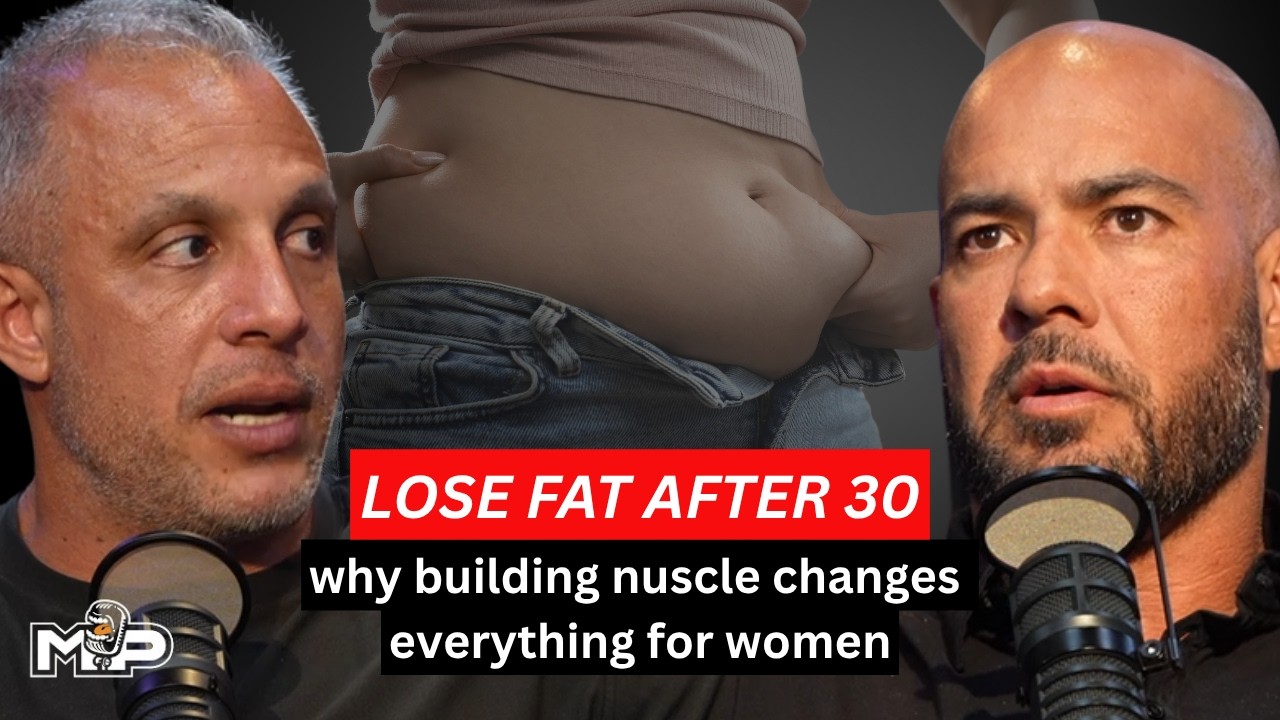
How Women Over 30 Can Lose Fat and Build the Body They Actually Want | Mind Pump 2920
Watch on YouTubeVideo summary
Women over thirty often face the frustrating reality that fitness strategies which once worked effortlessly in their twenties suddenly seem ineffective, leading many to believe that age itself is an insurmountable barrier. However, experts argue that this struggle stems less from chronological aging and more from a shift in lifestyle factors such as increased stress, complex responsibilities like childcare or mortgages, and reduced sleep quality. These elements compound the physical stress placed on the body during exercise, pushing it beyond its capacity to adapt and recover effectively. Consequently, what feels like a plateau is often simply the body surviving rather than thriving under excessive cumulative load, making old methods of high-volume cardio and extreme calorie restriction unsustainable for maintaining long-term results.
To overcome these hurdles, the most effective strategy shifts focus from burning calories to building muscle through strength training with compound movements like squats, deadlifts, bench presses, and overhead presses. This approach leverages testosterone's natural presence in women by increasing androgen receptor density, which enhances metabolic rate, improves insulin sensitivity, and promotes a favorable hormone profile without requiring hours of grueling gym time or intense cardio sessions that add unnecessary stress. By prioritizing strength gains over the arbitrary goal of hitting a specific weight on the scale, individuals can achieve significant body composition changes where they look leaner and feel stronger even if their total body weight remains stable or increases slightly due to new muscle mass.
Nutrition plays an equally critical role in this transformation by requiring women to "feed the gains" rather than restrict calories further when trying to lose fat. This involves consuming adequate protein based on target body weight while sticking to whole, natural foods that provide satiety and support recovery without triggering overeating behaviors common with processed junk food. A practical example illustrates how reducing high-stress activities like excessive running in favor of walking or hiking, combined with increased caloric intake focused on nutrient-dense meals, can dramatically lower body fat percentages within months. This method not only accelerates visible results but also improves overall health markers such as skin quality and energy levels by allowing the body to recover properly from strength training stimuli.
Ultimately, adopting this holistic approach sets women up for longevity and sustained success well into their later years, preventing issues like osteoporosis while fostering a sustainable lifestyle that feels manageable rather than depleting. The key takeaway is to abandon the cycle of yo-yo dieting and high-intensity cardio in favor of consistent strength training paired with proper nutrition and moderate daily movement like walking eight thousand steps or more. By trusting this process, women can build the resilient, sculpted bodies they desire while managing life's inevitable stresses, proving that phenomenal fitness results are entirely achievable at any age when the right strategies are applied correctly.
Read the full video transcript
You just found the most downloaded
fitness, health, and entertainment
podcast in history. This is Mind Pump.
Today's episode, we talk about how women
over 30 can lose fat and build the body
they actually want. Look, we also have a
buy one get one free happening with MAPS
programs. The top 10 most popular MAPS
programs. MAPS anabolic aesthetic
performance 15 minutes anywhere.
Symmetry, Starter, Muscle Mommy,
Powerlift, and 40 Plus. Buy one, get one
free at mapsbogo.com.
Now, this episode is brought to you by
one of our sponsors, Row Nutrition. So,
check this out. NAD naturally declines
with age. This is slower recovery, brain
fog, you get less drive. Rose liquid NAD
isn't a stimulant spike. It raises your
baseline, so you just operate better.
Then they have glutathione. This is your
master antioxidant. Most people are
depleted from hard training, stress,
poor sleep, and travel. So, here's the
difference with row nutrition. It's
liposomeal delivery. So these compounds
are encapsulated in liposomes that
deliver them to the target tissues of
the body. Oftent times when you take a
supplement or a compound, let's say NAD
or glutathione, you don't actually get
it. You don't actually absorb it. Well,
liposomaal technology is a
pharmaceutical grade technology that
takes these compounds and brings them to
where they need to go. So when you take
the glutathione, your body absorbs it.
When you take the NAD, it actually
works. Go try it out. Experience the
difference. Go to
ronutrition.com/disount/mindpump.
That's rhom
nutrition.com/disount/mindpump.
Use the code mindpump for 20% off. Here
comes the show. All right, real quick.
If you love us like we love you, why not
show it by rocking one of our shirts,
hats, mugs, or training gear over at
mypumpstore.com. I'm talking right now.
Hit pause. Head on over to
myposttore.com. That's it. Enjoy the
rest of the show. [music]
It's commonly noted by clients we've
trained in the past that when they get
over 30, it's harder to lose fat, and
build the body they actually want. This
was most echoed by our female clients.
So, that's what we're going to talk
about today. How women over 30 can lose
fat, build the body they actually want.
We're going to give you the steps today.
Let's go.
>> There. This is always a tough one to
communicate because there uh
>> there's a lot of truth to you know as
you get over 30 over 40 like the
challenges that are
>> but it has less to do with the age and I
think it has more to do with the the
time at which
>> we didn't do certain things or
>> patterns you've established.
>> Yeah. Patterns or how many times I have
yo-yo dieted or at this point in my life
uh I I I'm less resilient than I was in
my 20s. Hormone uh issues. is there's so
many other things and it's less to do
with it's an it's an age but it's
communicated like it's a it's an age
thing. It's like oh when you get to a
certain age all these things are
exponentially more difficult. It's like
well there's some truth to that but then
it's less to do with the number and more
to do with all these other things right.
>> Yeah. Yeah. And just to encourage people
um you get you can get phenomenal
results uh in your 30s when it comes to
fitness if you do it right. So if you do
it right everything comes together
everything works. uh your body moves the
way you want it to. You build muscle and
a metabolism. You burn body fat. It all
works. But here's the challenge. The
challenge is this is what we've heard.
How many times have you guys heard this?
Right. It used to feel a lot easier.
>> Yeah.
>> Right. The the the old ways that I used
to get in shape aren't working anymore.
What is going on?
>> Yeah. And that can be really frustrating
and confusing, especially if you have,
you know, quote unquote gotten into
shape many times in your 20s and
suddenly the formula that you have
applied maybe two times or three times
in the past that works so well for you,
suddenly it feels like it's doing
nothing.
>> And so, uh, this is very frustrating.
It's very, very difficult, um, and
confusing. But once you understand
what's going on, it's not so confusing.
Uh and that's I think it's important
that we kind of demystify uh what's
happening. And so does age play a role?
Of course it does, but it's not the main
player um in what's going on. Now, yes,
hormone changes can start to happen in
the 30s, especially as we get towards
the later 30s.
>> But here's uh what's what's really
contributing most to this this struggle.
Number one, uh life is different often
times, right? uh you have uh more
stress, more responsibilities, and time
is more precious now than it was when
you were in your 20s. Uh a woman in her
30s probably has a job, she's out of
school, maybe she has a kid or two, uh a
mortgage, she's in a long-term
relationship or married. Whereas in her
20s, the responsibilities were basically
about herself.
>> Um maybe went to school, but that was
kind of it. uh if I wanted to sleep in,
I could. I didn't have a kid that I was
responsible for. Um I didn't have all
these other responsibilities. And
although time was still uh precious, it
wasn't as precious as it is now because
I didn't have to divide my time so much
between all these other
responsibilities.
>> Yeah. And you got to factor that in all
those new stresses, responsibilities
because even, you know, making it a bit
more challenging to even consistently go
to the gym, but also to get sleep, which
sleep in itself is really where, you
know, you're going to get all the
results. you're going to get, you know,
the hormone balance. You're going to get
a lot of these benefits. Uh, and that's
just one of those big factors that
really shrinks as you as you
>> of all the things you just listed, do
you think there's a a bigger culprit of
all like which one's the greatest
culprit of all of them?
>> I mean, generally stress more
specifically, um,
>> yeah, because all of them
>> responsibilities,
>> all of them feed into that, right? Like
all the extra responsibilities causes
higher stress, right? And so the poor
sleep, higher like all those things. I
think I think that
>> so I think that's literally
[clears throat] the the first because
even though time uh as we get older with
more responsibilities, we have families,
jobs, careers, all these things. Uh you
are limited to time
>> the amount of time required to build a
healthy fit physique isn't that much.
No.
>> And so I don't if you do it wrong. Oh
yeah, of course. So I don't think that's
was the even though [clears throat]
that's a challenge, I don't think that
was like number one challenge. Right.
Well, no, but let me let me be let me be
more clear. Um, the ways that you got in
shape in your 20s, although they may
have quote unquote worked, although I
would challenge that, uh, because the
way I define if something works is it
sticks.
>> Yeah. Sustainable.
>> Yeah. So, like as a trainer, as a coach,
>> um, you know, success, part of success
is getting to your goal or getting
results. That's part of it, but that's
not the full thing. The full thing
includes maintaining. Okay? So, if
somebody ever comes to me, and again,
this I'm coming from a trainer uh,
perspective. as someone comes to me and
says, "Oh my god, I used to do this. I
do there's this method that I use. It
works every time. I get in great shape.
What happened? Why did it stop? Why did
you stop doing it?" So, it didn't work.
It didn't work because you weren't able
to maintain it. And and then people will
say, "Well, it's me that wasn't able to
maintain it." It doesn't matter. Um it
didn't work. So, I'll challenge that.
The other part I'll challenge is that
the method was was still ineffective.
The difference was you didn't have so
much stress uh compiling on your body,
so you got away with it. And the second
part was you could devote a lot of time
to wasted energy working out. I could
throw more stress on myself and do more
workouts and sleep in when I need to
when I go to bed late because uh my time
isn't as as divided. That's why that
plays
>> uh so much of a bigger role. Yeah. Is
you know in my 20s if I go to bed late
uh well you know Saturday guess what I
can sleep in as long as I want. I can
take naps if I want to. you know, when
you have responsibilities, especially if
you have kids, you know, here's the
thing about having kids, you can go to
bed as late as you want. They'll wake up
at the same time every morning.
>> Yeah. Yeah.
>> And so, you don't get to sleep in your
kids wake up and and you got to be up.
Um, and the old ways that you were you
were you were using before, they were
working in part, maybe they got you the
results, but you weren't able to
maintain them, but they got you some
results, not because it was effective,
but in spite of the fact that they
weren't effective.
>> Uh, why? because you could add a bunch
of stress on your body with the wrong.
Here's the deal with exercise. Exercise
is a stress on the body. That's what
gets your body to change from the
exercise. Your body's trying to adapt
and become more resilient. Um, but
there's a limited capacity your body has
to to deal with stretch. Once you
overcome that capacity, you're screwed.
Like there's no adaptation. You're just
surviving. And this is what it probably
feels like right now. What it probably
feels like right now is you're doing the
old stuff and it just feels like you're
surviving. I'm getting sore. I'm
sweating. But why isn't my body
responding? Your body's not responding
because it doesn't have the capacity to
adapt to that stress like it used to
because you have so much other stress uh
on your body.
>> I don't think you can stress enough the
that it wasn't effective because
how many times have you heard um you
know that one summer I followed that
Atkins diet and I lost 30 pounds or when
I was when I was training for that
marathon back in you know ' 05 I was in
the best shape of my life. It's like
they they will connect uh the the best
shape or the most weight they lost as as
a success even though it only lasted a
small semester of their life.
>> And so it's like it wasn't effective in
because it wasn't sustainable. Like you
weren't going to be running marathons
every other month or for the rest of
your life. You weren't going to be
following Atkins forever. And so even
though it gave you a temporary result in
the positive direction, it wasn't
effective. I think that doesn't register
for a lot of clients at first at because
they still hearken back to that
>> Yep.
>> that feeling or that moment in time. And
so in their head it was like, "Oh, that
worked."
>> Association.
>> It's like, "No, it didn't work.
>> You were you were you lost, you know, 30
or 50 lbs during that one time and then
you put it all back on and some, so it
wasn't effective." And and so getting
them to understand that like we don't
want to go back that way and it wasn't
effective is sometimes really difficult.
There is a far more effective way that
is also far more likely to be
sustainable by you. And this is what we
got really good at doing with our
clients. Cuz here's the deal. The vast
majority of clients that we trained uh
who were women were over 30. Okay? So, a
majority of our experience
>> Oh, yeah.
>> in training women was in training women
who were over the age of 30 for for a
couple reasons. One of them being this
is when when people typically have
expendable income and can actually
afford to hire a trainer. you're in your
20s, you know, you might be you might be
strapped for cash and paying $100 a
session to work with a trainer. That's
not going to happen. But now you're 35,
you've got a family, you've got a job,
you're like, "Man, this isn't working
anymore. Let me hire a professional. See
what happens." I'm going to tell you
right now, we solved uh this problem.
And I'm going to tell you the one thing
that made the biggest difference. The
one thing that made the biggest
difference was getting my female clients
to focus on getting stronger and build
muscle.
>> Yeah.
>> This was the big difference. Now, this
was a big difference because, and you
might hear now, and this more common now
to hear why this is an effective
strategy, but a lot of my clients when
they were in their 20s, the strategy had
nothing to do with getting stronger and
building muscle. It had everything to do
with trying to burn as many calories and
move as much as possible.
>> It was just let me sweat and move like
crazy.
>> Yeah.
>> And the goal was to get skinny.
>> To get skinny.
>> I mean, that was like a that was a a
common thing you would hear.
>> That's right. And often times, this is
uh what a young woman's goal is. It's
like just shrink, just shrink, shrink,
shrink. And this strategy uh is a very
difficult strategy. Building muscle and
getting stronger leverages your body to
be able to uh do a lot of the work for
you. Okay, that's that's why this is so
effective because if I have a female
client who's 35 years old who gained,
you know, 8 pounds of muscle, okay,
first off, she looks better. Uh her her
butts rounder, her arms are more
sculpted, her legs feel tighter, her
core feels tighter. She's heavier on the
scale, but everything feels tighter and
actually looks better. But that 8 pounds
of muscle has now leveraged the
metabolic rate in a direction where her
body now burns more calories on its own.
>> She actually has a faster metabolism.
She also has a a body that has a more
it's more likely to have a favorable
hormone profile. you have better insulin
sensitivity, which does play a role in
things like estrogen, progesterone, and
muscle. When you build muscle or
strengthen muscle, you increase androgen
receptor density. So testosterone is a
hormone that women have just just like
men. They just have a lower amount, but
it's just as important for women is as
it is for men. In fact, low testosterone
in women, same symptoms that low
testosterone men produces. low
motivation, low muscle, more fat gain,
low libido, low energy. Right? So when
we build muscle, we increase androgen
receptor density. These are the
receptors that testosterone attaches to.
So now whatever testosterone I have is
more effective. It's got more places to
attach to and become active uh at. And
so what I've done by building muscle is
I've shifted my body in a way that makes
it easier to get lean, easier to
maintain. And it's a it, by the way,
here's the best part about building
muscle doesn't require days and hours in
the gym like trying to burn calories
does. Like trying to burn calories means
I got to do stuff all the time. Building
muscle is I got to do a workout, send
the signal, let my body build.
>> And so that's the biggest that was the
one thing that made the biggest
difference. The difficulty was
convincing my clients initially to trust
me through this process, but once they
did and they saw the results,
>> the hamster wheel. Yeah.
>> It was over. Well, part of the part of
that challenge um is is getting them
away from using the scale as the metric
to to define their success or not.
>> And what's cool today, it's I feel like
it's a lot easier today than it was 20
years ago. Um because today I can tell a
client easily on their phone, they can
get on it and I can go um okay, let's
not change your weight at all. So you
don't you don't like that you're at 175
or 18 whatever your weight is. I want
you to type in show me a body at 19 a
female body at 19% at 180 pounds and
then show me one at 35%. And look at
both at 185 lbs and put those pictures
next to
>> so different.
>> Crazy different.
>> Yes.
>> And and so you can illustrate really
quickly how irrelevant the scale is. And
it's like we don't want to just lose
weight on the scale. Like we need to get
that out of our heads that you need to
be a certain weight on the scale. I can
show you radically different body types
and or bodies the way they look at
literally every weight number 120, 130,
140, like all the way up. Like I can
show you radically different bodies
based off of how much lean body mass
they have. And the pursuit of that is
through building muscle and strength.
Yes.
>> And so that's why that needs to be the
north star and not this arbitrary number
on the scale that you've attached to
this is what I like the look is. It's
like, no, let me tell you, you can not
even move on the scale and look
radically different.
>> So, to put it differently or to put it
plainly, um, if you're listening right
now and you're trying to build the body
you want, you're trying to get leaner,
you want to look fit, here's your goal.
Build muscle and get stronger. That's
your goal. It will leverage things in a
direction that makes it a lot easier. It
will boost your metabolic rate. It'll
make getting leaner easier, meaning you
can eat more food and maintain a leaner
body. And you look great. And here's the
best part. You feel great. Ladies,
muscle feels really good on your body.
You move better. Your joints feel
better. You've got more energy. The
testosterone that you currently have
becomes more potent because of the
androgen receptor density. So, your
libido goes up. You've got more drive.
This is the strategy. And I'm going to
tell you right now, if you're listening,
you're like, I'm kind of scared. What
you're doing isn't working.
>> Why not try something uh totally
different?
>> Yeah. And I mean, you're setting
yourself up for sustainability, for the
longevity through this whole process. I
think too, of course, you know, not
everybody's going to think really long
term about, you know, fitness and
training that uh you know, into their
80s. But what this is setting you you up
for is, you know, you're you're avoiding
osteoporosis. You're you're setting
yourself up for abilities uh later on in
life that you're going to benefit from.
>> Oh gosh. The the I'll tell you what.
Listen, we managed gyms for years. I'm
going to say something and I know you
guys know exactly what I'm talking
about. The women in the gyms that I
managed in their 60s that were cardio
fanatics versus the women in their 60s
that were strength training fanatics.
>> Completely different.
>> The the the difference the way in the
way they looked was radical.
>> Radical. I mean, the the lifting
fanatics looked younger, had better
skin. You can look this up. Strength
training stimulates muscle protein
synthesis, but it also stimulates whole
body protein synthesis.
>> They look different. They felt
different. They had better hormones.
>> Um, I mean, both groups were better than
no people who did nothing.
>> But the strength training, oh boy, did
it make a big difference.
>> Okay, so you're you're listening. Uh,
you've completely sold me on this is the
path. what are the the actionable steps
that I take and in in the most simple
basic way like what what do I do?
>> Number one, you got to feed the gains.
And I use the word gains on purpose
because that's a scary word, but you
need to feed the muscle. We're trying to
add active calorie burning tissue to the
body. And you can't do that if you're
eating too little. Okay? So, this isn't
going to work if you're eating almost
nothing every single day. You need to
eat your target body weight in protein
in grams of protein. Make sure you eat
whole natural foods and feed yourself in
a way to what it looks like essentially
is this. I'm going to eat when I'm
hungry, not overeat. I'm sticking to
whole natural foods. I'm not trying to
undereat and I'm going to feed the
gains. I'm going to feed the muscle
gains. And and this is I said this is
number one because this is the hardest
part because
>> hard one. I can convince uh people in
this category. I can convince women in
this category to lift weights far easier
than I can to get them to feed.
>> Yeah.
>> Uh the the harder part it sounds
counterproductive when I'm hung up on I
need to go down.
>> That's right.
>> When when when I've come to you and I've
hired you and I said s I'm uncomfortable
where I'm at. I don't like this weight.
I want to lose 30 or 40 pounds, whatever
the number is. Um, and and then you you
did your spiel you just did for the last
10 minutes to me. And I'm like, okay,
I'm bought in. I need to get strong. I
need to build muscle. What's step one?
And you're like, feed the gains.
[laughter] And I'm like, okay, you lost
me again. No [clears throat] way. Like,
I told you how you heard me. I want to
go down again. And then I feel like this
is the part where we're having to circle
that way.
>> If you feed the gains with garbage food,
heavily processed food, junk food, yes,
you're going to gain tons of body fat.
If you feed the gains with whole natural
foods and you hit your target body
weight and grams of protein, not only
will you be fine, but you will get body
composition change through this process.
Meaning, you'll get leaner as you build
muscle.
>> And and this is a necessary evil because
we can lift all the weights we want, but
if we live in a caloric uh deficit and
we don't feed the body what it needs to
build muscle, you won't build muscle. So
you can you can have the best strength
training program, have the best trainer
in the world taking you through it, but
if you don't fuel the body properly, you
don't give it enough calories and you're
always under on calories, you're not
going to build muscle.
>> Some of the best results I ever got with
my female clients were the female
clients that they hired me, I train
them, we're doing the strength training,
they're really resistant when it comes
to the diet, really resistant with
nutrition, really resistant,
restricting. God, I don't want to eat
more. Finally, I convince them, "Go up
500 calories. Go up 500 calories and
watch what happens." And within weeks,
they're blown away by how they feel.
Within months, they look in the mirror
and they're like, "This is wild. I'm
eating more food and I'm leaner." I'm
like, "Yeah, you built muscle." So, you
need to feed the gains. But again, you
will not eat so much food that you gain
a bunch of body fat so long as you stick
to whole natural foods. Whole natural
foods produce a natural satiety that
will match what your body generally
needs. When you eat a lot of heavily
processed foods, junk food, fast food,
candy, then yes, you will totally
overeat and gain a bunch of body fat.
But that's because those foods are
designed to make you overeat. So your
your body's systems of society are
totally thrown off with those things.
But if it's whole natural foods, feed
the gains. The next thing is this. Your
goal is strength. Your [snorts] goal is
strength. Your goal is not to look
different in the mirror. Your goal is
not to get leaner. Your goal isn't
anything else. It's to get stronger.
Now, here's what's crazy about what I'm
saying. If you get stronger, you're
sticking to whole natural foods and you
consistently get stronger, all the stuff
that you're looking for, the changes in
the way you look, body composition,
shape, sculpt follows. It all follows
>> more efficiently as well.
>> That's right. It follows it
consistently.
>> Now, would you say um to to even
simplify that to focus on a handful of
lifts to that you want to get stronger
in? Yes.
>> Versus just kind of like trying to do
all the things and say,
>> "Yes." And here's why. So, it's okay.
It's great.
Okay. It's great to get stronger at, you
know, hip abduction or a lateral raise
or a tricep press down. Nothing wrong
with that. Getting stronger is always
awesome, but getting stronger at certain
exercises just means a lot more. It
means a lot more in terms of metabolic
rate, muscle gain, return on investment.
Okay? So, getting stronger, for example,
at a barbell squat means a lot more than
getting stronger at a leg extension. Uh,
for example, both work the legs. One of
them is working a lot more than just the
quads, the hamstrings, the glutes,
>> more muscles involved, more of a loud
signal.
>> Yes. And so the typical exercises that
really mean the most, and there's
there's quite a there's a few of these,
but the ones that really mean a lot that
you get stronger at are things like
deadlifts, bench press, squats, overhead
presses, rows, like you get stronger at
those lifts. It means a lot in terms of
the visible results uh that you're
looking for, right? Here's a here's the
last one, and this is where it gets
crazy. I don't want you to do any
cardio. All right? I don't want you to
do any cardio. Now, look,
>> this is where we get we get so much push
back.
>> Now, now, here's the deal. There's
nothing wrong with cardio, per se. If
you want endurance and stamina, this is
the way you should exercise.
>> But here's the deal.
>> Uh, when we're dealing with adding
stress to the body, uh, and we're also
dealing with a lifestyle where I've
already got lots of compounding stress,
I'm going to leave the stress when it
comes to exercise to the thing that's
moving the needle the most. If we're
going to add stress to the body, I'm
going to focus on the thing that's going
to change the way I look. Yeah. The
fastest, which is the strength training.
So, I don't want to add additional
stress from cardio. Now, again, if
you're if your goals are athletic, you
want stamina, you want endurance,
nothing wrong with it. But you got to
understand when you add more stress from
intense cardio, you got to take away
from the strength train. You can't just
throw stuff on top of stuff because then
nothing happens.
>> Well, this is a best uses case. It's
it's the the the best use for cardio.
It's a tool at the end of the day is to
increase endurance and stamina capacity.
And so in that regard, like cardio is
amazing for that. Uh and I know people
enjoy doing it. So there's nothing wrong
with that. However, if we're talking
about fat loss and body composition
changes, there's a another tool that's
way better than that and that's strength
training. That's right.
>> And then we we also like eventually like
a if I had a client that's telling me
like I want to do it or I love to do it,
I like to do it which first of all it I
would always challenge that too. like do
you really love doing it or is it
because again you've attached that to
some sort of like result that you've had
before?
>> We can use that as a tool later on. Like
it's like okay don't worry that's that's
a it can be something that we use in the
future but initially right now when
we're trying to build the metabolism
scul the body build muscle in the manage
stress.
>> Yeah. And manage stress and all like
right now this is not the ideal tool for
this situation. Let's use the ideal tool
for this situation. Let's build that
metabolism. Let's drop some body fat.
Let's get to a place where we have some
consistency. We've built some strength.
And then maybe later on, we can start to
add that into your routine. And you've
got this beautiful balance.
>> Yeah. And so, again, a lot of this has
to do with managing stress on the body.
And so, if when we're adding stress with
exercise, I want to be judicious with
what exercise I pick. And if the goal is
body composition change, uh, then I'm
going to place that uh in the strength
training bucket. Um, and I'm not going
to use cardio. Now, here's the deal.
Does that mean we want you to be
seditary? Does that mean you lift
weights, you know, three days a week and
then the rest of the week you do
nothing? No. Daily activity is very good
for you. It's going to enhance uh and
accelerate these results. We just don't
want daily activity that adds to stress.
In fact, I want I would love you to move
in a way that's recuperative and
rejuvenating. And you know what the best
form of of movement for that is?
Walking.
>> Yep.
>> Walking.
>> So, here's what you're going to do on
the on every other day. uh you know, you
you lift weights and then in terms of
daily activity, try to hit 8 to 10,000
steps a day, which which is really no
small fee. If you have a desk job, it
actually requires you to kind of get up
and move quite a bit, but 8 8 to 10,000
steps day in and day out is a great way
to get that extra activity. Combine that
with the strength training
>> and you're totally crushing. Uh this
makes this reminds me, there's so many
client examples I have of this, but my
favorite client examples are not women
who hired me. I love training all the
people that I trained, but the ones that
stand out were the ones that were
already working out, were already doing
everything they thought they were doing
right, and then they hired me,
>> and they came to me because they were
frustrated. There was one woman I can I
remember uh specifically who was running
like crazy and strength training. So,
she was lifting weights
>> four or five days a week, plus she was
running about 25 miles a week. Okay, so
those two things, plus her calories were
in the sub 2000s. the the fact that she
was able to survive on that is pretty
remarkable. But that's what she did. And
I remember she hired me because her body
fat percentage was stuck in the mid20s.
And she's like, I you know, I'm running
like crazy. I lift weights all the time.
How is it that I'm like at 24 or 25%?
Shouldn't I be like 19% body fat? She's
like, what what do I need to do? Do I
need to do more working out? Do I need
to cut my calories even more? I'm like,
listen, if you cut your calories more,
you're going to lose weight, but it's
going to be muscle. Your body fat
percentage will go up. And if you try to
work out more, you're going to overtrain
yourself more and at some point you're
going to hit a wall and your hormones
are going to crash and it's going to be
terrible. And she was already telling
me, "I'm feeling fatigued. I'm already
feeling fatigued. I'm feeling burned
out. What do I got to do?" So we cut her
running way down. Initially, I went from
was 20 20 to 25 miles a week all the way
down to five because I couldn't cut it
all the way out. She was attached to it.
So I cut it down to five. Cut her
strength train down to two days a week
and I took her calories up by 400
calories. Anyway, over the course of
eight months, this woman went to zero
running, just walking, because she
realized she didn't really love running
as much as she thought she did. I think
she was doing it because she thought it
was keeping the weight off. So, she cut
that out, started hiking and walking.
She was still pretty active. Strength
training with me uh between two days a
week, one day a week on her own. So,
three days a week total. Her calories
got all the way up to almost 3,000
calories a day, and she was walking
around 18% body fat. And she she was
just remarkable how easy it felt. She's
like, "This is the weirdest thing. I I
always thought I had this crazy slow
metabolism. I always thought that I I
was just destined to never get as lean
as I as I thought I should be. She like
this feels genuinely easy. It's like we
shifted things in a direction to make it
easier.
>> Well, my I mean my one of my favorite
stories to share is Katrina. Um and not
just cuz she's my wife, but it's also
one of the last people that I really
helped like this. I mean I was on my way
out. we were already into mind pump and
and doing that uh when or building
towards this when uh uh we I finally
started to help her. We'd already been
dating for years at that time. Three,
five years we'd been together and she
just she had her own thing. She was
always an an athlete. So her way of
maintaining in shape was she'd allow
herself to eb and flow between 10 to 15
pounds. When she started to push up that
15 extra pounds that she didn't like,
she kicked up her running like crazy.
She would every time she lifted weights,
it was plyometric style from the way she
trained like as an athlete. And so her
approach towards weightlifting was
highintensity, low rest period, circuit
type training and lots of running. And
she'd shed those 15 to 20 pounds,
whatever it was. And I watched her do
that through, you know, years of being
together. Never said anything to her
because, well, I'm not going to tell her
what to do. You know, it's like if
that's how you like getting in and out
of shape. and she had watched me enough
times, you know, control my my body
composition and never do any cardio. And
obviously when I started to get ready uh
to compete was when she saw it at an
extreme level and she finally looked at
me. She says, "Okay,
throw my hands up. You take control."
And I was like, "Okay, sorry. Cut out
cardio completely. Reduce the amount of
strength training she does. Reduce the
intensity she does. Increased rest
periods and increase food. And at the
end of this, she had the best body she's
ever had, doing zero cardio, eating 7
800 more calories than she's ever eaten
before. And not only that, she saw we
saw all kinds of health. I don't I don't
talk this that much on the podcast about
this, but you know, she had she had
stuff with like acne that always
bothered her, that riddled her. She had
all kind she saw her her hormones.
>> She saw her skin get better. She saw all
this other stuff get better. uh her
hair, nails, all kinds of things that
improved in addition to and I remember
her afterwards being like, I can't
believe I've gone this long. That's
right. And had no idea how much easier
it was. And she was the same way too
where I love to run.
>> You say, I used to love to run, but it's
like again attached to the result of
that. She used to know that if I trained
really hard like this and ran like
really crazy, I could shed these 15
pounds. And that had proven to work for
her for so many times that she and then
she had attached. I liked
>> until she tried the right way.
>> Until she tried the right way and
realized, "Oh my god, this is way more
fun to be able to lift weights half as
intense as far as the amount of, you
know, her circuit type training as she
was doing, no running whatsoever, and
being able to eat more food and then
also be able to say, "I have the best
body I've ever had." Like, that was such
a cool thing to watch.
>> So, here's what we have. So, there's
there we're having a buy one get one
free with Maps programs right now. And
this is the best combo for what we're
talking about right now. So, if you're
listening to this, you're like, I want
to do that. I want to build a muscle. I
want to boost my met metabolic rate. I
want to do it the right way. Here's the
combination. We have a program called
Muscle Mommy. You do that first about 3
months long. Then you follow it up with
MAP's power lift, which is literally
about getting strong with your squat,
your deadlift, and your bench, which is
another three months. So, this is a
six-month course with both programs.
It's buy one get one free. By the way,
the buy one get one free applies to our
top 10 most popular programs which
includes maps anabolic aesthetic
performance 15 minutes anywhere symmetry
starter muscle mommy powerlift and 40
plus. So if you're interested go to maps
bogo.com.
Also you can find us on Instagram. It's
mindpump media. We'll see you there. All
right. I know you like that episode. If
you did check this one out. One of the
keys to fat loss is protein. [music]
It's true. If you're not eating a high
protein diet, you're not going to burn
as much body fat as you can. So, today's
episode, we're going to talk about the
smartest ways to use protein for fat
burn and to build muscle. You got to
watch this. [music]
>> I wish I understood this earlier in my
career. I think it was probably
almost 10 years in when I started to
just focus [music] on this with clients.
>> I knew it was important, but I don't
know how important. Yeah, I also did I
knew it was important and but I also