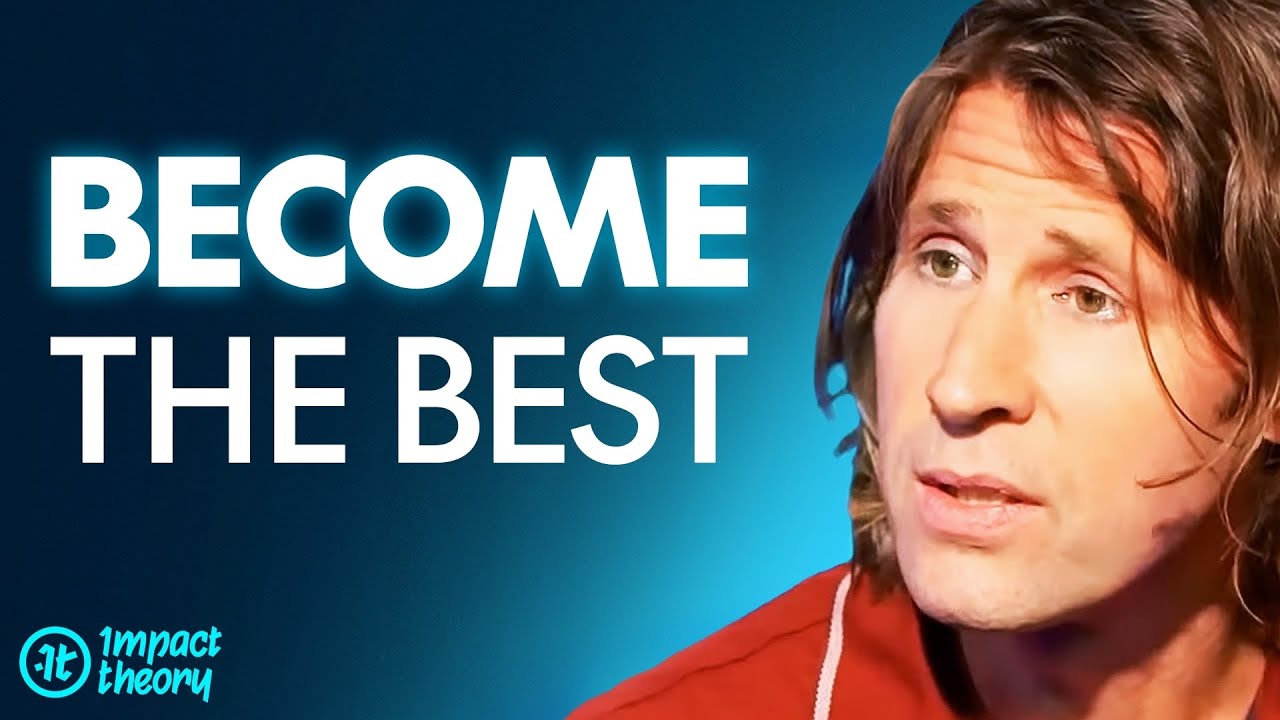
How to Use Pain to Become the Best In the World | Rodney Mullen on Impact Theory
Watch on YouTubeVideo summary
Rodney Mullen, widely recognized as the godfather of modern street skating and a member of the legendary Bones Brigade, is celebrated for inventing foundational tricks like the kickflip, 360 flip, and impossible. His journey began at age eight on his family farm in Florida with limited resources, yet he went on to win 34 out of 35 freestyle contests by age twenty-four before transitioning to street skating when that style became dominant. Mullen emphasizes that while talent is common among elite athletes like those who broke the four-minute mile barrier or mastered specific skate tricks, true progression relies heavily on belief rather than just skill. He argues that a culture often imposes barriers based on what can be proven or seen, but genuine innovation requires cracking open these limitations through an internal shift in perspective and axioms. The transition from freestyle to street skating was driven by Mullen's realization that winning contests created a protective groove where he played it safe rather than progressing further. He notes that achieving top status often leads to boredom because the initial fire of desire is quenched, leaving one with only static honors like trophies and stadium crowds which eventually fade into irrelevance. To sustain his drive, Mullen clings to an intuitive yearning for skating itself, viewing the activity as a form of meditation even when he was in pain or struggling. He describes this love-hate relationship with the sport, acknowledging that it involves hate, pain, and frustration, but these elements are what magnetize him back to the board every night, distinguishing his approach from those who rely solely on external validation. Mullen's resilience is perhaps best illustrated by a severe injury where scar tissue caused his femur to grind against his hip socket up to twenty times a day while sleeping or moving. Doctors advised retirement because cutting out the damaged area would result in losing too much bone, but Mullen refused to hang it up. Instead of surgery, he spent hours daily using a small plastic tool and leverage techniques on fire hydrants to manually break apart the scar tissue until his joint functioned again as a ball-and-socket rather than a stick shift. This process required immense courage and patience, demonstrating that necessity drives invention and that enduring pain can build character if one remains focused on the internal joy of movement rather than external accolades or fear of failure. Beyond skating, Mullen finds fulfillment in puzzles, building computers with open-source software like Linux, and connecting with people who possess strong character regardless of their profession. He highlights his work with Make-A-Wish as a profound humbling experience that strips away the ego associated with being an Olympian or inventor; meeting terminally ill children reminds him that he is merely a "lightning rod" for love rather than someone to be worshipped. These interactions teach him that what truly matters are the singular connections made and how one shapes themselves through reflexive couplings of action and identity, ensuring they do not become insufferable or disconnected from humanity as age and success accumulate. Ultimately, Mullen's philosophy centers on finding joy in doing something for its own sake rather than chasing accolades that serve as mere tombstones to great work, a sentiment echoed by physicist Richard Feynman regarding the Nobel Prize. He encourages individuals to peel back layers of why they do what they do and to nurture their unique variables—whether it is overcoming fear on big rails or dealing with personal demons—to express an individual identity he calls greatness. His impact extends beyond creating a vocabulary for skaters to connect, aiming instead to be a good man who leaves a legacy through the people touched rather than awards won, urging others to chase the ultimate intoxication of believing in their own ability to create something new despite barriers of disbelief.
Read the full video transcript
Everybody's got their stuff.
Whatever it is,
everybody has a unique set of variables
that they can put in place and express
their individual identity in a form of
call it greatness.
That's something to be remembered.
That's what you look for.
Everybody, welcome to Impact Theory. Our
goal with this show and company is to
introduce you to the people and ideas
that will help you actually execute on
your dreams.
All right, today's guest is widely
recognized as the most influential
street skater in the history of the
sport. He invented many, if not most, of
the tricks used today, including the
street ollie, kickflip, 360 flip,
impossible, and many, many others. He
began skating at the age of 8 against
his father's wishes and had little more
than the garage on the family farm to
practice in, and yet, he would end up
becoming the most dominant competitor
the sport has ever seen. He won his
first championship at the age of 14, and
over the next decade, he won 34 out of
35 freestyle contests. His impact on the
art and industry of skating simply
cannot be overstated, and that's why
he's known today as the godfather of
modern street skating. The Tony Hawk Pro
Skater franchise showed their reverence
by featuring his character for nearly a
decade. Additionally, in acknowledgement
of his unparalleled level of innovation,
the Smithsonian now hangs his board on
display, and he was chosen for one of
their coveted professional fellowships.
In addition to his contributions to the
craft of skating, he's been just as
influential on the business side of
things. He holds two patents for his
revolutionary skateboard and truck
designs, and his current company, Almost
Skateboards, which he co-founded in
2003, has been thriving for 15 years
already. Prior to that, he had
co-founded World Industries, the most
successful skate company of the '90s.
His insights into the nature of
progression itself has made him one of
the most sought-after speakers on the
topics of innovation, mindset, and the
staggering drive that it takes to be
great. So, please help me in welcoming
the two-time TEDx speaker and member of
the legendary Bones Brigade, the
godfather himself, RODNEY MULLEN.
YEAH, GOOD TO SEE YOU. THANK YOU SO much
for being here. Wow, that was an intro.
That That is a well-earned intro, man.
And as somebody who's been watching you
since I was a kid and desperately
wanting to be able to do the kinds of
things that you do, but couldn't and
wasn't able to break through the things
that hold me back.
Um I want to start with an idea that I
heard you talk about, which is the
barrier of disbelief. What is it that
holds people back?
One thing that happens all the time in
skateboarding and
like four-minute mile is cited often. It
happens.
Best dudes around the world can be
striving after one particular trick.
Finally, one guy does it.
And then the rest just come like
lemming.
Rarely is it
a question of talent or technique at
those levels.
It's just one of belief
and the concomitant will to kind of
do something that either no one's done
before
or even more, I think,
to crack open the barriers that people
considered impossible or undoable.
And that kind of belief, I think, is
rarer than talent.
Talent is
it's around.
And to have them both at those levels,
there's only a few people that that
really have that, I think, in the
history. They're the ones that have
really changed things.
So, how can you build that sense of
belief? That's the thing that I find so
fascinating about your story is I get it
when when you become part of Bones
Brigade and you're around all these
other guys and they're all pushing and
innovating, I get how you guys get
better. But, all of them say that you
were the one that progressed the
fastest, but you were the one that was
almost always isolated. So, how in that
isolation on the farm in Florida, how
are you able to create that belief in
yourself? It is easy to say, and I think
it's smothering to say, and often
there's a culture of saying that if
if it cannot be proven, it must not be
possible.
And the big takeaway from that theorem
is that there's lots of things that
cannot be proven, though they are
correct. And I think that this idea too
is skating that because we see things so
often in front of us the way that it
should be done, and it imposes a kind of
barrier through
what people know and see, a familiarity.
But maybe you can change something
within you that can be just outside a
new set of axioms.
Some new skill set that will take you
further, and I think that that's the
history of development, certainly when
it's skating. Yeah. I want to talk about
when you So, freestyle essentially dies,
becomes uncool, which I want to talk
about the emotional loss of that in a
minute, but for right now,
um you decide that you're going to
become a street skater. You're going to
reinvent yourself.
And one, what does that process look
like? And then two, how did you come up
with the idea to become formless?
Where do I begin with that? Freestyle
was never cool.
Uh
and
when I made the turn, it rode into the
ground. I won So, when you win a
contest,
that's good. Feels good.
Especially the first time.
After that, you are protecting.
There's sort of only second place.
Actually, there is no second place.
There's only losing.
So, contests were a big thing
in
a number by your name. That was
important.
So, once you're on that treadmill,
you're on it, and it
it militated against progression because
it forced me into
a pattern of consistency.
Do this best in show.
Again and again and again and again make
this.
To me, that's never what drove me.
It's interesting how getting what you
think you want can end up being the
force that pushes you
into pinch yourselves into a corner,
pushes you into a groove.
It's something terrible to be
top of the mountain, I'm the best, I'm
the king guarding it. With the Nietzsche
quote, right? What's left for you when
you make it to the top?
But, lightning,
you know?
So, knowing that that grain of sand by
grain of sand progress is so brutally
difficult, and it's hard in anything,
but in skateboarding it comes with
broken limbs and pain and an just an
ungodly amount of repetition. People
said you used to practice 9 hours a day.
So, what drove you enough to keep
pushing?
I'm easily amused. You know, when you're
looking at everything I I it's such a
gift
to be able to look at something and to
love it for the sake of it.
And nurturing and maintaining that
is one of the hardest tests
of any pro,
much less for anyone to find, right?
What if the Beethoven who never found
his piano or harpsichord or, right?
And like, so for me, I had an intuitive
yearning that skating was for me.
And when I found these movements and the
little subtle things that no one was
pointing me, telling me what to do
because I have such a visceral push
against being told what to do.
Especially for this, you know?
For the joy of what I'm doing, you're
going to tell me what to do.
I struggle with that. There's days you
want to go out, it hurts, or you're
sore, or
you just suck. You you you're not making
progress. You're ramming into the and
you feel defeated. Like, sometimes after
filming tricks, it would be everything I
could not from wanting to turn my car
off into the Do you know what I mean?
Like, you take it that personal.
But, that's
that's the nature of love, you know?
It's got hate in there, you know? It's
got pain in there.
And it draws you to it. That's the
magnetism. That's what
I guess I I have that. I've nurtured it
in my life.
I see people with talent, with all those
things, but the one thing they don't
have
is that just love for doing it for the
sake of it.
And the sense of obligation to
do something with what you're given, you
know?
There's something to that.
It's important.
I think
getting what you want quenches the fire
that got you there often.
Unless it's something replaced by
something more permanent,
which becomes more intangible.
I think the successes of winning, right?
You want to be the best in the
neighborhood.
And then win the local contest, and then
whatever, whatever. It's It just keeps
going up. And then by the time you get
there, you can have a stadium
screaming your name. It's actually
happened a couple of times to me.
And there is a visceral exhilaration to
it. There is. I've experienced that.
I know what that's like.
You land a trick and there's it just
lights up.
It's crazy.
But, at the same time,
it's hollow.
It's hollow. That's not the thing that
can drive you, at least not for long.
It's being able to say, "Oh, I had that.
I had a model." Or I had people
auto whatever all of these honors
Eventually that stuff fades to just
static and you're left with you and your
board. And if you decide that that's
what you love, that's what you're doing,
then your days are numbered.
And so the trick is to always peel back
of why am I doing this in the first
place?
Oh, yeah.
I still like I'm still that kid on the
farm, you know, and I cling to that.
Even the things that hurt, like the
things that I grew up with, the things
that still like
I got issues, you know?
But I nurture them. That's what gets me
out every night.
That's interesting. Tell me more about
that. What do you nurture?
It's funny, you know I
things weren't great inside the house at
home.
Everybody's got a story. Mine's not more
severe than the next guy. Everything's
relative. I'm not saying I'm different.
But
there are things that
it fractured something in there.
And for whatever it is, I got I
I need to get away.
And I got some stuff that I need to work
out.
And skateboarding has always been that
sort of meditation and
it's a meditation, you know, like where
you know, I'm on a Marsch, like like
some of like death metal, you know?
Which is the only thing that sounds like
music.
Right? I get to heaven. I expect that to
be played at the pearly gates.
Because somehow it connects with
something in my soul.
Or some of the like stiff little fingers
or the things that there's tumult in
there.
Because that's what's resonant for
what's inside.
And so I stay in tune with that.
I nurture that. Because that's part of
what fuels me. It's probably not
healthy. It's not healthy. What else am
I going to do with it? Why do you say
it's not healthy? That a lot of people
would agree with you on that.
Yeah. But why do you say it's not
healthy? And then
nurture it in yourself. I think because
it leads people to do a lot of stupid
stuff, like drink too much or take drugs
or fight or
smash something, you know? Does it lead
some people to be the greatest of all
time?
Absolutely.
I It's probably more than anything else.
Like everybody's got their stuff.
Whatever it is.
An ability to see patterns.
Or some genuine like there are guys like
I know gnarly guys like they do the big
rails and I'm fascinated by it. Some
guys are scared to death
and they overcome it anyway. I guess you
would call that courage? And for the
life of me there are at least a couple
that
their eyes don't dilate. They just I
know one guy in particular it's like oh
okay this is what you very robotic click
does it commits first try. It's nuts.
Different skill sets do things for
different people. Point being
is the beauty of skating of all things.
All shapes, sizes for the most part.
It's this a mixture. It's
everybody has a unique set of variables
that they can put in place and express
their individual identity in a form of
call it greatness.
That's something to be remembered.
That's what you look for. No question.
One thing that I want to talk about is
So over time you had these injuries
where your femur was grinding into your
hip and basically they just said want to
hang it up. Now is the time. But instead
of doing that you spent years if I'm not
mistaken breaking the scar tissue apart
in an insanely painful fashion. Um
walk us through that. What was that What
was the process? How long did you stick
at it?
Yeah. That was heavy.
You know?
I remember I used to talk to Tony a lot
because we're you know, he's he's close.
He's
Tony Hawk is it? Hawk. Yeah, he's good
as people come. He's so smart. And I had
scar tissue that somehow got around the
joint. And so every time you'd flex
muscles and the biggest ones in your
body,
it would pull the femur into the socket
and it would grind maybe 20 times a day,
turn over when you're sleeping,
whatever.
Again, brake to accelerator you'd feel a
little
And
it was worse than worse to the point
where you couldn't fall and roll. And if
you can't fall and roll, then what are
you going to you can't skate.
And
I went to the doc
and
flew me to East Coast, took a bunch of
pictures, friend.
And
he said with his eyes what he
wouldn't say
in words because he cared for me so
much.
That
he gave me this little tool, basically
they can't cut you open because there's
so much that generates more. So, what do
you do?
This is what retires people, scar
tissue.
And you've got to the point where it's
going to grind off the head and any
bones grinding, it'll calcify and stick,
right?
So, that's what was happening. And I
remember when it stopped moving like a
ball and socket to more of a stick
shift.
So, I'm hobbling around
and things are pretty dark for me.
And if you're champ, if your whole
identity is expressed through what you
do,
and then it's gone,
well, you become a mess.
A lot of people do, we see it.
Right? Child actor, first thing in mind,
what is it?
And they showed me that you can like a
masseuse's elbow
the fascia, fascia.
The pressure on it is the only thing to
deactivate it so you can pull a little
bit.
So, I started sticking this little
plastic thing that I started breaking on
posture curves, which are awesome.
And
I would realize that it's relaxing stuff
and I can get my leg around particularly
fire hydrants because then they have
those they have the separate stems.
And you can put them in you and then you
can reach over and stretch and then get
leverage
cuz I'm not that strong and so then you
can use your body
weight as leverage to pull things and
then you start to get to discern over
this is an hour or two of a day and you
use your skating
is like a micrometer.
When you're walking you don't know your
bounce but if you're on a board or a
tightrope you know your bounce.
And so I would pull pull pull and I
would find there are strings. You can
tell it's not you.
You're like, all right.
Gradually pull. This is after hundreds
of hours you get more courage
and you become
Everything you need to know has already
been said.
Right?
Is desperate people do desperate things?
And
necessity is the mother of all
invention.
All you need to know.
I was desperate and I needed to break
free.
And so I just ratcheted up.
And it takes a while to get used to the
pain but you just keep It's like all
those karate guys kicking bamboo.
You get tougher. Doesn't make you tough
but you get tougher.
That that is a crazy example of how
driven you are and how much this means
to you and how much it's become a part
of you. I mean literally when I think
about you hanging upside down in the
truck and that this searing pain becomes
a moment of joy for you it makes me ask
one simple question. Why'd you throw
away your trophies? Yeah.
A couple of reasons.
It is no disrespect to people that have
their trophy rooms and all like I get
that. I do.
This is all like my issues
growing up the way I did.
I never wanted to look at those dusty
things
and say that's what I was. To ever have
the inclination to have point other
people do it and say, "Hey, look what I
was."
I am what I am.
You know?
Because ultimately, look at what kids do
now. That stuff is irrelevant.
Cool, you did a kickflip. Everywhere I
look, they're doing it. You know what I
mean? Kickflip front crook, easy, you
know?
And
look, I'm honored people give me those
respect.
but that stuff moves on. And I'm honored
and and fortunate that I came in where
there was a blank canvas.
And so I'm given credit. I thank you. I
appreciate it. I do.
But the joy I get that I could
create some of the vocabulary for others
to express themselves, that gives me a
connectedness. I think a lot of skaters
are kind of outsiders. I think a lot of
us are outsiders even
at least in some way, right? You can
always find something.
And so that just means when you find
a connection with someone,
it means something, right?
Because they don't come easily.
So I'm privileged that I created
I created
I started a few some tricks and then
other people have taken it more and
that's turned into a vocabulary for
others to express themselves.
That to me is like a living trophy.
Cuz everywhere I look, I see and I feel
that.
But as for those things, you're number
one, number one
for that? Like
most of those contests, I didn't even
give all I had. I just played it safe.
Those are representative of me being
conservative, not doing what I could
have done.
Because I just wanted to win.
Because I was afraid.
I looked at trophies like that.
Have you broken out of that desire to
just play it safe and win?
That helped me.
I can't say that I'm cured.
I'm human, I'm insecure, I'm all these
things.
You know what I mean? Put me in a new
arena and I'm You know what I mean? Like
that's human nature. We're always
fighting. I don't think anyone ever gets
to the top mountain and kind of hovers,
you know? Oh, I'm enlightened, you know?
But I'm better.
I'm not as tethered. What lights you on
fire outside of skating? A lot of things
again, the gift of being easily amused.
When I couldn't skate, I went back cuz I
have some math background, biomedical
engineering, whatever through chemical.
And
it's like, how do I put this analytic
stuff I have a
I didn't have to study as much for some
of the courses that were analytic.
And
and I fell in love. I love puzzles.
Skating is a puzzle. I started just
building computers and playing around.
I was actually never fond of computers.
But then when you start building them
and nerding out and that that's cool,
but then that's just Legos and
and then I discovered Linux.
Different operating systems, it's all
rogue.
It's all open source, hacker community.
Doesn't make you evil.
It's just knowing something so well they
can use it in ways
it was never intended to be used and
create something new in the process. I
think, well, that's street skating the
whole time.
This culture
kind of rogue
it's got some dark spaces
but it's got a lot of light
and it's gritty
and it's underground
and I connected with it and I fell in
love with that community.
And and
yeah, I
I still I think that stuff's cool. you
know? I do. But there's lots of things,
you know?
Ultimately, just people with character.
I try to surround myself more with age.
You spend so much time focusing on being
good at one thing in the business that
takes a lot of time.
And then the friends you develop through
what you do. If it's through sports,
sports, something that requires a strong
body that
is a ticking time bomb,
then when you don't do that, the friends
that you love and share this experience
and love,
and it's a rare experience. And there is
a brotherhood
to an extent,
over hyped in other ways.
But when you're not skating with them,
you don't see each other.
And so finding friends of similar
character and heart,
that's important to me. I strive for
that.
You know, the greatest thing that's ever
happened, I think,
most humbling,
Make-A-Wish is
You get called up.
A great
great foundation.
Some poor dying kid,
for whatever specs by all the metrics of
modern science, is probably not going to
make it.
And so he gets a wish.
Lots of kids are really young. They
don't know what they're asking for.
One of the ladies told me that one kid
wanted to be a superhero.
So they dressed him up, took him around
the city, he solved the crime, they
brought him into the city council
meeting. You know what I mean? Like
they're kids.
And when you get the call from them,
that hey, this is some kid wants to meet
you because
dude,
it's It's reckoning because whatever you
think you've done that's cool,
in that light, you realize it's not.
It's not.
You are officially a fraud.
I skate. I roll around.
I do tricks.
Right?
I do maneuvers. What is that? Magicians
and prostitutes do tricks.
And
you go meet these kids and I'm
terrified. And it's always the parents.
They see you first cuz they're waiting
outside the hospital.
And you're like, "Oh, it's
embarrassing." cuz you're an adult. You
know that he's looking at you and going,
"You?"
And I'm like, "Your kid."
But it's actually not that way.
Because they meet you with these loving
eyes like, "I don't give a crap who you
are.
My kid wants to see you.
Make your way to the hospital room,
man."
You get choked up thinking about it like
depends. Sometimes cancer attacks people
and they kind of seem fine depending
what type something that's attacking.
They're all going to die.
For the most part.
One most memorable to me,
mom had this white blonde hair.
I get in
and they're unplugging the kid and he's
so excited.
He's jumping out of the bed, right? And
the nurse is getting scared because hey,
watch this stuff, you know?
And he just runs and jumps into my arms.
And all the anticipation of you're an
idiot. You're not
just goes away. Because ultimately what
it boils down to is
he's supposed to meet you.
You just become like a lightning rod of
something that he loves.
And I do, too.
That like
So you talk about stupid stuff.
You know?
Favorite pizza.
Favorite tricks. Whatever.
But you share this unspoken connection.
And whatever he thinks you are, that
stuff vanishes because it becomes what
you are in the moment. What kind of man
are you?
And are you able to be there?
And that is something that I take with
me with age,
with success,
that what you do in these reflexive
couplings shapes you.
You shape it.
It shapes you.
You don't disconnect from that.
You just tumble forward. Over time, you
become what you do.
And you find hopefully at the end of
that process,
you're not insufferable.
That you actually have something to give
and can be present, you know?
So for all I've done, I appreciate.
I don't look at it as much.
It's a long time ago. I go out like
believe me, I'm going out after this.
I'm going out tonight. And I'll go out
cuz I have something right now I can do.
I'm close.
If I do something,
if I get it, I'll film something and
that'll mean everything to me and I
will.
But ultimately, it just goes out there.
It's just what you do.
You just become one with that. I think
that's been a key for me of why I've
been able to sustain this fire that's so
seemingly easily quenched.
You know?
And so when I see people who have had
success,
I see boredom for the most part in them.
And then I see a tombstone.
And circling back to what trophies and
those things represented, right?
Feynman,
great physicist said that is the Nobel
Prize would be the tombstone on all
great work. Just look at it.
I haven't done the study of Academy
Awards, right?
But usually when you get what you
thought you wanted,
the fire goes away.
So, if there's anything, just find joy
in what you do for the sake of it.
And then recognize how you're being
shaped in the process, and hopefully you
become a better man through it, you
know?
Rodney, that is astonishing. Thank you
so much for sharing that.
Before I ask my last question, tell
these guys where they can find you
online. Oh, hm.
I'm so addictive, easily amused by
nature. I won't allow myself to have the
apps. Um, just I know my name, it's out
there. You type in Rodney Instagram,
whatever. There it's out there cuz I
write send it to my manager, he posts
that crap.
Um.
All right, perfect. We'll put links to
it in the show notes.
Okay. My final question, what's the
impact that you want to have on the
world?
I'm honored
to have had the rippling
impact
that
I have helped formulate the language
of a community where others can help
shape and express themselves in a
process and connect.
That to me,
for people like me,
that doesn't come easily.
But ultimately,
I just want to be a good man, you know?
You ever hear that goofy internet thing
of found it's the stupid stuff that
people send you? Can you name the last
Nobel Prize winners and Olympians,
right?
But you can name the fifth grade teacher
that had faith in you, right? It's the
people you touch singularly.
That's a bigger test in a way.
I love that.
Thank you so much for coming on the
show, man. That was incredible.
Absolutely incredible.
Guys, there are few people that I've
stalked as hard as this man to get him
on the show. Uh there's something about
the way that he thinks, the way that he
looks at the world, and what he has
accomplished in the past, and what I
think he will continue to accomplish in
the future. It is utterly breathtaking.
And the the level to which he is driven
by obsession, by desperation of his own
admission that there are just things
that he absolutely must make come true
in his life. And I resonate with that so
much. And I hope that you guys do as
well. And the notion of turning inward,
the notion of shutting out the noise,
and going inside of yourself to create,
to build something new, to break through
the barriers of disbelief, to be able to
create in your mind a willingness to
believe that you can do something that
is possible for me is the ultimate
intoxication. It's the ultimate thing
that each of us should try to be
chasing.
And then to have that wrapped inside
somebody who's
only finish line is to be a good man is
pretty extraordinary. This is one of
those people I know he eschews social
media, but go out. He's done some
interviews. They are breathtaking. Read
his book Mutt, How to Learn
Skateboarding Without Killing Yourself.
In it are life lessons. There's just no
other way to put it. And they are
extraordinarily
beautifully shared, raw, and something
that I think that you will all be able
to take something away from.
All right. If you haven't, be sure to
subscribe. And until next time, my
friends, be legendary. Take care.
Rodney, thank you, man.
Everybody, thank you so much for
watching and being a part of this
community. If you haven't already, be
sure to subscribe. You're going to get
weekly videos on building a growth
mindset, cultivating grit, and unlocking
your full potential.