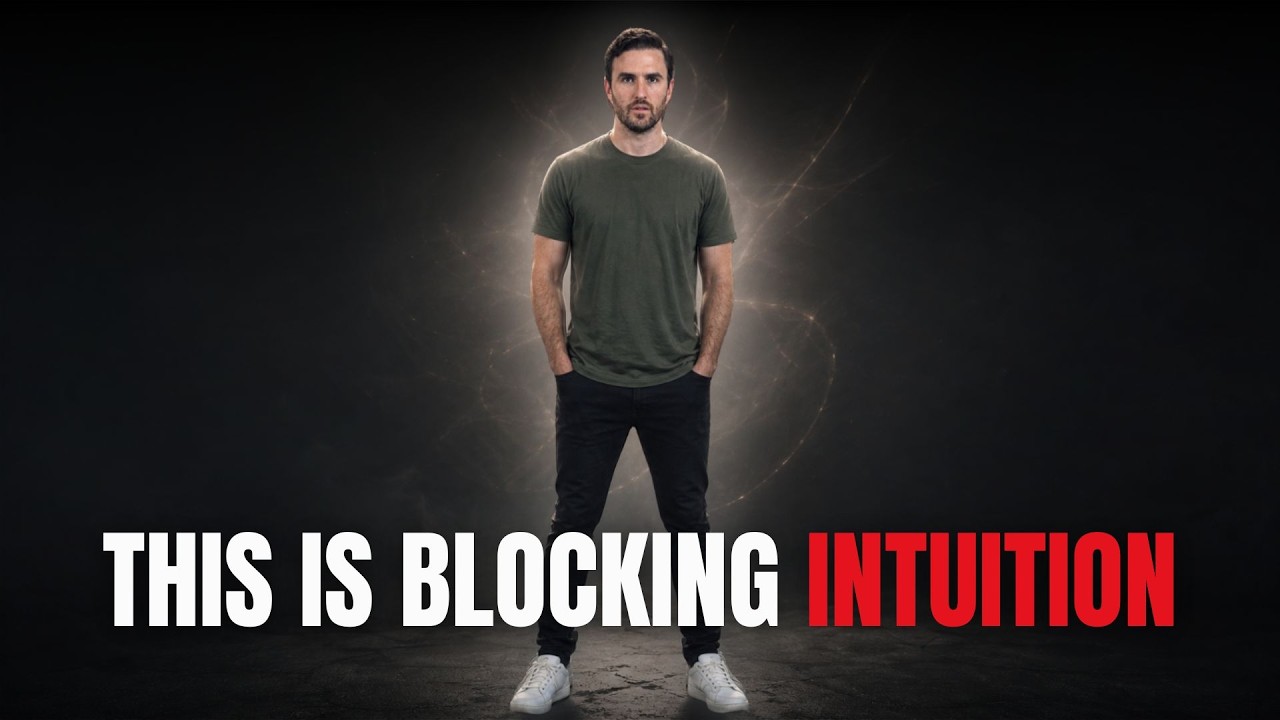
Video summary
The video explores the often misunderstood concept of intuition, arguing that it is not merely a mystical or unscientific notion but a powerful decision-making tool rooted in neuroscience. While society frequently encourages us to rely solely on logic and rational analysis, the speaker emphasizes that our gut feelings are actually physical responses generated by the enteric nervous system, often referred to as the "second brain." This complex network of over 500 million neurons located in the digestive tract communicates directly with the central nervous system and the amygdala, which processes fear. Consequently, a gut feeling is not just vague uncertainty but a real biological signal alerting us to potential dangers or opportunities that our conscious mind has not yet fully registered.
A central theme of the discussion is the dynamic between fear and intuition, described vividly as "fears screaming at you" versus "intuition whispering." Fear tends to be loud, logical, and focused on keeping us within our comfort zones by highlighting perceived risks, whereas intuition operates quietly in the background. The speaker shares personal anecdotes, such as quitting a high-paying job to start a podcast despite lacking immediate financial logic, which initially seemed crazy but made perfect sense years later. Similarly, trusting gut feelings about people often reveals red flags that logical observation misses until it is too late. The video concludes that while we should not blindly ignore critical thinking, we must give our emotional and physical signals equal weight to our rational analysis when making significant life decisions.
To develop and trust this intuitive ability, the speaker suggests practical steps centered on creating silence and quieting the mind. Since intuition whispers, it can easily be drowned out by the noise of constant activity, anxiety, and digital distractions. The recommended practices include meditation, breathwork, and simply taking time to sit in stillness without a phone or computer, such as staring outside while drinking coffee or thinking during a shower. By reducing external input and internal chatter, individuals can better hear the subtle signals their bodies are sending. Ultimately, the goal is to train oneself to recognize these patterns over time, allowing both the brain and the gut to collaborate so that actions align with one's true identity and desired life path.
Read the full video transcript
Your fears will scream at you and your
intuition will whisper. How do I know
what intuition is? How do I develop my
intuition? How do I follow my gut
feeling? But that feeling is still
really important and worthy of our
consideration. You've heard the phrase.
Trust your gut. Trust your gut, right?
And gut, feeling, and intuition I'm
going to use interchangeably today. But
you get a gut feeling about something or
you get a gut feeling about someone and
we've heard like trust your gut. And I
get it when you hear like trusting your
gut or your intuition or be intuitive.
It seems like it sounds mystical. It
sounds unscientific. It sounds real woo
wooy, right? And it doesn't really sound
like a great way to make decisions in
your life. That's the way I used to
think about it, too. But there's a whole
lot of research that's going into it, a
lot of recent research in neuroscience
and neurobiology that shows that like
this isn't just a theory. This isn't
just some woo wooy thing. It's actually
a fact to pay attention to that gut
feeling, to pay attention to that
intuition. In fact, it turns out that
your gut, your intuition may actually be
a really powerful tool for you making
the right decisions in your life.
Especially when it comes to assessing
people that you meet, like assessing
situations, opportunities, is this right
for me? Is this not right for me? Is
this relationship right for me? Is it
not right for me? is this this business
path and starting this business. Is it
right for me? Is this not is it not
right for me? And so often we're taught
in this this society that we live in to
re rely solely on intellect like what
what we think about it and and to be
rational and to be logic to make our
decisions, which those are definitely
important. And I've made a lot of
decisions based off of logic and being
rational and all of that. But very
rarely do we think to ourselves, maybe I
should trust my gut feeling. Maybe I
should trust my emotions. Maybe I should
trust my instinct. And the reason why is
because you kind of think like feelings
can be unreliable, right? Feelings can't
be trusted. A lot of people when you go
up to them and ask them about their
feelings, they can't attach their
feelings to a thought. They can't attach
why do you feel this way? I'm not really
sure. There's no logic behind it a lot
of times. And there's a a phrase that I
think is really important that I've kind
of lived my life by for a while. And the
phrase is your fears will scream at you
and your intuition will whisper. And so
it's like when you're thinking and
you're thinking, "Oh my gosh, I
shouldn't do this. I shouldn't do that.
Here's the reason why. What are they
going to think of me?" And you start
getting all these fears. You start
getting these limiting beliefs, all
these worries. That's your fear. And
your fear, which comes from your brain,
will scream at you. And the reason why
it does that is to keep you in your
comfort zone. Your intuition is like
this quiet little whisper that's in the
background. And this past week, I've
gotten this question around intuition
twice in the past three days around
like, hey, how do I know what intuition
is? How do I develop my intuition? How
do I follow my gut feeling? And this
question was popped up like, how do I
know what my gut feeling is? How do I
know my intuition is? But when you think
about this thing of like the heart
knows, but the mind cannot understand.
It's kind of like the gut, the intuitive
feeling, the pull that we feel towards
something. Sometimes we can't fully
comprehend in the moment why we feel a
certain way about a person or a
situation or whatever it might be. We're
not really 100% sure in that moment, but
that [snorts] feeling is still really
important and worthy of our
consideration. And we will be right
back.
Hey, real quick. If you're someone who
sets a goal, gets really fired up for a
couple weeks, and then somehow ends up
right back with the same habits that you
swore that you were done with, this is
for you. Listen to me for just a second.
It's not because you're lazy. It's not
because you don't have enough
discipline. It's because you're trying
to create a new life with the same
identity that you've always had. See,
you have to understand you will always
act in alignment with who you believe
that you are. So if deep down you see
yourself as somebody who quits, someone
who never follows through, someone who
always falls back into the same old
patterns, then you will keep proving
that story true over and over again. And
until you change that old identity
underneath it, nothing will change.
That's why on August 27th, I'm hosting a
completely free live workshop where I'm
going to show you how to identify the
patterns that have been controlling your
decisions without you even realizing it.
how to break those patterns and then how
to shift your identity so that the
actions that you want to take finally
match the life that you say that you
want. So, if you're ready for change and
you don't want to stay the old version
of you, go to 2026workshop.com
right now or scan the QR code that's
right here to save your free spot for
August 27th. So, go ahead, save your
seat and I'll see you there. And now,
back to the show. And that's the
important thing, which is logically it
might make sense. Like we've all done
this before where you meet somebody and
you're in front of them and logically
there's nothing wrong with them. Like
there's not anything there's not
anything offputting about them. They're
not saying anything wrong. They're not
acting wrong, but you get like a gut
feeling of like something's not right
about this person. And we've all done it
where you don't trust your gut feeling
because logically the the gut feeling
just wasn't making any sense. But it's
like I should trust this person. they're
good. They're not showing me that
they're going to screw me over. And
logically, it makes sense. And then
later on down the road, you find out
that there was something wrong with that
person. They screw you over. They did
something that that that you know was
wrong or offputting or whatever it might
be. And it's like, oh my god, I should
have trusted my gut. Have you ever had
that happen before? Like, I should have
trusted my gut with that person.
Logically doesn't seem to make sense. in
your intuitive gut feeling, it ends up
being correct later on down the road.
And so sometimes we can't fully
comprehend in the moment like why we
feel a certain way about somebody or a
situation, good or bad, but later on
down the road, it makes a lot of sense.
Like for me, when I started this
podcast, I had this feeling of like I
feel like I got to go all in on this
thing and I need to quit my job and I
need to go all in on the podcast. I need
to go all in on my coaching business and
grow it and grow myself. It didn't make
sense logically and a lot of people
thought I was crazy to quit my really
highpaying job when I was 29 years old
to go and start a podcast when there was
no money in podcasts. There wasn't the
there wasn't the Joe Rogan money in
podcasting back in 2015. There wasn't
the caller daddy money back in 2015.
There was like no money. But I had this
feeling of like I feel like this is what
I'm supposed to do with my life and I I
feel like I should at least follow it. I
should at least give it a shot. And now
when you fast forward almost a decade,
it's like, oh yeah, looking backwards,
it makes so much sense now. Now that
we've had over 350 million downloads of
the podcast, of course it makes sense.
But when you're sitting there at a
couple hundred thousand downloads a
couple months into it, you're like,
"This doesn't make sense." And so I
could have followed my brain and I could
be working at a job that I still hate
and maybe have just done the podcast on
the side. But now it makes sense why
that intuition was coming through and it
wasn't screaming at me. The fear was
screaming at me. I was terrified to quit
my job to follow this thing that was
screaming at me. My intuition was like,
"Hey, trust yourself. Trust this. This
is the way it's supposed to go." And so
it could be a good or bad feeling about
somebody or a situation, but it could be
a good or bad feeling about a
circumstance. starting a podcast,
growing a business, quitting your job,
whatever it might be, getting out of a
relationship, getting into a
relationship. And the good thing about
it is that now we can actually kind of
put some science to it. And research
shows that our gut feeling or the
intuition that we have is actually
rooted in our physical bodies. It's not
just out there in the this the ether
somewhere in the universe. Oh my gosh,
it's out there on Venus. No, it's not
like that. It's actually rooted in a
place that's called your ENS. It's the
entic nervous system and it's a network
of neurons that's actually located in
the walls of your digestive tract.
Neurologists refer to the ENS as your
gut and your second brain. And the
reason why they call it this is because
um they've actually found that there's
500 million neurons inside of your gut.
And so there's actually they call it the
second brain. And this was all published
originally in the journal of American
scientists in 199 1999 by professor of
his name is Michael Sherhan if you want
to know and he's a professor of anatomy
and cell biology at Columbia University
and he found that the gut functions as a
separate and independent nervous system
from your central nervous system which
is kind of crazy to think about right
you've got your central nervous system
and you've got the ENS which is a
separate and independent nervous system
from the central nervous system and That
nervous system has over 500 million
neurons and they call it your second
brain and it's located in the walls of
your digestive tract. And so this gut
feeling, this gut right there can
actually influence our cognitive
function and memory. If you want to go
down a rabbit hole, check out how much
the biology of your gut will influence
your thoughts, influence your brain, and
the bacteria in your gut will actually
make you make decisions. If you really
want to go down a rabbit hole, I just
don't have time to cover it today. But
your gut is this really complex system
that's capable of influencing both your
both your physiological and your
psychological processes. And this
communication between the ENS and the
brain is what they call birectional
which means that your gut can influence
your brain and your brain can influence
your gut. So they kind of go back and
forth between the two. And this is why,
and this is why it's really important
that you often experience physical
sensations in your stomach when you're
nervous or anxious or excited. So when
you have butterflies in your stomach,
that is actually your gut, your second
brain, 500 million neurons that are
actually communicating with you in some
sort of way. And so we could be like,
"Oh, I've got butterflies. That's so
nice." And not pay attention to it. We
could be like, "Oh, I've got
butterflies. What's this trying to tell
me?"
And so what's interesting about the gut
is that the gut is also connected to the
amygdala. And if you know anything about
the brain, if you've heard me talk about
it before, the amygdala is the main part
of your brain that processes fear. And
this [snorts] part of the brain that
processes emotions and also plays a
really key role in your fight orflight
response. This means that our gut
feeling is not just some vague sense of
uncertainty or nervousness or unease,
but it's actually a real and physical
response to a perceived threat or
opportunity, which means that your body
is always trying to talk to you at some
point in time. The question is, are you
listening to it? Are you taking a step
back? Are you being quiet? Are you
giving yourself a moment to process
like, okay, how do I feel about this
this situation? How do I feel about this
person?
And actually, when we get a gut feeling
about someone or something, we should
pay attention to it because it may be
our body's way of alerting us to a
potential danger or to a potential
opportunity. And it's it's alerting us
to it because our conscious mind hasn't
registered it yet. And so it's really
important to use your logic when making
decisions. Of course, your brain, but
it's also really important to use your
feelings and your emotions when making
decisions. And studies have actually
shown that people who trust their gut
instincts often have a better
opportunity of predicting outcomes and
making more accurate judgments even
though they don't have all of the
information. It's pretty wild to think
about it. There's studies that have
shown that people who trust their gut
instincts are better able to predict
outcomes
and make accurate judgments.
That's pretty crazy if you think about
it. So there's studies that have been
showing that if you trust their gut,
they make better outcomes. They make
better decisions. They make more
accurate judgments even though they
don't have all the information which is
like can your gut kind of see into the
is your body like Nostradamus? Is it
kind of seen into the future and we
should pay attention to it more? Now I
want you to say like this is not saying
that we should just blindly follow our
gut instincts and not have any analysis
or any critical thinking. What I'm
saying is we should give both our brain
and our body and our gut and those
feelings that come from our gut the
exact same weight as we would rational
analysis in logical decisionm.
And so we can use both of them to make
decisions. And I think both of them are
important and this is something we can
train ourselves to get better at. So for
me, it's not something that I meant to
do over time, but as I started
meditating more, as I started getting
more quiet, as I started to trust myself
a little bit more, what's interesting is
that I actually started getting really
good at making intuitive decisions. And
even my wife, like if you ask her, she
said it to me many times. She's like,
"Yeah, like you have you have a really
strong gut feeling." And if she's even
said, if you get a really strong gut
feeling about something and it doesn't
make sense, I will trust you with it
because it's been shown over and over
again in our relationship, like this gut
feeling actually is something that kind
of seems to predict the future. And we
do that with each other where she has a
really strong gut feeling where I'm
like, "Hey, what does your gut say about
this? What does your body say about
this?" And she's like, "It feels like
this." I'm like, "Okay, I can trust
that. I can trust that. We can see how
it goes." So, it's something that we can
train ourselves to be better at. Our gut
feelings can be honed. They can be
refined through practice, through
self-awareness, and by paying attention
to how our body responds to different
situations in different people. And so,
even the other day, our um you know,
like uh we had something that happened
with the baby and and Lauren started
getting really worried and I was like,
"Hold on, let me check in real quick.
Let me just let me get quiet." And I got
quiet and I was like, "I don't feel any
fear. I don't feel I feel don't feel
like there's anything that's going to
come of this." And she was really
worried about this situation and I
wasn't. and you know weeks down the road
end up being nothing. But I like checked
in with my body and I was like is this
something I really need to be hardcore
and worry about. And obviously I get it
like that sounds kind of weird and woo
wooy like this is it wasn't like a a
massive safety thing for our child. That
would have been different but it was
like I feel like this is safe. I feel
like this is okay. I feel like there's
nothing wrong here. I feel like we're
going to be okay. And we just learn to
kind of trust that. If my body's like
there's something wrong, there's
something wrong, then I'm going to trust
that as well. And so we can learn over
time, like this is something I've been
trying to hone and trying to develop
for, you know, 12 years at this point.
We can learn to kind of recognize
patterns and signals um that that kind
of say, "Hey, you're safe." Or, "Hey,
you're not safe." And those signals may
not be apparent to the conscious mind
immediately. And so it's the exact same
example I was given at the beginning,
which is like you might have somebody
that they come into your life, they seem
like the perfect business partner, they
seem like they're really good with
money, it seems like they're really good
with marketing, and they're like the
perfect fit to your business. And you're
like, I need to bring them on to my
business partner. And then six years
later down the road, they leave with all
the money in the business. You're like,
damn it, I knew it cuz I had that
feeling when I first met him. Like I
feel like there's something wrong with
them. But logically, it didn't make any
sense. It's the exact same thing for
like what I was saying with the podcast.
It didn't make any sense, but now it
makes sense. And so, what I really want
you to understand is like don't dismiss
it as irrational or unscientific.
Instead, like try to really take a step
back and consider it as a piece of
information that can help you make
better decisions. You can use your brain
and your gut to make better decisions.
And so, remember that your gut feeling
is not some random emotion or anything
like that. It's a physical response
that's deeply rooted in our bodies and
our minds. Your mind is picking up on
something. Your mind is getting
something from somewhere, I don't know,
from another person's body that's
sending the saying, "Yes, this is good."
Or from the other person's body saying,
"No, this is not good." And it's
something's in resonance or it's not in
resonance. And so the thing that's
that's super important about it is that
like I said, a lot of time it doesn't
make a lot of sense, but usually it
makes sense later on down the road.
Later on it makes sense down the road
more than anything else. And so the the
question I always get from people is
[snorts] how do I develop my intuition?
How do I get better at finding my gut
feeling? How do I get better at it? And
I think the most important way to do it
is to shut up, right? Like do less. Be
quiet more. Give yourself some more
space. Because if it if it is true, if
your fears scream at you, but your
intuition whispers, well, then I need to
get myself to be quiet. I need to
meditate more. I need to do more breath
work. I need to give myself more moment
moments of silence. I need to give
myself 45 minutes in the morning to
drink my coffee and stare outside and
just start to think about life and see
if maybe there's a little bit of a
whisper that comes through, a little bit
of an idea. My best ideas come when I'm
doing nothing. That's why a lot of
people's best ideas come when they're in
the shower. Not even when they're on the
toilet anymore because people on their
phones were on the toilet. But your best
ideas come in the shower. Why? Because
you're quiet. Because you're sitting
there. You don't have your phone with
you. You're not talking to anybody.
You're not at your computer. But it's
like you give yourself those moments,
those little gaps of space. And that's
usually that's where I believe those in
silence is where God or the universe or
your higher self, whatever you want to
call it, communicates with you through
feelings, through a little bit of an
idea that pops into your head. And so I
want you to think about this like think
about like really hone this in in your
in your own brain, your own body. When's
a time when you didn't listen to your
gut feeling and it backfired? Can you
think of one time? And then when's a
time when you did listen to your gut
feeling and you end up being ended up
being right. And so I want you to
understand like there's a lot of science
that's starting to show and I I believe
over the next few years there's going to
be more and more and more science that's
going to show this. But when you want to
make a big decision, I think it's really
important to check in with your logic,
with your brain, and check in with your
gut and your feelings and your emotions
and use both of those two to make the
best possible decision that you can for
yourself. Hey, thanks so much for
watching today's video. If you love this
video, click this one right here. this
is the one that you need to watch next.
And if you want to make sure you don't
miss any more of these episodes, click
that button right there.