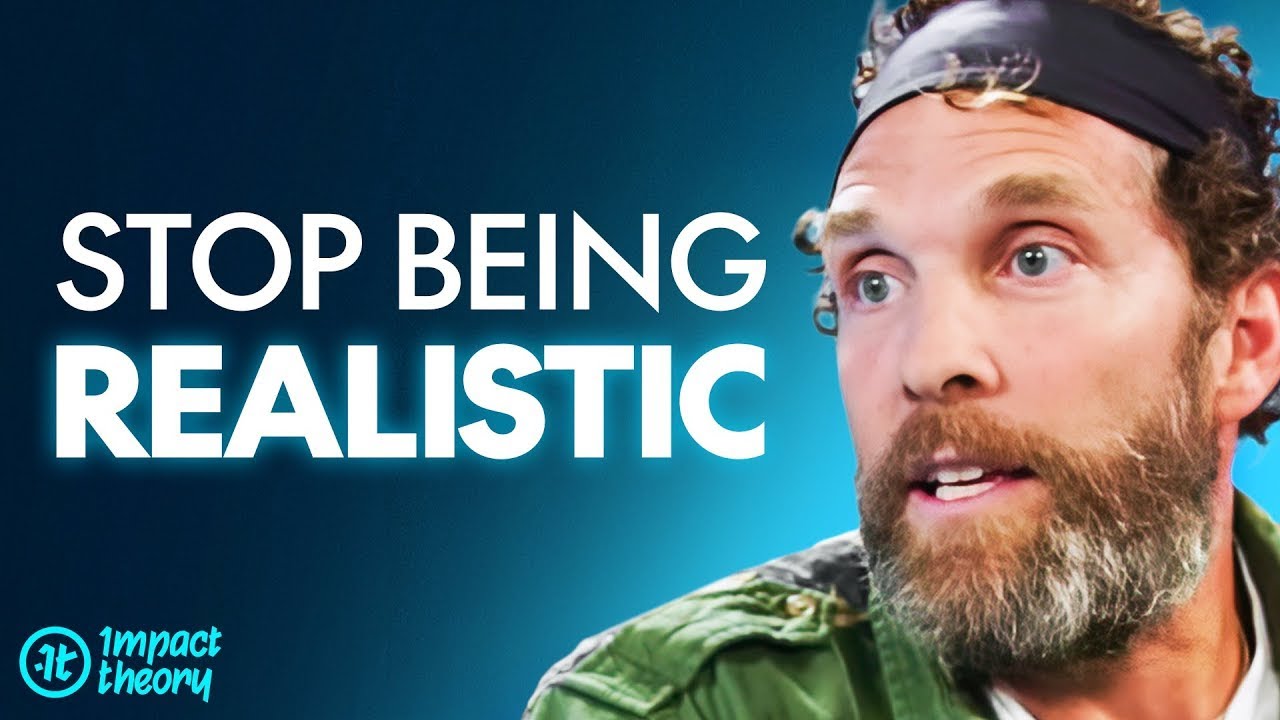
How to STOP BEING REALISTIC and SHOOT FOR THE MOON | Jesse Itzler on Impact Theory
Watch on YouTubeVideo summary
Jesse Itzler, a New York Times best-selling author and entrepreneur with a net worth in the hundreds of millions, joins Impact Theory to redefine success through his unique concept of a "life resume" rather than just a traditional work history. Despite having no formal business training or family connections—having scored only 980 on his SATs while peers broke 1200—itzler built an empire spanning travel (Marquis Jet), food and beverage (Zico coconut water sold to Coca-Cola), music, and sports ownership. His journey is characterized by extreme risk-taking and fearlessness; he launched Marquis Jet after being rejected from NetJets for twelve minutes before using a creative strategy involving muffins at the TED conference to secure his first sale. Itzler emphasizes that experience takes too long in an adrenaline-fueled world, advocating instead for getting one's foot in the door quickly and figuring out the rest later through tenacity and cleverness. A central theme of the discussion is the importance of managing time with urgency due to mortality awareness. At age 50, Itzler realized that if he lived an average life expectancy, he would have only about twenty-eight years left, a realization that shifted his perspective from feeling invincible to appreciating every moment. This mindset influenced his decision to live in a monastery for fifteen days with Russian Orthodox monks who were also master dog trainers. The experience taught him the value of simplicity and eliminating "time zappers"—minor decisions like choosing between cars or worrying about irrelevant details—that drain energy. He learned that growth often happens only during the final five percent of a challenge, after most people quit when they hit their wall, mirroring how dogs must remain focused on point B despite distractions thrown at them by trainers. Itzler also shares personal anecdotes regarding his marriage to Sara Blakely and his own emotional development. He recounts an early incident where he mistakenly thought the conversation with a fan was about him rather than her wife's success, highlighting his role as a supportive partner who celebrates others' achievements despite the loneliness of entrepreneurship. Regarding self-awareness, Itzler admits that for years he could not identify his feelings when asked by Sara, using running and meditation to process emotions instead. He describes how living with monks helped him understand that one must stick through discomfort without looking for "Cliff Notes" or shortcuts, a lesson reinforced by the dog training exercises where animals remained unblemished despite constant distractions like pork chops thrown at them. The conversation concludes with advice for young entrepreneurs and individuals seeking to manifest their dreams. Itzler stresses attaching oneself to something one loves rather than chasing money alone, noting that passion must be found in both the product and the process because shortcuts cannot build a brand or wealth effectively. He encourages taking real risks where bigger rewards await, while maintaining focus on long-term goals over immediate thrills like roller coasters. His ultimate mission is person-to-person impact, urging listeners to pledge actions for their own life resumes and take them immediately. By building a legacy of experiences with loved ones rather than just accumulating wealth, individuals can ensure they maximize the limited time available before aging or unforeseen circumstances intervene.
Read the full video transcript
The people that you meet in your 20s
rise up in their 30s and are in great
positions of power in their 40s. You
don't know when you're 20 in your 20s
who's going to who's going to make it
and who's not. So, you know, you treat
everybody properly and respectfully and
you stay in touch. And very often those
relationships merge their heads years
later, decades later.
Everybody, welcome to Impact Theory. Our
goal with this show and company is to
introduce you to the people and ideas
that will help you actually execute on
your dreams. All right, today's guest is
a wildly successful entrepreneur with a
net worth measured in the hundreds of
millions of dollars, but trying to
understand him by his financial success
would be to entirely miss the mark. What
makes him fascinating isn't just that he
managed to turn a 900 on his SATs and no
formal business training into a business
empire that spans travel, food and
beverage, music, and even sports. It's
that he has one of the most fascinating
life resumes on the planet. Here are
just a few of his highlights. He's a
former MTV rapper who used to be
labelmates with 80s hip-hop icons Tone
Loc and Young MC, and despite being
white, he convinced said record label to
listen to his demo by first pretending
to be a well-known black rapper. He
co-founded and built the world's largest
private jet card company Marquis Jet
with no previous experience in aviation,
and when he launched it, he got sales by
hoarding muffins. I'm not kidding. He's
rented an entire mountain, hired a Navy
SEAL to toughen him up, turned his
failed career as a rapper into a
successful company writing theme songs
for sports franchises, and now he's
actually a co-owner of an NBA franchise
himself. He helped launch the coconut
water craze with Zico, which later he
sold to Coca-Cola, and he's run 100
miles in a single day. He's also climbed
the vertical equivalent of Mount Everest
over a weekend and actually summited the
most deadly mountain in the US, Mount
Washington. In short, this guy does not
take the easy road anywhere and he's
proven that fearlessness and tenacity
count for a lot more than experience or
family money. So, please help me in
welcoming the New York Times
best-selling author of Living with a
Seal, the man who introduced the world
to the legendary David Goggins, the
author of the upcoming Living with
Monks, Jesse Itzler.
Thank you. Thank you. Thank you. Thank
you. Yeah, my pleasure. That was an
amazing intro. Your life is crazy.
Absolutely crazy. And this whole concept
of the life resume, you really sucked me
in and I I had written an original draft
of the intro where it was my more
typical like he does this and then this
and then this. And I thought that's
really to miss the point. And so, let me
start over and really look at it from
that resume perspective.
Right. And the crazy like broad stuff
that you've done, almost always with no
experience, is really pretty incredible.
When did you start thinking about that?
Well, I realized that experience takes
too long. Takes I don't have I don't
have enough time for everything I want
to do to get experience.
Um no, I just realized that I'm an
adrenaline junkie. I love newness. I
love challenges. I mean, that's what
makes me feel most alive. And I
discovered that early on when I was
trying to get a record deal and just
getting rejection and I didn't I had no
connections. My dad owned the plumbing
supply house in Long Island where I grew
up and we weren't connected to the music
world. And I just loved the thrill of
trying to do what everyone said I
couldn't do. Mhm. There's no way you can
you know, and every All my roommates in
college were writing their resumes and
sending it out to all the companies.
They're like, why aren't you writing
your resume? We're all like typing our
resume. Why aren't you working on it?
I'm like, cuz I'm going to get a record
deal. Obviously. When they said no, you
can't, it just fueled me more to
want to go out and get it. So, in that
moment and if you can get people to
understand this, like you will help so
many people break through.
Because it is that moment where people
tell you that you can't do it and you
don't just thrash and say watch me,
watch me. You really go out and do it
and get really clever about it. And so
there's two stories to me that parallel.
There's the muffin story and how you
launched
Marquis Jet, which I thought was
absolutely fascinating. And then there
was how you talked your way into getting
the record company Delicious Vinyl
Yeah. to listen to your demo. Sure. So,
well the Marquis Jet story, you know, my
partner and I were guests on a private
jet when I was 27 or 28 years old. And
when we walked onto the airplane, it was
like the scene in The Wizard of Oz when
everything goes from black and white to
color. Like people fly like this. This
is unbelievable. I want to fly like
this. And when by the time we landed,
we're like, let's start a private jet
company, you know, like definitely, you
know, so we could fly privately. Except
we had no airplanes. So,
we went to a company called NetJets
owned by Warren Buffett, the 800-lb
gorilla. They had 600-plus airplanes in
the fleet and pitched this idea for a
25-hour prepaid jet card, which was
called Marquis Jet.
How'd you get that interview? Like that
time with them? Oh, it's a crazy story.
You know, I had a friend of mine who
called me up and um
prior to that I was putting experiences
together for wealthy people. Like
impossible to get experiences. And a
friend of mine called me up and said
that he had a friend whose daughter was
turning 16 and he wanted to do something
at the Christina Aguilera concert. And I
happened to have a relationship with the
management company and I got his
daughter on as kind of like a backup
singer kind of thing with the mic off.
And the guy called me up after the
concert like the next day. She was the
star of the town, you know, everyone was
talking about it. And he was like, I've
no idea who you are or what you do.
But if you ever need anything, call me.
Like that was amazing what you did for
my daughter. And it turns out he was the
president of this company called NetJets
that owned all these airplanes. So, a
year later when we had this idea, I was
like, I I I know someone in this
business. You're like, the guy that we
had sing his daughter sang at the
Aguilera concert. And that's how we got
the meeting. Wow. But the meeting
actually, when we pitched the idea,
the meeting lasted 12 minutes and they
they threw us out. And the president of
NetJets said, and this is almost a
direct quote, he said, you know, cool
idea, but if you think we're going to
give two kids that didn't break a
thousand on their SAT, which Tom pissed
me off. I got like a 980, but I've
convinced myself I've gotten over it.
You're like, keep telling yourself you
broke a thousand. He's like, I'm never
giving you guys access to our our
airplanes. Cuz the the notion was if we
could sell and market onto their fleet
through this 25-hour program called
Marquis Jet, that's how we would
piggyback off their airplanes. And they
threw us out of the meeting and then
we were relentless and we came back and
we
we realized that we couldn't sell this
concept through a PowerPoint because
they'd seen
they'd seen a thousand PowerPoints a
month. So we literally brought our own
focus group in
to bring the meeting to life. And one by
one the guys stood up. We had Carl Banks
from the New York Giants and Run from
Run-DMC and a powerful real estate mogul
and and they explained that they would
never buy a fraction what NetJets was
selling. But they would buy a 25-hour
card if it was offered. And and that's
how we ended up
solidifying the opportunity. And then to
your point, when we started the company,
you know, this is back in 2000. So there
was I had no sophisticated way to get
leads. I didn't know a lot of wealthy
people. And the only way that I could
really build my database or sell anybody
was to go to events
where rich people hung out. So I heard
about this conference called the TED. I
didn't even know what it was in
Monterey, California. So I flew
commercial, you know, transferred three
flights, drove six hours when I landed
to get to TED to try to pitch this idea
to anyone that would listen. But when I
got to the TED conference, it was like
Fort Knox. Everybody had credentials,
double credentials, and I had nothing.
And they wouldn't let me anywhere near
the venue. So, I went to the local
coffee shop and just trying to figure
out how I'm going to get in or sneak in
or get someone to get me in or get
access. And I realized like every hour
or two, everyone with credentials
was walking into the coffee shop, and
they were buying lattes and muffins, and
lattes and muffins, and lattes and
muffins. So, the next morning, I woke up
at at 5:00, and I went to the coffee
shop, and I bought every single muffin
that they had. I took all the inventory
out of the shop. I'm like, "I'll take
all your muffins." They gave me like 80
muffins. And I was sitting, and then
when the first wave of TED
attendees, you know, broke for their
break, and they came, one of the
customers said, "Um, you know, can I
have a latte and a muffin?" And the guy
said, "Well, I can give you a latte, but
we're all out of muffins."
And when he was walking out, I said,
"Excuse me, sir. You know, look, I
I happen to have an extra muffin. I've
actually have 800 of them, you know, but
if you want a muffin, um, you can have
one of my muffins." He's like, "No, get
out of here." I said, "No, I said,
"Really?" I said, "We started Well, what
do you do? What are you doing here?" We
started having a conversation, and he
said, "You know, do you mind if I join
you?" And I you know, my only thought
was like, "You're qualified to buy a
card, you can join me." And he was my
first sale.
He was my first sale. A guy owned a a
company that sold it to eBay.
And, um, that was the start of the
adrenaline rush of, "Okay, let me try to
crack this code of,
you know, how we can build this thing
with um
not a big database." How do you
teach somebody to look for those
opportunities, to create those
opportunities? Because everyone's going
to hear the no, but 99.99999%
of people just accept it. I think it's
different. I think when you're young,
the consequences don't matter as much.
You know, you're just thinking about the
end result. It's a little bit different
now. I have four children, and I don't
think I could take the risk necessarily
that I did when I was 21 and living
check to check.
But at that point the consequences
didn't matter. If I had to get thrown
out of the TED conference or whatever,
it it
it didn't really matter. I would just
try again.
But um it's always been having for me
it's been probably similar to you when
you started your business, but it's
always having the end of the movie in my
head
and then filling in the script. So I
knew I was going to leave there with a
sale. I just had to write the script and
the script might change. There might be,
you know, call an audible and you have
to rewrite the script, but the end of
the script was always the same.
I'm going to run 100 miles.
Okay, well how are you going to do that,
Jesse? You know, like you've never
you're not like a crazy endurance
runner. Well, then let's think backwards
of how, you know, but it starts with the
end scene in the movie. Even the exit.
You know, like okay, we're going to
build this to sell. I don't know who I'm
going to sell it to.
But that's sort of been always kind of
the mentality and I think the second
point to that is once you get over the
fear of being embarrassed you know, no
no one likes to be embarrassed.
But once you get over being scared of
being embarrassed, it's super
liberating.
And it allows you to go into lanes that
you otherwise you wouldn't go into.
And everybody's wired differently.
You know, everybody's wired completely
different. It's hard to rewire someone
to take to be, you know, comfortable
taking risks, comfortable with being
embarrassed. And I think it comes from
having a lot of egg on your face
and learning along the way. You've
talked about I like to get my foot in
the door and then I'll figure out the
rest later. How have you not let I don't
know what I'm doing stop you?
It takes a long time. You know, that
it's a fast world. There's a it
build into that learning curve for me,
um 980, it takes a lot of time and I
just never had that time. I'm I'm
so I've always been like let me get my
foot in the door
and I will figure it out. I will hire
people that can help me figure it out. I
can go to experts
to help me.
But they usually won't help me get in
the door. Mhm. So, let me take the first
step. And then once you have momentum,
you can ride the momentum. So, that's
always been my MO, you know? It's always
been
um in everything. You mentioned Living
with the Seal, you know, when Goggins
came, all that stuff. It's just been
like welcoming the unknown and being
open to whatever
comes of it and learning from it.
So, let's talk about then the the
networking that you've done because the
the amount of places you've been able to
get your foot in the door are pretty
impressive. Have you done things
strategically knowing like
this is going to help me meet people
that could potentially one day
open a door for me somewhere. Yeah, I
mean, well, networking's been a big part
of my life forever. When I was 24 years
old, I wrote 10 letters a day, thank you
notes, to anyone that came into my life
that impacted me. And it could be even
if I didn't know you, but I saw your
show and I was like, you know what?
Tommy, you've had some amazing guests
I've really benefited from. I would just
write you a handwritten note because
one, the handwritten note shows intent.
You have to buy the envelope, buy the
stationery, write the letter, lick the
envelope, get the stamp, put it in the
mail. That's a lot different than
hitting send. Mhm.
It's also memorable. How many
handwritten letters have you gotten this
year? So, I would I literally wrote
3,000 letters
in 1 year. And it could be to a doorman,
cab driver, it could be anyone. I would
just get their card and I would thank
them. That was my form of networking the
even to this day.
I have a hot 50 list that I of 50 people
that can help me, that I want to stay in
touch with,
um that I make sure every quarter or so
I send them a note. And I they always
comment on it, you know? Like, thank you
so much and it's and it's authentic.
It's not I'm not just writing it to
write it. I mean, they have to really
have had an impact on me and I have and
it's a meaningful note. It makes me feel
great.
And it makes the recipient feel
attached to me in a different way. You
know, at an early age, I understood the
importance of that. The people that you
meet in your 20s rise up in their 30s
and are in great positions of power in
their 40s. You don't know when you're 20
in your 20s who's going to who's going
to make it and who's not.
So, you know, you treat everybody
properly and respectfully and you stay
in touch. And very often those
relationships merge their heads years
later, decades later.
Well, that's really incredible. One
thing that I find really fascinating and
super effective about your personality
is you'll capitalize and move quickly on
serendipity. So, um this audience knows
David Goggins very well. Uh he was a
phenomenal guest on the show.
But what I love in your story is you see
him running next to you, you see that
moment that's really become a core part
of his story where he's got the broken
feet, but he still runs the remaining 30
miles, but you reach out to him
afterwards and actually make something
of that. What was that process like for
you and why is that a thing for you to
to really you see something you move on
it?
Yeah, I think well, with Goggins, you
know, this is was his first
hundred-miler. And I was doing it as a
relay race. So, I was doing it with five
friends. He had no one to relay with.
Like he was his only friend at the race
and he was his own team.
And immediately I was drawn to him
because, you know, he was a super He was
heavy set at the time, really muscular.
And I was thinking like, how's a guy
that weighs this much going to run His
goal was 100 miles, you know, and he had
no supplies. You know, it was It was a
self-supported race. You had to bring
all your own supplies. I just sold my
company to Warren Buffett. I had like
way overdid our supplies. I had like
masseuses and a Whole Foods truck pulled
up, you know, and like Goggins had a
glass of water, a box of crackers, and
like, you know, a chair.
At mile 70, he went through this
he had crushed his feet, you know, he
broke several bones there.
And um
I watched him get up and continue on,
and I was like, what the
is going on here? And when I was done,
I'm like,
I got to meet this guy because and no at
this time he was relatively
unknown, you know, I mean this is 2007,
six or seven, I think, something like
that.
And um I wanted to meet him because
whatever drive
whatever got him off the chair and said,
I want to keep running.
If I could teach that to my kids or to
my employees or to myself,
like I want that secret sauce.
And initially, you know, um
I went out because I saw a lot of star
power in him. I saw just a whole just
different world, you know, he
represented something I never really
seen before.
And I realized that I wasn't going to
get that secret sauce through a
friendship or at a lunch meeting or this
and that. And then I asked him to come,
you know, would you come live with me?
Um
And uh
basically said, uh
"If you're crazy enough to ask a guy
like me to come, I'm crazy
enough to come." And came came to my
house. That's awesome. I love that. Is
that something that you do with
frequency to you'll see something, be
curious, be interested, and do more than
just the, you know, the casual hey, it's
nice to meet you? It is. I mean, if I
saw if I find someone that's inspiring
or an event or something, I try to
introduce he, she, or it to my life.
And that's part of just my own personal
development, you know, I learn better
through experience than through books.
Mhm. I like to be challenged, and I love
interesting people. I I like people that
are think differently, that act
differently. That's what attracts me.
That's just what makes me feel like I'm
getting the most out of life, you know?
And that is I'm on a constant search for
that cuz I'm very aware of my own
mortality. You know, I'm 50 years old.
I'm turning 50, and the average American
lives to be 78. And if that were the
case and I was average, that means I got
28 years left.
Mhm. And that dictates, well, who do I
want to spend that time with and what do
I want to do?
And that's a driving, you know, it's
like on repeat in my head.
So, to answer your question, you know,
that's that's sort of what makes me
tick.
And you've got a pretty deep obsession
with that. At one point, I think you
were writing the number of days that you
had on your wrist or something like
that.
doing that. Why'd you stop? I'm curious.
Um I'm just so aware of it now, you
know, um
uh it was starting to freak my wife out
a little bit.
Uh it's a little depressing, but for me,
it's not depressing.
Mhm. It's like, you know, I think
people's relationship with time, we talk
about relationships with humans. How's
your relationship with your kids? How's
your relationship with your wife? You
know, your dad or your parents. But we
never talk about our relationship with
money and time.
And the relation your relationship with
time is such a key component of your
life because when you
get caught in a routine, time goes so
quickly. When you understand
that there are maybe only 28 summers
left, and if you want to truly, you
know, get as much out of experientially
out of life, it just creates a
tremendous amount of urgency.
So, uh and the fear goes away.
Because you're like, man, nobody
on the planet like everybody no one's
going to be here in 100 years. Do I care
what he thinks? Like he's not even We're
not going to even be here in 100 years.
So, why wouldn't I take the chance?
And it's just I don't know. It's just so
I stopped writing it because I'm so
aware of it. There's not a day that goes
by when my head hits the pillow where I
don't say to myself, like, you know, did
I maximize the day and am I am and you
know, am I aware of
my mortality? And it might sound
depressing, but it's it's not. For me,
it's um it's thrilling.
It's thrilling. That does not sound
depressing to me at all. I think I'm
utterly fascinated by people that are
really trying to get the most out of
their life humanly possible. And knowing
that you're one of those people,
the obvious question to me becomes why
are you so obsessed with doing the hard
things? Like if you know you only have
28 summers as you said, why are we doing
polar plunges, running 100 miles? Like
what is it about that drive to encounter
not only the novel, but the incredibly
difficult?
I mean, I think easy's boring isn't
isn't easy answer to that. I think that
it goes to your point of building your
life resume. You know, we spend we
invest so much time in our work resume,
which is important, but I think it's
equally if not more important to build
your life resume because that's really
an indication of who you are and what
you're becoming. And that's really a
true uh look into your true body of
work.
How is your obsession with time and um I
guess anything else that led you to do
what you did with the monks? So,
what did you do? What drove you to do
all of what were some key takeaways? So,
uh I lived in a monastery with uh eight
monks, four of which have been there for
50 years.
And 50 years.
And um I went there for 15 days. I
think, you know, the obvious takeaways
were just the simplicity of how the how
how the monks live uh is something I
think everyone can benefit from. I
realized
immediately
you know already what you're going to
miss.
You're
your family and your kids and your
friends and some of the comforts. You
know, I I don't want to give away some
of the comforts that I had. But you also
realized how much at least I did in my
daily life, how much time I spend and
worry I spend on things that are
irrelevant. And when I released when I
released that, I got so insanely
creative and had so much energy
because like thoughts, worry, all that
it's exhausting.
I remember when When when I came home, I
said to my wife, um we were doing
carpool with our kids, and she was going
to take you know, with two cars and
she's like, I think I'll take the blue
car. I'm like, cool. And then she came
back and she's like, I'm going to take
the silver car. I'm like, okay, sweetie,
take the silver car. And then she came
back 30 seconds later, she's like, you
know what?
I want to be able to park it. I'm going
to take the blue car. I'm like, great.
Take the blue car. And then I was like,
do you know how much energy you just
used on something that's like completely
But it happens all day long and you
don't even realize how much energy you
use on like at the monastery, all the
decisions are taken away. So, what you
eat, you eat whatever they give you.
What you wear, nobody can I changed
once. I took one shower.
It just was super freeing. So, I left
there incredibly energized. And
and I surrendered a lot of things in my
life that just I didn't realize, you
know, are time zappers.
Uh and that might sound obvious, you
know, like, oh, you went to a monastery
and you realize, but it wasn't about
meditation, it wasn't about
so really religion or spirituality. It
was just about um
simplifying and prioritizing and
realizing like what's
I already know what's important to me.
But realizing like to eliminate some of
the things that really aren't important
to me and taking away those precious
hours.
What I found really interesting about
the book, and by the way, the structure
of the book is phenomenal.
Um the way that you invite us in to you
having trouble writing the book and that
we're experiencing with you the meeting
where you have to explain, I haven't
written the book and it's supposed to be
done and and then as you're reading,
you're like, wait, I'm actually already
in the book. So, it was like this sort
of adaptation, if you ever saw that
movie. It was really, really
interesting. And I'll just assume this
was intentional, but the very structure
of the book had that same sense of
dropping inside of your mind
that I imagine is exactly what happens
when you go to a monastery and there are
no distractions and suddenly it becomes
about what I'm learning about myself.
And I could I don't think you ever
actually said it in the book, if I
remember right, but the the sense was
that the struggle in writing the book
came from
I was looking for the universals that
were so present in Living with a Seal,
and I found only myself in that. And so,
how do I pull forth the the universals
by telling these incredible stories?
And that was really, really cool. And
one of my favorite stories was um Mrs.
Sara Blakely.
And it it's just a really cool story.
Walk people through that because
it got to the heart of something that I
think
a lot of people struggle with.
And your ability to both be the the top
dog in a scenario and to be a
cheerleader is is pretty remarkable. Um
so, tell that story if you don't mind.
I mean, you know, to that point, I'll
get to the end first. It's a key
component of a marriage is sharing in
each other's successes and rooting for
each other. And when the star shines on
someone, you celebrate it, and then the
other person, you know, they you your
partner celebrates it. And um and being
on the same page. And and for a guy,
that could be difficult if you're
married to
a gal that's in, you know, um
that that has a light shining on them.
But I was at a restaurant, and my wife
was running late. I was with my trainer,
a friend of mine. And there
I didn't know the spot with this woman,
but there was a girl at the other table,
attractive girl, who I thought was was
kind of like looking over the table. Cuz
she was kind of staring at me, and it
was a little uncomfortable. And I told
my friend like, you know,
I think this girl's like checking me
out, man. I I don't think I don't know.
I'm not sure, but like, will you look
over there and see if she's looking at
me? And he looked over, and she's like,
"She's checking you out." And um you
know, we started laughing about it. And
and uh and then she came over to me,
super attractive girl, and
um
I thought she was going to say like,
"Can I join you?" whatever, and then she
said,
"Are you Sara Blakely's husband?" And um
he, you know, he laughed and this and
that. And I said, "I am Sara Blakely's
husband." She said, "I'm a huge fan of
your wife." You know, like the whole
thing was about Sara. And I thought the
whole thing was about was about me.
Um and I write about that in the book,
you know. Uh um but that that's what
happened and it was uh it's a funny
moment, you know. But I was I'm so proud
of my wife, you know, and I'm her
biggest cheerleader. And that's part of
my job as a husband is to support her
through the ups and there's a little bit
of knock on wood a lot of ups, but also
plenty of downs. You know, being an
entrepreneur and and um is lonely.
You know, you went through the journey,
man, it's lonely. And um
nobody worries about it when you're the
founder like you worry about it. And you
can give out shares and compensation of
this and that.
But, you know, it's Tom's bar, man, you
know? And um so, there are times where
you have to be super supportive and and
understanding. And being an
entrepreneur, I'm very aware of that.
So, I think it's a good it's a good fit.
So, another thing you talked about in
the book was that you actually in the
early days of your marriage, you guys
would argue a lot cuz Sara would ask
you, you know, "What are you feeling?"
And you'd say, "I don't know." And she
finally had this epiphany where it's
like, "He really doesn't know what he's
feeling." Yeah. And what has it been
like for you to learn to really be
introspective and to understand your
feelings? Cuz at least from the outside,
and especially having read the book, it
feels like you've gotten to a place
where you're very in tune with yourself,
with your intuition, which is another
thing we should talk about. But like
what was that process like? Yeah, I
mean, Sara would ask me for years. She'd
be like, you know, "Sweetie, how does
that make you feel?" And I would say,
"I don't know." And she'd say, "Well,
you know, something
would happen." Like a big event would
she'd be like, "Well, what are you
feeling?" And I would be like,
"I really don't know." You know, like
and I really didn't know. And she would
get angry at me. She'd be like, "What do
you mean you don't know?" I'm like, "I
don't know. I'm like, you know, I don't
know
what's going on the hockey game." You
know, like I would just deflect it. And
um she finally realized like I really
don't know.
And
um
maybe that was a defense mechanism for
me. I don't I don't know. And I like to
stay super happy, you know, and um
upbeat and and
blow away some emotions that maybe but
through this journey through the
monastery and through Sarah's like
really big into talking emotions,
playing you know, she we we volley. She
always says like she'll hit the ball and
I won't hit it back. And um but now
we're volleying a little bit more. And
but it's a work in progress for me, you
know. My form of communication's been
running an hour a day. I've run In the
last 25 years, I've run 36,000 miles,
you know, I've ran
what? 10,000 hours or something, you
know, alone.
Basically alone. And that's been my
meditation.
And that's been my release. And that's
been my emotional, you know, it's been
my creative process. It's been my
physical well-being. It's been my, you
know, my own form of meditation and and
it's been my release.
And that's it. I'm good.
She doesn't do that.
So, you know, I've had to work through
some of that.
The The book was really fun in in for
anybody that's ever thought, "Oh, I must
just be bad at meditation." The part
where you try to meditate when you first
got there and you're like, um I you
know, I've got my transcendental
meditation. I've been given my word. I
can't reveal what my word is but it
sounds like a sushi restaurant. And I
really wish I had some sushi right now.
Right. And I thought that was fantastic
for people that think there's like some
big mystical moment you if I remember
right, you were like, "I was waiting for
somebody to say let there be light."
Yeah. And so if that moment never comes,
what is it that does come from being by
yourself for that long? Well, just to
just to play on to into that story, when
I first got to the monastery, I now went
to a room that was the size of where we
are, and I had a bed, and a light, and a
desk.
And um Brother Christopher, the was
like, you know, my go-to monk at the in
the experience, uh said to me, "Well,
we'll start tomorrow at 7:00 a.m. We
will start with prayer, reflection, and
meditation." And I was like, "Great.
It's 6:50 p.m. What do I do for the next
12 hours?" And he said, "Think."
So, I said, "Okay." You know, I just got
there. I
said, "Let me try to meditate." So, I
had taken a transcendental meditation
crash course years ago, and
had a mantra, so I set my timer for 20
minutes as instructed, and closed my
eyes, and you know, immediately got
bombarded with all the thoughts that
would, you know, how are my kids? What's
going on at work? How the all this
stuff, and I was like, "Why hasn't the
timer
dinged? I've been here forever. Let me
check and see if I actually set it." And
I'm like, "No, that would be cheating."
So, I continued on with this bombardment
of thoughts, and then after what felt
like an hour, I'm like, "This is crazy.
I'll be here all night. Let me set the
timer." And I went to set the timer, and
I looked at it, I'm like, "3 minutes and
27 seconds." And I was like, "I'm
I'm here for
15 days, you know." And that was my
first hour
at the monastery, and I felt really
alone, and you know, like I felt like I
was on Gilligan's Island, and usually
like you call your wife, or you send an
email. I couldn't do anything. I just
sit there and be like, "Fuck." You know?
And um
I started calculating how many minutes I
have left here.
And it started really with me,
you know? I was like,
"What?"
And um
by day two or three, I was really
flipped out. I was homesick. I was bored
out of my ass. Um
I was like, "Where are Where are the
lessons going to hit me? Like, just give
me the like give me the Cliff Note
version of this."
But, I realized like anything else in
life, there is no Cliff Note version.
The only way for me to get this
is to stick it out for the entire 15
days. And until I made that mental cuz
in the back of my head I was already I
was already convincing myself of outs. 7
days is enough. Who's going to care if I
if I live in a monastery for 7 days or
15 days? The book's going to be the
same. You know? And I was giving myself
an out. Once I flipped it and like made
the commitment that like, "No, man,
you're here. You're in this for the
duration."
I eased into it and I started like
appreciating the routines of the monks,
what they were doing. The lessons became
more vivid. Um and it would became a
picture for real life.
Like, you don't cut corners. And you
make a commitment and you know, you're
going to have to tough it out. And the
lessons are usually in the last You
know, like most people do 95%
the same.
But, the last 5% sure experienced it at
quest of times. Like, is where
99% of people quit.
But, it's the 5% with the extra five the
last 5% when you hit the wall and you
finish the marathon where the growth is,
not the first 18 miles. So, I realized
and once I made that shift
the whole experience changed for me.
You said being around a master of a
craft is always enlightening and the
monks there were master dog trainers,
which was very surprising.
What What were your takeaways from that?
I thought a monastery would just be all
prayer, reflection, meditation, and a
meal a day or something.
But, a huge part of it is manual labor
cuz they have to keep the lights on.
And the monastery that I went to
uh which was not It was not Buddhist. It
was Russian Orthodox. They were the
largest breeders of German Shepherds in
this country. And I remember the first
day I was My job the first day was to be
a distractor. So, they were training one
of the dogs and I had to like run in
front of the dog and woo woo you know,
try to like get him off of his game to
simulate traffic in the city or
distractions. And the goal is to have
the dog be able to walk
unblemished, no matter what you throw at
him. And I was going crazy. I was
running at him. I was like, you know,
doing the fart trick, all that stuff.
And um the dog
didn't
waver. It just walked from point A to
point B.
And uh one of the monks that was
training the dog said to me, "It's no
different than life." You know, he was
like giving me all this like, you know,
wax on, wax off But he was saying,
you know, you're going to get distracted
from your goals.
And all these things are arrows are
going to come at you all the time.
But the same way this dog goes from
point A to point B, even if there's a
pork chop there,
whatever your goal is, you got to get
the you have to get there. Even though
people are going to say you can't do it,
even though people are going to throw
different opportunities, you know, you
know, I'm sure your friends went out a
million times to happy hour when you had
to stay late when you were starting your
business. I mean, I was in the same
situation.
Those are the distractions that come at
you. But to get to your goal, you can't
go to happy hour every night. You have
to return emails and you have to check
the manufacturer and you have to
check the inventory and you have to big
sales calls. So, I was getting these
lessons, but being around the best at
what they do,
uh it was just impossible to not have an
appreciation and respect. That's really
interesting and I think that a lot of
times humans respond the same way. When
you meet somebody that's really just
centered, for lack of a better word,
they're not being distracted, they know
what they want, they're going after it.
There's just an an ease, a calmness
about them, which is really infectious.
I'm drawn to it. Mhm.
Yeah.
So, going back to the arrows that you
were talking about, how in your life
have you stayed the course? How have you
stayed focused when you had and and
maybe this goes to your why? You know,
what was it that allowed you to keep
going when your friends were going out
to happy hour?
Well, I I think like everybody, I feel
overwhelmed a lot still. Even though I'm
older now and I've had some success and
failure, but I still have a lot of
arrows that come at me uh all the time.
Requests for my time, challenges at
work, challenges raising kids, being in
a marriage, you know, is not easy. I
mean, we have a great marriage, but it's
not easy to work.
Sure. Um and it's overwhelming. So, for
me, I think part of it is always having
something
big on my calendar that I can look
forward to. Uh every every other month,
um
I try to put something on my calendar
for a weekend that I can really look
forward to. So, it helps me get through
the tough times. And I like to have one
at least one really big challenge a year
that kind of centers me and and keeps me
honest. Keeps me honest. And
it that's really helpful for me. And
then the other thing that I do that
really helps is I I have a journal. And
I just take everything that's on my head
and I keep it in a master journal.
Doesn't mean I'm going to get to it.
Doesn't mean it goes away, but it gets
out of my head and it goes somewhere
else to free up space in my head. And
then I'll just work it off or I'll
prioritize it from the master list, but
just the act of taking all the stuff
that's in your head, putting it on paper
in one place where it lives
is like really freeing and energizing.
So, you talked a lot in the book about
finding your why. Did you find a why? My
family's so important to me. I have four
kids under eight. So, my why is stares
at me in the face every day.
But for for me, going back to what you
said at the opening of the show and we
touched upon it, it's my life resume.
You know, it's um
helping people is important to me. And
you know, I feel great
um being able to help people in any way.
I love people. So, I like that's a big
part of my life.
Um, but my my own personal resume is
sort of my why. I just said to my wife
as I turned 50, like, let's have a big I
want to have a big celebration. This is
a monumental birthday and it's really
affecting me how I think, you know, it's
like I didn't think it would, but
turning 50 is having a big impact on me.
And I said you when I was 25, I had a
big party in New York City where I was
living and I want to kind of replicate
that. And she said, "Wow, honey, you
know, think about all the things that
you've accomplished in the last 25
years." And I'm like,
I appreciate it,
but compared to I haven't done anything
compared to what I the potential and
what I want to do, you know? And she
said, "Well, then think about the things
that you love to do over those over the
last 25 years. What are the things that
you've loved to do and who have you
loved to do them with?" And for me, it's
been
the races, the travel, the this and the
that. She said, "Well, look, put as much
of that on your plate as you can with
the people that you love to do it with
in the next 25 years of your life."
And that's sort of my mission statement.
So, how is turning 50 affecting the way
that you think? I'm super curious.
It's just realizing that like it went so
fast and realizing that there's so much
that I want to do and being aware that
your 70s are are different decade than
your 40s and 50s.
Then you have 20
years left. And when you real put it in
perspective of how many weekends there
are, you know, there's only 52 weekends
and you start to look at it like that,
you're like, I'm going to be 80 in 30
years. Scary.
You know, I got kids. It's scary cuz
there's a lot I want to do. I feel like
I haven't done anything compared to what
I what I want to do and the
opportunities. So, you know, it just how
do you manage your time? I never thought
like that. I always thought I'm going to
live forever. And um you know, I'm
bulletproof and all that stuff and I'm
not. And when you turn 50, happens.
Friends get sick, you know.
Let me give you an example of of just
how it's affected me and how even the
modest during this whole notion of time
which we've been talking, it's been a
theme of this conversation.
But like um your parents alive? Yeah.
How old are your parents if you don't
mind? 70. Okay. And where do they live?
In different parts of Washington state.
Okay. Do you see them? Yeah. Pretty
often? Once to three times a year. Okay.
So let's say they live to be 78. Which
is the I hope they don't. But let's say
that they they live to the average age.
So you see them one you said once to
three times? Yeah. Okay. No, you don't.
It means you're going to see them 16 If
you see them twice a year, you can see
them 16 more times.
When you look at it that way,
you're like, what?
You don't have
eight years with them.
You have 16 times with them.
And that's the shift in my life. And
that's the way I look at things.
That's a fundamental shift in the way
that I looked at
situations
six months ago.
And it's created urgency, it's created
um
a need to just like not put stuff off
and to recognize like what's on your
list of things that you want to do.
Yeah, man. That's that's really
interesting and the concept of urgency
to me has been one of the driving forces
in my life is the ability to create
urgency even when it wasn't age and I
felt like I was going to live forever,
that was still a huge driver for me. I
need to do this right now and that's
been one of the things that's really
served me as an entrepreneur. What
advice do you have for um you know, the
the young upstart whether they're young
in age or just new and in terms of going
after something for the first time, what
advice do you have for them like urgency
to actually help them get across the
finish line and and manifest their
dreams. Not just dream, but really make
them come true. I think the first thing
is like any goal is is attaching
yourself to something that you love to
do. And we we've heard that many times.
But we often neglect it because there's
an opportunity, maybe there's more
money.
But like it takes a long time to build a
brand or accumulate wealth or we hear of
these get-rich-quick things and they
happen.
But they're not the norm. It takes time.
So if you're not doing something over
that time, and all of a sudden you lost
your 20s and your 30s, you never get
them back. So I think you want to the
first step is to attach yourself
the passion has to be to something, you
know, um
that you like. I think if you're an
entrepreneur, you have to understand the
passion is around the process as well as
the product and what you're doing.
People often neglect the process.
But um you can't shortcut it. And if
that's what you're signed up for, you
have to respect it. What do you think
about risk and taking real chances?
Uh
I'm a big I'm a big risk-taker in
general, but not I'm not a
thrill-seeker.
So um
I'm an I'm an adrenaline guy, I'm an
endurance guy, but I don't go on roller
coasters.
I don't like I'm not jumping out of
airplanes, but um
the bigger the risk, the bigger the
reward.
That's really interesting, man. And your
life is certainly proof that there are
some big rewards for taking risks. All
right, before I ask my last question,
tell these guys where they can find you
online. So
uh on Instagram and all the social
media. Cool. And final question, what's
the impact that you want to have on the
world?
I just I mean it's person-to-person.
It's person-to-person. You know, the
world gets small.
Your world it's a big world, but our
worlds are small. You're going to leave
all this and you go to a very small
world as do I. So I want to just
positively impact the people that are
close to me in a way that will carry on,
you know, for for as long as they can.
Awesome.
Jesse, thank you so much for being on
the show, man. That was incredible.
Thank you so much.
All right. Guys, this whole notion of a
life resume is absolutely captured me. I
think it's really, really fascinating.
In his new book, Living with Monks, you
are going to love it. Literally, you
feel like you're tumbling down inside
his mind. If you've ever seen the movie
Adaptation, that is exactly what this
feels like. It opens with him confessing
to his literary agent that he hasn't
written the book that he was supposed to
be done with by now, and then confessing
that he kept a journal, and then you
sort of tumble headlong into the journal
with the person that his agent, and then
the stories that he shares and the
exploration that he's going on. I mean,
it's just really this fascinating look
at one single individual's reaction to
having their world shut down from a
distraction standpoint. And the book
itself becomes this like meditative um
practice in and of itself in that you
see the universals. You see yourself in
him as he's going through this, and it
is really incredible. He has such a
unique way of experiencing something and
bringing it back to people in a way
that's useful. And it's even
self-reflexive in the book how he talks
about that, how there's so many things
that you can't learn just from reading
that ultimately have to go out and
experience it. And the punchline of the
book in the end is he said he wants
everyone to build a life resume, to go
to the website, and to pledge what it is
that you're going to do and then
actually take action, which is why I was
so excited to get him on the show. You
guys know my absolute obsession is
actually getting people to go out and
act, to do something. What this man has
done with his life is beyond
astonishing. Every time he hits a note
to find some amazing, creative,
hilarious, and ultimately effective way
to get to the other side. It is
something that I hope you guys all hear
in his story. This is not a tale of
somebody who leveraged family money to
make it even bigger. This is somebody
who started with nothing and built an
absolutely massive empire not once, not
twice, three and four and five times. It
is absolutely astonishing. It's
repeatable. It's something you can learn
from. So, dive into his world. All
right, if you haven't already, be sure
to subscribe. And until next time, my
friends, be legendary. Take care.
Hey everybody, thank you so much for
watching and being a part of this
community. If you haven't already, be
sure to subscribe. You're going to get
weekly videos on building a growth
mindset, cultivating grit, and unlocking
your full potential.