Video summary
Jonathan from AJSmart introduces "Strategy Signal," a flexible and adaptable workshop designed to launch client projects, generate actionable roadmaps, and accelerate sales cycles by offering a specific package rather than generic facilitation. Led by a facilitator and a designated decider, the session follows strict time-boxed guidelines where participants work individually before discussing, avoiding multitasking in favor of prioritizing progress over perfection. The process relies on a Miro template that eliminates the need to purchase an accompanying book and can be conducted either in-person or remotely, making it accessible for durations ranging from hours to weeks depending on the team's needs.
The workshop unfolds over two days with a structured flow that begins with individual goal setting for the next 12 to 24 months, followed by a straw poll where participants pitch their choices before a final decision is made. The team then defines success metrics using a heat map voting method to select key indicators like customer numbers or store counts, aligns on long-term milestones, and spends twenty-five minutes researching inspiring examples from various industries to fuel creativity. Participants subsequently develop detailed solution concepts structured as hypotheses with six-week execution plans, focusing on differentiation and avoiding overly high-level ideas, which are added anonymously to a gallery for review the following day.
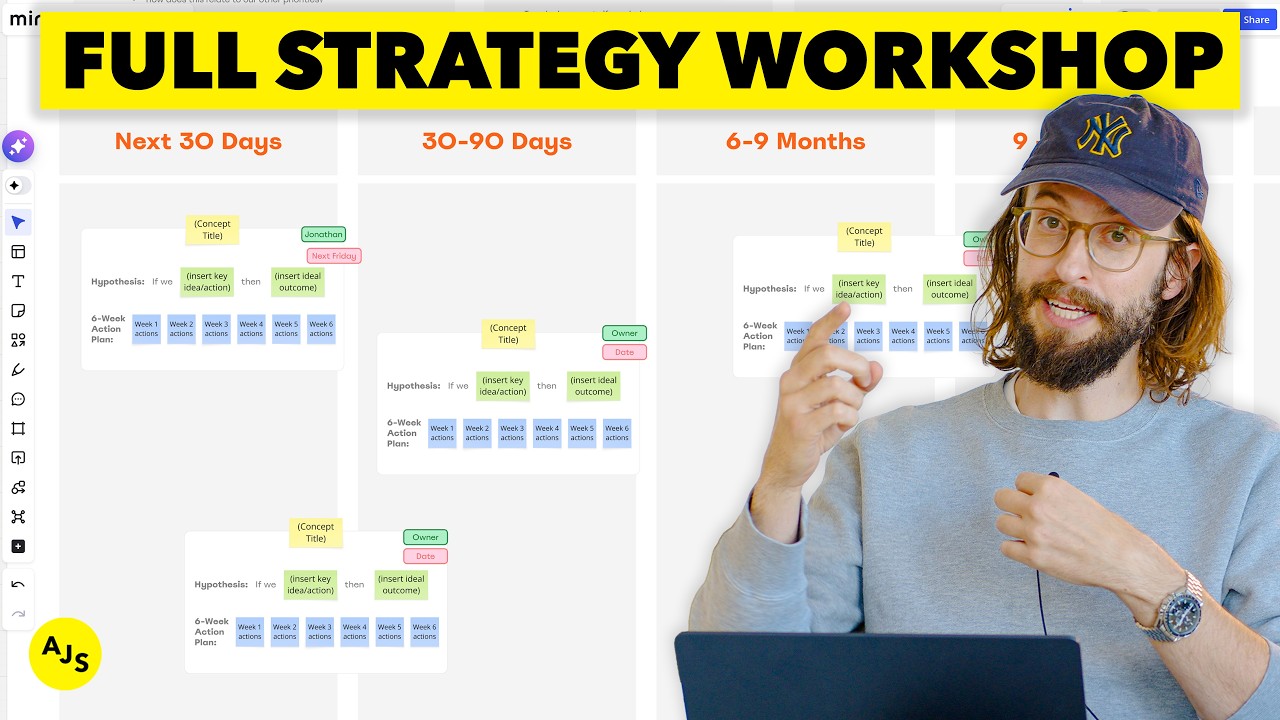
On the second day, the team reviews these concepts using heat maps and straw polls to pitch top choices, allowing the decider to select three to four concepts that can advance as multiple experimental projects. The group then finalizes these chosen concepts and places them on a broad timeline spanning from 30 days to several months to discuss initiation order and dependencies without setting rigid deadlines that cannot be adjusted. Each initiative is assigned a specific owner and a date for the first check-in meeting to ensure clarity on responsibility and next steps, culminating in a final sign-off where the decider reviews the complete roadmap with the group to guarantee full alignment before concluding the session.
The process concludes by ensuring every participant understands the finalized roadmap, including clear next steps, ownership assignments, and schedules for future check-ins for each initiative. All outputs are consolidated onto a single digital board that can be exported as a PDF or emailed directly to stakeholders to share outcomes effectively. Jonathan encourages viewers to subscribe for more detailed tutorials on running such workshops and directs those interested in professional facilitation services to visit ajsmart.com or facilitator.com to connect with the team for further assistance.
Read the full video transcript
Hey, Jonathan from AJSmart here and
today we're going to show you exactly
step by step how to run a strategy
workshop. How to run an amazing strategy
workshop. The structure we're going to
show you today you can use for a 1-day
workshop, a two-day workshop, a couple
of hours workshop, a oneweek workshop.
It's super flexible. This workshop,
which we internally call strategy
signal, we also released a book about it
uh earlier this year. You don't need to
buy the book. Everything's in this
YouTube video. So, don't worry about
that. You'll also get the template that
we show you in this video, the miro
template, so you can just run it step by
step yourself. And let me tell you a
little bit about this workshop if you're
interested. You can skip ahead if you're
not, but just let me tell you about the
workshop and how we use it at AJSmart.
So, we developed this strategy signal
workshop for three main reasons. One, to
have a really clear way [music] to kick
off projects with our clients. Meaning
that when we're on a call with a client,
instead of trying to figure out all the
different things we could do with them
and then going back and forth and back
and forth on calls, we always know, hey,
we want to kick this thing off with a
strategy workshop. Number two, strategy
workshops create the work that we want
to do for the clients. So, we wanted a
workshop that essentially generated the
projects that we wanted to do. And
strategy signal is a perfect workshop to
start projects [music] and also generate
a roadmap full of projects that we can
do for clients. [music] So it's perfect
if you're a consultant. You know, you
might be watching this and you're
working internally at a company and
that's perfect if you just want to
create a road map and create a strategy
for your team. But if you're a
consultant, what's cool is this workshop
can generate projects for you and we
wanted that at AJ and Smart. Number
three, we developed it as a way to
shorten the sales cycle when [music]
selling workshops to clients because for
us having a general sort of facilitation
and workshop offering was very hard to
sell. You know, telling a client, yeah,
we do facilitation. Yeah, we do
workshops. It kind of confuses them. And
so saying to them, hey, we've got this
very specific strategy [music] package.
That's something that, you know, 2 days,
3 days, 1 week, whatever. it's easier to
close that deal than trying to come up
with a big kind of complex facilitation
and workshop or collaboration deal. So,
we wanted to have a very simple, easy to
sell, packaged up workshop that almost
every client can understand. So, I'm
going to hand you over to Ammer on my
team in a second who's going to show you
the entire workshop from start to
finish. I think it's like 40 minutes
long. And so, if you want to run this
yourself, you can do it. You can rebrand
it. You can do whatever you want. And
all I ask is that if you like this
video, just give the video a like, maybe
subscribe to the channel, uh maybe leave
a comment. We're not asking you to buy
anything here. We're not asking you to
do anything other than just hopefully
enjoy it. And below in the description,
you can download the template that you
can see us using here. You can use that
yourself. You can rebrand it. You can do
whatever you want, like I said. And the
book,
as I mentioned, you do not need to buy
it. You can run Strategy Signal just by
watching this video. But if for some
reason you want the book, you can also
get it down below. We no longer sell it
as a physical edition because it's just
so so complicated to do this
self-publishing thing. And so you can
get a digital version down below if you
want it. Like I said, you don't need it.
That's just a if you want the thing. Uh
we don't care if you buy it or not. We
just want you to watch this video. We
want you to enjoy it and we hope you get
a lot out of it. Anyway, let's get to
the actual strategy signal workshop.
Enjoy.
>> Thanks, Jonathan. All right. All right.
Hi everyone. My name is Ommer and I'm
going to show you how to run the
strategy signal step by step. And for
that I prepared a miro template that you
can use very easily to run the strategy
signal remotely. So let's look at the
template so I can walk you through the
workshops flow step by step and I'll
show you how we set up our own muro
template for this workshop. It's very
simple. We have the two-day setup here
and it goes from left to right. So it
starts very simply by welcoming people
to the strategy workshop. We give them
an idea of what's going to happen today
and tomorrow. So we say like over the
course of today and tomorrow, we're
going to define a northstar and a
strategic action plan to help us reach
that goal, right? And then we give
people a preview of the two days. So
this is very important whenever you're
doing a long set of workshops to let
people know what to expect. So they know
that by the end of day one, they're
going to have alignment and a bunch of
ideas that you end the day with. But the
decisions and the planning is only going
to come on day two. Once you're done
with that, then it's time to introduce
everybody. So sometimes you you'll have
people who don't know each other or
don't know the different roles. So you
take a moment to do some introductions.
And here everybody takes one sticky
note, writes their name, writes their
role, and you also let people know who
the decider in the workshop is, and that
you're going to be the facilitator. So,
you would put your own name right here.
And from there, it's important to
introduce some guidelines to everybody.
So, a lot of people haven't experienced
what a well facilitated session is and
they don't know what to expect and they
go into it thinking like it's like a
normal meeting. So, it's important to
establish some guidelines here. So, I
tell everybody in this session we're
going to time box everything and my job
here as facilitator is to make sure that
we stay on track and that we don't lose
track of time. And so for that, I'm
going to be using a timer for each part
of today's agenda and for tomorrow as
well. And it's very important to stick
to that, otherwise we won't get to the
end that we set out to achieve. And
next, you say that we work often alone
together. They'll see what that means
later on, but you can just briefly touch
on it at this point. And all that means
is that there are going to be times
where instead of immediately launching
into discussion, we instead set a timer.
Everybody has some time to think to
themselves and come up maybe with some
ideas and then after that we might go
into a discussion step. Finally, uh it's
very important to remind people that we
kind of like go all in or not at all. So
that means no multitasking. We want
everybody to be fully locked into the
session. No dropping in and out. And
it's very important to set that
expectation so that your session doesn't
feel too chaotic for everyone taking
part. And finally, always prioritize
progress. And so we say we move first
and we polish later. That means at some
point if we get into like a discussion
and it's going on a bit too long, we can
remind people like, "Hey everybody,
remember what we said in the beginning
where we said we're going to move first
and polish later. We have enough to move
forward for now. So we don't need to you
know perfect everything and discuss
everything to the nth degree and it's
best to move on now right so when you
set these guidelines up front you can
call back to them later in the workshop
and that makes your job as a facilitator
a lot easier because you've already set
the expectations for how you're going to
run the session. So once you've set up
the guidelines and set the right
expectations for the workshop you're
ready to get started with the first
exercise and that is setting the
long-term goal. So this is all about
defining what success looks like in the
next 12 to 24 months. So we'll often say
you know in two years this is where we
want to be or in 12 months this is where
we want to be. And this is a little bit
flexible. So you as a facilitator can
decide what makes sense in terms of a
time span to tell everybody for this
exercise. And the way we do this is in
three steps. So first everybody works
alone together. That means you set a
timer for 15 minutes and over that time
everybody writes a sentence describing
what success looks like in 12 to 24
months, right? So you can even tweak
this before the workshop and you might
know it's like all right for what we
want to do I think it's going to be more
of the 12 months and so you just put
that right into the instructions and
then you remind people to be bold to be
optimistic um to you know think of the
best possible outcome and you also
remind them that we're not going to go
into like numbers or metrics just yet
and we're not going to prescribe a
solution. This is purely about defining
what a great end state for our strategy
is. For example, we might say something
like if we were talking about a coffee
company in this template, we're kind of
using a coffee company as an example
similar to what you would have seen in
the book. And for that coffee company,
we might say something like in two
years, our product is widely available
and is seen as a serious player in the
premium coffee space. Right? So, we're
not saying how we're going to do this.
We're not kind of putting in like exact
sales metrics because that's going to
come later, but we're just saying where
we want to be in two years. And so you
tell everybody, you walk everybody
through that example. Then you give them
15 minutes and each person has a few
sticky notes to come up with a few
variations maybe. So this template is
set up for seven people. And obviously
if you have more people participating,
you can just make some extra copies for
the new people. And then each person has
their own working area in which they
write their sticky notes. So once the 15
minutes are up, then everybody goes to a
straw poll vote. And what that means is
you're going to set the timer for 5
minutes. You're going to tell people
we're not voting just yet. Over the next
five minutes, I just want you to go
through all of the sticky notes. And
they're all anonymous. As you can see,
we don't put names on the boards, but we
just put numbers. So nobody's going to
remember where each person was working.
and instead we're just going to focus on
the contents of the sticky notes for
five minutes. Everybody's just examining
everything on the board. And then in
maybe like on a like a physical sticky
note or some like outside of Mero, each
person writes their own kind of mini
pitch as to which goal they would want
to vote for and why. And then only after
the five minutes are up, each person
takes one of these dots. So, I might,
for example, take this one and put my
name on it
and say, I really think we should vote
for this goal right here, right? And I
will have my mini pitch prepared and I
will explain why I think that this goal
is the best goal to to go for. Once the
five minutes are up, everybody writes
their name on one of these voting dots.
They move it to the sticky note they
wish to vote on. Then they present their
vote to the decider. They do their mini
pitch and each person has to up to one
minute. Right? So this needs to be
quick. That's why you prepare your mini
pitch in advance. And after that the
decider will have heard all of the
pitches and will make a final decision
on what the best goal to move forward
with is. And a little discussion can
happen here and you might have a little
bit of back and forth, but then at the
end of the 5 minutes, you as a
facilitator should jump in and kind of
gently nudge the decider to make a final
call on what a goal should be. And also
remember that the decider might not be
happy with any of the sticky notes on
the board, or they might want to combine
a couple of sticky notes. And that's
totally fine. If you hear the
conversation going and you feel like the
decider is kind of torn between two
goals that are not conflicting with each
other and can actually be combined
because they just highlight two
different aspects, then you can quickly
just write a new sticky note on the
board, present it to the decider and
have them move their vote there and then
you can move on to the next step. All
right. So once you have the goal, now
it's time to move on to the next step.
And when you have the decider's goal,
you can simply just kind of put it here
and you put the decider's vote on it.
That way, as we continue in the
workshop, we always can easily refer
back to the decider's chosen goal and
remind ourselves with it because in this
workshop, everything's going to build on
what came before and sometimes you'll
want to refer back to a previous
exercise. So, the next step once you
have defined a goal is going to be
defining the metrics. Right? This is the
part that we left out of the goal
exercise because it has its own step. So
it works very similarly to what we did
before. Again, everybody works alone
together for a few minutes, in this case
10 minutes. And each person comes up
with one or two metrics that will help
us define like how do we actually know
that we've reached our goal. Right? So
earlier we took the goal of like we want
our product to be widely available and
be seen as a serious player and it can
be very tricky to define what that is if
we leave it at this level. Each person
could have a different understanding of
what that is and that's why we define
the metrics. And so examples for that
could be again in this coffee example
that we're taking it could be like well
it means that we have confirmed listings
in you know over 300 retail stores
across at least five countries or we
have 10,000 or more active monthly
customers tracked through subscriptions
or repeat orders. And that's how we're
going to define you know being widely
available and kind of flesh out what our
goal was all about. So once you've
walked everybody through the examples,
you set 10 minutes on the timer and you
let everybody work in silence. We
typically like to have some background
music to help everybody focus and get
into their own headsp space. And then
once the 5 minutes are up, all of these
sticky notes on the board will be filled
in. And then we move on to the next
step. But this time around, instead of
immediately going into like preparing a
pitch and talking to the decider about
that, we're instead going to do more of
a a silent vote. So, in this step, uh,
we're going to do what we call a heat
map vote. And what this means is that
everybody has unlimited dots for this
step. And so, you can just copy and
paste as many of these dots as you want.
And you have 5 minutes to go through all
of the metrics on the board. And then
you can start to paste them around any
metrics that you think would be good
metrics to attach to our goal. So, I
might go around the board here, and I'll
paste a couple here, maybe three there.
So the more you like a metric, the more
dots you should put on it. And that will
make it very easy later on to see where
which metrics everybody gravitated
towards. And it will make the decider's
job easier for choosing which metrics to
finalize and move forward with. And so
after the 5 minutes are up and everybody
has placed all of the dots that they
wanted to place, you'll very easily see
that some sticky notes stick out more
than others and they will have a bunch
of dots on them. And it's at that point
that you as a facilitator would hand it
off to the decider and ask them to maybe
like walk the group through their
thoughts and ask them to call out any
sticky notes that they're kind of
gravitating towards. And then over the
course of 5 minutes as they're
discussing their thoughts, you have them
come to a decision as to which two to
three metrics they want to go for. If
they only want to go for two metrics or
two metrics are enough, we don't need to
enforce a third one. But if we really
feel like we need three metrics to
define and kind of capture the essence
of our goal, then we can do that as
well. But the important thing to keep in
mind both in this step and in all other
steps is to not get pulled into words
smmithing sticky notes too much and like
then kind of arguing about different
percentages or different numbers of
should it be 10,000 or 12,000. It's best
not to get pulled into these discussions
and just have something that is
generally agreeable for the the group
and the decider and move on and not get
pulled into taking too much time with
each of these exercises. And this is
something that you'll need to remind the
group of and you go back to reminding
them about how we have the time box for
everything and we need to move on. So
you can let the decider explore some
ideas both here and both in the the goal
exercise and all of the exercises really
as long as it doesn't take more than the
assigned time box which in this case 5
minutes should be enough to work that
out. All right. So once the decider
makes their decisions around the
metrics, you'll have two metrics that
the decider is happy with. And again you
can copy them here so you can easily
refer back to them. And this is actually
when we get to our first milestone. That
means we just highlight the important
decisions that have been made so far.
And that includes obviously the goal and
the metrics that we have defined. We
have two by default here, but you
there's a space for a third one if you
ended up going with three metrics. And
this is a good time to maybe give the
group a break and also celebrate them
for getting to this point because
they've gotten very quickly to align on
a long-term goal and some metrics to go
along with it. Once we have that done
and we can copy and paste the goal and
the metrics onto here, now it's time to
move into thinking of how are we going
to get to that goal, right? And how are
we going to realize that vision or
arrive at that north star? And for that,
we're going to go into some ideation.
But moving from kind of a goal statement
and the metrics into ideas immediately
can be tricky for a lot of teams because
they're just going to have like a blank
canvas and now they're supposed to come
up with solutions. So that's why we're
always huge fans of using the lightning
demos exercise, which is essentially a
great exercise for collecting
inspiration. You don't need to come up
with any new ideas. You don't need to
make any decisions. All you're doing in
this exercise is collecting inspiration
from maybe other people who have solved
similar challenges or have reached
similar goals to the goal that you're
trying to reach. So let's look at how
the lightning demos exercise works. And
to do that, you actually only need to
fill in a template and you can ask each
participant to maybe come up with one or
two lightning demos. So again, like with
the other exercises, first we work alone
together. So the way you do this is you
give everybody 25 minutes and in those
25 minutes, all they're doing is looking
for inspiration uh related to the goal
that we would have set earlier. So in
this case, you know, if our goal is in
two years, you know, the product is
widely available and is seen as a
serious player in the premium coffee
space, then we want to start thinking
about other situations where companies
did a great job of establishing
themselves in the market quickly,
establish trust and were able to come in
as a premium player into a space. So
we'll want to consider a few options and
maybe choose our favorites and bring
those to the board and prepare
essentially a demo for the rest of the
team. So to give a few examples of that,
we again taking our coffee company as an
example, we might look at things like
liquid death and Oatley. So for example,
for liquid death, we fill in this
template and essentially we have the big
idea, why it's interesting, and a
takeaway from it. So we say like all
right with liquid death the big idea is
that they took a basic product which is
just canned water and exploded it into a
$700 million brand with bold provocative
identity. And the reason it's
interesting is that they didn't invent
anything new. Uh they just made a boring
product really special and
unforgettable. And the takeaway here is
how can we make our coffee feel like a
movement and not just another bag on the
shelf, right? And so you can present a
few examples to the team so they
understand what this exercise is all
about and what they're supposed to be
doing and also how to fill in the
template. And once you've presented
that, you show everybody the templates
and you let everybody have 25 minutes.
And at this point, it's okay to use
devices. It's okay to go out on the
internet and search for inspiring
examples. But it's always important to
kind of remember and remind the team
that we're not just going to Google what
the competition is doing and instead we
want to see what other companies from
other spaces are doing. So if you'll
notice here, we didn't go and look and
see what other coffee companies are
doing, but instead we were looking at
other products in similar situation to
ours, right? Whether it's canned uh
water or milk or oat milk in this case
or companies from different spaces
entirely. So another example could be
how Tom's established itself in the
shoes market and how they were able to
set themselves apart, right? But it's a
similar challenge to the one that we're
trying to solve and that's why it's
relevant. And so once you've explained
to everybody what they're supposed to
do, what what to aim for, then they can
take the 25 minutes and they start to
bring in their ideas. So the way they
fill the template is they just put the
name of the the product or service or
idea that they're taking inspiration
from. They might bring a one screenshot
or a few screenshot just kind of as a
visual anchor because that always helps
with remembering what the idea was
about. And then they fill in the big
idea, why it's interesting, and the
takeaway. And then once the time is up,
you'll have this entire board filled
with different lightning demos. Then
it's time to share and present. So
whereas typically we would care about
you know anonymity and not knowing where
ideas came from in this case because
we're not making any big decisions and
it's only about sharing inspiration then
each person just presents the demos that
they brought to the board and you can
time box each person to 2 minutes and
then they can talk about the lightning
demo or couple of lightning demos that
they brought to the board and highlight
what's special about them and where they
thought we could take inspiration from
these demo for our situation. So once
everybody is done presenting then we can
have a quick group discussion no more
than five minutes just for us to see
like which demos did we gravitate
towards the most and maybe we write down
some key ideas that we want to bring
forward with us into the ideation stage
and maybe we just have a little bit of
back and forth to process all of the
presentations that we all heard just now
before moving on to the next step. So
with that, we'll have all the
inspiration that we need to go into the
next step, which is coming up with ideas
that will help us get to our long-term
goal. And for that, we'll start the
concept creation exercise. And similarly
to lightning demos, we have a specific
template that everybody fills in to kind
of structure their idea and what they
want to present to the team. What we're
trying to do here is ask everybody to
think of the long-term goal and look at
all of the inspiration that we've
collected so far and come up with one
detailed plan essentially or concept or
solution idea for how we might get to
our goal. And this could be a project
that we undertake. It could be a new
product idea, a new service idea. It
really depends on the context of what
you're discussing. So the template for
coming up with a solution concept is as
follows. You have you give the solution
a title at the top. This is just to keep
everything anonymous and we don't have
to call it Jonathan's concept and
Rebecca's concept. And instead we just
give it a title. So my concept could be
called liquid death but for coffee. And
this is kind of playing on the idea that
we're going to do something similar but
executed in the coffee space. Right? And
it just gives us an easy way to refer to
these concepts. And the way we fill this
out is by creating a hypothesis where we
say if we do X Y or Z. So if we take
this action then we get this outcome.
Once we've done that we come up with a
sixe plan for how we're going to execute
that. So let me give you an example to
make this a lot clearer. So we have
three examples here and I'll just go
over this one right here. So we have a
concept called shelf magnet strategy.
And the hypothesis here kind of like the
the idea that we want to maybe
experiment with or test or explore is
that you know if we get our coffee into
well-known premium stores and support it
with eye-catching displays then we'll
grow visibility, credibility and sales
across multiple regions, right? That is
kind of the main hypothesis. We don't
know that this is going to succeed and
that's why we call it a hypothesis. This
is just kind of placing our best bet
based on all the discussions from
earlier in the day, based on all the
inspiration that we've collected. We're
kind of coming up with an experiment and
something to test. And the way we're
going to go about doing that is with
this six week plan. So, it starts by
making a list of target cafes and
specialty grocery stores. Then, we build
out a simple sample kit and outreach
email campaign. Then we send a few
samples and pitch meetings to the store
owners. Then we design signs and shelf
talkers for instore support. And finally
we launch intore displays and start
tracking early sales. Right? So whatever
that is for your product or your
situation. The idea here is to come up
with a wellthought through plan for how
we might execute this idea. And this
just makes everybody think through maybe
like a an idea that sounds cool on the
surface, but then once you start
thinking about execution, you find out
that it's maybe too complicated and then
somebody finds that out and maybe starts
maybe pivoting a little bit or changing
the idea to be something that's more
realistic for us to achieve. So with
this template, you'll have somebody kind
of expressing a big bold idea in the
form of the hypothesis and you're going
to understand how we can make this a
reality. All contained in this template.
You can walk everybody through the
examples that we have on the board here.
We have three examples just to make sure
that you know everybody's crystal clear
on what we're trying to do. Then
everybody kind of proceeds to come up
with their own version of this and
they're going to have 30 minutes to do
so. And we also give people some tips
along the way. So the first one is
reminding them to address the main goal
that we set earlier in the session
because at this point it might be easy
to get pulled into one direction from
one lightning demo that somebody saw and
then they're kind of building an idea on
top of that. But it's always important
to remember the goal that we said
earlier and we literally read that out
to the group as they go into the concept
creation exercise. And second, we focus
we remind people to focus on
differentiation. So we don't want to
come up with something that already
exists in the market or that is not
differentiated. After all, the role of
strategy is to help us differentiate
ourselves in some shape or form. So
remind people to really focus on new and
novel combinations of ideas that haven't
been done before. And also at this point
because this might put pressure on the
team and some people might not be sure
about what to create or what kind of
ideas to go for. We remind people that
the strategy signal is a great time to
explore high-risisk, highreward ideas
because everything that we're going to
be coming up with is an experiment. And
that's why we use the phrasing like
that. It's a hypothesis. We don't know
if this is going to work yet, but we're
just going to experiment with a big bold
idea and we're going to come up with,
you know, a six week plan for testing
out this idea and then if we find out it
doesn't work, then we can iterate from
there, right? And another tip is to not
skimp on the details. So, this is just
reminding people that being too high
level with your concept will make it
hard for others to understand what you
actually mean by it and what it looks
like in practice. So, try to be
detailed, especially when it comes to
creating the six week plan. And that
will make it a lot more concrete for
people because remember, your concept is
going to be anonymous and you're not
going to present it by default to
everybody else. So, the concept really
needs to stand on its own and be
self-explanatory. And adding detail to
that helps a lot. And that brings us to
the last point, which is to be your own
first critic. So, since you're now going
to be pitching your concept, just make
sure that it's easy to understand and
that it addresses the goal clearly
without needing to be explained by you
or or anybody else and that everybody
can just read it and understand it
immediately. And with those tips out of
the way, then you can let everybody
start creating their concept. And you
time box them for 30 minutes. And again,
you remind them of the rules as they're
working on the concept. Everything
should be anonymous, should be
self-explanatory, everything should have
a title. The words are important. And
once they're finished with their
concept, they shouldn't, you know,
immediately like put it up and kind of
let others talk about it. And instead,
what we do here is once you're finished
with a concept, then you can, for
example, take it and add it to the
concept gallery. And once you've done
so, you can just cover it up with one of
these covers and leave it until the next
day because this is actually the last
exercise on day one. So, we end day one
by having everybody come up with ideas
for how we're going to reach our goal.
Then, everybody can just sleep on it and
come back the next day to look at all
the ideas with fresh eyes. So, now let's
look at day two. And day two has fewer
exercises as you can probably see, but
it has a lot of important discussions
and decisions to be made. Day two starts
by you welcoming everybody back to the
strategy signal. And you as a
facilitator will have copied all of the
solutions from the solution gallery from
day one and you put them on this board
here. And the next step from here is to
walk people through a few exercises that
will help us get to a decision as to
what are the concepts we're going to
move forward with. So how does that
work? We first start with a heat map
which is a step that we saw on day one
where everybody has unlimited dots and
we work alone together to vote on all of
the concepts and we just paste dots
around all of the concepts that we like
as you can see in this example right
here. So each time I see an idea that I
gravitate towards, I would paste a dot
next to it. And the more I like an idea,
the more dots I paste next to it. And
once everybody has done that, it'll be
very easy to see where the most
compelling ideas from all of the
concepts are. And this makes it easier
to go on to the next step. So in the
first step, everybody's just reading
through all of the concepts and they're
kind of registering their interest with
the dots on the board. And then from
there, you have the facilitator go
around the board and just do a quick
overview of how the heat map voting
turned out. So the facilitator can call
out where the hottest area on the board
are and where people seem to be most
excited around which ideas. And we don't
do a lot of discussion here, but this
again just helps everybody remember what
the most compelling parts of each
concepts were before going on to the
next step, which is the straw poll vote.
This is again a type of voting that we
saw in day one where each person would
write their name on a sticky note and
they would prepare a mini pitch that
they would pitch to the decider for the
decider to finally make their call on
the concept to move forward with. So in
this step, everybody will get another 15
minutes to look through all of the
concepts that have been voted with the
heat map and it's going to be very easy
to skim through them again. And then
once you find the concept that you want
to vote on, you would take one of these
sticky notes and for example, you know,
I would put my name here and then I
would type my explanation like I vote on
this concept because and I put in my
explanation kind of like what we have
here. So you'll have a concept and
you'll have somebody putting their name
and their explanation as to why they
believe this concept should be carried
over and should be one of the concepts
that we start executing on or exploring
to see if this is an idea that will work
for us once we try it. So once everybody
has picked a concept to vote on and
everybody has placed their votes,
everybody takes turns uh pitching to the
decider. again 1 to 2 minutes per person
pitching why they believe this concept
should be chosen to move forward with
and after that then it's over to the
decider to choose the winning concept.
So everybody in the previous steps only
gets to choose one concept but the
decider can actually uh decide to move
forward with three to four concepts
because when it comes to strategy you
often need multiple projects to realize
a long-term vision and you might be
experimenting with different approaches
to see which one works out. And so
you'll often need to select multiple
concepts to turn into projects to
explore. And that's why we allow the
decider to pick three to four concepts
to get started with. And then the
decider proceeds to do that the same way
that everybody did. We put the decider's
name on a sticky note with a different
color. And we capture the decider's
rationale for choosing each of the
concepts that they wish to move forward
with. And at this point, it's normal if
some discussion happens. That's why we
have this time box for 15 minutes. So we
always like to start by asking the
decider to think out loud and walk us
through which concept they saw
themselves gravitating towards. So we're
going to have this board full of
concepts and everybody will have already
done heat map voting and they will have
pitched to the decider and in this time
the decider has been kind of processing
all the ideas and they will have some
initial thoughts. So we have them start
to think out loud and kind of explain to
the group which ideas they gravitated
towards and which concepts and then we
slowly move towards having them pick
three to four concepts that they want to
bring forward to the next step in the
workshop. Okay. So once we have that,
we'll have reached another milestone and
that is having the chosen concepts that
everybody created on day one and then we
went through all of the concepts and
discussed them and pitched them to the
decider and the decider finally made a
decision on what to bring forward and
this is another great milestone. We can
take a break here and we can remind the
team of everything that they've
accomplished up to this point before
moving on to the next step and that is
the road map. So this is the final
exercise in the strategy signal and it's
the most essential part for giving
everybody clarity about how the vision
will be realized because we're going to
be talking about what happens next in
what order and who's going to do what.
Right? So the way we go about doing that
is first placing all of the concepts on
a timeline. And when it comes to road
mapping, we strongly believe that
granular road maps never work out the
way that people expect that they will.
So we have much broader and a lot more
flexible timelines. So the timeline that
we have looks like this. We talk about
what we expect to happen over the next
30 days. So sometimes that could be one
project or it could be starting a couple
of the projects and these are the
concepts that we're bringing onto the
board. And then there are things that
are going to take multiple months to
finish. We might start them now, but
they can only be done within like six to
nine months and some things could take
even more. What we're doing in this step
is literally taking the three to four
concepts that the decider has chosen and
then we start to have a discussion. So
initially all of these will be off the
board and then our first step in the
road map is to ask the group you know
when would it make sense to start this
initiative what needs to happen before
this can begin and how does this relate
to our other priorities. So we're asking
these questions for each of the concepts
and it doesn't really matter which order
you start them with. Sometimes there's a
natural concept that everybody knows
will be executed on first and so you
could start with that. In our case, it
could be for example the second one
right here and we say all right this is
the one that needs to start immediately
and we actually need to have this done
within 30 days. So we typically place a
concept where we think it will be done
and it could start as soon as
immediately but only be done later.
Right? For example, another concept we
might also begin straight away, but we
know that it will probably happen within
the next 3 months and then maybe we have
another one of these projects that gets
completed within the next 3 months and
another one that will take a little bit
longer. So, this board will look very
different for each team based on the
initiatives that they're bringing onto
this board. And that is the first step
of creating the road map. And you
shouldn't again with as with any
exercise in the strategy signal, you
shouldn't get pulled into very granular
details and discussing the minutiae of
each project, but you should instead be
placing kind of your best bets as to how
you think everything will go. And in the
end, every plan is a work in progress.
and you'll start executing on these
plans and might decide to change the
timelines and tweak things after you get
started. So all we're looking for is a
starting point and for that we don't
need to discuss this for hours and hours
but instead we can place our best bet
and within 30 minutes have everything
mapped out on the board. So that is the
first step. We do a first pass and then
from there we set another 10 minutes to
do some quick adjustments. And so once
we have the first pass of the road map,
we can make some quick adjustments. And
at this point, we just ask the team
whether they feel anything is out of
place or whether we missed anything big
that might change where we place these
concepts on the timeline. And from
there, you might have noticed in the
beginning that we have these two other
kind of tags on the concepts. And this
is a very important step. We don't want
to end the workshop without being
extremely clear on what's going to
happen, when it's going to happen, and
who's going to be responsible for making
it happen. And so, at this point, we
want to assign owners and dates to each
of these initiatives or projects or
whatever you decide to call them
internally. This is something that might
happen kind of in a group environment
where you might have people that might
naturally take lead on certain projects
or you might have the decider come in
and assign people different projects and
assign different dates, right? And so I
might take one of these tags here and
come
to the first project. I might say this
is something that Jonathan will be
leading. And then for the date, we're
really looking just for the first time
we're going to meet regarding this
project. And this is not the deadline
for when it will be done because that is
more captured on the timeline. This is
just us saying like all right, after
this workshop, what is the next step?
Well, the next step is that Jonathan is
going to lead this and that might
involve, you know, certain immediate
tasks, setting up certain meetings or
getting in touch with people, organizing
a team, all of that. And the first
check-in we're going to have around this
project might be next week or something
like that or next Friday to be more
specific. And that just means that we're
going to be meeting uh very soon to
discuss next steps for this project. And
it means that we're leaving this
workshop knowing that each project has a
clear person uh responsible for it and
owning it. And we have a date for
discussing the status of that project.
That way, nothing is kind of falling
through the cracks and nothing is
forgotten about. So, when we end this
board, everything will have a clear
timeline and a clear owner and a date
when we're going to talk about this
separately from everything else. And
that just gives everybody clarity around
what happens next. And again, these are
just initial dates. They're dates for us
to get started. And we're going to
adjust as we go along. And these are not
set in stone. And if the actual timeline
doesn't unfold like the road map, it
doesn't mean that it was a failure. It
just means that we learn new information
and we needed to adjust from there. But
that is how you do the road map
exercise. Once you have the owners and
dates, you do kind of a final decider
sign off. So at this point, the decider
should be super clear on everything in
the road map and they should be content
with how the road map is. And to do
that, we just ask the decider to walk
the rest of the group through the road
map. That way, they can almost be
thinking out loud. And if they have
questions along the way, then we might
clarify those. And we just make sure
that the decider is clear on the road
map. And of course, we make sure that
everybody else is clear on the road map,
what's happening next, who's owning
what, and when are we going to do our
next check-in for each of these
initiatives. And that brings us to the
end of our workshop. And we bring
everything to one neat board that we can
export and then kind of share via PDF or
email and share it with whoever needs to
know about the the outcomes of this
workshop. So this is how you run a
strategy signal step by step. Of course,
you can run this in person. You can run
this remotely with this template. So I
hope this was useful. And now back to
Jonathan. Hey, Jonathan here from
AJSmart again. If you enjoyed that
video, we've got plenty more like it on
this channel. Um, we've got like every
type of workshop you could ever want to
run on here as a detailed tutorial. All
we'd love you to do, you know, if you
enjoy this sort of thing is just let us
know by hitting the subscribe button,
you know, interacting with the video in
some way that sort of tells YouTube to
show it to other people. And if you're
if you watched this entire way and you
want to work with us at AJSmart, you
want us to run workshops for you, just
go to ajsmart.com, go to
facilitator.com, you can find all the
ways to contact us there. Thank you so
much for watching. Have a lovely, lovely