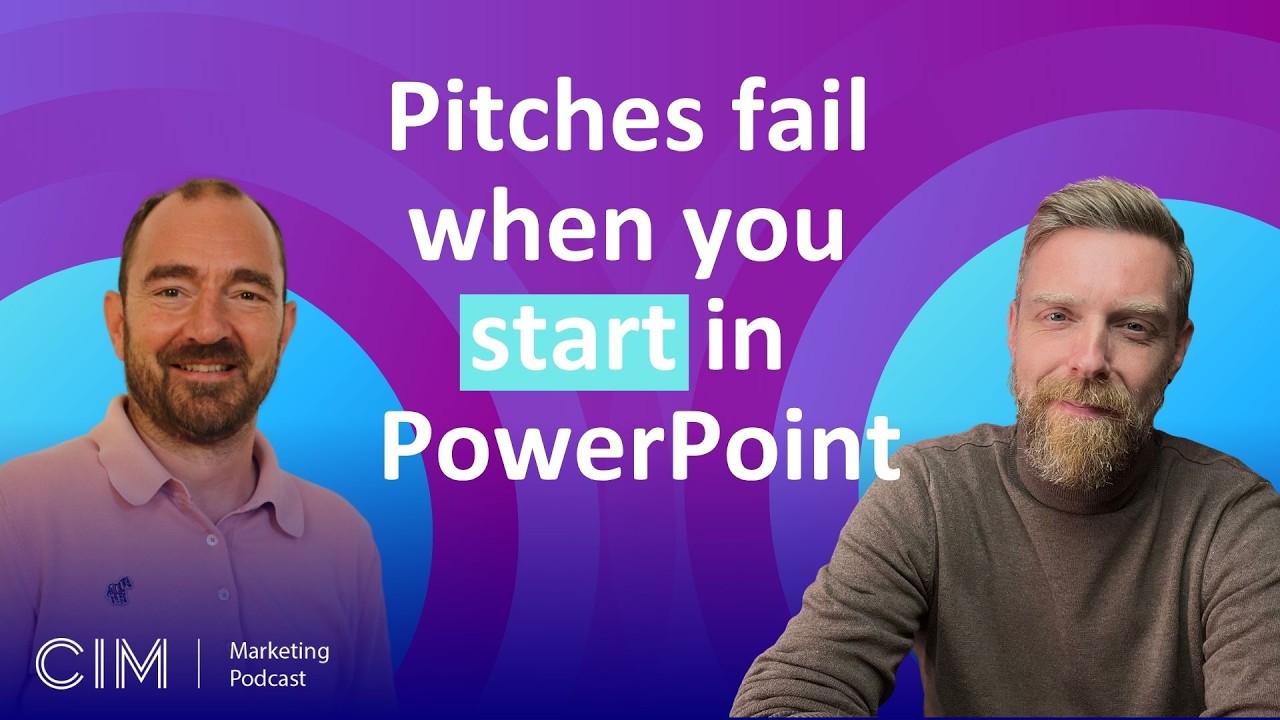
How to master the art of pitching and persuasion
Watch on YouTubeVideo summary
Mastering the art of pitching begins by understanding that genuine persuasion relies on establishing an emotional connection before presenting logical evidence, a principle illustrated by Danny Fontaine's career shift from struggling artist to successful sales professional. By staging immersive experiences rather than relying on traditional slideshows, he demonstrated how making the audience feel understood prevents them from rejecting well-reasoned arguments due to psychological resistance. This approach is further refined through storytelling frameworks where the client or prospect becomes the hero of their own journey, while the presenter acts as a supportive mentor guiding them toward success, ensuring that the pitch feels like a collaborative conversation rather than a one-sided sales presentation.
Effective execution requires deep research into every specific prospect and avoiding the reuse of outdated materials without significant adaptation to prevent the content from feeling stale or irrelevant. When facing unexpected challenges or deviations during a meeting, it is crucial to remain calm, ask clarifying questions to buy thinking time, and pivot based on what the audience actually needs rather than rigidly sticking to a prepared script. Furthermore, building long-term trust involves refusing requests outside one's area of expertise, much like a trusted restaurant waiter who recommends better options instead of simply pushing expensive items, thereby positioning oneself as an honest advisor whose recommendations are rooted in genuine competence and belief in their own value proposition.
The line between manipulation and true persuasion is drawn by the intent behind the techniques; while methods can be used to exploit someone's detriment, authentic influence stems from creating a bond where logical backing supports established rapport without causing cognitive dissonance for the listener. Embracing failure as an essential part of learning allows teams to iteratively refine their pitches based on feedback rather than fostering blame cultures that discourage innovation and growth. Ultimately, successful pitching demands a mindset focused entirely on creating joy and emotional connection for the audience, similar to planning a surprise birthday party, while effective leadership balances empowering the team with decisive authority to manage risks and foster strong chemistry within the group.
Read the full video transcript
And I was waiting for my boss to walk
over to me with that, you know, I'm
about to fire you look in his eye. Yeah.
>> So that I could whip out the letter
first and say, I've decided to resign.
>> Right. So you you you got you were going
to get ahead of it. You were going to
the cool guy.
>> Don't want that on my record.
>> I don't want this on my record. This
job's not good enough for me.
>> Yeah.
>> What happened?
>> Well, I didn't get fired. And there's
one reason I didn't get fired and it's a
story. And the story changed the entire
trajectory of my life and my career.
[music]
Hello everybody and welcome to the CIM
marketing podcast. I'm delighted to say
we're back in the studio and we're going
to be talking about how concepts become
reality. Most of all, how we make our
brilliant concepts turn into a reality,
turn into a new account, a new project.
And that, of course, the interface is
the pitch. Something that's familiar to
many marketers.
It doesn't matter how good your concept
is. If you can't sell it to your
customer, if you can't sell it to your
audience, it will never become reality.
And today to discuss this highly
important topic, we have none other than
the pitch guy, Danny Fontaine. Danny is
author of Pitch: How to Captivate and
Convince Any Audience on the Planet, and
he's with us today. Danny, great to see
you.
>> Great to see you, too. Thanks for having
me on. I appreciate it.
>> Your book title says a little bit about
yourself, but you're going to tell me a
little bit more about yourself, I hope.
>> I certainly can tell you lots of things
about myself. Um, let's start with the
fact that I have been obsessed with the
topic of pitching for the last 20 years.
It's been like
what I've dedicated my life to,
but I wasn't always. So, I've got a bit
of an interesting story and I think some
of the people listening might be able to
relate to this. So when I was younger, I
just wanted to be either a world famous
rock star or a world famous artist. They
were one of the two and I would have
been pretty happy. So uh I went to art
college when I was 16. Um
>> you weren't bothered which you you
>> not too bothered. I would have chosen
rockstar.
>> You preferred the rockstar. Okay.
>> But for me it was crazy that at 16 I was
allowed to only study art and drop all
of the other subjects. It was the the
greatest thing in the world. Um and then
I went to university and I studied fine
art. I did a degree in oil painting. All
right.
>> And um joined various bands and life was
going well. And in my early 20s,
um I got married quite young and I was
even though I was out every Monday
evening playing pubs in North London to
four or five people, the music just
wasn't bringing the money in that I
needed for my family. So essentially I
was forced to kind of get a career
outside of being an artist or a musician
and I kind of just fell into the world
of digital agencies and digital
consulting. And my first agency role I
was fortunate enough to basically try
every single job within the agency. So I
was a project manager. I did UX. I did
research. I did UI. I did a bit of
coding. I tried absolutely everything
that I could. And a lot of that was kind
of enjoyable but not fulfilling. It
didn't fulfill that creative side of art
and music that I've always had kind of
flowing through my veins. And then one
day my boss said to me out of the blue,
"Danny, I think you might be good at
sales."
And I thought, "All
it's like the last thing that I would
ever want to do." Like, "Don't you know
I'm an artist, darling?" [laughter]
>> So I said, "No." And he said, "Well, you
will get commission on top of your
salary if you do sales."
>> And I said, "Yes." And that's how
[laughter] I got into sales essentially.
Um, but when I started sales, I was so
bad at it. It was all so foreign to me.
And I just filled my time, again, some
people will be familiar with this, uh,
with busy work.
>> So, not caring how good the work was,
how valuable, not caring whether it had
any impact on the sale itself, but just
doing as much as possible. So, if anyone
said, "What have you been up to?" so I
could show them a wad of stuff, hundreds
of pages of powerpoints and word
documents.
Uh, but that wasn't going so well. It
was hard to keep up that pretense. And I
basically I knew I was I was going to
get fired. I knew so much that I was
going to get fired that I printed my
resignation letter and I had it next to
me at all times on the desk.
>> Your heart your gut was saying
[laughter] to you, you're a goner.
>> Yeah. You suck. you're an impostor. What
are you doing here?
>> Get ready cuz you're going to get booted
out. And I was waiting for my boss to
walk over to me with that, you know, I'm
about to fire you. Look in his eye
>> so that I could whip out the letter
first and say, "I've decided to resign."
>> Right. So, you you you got you were
going to get ahead of it. You were going
to look at the cool guy.
>> Don't want that on my record.
>> I don't want this on my record. This
job's not good enough for me.
>> Yeah.
>> What happened?
>> Well, I didn't get fired. And there's
one reason I didn't get fired and it's a
story and the story changed the entire
trajectory of my life and my career.
>> Cool. What happened? [laughter]
>> The story of British Rail, which I'm
sure you are probably familiar with.
>> I am. Yeah.
>> So, I'll tell you the story. It's a
short story, but the year was 1979.
British Rail were a publicly funded
company. So the taxpayers were were
forking out and they had loads of
problems. Their trains were late. Their
trains were run down. The customer
service was absolutely awful. And in
their wisdom they said we need a PR
campaign.
>> Uh now at the time Sachi and Sachi were
the the gi I mean they're still giants
but they were the giants in the
advertising industry. They were so good
they just helped Margaret Thatcher get
elected as prime minister which I think
says quite a lot.
and
British Rail wanted to hire them, but
you couldn't just hire a company. Just
like today, there's procurement
processes in place. They had to go out
to tender. They had to get multiple
agencies into pitch, which to them was a
formality.
>> But there was one agency called Alan
Brady and Marsh or ABM. And they were a
pretty new agency. They've been around a
couple of years. founded by this guy
called Peter Marsh who had zero
background in advertising.
He was actually a a theater guy. His his
background was amateur dramatics and he
was very enigmatic and very flamboyant
and he knew
>> he was an artist.
>> He was he certainly was a lot like me.
Yeah.
>> He knew that he had to do something
completely disruptive if he wanted to
topple the giants that are Sachi and
Sachi. So the day of the pitch arrives
and the British rail men arrived at the
ABM offices. It was 1979. They were all
men. Uh and they they rang the buzzer to
be let into the building and no one
answered the door.
They rang the buzzer again
>> and still no one answered the door. And
this is the chairman of British Rail and
his goons, a better word, stuck outside
in the rain.
>> Oh gosh.
>> For three minutes getting really pissed
off. So the door finally opens and they
walk in and they approach the
receptionist and the receptionist is on
the phone and she looks up at them and
she is visibly annoyed that they are
trying to interrupt her phone call which
was a gossipy phone call.
>> Yeah. and she waves them away to the
waiting area. And so they're in this
waiting area a lot like this and they
look around them and there's dirty
coffee cups on the table and there's
magazines and newspapers from two months
ago and there's an ashtray with
cigarette ends just stinking the place
out. It's just disgusting. And again,
they just have to wait. And after a
while they stand up and they approach
the receptionist again and they say,
"Where is Peter Marsh?" And this time
she's literally filing her nails while
she's cradling the phone under her chin.
This is all a true story and I can tell
you how I know the facts in a minute if
you want. And she just shrugs at them
and they said, "That's it. This is
ridiculous. We are leaving. You have
lost our business." And they stormed
towards the door. And at that moment,
Peter Marsh bursts into the room and he
says, "Gentlemen, you have just
experienced what your customers go
through [laughter] every single day.
Now, shall we see what we can do to put
it right?"
>> That is absolute genius.
>> And they win the work. And it's the
British ad the biggest deal in British
advertising history at the time.
>> Massive public sector client. Must have
been the biggest account near enough you
could win
>> ever. Exactly. Goodness me, that's
genius.
>> Now, I heard that story and I thought,
hang on a minute. That's that sounds
like so much fun.
>> That I would have loved to been involved
in that. And it was so incredibly
persuasive as well.
>> If they had just shown the British Rail
guys PowerPoint or overhead projector
with slides, they wouldn't have won the
work. And it made me realize that a
pitch is simply a speech or an act that
attempts to persuade someone to do or
buy something by any means possible.
>> So when we pitch to someone, we can do
anything. We've got an hour, half an
hour, even three minutes with another
human being in a space where we can do
anything that we want to persuade them
of our idea. But instead we default to
these huge hundpage PowerPoint
presentations with reams and reams of
information and audiences all over the
world are bored to tears listening to it
and presenters all over the world are
tired and stressed and you know nervous
about getting in front of the audience.
And so my whole ethos and what the book
is really about is that there is a
better way that we can enjoy ourselves,
believe it or not, when we pitch that
our audience can enjoy themselves.
But the sum of those two things is that
we are also infinitely more persuasive
in doing it that way as well.
>> Before we took this amazing journey with
British Rail, we left you about to get
sacked in your [laughter] office.
>> Right. So let's rewind back to that.
What happened and how did BR save your
job?
>> My entire
paradigms changed and I began to work on
crazy,
>> right? I began to come up with big ideas
that no one ever wanted to do. My
colleagues, no one ever wanted to do it.
Everyone said it's too risky. And this
is another lesson I've learned.
It's kind of cool, but come on. It's so
different from what we normally do. And
I was persistent. I was belligerent
until someone let me try a little thing
on a small account. And every time we
tried to do something different, it
worked.
>> Yeah. So you you had no you thought you
had nothing to lose.
>> Unless I unless I do something out of
the ordinary, unless I do something
extraordinary,
>> right?
>> I'm going to get I'm going to get the
boot.
>> Exactly.
>> So that's what I'm going to do. That's
it.
>> I'm gonna I'm gonna throw away the rule
book. I'm gonna throw away the 100page
documents. I'm going to kick out the
spreadsheets and the PowerPoint.
>> That's it.
>> And I'm going to channel my inner Peter
Marsh.
>> That's it. Exactly. That is it. Exactly.
>> So, let's hear some more out of those
from your pictures then um of your
experiences of using that sort of
paradigm to win business. Well, I've got
a number of f one one of my favorite I
can't name names for any of these
examples unfortunately because of NDAs,
but uh they're in the book lightly
disguised, [laughter]
>> but there was one of my favorites was we
were pitching
>> You can give them a moniker. Give them a
different name.
>> Well, let's call them company X.
>> Company X.
>> So, we were pitching
>> the well-known company X.
>> Company X who were a major European
luxury retailer.
>> Yeah. Luxury PLC,
>> right? Yeah,
>> exactly.
>> I know them well. Yeah.
>> Now, they uh didn't even want to hear
our pitch. We wanted to talk to them
about how to improve their customer
experience, how to bring innovation into
the stores, how to do all of this
modern, contemporary, new stuff that
works so well with other clients and
they just said, "No, we can't risk it.
There's, you know, our our customers are
high netw worth individuals. They know
what they want and we know what they
want. We've been this way for many
years. We're not going to make any
changes there. And we persuaded them to
at least come and listen to us for an
afternoon to to do a kind of a workshop
with us. And um I spoke to the CIO
and I said, "I can't tell you anything
about the agenda though."
>> Right? and he was really uncomfortable
with this and he said that that's fine
but what I don't want you to do is just
try and sell us any of your products
because I'm sick of it. Your sales guys
are ringing me every day. Don't want to
hear it. So you've got the afternoon but
his expectations were like on the floor
essentially.
>> Yeah.
>> Sound like he just wanted it over with
really.
>> He didn't want to do it at all. He was
like he was doing someone a favor in the
company and and be because that was a
bit of a nothing to lose situation. I
was lucky enough that the uh team I was
working with at the time allowed me to
do this disruptive thing. So we get in
the room and everyone sits down and
we've got company X boards all over the
place and we even got some vasees of
really big uh bouquets of flowers in the
two colors of company X as well. So they
walked in and it was the whole room was
branded their their colors and and and
logo everywhere.
So I open up PowerPoint and the first
slide on the the screen is how company X
can succeed with our products.
>> Oh, right. [laughter]
Gosh,
>> I didn't really need to do that, but I
just thought it was hilarious because
the look on the guy's face on the front
row, the CIO was going, "You
>> Yeah. Yeah. Um, so then I I started for
about 15 seconds on an incredibly dull
slide and then out of nowhere on the
screen I got a FaceTime call on the same
screen I was presenting on.
>> Oh, okay.
>> I said, "Oh my goodness, I'm so
incredibly sorry about this. Let me just
get this so I can tell them I'm busy."
And so, uh, a lady appeared on the
screen and she's like, "Danny, how you
doing?" And I was like, I'm in the
middle of something at the minute.
Actually, I'm with the people from
company X. And she said, no, I know.
That's why I'm calling because I got to
tell you about this dream I had last
night. It was so good. I dreamt that I
had a massive European retail department
store. And it was just epic. It was the
best customer experience. And it my
dream inspired me so much that I've
decided uh that I'm just going to buy
one.
>> Right. And so this morning I purchased a
property. It just happens to be next
door to company X's building. Uh same
square footage, same kind of
departments. Um but we don't have any
customers and we don't have any
technology.
And so I really need some expertise to
help me figure out what to do because my
main thing is that I'm better than
company X. And I was like, man, okay, I
don't know how we're going to do this.
And she said, well, I've already taken
the liberty of hiring everybody in the
room to work for me. don't worry, I've
doubled their salaries. So, if you can
just start working on some of these
points, that would be great. And then
she said, "Bye." And she hung up. And at
that moment, a guy uh with a baseball
cap with uh the the new logo on there.
Well, I could tell you the new logo
because it was made up Brmpton Place. It
was this other one. And had Brmpton
Place on the baseball cap.
>> And he had a huge thing of balloons.
Huge thing of balloons with Brmpton
Place on them. delivery for Danny and he
gave me these balloons and then
meanwhile someone else had taken all the
company exports and flipped them round
to say Brmpton Place. We turned the
flower vase around halfway and it was
the colors of Brmpton Place and all of a
sudden we transformed this room at least
enough for their imaginations. And this
is a key point. Uh you don't have to do
much to get people to imagine that they
are immersed in a parallel reality. And
I think that people think you got to
spend tons of money and have this huge
production, but a few balloons and
baseball caps absolutely does it.
>> And they're there. They're suddenly
there.
>> They're there like that.
>> Yeah.
>> So then we spent the afternoon with
these people and their prerogative all
afternoon was to find ways of being
better than their own company at all the
things we wanted them to be better at.
And my friend came on screen every now
and then and gave them a new task. and
we ran some design thinking exercises
and they came up with hundreds,
literally hundreds of ideas. And then
towards the end of the afternoon, my
friend came on screen again and she was
all disheveled and she was at the
airport. Oh.
>> She's like, "I'm really sorry. Um, the
sales fallen through. This obviously
just wasn't for me. It's not going to
happen. Um, I don't know why, but uh,
she said, [laughter] "I'm off to Antigga
to see Hall of Notes."
>> Oh, right. It's an interesting aside.
[laughter] Yeah.
>> I mean, to me it meant something because
during the breaks I'd been playing Hall
of Notes. I don't think anyone would
have ever connected those two things,
but uh, it's in the details, right?
>> It's the details.
>> She said, "But don't worry, you've got
all your your jobs back at company X and
feel free to use the ideas." Yeah.
>> So then the last part of the day they
were in teams and they used the ideas
from the day about how to be better than
their own company to actually figure out
how they could use them in their company
>> and pitch these great ideas back. And
then at the end of the day, my my friend
who had been on the call actually walked
into the room in person because it was
all pre-recorded and there was a bottle
of champagne for the winner. And they
went forward not just with one idea with
us but with many ideas. We filled a
backlog of ideas that they refused to
even entertain listening to a few weeks
before
>> and just capturing the imagination of a
client
>> driving into their emotions.
>> Absolutely.
>> And also capturing their imagination
>> and it's memorable. I'm sure those
people will remember that day for years
to come.
>> We've had some fantastic guests on the
show recently. one of whom was Steven
Woodford who is chief executive of the
advertising association
and he says that we assume when we make
decisions as human beings we think we
feel and then we act.
Um but actually that's not the way that
we make decisions.
What he says we actually do is we feel
then act and laterally we think. So
we're actually postrationalizing
our decisions.
>> We're we're justifying
>> we're intellectualizing our emotions
really an emotional reaction. And some
of these great anecdotes you've given to
me today really speak to that, don't
they? And that presumably is the sort of
c the core of your book that the art of
the pitch is about grabbing the hearts
of people rather than necessarily their
minds.
Well, it is and it isn't. It's an
interesting topic and I get this
question a lot which is you know how can
you just be emotional? People want to
see governance slides and commercials.
There's no doubt about it. But really um
the interesting thing for me is the
order of it. But let's talk about
emotion first. So there's a phenomenon
in psychology called the backfire
effect. And this basically says that if
someone has an opposing view to our own.
So if you don't agree with me on
something and I try to convince you with
logical arguments, evidence, facts,
figures, no matter how good my argument
and evidence is, you will actually
sit back even further in your own belief
and you will push back against it and
leave the room uh even more convinced
that I am wrong and you are right. And
when we're in a pitch, this can often be
the situation. If there's a uh an
audience that wants to choose a
competitor, for example, or an audience
that wants to do things in a different
way to the way we're proposing, even
though we know it's the best way because
we've done it before,
>> we end up getting into an argument where
we leave the pitch with them thinking
even less of us than when we entered it
in the first place.
>> And the way that we shortcut
that backfire effect is emotion. That's
why it's so powerful because if I make
an emotional connection with another
human being, then it opens
all sorts of things up. You like me for
starters. You immediately like me. When
you like someone and you have a bond
with them, you warm to them. You want to
hear more about what they say. And
certainly when we're pitching in
business, it means that you'll want to
work with me as well. Now, some of this
ideally we're doing before the pitch.
So, we're not just trying to create a
brand new relationship within that
moment. Ideally, we're creating
relationships, but in a pitch, if we can
create that emotional connection, it's
memorable. It makes people like us. And
then they think, right, well, my heart
is essentially now saying, I want to
work with you. Could you please give me
some evidence so that my head can back
it up?
>> So, this is how we pitch. should always
start with that emotional connection,
but then we need to back it up with the
arguments of logical facts and figures
so that there's no cognitive dissonance
in our audience. So, it's not just
emotion, it's both, but it's emotion
first, information second.
>> You you strike me more as someone who
does the emotional grabbing, but you
actually you're you're willing to get
down and dirty with the with the
evidence and the hard stuff as well, or
do you leave that to somebody else? No,
I I don't leave anything to anyone else.
>> Right.
>> I work with lots of
>> You're the one-stop shop.
>> Well, not exactly. What I mean is I I
work with lots of teams, lots of
different teams all the time, or very
talented people. Um,
and we've all got our specialtities and
our roles, but my job is not to come in
and create a spectacular firework and
walk off. It's uh you know really I
believe everyone on a pitch team should
understand
the entirety of what we're trying to do
and the rationale why and we should all
know the facts and figures and we should
all understand and ideally be involved
in the emotional part as well so that we
come across as a single cohesive team
with chemistry not sales guy first
developer second we get it it's it's all
of us and anyone can tell an emotional
story. Anyone can create an emotional
connection.
>> So, to intertwining emotion and
intelligence is [snorts] the key to
success.
>> Correct.
>> Um, you know, that's essentially could
be sort of tied up in this notion of
storytelling. It's a lot we talk about
storytelling a lot on this show. It's
very interesting to marketers. It's seen
as a sort of golden thread, a way that
if you can tell a story, if you can link
the hearts and the minds, then you're in
a you're in a winning position. Um you
talk about in the book about creating
heroes. You know who is the hero of the
piece. When you go into um uh uh uh the
BR example, I was thinking well the real
hero of the piece was a heroine who's a
receptionist. I mean she's she is a
stoogge there that she is creating this
perfect example you know okay anyone can
leave a sort of uh pile of faguts around
and finished coffee cups but she she's
this brilliant stowge who's creating a
sort of you know this sort of resistance
about what the way that people felt when
they were dealing with that organization
customers felt um when you went into the
other the luxury PLC anecdote I thought
well the hero of the piece there was
almost the first of all it was the lady
who joined on the call, but then he
became the people themselves. The custom
customers themselves became uh the hero
of the piece because they themselves
were generating ideas. And in a sense,
you'd gone into a pitch and you'd let
them pitch to themselves in a genius way
of doing so. What you've done is you'd
spar their imagination. When we're
trying to create that story, how do we
decide in our pictures who the hero
should be? Should it be ourselves?
Should it be a customer? Or should it be
a third party like the receptionist?
>> So, it's pretty straightforward. So I
would argue that in the British Rail
story, the hero
>> of the story of the British Rail story,
you might say it's the receptionist or a
number of people who played a part. But
if you're British rail or the heroes,
not the receptionist, the hero is the
British public. ah
>> they're understanding
what the British public face and why
it's not just an advertising campaign
>> but why real people's lives have been
affected all over the world they've been
put through it themselves and that's the
answer the the hero is the audience and
the audience's customers depending on
who you're pitching to. So if you're
pitching directly to a customer then the
hero is the customer. If you're pitching
directly to a business then usually they
are the hero because they are also the
ones who can help their own customers if
you like. Now the mistake that we make
all of the time is by making ourselves
the brand or the company the hero and we
walk in and we say we're the best
company in the world. Let me tell you
about how many awards we've won and all
of these other things. And it's such a
boring story because the audience wants
to hear about themselves.
>> So there's lots of storytelling
frameworks of course and you know we're
sort of alluding to the the hero's
journey by Joseph Campbell here. And a
lot of people be familiar with the
hero's journey. A hero has a desire,
meets uh friends, meets an enemy, meets
a mentor, and goes through trials and
nearly fails and has an apotheiois and
then conquers it and returns home
transformed.
Now, when we're telling stories, we are
not Luke Skywalker.
>> We are Obi-Wan Kenobi. That's the best
way I can put it. So when I'm talking
about um
a story to a business, I will talk about
them and how we can help them to achieve
what they desire, how we can help them
overcome their obstacles so that they
can be transformed and this is then an
incredibly uh interesting story. So it's
interesting, isn't it? Because what
you're doing is you're and in in the
luxury P the luxury PLC example was a
perfect example of that. What you're
actually doing is you're trying to bring
the best out of your customer. No PR
agency, no marketer can actually do the
job for the company. What they're trying
to do, they're trying to they're trying
to pitch to say how can we help you do
the job for yourself. Presuming that's a
mistake that lots of pitchers make is
that you come in as marketers and you
think gosh we have got to solve this
company's problem.
>> Right.
>> But you're not solving their problem.
They're solving the problem.
>> They're solving their problem. Exactly.
Now I am a total storytelling nerd. I've
read all the frameworks. Well maybe not
all of them but as many of that I'm
aware of. Um you know big fan of Kurt
Vonagget and his shape of stories and
all sorts. And I in the book I've come
up with my own framework which I call
the story coaster. And it aims to
specifically give you a six-step model
to create your own story in business for
any pitch that looks at the emotion
first and then the information last. And
it purposely contrasts constantly
between positive possibilities and
negative pitfalls because it's that
contrast between good and bad that keeps
our audience engaged and that makes a
compelling story.
>> Shall I walk you through it really
quickly?
>> Yeah.
>> So, we start off in the pitfalls. We
talk about our audience and their
problems, the world that they're in and
the challenges that they face so that we
can convince them that now is the time
that something has to be done. They must
act now. And then we contrast that with
a glorious vision of the future, a
utopia where all of those problems are
totally fixed and they're making money
and they're delighting their customers
and they've got the latest technology,
speed to market, all the rest of it. And
then we dip again and we say, but
getting from where you are to that
utopia
isn't going to be easy. You're going to
face all of these challenges along the
way. We know this because we've helped a
lot of people before. But then we
contrast again and say, "But here's our
proposition. This is how for you we can
take you from where you are to where you
want to be and overcome those challenges
along the way." And then we say, "But we
can't just do this to you. You're
involved in it with us. There are
dependencies on your success that you
own. So these are the things that you
must do if we're going to be successful
together." And then the final box is the
information part and it's the bit that
people often start with. It's the secret
source that we have. It's we've told you
the story. We've told you the journey.
Now let us show you why we are the only
company in the world who you can trust
to do this. And this is where we stack
the evidence, the awards, the case
studies and all of the rest of it. And
at that point, they should be already
drooling at the prospect of working with
us. And that seals the deal.
>> It's it's an amazing analogy. You use
the Luke and Obi-Wan analogy. And Luke
is the guy who actually did the
shooting. He went to the Death Star. He
shot the
>> He's the hero.
>> He's the hero. He that's the client.
Luke's the client
>> 100%. Uh Obi-Wan is the marketing
agency, the guide creating the map,
>> co doing the coaching, showing the way
>> to allow the hero to succeed.
>> Because without Obi-Wan, there is no
Luke Skywalker.
>> Well, there is, but he doesn't succeed.
He doesn't do
>> right. He's not a Jedi.
>> He's not a Jedi. No,
>> he doesn't discover the Force. No.
>> Yeah.
>> No.
>> So, that's really that's a really
interesting analogy. People will be
listening to this and watching this and
thinking there's some great anecdotes.
There's some great guides here. This
guy's had a lot of success.
Is there such a thing as a perfect
pitch? And if so, how do marketers get
to it?
>> I mean, the short answer is no.
>> And this is where I disagree with a
number of books and and things out
there. And the reason being that I could
pitch to you right now and you could say
to me, "That was the perfect pitch. I've
never seen anything so entirely
convincing in my life. Here is a blank
check.
I could do exactly the same thing to
somebody else tomorrow and I can say,
"No thanks. Don't like that." Because
we're all humans. We're all individual
and things change over the course of
days and weeks and months and years.
Things change depending on the audience,
the weather. It's like this, you know,
there's infinite possibilities in the
world and sometimes we can deliver a
pitch and it is perfect, but there's no
repeatable method. So, you know, there's
things that we must do to get the best
pitch possible, but you can't create it
once and do it a thousand times and
expect the same results. But the number
one thing with that in mind is research
is huge. And this is something that a
lot of people don't do enough of because
they've had success with a particular
PowerPoint and a particular story. And
so when they're pitching it to the next
company or the next person, they just do
a save as and change the names
>> and sometimes they'll use the same deck
for years.
>> Not only does it get very stale, but it
does not have the same effect on a
different audience. So I always say
treat every pitch as a brand new pitch,
as a brand new opportunity. It makes it
more exciting as well.
>> And start with research. Research the
audience, the companies, their
customers. You know, if I'm pitching to
a taxi firm, then you better believe I'm
taking their taxis to see what the
experience is like before I offer my
opinion on where they are against their
competition.
>> Market agencies do that. All agencies do
do that because it's a it's a shortcut.
You know, they've got, as you say, they
had a successful pitch
>> and they repurpose.
>> And a lot of people are saying will be
thinking, "Oh god, I do that." You know,
should I do that? Should they just do
should they only do one-offs? So, should
they should they if they have a
successful pitch, should they maybe take
some headline learnings and then chuck
away the document?
>> Not necessarily.
>> Or Okay. So what?
>> So here's the thing. I think that um
another
mindset shift is where do we start with
a pitch? And a lot of people start in
PowerPoint.
>> And when you've already got a PowerPoint
and you think, well, I know there's some
good in that, so screw you, Danny. I'm
not going to throw that away and start
with a blank sheet of paper. Cool. I get
that. How about don't think about
PowerPoint or Keynote or the medium
whatsoever
yet,
>> right?
>> Start with the research. Build your
story. Figure out how you're going to
differentiate yourself. Figure out, you
know, what the big themes are that your
audience is going to like. Build
essentially what you're going to say and
do in the pitch first. And then think
what visuals if any but admittedly
normally we do need visuals but what
visuals are now going to elevate
that story and that script that I've
created
that slide from that old pitch deck.
That's great actually. So we'll keep
that one. But the story is a bit
different. So we need to make a new one
here and there. So it's not starting
with a blank sheet of paper and throwing
anything away. But it's creating the
story for the specific audience, the
specific brand and then deciding whether
there are things you can reuse for that
and what needs to be new. So the so the
the check on your mind is don't reach
straight away for that last pitch that
you did to client A because it was
successful. Just just get off. Leave it.
Leave it. Leave it.
>> Research client B, the new the new
prospect. Think about what it is they're
wanting.
create an idea in your mind of how
you're going to pitch your your agency
to them and then go looking back through
the archives to see if there's any bits
of that material you can potentially
reuse. I would go even further than
that. There's a step in between after
you've decided how you're going to do
it. Literally write the script,
>> right,
>> for your entire pitch. Imagine that
you're in a scenario where all the
electricity goes off and there's a fire
alarm and you're outside on the fire
escape with your client and they go,
"You're still going to have to do the
pitch because we've only got half an
hour."
>> Yeah.
>> And so you do it without any supporting
materials. How good can you make that?
Because when you then add visuals,
you're just elevating and accentuating
something that couldn't be more powerful
without them. And that's the key for me.
One other thing, if you're using the
same pitch that you've used before, even
if it's brilliant,
you're never coming up with new ideas
for pictures.
If you have a new brief and you leave
the PowerPoint and you actually go for a
jog or a swim or do a jigsaw puzzle and
do something else all together, you'll
find that your mind will wander and your
subconscious
at bloody 2:00 a.m. in the morning
usually for me. Yeah.
>> Will say you should do this in the pitch
and you a genius. And you
>> make a note of it,
>> right? And you make a note and then
you're like right well I'm awake now but
it's worth it.
>> Yeah. that's probably more exciting for
you and it's probably more compelling
for a client than the save as of the
deck before, even if that one was good.
So, do yourself a favor and don't get
bored of your job by
>> always doing the same ideas as well.
>> When we're pitching, we're often up
against
other agencies who are also very good.
>> That's right. Let's be honest, many
competitors will watch this show. We're
going to have three or four or five or
six or seven agencies in at some point
in the future who have seen this show
and we'll think, "Oh god, I'm going to
use those tips."
>> And they'll end up beating me.
>> They might even end up beating you. You
might have given
>> long as they tell me afterwards what
they [laughter] did. I collect stories
to be honest.
>> That's it. That's it. I mean, at least
you get something out of it if you beat
they beat your own your your own agency.
At least you you felt that you've shared
you've shared the wealth in some way.
But they'll take the tips and if they
listen to the tips and they act upon
them, they may end up in a in a similar
place at least in terms of technique.
One thing we're always looking for in
marketing is this golden word of
differentiation.
>> Um, you know, we don't just have to be
as good as our competitors. We don't
sometimes just have to be better than
our competitors. We have to be different
to them so we stand out. you know, if
we're the one that stands out and
there's many good agencies, we've got a
bigger chance of winning. How do we get
there?
So, this is huge and it's not an easy
answer to tell people watching how they
can be different. They're going to have
to figure it out themselves. But there
are a couple of things that we can do
when we think about differentiation. And
just for the record, you can win by not
being different if you're the cheapest.
>> True.
>> Not always, but it's often are you the
cheapest or are you different? And if
you're not the cheapest, you've got to
be very different in terms of the value
that you're adding for the extra money.
Especially in today's climate, a lot of
people are going for the cheapest
option.
>> Now, the bar is very, very low. I love
your optimism that people are going to
watch this and start doing crazy ideas.
Um, and I don't mean to sound negative,
but in my experience, I still see very
little of it. Even to people I teach in
a classroom for a day, they go, "That's
brilliant." And then they kind of carry
on sometimes.
>> Why? Why is that? Is it do they go back
to their office?
>> It's easier or or there is internal
pressure to do
>> not to do that to do what they've always
done.
>> Both.
>> It's easier. It's more work to do it my
way. And it takes uh it's more risky. It
takes more courage and things like that.
It also
>> takes um advocacy from others to allow
you to do it.
>> Yeah.
>> It's accountability. If you do something
wild and it doesn't work because of
course my methods don't guarantee 100%
win rate,
>> right?
>> Then people go, "Okay, Danny, we tried
the crazy thing. It didn't work. Thanks
very much. Let's go back to how we've
always done it." There's a ton of
reasons not to do it, but there's so
many more to try it.
But anyway, my point with that is
actually that the bar is so low and
actually yes, we're up against brilliant
competition, but they're often doing
things in the same way that we are. It's
PowerPoint versus PowerPoint versus
PowerPoint, which often uh reduces to
well then price or existing relationship
with the client. Now, if we're going to
beat price and if we're going to beat
someone else's existing relationship
with the client, we've got to be
different in at least two ways. One is
genuine unique value that we are
offering that our competitors are not
offering. So, when you write down a list
of all the things that you know are
different about your company, you got to
be your own biggest critic. Because when
I write things like we're trusted or
we're really great at this technology or
we're experienced, these are all things
that our competitors will say. So
>> say and they'd probably be true
>> and they're the truth. Yeah,
>> we're not lying, but there's table
stakes that people confuse with
differentiation.
>> So what is genuinely different? If you
put yourself in the client's shoes and
you know who you are up against and it
was your money, would you really choose
yourself to do the work? If you don't
know the answer, then you got to think
more about the differentiation. And
differentiation doesn't always have to
be we are the best at the technology. We
can prove it because we've got one more
award than someone else. It can be, you
know what, every Thursday we bring our
dogs to work
and it can be a cultural alignment with
another company. And this is why the
research is so important because your
differentiators aren't always the same
either. They depend on the audience.
Sometimes it's culture, technology,
people. People is something that can
never be directly the same in any of
these things. But we often don't um
elevate the people in the pitch as much
as the technology and the information in
the pitch. So that's really important.
So how do you find your unique
differentiation? Make a list. Can you
put your competitor's name there? Cross
out everything that you say yes to. Look
harder. Look deeper. And then the other
way we can differentiate is what we've
been talking about for most of this
episode, which is how do you show up and
make your audience feel something?
Because if you've got three companies
saying essentially the same three
things, but one company did something,
that means when you get home this
evening and you're sitting around the
dinner table with your family, you say,
"I got to tell you what happened at work
today. who was mad.
That is the litmus test because that
means that you are remembering and
holding on to that emotion that you felt
from that pitch today.
>> The others were good but they weren't as
memorable,
>> right?
>> And that's your differentation. Um,
you great at convincing. You use the
word convince and we've talked about
persuasion
>> a lot today.
When do we cross that line from being
convincing, being persuasive
to being manipulative and how do we
avoid it?
>> Yeah, it's uh it's another question that
I get. I mean, for me, it's it's not a
long answer either, unlike most of my
verbose answers to you today. I think
>> I think um
>> you can use these techniques to
manipulate people,
>> right?
However, what is manipulation?
Manipulation is persuading someone of
something to their detriment and our
advantage. Now, if I truly believe that
my company is the right company for the
client and I use these techniques to
persuade them and make them understand
that we are the right people, then
there's no manipulation because all I'm
trying to do is genuinely give them the
answer. I'm the Obi-Wan again. I just
want them to succeed and I think we can
do it together. So, that's not
manipulation. If I'm trying to do
something to the detriment um by
convincing them when really I don't
really know what I'm doing, but they're
buying, so we'll figure it out later.
This is this is interesting, isn't it?
Because what if they're going shopping,
that doesn't mean that you should sell
to them. If you don't in your heart
think that your agency is the best
agency for this client, you're basically
saying to me, don't pitch for it.
>> Bingo. There's a huge well, not huge,
there's a whole chapter in my book
dedicated to qualification.
The other problem with this is that if
we're spending our time trying to win
work that we don't even think we're very
good at, we're not spending our time on
the work that we do think we're good at.
We're spending half the time. So, we're
not dedicating ourselves to the work
that we really should be winning. Quick
anecdote. I I had the pleasure of
speaking to Simon Synynic. I interviewed
him.
>> Yeah.
>> And he told me a story about when he
first started out in marketing and he
was pitching to a company and they were
like, "We think you're great. Can you do
this as well?" And he said, "No." He
say, "Oh, can you do this and this?" And
he was going, "No." "Oh, no. I'm
terrible at that. Oh, I'm awful at that
one." But I've got I know another
agency, a competitor who are really good
at it. By being that genuine, the amount
of trust you earn from that client means
that they don't only buy that piece of
work, they see you as a trusted adviser
and they will keep coming back to you.
And that's that strength of that
relationship is when we get a new
client, we want them forever.
>> Not one year, make as much money as
possible and hopefully not see you in
court, but goodbye. I always liken it to
the the great waiter or waitress in a
restaurant that you love that he or she
won't always recommend the most
expensive bottle of wine. In fact,
they'll sometimes say, you know, that's
not worth the money.
>> Absolutely.
>> Don't have the, you know, don't have
today's special. You know, it I've tried
it. It's not that great. Have this
instead. And it might be a cheaper
option. The reality is you then trust
that individual. You trust the place and
you're more likely to return. So in the
long run, even in the medium run, that
restaurant's making much more money out
of you than if you're getting bad
advice.
>> Exactly that.
>> Right. So we've got all that. We we we
know about how not to don't you're not
manipulating if you think you're the
best. We know emotion comes first and
then bring their evidence afterwards. We
know about telling a story.
One people will be ask desperate for me
to ask you about this which is a thing
that you know strikes fear into the
heart of anybody who's doing a pitch
which is the curve ball.
>> Oh yeah.
>> You know the curve ball. You're standing
there, we've all had them. I've had
them. You're standing there. It's going
so well. You're 20 minutes in. You're 25
minutes in. You're thinking, "Oh, we
might get this account here." And then
suddenly in it comes the dreaded curve
ball. And typically it's from the chief
executive or the chairwoman or someone
pretty senior. and you just don't know
the answer to it. [laughter] You can't
go read it back to your computer. You
can't check a spreadsheet. You can't
pick up any notes. You're there. You're
effectively on stage. How do you handle
it? So, that's quite a specific
scenario. I think that if I can talk
about a slightly wider scenario, there's
often times when we are we've prepared a
pitch, we've rehearsed, we've timed
ourselves, we've practiced with each
other, we're ready to go. 20 minutes in,
someone says, "We've already heard this
bit. We don't want to talk about this.
Can we talk about something else
entirely? We really want to know XY Z."
You know, so it's a curveball, but
hopefully one where we at least know the
answer. I'll just park that there for a
second.
>> If we don't know the answer at all, then
it's about keeping your cool and your
calm and either asking them
clarification questions because why
don't you know the answer? Is it that
you don't understand the question which
if it's from a you know a red
personality type and they go
>> sometimes you go I don't really know
what that means I'm on the spot. So
>> asking a clarifying question not only
helps to clarify it obviously but it
also gives you that moment to just
breathe and when the air comes back into
your lungs your brain starts firing up
again and you might find that you do
have the answer. If you really don't
know the answer, then you're gonna just
have to say, "Look, I'm gonna have to
come back to you on that one." I think
it's a brilliant question, but can I
email you an hour after this meeting?
Just keep your cool and your calm. But
if I go back to this bit,
>> yeah,
>> the curveball, the mistake people make
is that they hear this question about
something else altogether and they
think, "Nope,
I'm going to stick to the script.
>> I got to stick to the script, mate."
[laughter]
cuz uh I don't like how that makes me
feel. And they kind of go, "We'll come
back to that." And they plow on.
>> Yeah.
>> And they spend half of a pitch going
telling someone something that they
don't want to hear.
>> Yeah. It's
>> ridiculous. You're not going to win that
way. So, how do you get around that?
Well, it actually comes down to um being
quite Buddhist about it. All right. So,
rehearse, practice, get to time, all the
things I said before, and then trust
when you walk into the room, let it go.
When I walked into this interview, you
know, I'd seen a couple of the questions
beforehand and I was thinking, right,
this answer, this answer, and there's
too many things to hold in my head
really. Anyway, so you just come in and
you breathe and you trust that you know
your stuff and you stay in the moment.
That's the most important thing. You've
got to be in the moment. You're in the
room with another person and when they
ask you something, you got to think,
what did they actually say? I'm going to
listen to what you've actually said and
consider it. And then if I need to
pivot, I'll go with the pivot that
you've requested.
Calm,
deliver what they want. Which brings up
one other quick side note. If you've got
half an hour to pitch, do not create
half an hour of content.
>> No.
>> Great tip.
>> Pitching is about listening as much as
presenting.
>> I can say a few things and then ask my
audience, does that make sense? Is this
what you wanted to hear? Is this what
you expected to hear? Or you can say,
I've made an assumption. Tell me if I'm
wrong or not. The more a pitch can be a
conversation, a collaboration, the more
you know you're going to give the right
answer because you're getting feedback
loops, but the more you're going to
create that emotional connection and
chemistry with your audience as well.
>> It's fantastic. That is a great tip, by
the way. That really resonates for me is
there is a tendency in agencies to think
we're going to be there for an hour or
going to be there for 45 minutes.
>> Make sure we've got a show that lasts 45
minutes. Yeah. And as you say, you never
get to the run through the show because
it's an interaction or it should be,
>> right?
>> I mean, some of the best pitches I've
ever done.
>> And again, it takes a bit of courage. If
you got an hour to pitch,
>> do 15 minutes of content.
>> Wow. As little as that.
>> As little as that. And don't go deep on
any of it.
>> Yeah.
>> But give your killer headline, your
killer unique point of differentiation
for each one. and then say, "Right,
we've got 45 minutes for you to ask us
anything about any of those topics
because we could spend an hour on each
one and we want to make sure that we're
answering what you want to hear."
>> Absolutely. How do you cope with
failure? You know, you can do all of
this stuff, can't you? Let's be honest.
You can do all of this stuff and, you
know, you can still not win the account.
>> Well, yeah, of course.
>> In fact, most of the time you won't win
the account,
>> right? I mean, a good win rate is one in
three pitches. Yeah. It's a very strong
win rate. Yeah,
>> you got that. You should be feeling
great. That means that you're failing
66% of the time.
>> And you've got to embrace failure.
That's it. I mean, I think, you know,
this is not a
any new fangled idea. This is something
that, you know, Thomas Edison, uh, Ford,
you know, people much further back have
talked about. The only way we can learn
is to fail and get feedback. And again,
this comes back to using the same pitch
every single time. We're never learning
new things. We're learning that some
people like that pitch and some people
don't. But if we change it every time to
try new things and get new feedback
knowing that failure is good because
it's the only way that we can learn then
it you know it helps teams to come out
of a blame culture come out of a blaming
a single person or making one person
accountable. If you all agree as a team
that we're going to try something new if
it works we can use it again and we can
build on it. If it doesn't, then we
won't.
But you can't know until you're in the
live pitch scenario if someone
something's going to flop or be a huge
success.
>> You can't um we want to maximize our
chances of success. You've got your own
podcast. You speak to some really senior
brains uh in the industry, Rory
Southern, and you've mentioned Simon
Synynic. And of course is your of course
is yourself your own experiences. Um
we've run out of time today on today's
show. But before we go
boiling down all of the testimonies
you've heard from the southerntherlands
and the sinax and the fontains of your
in your own head and your own
experiences.
What is your best piece of advice you
would give to anybody who's got a big
pitch coming up? What would you tell
them?
I would tell them to imagine that the
pitch is
like creating a surprise birthday party
for your best friend.
Because if we create and plan a surprise
birthday party for our best friend, what
are we thinking about? We're not
thinking about how good we're going to
look at this party. We're thinking about
what's going to make them laugh and
smile and be surprised and be emotional
and in a good way.
>> In a good way. And we get excited
thinking, "Oh, if we did if we I know
that they really like this band, so when
they walk in the room, we'll have that
song on. Oh, I know what their favorite
food is, so we're going to do a special
cake that's just made out of anchovies
and put that in the room. And I know
what their favorite colors are. or when
I know they like magicians and elephants
and we plan this thing and we think
right well the first thing when they
walk in the room everyone's going to be
standing here so when they walk in we'll
shout surprise we better practice that
let's practice doing that and we cannot
wait for this surprise party because we
cannot wait to see the look on their
face when they walk in a room and we
jump out and they see all of the things
we've planned for them and the look on
their face and the emotion that we're
going to have as a one unit in that
moment. Now imagine that was a pitch
trying to make your audience feel like
that. How fun is it to create that
experience? How fun is it for your
audience to experience it? It's all
about joy
and like I said at the beginning, we
will also be infinitely more persuasive
if we take that mindset.
>> That's really interesting because you're
you're you're anticipating pitch day.
You you can't wait for it. That's almost
the sort of emotional test to oneself is
that am I looking forward to this thing
and if the answer is no then you
probably need to do something else. You
know you probably you've got more work
to do. If the answer is yes, I'm really
looking forward to coming and and
talking to these people.
>> Then you've probably got that surprise
birthday mentality in your head.
>> So I mentioned earlier when I told you
the British Rail story that I knew it
was true and other people have said to
me, "No, that's not British Rail, that's
British Airways." Yeah. Oh, hang on a
minute. I'm I'm going to write about
this in a book, so I got to be right
about this. And I researched and
researched and I managed to find a guy
who's now uh in his 70s who was the
20-year-old account exec. I don't know
whether my maths is right. It's about
right in the in 1979.
And his job was he came in after the
British rail people and sat next to them
and exchanged looks with them like,
"Yes, this is disgusting. What the hell
is this?" And then when he saw they were
about to leave, he got up first and told
Peter Marsh they're about to leave. And
I did a very long podcast episode with
him because I was fascinated. We had to
cut it down a lot. But he walked me
through that day and they were so
excited
>> about doing that pitch because they'd
rehearsed it and practiced it. They knew
how much they were going to piss these
people off. Yeah.
>> But they anticipated how good it would
be at the end.
>> That's the fun of the pitch.
>> And a lot of this stuff is, let's face
it, when you're trying to sort of
convince your agency about it is, you
know, we some of this stuff is seems
pretty high risk. I mean that's kind of
the sort of your resendetry. You've got
to take risk with this stuff. You know,
get rid of the traditional formula. Get
rid of the the old documents and and
start a fresh and think differently. You
know, someone's going to have the job of
leading the pitch team. You know,
they've got to carry this risk. They've
got to they've got to prepare the team
for taking a risk. They've got to
prepare the team for failure, being able
to defend it back at the agency and all
that sort of stuff. What are the
essential skills of that person? the
person whose job it is to lead that
pitch, the leadership skills to get this
sort of formula in and working in your
agency.
>> I mean, there's a few things, and it's
not all necessarily related directly to
the formula, but certainly you've got to
be uh willing to put your neck on the
line. You got to say, right, because it
might not have been your idea in the
first place. It could have been a junior
account executive g, I've got this wild
idea. And you go, okay, I'm going to
defend you to the people below and I'm
going to to the people above, sorry. And
I'm going to inspire the people below to
all come together as one team. And you
got to own it as much as anyone. And
you've got to make sure that you are all
in it together as a team as well. You've
got to make sure that you are, you know,
I'm a big believer in servant leadership
essentially. I don't want to be a
dictator. I want to constantly make sure
that I can enable my team to do the best
work of their careers and figure out how
to allow them to do that. I've got to
build chemistry in the team. I've got to
make sure that I'm not Sometimes people
have got to work till 2 a.m. for three
nights in a row. I wish they didn't, but
this is deadlines, right? So, how do you
make sure that at the very least we're
breaking that up with some kind of
social thing that everyone enjoys? And
you know, the mistake that some teams
make is that the leader likes going to
the pub. So, they go, "Team, don't
worry. It's Friday. Well, I'm taking you
all for a drink at lunchtime." You got
to be aware, just like you have to be
aware of your audience, of not what you
like, but what the team likes. They
might none of them might like going to
the pub, but they might really like
playing N64 Golden Night at lunchtime.
So figure out those little rewards that
are uh representative to them as well.
But you've also got to be decisive as
well. You know, I think servant
leadership doesn't mean you're a total
democratic team. It doesn't mean you
have to always take a vote on things. As
a leader, I think you've got to say it's
my vision with all of your input, but
I'm going to make tough decisions when I
need to. Two people have conflicting
ideas. I will choose one. Done. And now
we move on. So there is a balancing act
of listening and giving everything to
everyone as much as you can but also
having that authority and decisiveness
to make things happen to determine a
course of action.
>> Absolutely.
Embrace the fun. Danny Fontaine, thanks
very much indeed.
>> Thank you.
>> So that's a wrap on another fantastic
season of the CIM Marketing Podcast.
It's been an incredible journey and
we've welcomed many brilliant guests on
the show. We'll be back in a couple of
months with six brand new episodes
welcoming some of the biggest names in
the industry. If you can't wait until
then, CIM has lots of fantastic content
available to access over the break. Go
to cim.co.uk/newsletters
to sign up for our three regular
updates. CIM Insights, CIM Newsroom, and
CIM Connect. Keep an eye out for our
member exclusive webinars which where we
take a deep dive into the skills you
need to stay ahead of the competition.
CIN members can access our full back
catalog of member exclusive webinar
recordings as well as our exclusive
membership magazine Catalyst. Finally,
we'd love to hear your suggestions for
the show. Fill out the survey. We do
read your answers and we do act upon
them. So, this is your chance to shape
the future of the podcast.
Thanks for listening. We're delighted to
have you with us and we'll see you next
time.
[music]