Video summary
This video tutorial from Southern Baking demonstrates how to prepare sweet lemon scones, beginning with the creation of a rich dough using self-rising flour and butter cut in until pea-sized pieces remain. The host emphasizes that while recipes often call for whipping cream, ingredients like evaporated milk can be used as effective substitutes depending on what is available at home. Sugar and vanilla are added to enhance sweetness and flavor, though the baker notes that other citrus options or spices could also work well with this base recipe. When incorporating berries such as blueberries, it is recommended to fold them in after rolling out the dough rather than mixing them directly into the bowl first, which helps prevent bursting during baking due to the heavier texture created by the sugar and liquid content.
Once the dough is prepared, it is rolled into a circle about half an inch thick before being cut into eight triangular wedges. The baker suggests spacing the scones apart on the baking sheet rather than cooking them close together to ensure they do not take too long in the oven. Before sliding them into the heat, large sugar crystals are sprinkled over the tops to provide a delightful crunchy finish upon removal from the oven. After about ten minutes of initial baking, convection mode can be activated to speed up the process and achieve an even golden brown color quickly.
The second half of the video focuses on making homemade lemon curd, which serves as both a topping for the scones and a filling for cakes or pies. The host explains the key difference between lemon curd and custard, noting that curds contain no milk but are thickened using cornstarch and water instead. To maximize flavor, fresh lemons are warmed slightly in the microwave to soften them before zesting and juicing, ensuring bright citrus notes without any bitterness from the white pith. The mixture of sugar, cornstarch, lemon juice, zest, eggs, and cold water is beaten vigorously until smooth and thickened, after which butter is stirred in off the heat for a glossy, rich consistency.
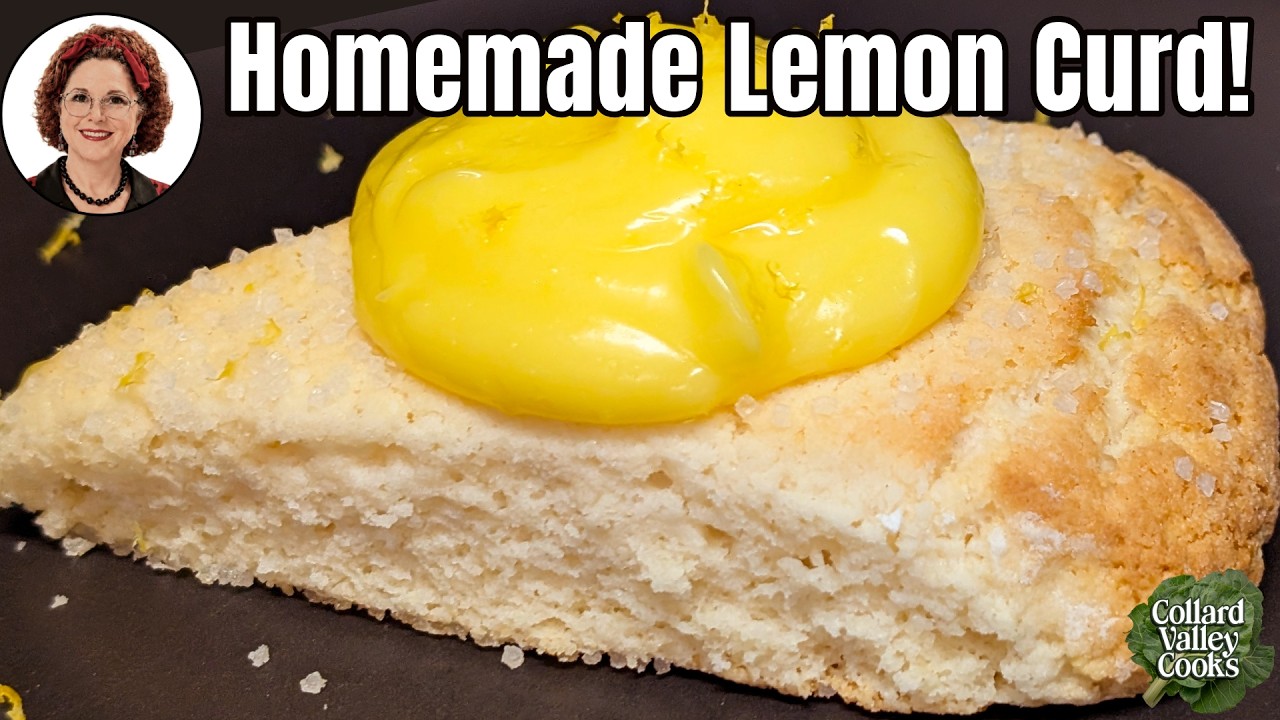
The final product showcases fluffy scones with a sugary crust paired with a deliciously tart and creamy lemon curd that can be enjoyed on its own or spread between cake layers. The baker highlights how simple it is to make this dessert at home without needing to stand over a stove constantly, as the process relies mostly on mixing techniques rather than constant stirring. With options for customization like adding bourbon vanilla or different citrus zest, these scones offer a versatile and comforting treat that captures traditional Southern baking styles while remaining accessible for any home cook looking to share with neighbors or family.
Read the full video transcript
We're going to start out making some
scones.
So, we're going to start with two cups
of self-rising flour.
Two cups.
And you're going to use 1/4 cup of
butter, which is not a lot. Half of a
stick.
Okay. Going in. And you're going to
blend this together with your blending
fork. butter and um
shortening is a breeze with this
blending fork. If you don't have a
blending fork, it'll be the best $10
you've spent. If you like to make
biscuits, scones, streusel, I mean,
there's all kind of things you can use
it for. Some people use it to flip their
meat. Um so, you're going to blend that
in until it's about pa size. And I think
I about got it. And now
we are going to add
half a cup of sugar
cuz this is scones
going in.
And
we're going to put in our whipping
cream.
Now,
I have to be honest with y'all. I didn't
have whipping cream. I'm using um
evaporated milk cuz that's what I got.
So, sometimes we can adapt these recipes
to what we have. We're going to put some
vanilla in it.
Make it good.
I think vanilla would be good with
lemon, but I wasn't too sure about other
spices.
Orange would probably be good.
Mixing up citruses would be fine. And
you're going to mix it together. It says
you may not use the whole cup, and I
didn't. I used about 3/4 of it.
Really, I could have put less in it, but
that's all right.
I forget with that sugar in there. It
makes a difference in the texture of
these things. All right. So, now we're
going to put some flour on the counter.
But see how easy that was? That's all
there is to it, y'all. Now, if you're
going to put berries in them, I fold
them in when I'm rolling them out. I
don't put the berries in the bowl, but
now some people probably do. And that's
fine, but they bust real easy when you
do that.
Especially if you want to try to get
frozen berries in there. Um, it will as
well. You know what? Blueberries would
be good with this and lemon.
Uh, this dough is a lot thicker than a
biscuit dough because it's got all that
sugar in it and the cream. So, it's a
lot heavier dough
than those. I'm just putting a little
bit extra flour in it just because I I
really did add quite a bit of liquid to
it.
All right, you're going to roll them
into a circle.
And you're going to pat them out to
about half a inch. Now, if I were
putting berries in these, I would pat
them out to a quarter inch, put the
berries in them, and then fold it over.
Then flip it over and cut it. All right.
So, we're just going to cut it into It
says eight.
Um,
so we're going to cut it right down the
middle.
So, I'm just going to pick them up with
my scraper.
Or you could just pick them up. They're
kind of like biscuits. And you usually
cook them pretty close together, but I'm
not going to because I don't want them
to take a really long time to get done.
So, normally you'd scoot them all
together and just bake it. I got some
sugar crystals and I'm going to put some
sugar on top of them to make them good.
Then we're going to get them in the oven
and start our lemon curd.
If you're enjoying this video, please
give us a like. If you're new to the
channel, please head down, hit that
subscribe button, and click that bell
for notifications when new videos are
uploaded. Now, I've got some large sugar
crystals. I got them through Amazon.
I've had them for years. And I'm just
going to sprinkle them on there.
I like that little bit of crunch on the
top
when they come out of the oven. And
we're going to slide these in the oven
and get them started.
And I after about 10 minutes, I'm going
to turn it on convection and then we can
really get them out quick. Okay. Now,
let's let's scrape off our mess and
we're going to start our lemon curd. and
you're going to see how easy it is to
make a lemon curry at home. So, we're
going to start it by adding our sugar,
which is a/2 cup.
And you're going to add two tablespoons
of corn starch.
There's one
and two. And y'all going to see how fast
this is.
You're going to whisk this together
really good.
Now we got a question. What is the
difference between lemon curd and lemon
custard?
>> Custard has milk. Lemon curd doesn't. A
custard is milk but you know based and a
lemon curd is almost like a lemon
mering. It doesn't have the milk in it.
There's no milk in it.
All right. So you use water corn starch
to thicken it up. kind of like you do
for strawberry glaze that you put on a
Shony's pie. Kind of like that. So
before you juice your lemons, go ahead
and get some zest off of them and make
sure you don't get down in that white
part. Just constantly turn it.
It says to use two large lemons, y'all,
but I have small lemons, so I'm using
four because I want it to be good and
tart. And you're going to use your zest
in this as well as your lemon juice. So,
go ahead and zest it before you juice
it. And I'm going to save what's in
here. Um, I'll just barely tap it. We're
going to save a little bit of this for
the top of our lemon curd when it comes
out and we get it done just to make it
pretty. All right. So, what we're going
to do now is juice our lemons. And I
just got an oldfashioned juicer right
here. And that's what we're going to
use.
Simple enough.
And I did warm these in the microwave.
I put them on um I didn't put them on
high. I put them on deep like a warming
>> soften.
>> Soften. Yeah. Good. Thank you, Chris. A
soften setting.
>> And I love to use these rind in my
garbage disposal. Cut them up small and
put them down in there. It makes it
smell good.
All right, here we go with the eggs. Are
y'all ready?
These are soft. They're at room
temperature.
So, even doing it this way, when they're
soft like that.
Sometimes
they still want to bust.
They shouldn't. It should do like that.
See how pretty that one is?
You're going to do a half cup of water.
And it's cold water.
You're going to do your lemon juice.
Look at all that pulp. Looks good, don't
it?
>> And your zest.
Your zest.
That's all there is to it.
And you're going to mix it really good.
Now, let me tell them this about my
eggs, y'all. My eggs don't have the
little white things in them because I
don't have a rooster. They're not
fertilized. If you're at the store and
you're using storebought eggs,
a lot of them will have the little white
thing in it and it's where it's been
fertilized. Okay? So, if it has that in
there, um, you don't want to put that
inside your curd. Okay? Cuz it'll make
it it could form a lump.
But I don't have them in my eggs.
And when I say beat it, I mean beat it.
I mean beat the hound out of it like
mama would say or dickens. Beat the
dickens. You little dickens. Did your
mama say that? You little dickens. My
mama did. All right, we're going to get
this in here and we're going to put it
on one minute.
It's simple, y'all. Just so simple.
Get it out. Beat the crap out of it
again.
Now, once it sets up, that's when you
put your butter in
and we'll take a look at our sponge. So,
it's every minute
you get it out.
All right. See, it's getting thicker,
y'all. Look. You see that?
So, I'm I'm using a different whisk this
time.
You don't have to,
but you really need to beat it.
And if you don't have the arm power to
do that, then I suggest this is ready.
Then I suggest you um
use a mixer, hand mixer. Look how pretty
it is. Now we're going to put in the
half cup of butter. It's done, y'all. A
lot of people think they have to um
>> stand over the stove.
>> Stand over the stove.
But it's too much trouble. And this is
how easy it is to make a lemon mering
pie, too. It's almost the same thing.
The difference is that you don't use as
many egg yellows.
Here, I'm going to pour just a little
bit of this in here to make up the rest
of the half cup.
So once it's done,
then you beat in the butter.
Oh, it smells good.
Lemon curd is delicious, y'all.
Absolutely delicious.
You smell it, Chris?
>> Yep.
>> Smells good, don't you?
>> All right, let's pour it up in a jar.
I'll show you how pretty it is. This is
what I should be doing with all my eggs.
Making a bunch of lemon curd and giving
it to the neighbors.
Now, this is really good in between
coconut cake layers.
>> And it's really good in a lemon cream
cake.
Um like I could make a lemon cream cake
this week and spread this in between the
cake layers. Oh, would be good.
Perfect.
They look beautiful.
All right.
Get this out.
Boy, that looks good, don't it? And that
sugar on the top looks good. If you
don't have some big sugar, uh, go on
Amazon and get you some. You'll be glad
you did.
>> Put it right on top. Huh?
>> Yep.
We're going to give it a try, y'all.
I'll take my picture after we go. Look
at that. What a dessert.
Now, I can't eat this whole thing and
Chris can't either, so we'll share it.
Okay. But I want the crunchy part at the
end right here.
But whenever you make a scone, they're
nice and fluffy on the inside.
Let me show it to you.
See it? Fluffy.
That is really delicious.
You can really taste that bourbon
vanilla in there, too.
You can't beat that. I might have to
take some of this to my neighbor. I hope
y'all have a blessed day and we thank
you for watching Collard Valley Cooks
where we cook like our mas did. Bye
y'all. Love you.