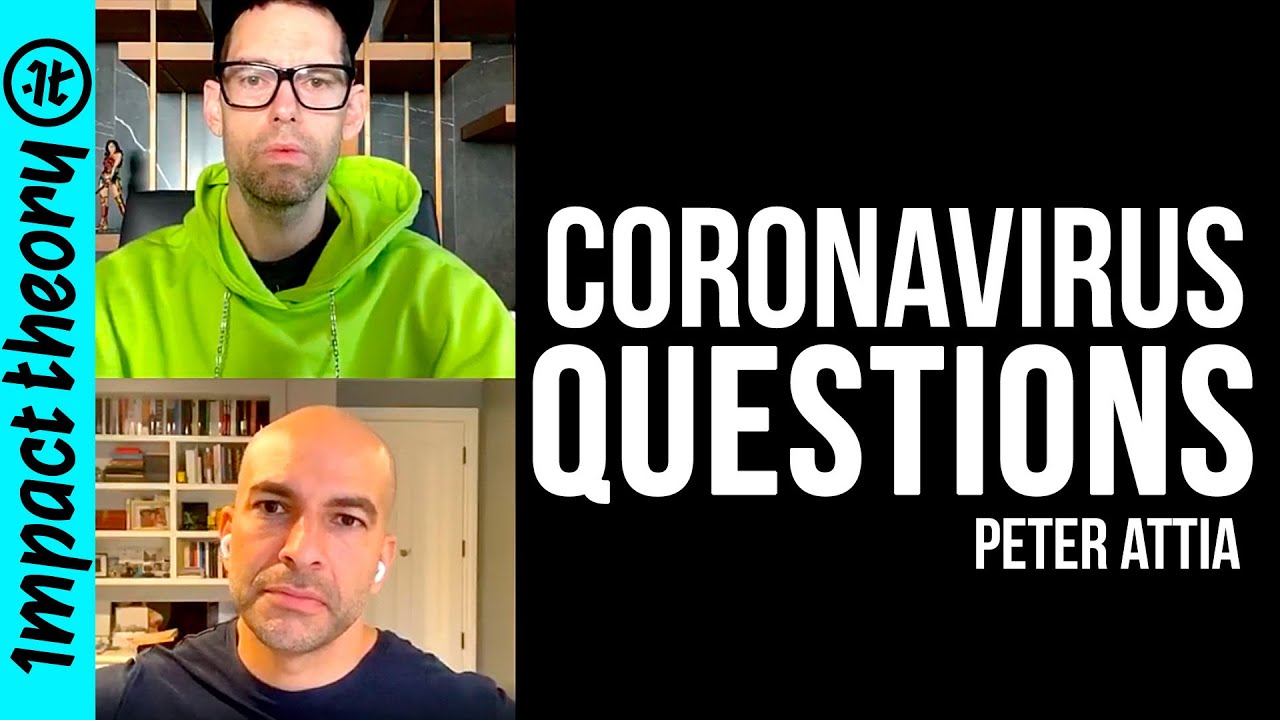
How to Make Sense of the Constantly Shifting Info on the Coronavirus | Tom Bilyeu & Peter Attia
Watch on YouTubeVideo summary
In this high-stakes conversation, Dr. Peter Attia joins Tom Bilyeu to address the rapidly evolving landscape of the coronavirus pandemic from a medical and longevity perspective. Attia emphasizes that while their research team has pivoted resources over the last few weeks to model virus spread using experts from hedge funds and medical students, significant uncertainties remain regarding immunity and drug strategies. He notes that unlike mild coronaviruses which typically do not confer lasting immunity, this new strain may offer some protection similar to SARS or MERS but is likely intermediate in nature. Crucially, Attia warns against relying on anecdotal evidence for treatments; while many drugs show promise through off-label use, a fully vetted strategy based on randomized control trials has yet to be established. His primary advice for immediate safety remains robust social distancing at both individual and societal levels, acknowledging that the economic impact of zero-revenue scenarios is unprecedented but necessary to curb a virus designed to spread before symptoms appear. Regarding personal health optimization during quarantine, Attia challenges listeners to balance their usual high-performance regimens with current physiological needs. He argues that while exercise induces short-term stress (hormesis) beneficial for long-term adaptation, the intense training required to maintain peak fitness is not optimal when one's goal shifts from being "the fittest" to being "healthiest." Consequently, he recommends dialing back high-intensity interval training in favor of daily moderate activity like bodyweight exercises. Similarly, while short-term time-restricted feeding or intermittent fasting can help manage stress-eating tendencies without causing harm, Attia advises against prolonged fasts (three to seven days) as they elevate cortisol levels and mimic a starvation response that is counterproductive during this crisis. He also addresses cold exposure, noting its benefits for muscle recovery and potential antidepressant effects but clarifying that evidence supporting immune-boosting properties of cold therapy is lacking compared to heat therapy. Nutritional strategies are another focal point, with Attia advocating for targeted supplementation over generic multivitamins which often contain insufficient active ingredients. He identifies zinc (30–50 mg in bioavailable forms like lozenges) and Vitamin D as critical supplements, particularly for those unable to access sunlight or fresh produce due to quarantine restrictions. While red meat contains some vitamin C, it is only sufficient if consumed without carbohydrates; otherwise, direct supplementation with Vitamin C is recommended. Furthermore, Attia suggests a pragmatic approach to food sourcing: rather than making drastic dietary pivots that might lead to poor choices during supply shortages, individuals should focus on washing hard-skinned vegetables like tomatoes and peppers thoroughly while avoiding soft produce such as lettuce or berries where the virus could persist. He also highlights the importance of getting fresh air whenever possible, even if it means sticking one's head out a window in an apartment building. Beyond physical health, Attia stresses that mental well-being is equally critical given the psychological fallout observed after previous pandemics like the 1918 flu and SARS. Drawing parallels to Winston Churchill coping with World War II stress, he encourages listeners to distinguish between "dead time" (passive consumption of media) and "live time," urging people to engage in hobbies, reading novels, or other distractions that provide a sense of agency. To manage the inevitable anxiety and irritability, Attia shares his personal practice of conducting frequent emotional check-ins rather than suppressing feelings until an eruption occurs. By treating emotions like a rheostat instead of a digital on/off switch, individuals can recognize displacement tension early and address underlying fears directly. Ultimately, he concludes that controlling one's attention is the most powerful tool available; focusing on stories of community resilience and human ingenuity offers a more constructive path forward than dwelling on negative news cycles or worst-case scenarios.
Read the full video transcript
all right what's up everybody we're
gonna be talking to the extraordinary
dr. Peter Atia today I'm very excited to
bring him to you guys he is somebody
that we've had on the show a few times
he's also somebody that I know
personally and I think he's a super
extraordinary dude
so he'll be giving us some insights into
kovat 19 what's going on from a medical
perspective what's going on in the
healthcare system what we can do to
protect ourselves all that good stuff so
yeah he should be joining us any minute
again we're gonna be joined by dr. Peter
attea today if you guys haven't seen the
episode episode or episodes I can't
remember if we've had him on multiple
times or not but just a super
extraordinary guy I've known him now for
many years Wow and is just an incredible
incredible thinker he is he's done an
amazing TED talk too by the way so yeah
super super smart guy very well-versed
in all things medicine related the human
body longevity all of that stuff he's
also an extraordinary concierge doctor
so he works with a lot of people doing
some pretty in-depth analysis of the
human body and what it responds to in
terms of living a high quality life for
as long as humanly possible and so he is
gonna be joining us this morning thank
you so much for joining us today and I
imagine you're doing this all day long
now with people given your expertise and
how have you been approaching learning
about Kovan 19 well I mean you know
luckily we've got a research team that's
sort of spent the last whatever five six
years thinking about longevity which is
completely unrelated to this but at
least we have the infrastructure in
place of a team that can be basically
redirected so it's super hard I mean we
have to basically pivot every other day
and if I think about what we've learned
in the last four weeks it's
it's it's staggering and if I also think
about how many times we thought we knew
and understood something only to realize
a few days later no that's probably not
correct so we have many different things
that we're pursuing and and on top of
that we've got people who are now
volunteering to help us we've got you
know guys that work at hedge funds that
would normally be modeling you know
market scenarios that are saying how can
we help and so now they're helping build
the models that we're using to try to
understand spread and we've got other
people who you know you know medical
students pre-meds that normally you know
do volunteer work that are saying hey
how can i help contribute to these
efforts with respect to doing research
so it's it's been in that sense it's
been actually quite humbling to see how
much people just want to help that's
that's actually really extraordinary and
look there's I wouldn't wish this on
anybody but watching people come
together seeing the outpouring of people
really trying to help make other
people's lives better is it's a pretty
cool response so walk me through you've
talked about how a day in the life of
kovat 19 is like a month em anywhere
else what if what if we learned in the
last couple days that maybe we didn't
understand before like you were saying
that people should be aware of well I
mean I think we are probably seeing that
there is some evidence of lasting
immunity so that's one piece of good
news is that people who are recovering
from this based on some animal data at
least should have some protection at
least for the year coronaviruses are
kind of different viruses and they we
generally don't get lasting immunity
from them the mild ones at least we you
know people did get lasting immunity
from the really severe ones that caused
SARS in oh three oh four and MERS this
is probably gonna be somewhere in
between that's going to probably become
relevant over the coming year I think
the other thing that we're learning is
that we still don't really have an
effective drug strategy that's been
truly vetted in other words we have lots
of anecdotal stuff we have a lot of
what's called off-label use and open
label use which means things that are
being tested but without random
as control trials that look somewhat
safe and somewhat promising but the
reality of it is we don't yet have a
fully vetted strategy around drugs I
think the other thing we're seeing is
that you know New York does probably
look like it's headed for a real stress
on its healthcare delivery system our
view a week ago today was that it would
probably happen within one to two weeks
which means sometime this week
you know our projections if they were
half right would suggest that there's
really going to be a mismatch between
how many people need medical care in New
York and how many don't the data as of
last night were basically about a
thousand deaths in New York but they're
disproportionately in the borough's so
how does one interpret that well we
interpret that to mean that the people
in the borough's were the most affected
to begin with because they were probably
the ones that were most in the subways
commuting into and out of the city so
actual deaths in Manhattan of those
thousand were probably less than 200 so
it's still I think a bit too soon to say
but unfortunately if I had to guess I
think the number of infected people in
New York is is much higher than we
realize now and so what can people be
doing to protect their immune system or
is that sort of a joke and don't even
focus on that just focus on isolation
what what's the best strategy right now
for staying safe I think it's all of the
above I I do think that there's probably
nothing that beats you know robust
social distancing both at the individual
level and obviously at the the societal
level for the short term we're seeing
the economic consequences of that are
probably much more grave than certainly
than I expected or understood I felt for
this realization and talking with a
bunch of people and you can think about
this because you understand how
businesses work I'm sure your listeners
do as well there's there's probably no
business out there that's ever modeled
zero revenue as a scenario you know when
you're scenario planning you know you
might say well you know
really go badly you know maybe we'll see
a 20% reduction in in revenue but but
there's no such thing as well why don't
we just model six months of no rest like
that that's never been done right so so
that you know I say all that to say like
I don't take this idea of social
distancing lightly but you have to be
able to put this virus back on its heels
and a big part of that is is sort of
stopping the spread of a virus that
really if you were designing a virus to
be maximally destructive you would
definitely take a few things from the
Tsarskoe V twos playbook it's not the
most deadly virus in the world you know
in other words this is not a virus that
wipes our species off the planet but if
you wanted to make such a virus you
would absolutely take some things that
this virus does namely that it can be
very infectious long before you are
symptomatic that's a very powerful tool
and a viruses toolkit to spread so going
back to your question look I think that
the most important thing people can do
for their immune system is sleep
I think of all of the levers we pull you
know getting eight hours of sleep a
night is going to move the needle as
much as any I think other things that
matter are exercising every day but not
doing it at at super high intensity so
kind of two types of people right there
are people that don't exercise enough
generally they need to be exercising
more and then there are probably people
like you and I who exercise a lot and
probably exercise a little too much and
a little too intense we have to actually
dial it back so I'm you know really
focusing on exercising every day but
only about an hour and not at the level
of intensity that I would normally and
you know a lot of it's just body weight
stuff it's just sort of moving it's just
being active and it's as important for
my head as it is for my my body with
respect to food that's been a huge
challenge for me you know I tend to
stress eat a little more than I would
care to admit so I've been kind of just
focusing on doing more time restricted
feeding it's just a little easier for me
to be binary and you know at least say
okay how about I just don't eat anything
for these 18 or 20 hours as opposed to
well
allowing myself the liberty of stress
grazing yeah that that I was actually
thinking about you the other day I
remember the story that you told about
if you have if I remember I was cashews
to have cashews in the house they have
to be hidden and you can't know where
they are and I thought well what's he
doing in lockdown where it's like the
either to not have anything that you
want and and it be psychologically
taxing in that way because you just
can't have anything delicious in the
house or like does he have to go hide
while his wife pulls it out of hiding so
he he doesn't see like what part of the
house she goes to was just nice my
littlest kid is potty training right now
and his reward is M&Ms every time he
goes you know peepee on the potty he
gets his M&M and the problem is I was
just eating them by the handful every
time I walked by and I would rationalize
it by saying well look I'm using the
potty so loud so yeah we finally had to
put the kibosh on that so the M&Ms are
in hiding I don't get to know where they
are and that's the way it is as far as
you know I get asked a lot about
supplements and stuff and I saw some
people are asking questions about
supplements I think at this point you
know there's reasonable evidence that
zinc is probably worth taking the
challenge of course is in what format so
zinc is not necessarily the most
bioavailable thing depending on how you
take it
but you know you're generally going to
need about I don't know call it you know
30 to 50 milligrams of a relatively
bioavailable zinc the lozenges which are
typically pretty good have been kind of
sold out on Amazon for quite some time
so you know zinc supplementation
probably makes a little bit of sense you
know as far as anything else I think
it's just too hard to say and my concern
with it is I wouldn't want to give
somebody a false sense of confidence
that because they're taking you know
vitamin C or vitamin D which also is
probably quite important especially if
you can't get out into sunlight so you
know people who live in parts of the
country or the world where they can
still despite a quarantine get out and
get sunshine I think that's hugely
important to get vitamin D in the
natural way if people can't then
I think supplementing vitamin D would
also matter but again you just don't
want people to think that that protects
them from washing their hands and things
like that yeah and of course distancing
from you know people who themselves are
not able to quarantine so going back to
the notion that you were talking about
with be a little bit careful about
definitely be careful about under
working out but you actually have to be
careful about over working out so I have
a regimen
I take cold showers every day I work out
every day I intermittent fasting day I
would love to stop all of them so you've
already addressed the working out what
about cold showers what about
intermittent fasting what about
prolonged fasting where we're in that
sort of do hard things um to prolong
your life regimen do we find that we
might be cracking over into creating too
much of a stress response so let's look
at the one area where we have the most
data on that tom is exercise so it's
been clearly studied the different types
of exercise and how they trickle into a
stress response so remember everything
that you just described is a short term
stress or hormesis that is meant to
produce a long term adaptation that is
beneficial right so exercise is
stressful right exercise breaks down
muscle it taxes the body and it's our
response to that that is beneficial so
when we look at exercise and we look at
sort of modest low intensity aerobic
exercise we observe that the immune
system transiently actually gets
stronger not weaker as a result of that
conversely when we look at studies of
high-intensity interval training we find
a transient reduction in immune system
before a bounce-back
and again that's probably because that
high intensity training causes an
overabundance of stress in the short
period of time and while that produces
great physiologic benefits down the line
I think we have to figure out what we're
optimizing for it in this moment are you
optimizing to be the fittest version of
Tom or the healthiest version those
aren't necessarily the same thing so how
do we extrapolate that to fasting
because that's something I think a lot
about well I think we also know that
prolonged fasting you know three four or
five seven day fast
actually raise cortisol levels they're
actually quite stressful in the short
run because evolutionarily when you know
our ancestors didn't eat for three days
that was a bit of a kick in the butt to
go out get food be more efficient you
know we we require less sleep during
periods of intense fasting in part for
that reason so for that reason I just I
just don't think this is the time to be
doing prolonged fasting you know I think
the typical three to seven day fast that
I do you know with great frequency I'm
just going to be holding off on those
until I have a little bit more clarity
that said there's no evidence that short
term you know time restricted feeding is
problematic and I think in many ways
timer triggered feeding is an efficient
way for us to manage if you're someone
like me stress eating if you're just
looking to have a little bit control I
mean you know yesterday I did a nomad
which I haven't done in a while and I
just felt a lot better than I felt
during the sort of grazing of food all
day which is what Sonoma - sorry one
meal a day so I just had you know dinner
Sunday dinner Monday I'll probably just
do it again today I won't eat it until I
have dinner tonight that's kind of a
long time restricted feeding yeah for
sure and what do you think about cold
exposure where do you fall on that yeah
I've looked a lot into cold exposure and
heat exposure for different reasons
my cold exposure is quite interesting
really the data on cold exposure so I
think two reasonable lines of benefit
the first is it clearly has a benefit in
what's called delayed onset muscle
soreness or Dom's so if people use cold
exposure as a way to recover from
training it definitely shows an
improvement in symptoms there but of
course given that we're not going to be
training to the point of crushing
ourselves it's not clear that that's as
important I think the other area where
cold immersion seems to be beneficial is
probably from a neuro perspective I
think there's reasonable evidence that
there are some anti-depressive
properties of cold immersion especially
with respect to neurotransmitters that
have anti-depressive benefits contrary
to popular belief there's really a
complete dearth of evidence
staying that cold therapy boosts immune
function reduces you know other types of
inflammation or generally produce as
much benefit I mean the benefits on heat
therapy are much greater than cold
therapy so I'm not I I guess I wouldn't
say that cold therapy is necessarily
harmful because I don't think you know
it produces any downsides obviously mild
cold therapy is also known to activate
brown fat which is metabolically quite
active and truthfully I it doesn't occur
to me that that would necessarily be a
bad thing or necessarily a beneficial
thing so I guess long-winded answer
would be if cold therapy helps you feel
better like literally for some people I
think it is just an amazing
antidepressant this would be a great
time for it because I think for many of
us right now the sort of anxiety and
uncertainty of what's going on is itself
a burden I've seen one thing go through
the comments a lot which is people
wanting to know if a multivitamin is
something that will be useful I'm
assuming if it doesn't contain zinc that
it's probably zinc and vitamin D where
as you were talking sort of the two
things I took away as maybe being the
most important but is there a
multivitamin that you recommend or is it
a way no I think I think multivitamins
are not great because they basically
have too little of the things you want
and generally more of the things you
don't care for so I my view is if you're
going to supplement something if you if
you believe that you can't get enough
vitamin D from sunlight then you really
probably need to just be taking
straight-up vitamin d3 and you know
probably 2 to 5,000 IU is the sufficient
similarly if you're not getting enough
vitamin C in your diet you know you
probably ought to just fully supplement
vitamin C and if you're not getting
enough of the B is b6 b12 folic acid you
know again if you again this is an
important point to consider right there
are many people who aren't able to get
fresh foods the way they once would so
again those are times when you want to
turn to supplementation but my view is
go directly for the supplement as
opposed to the multi I don't never
really understood the value of
multivitamins except for marketing
very fair so in in a time of limited
access to foods if we were going to try
to do it all through foods which I
certainly will do my best I try to get
sunlight as close to everyday as humanly
possible I'm very fortunate to live in
Los Angeles where it's not exactly a
hardship to even just like stick your
head out of window and I've tried to
revisit so obviously I'm in a fortunate
position now where it's much easier to
deal with being in a quarantine I'm
trying to revisit like what this
quarantine would look like at the
different phases in my life when I was
dirt poor didn't even have a balcony you
know it was like but there was one
window in the house you could wind open
in the kitchen and it's like you know
could if you legitimately could not walk
out your front door could you at least
you know stick your head out the window
the importance of getting fresh air but
anyway that's that sort of a cyclone
what I really wanted to ask was if we
were going to try to do all of this
without supplementation what are the
things like should we be getting red
meat because I know that red meat
contains all the vitamin C that you're
going to need should we be eating
certain leafy greens like what are the
like four or five things if we know that
we only have access to a limited number
of sort of widely available things what
would that selection be well I mean you
know we have to be careful about
assuming we can get enough vitamin C and
meat that's really only true if you're
not consuming carbohydrates with it so
in the case of like the Inuit and the
Masai who are basically just eating meat
you're right they could get trace
amounts of vitamin C in there but
because they didn't have any glucose in
their diets it was sufficient but if one
is you know eating meat and potatoes but
not eating you know anything that's
citrusy lemons oranges things like that
they're probably not getting enough
vitamin C and they might want to
supplement it with respect to vegetables
you know we've taken a cautious
principle internally in our practice now
and recommended the following to our
patients most of us of course are
getting groceries delivered
intermittently if you're not you know
lucky enough to have a garden where you
can grow your own stuff we take this
idea pretty seriously that you want to
be able to assume that any piece of food
that comes in your
is carrying a virus on it and the good
thing about this virus is we know that
it's quite susceptible to soap and water
you know it's not like a virus that is
unkillable but you've got to be able to
you know scrub it with soap and water so
things like lettuce berries things where
the surfaces are just not amenable to a
full cleaning we're just kind of
avoiding and you know you've heard me
joke about how much I love salad every
day I need a salad in a bowl the size of
my head so that salad has morphed so
that salad now is which used to be a
very leafy sort of salad is now
basically tomatoes cucumbers carrots and
bell peppers which are basically all
things you can completely wash cut up a
little olive oil lemon juice in a way we
go so that's kind of a pivot that I've
made on that front and then if you know
it's also sort of you know relying on
so so far less fruit than normal and you
know again we're fortunate from a meat
standpoint because I hunt and we've got
a freezer that's just sort of stockpile
you know venison but again I sort of
think like it's the biggest issue with
respect to food is like trying to
minimize the destructive eating I think
it's you know I don't think this is a
time to make enormous dietary pivots
right if somebody normally likes to eat
red meat great keep eating it but you
know make it the highest quality that
you're able to get and acknowledge that
any port in the storm means like half
the time when we look at instacart or
whatever we're using the ordering like
you just can't get what you want
sometimes so you know you sort of pick
and choose your battles the other thing
I want to come back to that I I really
hope to have a better bead on within the
next two weeks is what is going to be
the availability of protective masks
because as we go to the point that you
raised you're someone who lives in a
tiny apartment building in New York you
barely have a window to look out you
know what is it going to mean for your
sanity to be able to get outside well I
think it's gonna need a hell of a lot
and I think the evidence is emerging
rapidly in the past few days that you
know that the proper type of mask is
truly protective now
again a month ago the message was no
this is not the case and I think there's
been some real bungling of this through
through through some of the the sort of
political responses to this but I but I
think if you really look at the proper
use of an n95 mask I think it is both a
great tool to protect a person who's
wearing it from others and to protect
others from the person wearing it in
other words I think there really is
emerging evidence that if we were all
gonna walk around with masks outside and
take great precaution we could start to
mobilize a little more than we are so
what I'm hoping is we get to a point
where the production of those masks is
ramped up now 3m which is the leading
manufacturer of the n95 masks is able to
make I want to say 35 million of those
masks a month so we maybe it's a week
and of course it matters greatly the
point is whatever they're able to make
right now is probably gonna take us a
while to have a sufficient number of
these things that's a week so so we've
we've you know I think we're still early
in the days of knowing that everybody
can have sufficient access to these
things and obviously you have to
prioritize who gets them first and
nobody needs them more than health care
workers but I do hope that you know a
month from now we're sitting having this
discussion when everybody's got an n95
mask and that is opening up the door for
them to actually get outside and start
to interact with the world again because
I I think that's you know listen it's a
real you know challenge for everybody
that's in quarantine
yeah mental health is obviously with
what I do and the thing that I guess I
know about in terms of dealing with the
public that's that's been huge a lot of
questions around that and I think that
there's going to be a lot of it it isn't
as much of a part of the public
discourse in terms of this effect on
people's psychology we don't have a lot
of time left with you so what I want to
ask is there anything that you think
that people can do during quarantine to
optimize for that whether that's to hey
do bodyweight workouts because of the
you know BDNF and things that are going
to help you pull yourself
psychologically or physiologically out
of a bad psychological state or is it
just some is there any optimistic news
that you can impart around what's going
on with kovat nineteen that would be
amazing you know there is you point of
time we're putting out podcasts at a
great clip right now far more than our
normal clip and every podcast we put out
in the last three weeks including one
that's going to come out today I mean
they're just exclusively geared to this
none of the content is behind a paywall
and I would just kind of direct people
to that so for example you know
interview I had with Ryan holiday a week
ago is just a great you know really
dealing with the psychology of this
stuff in fact we've had two episodes one
win Sam Harrison one with Rick Elias I
mean that pardon me with Ryan holiday
that have just dealt with sort of these
questions and you know one of the things
that Ryan brought up that I really liked
was the you know the difference between
dead time and a live time so you know
you we don't have much control over the
fact that we're all kind of corn but
there's a way to sort of take that
situation and make something great of it
and and look it's tempting to say maybe
I'm just going to sit here and watch
Netflix all day long but that's kind of
dead time right and so maybe you know
watch Netflix for an hour a day but
spend time reading completely unplugging
from the situation and going through
those novels you have not had the time
to look through or you know picking up a
hobby like you know there are other
little goofy things I'm trying to make
time to do everyday that don't seem to
add much value to my immediate life
they're a great distraction you know we
talk a lot about Winston Churchill on
this podcast and how he kind of coped
with this never-ending stress of you
know the Second World War and how
despite that he's done still found time
to be still so I do I think that the the
mental health component of this time is
enormous and it's only going to get more
important as time goes on and in fact I
was reading an article this morning
that talked about the psychological
fallout of each of the previous
pandemics from the 1918 flu to SARS MERS
and h1n1 and actually it's very
disturbing some of the lingering trends
we see both in health care workers who
face protracted burnout following these
things and also a number of the people
who have been in quarantine and then all
of a sudden start to develop phobias
that make it harder for them to go out
even when the quarantine is over so I'm
glad people are paying attention to this
now because I think it's going to be an
enormous area of of attention it's going
to need to be an enormous area of
attention regardless of how this thing
resolves yeah so that word attention I
think is is super critical for people to
hear your whatever you point your
attention at you're going to see more of
and look this is this is certainly not
an easy time but the only thing that I
think is gonna make it worse for people
is if you focus on all of the negative
if you focus on all the ways that things
are going wrong we started a podcast or
whatever this is the IG live by talking
about you know some of the ways that
people are coming together and the ways
that people have been offering their
assistance you for free just to like
help you model things out people that in
any other time certainly in our
lifetimes would have been pointed at you
know something else something probably
revenue-generating
and you know there there really is this
cool other thing happening that is
people doing their best to reach out to
connect to find excuse me find ways to
do things with their time like you said
to make it more a lifetime so I'm super
interested in that and I think that
trying to get people to understand that
they control their attention and what it
gets aimed at will be huge I I hadn't
thought of Winston Churchill in this
context but that's actually really
interesting and there's a forget I said
it but there's a quote about meditation
which is if you don't have ten minutes
to meditate you're the person who needs
to meditate the most and I think that
that's really true and for people to
take time to really begin to you know
get their head in the right place is
going to be pretty critical I've heard
you
talk about how you've been a little more
irritable through this what have you
done to deal with that what are you
doing to focus yourself on something
that stays in a more positive direction
I'm trying to be more attentive to my
emotions so I tend to suppress them and
ignore them and they only become
apparent when I'm about to erupt so it's
like I sort of live on an emotional
binary scale I'm digitally emotional
like zero one zero one and I'm trying to
be more analog right like a rheostat so
that means you know when my kids are
just completely driving me bananas I try
to hit a pause a little sooner in the
process and say is it really upsetting
you that they're doing this or that or
are you actually upset about something
else and you're starting to displace
your tension towards them it's actually
made a really big difference I mean that
sounds like a very cliche thing to do
but this very deliberate focus on doing
what's called an emotional check-in has
been really powerful and ever since I
had that really bad couple of days where
I was just like kind of losing my mind
and flipping out at the kids over
seemingly nothing these these very
frequent emotional check-ins have been a
helpful way to do it and of course if
you can do it with somebody if you can
do it with your spouse and doesn't have
to be somebody in person I think that's
a really valuable thing to do it's just
to be able to say look man I feel scared
today like and every day I sort of my
wife asks for my sort of temperature you
know how are you feeling today and I'm
like you know some days I'm like I'm
totally optimistic like we're gonna you
know this is gonna happen is gonna
happen there's other days I'm like like
last night I was just really depressed
and I went to bed and I was like this is
gonna be a disaster and and and again
neither of those extremes are likely
true but how you feel definitely impacts
how you color the world yeah that that
is for sure well my friend thank you so
much for joining me dude it is always
awesome to connect with you and spend a
few minutes together your insights are
absolutely extraordinary thank you for
being on the front lines of this for
making so much your content available to
everybody there
resources that you have at your command
not the least of which your own mind is
is unbelievable man and I am super
excited that I live in a world where
you're putting out this content it's a
game changer so thanks for showing up
thanks for talking people through this
difficult time and hopefully I will
connect with you soon
thanks man be well all right same
everybody out there be safe take care of
yourself wash those hands get some
sunlight eat right exercise a little bit
but not too much and we will get through
this
I promise keep your head right everybody
all right peace out take care