Video summary
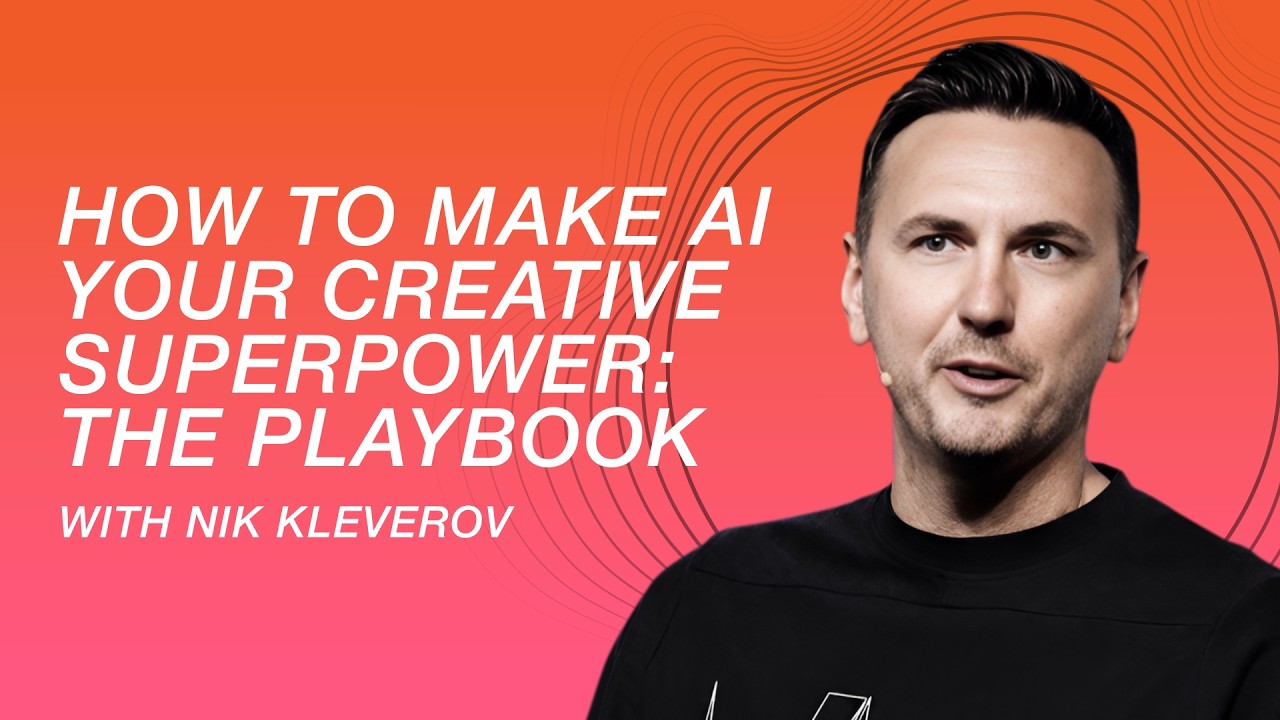
Nik Kleverov, a creative officer leading storytelling efforts for major brands, shares his journey of integrating artificial intelligence into traditional advertising and film production. He recounts early collaborations with OpenAI, where his team utilized pioneering text-to-video tools to create the award-winning short film "Critters," proving that AI could be used for irreverent, family-friendly content rather than just dystopian sci-fi. This experience established his agency as a pioneer in the space, leading to high-profile partnerships like the origin story of Jeffrey the Giraffe for Toys "R" Us and innovative campaigns for Coca-Cola and Delta Air Lines. Through these projects, Kleverov demonstrates that AI serves as a powerful supplement to human creativity rather than a replacement, allowing teams to visualize complex concepts, such as future flight scenarios or mythical mermaid stories for cruise lines, with unprecedented speed and flexibility.
The integration of AI has fundamentally shifted the creative workflow, blurring the lines between pre-production, production, and post-production phases. Kleverov argues that editors have effectively become the new directors in this era, orchestrating a malleable process where pieces are plugged together and refined iteratively. While acknowledging valid concerns about job security among highly specialized professionals, he emphasizes the rise of versatile generalists who can leverage AI tools to deliver work faster without sacrificing quality. He highlights instances where traditional artists initially resistant to AI eventually embraced it to enhance their efficiency, noting that the technology is additive rather than substitutive when used with intention and purpose. This shift encourages a mindset focused on shipping great ideas quickly, as the ability to iterate rapidly becomes a key competitive advantage in the modern creative landscape.
Despite the technological advancements, Kleverov insists that maintaining human authorship and emotional resonance remains critical, a stance reinforced by his team securing the first copyright for an AI-generated short film through meticulous documentation of human contributions. He addresses common fears regarding "AI slop" and lack of diversity by explaining that high-quality results depend on thoughtful direction and high-resolution input data, noting that tool providers are actively working to fix biases in representation. Furthermore, he predicts that within the next five years, the distinction between AI-generated and traditional content will become irrelevant to audiences, much like the current perception of Photoshop usage. To ensure transparency in a future where most visual content is AI-assisted, he suggests that blockchain verification for geo-tagged and timestamped media may become essential for distinguishing reality from fabrication.
Ultimately, Kleverov envisions a future where human creativity and AI systems collaborate seamlessly to expand storytelling possibilities without flooding the internet with low-effort content. He believes that the most successful creatives will be those who use these tools to tell stories they previously could not imagine, whether through detailed previs for live-action shoots or bringing 3D renders of unbuilt restaurants to life. By keeping humans in the loop at every stage and focusing on genuine connection with audiences, the industry can navigate the ethical and practical challenges of this new medium. As he concludes, the adoption of AI is not about abandoning artistic integrity but about empowering storytellers to push boundaries, hire diverse talent from various backgrounds, and continue producing meaningful work that resonates deeply with people around the world.
Read the full video transcript
Welcome to AdSe Week's podcast about the
business of marketing, media, and
creativity. In this episode, we're
sharing a conversation recorded live at
one of AdWeek's events featuring leaders
from across the industry discussing the
ideas shaping brands right now. Let's
get into it.
As the creative officer of this brand
storytelling creative agency, you know,
um my job is to kind of usher in what's
happening with AI. We started in a
pre-AI world actually and and we started
doing brain storytelling for startups to
Fortune 100s, kind of everything in
between. My favorite startup that we've
worked with is a little company called
Open AI and you know working with them
funny enough a lot of the work we do for
them is actually documentary. It's in
the documentary space and we got we were
one of the first creative agencies to
really be working with them and they
gave us access to some tools in 2022. I
was playing with a tool called Dolly
which actually predated Midjourney. It
predated Chad GPT and it was a text to
video tool. When playing with I was like
man we could actually probably use this
tool for storytelling. So we convinced
Open AI to fund a short film called
Critters. You just saw a little blip of
it. And Critters was kind of a David
Admiral Planet Earth crashing into a
Monty Python sketch. And in an era where
all the AI demo videos coming out were
like dystopian sci-fi futures, we made
this cute little irreverent fun family
thing that was very successful in the
sense that it went to a lot of
festivals. It was nominated for and won
a bunch of awards, including a PGA
innovation award. And what we kind of
learned from that is, wow, like we can
actually use these tools to do anything.
and being in with open uh when they
decided to go multimodal I was invited
as one of the first seven people in the
world uh to use Sora their texttovideo
tool obviously when that came out it was
a really big deal people's minds
exploded uh they called us the Sora 7 as
if we went to the moon or something and
uh you know everyone's films were great
friends with all of them there's like a
lot of very interesting artful films I
decided to take the lane of the brand
world being a bit of an ad guy myself.
That's what I do every day. And also
advertising is always pushing innovation
and we're able to tell these short
stories and all innovation in in film
making really happens from advertising
for the last half century or more. And I
wanted to find a partner that was
meaningful, had that legacy, but also
nimble enough to move with us and
partner with us cuz I wanted to make a
real piece. Everyone in here knows it's
very different to make something by
yourself or for fun versus with a client
partner. And that partner was Toys R Us.
Fantastic partner that, you know, we
were able to come together and we were
able to do the origin story of Jeffrey
the Giraffe. Charles Lazarus falls
asleep in his dad's bike shop. He wakes
up, you know, he sees Jeffrey and and
the rest is history. Uh, of course, it
was very hard to make that with text
video. This was pre-image upload tools.
You know, try typing out an
anthropomorphic giraffe with yellow, you
know, brown stars instead of stripes. I
mean, it was chaos making the piece
truly. But we learned a lot and we also
kind of established ourselves as a
leader and pioneer in the AI space.
Since then, a lot of the work we do is
more of the AI nature, although we do
still pick up cameras and and shoot
things every now and then. Um, being
here in Atlanta, I'll mention, you know,
we work with Coca-Cola, we work with
Delta, as you saw there. We were part of
the Delta Centennial Celebration at the
Sphere this year, which was really
exciting. being a bit of a Delta fanboy
myself and uh thirdyear diamond it was
uh very fun to and by the way like real
like not on Delta 1 like I'm putting in
the work I'm putting in the hours I'm
flying so you know you're welcome Delta
um but you know working with them we did
this beautiful film with Bola Davis Han
Zimmer that was live action but we also
used AI to explore what the future of
flight would look like through the eyes
of kids and then we would play that back
to the kids and you see that wonderment
so to me it's always about keeping that
human in the loop and human element in
everything we do. The little short film
I mentioned that we did prior is now
becoming one of the first AI feature
films. It's the only film being backed
by OpenAI and you know we're really
excited to have that ready next year. We
are going to also explore other
expressions of IP and that's you know
obviously storytelling comes in many
forms. So I'm also very interested in
what the future will bring and how we
interact with IP. So that's me in a
nutshell. Um, thanks for joining me for
this AMA. I've got some questions here.
So, I'm guessing these are from you all
in the audience. So, I'll I'll get
through these really quickly here. Um,
number one, when you created the first
AIdriven brand film for Toys R Us, what
did that moment tell you about where
creativity is headed? I'll say this, and
this is the first time I'm reading
these, so these are not planned answers.
Um, I had become a bit of a jaded kind
of like business guy. You know, being a
partner at our our agency, you know, I
think about the bottom line. you know, I
have to do a bunch of boring stuff. And
I've been really creatively invigorated
in the last couple years. Like, I'm back
on the box. I'm on the system. I'm doing
things. And I will say that I think that
the AI tools, I'm very optimistic. If
you can tell about them, I think they're
going to help creatives really dive in
and be able to tell stories that they
weren't able to tell before. Cuz that's
what what I've been able to do. My dad
was a famous artist in Soviet Russia. He
painted for the freedom, you know, he
fought for the freedom to paint. The KGB
was not very into that. Uh, a lot of his
friends fell in front of subway trains
and he was actually arrested and spent
uh some time in jail uh being a
political prisoner and you know, we came
to America for freedom and to do all
this stuff. Anyway, I have this this
whole song idea and I did the spoken
word thing about like trying to
visualize that through the POV of my
dad's eyes set in 1960s Soviet Russia.
There's no way in hell I would have ever
been able to make something like that.
But now I was able to sit down and plug
away at this like personal project to
tell that story, to visualize it. And it
actually won best music video at LA
International Short Film Festival, a
festival running of 30 years. That's
like an Oscar qualifier. And it was not
an AI festival, just a festival. So I
think we're we're starting to see that
merge of what's AI versus not. Like
we're all storytellers. So it doesn't
matter. It's create by any means
necessary. How can you make something?
use whatever tools you have and and make
them. Uh, number two, how's your
creative process evolved since
integrating AI into visual storytelling?
I think I probably just touched on that
a little bit, but it's much more
malleable. I don't think there's the
pre-production is the production is the
post-production. My hot take is that
editors are the new directors. And I'm
not just saying that because I came up
as an editor, but you know, you sit at
your control tower and you're kind of
plugging in pieces and you have to make
things and refine them as you go. So,
it's a much less structured process, but
I think it's a much more creative one.
What do you think scares creatives most
about AI and what excites the most?
Yeah, I've lost many friendships over my
stance and position at AI. Friends of 20
plus years that just won't talk to me
anymore. And I think a lot of people are
really worried about their jobs and I
get it and I'm empathetic to that. I do
also think though that we are exiting
the age of very highly specialized
specialists that can only do one thing.
I think generalists that have big ideas
or can deliver um you know I've always
been of the shipping beats perfection
mindset. You know you have to deliver
and you have to make something are going
to really win in this AI age. I think
that um you know it's tricky if you're a
lighting tech and that's all you've done
for 30 years. It's hard to say okay well
what what am I supposed to do now? I
will say that some of the best DPS I'm
working with now for live action shoots.
They're like hey look I actually
prevised out this whole thing ahead of
time and so we can actually see what the
lighting is going to look like. So it's
not it's additive in that sense. It's
not replacing. It's actually saying okay
great. Yes. And I'll give you another
example. On the Critters film, which
we're creating now, one of the
storyboard artists, and yes, we're
storyboarding the whole thing, worked on
the 1996 Space Jam. And you know, he
came in, he's like, I don't know about
all this AI stuff, and I'm just here to
do my boards and I'm out of here. Two
weeks later, he's like, "Wow, this
actually kind of cool. Like, I can do
this and I can do this and I can make
that faster." So, I think there's I see
the hesitation, but I think with every
creative I talk to that starts using the
tools and using it to supplement what
they do, they're they're seeing pretty
incredible results. How does visual AI
differ from generative AI in practice
when it comes to campaign work? So, we
previs everything now. You're kind of
almost making the commercial before you
make the commercial. And we are using AI
tools for that obviously. Um, we're also
doing that though for campaign work and
and a lot of the stuff we're doing is
finished frame. We just finished a
campaign for Virgin Voyages. They have
four ships. Each ship is personified by
a mermaid. They've been wanting to do
this story about their mermaids for a
long time. This would cost millions and
millions and millions of dollars. But we
were able to create a brand storytelling
system where we identified each story
line of each mermaid based on the places
that ship goes and created a system
that's malleable and they can create all
sorts of stuff with and it the
expressions go into all parts of their
business which is is really fun. But I
think there's no clear line to to divide
it. Um what are the most promising use
cases for visual AI in branded
storytelling today? Uh, I've see a lot
of small brands and startups kind of
diving in. Obviously, there's a little
bit of less less red tape to do.
Although, I think, you know, with us,
what we did with Toys R Us and then
Coca-Cola that followed shortly after, I
do think kind of opened it up for brands
to embrace it. We're also able to offer
indemnity to our partners because we
work in a walled garden which means data
that's put in isn't being used to train
the models and we're able to guarantee
that nothing else was you know
referenced that wouldn't want to be
referenced and I think a lot of
companies like ours are are doing that
now because it's the only way to kind of
keep moving forward. Let's see we got
some more questions. How do you decide
when to use AI versus traditional
production methods? When I was creating
the Toys R Us piece and I just wanted
this kid to like stand up and walk, it
took hundreds of generations to try to
make that happen and I was just beating
my head against the wall saying like, I
wish I could just pick up a camera and
just do this. So, in some cases, it
doesn't make any sense. In some cases,
it's a conversation between two people
at a coffee shop. Just make it that.
There's no reason. What really annoys me
is actually when people just try to make
things AI for no reason, it's like,
well, we got to do it at AI. It's like,
well, why? This creative doesn't call
for it. On the other hand, if you're
able to tell a story you weren't able to
tell before because of AI, I think
that's fantastic. And that is what AI
should be used for. What is authorship
mean in a world where AI helps generate
imagery and ideas? That's a great
question because we achieved the first
ever copyright for an AI short film and
that was for the original critter short
partly thanks to our legal firm Perkins
Kuey. Big shout out. But it is because
we kept really great detailed track of
the human authorship that went into each
piece. And that is what we're doing with
our feature expression critters as well.
We have humans in the loop at every
point. And I think that's actually
critical when people talk about like,
"Oh my god, I just used chat to write
all the scripts and I'm going to make
10,000, you know, shampoo commercials
and I'm going to just flood the
internet." Like, that's disgusting to
me. I I think that's horrible. That's
not the kind of brand storytelling I
like to do. I like to really connect
with people, make human stories, and
sure, we're using the tools to do so,
but it doesn't mean it just needs to be
this like ugly floodgate of from hell.
How can v a visual AI expand
representation or diversity in
storytelling? This is also a great
question because the first versions of
these tools, you know, we would
literally upload a picture of an
African-American person or of an Asian
person and they would like become white
halfway through the cliff. I was like,
"What the hell is happening? This is
insane." I think all the tool companies
realize that and started to have to, you
know, augment the data that they're
using and really fix that. And I think
we're getting better and getting close.
And I think that, you know, different
types of bodies, different types of
faces and people are starting to be
represented. I think it's the job of the
tool providers and also the job of the
storytellers to make sure that we're
handling that. Uh, how are clients
reacting to AI generated creative? Are
they skeptical or inspired?
It's a mixed bag. I mean, you know, some
clients love it. Some clients are like,
"Do not touch AI with a 10-ft pole." It
is interesting because I I think at the
heart of all AI generated creative, good
ones anyway, is is still the the humans
and the humanity that we're driving the
ship. And so, I think there's still a
lot of legal hesitation and we are
finding kind of a 50/50 split with our
client partners on this. How do you
ensure transparency with audiences when
a campaign uses AI generated visuals?
That's an interesting question. Right
now there are still, you know, generated
by AI made by AI watermarks. I do think
that in the next 5 years it's not going
to matter. And I think in the next 5
years saying you used AI is going to be
saying like I used Photoshop to make
this and be like okay so what who cares?
That is the world we're headed. That
opens up a whole different discussion
which is and those of you that have seen
Sora 2 and how realistic and lifelike it
looks now I think we're very soon
entering that age where you know 90 to
95% of all content photos videos made
are made with AI and then it's like well
how do you know what's real and as the
father of a young kid I'm already
starting to talk to him about like okay
well this is real this is not real
here's what AI can do and I do think
that actually opens up a whole different
discussion of I think this is where
blockchain is going to work because if
we have cameras that can geo tag and
timestamp things that's written to a
public blockchain that can be verified,
that's actually going to be a way where
we know if things are real or not. Um,
but I can nerd out about that later.
I've got a bunch more questions to get
through. What are some misconceptions
about AI creativity that you'd like to
clear up? Um, the AI slop thing I see
thrown out a lot on things that is AI
slop and is not actually AI slop. Uh,
it's the really easy term to throw out
if you just don't like AI. But I can
always tell when something is done with
thought, with purpose, and, you know,
not unlike the way we've been creating
for a long time. I actually came up
doing main title sequences. The one that
most of you would probably be familiar
with that I'm famous for is is Narcos.
And, you know, when you're doing a title
sequence, you're distilling the themes
or ideas of a series, a show, a movie
down into a minute or 30 seconds or
less. And it's this process that's
really exciting because you have to get
it's kind of like commercial
storytelling. You have to tell a story
in a short amount of time. You get to be
artful. You get to use design while
doing it. And one thing we've gotten
really good at is doing those. It's
always a team of like 12 people. It's
creative director, art director, some
designers, some animators. You got edit,
post, sound, VFX, cleanup. That's the
team that it takes to do an AI piece. So
when I transition into the AI, I was
like, I know this workflow. This is
easy. like this is exactly what we've
been doing. It's these small really
concentrated teams that can bat above
their weight because of the tools. Um
what new roles or skills are emerging on
creative teams because of visual AI? I
would say definitely AI artists and
within that there are those that create
images. There are those that are great
at workflows. There are th those that
are great at making images move.
Interestingly enough, it's a there are
different specialties within the AI
world and people that are good at some
things might be less good at others and
vice versa. But what's interesting is
we're kind of seeing talent come from
everywhere. One of our best AI artists
was a fine painter who's a fine artist
before. And uh you know, it's funny
actually on some of the negative
comments that that come up online, he'll
go in and he'll be like, "How could you
say this is an art when I'm an artist?"
And I was like, "Dude, you got to calm
down. You can't you can't get in the
comment section on this stuff. But I
will say it's gotten better over time,
right? Toys R Us came with so many death
threats and Bible verses sent to me. Now
it's mostly like poop jokes and stuff.
So I think there's a lot of progress
happening in in the AI world. Um what
does collaboration look like between
human directors, designers, and AI
systems?
We are still collaborating. I think
great things happen when we're in a room
together. We do have a global team
because we're in the talent business of
finding the best AI artists and bringing
them together. But it's the same amazing
process and that is why I'm so
optimistic and hopeful because we've
actually hired so many more people since
the AI stuff has started. We're doing
more jobs. The jobs go quicker. There's
more opportunities in general. Um
I'll try to get I've I'll try to get
through a few more questions here. How
do you maintain emotional resonance when
parts of the story are machine
generated? That is a great question and
I would say liveaction based things are
still the furthest away. There's there's
that uncanny valley and you've heard it
before and you'll hear it again. As as
good as this stuff gets, it's still not
quite there. I think once we pass that
barrier, it it'll be something. But you
still need great data and input imagery.
For example, we recently did a piece for
Carbone when they were opening in London
and, you know, the restaurant wasn't
built yet, which is a to me the perfect
case for AI. You know, we were able to
take 3D renders and go there and kind of
bring it to life in a new way. But even
to do that, we had to go to Carbon in
New York. We had to take photos of Mario
and the team. We had to do scans. I of
course had to try some of the food
because, you know, I can't do stuff that
I'm I don't know about. So, I had to do
the spicy rig. guy that gets a mistake,
you know. Um, and in that sense, it's
still very collaborative situation where
you're able to try to bring that
humanity forward. And I will say also
animation, you're asking people to
suspend their disbelief and go on a
journey with you. So, that is why we're
doing so many animated projects right
now. It's just the tools are further
along in that realm. Um, I've got more
questions, but I've also only got 10
seconds left on the clock. So, uh, thank
you very much. Really appreciate you
all. Uh, I'm around. I'm Nick Cleveroff
from the Foreign. Thank you guys.
>> That was a conversation recorded live at
an AdWeek event. You can find more
coverage, analysis, and interviews from
across the marketing and media world at
adweek.com. Thanks for listening to
Adspeak. If you like the show, be sure
to follow or subscribe wherever you get
your podcasts.