Video summary
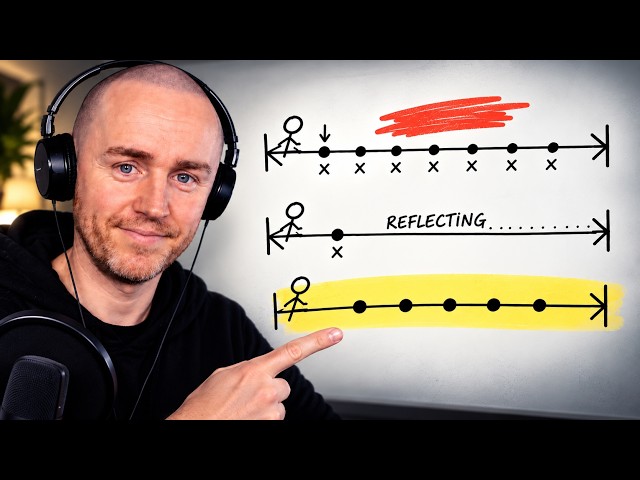
The video addresses the common struggle of procrastination by challenging the conventional self-help and hustle culture mindset that suggests the solution is simply to try harder or make better plans. The speaker argues that a truly bad day with procrastination is characterized not just by inaction, but by a cycle of making commitments, failing to meet them, and then immediately scrambling to recommit to new start times throughout the day. This pattern of constant re-promising reinforces a lack of self-trust and damages self-esteem, as individuals internalize the belief that they are lazy or incapable. Instead of viewing this dynamic as a failure of willpower, the speaker proposes a transitional phase where the goal is simply to have "better days" rather than immediately achieving super productivity.
In this transitional approach, the speaker advocates for a radical shift in behavior after failing to show up for a commitment: stop making new promises and instead create space for honest reflection. Rather than filling the void with more frantic activity or self-judgment based on labels like "not organized enough" or "not mature enough," individuals are encouraged to pause and curiously investigate why they did not follow through. This process of non-judgmental reflection reveals that the reasons for procrastination are often deeper issues such as feeling overwhelmed, perfectionism, or tying self-worth to specific tasks, rather than simple laziness. By accepting that it is okay not to show up without immediately trying to salvage the situation, one breaks the cycle of undermining their own trust and begins to understand their unique resistance patterns.
As this practice becomes second nature, the nature of commitments changes significantly because they carry much more weight; knowing that there will be no frantic recommitting if a task is missed makes future promises more certain and realistic. The speaker describes a progression toward consistency through what he calls "rolling start times," where one simply shows up for tasks as they arise without relying on a grand, rigid plan. This consistency is not achieved through force of will or impressive discipline, but through the ability to step away from failed commitments and learn from them. Ultimately, having great days becomes possible only after moving past the phase of trying harder and embracing deep, honest reflection on failures, which rebuilds self-trust and allows for a sustainable, consistent approach to productivity without the constant stress of bad days.
Read the full video transcript
So, when we're talking about
procrastination, I'm going to show you
how to
no longer have terrible days with it.
Um
we're not going to have the goal here of
having super productive days overnight.
There's actually a
sort of a
transitional phase we go through. It's
kind of the the point of my new book,
which is no more bad days. We're just
going to start having better days for a
while.
And that will ultimately lead us to
having these um you know, much
much better days down here where um
we're actually [clears throat] become
becoming much more productive and
consistent in our goals, okay?
But let's try and identify or define
what a really bad day looks like when we
have procrastination.
Now, what the what the better day will
look like might be a little bit
surprising, but again, it's a
transitional phase that we're going to
go through here.
So, it might be a little bit surprising
as to what I think a better day looks
like cuz it doesn't initially look
particularly productive, okay? But
remember, we're not going to jump from
inactive and inconsistent to completely
consistent and super productive
overnight. There's a sort of a process
or transition we go through.
So,
the first thing is about these bad days
that we're having.
What does that look like? Well,
typically it's going to start off with
making a commitment. So, let's say
you're starting off here. This is your
day.
You're going to start off and you're
making this commitment to I'm going to
start at this point.
We show [clears throat] up at this point
here.
Well, actually we don't show up at that
point. And what happens is in the book I
identify we make immediately after not
showing up for that point that that
commitment to ourselves,
we change it to well, actually no, not
at that point, but I'm going to start
here.
We don't want you up there.
Well, actually hold on. I'm going to do
it here.
So, we're getting these sort of series
of
commitments
that we're not honoring. And what we're
doing is we're we're trying to scramble
to salvage it. Okay, I didn't do it yet,
but I we're recommitting and
re-promising.
Okay, so these are a series of promises
without commitments. And this can go on
in a really bad day. I've been there
myself. Well, not here. I'll do it here.
And we come up with these sort of
reasons why. And we can have a series,
this is a really bad day. It looks like
we're trying a hell of a lot.
Okay, and that's what self-help and um
hustle culture encourages us to do,
which is to try more. And it would
identify it would say the reason you're
doing this
is that
you're not
trying hard enough. You're not meaning
it hard enough. That's what it
identifies the That's the culprit.
That's the problem according to this
hustle culture, right?
So, lots of trying, lots of efforting,
lots of promising,
but not much happening.
And this dynamic has a really bad impact
on your self-esteem and your self-trust.
Okay, do this enough.
How many have we got here? We've got 1 2
3 4 5 6 7 commitments.
And what we're actually doing here with
this is we're training ourselves or
conditioning ourselves into not trusting
ourselves. We've literally reinforced it
seven times.
Okay, so again,
my approach and in my new book and my
approach in general is about forget the
trying stuff. It's not about trying more
or meaning it more or committing better
or having a better plan.
It's about the pattern of no longer
doing this, reinforcing, and literally
training ourselves to not trust
ourselves. Okay? So, that's what a
really bad day looks like. I've been
there. Way more than seven commitments I
would have made and honored none of
them.
At the worst of it, right? So, in the
transitional phase, and this is the idea
in the book after you don't show up,
basically, and again, [clears throat]
don't don't accept
don't
expect it to look impressive. But, this
is a much better day by my definition.
So, let's look at this.
Here we [clears throat] are at the start
of this day.
And we're going to make a commitment.
It's important [clears throat] that we
do make the commitments to do the thing
that we want to do.
Now, typically, we would
make a commitment here.
And
this is the really weird thing about it.
What I'm advocating for is that it's
actually not that important that you
show up to do the task that you commit
to.
And in this transitional phase, very
often, you will not.
And it's about taking all the fear and
shame out of that and making it actually
something that's okay for you to do. So,
it's okay on a better day for you to
say, "Well, I didn't show up there."
Again, the book is called After You
Don't Show Up. So, we're actually
interested in now is, well, now what's
going to happen here?
You see, we've noticed what happened
here on a really bad day.
It's the reconditioning. It's the it's
reinforcing
of the the promising and it's
undermining your trust in yourself.
So, what we're going to do
is we're going to actually, at that
point on, we're going to go into making
zero new commitments for the remainder
of that day. Now, that space
opens up.
And really, what you're going to be
doing in that space is, well, anything
else effectively other than the task you
committed to here at the start. But,
what you're going to be doing there is
reflecting.
f l e c t
i n g reflecting. Okay, that's what
we're going to be doing for this the
remainder of that day.
Now, reflecting doesn't mean analyzing
the crap out of it, right? But it just
means we we become curious as to what
actually happened at this point.
Right? Up here,
we're actually not curious about what
happened here. Because we typically
think we know why we didn't show up at
that point.
Lazy, not good enough, not organized
enough, not mature enough, not
trustworthy enough, etc. etc. All that
barrage of self-judgments is what it is.
That's what we think is causing all of
this. But actually, when when you stop,
you're allowed to not show up. But if
you don't fill it with more of these
commitments down here,
you've got the space now to reflect. And
what you will realize is there was
actually a very good reason
why you didn't show up at that point.
And notice also you are no longer
reinforcing this pattern. So, it's this
is now a much better day because you've
only got one instance
where you failed to show up for
something. Now again,
day one and day two, neither of them are
productive. But this is a much better
experience to have than this.
Okay? Because it's making the space for
reflection.
And it's going to inform you, right? You
see the the immediate thing is when
you're reflecting, you look at, okay,
why didn't I show up there and do the
thing? Well, there's something wrong
with me. I'm a bad person. But if you
give yourself enough space, you'll
realize, well, that explanation doesn't
really mean anything and it's not
helping me.
And you realize
something deeper. You'll get some sort
of a deeper insight will emerge here
where you're actually beginning to, ah,
okay, that's why I now I'm beginning to
realize why I didn't show up at this
point when I said I would and I wanted
to.
Typically, it's going to be about
overwhelm. Probably what you did here
when you tried to attempt the task was
it has to be done I have to do a lot of
it. I have it has to be done perfectly.
It means something about me personally
as a person. My self-worth is wrapped up
in it. All these things reveal
themselves now when you give yourself
space to reflect and that informs your
strategy.
Okay, and you start to and when you're
no longer reinforcing that thing of
recommitting and re-promising
you're no longer undermining yourself
trust self-trust re-emerges.
And when you know, look, if I don't show
up there, there's no recommitting.
Your future is start times your future
commitment start to carry a lot more
weight because you know it's either I do
it at the time or I will step away from
it. Becomes a lot more certain.
So what a a good or a great day looks
like is
you start your day and you start to
realize, okay,
there's my commitment.
That carries a lot of weight now.
Okay, because if I don't do it, I won't
be trying to salvage the situation.
I won't be down here in this space
wondering what's going to happen with my
day, when will I do it. You're just
stepping away from it. Okay? Now,
because [clears throat] it carries more
weight,
and you've gone through that
transitional period where you're no
longer undermining yourself,
you will show up to that.
And what you will do then is you just
make another commitment
to yourself
and you will also be showing up for
that.
And you do it this is what I call a
series of rolling start times where you
start to notice there's no big plan
involved, but you're showing up for
these different commitments throughout
your day.
And then at a certain point maybe
you don't honor one of them.
And then as soon as you don't honor one,
you step away, right? There's no more
recommitting at that point.
But you're noticing that you're becoming
consistent now. You're starting to show
up for these things without a big plan,
but you're realizing that the whole
thing hinges on what is it I'm doing
after I don't
show up for a commitment. I stop and
reflect.
This This consistency down here only
becomes possible through the process of
reflecting deeply and honestly on why I
didn't show up for something that I said
I wanted to do.
Okay? That's what makes this possible.
This is not achieved. Having great days,
productive days, is not achieved through
you pushing yourself and wishing and
wanting yourself to be productive. It's
something that you learn
through the process of deep, honest
reflection on failures to show up for
yourself. Again, not judging yourself.
Judging yourself is part of the problem
with this.
But you start to become much more
when when you're doing more of this
reflective work
that creates this the possibility for
great days to happen. You start to
become much more
well-informed,
much more
discerning, much more careful when
you're setting start times for yourself.
Okay? Much more realistic in terms of
what is acceptable for me to commit to
right now
and what isn't. What's too much?
And you start to learn a lot more about
your own resistance to taking action,
whatever that whatever the task is.
Okay, so it's learning and understanding
your resistance instead of
wishing it wasn't there, pretending it
wasn't there, and forcing yourself
through recommitting more and more.
So, isn't it weird
>> [clears throat]
>> with all the personal productivity stuff
that encourages us to try harder?
Trying harder can actually be a problem.
Now, some trying is is legitimate. Like,
we do need to get into the practice of
committing, right? We want to start
committing, but
it's what we do after we fail to show up
that is turns the whole thing around.
This becomes second nature after a
while, right? You be it's not because
you're more productive or impressive or
disciplined or you've got better
willpower. You've just learned about
your resistance.
How it works.
What helps it? What doesn't help it?
Etcetera, etcetera. And this can become
um
a way where you can actually have a lot
more great days. But don't try and go
from bad days to great days. That's what
that's what hustle culture and self-help
is is kind of all about. This is what my
book is about. It's about teaching you
about this. How to have better days
where you are no longer undermining
yourself and you're you're you're
developing that self-trust in yourself.
So, that's how we go
from having a lot of bad days to having
better days to ultimately having great
days consistently in our productivity.
Hope that's useful. And um if you want
to learn more, the link for my new book
on this is is below.
And you can also find my information to
uh to reach me for one-on-one work.
Thanks so much for being with me. Hope
you enjoyed this video.
And I'll talk to you very soon. [music]
Take care. Bye-bye.