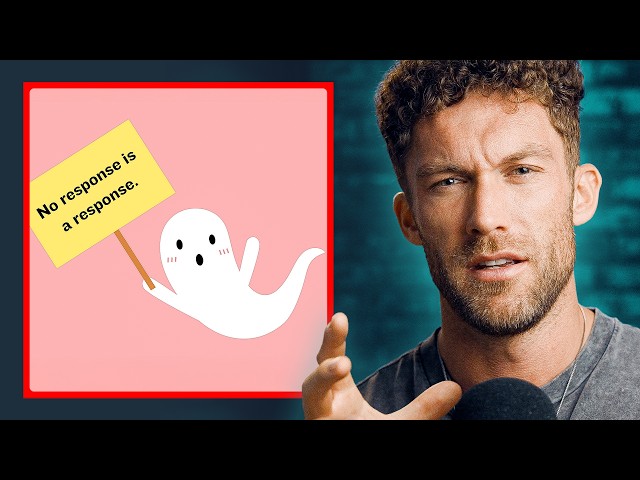
Video summary
The podcast addresses the painful experience of being ghosted and rejected, specifically focusing on how to overcome the resulting shame. The host acknowledges that while this situation is emotionally difficult because it often leads individuals to question their own worthiness or imagine they could have been "more" alluring if things had gone differently, logically speaking, such behavior serves as a fortunate early warning system. If someone uses and ghosts you, they possess a psychological makeup incompatible with long-term partnership; therefore, the rejection is not a reflection of your inadequacies but rather an indication that this person was never a suitable match to begin with. A significant portion of the shame stems from the fear that one must constantly change themselves or perform different roles—making oneself smaller or bigger—to be loved in the future. The host argues against this mindset, emphasizing that the goal should not be to manipulate others into seeing you as someone else through "super squirrel" efforts, but rather to strive for relationships where you can be unapologetically yourself. Trying to curate a version of oneself just to avoid rejection leads to playing roles and suppressing parts of one's personality, which is detrimental to genuine connection. The core issue in such scenarios is identified as bad partner choice on the other person's part rather than an inherent flaw within the individual being rejected. For women navigating dating life at 37 or any age where there may be added complexities like children or divorce history, the host advises against succumbing to a sense of urgency that leads to compromising too much. Instead of listing numerous superficial criteria such as height, body fat percentage, education level, car type, or general "coolness," which are largely non-predictive for relationship success and can drastically reduce one's pool of potential partners, listeners should identify only two or three truly non-negotiable traits. These priorities must focus on psychological stability, loyalty, trustworthiness, safety, emotional regulation, and the ability to communicate feelings well, as these factors are far more predictive of a lasting partnership than physical attributes or social energy levels. The discussion highlights that many people mistakenly optimize for superficial qualities like extraversion (often linked to being "cool") or openness to experience without realizing that excessive openness can lead partners to stray in search of other options. The host suggests looking for someone with moderate openness rather than high levels, as too much novelty-seeking behavior is a risk factor for infidelity or drifting apart. To find the right partner, one should merge these scientifically backed predictive areas with personal preferences while remaining flexible on less critical details. This approach prevents the "math" of dating from narrowing options down to an unmanageable fraction of the population based on arbitrary metrics that do not guarantee happiness. The episode concludes by recommending specific resources for those interested in deepening their understanding of these psychological dynamics, notably mentioning Seth Stevens Davidowitz's book *Don't Trust Your Gut*, which challenges common misconceptions about intuition and human behavior. The host also references Tai To Shiro as an author with relevant books on the subject, encouraging listeners to study how gut feelings can be misleading when it comes to assessing character. Ultimately, the message is that by focusing on stability and safety rather than superficial optimization, individuals can avoid repeating patterns of rejection and build relationships based on authentic self-expression rather than performance or fear.
Read the full video transcript
How do I get over the shame of being
rejected by a guy who used and ghosted
me?
Yeah, I'm sorry that that happened. Uh,
it is unfortunately very common,
maybe less in reverse, but happens both
directions. And uh, that sucks. I'm
sorry that that that was something that
you went through.
It's going to be difficult because
you'll have placed some of your
selfworth into this person and the fact
that they didn't choose you is going to
make you feel unworthy.
Um, you're going to wish that if only
you'd been better. Are you going to
think if only I'd been more or
bigger? If I'd been more electric or
more more uh alluring in some way, uh
then they would have stayed. they
wouldn't have rejected me. Uh they
wouldn't have used me and then they
would have at the very least given me
the respect to have said this is over or
whatever.
It's going to be really hard to
get past the emotional side of this. So
I can give you a logical answer which is
if you've been rejected by a guy who
used and ghosted you, if he's the sort
of guy that uses and ghosts you, that's
not rejection. That's a very fortunate
early warning system from somebody that
has a psychological makeup that you
would not want to be in a relationship
with long term. Like that is not the
sort of guy that you want. That's is
that the sort of son that you would
want? Absolutely not. Okay. Your kids
are going to be made up of the genetics
of the partner that you choose. Do you
want those genes? you really want. Would
you want would you have preferred that
he'd stayed with you being the sort of
guy that could use and ghost you?
I'm going to guess that he's a little
bit younger. Um, unfortunately, this is
the peril of dating in your 20ies. I
mean, I will hold my hand up. I did that
to girls. I did that when I was in my
20ies because I wasn't brave enough to
tell them what I meant, which was I
don't want to be with you or this is
over or that was something that was
casual, not something that was longterm
and maybe I did or didn't. Maybe it was
wishful thinking on your part or maybe I
even was a little bit um obfiscatory
about what my intentions were and made
you think that it was going to be longer
term. Like these are all these are just
the things that both parties do when
they're so scared about telling the
truth and they don't know how to open
up. Um so it's not a rejection if it's
somebody that you would have hated being
in a relationship long term. You've been
saved by the fact that this guy behaved
that way. The shame comes from feeling
like I need to make myself more or
different in order to be loved in future
because I evidently wasn't enough this
time and if I don't change myself, it's
just going to happen again. I would say
what the issue was there was bad partner
choice, not an issue of you. Uh now you
may be awful uh but the used and ghosted
thing like
that that isn't a you thing that's a
them thing. So trying to remember your
goal is not to find somebody
your goal is to find somebody who will
treat you right as you. Not to make
yourself into the sort of person that
someone who would reject you and ghost
you won't do simply because you've sort
of super squirrel [ __ ] like Jedi mind
tricked them into seeing you as somebody
else. Your goal should be to be as
unapologetically yourself in a
relationship and have that be chosen by
the other person because anything short
of that is going to result in you
playing some sort of a role or curbing
off different parts of yourself or
making yourself smaller or making
yourself bigger having to perform and
that's just not good. So,
I hope that helps. Any advice for women
your age trying to navigate dating life?
I'm 37. And women trying to navigate
dating life at 37 is uh fraught because
presuming that they
haven't got something they're bringing
along with them like kids or divorce or
whatever or even if they have the
divorce thing as long as it's not kids
it's a it's a minefield out there
because there is this sense of needing
to hurry up that you're going to have to
go through and even if you have got kids
uh like [ __ ] like I really want I want I
want it to be the I want it to be the
the relationship for the rest of time.
Um,
I would be uncompromising with what it
is that you uh like two or three things
that you really really want. I want a
partner who is peaceful. I want a
partner who makes me feel safe. I want a
partner who can provide for me
financially. That sick. All right. He
doesn't get to be six foot. You don't
get to complain about his body. You
don't get to complain about his
education. that like you
if you are 37 as a woman, if you're any
age that you really shouldn't have more
than about three things that are [ __ ]
super super non-negotiables because
you've all seen that whole math like
delusion calculator thing for women.
It's like how tall does he need to be
and what's his body fat percentage and
how much does he need to earn and before
you know it you're down to 0.5% of the
entire population from a small number of
things. Um,
I would say pick the things that really
matter and learn to be flexible about
the other ones. I would prioritize
something like psychological stability.
So, how long after you've had a uh
psychological perturbment? Are they able
to get back to baseline and be calm? Uh,
that's real important. Um, are they
loyal? Are they trustworthy? Do they
make you feel safe? Like, do you when
you're around them, do you feel
regulated or are you uncertain? Can they
communicate their feelings well? Like
all of these things like are so [ __ ]
accessible and really predictive of
long-term relationship success. And most
people are optimizing for other things.
They're optimizing for how tall they
are. They're optimizing for what their
education level is or they're optimizing
for like the car that they drive or like
even other stupid like how cool they
are. Like oh he's you know cool.
Poolness is basically extraversion plus
openness to experience
uh and uh like energy I suppose like
high energy vibe you go all of those
things really really great totally
non-predictive when it comes to your
partner in fact you want a partner
that's a little bit less open to
experience you want a partner who's like
just moderately open to experience
because too open to experience causes
them to stray and look for other
partners. So, pick a small number of
non-negotiables. Stick to those. Be
flexible with the other ones. Focus on
the things that predict relationship
success long term. Tai to Shiro's got a
great book on this. So, has uh
not Scott Barry Coffman, not Steve
Stewart Williams. [ __ ]
Who was the dude that did don't trust
your gut and everybody lies? Seth
Stevens Dvidowitz. Choosing like all the
[ __ ] triple barrel Jewish names that
I can think of. Uh Seth Stevens
Dvidowitz. Don't trust your gut.
Wonderful book. What are the predictive
um areas that you should be looking for?
Merge those with your own preferences.
You're off to the races. In other news,
this episode is brought to you by
Function. Did you know that your annual
physical only screens for around 20
biomarkers, which leaves a ton of gaps
when it comes to understanding your
health, which is why I partnered with
Function. They run lab tests twice a
year that monitor over 100 biomarkers.
They even screen for 50 types of cancer
at stage one. And then they've got a
team of expert physicians that take the
data, put it into a simple dashboard,
and give you actionable recommendations
to improve your health and lifespan.
They track everything from your heart
health to your hormone levels and your
thyroid function. Getting your blood
work drawn and analyzed like this would
usually cost thousands, but with
function, it is only $499. And for the
first thousand Modern Wisdom listeners,
you get $100 off, making it only 399
bucks. So, right now, you can get the
exact same blood panels that I get and
save $100 by going to the link in the
description below or heading to
functionhealth.com/modernwisdom.
That's functionhealth.com/modernwisdom.
Look, you made it to the end of the
video. Seeing as you're still here, why
don't you check out this right here?
Come on.