Video summary
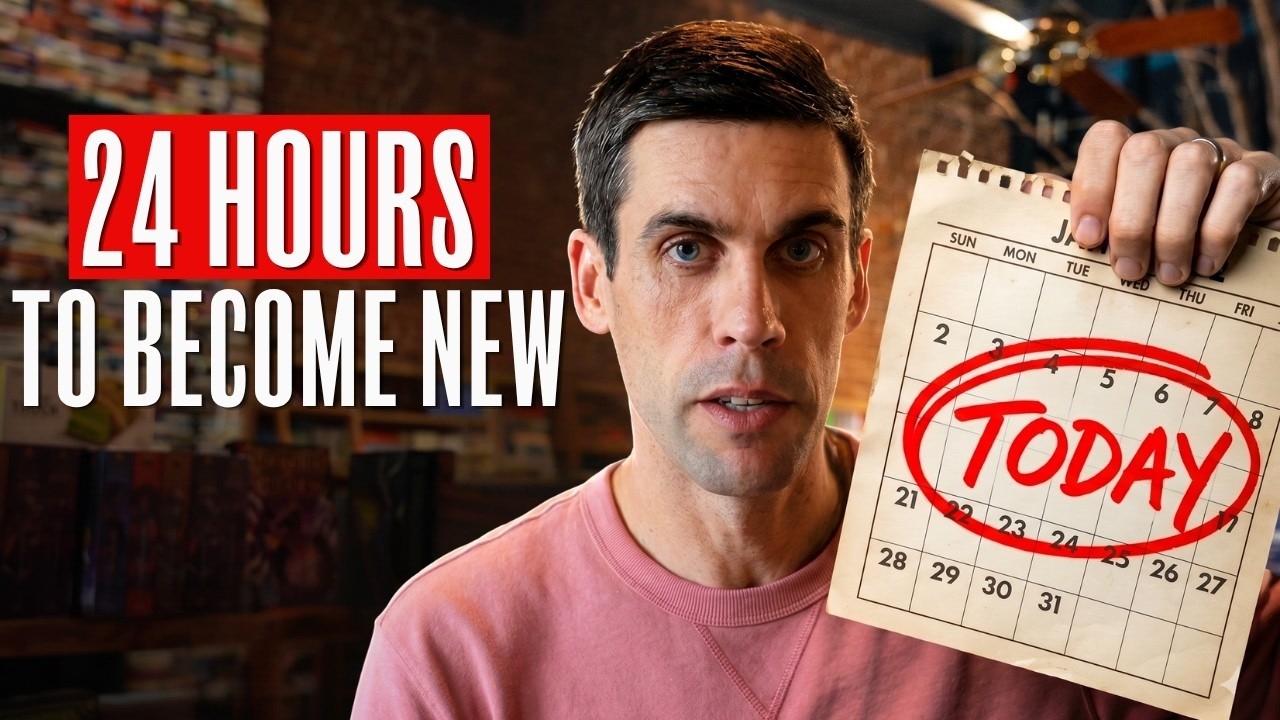
The video begins by asserting that today offers a unique opportunity to reinvent oneself, drawing on Stoic wisdom to encourage breaking free from old habits and patterns of behavior. It references Marcus Aurelius's observation that clinging to who we have always been is tragic, comparing such stubbornness to gladiators begging for another chance at the same fate because their current approach has failed. The core message is a call to action: instead of repeating past mistakes or comfortable routines, individuals must choose to do things differently. This shift requires waking up early despite discomfort and embracing difficult tasks that push personal limits, such as cold plunges or long hikes. Seneca's philosophy supports this by suggesting that rigorously training the body ensures it remains obedient to the mind, thereby building a mental muscle for handling challenges with confidence rather than fear.
A significant portion of the discussion focuses on mastering one's internal state and recognizing various forms of slavery that prevent true freedom. The narrator explains that everyone is enslaved by something—whether it be money, power, attention, or destructive habits like smoking—and real liberty comes from taking control of these impulses through self-imposed orders to stop them. This concept extends to professional life as well; the story of Lou Gehrig illustrates that one cannot expect peak performance every day but must simply show up and meet a minimum standard consistently. By accepting imperfection and focusing on daily effort rather than waiting for inspiration, individuals avoid disappointment and build lasting discipline. The video also highlights the importance of saying "no" to distractions and non-essential commitments, noting that every time we agree to something trivial, we are inadvertently denying ourselves or our loved ones more valuable time.
Furthermore, the transcript emphasizes the Stoic principle that while we cannot control external events like shipwrecks or natural disasters, we have complete authority over how we respond to them. The example of Zeno turning a devastating loss into the foundation for his philosophical school demonstrates that obstacles can become opportunities if chosen wisely; it is not the event itself that defines us but our reaction to it. To live well requires concentrating fully on the task at hand as if it were one's last, treating time as a finite resource rather than an endless supply. Seneca warns against foolishly protecting material possessions while wasting life on unproductive activities, urging viewers to make courageous choices about how they spend their limited days. Ultimately, the video concludes that true happiness and wisdom are found in small, consistent steps toward truth, maintaining control over one's character, and making every moment count by living with intention and purpose.
Read the full video transcript
This is the day to change your life. We
have a new day in front of us. A new sun
has risen. We can be anyone. We can be
anything. We can do it a new way. We
don't have to [music] do it the way
we've always done it. It's a tragedy,
Marcus Aurelius says, [music] to cling
to being the person you've always been.
He says we're like those gladiators
[music] at the games, torn to pieces,
begging to be held over till tomorrow to
do it the [music] same way. It hasn't
been working. So, let's do it
differently. And that's what we're going
to talk about in today's episode. How to
have a great day. How to be a great
person. How to be a new person. And what
the Stoics can tell us about doing
precisely that.
Nobody likes getting up early, not even
Marcus Aurelius. In Meditations, he
talks about trying to get up early, and
he has this fantastic conversation with
himself. He goes, "But it's warmer under
the covers." And he says, "Is that what
you were put here to do? To huddle under
the blankets and be warm?" He says, "But
it's nicer here." He says, "Is that what
you were meant for? To feel nice?" He
says, "No, you have a nature. You have a
job. You have obligations." He says,
"We're all put here for a purpose. We
have a nature. We have a duty. And we
have to go, and we have to do that. And
the morning is the best time to do
stuff, to get stuff done." So, that's
why the Stoics tried to get up early. I
say tried cuz they didn't always do it,
and it wasn't always easy, and they
didn't always like it. They tried to do
it anyway.
Doing hard things is good for you.
Cold plunges, long hikes, long runs,
challenging yourself, pushing your
limits. Seneca says we treat the body
rigorously so that it's not disobedient
to the mind. Doing the things you don't
want to do, but that you're glad you did
after. That's the skill that life
demands more than any other skill. The
ability to push yourself a little bit
further, to hold on a little bit longer,
to go a little bit further than you
thought, to put up with a little bit
more than you thought. That's what it's
about. And so we find practices, we find
places, we find experiences that allow
us to practice that. They're also
beautiful and enjoyable, but they allow
us to build that muscle, the muscle that
says, "Hey, I'm in charge. Hey, I push
myself. Hey, I'm comfortable being
uncomfortable. I'm comfortable being
challenged. In fact, I like those
challenges. I seek them out. I do hard
things." just that I can do hard things,
but I do hard things on a regular
consistent basis. That's what it's
about.
The purpose of philosophy is not about
getting to some magical place of
enlightenment. It's not about these
epiphanies, these life-changing,
transformative moments. That's not how
it works. Seneca writing to his friend
Lucilius talks about how, "Look, if you
can just acquire one thing a day." He
says, "Something that makes you a little
stronger, makes you a little wiser, less
focused on things that are outside your
control." As long as you can inch your
way towards truth, he says, "That's what
it's about." So today, let's think about
what have we acquired? What's something
we've learned? What's something we've
added to our quiver or our toolkit?
That's what the path to wisdom is. It's
step-by-step. In fact, Zeno, the founder
of Stoicism, says exactly that. He says,
"Well-being is realized [music] by small
steps, but it is no small thing."
The Stoics say you have to stop being a
slave today. There's a story I tell in
Discipline is Destiny about Richard
Feynman. One day, it's like 10:00 in the
morning, he's out for a walk, and he
feels this pull. He wants to have a
drink. He never saw himself as an
alcoholic, he never had this problem
with alcoholism, but he was deeply
uncomfortable with this drive, this pull
to do something that was coming from a
part of him that he didn't control. And
the Stoics say, "That's something you
have to be really suspicious of." Seneca
says slavery isn't just this legal
status. He says everyone's a slave. He
says someone's a slave to their
mistress, somebody's a slave to money,
someone's a slave to power and
attention. And he said those people
might be literally free, they might be
powerful, they might be important, but
they're not in control. In this book I
say I also tell the story of of
Eisenhower. He was told by his doctor
that his smoking habit, he'd smoked like
four packs a day for 40 years, it was
substantially hurting his health. He
says, "Okay." And he and he I love this.
He says, "I gave myself an order to stop
smoking." And he stopped smoking cold
turkey like that. It's going to be
harder for some people, easier for some
people, but the point is you got to give
yourself that order. You have to say,
"Who's in charge? This habit, this
addiction, this vice that I have, this
this thing that I want, or am I in
charge? Am I the boss or is it the
boss?" And that's what Feynman was
reacting to, that's what Seneca was
reacting to, that's what Eisenhower's
reacting to, and ultimately that's what
Epictetus is reacting to in the same
court as Seneca. He looks around and he
goes, "I'm a slave, but I'm freer than
these people cuz I'm in control of my
habits. I decide what I do and what I
don't do, and we have to give ourselves
that power."
The best piece of advice that Lou Gehrig
ever got came when he was a a young
minor league player. He was struggling,
he was in the middle of a slump. He was
losing his confidence, he was losing his
passion in the game. The Yankees
dispatched a an old seasoned manager or
coach up up to see him in Connecticut
and they said, "Look, the most important
thing a baseball player can understand,
Lou, is that you can't be good every
day." Right? What matters is that you
show up. What matters is that you try
your best, but you're not always going
to be at your best. And when you think
about his streak, there's obviously a
lot of terrible games in there, a lot of
games where he was physically present,
but the level of performance wasn't
there. You learn this as a writer. It
What matters is you show up. If you're
sitting around waiting for inspiration,
if you're expecting every day to be
productive and perfect, you're going to
be be disappointed. That's why there's
this writing rule, just a couple crappy
pages a day. It's that there's a minimum
[music] and that there's a day that you
do it every day, that you meet this
minimum. You're not expecting the
maximum of yourself, you're expecting
the very least that you meet the
minimum. Now, sometimes you totally
exceed the maximum. Sometimes [music]
you really are feeling it. Sometimes
it's amazing. But, what matters is that
you show up. What matters is you do it.
What matters is you keep the commitment.
This is my dog Oreo. My wife [music] and
I found her on the side of the road a
little over a year ago near a ranch in
Texas. Somebody had dumped this dog and
her sister. They [music] were puppies.
They were covered in fleas. They were
horribly malnourished. And now she is
about the spoiledest dog in the entire
world. [music] If you have a dog, you
know you'll give your dog basically
anything. And that's where today's
[music] sponsor comes in. This is Sunday
for Dogs, human-grade food for your dog.
She does not realize how spoiled she is,
that she was
on the side of the road not that long
ago and now she eats human-grade dog
food. All the food's air-dried to lock
in the flavor, USDA-grade beef in there,
then it puts in other awesome
ingredients.
Pumpkin, ginger, chicory root,
blueberries, kale, spinach, fish liver
oil, sunflower oil in here, which is
stuff for their skin, their coat, joint
health. Start [music] serving your dog
the 100% superfood and real meat food
they deserve. You can get 50% off on
your first order. [music]
Sundaysfordogs.com/stoked50
or you can use the code stoked50 at
checkout.
>> [music]
>> I'm not saying it'll solve all your
problems, just most of them. I'm not
saying it's the most philosophical thing
you can do today. I'm just saying it's
something that all the philosophers
tried to do every day. Look, what I am
saying is that you should go for a walk.
It'll make everything better. It always
does. Relaxes you, it calms you down, it
gets you outside, it gets you moving. It
both slows the mind down and gets it
moving. Seneca, the Stoic philosopher,
said [music] that we should take
wandering walks. He said so the mind
might be nourished and refreshed by the
open air and deep breathing. Nietzsche
actually said that only ideas [music]
had by walking have any worth. So, why
aren't you doing it? Why are you sitting
there? Why are you watching this on the
couch or at your desk? You need to get
moving. You need to get outside.
>> [music]
>> So, in my office I have two pictures of
my kids. [music] And in between those
pictures, I have this other picture that
a sports psychologist once sent me. It
depicts [music] Oliver Sacks in his
office, the the great doctor and writer.
Sacks just had in his office right
behind him a giant sign that said
[music] no. So, it's capturing this
great writer, this great thinker, in his
element and a reminder that he needed
while he was in there that he has to say
no. It's so easy to say yes, but we have
to remember that everything we say yes
to is a no. It's saying no to someone or
something else. And I try to remind
myself that when I get random emails,
when I get cool invitations, when I find
myself getting distracted or or whatever
it is, when I'm saying yes to that cuz I
don't want to be rude, cuz I don't have
enough willpower, cuz [music] I think I
can squeeze it in, I'm saying no to the
two most important people in my life.
So, saying no is hard, but it's also
essential. And that's why I have that
reminder. And it's a very Stoic idea. In
Meditations, Marcus Aurelius says, "Ask
yourself in every instance, is this
essential?" He says, "Cuz most of what
we do and say isn't essential. But when
we eliminate the inessential," he says,
"we get the double benefit of doing the
essential things better."
>> [music]
>> Bill Belichick, greatest football coach
in history, tells his players, "Do your
job."
>> Look, fellas, it's just about doing our
job.
>> Marcus Aurelius asked himself that same
question in Meditations. He says, "What
is my vocation?" He says, "To be a good
person." That's the job at the end of
the day, to be a good person, to do good
things, to make a positive difference in
the world for yourself and the people
around you.
>> [music]
>> Around the 4th century BC, there's a
Athenian merchant and he suffers a
shipwreck. He loses everything in the
shipwreck. No one would say that that's
good. No one would say that that's
positive. But Zeno would say that he
made a great fortune when he suffered a
shipwreck cuz it drove him to
philosophy. He chose for it to mark a
new chapter in his life. He went through
the the door that life opened for him.
He would create Stoicism out of this
disaster. It was good because he made it
good. He turned it into something. This
is what the Stoics mean when they say
that the obstacle is the way. They're
not saying it's wonderful that you were
robbed. They're not saying it's
wonderful that your spouse cheated on
you. It's not wonderful that there was a
hurricane or a fire or a natural
disaster. None of this is is good in
that sense, but it can be good if you
choose to make good out of it. That's
what Stoicism is. We don't control what
happens. We control how we respond to
what happens. We have the ability to
make this thing good with the response
that we take, with the action that we
take.
>> [music]
>> "Concentrate like a Roman," Marcus
Aurelius says. "Concentrate on doing the
thing in front of you as if it was the
last thing you were doing in your life."
I think about that pretty often. It's
not that you're going to die tomorrow
for sure, but that it could be the last
time you send this email. It could be
the last time you have this
conversation. It could be the last time
that I sit down to write or that I sit
down to make a video. So, am I going to
be fully present? Am I going to
concentrate? Am I going to do my job? Am
I going to meet the standards of my
people, of my profession, of my family,
whatever it is? I'm going to concentrate
like a Roman. I'm going to do it like
this thing matters, like I might not get
another opportunity to do it. To me,
that's the test. That's the standard to
try to meet every day that you are lucky
enough to be alive.
It's not that life is short, Seneca
says. It's that we make it short by
acting as if we have forever, by putting
things off until tomorrow, by doing
things that we shouldn't do. He says,
"It's insane. We We protect our money.
We protect our property. And then we are
foolish with the one thing that can't be
replaced, [music] the one thing they're
not making any more of." He says, "Don't
spend your time on anything that's
[music] not giving you a return." And of
course, he doesn't mean that
financially. He means, "How are you
going to spend this limited amount of
time that you [music] have here on
Earth? How are you going to protect that
valuable resource? [music] How are you
going to make good choices, courageous
choices, disciplined choices?" Memento
mori, death [music] isn't this thing
that's at the end, Seneca says. It's
happening now. The time that passes
belongs to death. So, how will you spend
your life?