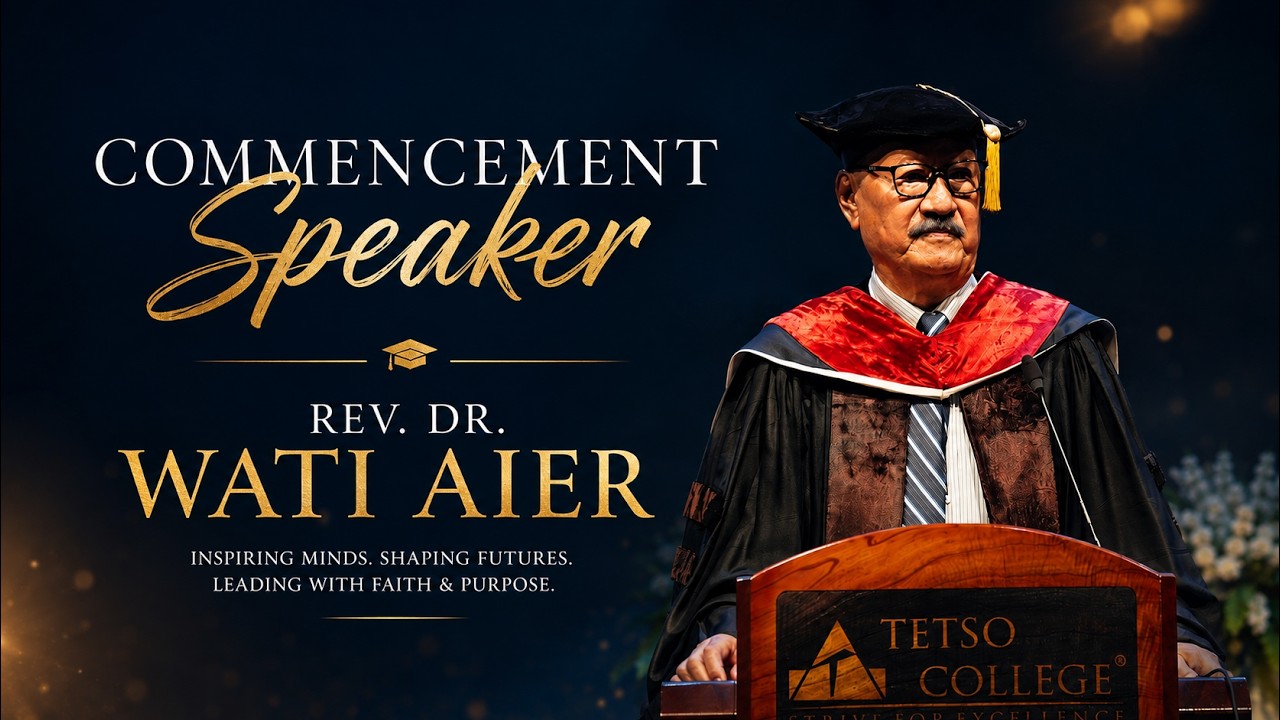
How to Break Free from Broken Systems & Reconstruct Your Future | Rev. Dr. Wati Aier
Watch on YouTubeVideo summary
Reverend Dr. Wati Aier's commencement address at Iteso College serves as a powerful declaration that graduation marks not merely the end of academic studies, but rather "the end of a beginning" for the Class of 2026. Drawing on insights from poets and sociologists like John Masefield and David Graeber, he emphasizes that universities are living communities dedicated to inquiry where truth is pursued with courage, yet these institutions exist within a broader world defined by inequality, bureaucracy, and rigid hierarchies. The speaker warns against the state of "anomie," or normlessness, which can leave individuals feeling disconnected from collective meaning, but firmly asserts that such societal structures are human constructs rather than immutable laws. Because they were built by humans, he argues, these systems can be deconstructed and reconstructed to better serve humanity.
The core message delivered is a call for the graduates to recognize their agency in reshaping reality despite living in what sociologist Peter Berger termed an era of "many globalizations." Dr. Aier challenges the young people not to accept institutionalized corruption or systemic oppression as inevitable, urging them instead to engage in praxis—the practical application of learning—to dismantle structures that promote dehumanization and inequality. He specifically addresses the risk of being defined by class cultures or political constructs that might label individuals as inferior, reminding the audience that their potential is vast and not limited by existing power dynamics. By looking beyond these artificial boundaries, he encourages them to embrace a future that is more equitable, free, and humane for all people.
Ultimately, the speech grounds this call to action in a profound source of hope: faith in the living God. While acknowledging various secular voices on change and possibility, Dr. Aier posits that trust in God provides an unshakeable assurance when systems fail or hierarchies attempt to silence individuals. This faith serves as an anchor reminding everyone that human dignity is inherent rather than bestowed by society, rooted in the belief that every person is created in the image of God. As he concludes, he charges the graduates with carrying forward courage to question, humility to learn, and this deep-seated faith into their future endeavors. He expresses his hope that their lives will become testimonies proving that the world can indeed be made more friendly and liberated through their conscious efforts to reconstruct a better society.
Read the full video transcript
Ladies and gentlemen, may now invite
Reverend Dr. Wati Aier to deliver the
commencement address.
>> Respected principal,
Dr. Uwatse King,
chairman of the college,
Mr. Apollo
Luoy,
members of the faculty,
dear family members,
esteemed guests,
and
wider scholastic community.
It is a profound
honor
to
be in front of this
vibrant
scholars.
I take my hats off
to honor you.
It is
a very important milestone
in the life of
each
individual.
And not only that, it is also
a wonderful event for this college,
Iteso College.
So, for the class of 2026,
this commencement
is not simply
an exercise.
It is not all about conclusion of your
academic studies.
It is,
as we often say,
the end
of a beginning.
Today's event will have an abiding
significance
not only in the history of this
institution, but more importantly
in the unfolding journey
of each of you.
John Masefield,
a poet
and a writer,
in his tribute to the English
universities once said this,
"Therefore,
if you look around the world, he says,
quote, there are few earthly things more
important than a university.
A place where those who have
ignorance
may strive to know,
where those who perceive truth may
strive to make others see.
This was sounded
by this great man
in
places like Oxford,
Cambridge, and so on.
This is the essence of what you have
experienced here.
A university,
a college,
a learning institution is not simply a
building.
It is not only a curriculum.
It is a living community of inquiry,
a place where minds are sharpened,
where questions are welcome,
and where truth
is perceived with courage.
As you stay behind
and beyond
this walls
of this
wonderful institution.
You will be You will encounter a world
even in front of us within
our
state.
You will encounter
a world marked by inequality,
bureaucracy,
and rigid
hierarchies.
The sociology of Emile Durkheim
coined, along with Robert Merton,
anomie,
a state of
normlessness,
where
individuals feel disconnected.
They feel
out of place
from a collective
meaning.
But remember,
dear
scholars,
these structures that we see around us
>> [snorts]
>> are not immutable.
They are not unchangeable.
They are
human constructs.
They are our constructs.
And what is constructed
can be
reconstructed.
David Graeber,
in his 2024, just 2 years ago
one of the
famous book in the field of anthropology
and also sociology
wrote the ultimate hidden truth of the
world. That's the title of the book.
The ultimate hidden truth of the world.
In this book, Kramer reminds us that the
hidden truth is this.
The world is something
we make
and could just as easily make
differently.
So, the construct is our construct and
the hidden truth is we can we can
remake, we can reshape, we can
transform. That's what it is.
So, students
you are not distant.
You are not conditioned
to be
under rigid hierarchies
or shaped by
normlessness or formlessness.
You have the capacity.
Yes.
You
individuals, you have the capacity
and the ecology.
Do not think
of yourself
as too small.
You are somebody very, very special.
You can do it.
Therefore,
you can consciously decide how you want
to be.
To be or not to be.
You can consciously decide what you want
to be.
Today, we talk about postmodernism. We
live in a postmodern era of of what
Peter Berger, the sociologist, called it
many globalizations.
Of course, that's the title of the book
that he wrote
with Huntington.
Samuel Huntington, the one who wrote The
Clash of Civilizations. They jointly
wrote Many Globalizations.
This plurality of words
demands that we challenge
institutionalized structures of
corruption
and dehumanization.
Young people, it's in your hands.
How long are we going to go in this
condition, in this situation?
We have
added ecology
in our our minds,
in our
right writings, in our vocabularies, as
well as in our action.
praxis
A reflection of what you learn, putting
into practice, is praxis. The
praxiological dimension of your being
is to challenge institutionalized
structure,
systemic operation, inequality,
looking down on others, and corruption,
and all that structures of
dehumanization. And you can do it. Young
people, am I right? Amen. You can.
You have to walk out from here with a
determination
to change
our settings,
our condition. This is your world.
So,
there are so many possibilities.
Political possibilities, cultural
possibilities, social possibilities.
Humanity has always reinvented itself.
In every generation, they have
reinvented
themselves.
And your generation,
generation alpha,
must look beyond the existing power
structures
to embrace
the potential for a more equitable
and a free
future.
Do not let social and political
construct limit
your outlook.
Today,
you are caged.
You are being limited. We have limited
you.
The system have limited you, but do not
let this political constructs, social
constructs that we have given to the
younger generation, limit your outlook,
please.
And if we have limited you, forgive us.
But today,
you have
in your hands
power.
Do not allow bourgeois
class
or
the class culture in the Naga context or
in beyond the Naga context
to define you as inferior.
To define you as
below average. Do not let them define
you.
The vast vista of possibilities is
before you.
It is there.
And yet,
beyond all human striving,
there is a deeper
source of hope.
Today,
great writers are writing
Malcolm Gladwell,
The Tipping Point,
Jitan Bukta,
motivational writings.
All so many are talking about
changes, possibilities,
a
a secularized version
of the Bible, a secularized version of
the of the gospel of hope.
Very good.
But we have much more
source, a source that's deeper,
and this is trust and faith in the
living God.
Trust
and
have your faith in the living God
is the greatest
assurance that we find.
It is in all the sacred books.
Trust in the living God is our greatest
asset,
greatest assurance.
It is this faith that anchors us when
structures fail.
When system oppresses us, when
hierarchies
try to silence us, and when the world
seems fragmented,
faith reminds us that dignity is not
bestowed by society,
but is inherent
in each person,
created,
as the Bible says, in the image of God.
It is this conviction
that must guide you and I
and enter
step out from
this evening into a wider possibility.
So, therefore, graduates of 2026,
today
you commence a new beginning.
Carry with you the courage to question,
the humility to learn, and the faith
to hope.
May your lives be testimonies that the
world can indeed be made
more friendly, once more
more humane,
more free.
So,
thank you.
Thank you for allowing me to share in
this
wonderful event.
God bless you.
>> [applause]