Video summary
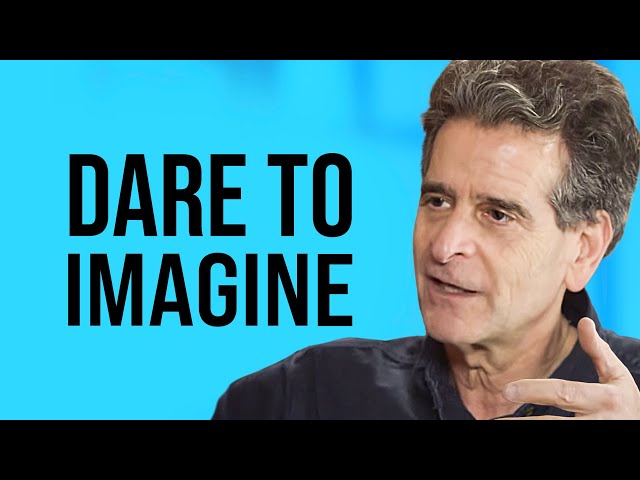
In this episode of Impact Theory, host Peter Diamandis interviews legendary inventor Dean Kamen at Abundance 360 to explore how humanity can evolve into an "adaptation machine" rather than relying on strength or intelligence alone. Drawing from Charles Darwin's actual theory that survival belongs to those most capable of adaptation, the conversation centers on shifting human potential from mere possibility to execution. Kamen highlights a critical distinction between knowledge and imagination; while facts are now commodities accessible instantly via smartphones, it is imagination that drives innovation by allowing individuals to view existing problems differently. He cites Albert Einstein as an example of someone who used his imagination to fundamentally alter the understanding of physics—such as relativity and mass-energy equivalence—before proving them mathematically, arguing that true breakthroughs often stem from imagining answers first rather than incrementally building on current knowledge. Kamen's extensive career serves as a testament to this philosophy, boasting over 440 patents ranging from the Segway and iBOT mobility device to life-saving technologies like the Crown stent and wearable insulin pumps. Despite his immense success, he emphasizes that expertise can become a trap if it leads to dogmatic adherence to outdated truths, noting how industries failed when they clung to old models of television broadcasting or wired telephones despite rapid technological shifts. He argues that experience and judgment often represent fixed perspectives in a changing world, warning that the inability to adapt these views can lead to downfall. This lesson is particularly relevant given his own history with dyslexia; he describes how early schooling felt like drowning under a "firehose" of information where memorization was valued over understanding concepts like Newton's laws or calculus limits. To address what Kamen terms not an education crisis but a culture and demand problem, he founded FIRST (For Inspiration and Recognition of Science and Technology) nearly 30 years ago to transform how children engage with STEM subjects. Recognizing that kids are naturally passionate about sports and entertainment, Kamen designed FIRST as a "cooperatition" where students build robots in project-based teams without grades or final exams, mimicking the high-energy environment of professional athletics but focused on engineering principles like F=MA. By partnering with major corporations to provide mentors rather than teachers, he successfully scaled the program from 23 schools to over 55,000 institutions serving more than a million children globally. The initiative aims to shift students' mindsets so they view their unique learning styles as assets and develop skill sets relevant for future careers in technology and innovation. Ultimately, Kamen's message is one of empowerment through self-redefinition; he recounts how he stopped taking poor grades personally by realizing teachers were playing a different game based on rigid standards that didn't suit his "different baud rate" of learning. Instead of seeing himself as stupid or lazy, he began inventing electronic devices in high school and eventually founded companies like Auto Syringe and DEKA Research to solve real-world problems, proving value through creation rather than regurgitation of facts. He concludes by envisioning a future where technology unites the global youth on "the same team" to tackle shared challenges like climate change and cybersecurity, fostering what he calls "gracious professionalism." Through FIRST, Kamen hopes to inspire every child regardless of background to find their niche, execute on their dreams, and contribute meaningfully to society by leveraging their unique abilities rather than being limited by traditional educational metrics.
Read the full video transcript
You when you think of how we look at
evolution, Charles Darwin, everybody's
heard Charles Darwin.
But they don't know what he said.
Charles Darwin did not say it's the
strong that survived. He did not say
it's the smart that survived. What
Charles Darwin said, which is so
brilliant about evolution, what it
Charles Darwin said, it is those that
are most
capable of adaptation.
Everybody, welcome to Impact Theory.
You're here, my friends, because you
believe that human potential is nearly
limitless, but you know that having
potential is not the same as actually
doing something with it. So, our goal
with this show and company is to
introduce you to the people and ideas
that will help you actually execute on
your dreams. All right, today's episode
is a little bit different than normal.
It was shot at Peter Diamandis'
Abundance 360, which is an incredible
gathering of some of the world's most
profound thinkers to look at the state
of technology and where humanity is
going to be in the future. And it
brought through some people that we've
been trying to get on the show, but for
scheduling reasons haven't been able to,
so we took advantage. All right, today's
guest is one of the most accomplished
inventors in US history. He has over 440
patents to his name, and he started
inventing when he was just 5 years old.
And by the time he graduated high
school, his inventions were netting him
roughly $60,000 a year, which was more
than both of his parents made combined.
While still in college, he founded his
first company called Auto Syringe, which
made cutting-edge medical equipment,
including the first wearable insulin
pump for diabetics. The company was so
successful, he was able to sell it to
Baxter International and then create
DEKA Research and Development, a company
that was designed from the ground up to
foster innovation and generate creative
breakthroughs on a grand scale. He and
his team at DEKA have already
revolutionized several industries,
including human transportation,
healthcare, and bionics. They've created
such game-changing technologies as the
advanced prosthetics used by DARPA, the
Hydroflex surgical irrigation pump, the
Crown stent which has saved millions of
lives, and the first home dialysis
machine, as well as a water filtration
device that can turn the world's
filthiest water into safe, clean
drinking water.
They've also created such ubiquitous
staples as the iBOT mobility device,
which is the world's most advanced
wheelchair, and the Segway. He was also
recently granted a $300 million contract
to begin work on regenerative medicine,
and for this insane list of
accomplishments, he was inducted into
the Inventors Hall of Fame in 2005,
awarded the National Medal of Technology
presented by President Bill Clinton, the
Lemelson-MIT Prize, and in 2011 he was
named the laureate of the Franklin
Institute in Mechanical Engineering.
So, please help me in welcoming the
founder and chief enthusiast of FIRST,
which serves hundreds of thousands of
kids ages 6 to 18 in more than 60
countries around the world, the college
dropout who is now a fellow of the
American Institute for Medical and
Biological Engineering, Dean Kamen.
Dean, thank you so much for joining me
today. This has been for me at least,
this has been an interview that I've
been hounding Peter to help put together
for a very long time, and it is an honor
to be sitting here with you.
Um
your accomplishments are are just
astonishing, but what I find far more
interesting about you is the way that
you bring humanity into it, and that
collision to me is is really really
interesting.
And I want to start earlier today
actually, uh when you and I met for the
first time, you quoted Einstein and you
were talking about how he said knowledge
is less important than imagination. So,
why is it that you think imagination is
more important, and what does it really
mean?
I think what he meant when he said it,
and it's even way more true now, because
while imagination is
more valuable than ever,
Knowledge is a commodity. I mean, you
know, 100 years ago if you wanted some
fact, you might have to traipse to some
library if they had it and if you know
where to find it. Today, a few billion
people are walking around with a thing
in their pocket that has access to all
the knowledge that's ever been
documented.
So, knowledge is virtually free and
accessible instantly.
Imagination
is what allows us to do the next great
thing. Imagination allows us to say,
"Well, I can take all this knowledge."
That's what we have today.
How do I make a better tomorrow? Well,
what do you add to knowledge
to create the future? You have to
innovate. What's innovation? Innovation
is taking all the same facts that
everybody else has, looking at the same
problems that everybody else is looking
at, but see them differently, and say,
"Aha,
this is what we can do to fix this
problem."
That's imagination.
And I think
what Albert Einstein was trying to say
was in his day, surrounded by the great
physicists of all time,
they were stuck in a model where they
all had the facts in the emerging field
of, you know, quantum mechanics and the
emerging fields of physics at the turn
of the 20th century, he was one by one
literally
pulling out the pillars of what for a
few thousand years were the core of what
we thought was knowledge. I mean,
he said, "Well, time Time isn't a
constant. Time, the unit of time,
depends on your frame of reference.
That's relativity."
He said, "Mass Mass isn't what you think
it is.
You accelerate things, their mass
changes."
The guy literally undermined the
fundamental pillars of what we all knew
were the laws of nature, and he said,
"Well, Newton sort of got it right. It
was an approximation that sort of works.
But just philosophically,
as well as based on data that came from
the experiments done as a result of his
theories, but philosophically he said
nature is actually more beautiful than
it had been depicted in the classical
version of physics and he changed it
all.
But what I think he was trying to say
when he said imagination is more
important than knowledge was
he didn't
incrementally take all those ideas and
then jump to relativity or any of it. I
think it's the other way around. He had
the imagination to know the answer and
then backed into the proof to get us
there because he was also a brilliant
physicist and mathematician. Now, do you
think that you can train people to think
in that way? I know you've warned people
about getting stuck in their dogmatic
beliefs and that being an expert can
actually be a trap. Like what can people
do to keep their thinking fresh? Well,
you hit a couple of things. I think an
expert
is somebody that
because they've spent a lot of time and
energy on something and got to some
result that worked, that's why they're
considered by their peers an expert, is
now stuck with that fact, with that
truth. And the irony to me is
truths,
things we value, are unfortunately
transient.
And most people, once they've spent the
time and the effort and the energy and
the frustrations to learn the hard way
what a truth is, don't want to give that
up.
I mean, think about an industry.
Probably in the year you were born, the
truth was
television
is for everybody and it comes over the
air. There were bunny ears and there was
NBC and ABC and CBS and
telephones in the year you were born had
a wire on them because it was for
private conversation.
The truth was
television is through the air, telephone
is over wires. You ask a millennial
today
television is called cable
and a telephone is something you carry
anyway you want and they don't know what
a payphone looks like with a receiver
connected to a box.
Now,
people weren't lying in the '60s and
'70s and '80s
about what the truth was,
but the truth changed.
And the proof that being expert is
dangerous is who with a laugh asked
people to figure out that that changed.
The big networks nearly went out of
business. They didn't see that change.
They didn't believe in that change. It's
ironic to me that once you're big
and have a lot of experience and a lot
of knowledge about something that worked
for you,
you don't want to give that up.
It's unnerving. In fact, we we
talk about things like experience and
judgment and all those things that we
value in a mature adult as positives.
I think you might want to say those
things really represent
a fixed perspective of a changing world.
And if you can't change with the world,
those perspectives might be your
downfall. I mean,
you when you think of
how we look at evolution,
Charles Darwin, everybody's heard
Charles Darwin,
but they don't know what he said.
Charles Darwin did not say it's the
strong that survived. He did not say
it's the smart that survived. What
Charles Darwin said, which is what so
brilliant about evolution, what Charles
Darwin said, it is those that are most
capable of adaptation.
What he said was,
if if an animal can't adapt to its
environment,
it's toast. It's going to go extinct.
Well, that's true of people and ideas
and cultures.
And all I was trying to say was while
there were things that worked very well
for us when we had this level of
knowledge and this technical capability,
this is the best we could do.
Those things change. The point is
as our understanding of the world gets
better, we have to change what we
believe to be is true,
what the norms of our behavior ought to
be, and we're reluctant to do that. Our
education system today
looks like the education system of of
150 to 200 years ago. I used to say to
people, the reason you need to put first
in your school is kids want to be
interactive. They want project-based
learning. That's why they love to be in
school to do team-related things,
football and basketball and
cheerleading.
They don't like to be lined up. They
don't need to get facts anymore. And I
used to say like the industrial
revolution mentality of training people
to be workers at a factory,
and I decided that was being too kind to
our education system. It acts like it
was stuck in the age of the industrial
revolution. I think it's stuck in what
was just before that, the agrarian age.
Our school still let kids out for three
or four months during the summer. I
guess to go, you know,
raise all the crops and bring them in.
Our education system
with the available technologies that we
now have
should make kids so excited to learn,
whatever they want to learn, music or
art or history or mathematics or
physics, because we have the resources
to do it, because they don't have to
spend 10 hours a day in the field, they
don't have to spend the summer
harvesting.
We should have the most exciting
environment for kids to learn relevant
things. And the relevant things include
teamwork. Tell us a little bit about
FIRST and why you developed it and uh
primarily around this idea that I love
which is tell people what it stands for
cuz that notion of inspiration
is so critical to this.
So, first
for inspiration and recognition of
science and technology I put together
now about almost 30 years ago
on a premise.
I said a few minutes ago I'm an
inventor. What do inventors do?
Inventors look at the same problems as
everybody else but see them differently.
My mom is a teacher. Still is. I talked
to her this morning.
She was a good teacher.
Everybody I know can think about some
great teacher that impacted their lives.
Yet 30 years ago and today
in a culture that loves to find blame
and and one-line of solutions to
everything, we decided back then and
today we have an education crisis.
If you assume you have an education
crisis
we need more books, we need more
standards, we need more teachers, we
need dot dot dot. You might solve your
problem.
If you've misdiagnosed your problem in
the first place, it's unlikely you're
going to do anything to fix it. So, 30
years ago I said, you know, while
everybody else is saying, "Oh, we got
this crisis in education. Change this,
change that. Like teachers are
incompetent or lazy or stuff. Like who
knows?" I said, "You know what? Let's
take the assumption we don't even have
an education crisis." Which is a good
thing because if we did, since it's
already massive piece of every local
budget, it's not like you can easily add
a material amount of resources to it or
amount of time in the day or amount of
anything. If it
So, I said, "Let's take the assumption
we don't have an education crisis at
all. It's not what we don't have enough
of
teachers, books, resources.
It's what we have too much of
distractions from kids wanting to learn.
Let's assume it's not a supply problem
at all. It's a demand or lack of demand
problem.
We live in a culture, it's a free
culture, America, that's what's great
about it. And in a free culture, you get
the best of what you celebrate.
And in the same schools that all had an
education crisis, even the inner-city
schools that have no budgets for
anything, in fact, particularly the
inner-city schools, were managing to
make all the great football players and
basketball players and stars for
Hollywood. Well, why is that?
Maybe it's because
a little bit of real desire
and passion is worth a lot more than
the opportunity they throw at you when
they force you to go to school like it's
punishment.
And I said, in our culture, by then, 30
years ago,
we knew certain things were really
energizing all kids, no matter what the
socioeconomic background, all kids
our whole culture was obsessed, and
still is,
with sports and entertainment. That's
not bad.
I love sports and entertainment,
but
you got to understand that's the result
of having a rich enough society to be
able to afford those things. It is not
the cause of our wealth, it's the result
of it.
Well, I like ice cream, but when you're
a little kid, your mom says you can have
the ice cream after you eat your
brussels sprouts, right?
It's great to have sports and
entertainment, but kids have to
get an education that can give them
skill sets to build careers, to become
successful for themselves and their
community and their country and the
world.
But I said, "Hey, and a good inventor
never invents something when you can see
something that already works, and you
borrow it.
You only invent the stuff that's
missing.
You don't invent the wheel to make a
car, you just put four of them together,
right? You don't invent the wheel to
make a Segway, or you get it.
So,
I said, "Look, here's the problem.
We know kids all over this country are
rarely
excelling in math and science.
Those are hard things to learn. It takes
many to do it.
Compared to even the developing world,
we were sliding.
That bodes very badly for this country
maintaining a quality of life, a
standard of living, or even our
security. But I said, "Here's the thing.
We know something that works, that
motivates them, that inspires them. They
recognize as being something they can
do, the world of sports and
entertainment."
So I said,
"I never saw a kid running around
cheering, I want to be second."
You know, not in the sport, but they're
willing to take math pass fail.
They're willing to not take physics at
all.
And you think, "Wow, in this culture of
ours that that creates role models and
superstars in a couple of industries
that very very few people will ever have
a career in,
but they'll spend a lot of their time
trying to get there." These same
inner-city kids that become the
superstars of basketball and football,
all the other 90% or 99% of the kids in
that school have a pretty marginal
skill.
And they're not ready to take on the
exciting jobs and careers of the future.
So I said, "Given what we got,
I don't need to
reform education. These teachers are
fine. We've got schools, they're fine.
We spend more money on education than
the rest of the world. What I need to do
is change the attitude of the kids so
they'll make use of this resource."
So I said, "Well, we know how to get
them passionate. They like sports and
entertainment. All I got to add is the
sport they do
has to give them a skill set which isn't
bounce bounce bounce throw. The skill
set they're going to pick up is analytic
thinking. They'll learn the power of
mathematics, of physics, of engineering,
of of what real logic is.
Oh, but let's package it up in the stuff
we know they really like. In fact, we
justify sports in school budgets all
over the country, big cities, the
parquet floors and the we justify sports
all over because we say, "Well, they you
know, they learn teamwork."
Well, if teamwork's so important in
school, why when they do it in a
classroom do you call it cheating?
So, I'm sitting there thinking
I'm sitting there thinking they've
nailed it. The world of sports and
entertainment are the perfect model for
education. It it's engaging. It's
involving. It's a project-based
situation. They do have to learn
teamwork. They have to think on the fly.
It's a reason to get together. Now that
everybody's got the internet, they don't
need to get together to look at facts.
They don't study football, they play it.
They're involved. So, we got to get them
to play with math and science and
engineering and physics. And what's the
game that you guys use?
So, 30 years ago
having this epiphany, "Hey, we don't
have an education crisis. We have a
culture crisis." I said, "I'll form a
not-for-profit organization with a
simple goal,
change the culture of the United States.
Using sports and entertainment, create
as much passion among kids to develop
the muscle hanging between their ears as
any of the others cuz it's the most
powerful muscle we got. And the
perspective of kids comes from our
culture. Don't blame the Department of
Education
for the fact that these kids aren't
working hard at math and science because
our culture doesn't show them how,
particularly girls and minorities.
So, 30 years ago I said, "I'm going to
form a sport.
I will said I'm going to form a
not-for-profit that doesn't have the
word education in it cuz it's not about
education. It's for
inspiration and recognition of science
and technology and make it fun and
competitive. So, the word first,
everybody in sports wants to be first.
So, tell me a kid Tell me a kid you've
ever met that doesn't want to be first.
So, I want all kids to be first.
So, I go out and I
found about 20 CEOs of little companies.
Now, IBM, Boeing, United Technologies,
but they're all companies that
desperately need the next generation of
tech capable people.
And I said to all of them,
"You're your own worst enemies.
You complain about the education system
and think they're going to fix a problem
that you created.
Because you guys market to
the world your products, but you are the
biggest sponsors of all the
international sporting events and all
the international
television, you know,
whether it's entertainment or sports,
your industry support them.
And we get what we celebrate.
So, I'm begging you. You need these kids
more than they need you. I said to these
companies, "If each one of your
companies will lend me one or two
enthusiastic technology people that can
go to a school
and be there as the mentor, not the
teacher, not be the mentor.
I'll give you a kits and they can work
with the teachers who might be a little
intimidated to do this on their own.
And we'll just make it a fun thing with
no grades. We'll do it in the same way
sports work. They don't get They do it
and at the end of the season they build
their robot. They don't get a final
exam.
They have a double elimination
tournament and they get trophies and
prizes and we'll bring the cheerleaders
and we'll bring the mascots and we'll
bring the school band and we'll
celebrate science and tech." I love that
idea cuz you and you've talked a lot
about that. Like you get what you
celebrate. You said that just a minute
ago. But seeing these events, which you
can now see on YouTube, it is pure
insanity. It's super high energy. It's
robots playing basketball, thrashing
each other. I mean, it's really cool.
So,
think about this. In that first year, I
convinced, I think, 23 companies. Now,
that's a small number, but they were
some of the biggest companies in the
world
to lend me these people and I
connected them to 23 schools I could
really use a boost in their perspective
on tech. So, the second year we had
about 50 teams. The third year, 100
teams. The fourth year, 200 teams. By
about the fifth year, some of these
whole high schools that had played year
after year had been transformed by this
thing. They had more kids on their first
team than their football team. This
year, we have 55,000 schools. We have
over a million kids.
Wow. We have 200 universities. Little
ones like, you know, MIT and WPI and
RPI. That gave us
$50 million in scholarships for these
kids. That's incredible.
will give out this year at the
championship. We have over 100,000
volunteer technology people acting as
the local mentors. This program brings
together the technology community, the
education community, mom and dad,
uh
corporations that are desperately
needing world-class uh
kids.
What you put together is is
otherworldly. I want to put it in
context.
You stru Thank you. You struggled with
dyslexia as a kid. And still do, but I
consider it an asset. And I as actually
what I wanted to ask you. So, A, how
does how does that become an asset when
you're a kid? I'm assuming it doesn't
feel like an asset. So, how do you shift
your mindset to it becoming an asset,
and how much does that play into what
you've done here?
I would have to admit I didn't
consciously believe that I started first
as a result of a life in which
part of my life is dyslexia. But early
on, other people have sort of either
asked me about that or or through their
questions pointed out to me, they're
probably not unrelated.
As a kid, I couldn't read very well. Did
you feel stupid? Or
the problem. I couldn't read, and I was
watching every I also would sit in the
classroom, and the teacher would be
screaming along.
Now, I
I think it fundamentally
unfortunately, after torturing myself
for probably six or seven or eight
years, probably if you start school at
five or six. I probably was in like
junior high school getting to high
school before I realized
that their definition of learning or
knowing something knowing something
really meant being familiar with it.
To me, understanding something is very
different than being familiar with it.
But, you know, in retrospect, it's not
their fault. You know, they got to cover
all these I mean, I remember sitting in
a classroom as a kid and
we were doing square roots by then,
fourth or fifth grade. And there were
some easy square roots. I don't know.
The square root of four is two and the
square root of nine is three, you know.
What's the square root of three? That's
a really weird number. Well, 1.732.
Oh, 1732. Oh, that's the year
George Washington was born. Now, the
fact that the square root of three
happens to be quick They're unrelated,
but you're sitting in your classroom and
a minute ago you're doing history and
you saw the book and it said 1732. The
next thing is square
What does that got to do with it? And
then you're thinking about how bizarre
that is and you're asked the question.
You don't even know what they're talking
about. You're accused of
not paying attention, which I guess is
true. I wasn't paying attention. I was
thinking. Um
but I would sit in school and this
firehose of information at any level,
you know, like a teacher.
We're going to do division.
And you know, I tried to do the You
know, you learn the things you have to
do by memory. 7 * 5 is 35.
And then you're going to do division.
And the teacher says, "Well,
division is exactly the same as
multiplication. You do the opposite
thing.
They're the same."
And I'm thinking, "Oh, I yep." Cuz 4 * 3
is 12. 12 / 4 is 3. 12 / 3 is
But I'm sitting here thinking about this
and I'm thinking, "Well, division really
can't just be the opposite of
multiplication because I can take any
two numbers." But again, you're a kid.
You're not doing irrational
transcendental functions. You're doing
You got numbers. So, I got a number and
I can pick a number, seven, and I can
pick another number, three, 21. You can
take any two numbers, multiply them.
But, if you take any two numbers and
divide them,
21 / 7 is three. 21 / 8
or nine or 10. Holy mackerel.
You got to get really lucky when you
want to do it backwards. Any two numbers
you multiply, you get another number.
Any two numbers you divide, not so much.
And I'm thinking that's really odd.
They're not the same.
And then you hear, "Oh, well, we had
this rule. Any number divided by itself
is one."
Well, that makes sense. Well, if I had
10 apples and I had 10 people, 10 / 10,
they each get one. If I had seven people
and seven apples, 7 / 7, one. So, any
number, no matter what it is, divided by
itself is one. I'll buy that.
And zero is zero. So, zero over one is
zero. Zero over 25. If you got none of
them and you got 25 people, they all get
none. If you got zero and you divide it
by 52 people
So, zero divided by any number is zero.
One.
Any number divided by itself is one.
Those are the rules they gave us. And
I'm sitting there thinking,
"Hmm, what is zero divided by zero?"
By the rule I heard yesterday, any
number divided by itself is one. So,
zero over zero should be one.
But, the rule they gave me was zero
divided by one is always zero.
How do you divide zero by zero? What do
you get? I don't know.
So, I asked the teacher.
I said, "Well, I don't know what the
right answer is, but you gave me two
rules that are internally inconsistent.
One of them's got to be wrong." So, then
you go to the library.
And you don't get a book for a third
grader. You find out as you look at
this, this is not
You're not the first guy that's worried
about this. That's sort of the
rudimentary process of limit theory.
That's calculus.
Oh.
Well, if you're sitting alone in a
library,
no matter how slow you read, you can
read it.
And you can go read.
You know, then they went to physics and
you know, Newton's laws.
F = MA.
The most powerful law in all of physics.
F = MA. By then, I'm probably in junior
high school and learning.
And I'm still Wait a minute.
Isaac Newton,
the greatest physicist, greatest
mathematician of all time, gave us this
mathematical equation?
F = MA. Something is equal to something
times something.
Linear first order.
That's like saying, well,
A = B.
It's probably true, but it's pretty
trivial. What are you going to do with
that? Okay, A = B times C.
Something is equal to something times a
constant. That's
the simplest mathematical statement you
could possibly make without being
trivial, like A = B. A = B times a
constant.
So, it couldn't be that
Isaac Newton is recognized for the most
brilliant mathematics there. It's the
simplest equation that's not trivial.
There had to be more to this story.
Well, he didn't say A. A was DP DT, the
second derivative of the And he was
doing it in a way that he was trying to
figure out, you know, projectile motion
and he was
And if he's really such a great genius,
how come
F = MA got one
paragraph in a book that also had on the
next chapter is electricity, the next
chapter
So, wait a minute. I'm just some dumb
kid.
And I'm supposed to read in one
paragraph something that took the
greatest genius of all time his whole
life to do. Uh this isn't going to work
for me. So, I go to the library and I
find out he wrote a book. It was called
Principia.
Incredible.
But it's hundreds of thick.
But if this
genius wrote this thing which today we
still have called Principia, instead of
feeling like an idiot and not even
understanding what's so special about
it, why don't you read what this genius
wrote? Well, because they can't in a
school environment spend a couple of
years on that. They got one part of one
45-minute class to cover that subject.
So to me school was like being
a firehose of of knowledge is being
shoved at your head and you're drowning
in it.
I don't even know what subject they're
on. Oh, now we're doing spelling, you
know, knife. I mean, I I I I I I I I I I
I I I I I I I I I I I I I I I I I I I I
I I I I I I I So
I just didn't understand
what made sense.
And then I realized you couldn't
possibly learn all of that stuff that
quickly and have it make sense. What
school was there to do was introduce you
to all these ideas
and make you familiar with them. So on
the test they'd say, "What's Newton's
law?" I have to write that. You got it
right.
That doesn't mean you understand this
remarkable relationship that tells you
all about the motion,
whether it's subatomic particles or
galaxies. F equals MA is a pretty
powerful, all-encompassing statement,
but it wasn't just the algebra, it was
the concept. And to understand the
concept takes a lot of time, at least it
did for me.
But what I found was I'll go to school,
it's a blur. I can't keep up with them.
And then I'll look at what seems like it
must have been really interesting there
and then I'll go off by myself, go get
the book,
and even if it took me hour after hour
to read it, reread it, try again, and
reread I'd finally get to where I
thought, "I really understand some of
this stuff." It sounds like curiosity
really saved you, which is amazing and I
think that a lot of people don't have
that and thusly don't get saved. Well,
it's worse than they don't have it. I
think it gets knocked out. I think every
kid shows up at school as a question
mark and goes out as a period. Because
you got to take what they gave you right
away
and then regurgitate it. And again, this
is not a rap on schools. As I said, I
love teachers, and my mom's a teacher.
This is the process we have of what the
education system has done. And instead,
let school be a place where they can
work with each other to understand some
of these concepts.
And again, first, I think the reason
kids like sports is they can practice
it, get better at it, work with each
There's all sorts of reasons, and it's
not judgmental, and if they don't do
well, they don't get an F, and and if
they do well, they get recognition. But
I said,
let's take all the ideas
from
everything we know about
science,
the laws of the universe,
the power of mathematics to write them.
The language of science is mathematics.
Give kids that language, that tool. Give
them a sense of this incredible stuff,
and then let them see how to apply all
that science through technology and
engineering, and feel that they're
competent in it, and that they're moving
positively in that world, and it'll just
take them over.
Because there is no other sport they can
do that is as empowering to them as
learning how to develop the muscle. And
empowering is what I really want to to
ask you about. So, how did you if you're
dyslexic, you're feeling dumb, the
school isn't exactly helping, how did
you build self-esteem?
So, what I finally did, and this is what
I'm probably not the most proud of this,
is I reached a point where I just said,
"Yeah, these teachers will keep giving
me bad grades and ridiculing me and
telling me I'm not paying attention."
But I finally realized they just have a
different set of standards.
So, I'll sit there,
but
I won't let it
I won't take it personally. They have a
job to do, which is to give me an F
because I couldn't finish reading the
whole thing, and
or I would sit there and there'd be this
multiple choice question. I used to love
those tests. You'd sit down like the the
SAT kind of thing and you'd read the
question
and then you had to pick
the best answer and they'd say the best
answer, A, B, C, or D. Well, you'd read
A and it's ridiculous. It's almost
funny.
B, huh, I bet that's almost right but
it's subtle and it's not right but boy,
that's a bad thing because you could
almost think it would work so it's sort
of reinforcing a tricky but wrong
answer.
C, yeah, that's probably the answer they
want. D, no.
But I'd look at them and think
well, of the answers they gave
those four, they probably want this one.
But they said what's the best answer? I
think there's got to be a better answer
and I'd sit there look at that question
and try to think of a better answer. I
got a better answer that that
but so the hour's up, I didn't do any
other questions but I got a better
answer.
And you fail, right? But I said
that's fair. They're playing their game
with their rules and in that game I
probably wouldn't do very well.
But I would just learn that then I can
go and think and learn at my own pace
much which is slow and I focus deeply on
something and then I would go and find
people that can help me and I said
school is probably an efficient way to
get everybody to a baseline if they're
good at
taking it in and regurg. My older
brother is a brilliant guy, you know, he
he's an MD PhD faculty member at Yale. I
mean, he's a brilliant guy and he used
to send me thing, why do you torture
yourself? Just give them what they want
and then I said, but
it's not like I'm I can't just I don't
read that I can't give them what they
want. So I either have to sit here and
decide I really am just dumb or I have
to just not be offended by not doing
well playing their game.
I'll play my game and in the end I'll
let history answer
whether I could add value my way. And so
when I was 14 or 15 I started a little
company
making electronic stuff.
And I said if people want this and
they'll buy it from me
and I can add up the cost of making it
and add something to that for my time
and my effort and sell it and make money
doing that, it proves A I knew
something, B I could create something
that people want because they freely
parted with their money to get my thing.
And off I went. And by the time I got
into high school I was making a lot of
stuff, then making a lot of money and I
turned my parents little basement into
my little electronics production
facility. And by the time I got to
college I was making insulin pumps for
diabetics because my brother was then at
the med school. I was making all sorts
of things that people needed and I was
using the faculty there as advisors.
I love learning. I think people said
boy you were a terrible student and you
hated school. No.
Those are two different statements.
I love learning.
To me that's
what I life is all about. I just don't
do it in a way that's
schools are not a very efficient way for
me to get information. I have a
different baud rate. I want to
understand things at a deeper level
perhaps or from a different perspective
and some of the stuff they're teaching I
don't really care about at all so I
can't pay attention to it. And if I need
to I'll go learn it later.
So
that's a long way of saying I finally
get 25 26 years ago to a place where I
have lots of engineers. My company now I
have 500 engineers. But back then I was
looking for smart people
I was listening to this public debate oh
there's an education crisis and I said
boy there's got to be a lot of people
out there
that given the opportunity particularly
girls that don't see
how much fun tech is. And I said if I
can make it a sport like every other
sport, except kids that play it even one
season will say
it's more fun, it's more accessible,
it's more rewarding
than any of the other stuff I did,
we'll change their perspective and we'll
change their life choices while they're
still young enough to pick a different
career."
And sure enough,
um we started it and my belief was there
may be kids that are great academically
in school and they'll be on the team,
they'll be the the organizer, the
president of the team.
That's fine. And then there'll be kids
that didn't do well in school, that
don't do very well at multiple choice
tests, but give them a box of junk and
say, "What could we do with this box of
junk to turn it into something that's
going to be better at getting balls over
that wall than the other guy?"
Well, whether you're good academically
or not,
you might have a really good shot at
shining and participating on that team.
And then that kid, instead of feeling
inadequate or stupid, would say, "Huh,
I just have a different skill set. I
just learn a different way, but there's
a place for me." I love that.
All right, sadly I've got to get to my
last question, but before that, where
can these guys find you online?
I would suggest everybody goes to FIRST.
Uh FIRST Inspires.
Um
I love to
get more support for FIRST anyway I can.
And if it's a parent,
we'll figure out how to get a
wherever they live these days, as you
can see, we'll get a
somebody from FIRST to help them
organize a team for their school. If
it's a company or an engineer that's
willing to step in and be the role model
and the mentor. If it's a school that
says, "Yeah, we we we need a team." No
matter who you are in our society, the
kid, the parent, the teacher, the
company,
everybody that gets involved in FIRST
gets more out of it than they put into
it. Mhm. And they put in a lot.
I don't know how to get enough media
attention behind FIRST because there's
now two kinds of schools.
There's the ones that have been
transformed by FIRST.
And there's the ones that have never
heard of us.
What if we could get all the kids in the
world on FIRST teams?
Because the language of tech is the same
everywhere. F equals MA everywhere. What
if these kids around the world
could learn how to communicate and
cooperate and be on teams helping each
other build the future instead of
learning from their parents how to
destroy each other?
This could be the first generation, due
to technology, of kids on this planet
that could grow up saying,
"We're all on the same team. We're still
competing, but we're all on the same
team. We're competing, all of us, with
global warming,
with access to food, and cybersecurity,
and health care." What if this
generation of kids said,
"Instead of the mindless, never-ending,
self-inflicted wounds of one tribe to
another, what if we get to them young
enough to get them on FIRST teams?" And
by the way, in FIRST, we don't call it a
competition. It's called a
cooperatition.
Cuz the kids all work together. The
robots, some of them lose, but all the
kids win.
And we say, "You're in a cooperatition,
and you have to exhibit what we call
gracious professionalism. You have to be
as competitive as you can to raise the
bar, to make it exciting, to feel good
about competition and winning.
But you can never do it at the expense
of the other people. It's gracious
professionalism, and it's a way to build
a world
that if we don't do it right,
uh
you're not going to want to live in. I
love that. Dean, thank you so much for
coming on the show. That was absolutely
incredible. Guys, this is somebody whose
world you are going to want to dive
deeply into. It is absolutely
astonishing what he's done with his
life, and I absolutely love the way that
he set that question up. That in school,
he felt stupid. He felt like he was
being beaten down by the system, a fire
hose of knowledge in his face. He didn't
know what to do. He's going to the
library. He's trying to learn, and
ultimately realizes he can't give them
what he wants.
And his only solution is to either see
himself as stupid or let history be the
ultimate judge. And from that, begins to
look at the world in terms of the way of
saying, "I can develop a certain skill
set. That skill set has value, and can I
create enough value that people will get
things from me that will improve their
lives?" And when you look at the laundry
list of things that he's invented,
I think the answer is an unequivocal
yes. So, to everybody watching, I hope
that this story inspires you to look at
yourself that way, to look at yourself
and say, "What can I do? What skill set
can I gain, go out, execute against, and
become whatever I want to become?" So,
guys, if you haven't already, be sure to
subscribe. And until next time, my
friends, be legendary. Take care.
Thank you guys so much.
Hey everybody, thank you so much for
watching and being a part of this
community. If you haven't already, be
sure to subscribe. You're going to get
weekly videos on building a growth
mindset, cultivating grit, and unlocking
your full potential.