Video summary
The portrayal of the Incredible Hulk within the Marvel Cinematic Universe has suffered significantly from a lack of depth and characterization, primarily due to rights issues preventing solo films since 2008. The narrative foundation laid in Edward Norton's *The Incredible Hulk* was already flawed by altering the character's backstory; instead of representing America's anxiety over nuclear warfare through a gamma bomb explosion while saving a child, the film reimagined his origin as a lab accident involving super soldier serum variations. This change stripped away the essential guilt and trauma that define Bruce Banner, reducing him to a man simply on the run rather than exploring the complex dissociative identity disorder where Hulk is a manifestation of suppressed emotions and fear of becoming like an abusive father. Consequently, early MCU entries treated Hulk not as a person with needs and wants, but merely as a mindless monster or a tool for destruction that Banner reluctantly utilizes when necessary.
As the franchise progressed through *The Avengers* and *Age of Ultron*, this neglect continued, failing to explore the internal synergy between Banner and his alter ego. In these films, Hulk is often depicted as a disease rather than an integral part of Bruce's psyche, with no genuine effort made to understand why he manifests or how their relationship evolves beyond simple cooperation for battle. The potential for deep character exploration was squandered; moments that could have addressed Banner's guilt over Ultron's creation were ignored in favor of treating Hulk as a mindless force. Even when *Thor: Ragnarok* offered a glimpse into an alternate personality blending the "Joe Fixit" and Savage aspects, this development felt isolated because it occurred without Banner's control or memory, leaving their fractured relationship unresolved until they returned to Earth.
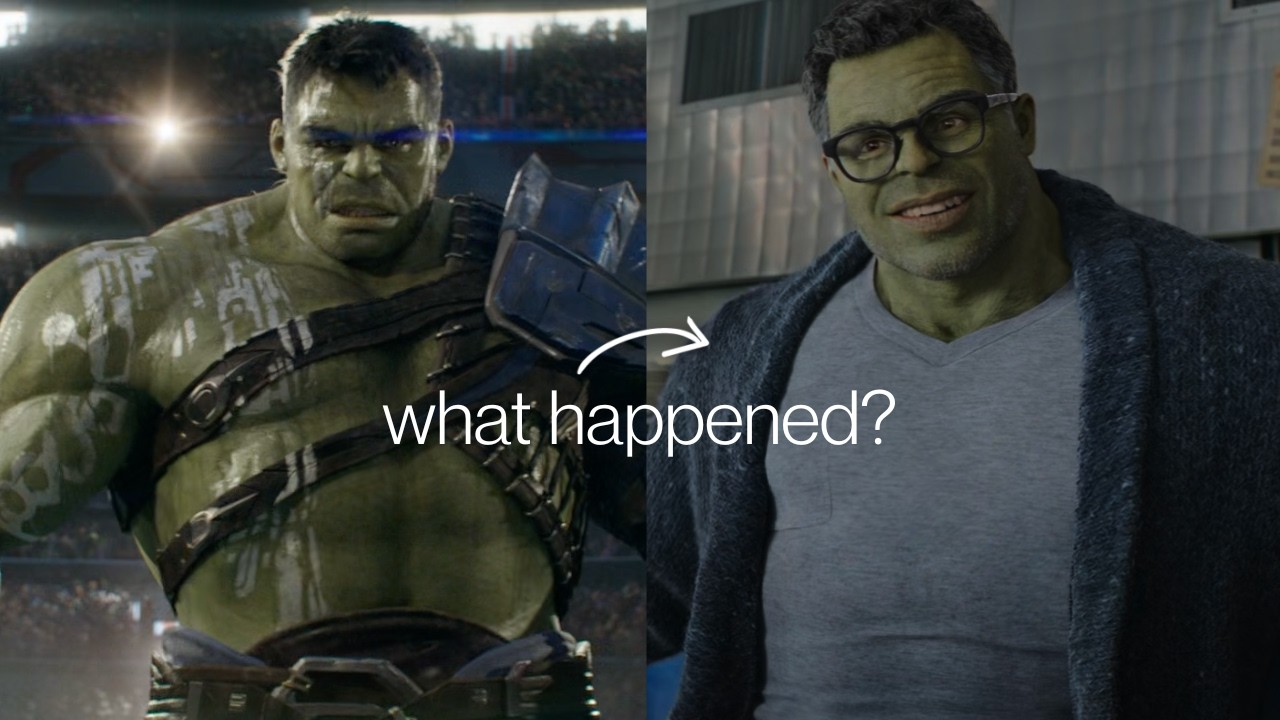
The situation reached its nadir with the introduction of Professor Hulk in *Avengers: Infinity War*, which fundamentally disregarded years of established character work by merging Bruce's personality entirely into a single form that claimed to be both mind and body. This decision effectively erased the duality, alternate personalities, and internal conflict that made the character compelling, presenting instead a version where Banner had supposedly cured himself but still viewed Hulk as something separate or dangerous. The loss of this complexity was further highlighted in *Endgame*, where despite being responsible for reversing Thanos's snap, Professor Hulk refused to let Savage Hulk take control during the final battle against him, denying the audience any chance to see a reconciliation between their conflicting selves. This approach reduced one of Marvel's most tortured heroes to a mere vessel for Banner's actions, stripping away his unique struggles with repression and trauma that make him relatable to audiences facing similar internal battles.
Ultimately, the MCU has failed to honor the rich potential of the Hulk by consistently treating him as a husk rather than a fully realized individual grappling with abuse, fear, and identity. While *Thor: Ragnarok* provided some high points regarding personality expression, subsequent films reverted to viewing Hulk through Banner's lens of shame and disgust, ignoring his desire for acceptance and connection. The series missed crucial opportunities to explore the darker aspects of Bruce's psyche or to utilize characters like Doc Samson to facilitate healing, instead opting for a repetitive cycle where Banner tries to suppress or control the Green Giant. True heroism in this character lies not just in physical strength but in the choice to forgive oneself and embrace one's darkest parts with faith and hope—a nuance that has been largely absent from his cinematic journey over nearly two decades.
Read the full video transcript
The Incredible Hulk is a character that
is loaded with depth, fascinating
characterization, and is way, way more
than just a big angry green monster. But
as the MCU has grown over almost two
decades, the portrayal of the Jade Giant
has been very, very poor. Very
disappointing.
to quickly run it down. In short, the
reason why there hasn't been a Hulk solo
movie after 2008 is a rights issue.
Universal owns the rights to Hulk, and
clearly they haven't brokered a deal,
allowing Hulk to have his own solo
movie. Now, whether or not Disney wants
that is beyond our scope of knowledge.
What we do know is that he only appears
in movies that are not his own, which of
course severely limits his
characterization, but that is not an
excuse for the lack of care shown to one
of Marvel's biggest and greatest
superheroes. So, let's see how it's been
over the past 18 years.
Hulk's journey starts in The Incredible
Hulk, the 2008 solo film starring Edward
Norton. The first red flag is the change
to Hulk's backstory. Instead of Banner
creating the gamma bomb and it exploding
while he tries to save a kid, it's
changed to a lab accident with a gamma
variation of a super soldier serum that
he tried on himself, thus creating the
Hulk. This change flattens the nature of
the giant, who is supposed to be
representative of America's anxiety over
the atomic age and nuclear warfare. And
it also softens his own guilt that is
baked into the character with Hulk being
a potential punishment for Banner
manufacturing weapons of mass
destruction.
The movie itself is largely uneventful
with Banner being on the run for most of
the film as it chooses to focus more on
Banner and Betty Ross' relationship than
anything else. This portrayal of Hulk
and Banner forgets the most important
part of the character, his psyche. Hulk
is the manifestation of all of Bruce's
fears and his guilt and his dissociative
identity disorder, which existed even
before the accident. Hulk is a
manifestation first and foremost because
of his father. His father, who beat him
relentlessly, began calling Bruce a
monster when he was as young as 3 years
old, leading to the point where Brian
Banner beats and kills his wife in front
of a young Bruce. In response to all of
these horrific things happening to the
young Banner, Bruce bottles up all of
his emotions. His response to this
trauma is that emotions, when they get
out of control, will eventually lead to
anger, and that will lead to violence.
Bruce equates violence with his father,
and he never ever wants to be like his
father. From a teenager well into his
adult years, he's held on to this very
childish notion that emotions are bad,
that they hurt people. And as the Hulk
manifests with violence and anger as his
motto, he is reminded every time he
looks in the mirror of the very man he
is trying to run from. Bruce escapes
becoming his father by shutting the Hulk
down, therefore repressing himself and
his feelings. Without them, he is both
safe from his father and safe from
becoming like his father.
Hulk as a character does not work
without the synergy between Banner and
the Green Giant.
The 2008 film is a poor depiction of
Hulk because all of the Jackalyn Hyde
Frankensteinesesque conflicts, the best
parts of the character are removed. No
trauma, no abuse, no repression. just a
man on the run, fearful of what he has
become with no exploration of how that
affects what goes on inside of his head,
only how the world around him is
affected.
In the first Avengers movie, there's a
bit of a time gap between the Hulk's
film and this one, where Banner and Hulk
are not necessarily on good terms, but
Bruce can call on Hulk when needed, and
the Green Giant will play his role. He
will smash things. But Banner rarely
even refers to Hulk by his name, calling
him the big guy or the other guy. Banner
doesn't even want to acknowledge or
identify with the Hulk. And yet, they
end up working together in the end.
There isn't any hint as to what that
conversation looked like. So, we don't
get much of Hulk or Banner's
personality. In the crumbs that we are
given, we know that things got so bad
with the Hulk that Banner tried to take
his own life, but Hulk wouldn't allow
it. He spit the bullet out. It's these
moments that would have been perfect to
explore Banner's inherent guilt that
comes along with having the Hulk inside
of him. But instead, we are only shown
Hulk as this raging monster and Banner
as the sane one. Hulk, however, does
show empathy and nobility later on in
the movie when he saves Iron Man and
playfully punches Thor. He recognizes
them as friends. This first film is
nothing remarkable, a passible depiction
of the Incredible Hulk. It establishes
his role as a founding Avenger.
In Age of Ultron, Hulk's arc is that he
has a hard time calming down and
changing from Hulk back into Banner.
Because she recruited and cared for
Banner, Black Widow now has the job of
turning Hulk back into Bruce. She
appeals to him the best. For me, their
relationship is unnecessary. just a
point to try and romantically connect
Natasha and Banner due to their shared
trauma on a team and in a film that is
lacking many of these interpersonal
connections. But the real crime for me
is that Banner and Hulk should both be
responsible for the possession of
Banner's body. If Hulk doesn't want to
change, explore why instead of inserting
a character who has no idea what's going
on inside of him to fulfill that role.
Hulk has zero characterization in these
films, and this could have been the
chance for the two characters to grapple
with the idea of Hulk having autonomy.
Instead, like in films past, Age of
Ultron's banner only sees Hulk as a
mindless monster that he does not trust,
like a disease. It's not you that I
don't trust.
>> And that's the problem with Hulk's
character. He is treated like a mindless
monster throughout almost every single
one of these movies, never treated as
his own character with needs and wants.
The films treat Hulk like a thing rather
than a person. We've also left Banner
off at an important moment. He is a
character normally racked with guilt,
and this was the time to show off a
tormented Banner who just probably hurt
a lot of innocent people, and he also
helped in creating Ultron, who also just
hurt a ton of people. Benner's guilt,
his apprehension should be at an
all-time high. But again, nothing for
this character. In this film, everyone
gets their mind corrupted or altered by
Scarlet Witch, where they all get to see
some of their worst nightmares, their
dreams, their potential futures. For
Hulk and Banner, nothing. He just gets
taken control of for the second straight
movie, like Loki with the tesseract. And
Hulk becomes the mindless, raging
monster that they always allude to.
Benner then takes the Quinjet and he
leaves Earth only to be found later
during
Ragnarok has without a doubt Hulk's
greatest depiction in the MCU. One that
explores Hulk with an actual
personality, a first potential alternate
personality of the strongest there is.
As Benner lands on Sakar, we see through
a flashback that he has changed into the
Hulk as a survival mechanism and has
been the Hulk for over 2 years. On this
planet, people accept him. They cheer
him on. He is their champion. A very
loose adaptation of Planet Hulk.
It feels as though Ragnarok's Hulk mixes
in the two most common Hulk
personalities, Joe Fixit, the Greyhulk,
and Savage Hulk, the common green Hulk,
with the appearance of Green Scar. The
Joeixit aspect of this Hulk comes alive
after his fight with Thor. Hulk loves
fighting, but he loves winning. We see
him enjoying a hot tub, eating food.
These are his spoils of war. He loves
this world because this world loves
Hulk. The way he yawns while Thor is
speaking, the way he spits out the seeds
of his food inside the room, how he
laughs at Thor, even the way he carries
himself. It has an air of arrogance.
This is the hedonistic, pleasure-
seeeking aspect of Joe Fixit, but
obviously without fixits intelligence.
This Hulk, however, is a bit more
simple-minded, [music] as he holds a
grudge against Thor, but when he beats
him, he boasts in his face. And that's
where the childlike savage Hulk comes
through.
>> I smashed you.
>> Yeah, sure. Sure.
>> Baby arms.
>> And it's astonishing, but these are the
MCU's Hulk's second words ever. He's
only ever said this to Loki.
>> Puny god.
>> That's it. Moving forward, the MCU's
Hulk always had a bit of empathy. We see
that during the moments with Widow,
saving Iron Man in the first Avengers
movie. And here in Ragnarok, he's able
to identify and respond to Thor's
sadness.
But still, he quickly admonishes the god
of thunder for crying like a baby. And
when the two argue, Hulk throws a very
sharp, very dangerous shield at Thor,
prompting Thor's anger. And the god of
thunder ends up calling Hulk the stupid
Avenger and telling him that Earth hates
him. This severely wounds Hulk. And what
made that distinction between the
childlike and the slightly older Hulk
was his reaction here. Hulk throws his
arms and he grunts much like a child
throws a tantrum because they're unable
to communicate what's wrong. And Hulk
sits down and he turns away from Thor.
He can't even face him. That conveys his
level of hurt. He considered them
friends. But it is a very childish
approach to his emotions.
However, right after he shows a very
mature understanding of Thor's emotions
and he accepts his apology and Hulk is
even able to identify that he himself is
someone who just gets so angry all the
time and he too apologizes for that.
This Hulk bounces back and forth between
these two personalities to create this
blend. Ragnarok's Hulk is direct. He
prefers actions over words. When he
wants Valkyrie to stay in a room, he
throws a chair at the door and then
asks. Violence and anger are still the
number one emotions he leads with, and
he finds comfort in them. But it's not
always for the wrong reasons. This is
the most Hulk in Hulk's own personality
that we've ever gotten from the movies.
And unfortunately, the most we will ever
get in his current run of the MCU. It
all happens without Banner's control.
When Banner regains it over the course
of the film, he doesn't remember
anything. He hasn't seen any of Hulk's
growth. He still views Hulk as a
monster. But Hulk and Banner never
discuss the last 2 years. They never
discuss issues, their problems, their
fears. But nevertheless, Ragnarok is
Hulk's greatest appearance and depiction
in the MCU to date. incredible highs to
counter his incredible fallout.
In what is probably Hulk's lowest moment
in his MCU existence in Infinity War,
Thanos embarrasses Hulk in a very quick,
very brutal defeat, one that Hulk
doesn't recover from throughout this
movie. With the world at stake, Hulk
refuses to show himself, leaving Banner
to aid in the fight against the Mad
Titan through a Hulkbuster suit.
I don't care that Hulk lost. In fact, I
think that it's a great choice because
of the potential for self-examination.
I'm more disappointed in the way that it
was handled. Hulk losing is perfectly
normal and could have been positive for
Banner and Hulk's relationship going
into Endgame. Hulk prides himself on
being the strongest there is. In his
mind, no one will ever make Hulk feel
small and weak like his father did if he
never loses a fight. That's how he
copes, and that's why the Hulk is so
strong. so much of himself, his pride,
his ego is predicated on that strength.
So losing to Thanos here and actually
being afraid or embarrassed or whatever
was a chance here for Banner to engage
with why exactly Hulk was so unwilling
to return, investigate what the origins
of that fear are. It could have been the
perfect time to visit the Hulkcape.
Alternatively, Banner could have
potentially gotten Hulk to call upon one
of his alternate personalities. Maybe
summoning Green Scar, the strongest
Hulk, to take over and fight, or
exploring Devil Hulk as one of the Hulk
alters who exists as a pseudo father
figure, the one who protects Banner when
Thanos threatens him and the child,
Savage Hulk. There was a real chance
here to once again explore the psyche of
Bruce Banner and mend that relationship
following the events that had happened.
but instead the worst possible outcome
happened.
Professor Hulk is the worst possible
outcome for a few reasons. The first is
that all of the development that
happened between Banner and Hulk
happened offcreen. 18 months, Professor
Hulk says, inside the Gamma Lab. We
missed out on 18 months of conversation,
fights, exploration of the duality of
the Incredible Hulk. Second, whether
intentional or not, we were lied to.
Professor Hulk said that he put the
brain and the brun together, that he now
looks at Hulk as the cure rather than
the disease. This is a lie. The problem
with Professor Hulk is that it
fundamentally disregards Hulk, the
character. It takes all of Bruce's
qualities, his personality, and simply
shoves it into Hulk's body. There are no
different personalities for Hulk and
Banner. No alternate personalities at
all. It's all banner. There are no
Hulk-like approaches to conflicts. There
is no Hulk perspective. There is no
aspect of the character other than the
big green body.
It smooths out all of the characters
intricacies. All gone. That Ragnarok
version of Hulk is gone. In Endgame, he
gets his quote unquote moment by
snapping everybody back and being
responsible for that. But during the
final fight against Thanos, who
embarrassed him, he gets nothing. Banner
doesn't even relinquish control to Hulk,
not even for a second. It's Professor
Hulk, but the Hulk doesn't exist.
Hulk appears in She-Hulk's first episode
where he serves as his cousin's mentor
on how to control her Hulk form, but
they quickly learn that She-Hulk doesn't
have another personality. It's just an
extension of Jennifer's rage, but she is
fully conscious and fully aware. We
don't learn anything new about Banner
and Hulk in this series, but for as
timid and careful as Banner used to be
in the earlier movies, he has grown into
his role as a hero. It's something that
he truly does take pride in, it feels
like. But for the Hulk, Banner mentions
Hulk as an alter ego with the analogy of
two guys on the steering wheel, but I
just don't see Hulk's personality. It's
another instance of Banner's personality
overtaking Hulk's body.
A brand new day's Hulk is a lot of what
we've already seen. Banner and Hulk are
at odds once again. Professor Hulk no
longer exists, and Banner controls Hulk
thanks to these inhibitors that he
wears. When Gene takes control of Hulk's
mind in the film and sets Hulk loose,
there is a line that is said, quote, "No
Banner, no girl, only Hulk." This
perhaps points to the two grappling for
control and Hulk finally lashing out
after being caged by Banner.
We do get a look at Hulk's power and
strength, which we haven't seen since
Ragnarok, and he easily dispatches
Punisher and Spider-Man during their
battle. Still, Hulk does once again show
his trademark nobility when he's
fighting Spider-Man. And at one point,
Peter pleads for Banner not to hurt him,
and Hulk looks at himself in a broken
mirror, and he acknowledges his own pain
and anger, and he realizes that he's
hurting his friend. In the aftermath,
Banner says that something broke inside
him as he is brought to a psychiatric
ward in the scenes that follow. Now,
wishful thinking would be Devil Hulk,
who's historically been caged up, just
like Banner is going to be. They could
also explore the character with the help
of a very prominent green-haired
psychiatrist, Doc Samson. But it is more
likely that Banner and Hulk have a lot
more work to do offscreen. One thing
Banner mentioned to Peter when
discussing parts of oneself, he asks
Peter which parts of his nature will he
determine are good or bad.
>> How would you decide what parts of
nature are good or bad?
>> And of course, he's talking about
himself as well. He spent all this time
demonizing Hulk and even at one point
tried to take his own life to stop the
Hulk. But it seems as though it's still
a question for him that maybe Hulk isn't
quote the bad. It's something perhaps
that he still needs to reckon with.
Banner yelling at everyone to get out of
the building while physically and
audibly hurling at Savage Hulk's
emergence was a neat new addition,
adding a horrific element that
inherently exists in Hulk's story. That
transformation is not a clean one,
especially when the two are fighting for
control. But that guilt, that repulsion
never amounts to any sort of real
exploration for the character, so it
just plays as Banner being ashamed and
disgusted with Hulk once again. The
disease is back.
The MCU's version of Hulk's relationship
with Banner can be summed up best by a
quote from Al Yuing's Immortal Hulk,
where Savage Hulk lets loose on Bruce
Banner. And Hulk says that he hates
Banner because of the way Bruce treats
him. That Bruce is Hulk's prison. Quote,
"Banner always wants a cure for Hulk,
wants to take Hulk's strength and lock
Hulk in darkness or kill Hulk, and if
Banner can't, then he'll get someone
else to do it. Banner would rather die
than let Hulk live.
We have a Banner who hates and is afraid
of Hulk, which is why he won't even call
Hulk by his name. And a Hulk who doesn't
want to relinquish control back to puny
Banner because he knows Banner hates
him.
Bruce is always taking and taking from
the Green Giant and never addressing
what it is that Hulk wants. So, it's no
wonder why their relationship is
fractured. And it gets repetitive when
the MCU just uses him as their resident
monster. Banner should be much nicer to
Hulk, but we never get that
confrontation and no desire to come to
the conclusion that they need each
other. Angle's Hulk in 2003 is the best
depiction of the Hulk so far. It isn't
an MCU movie, and for all of its
problems, at least it had heart and
intentionality in depicting Hulk as an
endlessly complex, troubled, repressed,
and tortured individual. It tried to see
Hulk not as something opposite to Bruce
Banner, but a part of him and a part of
him that could be good.
In summation, Hulk in the MCU is very
much a husk, a shell of what this
character could and should be. I'm not
looking for the perfect adaptation from
comic to film. I think the comic
versions of Hulk that so many great
writers have been able to conjure are
more than enough. But if the character
is to be adapted to the silver screen,
it would have been nice to have seen it
done correctly. Hulk is a character that
represents so many things, abuse,
trauma, repression. He is an emblem of
the fear of nuclear war and violence, a
character that critiques masculinity.
Hulk is tortured and struggles with the
side of himself that he doesn't want
anyone to see and yet forces himself to
choose.
And the heroic aspects of Banner and
Hulk always choose to try and put his
best foot forward. Hulk is the only
character whose deepest, darkest secrets
and traumas are always exposed. He's the
only one with these issues that get
manifested larger than he is out there
for everyone to see. Hulk and Banner,
they choose faith and hope in
themselves. They choose to forgive
themselves. And that's what makes him a
superhero. It's that choice. He is a
character that I believe people can
relate to. But the Hulk that I've seen
depicted in the MCU over the past 18
years simply hasn't been that.