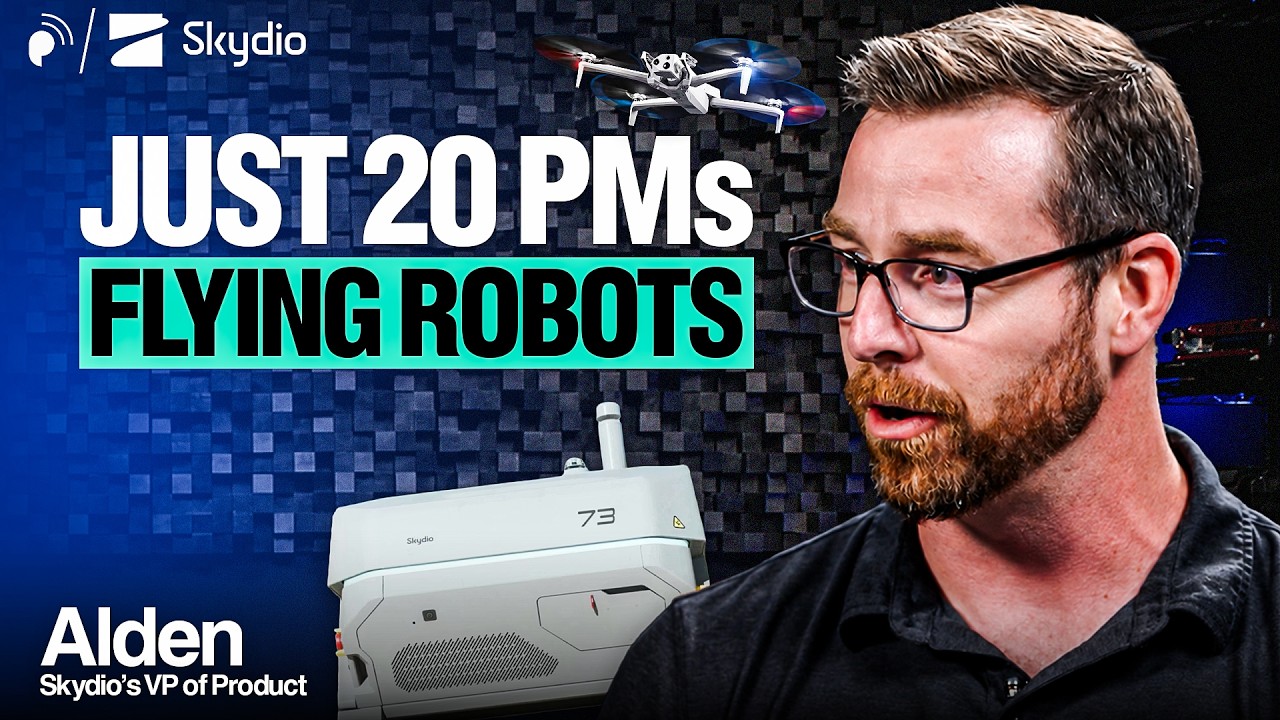
Video summary
Skydio is redefining the role of aerial robotics by evolving from simple consumer toys into critical infrastructure that solves complex business problems across four main sectors: public safety response, defense and intelligence surveillance, physical security for large venues, and industrial inspection. Unlike traditional drones often viewed as mere camera platforms or expensive helicopters costing thousands per hour to operate, Skydio's flying robots are designed to be autonomous tools that integrate hardware, software, and cloud services into a vertically integrated solution. The company emphasizes that their technology is not just about the quadcopter itself but includes robotic base stations and arms, creating a full-stack ecosystem where drones can act as first responders or provide real-time intelligence without requiring constant human intervention.
The operational model at Skydio relies heavily on deep customer immersion rather than traditional market research, driven by a philosophy of being "customer first." With only about 20 product managers managing the entire stack from hardware to autonomy, the team operates with no travel budget for their PMs; instead, they are expected to go directly into the field to gather data and understand real-world usage. This lean approach is supported by specialized engineering teams that execute deep investments in specific features, such as night vision capabilities or advanced obstacle avoidance algorithms, often embedding engineers directly within customer operations like fire departments or military units for extended periods to ensure the technology meets exacting needs before returning to refine the core platform.
Financially and strategically, Skydio distinguishes itself by funding its massive expansion through revenue rather than debt or heavy venture capital rounds, committing $3.5 billion over five years specifically toward building a secure supply chain in the United States and allied nations. The company competes for top-tier talent against tech giants like Google but maintains this position through a mission-oriented culture that values solving real-world problems over theoretical innovation alone. By earning regulatory trust from bodies like the FAA through demonstrated safety and autonomy, Skydio has secured waivers ahead of competitors to scale fully autonomous fleets in the near term, proving that advanced robotics can democratize access to air support for squad-level units rather than just elite military battalions.
Read the full video transcript
We've all probably heard of drones. We
actually believe that we're on a journey
from toys to tools to infrastructure.
>> Alden Jones, VP of product at Skydio.
>> You are literally competing head-to-head
with Google, the large
>> Always in terms of talent.
>> Yeah, and then on the mech E's, the
mechanical engineers, electrical
engineers, you're competing with I mean,
we're in the Bay Area to get the best
talent, but we're definitely competing
for it.
>> When can we expect like fully autonomous
[music] fleets of robots flying?
>> It is very near-term. I think we're
>> Do you oversee both the software and the
hardware component of the robots?
>> and then we have software leaders on the
autonomy side, SVP of engineering
overall also work with the hardware
engineering and manufacturing leaders.
In Ukraine, they're doing a lot more
unfortunately like really large-scale
battle, and so today a Ukrainian soldier
will not move on the battlefield without
air support from the drone.
>> I'm curious to know what is your
background in order to, you know, make
you want [music] to combine both worlds
cuz it's also like not something easy.
>> Hey, this is Carlos, CEO at Product
School, [music] and your host on the
Product Podcast. Today, I flew out to
Skydio's office in California because my
guest [music] builds flying robots.
Alden Jones runs product there across
hardware, software, and autonomy, which
is rare enough. What's rarer, he has a
history degree, he is not an engineer,
and he [music] drove supply trucks in
Iraq before any of this. Here's what we
cover: Why they refuse to call them
drones, the 3,000 an hour helicopter
they are replacing, 55,000 emergency
calls a month, and the metric for when
nobody gets dispatched, [music] 20
product managers, no travel budget, go
get the signal, a 3.5 billion dollar
commitment funded by revenue, not debt.
[music] Let's get into it.
>> Alden, welcome to the Product Podcast.
>> Thank you for having me.
>> Well, thank you for having me, and
technically the host of the the podcast,
but you're hosting me at your office.
>> Yeah, but you're in charge now.
>> Well, we we see, and I had to come
because what you guys are building is is
incredible, right? It's flying robots,
and I think it's something that you I
I'm very lucky, very grateful I had the
opportunity to to to see.
>> Yeah.
>> And I hope that we can take some of that
magic and explain what you guys are
really building here. Um but maybe we
start with the beginning. Why am I using
the term robot, flying robot, instead of
just drone?
>> Sure. Um
so I think we've all probably heard of
drones and we think about quadcopters
and many people probably think about
them as toys. Many people who work with
them maybe think about them as tools. We
actually have believed that we're on a
journey from toys to tools to
infrastructure. And when you think about
robots being used to do really important
jobs, there are so many different things
that we are building that isn't just the
flying quadcopter. So we're building
different kinds of platforms. We're
building robotic uh base stations to
host those platforms. We're building
robotic arms. So in order to deliver the
full solution, we don't just build
quadcopters that people are probably
used to. We're now building a suite of
robots to solve problems.
>> And give me a sense of the scale of your
business today.
>> So we're just under 1,000 people uh
which includes manufacturing, which we
also do here in California, uh and a
super multi-disciplinary team of
experts. So we do everything in house.
We do
um everything from software, hardware,
logistics, supply chain, manufacturing,
chip-down design, and most of the team
in engineering is is here in California,
but we actually have engineering offices
around the world to capture certain
disciplines like autonomy and cameras,
um some defense tech, and then
go-to-market is
uh all over the place.
>> And you guys cover the full stack,
you're very vertically integrated.
>> Yep, vertically integrated. Uh build the
hardware, ship the embedded software,
ship and build all the cloud software,
all of it.
>> Well, and you as the product executive,
like how do you actually fit into this
picture?
>> Yeah, so day-to-day uh what I think
about my team is we have sort of the
core product platform team. So these are
the folks who are looking after
hardware, the core software experience,
core autonomy, embedded work,
communications, or connectivity as we
call it, and product operations. And so,
they are supporting building a lot of
the tech stack, essentially, that our
business is built on. And then, we also
have vertically integrated PMs who they
aren't quite GMs, but they are really
focused on delivering uh bespoke value
for a specific use case for a customer.
And so, we do that across several
different industries.
>> So, you oversee both the software and
the hardware components in their
products.
>> Yep, and then we have a software leaders
on the autonomy side, SVP of engineering
overall,
uh and then also work with the hardware
engineering and manufacturing leaders.
>> So, typically host the CPOs that work in
software products only, like Netflix,
Airbnb, many others. Yeah.
This is quite unique. And I'm curious to
know what is your background and that
to, you know, make you want to combine
both words cuz it's also like not
something easy.
>> Yeah, it's a great question. So, maybe
just a spoiler alert, I'm not an
engineer. Uh I have a history degree,
and I was really motivated at at a young
age to join the military. Come from a
family who's done service, and I really
wanted to to try and give back. And so,
that's what I did earlier in my career.
Um and I think in that I got to see how
technology needs to be used to succeed
in really critical situations. And as I
got back into the workforce, you know, I
had some like kind of Fortune 500, like
I call it leadership jobs. They were
kind of boring stuff. It's what you do
when you get out of the army. But I
eventually found my way to an innovation
role at a telco company where I got to
start to experiment with drones. And I
think I had an opportunity there
to really teach myself about technology
and like got to, you know, start to work
a little bit in software, start to try
and code a little bit, learn about
drones, learn about physics. And
ultimately, that that led me to Skydio.
And then, I actually started at Skydio
as the customer success leader. So, we
had a team of zero. We built all the
functions. So, everything from pre-sale
solution engineering to post-sale
support, but this is just a incredibly
technical company and so I got to build
really great relationships
and learn a lot with engineering leaders
and hardware software as we grew the
business and grew the company and bumped
into all the problems got to learn about
how this tech stack works and like
really dive deep to explain what was
going on and then ultimately I got I got
the opportunity. I will also say that we
have fantastic technical founders. So
Adam's our CEO and and co-founder.
They're fantastic brilliant engineers.
Adam and I work quite a lot together. I
would say that he visionary wise
absolutely hardware vision and probably
a little bit more executing on the
hardware side with my team and on the
software side probably a little bit more
leadership there.
>> Cobus I now want to dive a little deeper
into the actual product. You were giving
me I wouldn't even call it a demo. That
was real. Like you were flying multiple
drones actually multiple robots sorry at
the same time what is the actual use
case or main use cases that you are
covering with your flying robots?
>> Yeah. So maybe let's just zoom out a
little bit. You mentioned this before.
We call ourselves a flying robot
solutions company and so at the end of
the day we are trying to solve business
problems or critical problems for four
kind of main use case. So one is
response. We call that drone as a first
responder. You can think about that
matches pretty nicely with public
safety. ISR intelligence surveillance
and reconnaissance which is a term that
is used in the military essentially for
gathering information on the battlefield
and so we provide use cases essentially
camera drones to collect intelligence
and work with militaries. We have all
departments
under the Department of War and 29
allied nations so very proud of the work
that we do there. We work on security so
this is imagine large fixed sites that
our customers have so think of a data
center or a dam or a power plant. They
want to secure that today customers are
usually have roving patrols of human
beings walking or in cars 24 hours a
day. It's expensive. It's inaccurate. a
lot of false alarms. And then
inspection, there are trillions of
dollars of infrastructure around the
world and this is what I did in my
previous role, digitizing a portfolio of
assets allows businesses to be so much
more efficient and I have a couple
stories that I want to tell but I I want
to
talk about DFR just real quick real
quick. So just sense of scale in DFR. So
there's around 250 million to 300
million, it depends on how you count it,
public safety or 911 calls in the United
States every year. Today Skydio and Jess
about 3.5 3.8 million
911 calls every every month. We respond
to 55,000 911 calls every month and
around the country
25 million Americans live within 2 miles
of a Skydio DFR dock and that is up from
12 million I think just like
8 months ago. So like things are really
growing
um and the use cases there are
essentially helping public safety get
the best information as fast as possible
to make the right public safety
uh choices as they're helping the
community.
>> So I think this I want to double click
on that because I was asking you this um
off camera um the traditional
alternative
today is what?
>> Yeah, so there's so in public safety
there's two alternatives. The one that
probably everyone is thinking about, you
immediately reach this conclusion which
is right as the helicopter. It's an
interesting uh proxy. I mean it's it's a
flying camera. It's just really
expensive. It's $3,000 an hour to
operate. You know, the going rate of a
helicopter somewhere between 10 and 25
million dollars depending on how much
money you want to spend. So it's a very
expensive tool and
you just cannot respond to the density
of calls that you have in any given
city. And so one of the things that we
do with DFR when we sit with our
customers early in the pre-stage or the
pre-sales process, we actually sit with
them with their data and we map all of
their 911 calls for the year. They give
us parameters on which kind of calls and
priorities they care about and then we
advise them on where they can best put
docking stations so that they can most
quickly respond to those things. The
other alternative, which I know you've
had a I've I've listened to a few of
your guests, I know some of your
listeners have done this, but if you go
on a police ride-along, which you can
actually request from your community if
you ever want to do that, you can go to
the police station and ask, is just the
radio. They'll they'll have a they've
what's called a mobile data terminal.
It's a little toughbook kind of computer
in their in their car, and they'll get a
one-line dispatch, you know, "Suspect
with knife threatening whatever." That's
all they know.
No images, nothing visual, and we're
such visual creatures, and maybe a radio
call saying like get there or go off
your this job and go do that. There's a
lot of nuance department to department.
There's I think like 18,000 different
public safety agencies in the United
States, so it's a wide tapestry, but
generally that's the use case, or excuse
me, that's the workflow. And so it's
just imperfect information in a really
high-stress scenario.
>> It's difficult about success metrics,
right? Because here you are talking
about literally responding to
emergencies in some cases, right? So,
how do you measure success?
>> We actually have something in the
product I should have shown you this. I
didn't Oh, man, what a miss.
>> Maybe later.
>> Yeah, afterwards. Uh we call it the DFR
uh outcomes dashboard. So, we measure um
a couple of critical things. We measure
response. So, did the drone get there
first? That's like a big important
thing. We measure what the response time
was. Uh we talked about this a little
bit off camera like and if you go to any
city council meeting, any mayor, any
police chief, they are really interested
in what is my response time. There's a
lot of budget and funding and and a lot
of contributing factors to this, but
it's as a community as Americans or as
anybody, we're we expect public safety
to show up when we call, and how fast
you show up matters. We also track if
the drone provided useful information.
So, like did it actually help the
officers on scene make a better choice?
And then last, we actually track this is
this is a fun one for maybe B schoolers,
we track how often a officer was not
dispatched because the drone got there
so fast, realized that there was nothing
going on, it was a nuisance call, and it
was a waste of public city city
resources to send a cop, and so they
don't go. And the best part about all of
this is
the customers report this themselves in
the product, and then their leaders get
to see all these metrics.
>> And this is the main segment for your
business.
>> This is the largest part of our
business. The other three segments are
yeah.
>> They are there too. I would group three
and four kind of into one. So, two is
defense.
>> Yep.
>> What are some of the main use cases
there?
>> Defense is really interesting. If you
think about a military unit,
it it's like a mini city. So, they have
a base.
It has a border. Or maybe even a mini
country. It's got a border. There's
houses where people live. There's a
grocery store. There's police. There's
also people going to work every day.
There's commuting. There's traffic.
There's training area. So, that's like
on base. And that's probably not what
most people think of when we were
talking about the military application,
but it's an important thing. And it's
something that we definitely serve our
customers.
On the And that's mostly the security
use case. On the ISR side, tactical ISR
is is what you imagine. I think all of
us are reading the news today, and we
know what's happening in Ukraine, and
it's it's a very unfortunate tragic
situation. But essentially, the goal is
to have the best information possible to
to keep yourself safe, and to you know,
complete whatever objectives that you
are assigned. So, I mean, I can I'm
happy to get personal. Like, I'll think
about my own deployment. So, you know,
my job I I I wasn't anything fancy. I
was a I was a truck driver. I was a
truck driving officer. So, I had a
20 trucks, folks that worked for me. We
would bring supplies back and forth in
Iraq. And so, we might be driving from
base A to base B to bring them, you
know, medical supplies. I'll give you
one example as a mission. And there
might be something in the road. And you
know, we would stop, and we kind of look
through our binoculars, and we'd like
look around, and we just maybe we get
out of our truck and kind of like go
poke at it with a stick, you know, like
that's Okay, well, instead of doing
that, just send a drone, find out
exactly what it is, and then you get to
make a decision. In Ukraine, they're
doing a lot more uh unfortunately like
really large-scale uh battle. And so,
today a uh Ukrainian soldier will not
move on the battlefield without air
support from a drone. And they're doing
really sophisticated stuff,
unfortunately born out of a out of a
need. So, they will recon the objective.
They're using drones to see where the
opposing forces are. They're using
drones what's called uh as a in a
kinetic way, so that's like to deliver
battlefield lethal effects. We don't do
that. We're camera drones only. But, our
job is to help those soldiers identify
essentially where the people who are
going to hurt them are, and then like
use that to make decisions on the
battlefield.
>> And similarly to the first um segment
that you mentioned, the traditional
alternative maybe was no alternative,
right? Air support is something that was
extremely
>> Yeah. Air support is really expensive.
Like a Predator drone, we've probably
all heard that in the news, is millions
of dollars. You know, special forces or
or units that are in like really hot
areas might get some air support, but
you just can't build or buy enough of
them. And so, our belief is that, you
know, thousands of camera drones on the
battlefield giving commanders much
better information to make better
decisions is a way to democratize the
technology down from my battalion was
about 750 people. We never had air
support. And we want it we have units
today who at the squad level, which is
10 people, they have a drone.
>> And again, like thinking about the
success metrics, I can first of all,
think about life saved here based on the
example that you provided.
>> Sure.
>> Is there any other way to measure the
outcome success here?
>> You know what's really interesting? I
you know, I could rattle off a bunch of
flight uh metrics. We're about to cross
our 5 million flights, uh which is
really exciting. All all those metrics
that we give, it's none of it includes
our tactical ISR users, because all of
that is completely disconnected, offline
air gapped. So, we actually don't get as
much feedback. There's different kinds
of feedback methods with national
security customers, but yes, like live
saved is is the metric. Um or sometimes
grim, but this is, you know, when we ask
our soldiers to do something, sometimes
it can be that like they accomplish
their mission, which might be to go move
to a piece of terrain or capture
something or or go fight.
>> And then moving us to the next uh bucket
or segment, right? Um I was yesterday
work at FINA. Um yeah. I was born in
Spain, so I have to say
>> Amazing. Congratulations. He's so
[laughter] cool.
>> Thank you.
>> We were rooting for you.
>> I saw one of your drones there, right?
So, maybe that's a good way to exemplify
how you guys are covering also like the
other type of commercial applications.
>> Yeah. So, um we talked about this a
little bit. Public safety agencies are
using the drones there, but they're
doing what we would call a physical
security use case. And so, a stadium's a
great example. Uh there's a big stadium.
There's
tens of thousands of people. You want to
protect them. You want to make sure
everyone's safe. You want to, you know,
do perimeter sweeps. You want to know
what's going on. You want to be able to
get eyes on a hotspot. Um so, the two
ways that we think about security
applications is kind of dual use. So,
one is autonomous patrol. We essentially
tell the drone, this is all happening
autonomously, to just fly around. And
the way it can happen autonomously is
we're also running
um AI communicating back to models to
essentially look through the like the
images that we're getting and either on
board the drone with certain models or
off board with other models like
identify if there are things that the
operator decide or excuse me, the
customer decided that they cared about.
And so, that's kind of the patrol mode.
Today, that's happening with guards who
are walking around or or people driving
cars like we talked about, which isn't
which isn't the greatest job. Uh or
response. Um we I can't mention the
customer's name, but there is a we are
working with
venue kind of companies as well, but
there's also data center companies, also
logistics companies. But you can imagine
they have an alarm. And today a guard
has to physically go and like go to
where that alarm is and or try and see
it in the camera and clear the alarm. Um
we pulled these stats uh when we were
talking with some customers recently
about somewhere between 90% and 95% of
all alarms in physical security in the
United States are false alarms.
So it's just a huge waste of time. Like
why wouldn't you just send a drone?
It'll probably get there in 50 seconds
or less depending on where it is on its
route. And then you immediately know
like do you need to do something or do
you not? Um and now that we're building
indoor and outdoor drones, you know,
we're really excited for this
application to start to to scale.
>> I I like that and I think that example
applies to all the segments in in terms
of confirming false positives. I don't
like not only accomplishing a certain
mission, but like knowing when there's
no mission.
>> Totally. You don't have to do anything.
>> And like why not send a the the marginal
cost of the 3% of batteries like
nothing. So it's like it's not quite
software zero marginal cost, but it's
almost nothing. It's a couple electrons.
Why wouldn't you do that?
>> Let's actually talk about the software
because you showed me some of behind the
scenes and seems like one human can
handle multiple flying drones at the
same time?
>> So it's very exciting. Uh I I want to
talk about two things here. So one uh
just to nerd out on the tech. Um so
today we have customers who are flying
one pilot four drones. We did two to
one. Um it depends on the use case like
depends on how much attention you need
to pay to every drone, but you can fly,
you can autonomously command the drone
to go do things. One of the things that
makes uh Skydio great is uh our
autonomy. And what we mean by that is a
combination of deep learned models that
are on the drone that are looking We
have cameras that look in all
directions. And so we are both building
a three-dimensional model of the world
to to identifying and digitally create
objects that we can go around. And we're
identifying things to like know where we
are and make smart decisions like the
sky. Um so
>> Like a Minecraft.
>> It's very my Yeah, so the the 3D model
is very Minecraft. You just need to get
enough to know that you're and
especially if you're flying 45 miles an
hour, like you're not going to resolve
fine details, but you just need to make
sure you don't bump into things. But one
example of like where the deep learning
model is is being used on the system is
we might be We have customers who will
fly into a parking garage to try and
clear an incident. And the drone can
automatically just find its way out. And
when it knows that it sees the sky, it
can be like, "Okay, I see the sky. I can
go do what I need to do." So that that
kind of stuff. The reason why autonomy
is important is the only way that you
can truly operate multi-drone is that
you have to trust that this system can
handle itself. Handle itself also when
there are off-nominal so
situations. So like let's say the city
loses power. You need to trust that all
those drones can fly home by themselves,
get them safely, land by themselves, and
so 1 to 4 is an amazing application.
That's just the beginning. This is going
to continue to scale. And one of the
things that I the second thing I wanted
to talk about is for a long time in the
drone industry, there was somewhat of an
adversarial relationship uh with the
FAA. People that you'd go into the
forums and people would be complaining.
And so they say, "What is FAA?" Uh this
is the Federal Aviation Administration.
Thank you. And we have taken just a
completely different approach. You know,
we believe that it is our
duty and our mission as a vendor and as
a manufacturer to earn the trust of our
regulators. And so the way that we do
that is we built autonomy. We've hired
the best folks in aviation safety in the
world and regulation and understand it
deeply. And we work with the FAA every
day to make sure that we are earning
their trust. And in doing so, we have
been given all of these groundbreaking
waivers before everybody else because
the tech can support what we want to do
and they believe in us.
And we prove it to them. I guess they
didn't believe right away. And and we're
also, you know, working collaboratively
with them.
>> So you said that 1 to 4 is the
beginning.
>> Yeah.
>> When can we expect like fully autonomous
fleets of robots flying?
>> I don't want to like uh give away too
many things about our user conference,
but like people should tune in.
It's It's in September. Uh, so it's not
out of the question. It is very near
term. I think we're
I think in the industry people imagined
a world where we would talk about this
and talk about it and nothing happened
and nothing happened and the scale that
we are reaching in autonomous flight
that's happening every day for the
majority of of all of our flights, even
if it's a response, like it's most of
the time flying there autonomously and
flying back but some time when they're
on this on the objective, but we've now
earned the trust that this is system can
do what it needs to do and so like this
is This is not 10 years out. This is not
a That's not what this is anymore. It's
happening now.
>> And obviously as a probably that I'm
sure you're looking for patterns and
ways to,
uh, group certain use cases, but at the
same time you guys are covering a lot of
ground. Quite literally, right? So, how
are you thinking about funding the
operations and making sure that you can
continue building across the entire
stack?
>> So, it's interesting you asked that.
Like, we've been working with these
customer bases for quite a long time,
but I would say that you know, for the
first The company was founded in 2014.
So, for the first half of the company's
life, there was just a lot of sort of
R&D and innovation teams and we we had
this novel thing. We had autonomy and we
had this obstacle avoidance and people
could see where this was going, but we
weren't delivering value.
And, um, as a company we then really,
uh, got close to our customers and
started to deliver real value. And I
think what changed for us is X10, which
is the quadcopter our like, uh,
workhorse quadcopter platform, the dock,
and the remote operations software. When
those things came together, it
fundamentally changed the paradigm and
so lots of folks wanted to work with us
and DFR really took off. And from an
investment perspective, the way that we
think about it is we we actually
prioritized that pretty ruthlessly when
we were on that path. It was the number
one company goal that we were going to
make DFR successful, and we, you know,
didn't invest as heavily in some of the
other areas for a period of time. But,
once DFR took off the way it has, and
we've been so pleased with the results
that our customers are having, and we
get to benefit from them, we say
internally we've now earned the right to
go invest in all these other areas. Um
we've always had a large military
business, and we're we're extremely
proud of that. It's a little bit more
lumpy, and some of the other businesses
are less lumpy.
>> This kind of reminds me of what we're
seeing with a lot of the LLMs, with all
these labs, right? They were in the dark
for many years, losing money, no
product. Suddenly, product product
market fit. They're growing at the same
time the the capex investment is
massive, really. But they're growing
revenue-wise,
they're not profitable yet at all,
right? So, as I think about hardware
investments, I don't know if data
centers is an area of investment, but
other areas, like how are you thinking
about finding the funding the
operations, and and also making sure
that you are Um I think you you you had
a stat that was like a certain level of
commitment in terms of
>> Yeah, yeah.
Our CEO announced this stuff a few weeks
or months ago. So, Skydio is committed
to 3.5 billion of total investment over
the course of the next 5 years. And
there's like really two flavors of this.
Like this is all of the work that Skydio
is going to do, all of the drones that
we're going to produce, um and there's a
lot of investment in essentially the US
and allied supply chain. So, in order to
build the tens of thousands, hundreds of
thousands of drones that we're going to
be shipping, we want really secure
supply chains, and we want lot more
investment in the US and our allied
nations. Um and so there's been a lot of
work, and that's part of our commitment
is
US manufacturing backed by, you know,
allied and partnered supply chains. And
so a lot of the investment is going to
go there, plus all of the other
activities that we're going to be doing.
>> So, that's a pretty big number.
>> Yeah.
>> With a B.
>> Yeah.
>> So, as you look at the competitive
landscape of the market in general,
right? Like, what is your strategic
positioning and that make gives you the
confidence to know that you are going to
be able to raise those funds so you can
actually deploy them.
>> Well, the great thing is is like we're
not we're not taking that. We're not
like trying to go raise a big round to
do that. That's just the revenue of our
business driving how we're going to go
make those investments, which is really
exciting. I think our last round we only
raised like a hundred million dollars
because we we don't that's not what
we're trying to do. We're not funding
this via debt. We could decide to
continue to do that if we wanted to go
after even more markets and we might
decide to do that, but that investment
particular is just revenue funded, which
is really exciting.
Um in terms of the market landscape,
yeah, I think like there's a couple
things that make us special. Uh we are
and I don't put myself in this category,
but the company is a world-class
engineering company. I I just I am so
impressed with the talent that we have
here and we have such a high bar for
talent and a culture for how to go and
get the best engineering talents. Where
do they come from?
All over. Uh there's clearly on the
autonomy side you can imagine labs, PhD
programs, drive autonomous driving, like
probably some of the more traditional
things, but on
uh software engineering side we have
folks from all different walks of life.
>> So, you're actually competing
head-to-head with Google the labs in
terms of talent.
>> and then on the mechies, the mechanical
engineers, electrical engineers, you're
competing with I mean we're we're we're
in the Bay Area to get the best talent,
but we're definitely competing for it.
>> Um so, in terms of them you mentioned
before the team, like how you are
actually designing it. You have people
who are owning different segments, not
quite giants in terms of owning the
number, right? So, tell me give me more
details cuz I think this is quite
unique, right? Like most of the the
product teams that I've interviewed they
have software.
>> Mhm.
>> So, maybe their taxonomy is slightly
different. I just want to learn more
about it.
>> Yeah, I think to zoom out a little bit
that this this org structure comes from
a philosophy. So, our philosophy at
Skydio is is customer first. And I was
listening to a bunch of the folks that
you have interviewed. I think like one
thing that is true from all successful
companies is that they are customer
obsessed and they're customer first. It
might sound different in how they do
that might be different by company, but
it's very clear that that is the most
important thing. Like, are you
delivering value for your customers? And
we have a very mission-oriented culture
here in terms of solving real problems
for customers. So, that's the start. And
then then when we look at the team, we
know that we have deep deep investments
that we are making from an engineering
side to do the things that we do. So,
just to give you like maybe one example
of X10 is an amazing platform, but our
customers in the military and public
safety and security and in inspection,
they need to fly at night. And they love
the fact that we have 360° obstacle
avoidance and autonomy, but it only
worked in the day. And that's 12 hours
of robots not doing what they need to
do. And so, we invented NightSense,
which is this active illumination
invisible to the naked eye in in IR so
that you can do all of the autonomy
functions at night. That is deep
investment across a wide range of teams,
hardware, software, autonomy. And so, we
did not want to disrupt the engineering
and invention engine of Skydio. So, you
have this like platform at the bottom.
And then at the same time, we are
incredibly customer focused. And we
believe that if you don't really know
what the customer needs, then you're not
doing a good job in as product, as
engineering leaders. I say this to
everybody who joins my team at Skydio.
Our team is not very big. We're like 20
product managers across that whole
stack. So, we run pretty lean. We like
it that way, but when you join Skydio as
a product manager, I call them product
leaders, there is no travel budget. If
you need signal, go get it. I don't care
where it is. Like, the thing about
physical AI is we love data. I have I
host something called product data day
where we all get together and we all
look at stuff and we poke at each
other's data, but you have to go see the
robot in the real world and see how
they're using it. Otherwise, how do you
know? So, you need that deep embedded
with the customer focus from the product
and engineering teams. The product
leader is paired with an engineering
leader and an engineering team and they
go do what they need to do.
Um and then we have what's called
strikes. So, a strike is you might have
a deep investment. We have a um
a feature called pathfinder. So, we take
maps of the world, digital surface maps,
we know where buildings and trees are,
and we autonomously will plan a route
for the drone that is the most efficient
way to get there without bumping into
anything. That was a deep feature that
we built. We built it very expressly for
DFR to minimize the time on site or to
the time to get to site. And so, several
core members of autonomy and embedded
engineering went and we call it a
strike. They embedded with the DFR team
and they just worked with that team.
They sit at the same place, they eat
lunch together, they do everything for 6
months until it's done, and they go back
to platform.
>> That sounds like what other companies
would say um forward deployed engineers.
>> Uh almost. Yeah, yeah, yeah. Except
uh yeah, yeah. Very similar, yeah.
>> Yeah. So, it's engineering plus product
as part of the same org with an R&D
platform.
>> Yeah. And design. I can't I can't forget
my design fact uh partners.
>> What do you think about design here?
What do you mean by that?
>> So, uh we have
When we think about design, I think
there is so much
raw
engineering that goes into like how how
do we deliver something that works? It's
a really hard problem.
The product managers are spending a ton
of their time thinking about like is
this the right thing that I need to
prioritize?
We have so much
demand for what we're building that
every day is like an agonizing choice
between like can I
where do I invest here or here? And
design is really important for us to
make sure that what our customers are
experiencing is intuitive to use, feels
safe for them to use. If you think about
like more and more autonomous actions
from a flying robot,
they need a customer needs to feel that
this thing
is is going to do what they ask and when
it takes its own action, is doing so in
a safe way and and showing them how it's
going to work. I don't know if you have
any if you've done any self-driving with
a Tesla or whatever but like it's great
that you know where it's going to drive.
Like you need to have that you intuitive
user experience to make sure that they
trust the robot.
>> So, let me use the example of this that
here because in a way I can see some
similarities with their building
hardware plus software. The software can
be upgraded very frequently.
>> Yep.
>> How long is your hardware cycle?
>> So, what what we call a major program is
about 2 years. We've done one, I think
R10, which is our uh indoor drone, we
might have done in like 13 months or 18
months, maybe 18 months. But generally
about 2 years and we make big jumps. Uh
we also do revisions on that hardware uh
to make reliability improvements, to
make other product improvements for
capabilities and we have attachments and
accessories and stuff like that. So,
that's shorter but I'd say generally
it's about 2 years.
>> Well, thank you for the master class on
hardware with uh software
in our flying robot context. This is
definitely a very unique episode. We've
never had any any anyone who's building
something like this before. So, it's
been a pleasure.
>> Yeah, absolutely. Thank you so much for
uh
letting me on the show. It's been great.