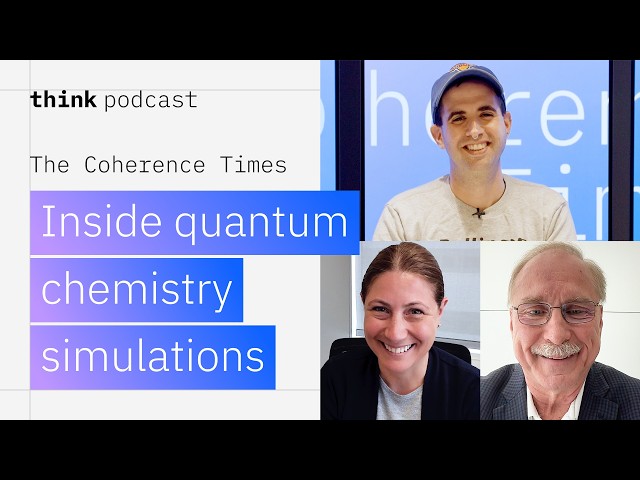
Video summary
The rapid advancement in quantum chemistry simulations is driven by a strategic collaboration between IBM and Cleveland Clinic, which has successfully transitioned from studying small molecules to simulating complex proteins containing over 12,000 atoms. Dr. Jamie Garcia of IBM explains that while classical computers struggle with the intricate electron interactions inherent in molecular systems, quantum computers naturally operate under the principles required to model these behaviors effectively. Early methods like the Variational Quantum Eigensolver (VQE) faced limitations due to noise and scalability issues, prompting a shift toward Subspace Quantum Diagonalization (SQD). This newer approach allows researchers to break large molecules into manageable fragments for calculation on quantum devices before stitching the results together classically, thereby overcoming previous hardware constraints.
This hybrid workflow integrates diverse computing resources to maximize efficiency, where classical GPUs and CPUs handle initial Hartree-Fock calculations, circuit parameterization, and reassembly, while specific fragment diagonalizations run on high-performance supercomputers like Fugaku or local quantum hardware. A key innovation involves using tunable basis sets focused on functional groups or amino acids, ensuring that high-fidelity quantum calculations are applied only where necessary while other regions are handled by simplified classical methods. This clever parallelization technique can reduce circuit depths significantly even on current devices with 100 to 200 qubits, demonstrating that solving large molecular systems does not strictly require massive qubit counts on a single device but rather relies heavily on algorithmic advances and heterogeneous computing architectures.
The ultimate goal of these efforts is to save resources, reduce time-to-solution, and discover new catalysts through scientific discoveries impossible for classical computers alone. By combining SQD with the Embedding Wave Function Method, the team has already successfully simulated drug-like molecules in water environments involving significant binding energies, proving the viability of this approach. As error correction improves over the next two to three years, these strategies will enable even more profound breakthroughs, moving beyond mere hardware scaling to optimize existing quantum computers through new algorithms and mappings.
Looking ahead, the vision is to eventually utilize fault-tolerant devices for Quantum Phase Estimation (QPE), which will provide chemically accurate data essential for training machine learning models and optimizing catalysts, materials, and therapeutics without needing prohibitively large systems immediately. Progress in this field depends equally on hardware advancements and novel circuit designs, with the excitement driven by pushing boundaries on real molecules to solve complex chemistry problems. Ultimately, the future of quantum computing lies not just in building bigger machines but in leveraging clever algorithmic strategies that allow current technology to tackle previously unsolvable scientific challenges while preparing for a fault-tolerant era where full chemical accuracy becomes achievable.
Read the full video transcript
Welcome to the Coherence Times, where we
bring coherence to the entangled world
of quantum computing. I'm your host,
Ryan Mandelbound. Every other week, I
will bring you stories about how
scientists, developers, and businesses
are making quantum computing a reality.
We'll explore the latest research and
development, highlight the latest
advances in the field, and see how users
are trying to extend quantum to
realworld use cases.
>> [music]
>> Last year, we told you that simulating
chemistry would be one of the first
valuable use cases for quantum. There
were already a few promising simulations
back then. For example, Cleveland Clinic
and IBM had used quantum to study
molecules with up to 36 atoms, and we're
about to publish another paper
simulating a 303 atom mini protein. Now,
it's mindboggling to think about how far
things have come since then. Just a few
months ago, IBM and Cleveland Clinic
teamed up with Reken in Japan to publish
a simulation of a protein with over
12,000 atoms. So, [music] I wanted to
bring on some folks who could talk a bit
about the progress on this work and
where things are going to go next.
First, returning from our very first
episode is Dr. Jamie Garcia, director of
strategic growth and quantum
partnerships at IBM, who's also an
expert when it comes to doing chemistry
with quantum. And joining us for the
first time is [music] Dr. Kenneth Murs,
staff scientist from the Cleveland
Clinic Center for Computational Life
Sciences, who leads the team responsible
for these exciting new demonstrations.
[music]
So Jamie, just as a quick recap, can you
give me a sense of what makes quantum
computing good at simulating chemistry?
Yeah. So quantum computing holds a lot
of promise for simulating chemistry
problems. Um mainly like the premise for
this is based off of the idea that
quantum computers operate fundamentally
under you know the principles of quantum
mechanics which is basically the OS
system for the universe if you will. And
so because of that uh chemistry is
really well modeled by uh quantum
computers and it holds a lot of promise
for the future and doing things um
beyond what we can do classically today
with approximate methods.
>> What makes chemistry problems so hard
for classical computers?
>> Yeah. So classical computers uh are
basically fundamentally use one and
zeros to represent systems. This doesn't
work particularly well when you're
trying to model molecular systems. Uh,
molecular systems are incredibly
complicated and you can kind of think
about it of like they're built up of
these subatomic particles including
electrons and electrons and how
electrons interact with each other
dictates a lot of what you know
materials and chemistry properties um
and reactivity and everything else that
we that we know about how chemistry
actually works is governed. So what we
really need is to be able to have some
sort of computational platform that can
manage those kinds of interactions as
they scale. Um so essentially if you had
if you can imagine having to model every
single electron with electron B and
electron C and electron D and then doing
that over and over again that just gets
really computationally expensive on a
classical computer. So the idea and the
promise is when you're using a quantum
computer that it now it's fundamentally
behaving under the principles of quantum
mechanics which is also how you know
molecules behave. It's the same rules
that govern molecular behavior as well.
And so the promise is that you can
actually be able to use algorithms that
then really much more accurately and
comprehensively describe the molecular
systems that we're interested in and
then we can understand the behavior
better. So maybe I can take us even
further step back and ask you Kenny, why
would we want to simulate chemistry or
simulate molecules in the first place?
>> Yeah, I mean you know molecules this
particular uh drug discovery type
things. The constitution of a molecule
really governs its behavior um quite
intimately actually. So the classic
example people use is aolyomide right.
So one form of theolyomide is a mutagen
traden right and causes lots of you know
birth effects and things of that sort.
The other one is works very effectively
for morning sickness. So it's just it's
just one change in the chyal center in
the molecule. So the the different
interactions that a molecule presents
say to a receptor are critically
important for its function. And so
that's why you really want to understand
these at the fundamental level. You
know, I guess what I'm hearing is right
like you can just twist a molecule
around, change its shape and then form
kind of function follows form in a way.
>> Yeah. If you think about like a receptor
site and you have say a lead molecule,
right? You can look at that receptor
site and hypothesize about where you may
want to add to that molecule. The
addition could be something as simple as
a methyl group or a benzene group or a
carbonal. Um and the the goal there
would be to optimize its interaction
with the receptor to make it more
efficacious as a potential drug
candidate. Right? You would get a better
binding affinity um for the receptor for
a given drug molecule. So this is the
classic thing that's done you know week
after week around the world in
pharmaceutical and biotech companies
where they're trying to optimize the
characteristics of the molecule given a
particular receptor. How are they
simulating these molecules today and
kind of you know doing this workflow?
>> Yeah. Uh so the computational chemistry
has evolved over the years. Uh you know
initially was microraphics or just
simple energy minimizations using a
force field or very simple um
representation of a molecule as balls
and springs. Um then it evolved into
more sophisticated docking studies where
you would take a receptor and you would
just place um potentially millions of
molecules into the pocket to find the
one that had the best complement uh with
the you know the receptor. And this is
done again with kind of force field
based methods. You know uh this is still
a widely used approach but it's kind of
a 50-50 approach. um it's usually like
for hypothesis or idea generation rather
than quantitation. Uh more recently
people started using molecamics uh
so-called free energy calculations where
you can actually simulate the behavior
of these molecules and get the relative
free energy differences between you know
adding methyl group or adding benzel
group. Um some of these now are done
with quantum mechanics and we actually
have reported on archive actually doing
these kinds of calculations using
quantum computing uh you know where we
calculate the relative free energy of
binding of of different uh molecules to
the same receptor. So these are sort of
um this kind of where things are now I
would say u what we're doing I believe
is more pioneering work. uh it may be
something that's going to be you know
more routinely used in the coming years
as you know the technology gets better.
>> Let's talk about that. Yeah, let's start
talking about that work. So maybe Jamie,
can you talk to me about how this
collaboration started like uh you know
who reached out to who? How the first
conversations go? I think early days uh
it had to do with leadership uh having a
vision for a collaboration and and
really I give uh Cleveland Clinic a ton
of credit on this for understanding and
realizing the potential that you know
quantum computing could potentially have
on their own research. Um so I think it
started very early. I mean Cleveland
Clinic was one of our very first. So,
uh, you know, partnerships, large
partnerships and, uh, by the way, thank
you for, uh, being one of the firsts on
that and we we went through a lot of,
uh, different trials and tribulations
as, as we went on, but um, certainly I
think it started at a high level and
then, you know, uh, folks started
getting really interested in using the
quantum computer and that was where I
would say a lot of the magic happened in
the partnership because once people
started actually using it and really
working together and working through
problems and identifying like what they
thought could potentially bring an
advantage for using a quantum computer
for relevant problems for the Cleveland
Clinic. Um that was really what needed
to happen to like really start
catalyzing and then working with Kenny
and and your group has been amazing. Um
the progress is just incredible. So, you
know, you talk about doing some of these
smaller simulations and then in 18
months, you know, you go from like 10
atoms all the way up to like almost
13,000. It's uh incredibly rapid growth
and uh evolving research. So, I think uh
that's that's sort of the vision. I
think we're continuing down that path
and and trying to look at problems that
are really interesting and relevant to
Cleveland Clinic and also uh uses the
quantum computer in the in the right
way. I mean, and then Kenny, how did it
feel to kind of go to your leadership
and your team and say, "All right, we're
going to get into quantum computing."
>> You know, I think I realized early on
the importance of having access to
cutting edge hardware, right? If you
really want to kind of explore new
things, and this goes back to like say
vector computation to parallel
computing, getting a hold of some of the
earliest parallel devices, um, GPUs,
right? And um you know Cleveland Clinic
you know again like Jamie said you got
to give them a lot of credit for you
know jumping into this and being one of
the the first you know installs of the
on-prem device you know in the United
States. Um but that was very very
attractive to me right and I I had
always kind of been following the
quantum computing area. I have been
interested in fragmentbased methods
which is what this uh calculation is
based on uh for some years and I I just
thought this is a perfect marriage
potentially right and so I joined uh
Cleveland Clinic and then you know IBM's
been amazing in terms of training my
team right because we started pretty
much at ground zero you know how to use
the device um so the training is awesome
that you know um IBM's offered and then
just the scientists right and also the
sharing culture. uh we were using
something called a variational quantum
uh solver uh initially to try to do some
of these calculations and you know we
weren't making much progress let's let's
be honest right and then uh IBM
introduced us to SQD and it became very
clear that the subspace quantum
diagonalization approach was going to be
the way to go right and they didn't have
to share that with us right um they
shared it a few weeks early before it
came out on archive you know giving us a
boost right and So immediately this
whole journey started from you know we
had the idea we had the molecules then
we finally had the technology to go
after it and then uh were able to very
quickly you know study some you know
smaller systems methane dimer water
dimer u but it became pretty clear that
we could go much larger and then um we
discovered a method called embedding
wave function method it's uh developed
by George Booth out of the UK and this
allowed us to go at the atom level and
this allowed us to be right in the sweet
spot for SQD, right? In terms of the
number of cubits like 40 to 80 cubits
and uh we're able to put it together to
go to this large scale uh calculation.
So that's kind of really the journey I
would say and it's you know just
everyone being super supportive right
and the IBM quantum network connecting
us with say with rican and um you know I
think the rest is just everything fell
into place and we're off to the races.
Maybe we can go and tell a bit more of
that story. Like Jamie, what made it
like so VQE wasn't working? And then
what made this SQD algorithm that
Kenny's talking about kind of a more
valuable approach to tackling these
kinds of problems?
>> Yeah, I mean, I think they're they're
different algorithms, right? And I think
um you know, we we've been using VQE for
quite some time um since it was it was
really popularized in around 2014. Um
and and so people started seeing it as
being one of the first uh ways that you
could actually start studying chemistry
using a quantum computer because it was
efficient. Um which is great. Um but at
the same time the method is is set up in
such a way that you know the impacts of
noise is actually pretty substantial.
And so while you're still, you know, um,
in a in a world where we don't have
error correction yet, um, you're always
going to have an impact by that. So the
problem was really like how do you scale
and how do you get to places that, you
know, to larger molecules that are more
relevant um, you know, it was really
great that we were able to simulate
lithium hydide and hydrogen and
burillium hydide, you know, the 2018
nature paper. In fact, it was rather
inspiring, I would have to say, because
at that point in time, we weren't sure
uh what quantum computers were going to
be able to do. And so, to actually see a
tangible example of like here's a ground
state energy calculation of small
molecules, but still relevant molecules
and real molecules, I think, was an
inspiring moment. So, it's just about,
you know, it's about algorithm
development. It's about understanding
the systems that you're looking at and
putting the pieces together in the right
way. So, you know, Kenny and the team,
you know, very cleverly put together,
you know, EWF alongside SQD. And really,
it was understanding how these things
fit together that I think was what
enabled uh them to be able to produce
the results they did. The other thing I
want to point out too is that it's it
takes a village in a lot of ways. So you
really need like people who are coming
together with those different
backgrounds whether it be from the HPC
world um whether it's from the you know
computational chemistry world quantum
information science and getting again
like coming together and really thinking
through a problem um in detail is really
what can advance us to that next phase.
So I think it's a combination of having
people that have an intuition for the
systems they're studying and combined
with those who have the experience with
the algorithm development and
understanding how to map things on a
quantum hardware and then working
together with the HPC and the classical
resources as well to stitch together a
complete solution to a cobble.
>> You know BQE really was a pioneering
method as Jamie is showing and or had
had described. Um for us we were trying
to go to like the bigger molecules and
it was the errors and things like that
were really consuming us right. Um so I
think we just ran into the kind of wall
if you will in terms of the range of
applicability for for VQE and SQD opened
up the the next branch. So I agree with
Jamie like some of these early papers
were were very inspiring right and
actually did inspire me in the sense
that you know I looked at these and I
said okay you know you can do small
molecules so if we could do something at
an atom level you know we could go
probably quite bigger right and much
larger and so I think that indeed bore
itself out from this this early
pioneering work. Yes.
>> So maybe Kenny can you walk us through
then the sort of workflow of how this
simulation actually works? Yeah, sure.
So the, you know, it was known since
probably like the early 90s that you
could take a larger quantum chemistry
problem and break it up into fragments
and then there was different ways in
which you could stitch it back together
to get answers that were very comparable
to doing the full calculation. You know,
prior to this time period, you know, the
thought of breaking a molecule apart in
a quantum calculation was kind of
anthma, right? It wasn't something you
would think about doing. Um but then
pioneering work by say way tao yang and
others in the early 90s you know kind of
broke that barrier and allowed you to
start thinking about it. So the way you
look at and it's actually proteins are
interesting because they're insulators
right so they're not you know
particularly conducting a lot of the
chemistry is very local and so you could
take a protein molecule and you could go
well we early work went residue by
residue amino acid residue uh in this
particular work we went atom by atom uh
and using the CWF method we could take
like a glycine amino acid which consists
of an NH so we could treat the nitrogen
by itself with an environment. The
hydrogen by itself with an environment,
the C alpha with um just a carbon and
its environment, the hydrogen's attached
to the C alpha and then the carbonal. We
could treat the the carbon of the
carbonal and the O all independently,
right? And then we can do the
calculation and then there's a procedure
by which you can stitch the individual
energies together to estimate the the
energy of the global system which
matches the uh full calculation uh quite
closely. So this is really the power of
the method like uh instead of trying to
solve a global problem right which would
be you know I don't know tens of
thousands of orbitals electrons you know
we can break it down into smaller
components and then stitch it together
to get an estimate uh of the total
energy of the system. So that's the
power of the approach I think.
>> Got it. So I mean this is kind of the
beauty of it right is and this this is
what you've been doing sort of since the
beginning right is taking these large
molecules splitting them up into
individual fragments and then basically
by characterizing each of these
fragments you can kind of stitch it
together to create a good approximation
of how the entire thing should act. I
mean that's in a nutshell. I mean we can
dive into like some of the real
technical things but I don't think you
know I think you know if you understand
that basic concept you you're 90% of the
way there and then you know we started
with a 300 atom this TRP cage molecule
this mini protein and then we sort of
the next step was coming out with this
paper we simulated two proteins that are
11,000 12,000 atoms um which sounds kind
of mindboggling to me that just in 6
months we can kind of scale up like that
um so maybe Kenny you can walk me
through how that's even possible. Well,
I mean, so we had done some simple
molecules like test cases like peptides
and things like that and you know went
really fast. We were really surprised,
you know, uh is quite efficient using
just sort of um IBM Cleveland, you know,
one quantum device and our local compute
resources. Uh and so we were able to
quickly scale up to the 300 atoms. Uh
and that worked quite it was in the gas
phase of course. Um, and that went
really well. And you know, we had been
in contact with Rean and IBM and IBM was
interested in in sponsoring a Gordon
Bell submission and so we we put it all
together and I thought, well, gee, you
know, we'll go for 10 or 15. Oh, that's
going to be so challenging, right? Um
but we're able to pull it off in this in
this particular case it was in water and
we were looking at a drug-like molecule
binding you know that looking at
computing the binding energy and uh I
think the realization as I said IBM
thing you know I I undersshot I mean we
could have probably double or tripled
the size and and actually been able to
do that as well. So it really uh you
know just everything like Jamie said you
know it's like takes a village and just
like everything just fell in place right
and we were able to line our ducks up
and away we go
>> on seeing the scaling of this you know
when you first saw this 12,000 atom
paper um what was it like how did you
react
>> I mean for me it was remarkable right
like we we had started publishing some
work with uh some partners in 2018 where
we were looking at you know how to how
to do energy calculations for lithium
hydide and you know seeing this scale up
has just been uh really remarkable. At
the time when we were when we were doing
this a lot of you know when I was
talking to folks in the in the chemistry
community about it they were
probably a little underwhelmed with the
size of the molecules we were looking
at. And so it often times came back
where the comment would be like, "Well,
that's great, but you know, I needed to
be able to do something much larger."
And so I feel like now like I my
reaction to this is that we can say that
scaling is no longer the issue with
quantum uh and using quantum computers
for uh studying chemistry. So I think
it's a huge moment. I think it's really
important for our field and a very good
demonstration of how you can combine
methods and algorithms to get to
something much much bigger than people
would expect.
>> I mean, Kenny, these, you know, what
Jamie's just said is really interesting
to me, right? Because now we've caught
the attention of these chemists and of
these biologists. Um, and what's cool, I
think, is that these 12,000 these these
atoms, these proteins that you guys are
simulating are are legit. Like, these
are real molecules that people have
heard of. Can you kind of walk us
through what these molecules do and why
they're so exciting?
>> Yeah, I mean one's tripson uh
benzamadine. So benzamadine is a small
inhibitor. It's electrostatic driven.
It's it forms a salt bridge with the
protein. And uh so that was one side of
the equation, right? We wanted something
that was more like polar hydrogen
bonding electrostatic interactions to
see how you know could we do those kind
of calculations. The other one um T4
lysosyme with nbutylenzene bound uh
bound to it and that was on the
hydrophobic side. So a typical drug
molecule will have hydrogen bonding you
know polar interactions but it also have
non-polar and a lot of times the
non-polar interactions are the major
driver in a drug molecule binding to a
receptor. So both of we sort of covered
both ranges of these uh kinds of
interactions. And just to respond to uh
Jaime's comment,
when I jumped over to Cleveland Clinic,
I had several colleagues say to me, "Oh,
MS, what the hell are you doing? You
know, you're, you know, you'll be lucky
if you do, you know, I don't know,
methane or, you know, propane in the
next five years, right?" And I sort of
took that personally, right? And so it
became my goal to is go as big as
possible to exactly what Jamie said, to
shut up the excuse my frame. I mean you
know quiet the um naysayers and and I
agree you know the once we have this
kind of thing mechanism or structure in
place workflow we can go after things
like bigger basis sets you know more
sophisticated treatments um it's you
know this workflows um hardware agnostic
solver agnostic
so you know we can plug in anything you
know newer methods QPE you know quantum
phase his estimation could you know be
plugged in tomorrow if the machine was
available to to do these kinds of
calculations. So really like as Jamie
highlights I think the problem now isn't
so much can we scale we check we can do
that right now it's really like how do
we get even better answers you know
better basis sets higher quality
calculations so that's the exciting part
for me I think Jamie this scaling is um
not just a quantum story and I think you
got into it a little bit before but part
of what makes this method so interesting
to me is the fact that we're pulling all
of this um sort of supercomput high
performance compute even GPUs in way um
can you talk about the contribution
there and how REK got involved and what
we're doing on this quantum ccentric
supercomputing front?
>> Yeah, so I think that you know one of
the most exciting things about recent
developments has been the integration of
quantum computers with HPC and AI. And
one of the the doors that that opens is
that you can start really developing
these customized workflows that leverage
capabilities of CPUs and GPUs and QUUs
in the correct fashion. So you just you
assign the QPU to the part of the
problem where it makes sense to use a
QPU and the same thing for the GPU and
the CPU. Um so I think all of it has to
to come together. um the and it has a
lot to do uh with the algorithm
development and basically how you're
actually setting your problem up and
structuring it to leverage a
heterogeneous uh compute structure. Um
it will be even more interesting as time
goes on and we start seeing more and
more examples of exactly how workflows
can leverage each piece of that
architecture for different parts of the
problem over time. um because I I think
we're just going to start seeing
cumulative examples of these um over
time build up so that you can start
getting to a place where you can
generalize a little bit more. Right now
I think it's still very bespoke. We need
to focus in on the problem that we're
looking at. We need to really kind of
leverage the um infrastructure that we
have access to and and utilize the
quantum uh compute in the right way as a
you know as a part of this overall
structure. So I think that's what we're
starting to see examples of and I think
that's really what enabled the you know
getting to the scales that we needed to
for some of the things that you know
Cleveland Clinic is interested in is
other as well as other biologists. Um
and I think we're we're just going to
see more and more of that and creative
science and and uh experimentation to
figure out like where where each part of
the compute is best suited in a problem
solving.
>> Got it. I mean, and then Kenny sort of
taking that back to you. Can you walk me
through how that actually worked, you
know, in practice as you guys worked on
this 12,000 atom study?
>> Yeah, I mean, in terms of the
collaboration, you know, Recan was just
just fabulous. You know, I've known
people at Recan for some years, you
know, Sosan uh and then I met through
the quantum network, IBM quantum
network, you know, who are like the big
drivers there. And, uh, you know, Sosan
made sure we had the compute we needed.
So we got two full days of Fugaku to do
these calculations. Also they have a
quantum device as does Cleveland Clinic.
So we were given uh about 50 hours both
sides allocation on these quantum
devices um for a cumulative like uh 1.3
billion shots uh to to get these
samples. U so that was the the quantum
side. the there's a couple steps right
to initiate it you need to do just a
simple heartchie f calculation on the
whole protein right and so this is done
just using classical methods uh GPUs um
and then there's some circuit
parameterization steps and this can be
done on CPUs u and then once you have
the the circuits parameterized you do
the shots on the quantum device and then
reassembly occurs on classical hardware
so that's sort of the the overall step
The rate of limiting step is actually
the diagonalization of the hilbert
spaces that you get for the individual
fragments. Uh that was the most
expensive part and that's what
predominantly used uh two full days for
the two proteins of fugako to uh do
those calculations. Got it. Yeah. And
just to you know folks might not have
heard some of these before. I want to
make sure they understand that the way
that this sort of algorithms actually
working is you can imagine taking all of
the you know most of quantum most
chemistry can be represented in like
these large what we call tensors but
really it's just big old lists of
numbers. Um so what we're trying to do
is find essentially a because we need to
approximate this. It's way too many
numbers in order to actually explain
this. We have to find a good subset of
these numbers of this table that could
well approximate our system. And then
that is what the quantum computer does.
And then we send that subset over to a
classical computer that does the
diagonalization which really is just
saying turns that list of numbers into
something that we can easily calculate
the you know energies we're interested
in from. Right.
>> Yeah. Exactly. The I mean what's the
dream? The dream is to have a quantum
device that will return the u bitst
strings and only those bitst strings
that are needed to reach chemical
accuracy for the calculation. That's the
dream, right? And as you point out, I
mean, currently the methods SQD and
extended SQD and trim SQD, which are
different variants and they improve as
you go along that series, um, are
attempts to, you know, reach that level
of sophistication and, you know, my
expectation over time and as Jamie is
highlighting, there'll be a lot of, you
know, intense interest in trying to
actually achieve the dream, right? And
um so stay tuned right I think there
will be new methods and new approaches
coming out and then once we get to the
point where we can you know say we need
1.3 trillion Slater determinants you
know to solve a particular problem but
we only need 10,000 to get chemical
accuracy right so eventually we'll have
methods that start you know getting
closer to that and then that's going to
speed up the the whole calculation and
then the accuracy will just continue to
improve.
Jamie, can you tell me about what the
methods are that are going to take us
there? I mean, I know that there's SQD
is almost like uh it's what we're doing
today, but in the future, we're going to
get into things like quantum phase
estimation, you know, things like that.
>> Yes. So, I think you're uh you're aware
that error correction and the
possibility to, you know, run algorithms
on fall tolerant devices are coming
sooner uh than anyone even realizes. And
so I think like the the magic in in sort
of the research and the art of the
science, if you will, is to start seeing
how we can test out small examples of
that and then ultimately take lessons
that are learned from exploring that for
chemistry problems alongside what we
already know and what we've built up as
a body of knowledge and then bringing
together new methods. So that's what I'm
predicting is going to happen is we
start having you know the hardware made
a available and you know start actually
having you know logical cubits that you
can you can try running some small
circuits on. Um, and then I think at
some point, you know, we're going to be
building up, you know, our capabilities
and then there's going to be an
intersection point uh there with like
all of a sudden you can say like this is
hands down the best method, you know,
that we could possibly use to study
this, you know, molecular or biological
system. And I think that that's the part
the moment in time that I'm personally
very excited about because I think at
that point you're going to say like okay
quantum is really bringing something new
from a computational standpoint for the
field of chemistry that we needed. you
know, we really needed this to be able
to to simulate um the systems that we
want to simulate and to be able to guide
experiments and find new therapeutics
and find new catalysts and all the
things that that we think that this has
the potential for. So I think that
that's if I had to predict, you know, it
it kind of follows the error correction
roadmap that we have set out in front of
us um as to being able to try out
different algorithms and then starting
to piece things together in the right
way to really really get to those uh you
know substantial and valuable solutions.
>> Yeah. I mean the way to think about it
is like you had VQE, right? And so BQE
had its moment in the sun sort of maybe
fading a little bit for for
computational quantum chemistry right
let's just say uh because I know other
fields are still using it sqd is now
come to the four next week there may be
something totally different right you
know so things are evolving really
quickly um on the way to say a quantum
phase estimation a fault tolerant
quantum device
>> I'm sorry and get away from that sort of
variable um kind approach where you have
a variational approach to to the
algorithm. Um, so those these this is
where we're going to start I think
seeing little glimpses of that and then
I think like I said you know the the
beauty of it will be when people start
pulling it together to solve like these
real problems. Kenny, once that's
available, what does your workflow start
looking like as a chemist?
>> You know, I mean, basically the workflow
is there. We we need to sort of get it
optimized. Um, and this, you know,
getting it scripted up and so we're
working with Rekin and IBM to do that.
Uh, you know, make it available in
Kizkit. And then, you know, for us,
we're starting to already explore ways
we can do larger basis sets. Uh, we can
do layering, right? So we can have you
know a larger base set where it matters
and and we can use a smaller one you
know further out you know so there's
just to me you know once I had this in
place it's like there's hundred
different directions we can go uh we're
looking at circuit optimization as well
with the collaboration with Sergey
Stchuk at at Oxford. Um so we're we're
going after this in many many different
directions uh and continue to work you
know closely with IBM on uh you know
trying to do innovative things. The one
thing I'll say that we haven't really
touched on Jamie is you know we've
really talked about bi biology right but
this method can be applied to materials
and an example is we've looked at
something called florine lithium
burillium molten assults in
collaboration with DOE
>> the five yeah [laughter] exactly I know
it sounds like flipper or something
right
>> so it's not you know exclusive to
proteins right Jamie I mean we could
apply this all sorts of other different
problems right so that's the another
exciting aspect of it that we can
explore in the coming weeks and months
>> and I think we're going to take lessons
learned from like people studying this
for optimization and partial
differential equations and like you know
it's it can come from other parts of
study and and the the really you know
the brilliance is when you apply that to
the problem and that has real
application. Um so I think that we're
going to just be taking you know lessons
learned from all this but yeah I mean
certainly materials uh and then you know
the future you know thinking of systems
that are just dynamic in nature and
starting to look at other properties you
know beyond ground state energies like
what else can we explore um I think
those are those are the really
interesting open scientific questions.
>> Can you guys like imagine with me what a
like what it might look like when this
stuff goes into production? I mean is
there going to be a time when you know
there's I we want to cure a disease and
so you just ask your new found quantum
centric supercomputer what the uh best
molecule to solve it looks like is that
what we're thinking so you know I think
this is an interesting question right so
the way I way I really describe it and
you know Jamie knows this well is
quantum you know quantum mechanics is
the foundational method of computational
chemistry if you take quantum mechanics
out we have we don't have a method that
can guarantee
uh exact or near matching with
experiment right so I think it's a the
fundamental method right so there's a
number of different ways you can go with
this you could use it in simulations
like I described to get free energies um
certainly you could go that way another
way to think about it is we and this is
an area where there's not much data
right uh we could evaluate potentially
millions of protein liant complexes or
poses,
excuse me, and get ultra high accuracy
energies and this then can be
complemented say with an alpha fold type
strategy uh to actually create like say
machine learning uh type approaches to
solve this problem. So I think it's as a
data generation tool it could be really
really powerful as well as a tool to
understand you know very complex
interactions and as you know Jamie
mentioned uh excited states uh photos
problems all these kinds of things where
you know you really need this you know
high level quantum rigor to to address
these problems so that's kind of how I
view it evolving um you know being a
molecular guy I'd really love to be able
to do it on the molecular side but I
think there's also the realization of
the power of machine learning and and
how that you know this approach being a
fundamental you know the cornerstone or
foundation of our field could actually
help propel you know methods like
machine learning is just a stocastic you
know approach you know you can't it
depends on the data right but now if
you're providing it with highle you know
structural data from x-ray or you know
uh different approaches combined with
ultra you know ultra accur but very
accurate energies. Um, you know, you
have another direction, another avenue
to go to solve drug discovery problems.
>> So, right now it's like we're starting
to see the very beginning examples of
like where experiment is used to
validate uh solutions that we're getting
you know using quantum computing as a
part of the workflow for the solution.
Um and I think that that is going to
continue right where you use experiment
to validate. My hope and dream as an
experimentalist uh myself is that
someday we can use simulation to
actually give us you know enough of like
a reliable insight as to how the problem
actually would evolve and experimental
parameters that we would need that we
could perform you know these uh
calculations in silicico first and then
take that and go run the experiment. So
it's sort of like uh taking what is
already starting to happen and then just
like extending that out even further and
that ultimately I think would save a lot
of time um and a lot of money and a lot
of resources uh if we could do that.
>> Yeah. sort of like an iterative loop,
right? Computation, make suggestions, if
it works, you know, great. If it not,
you know, feedback and Yeah, for sure.
>> Right. Right.
>> I mean, it's kind of beautiful when
you're all putting it this way, which is
you're really thinking beyond just, you
know, what will quantum computing do as
a tool for kind of day-to-day drug
discovery, but really, how will quantum
computing revolutionize the science of
drug discovery overall? I mean, you
know, from this like I imagine a
molecule, I can use a quantum computer
to just create it to even what Kenny is
saying, which is like I can just create
a suite of molecules that don't exist
and then use machine learning methods to
help uncover things about biology and
chemistry overall. I mean, these are
like these, you know, we're think we're
not just shooting for like uh for
tomorrow. We're shooting for the stars
over here is what I'm hearing.
>> Yeah. I mean, it's a dream, right? you
know, can you, you know, actually get to
the point where you can get these
chemically accurate calculations done
routinely to generate data sets for
machine learning and also use them for
exactly what Jamie is saying use it an
iterative process to optimize catalyst
or you know protein league interactions
or photophysical problem properties you
know whatever you might be interested in
um I think that's been the dream all
along right and I think you know uh
there's this famous diary a quote which
basically says, you know, all of
chemistry and much of biology, you know,
is defined by quantum mechanics, but the
equations are too hard to solve. But
we're getting to the point now where
that's no longer the case, right? And
then this dream could be potentially um
realized. Um you know, I've been doing
computational chemistry for a while and
you know, it's exciting to see that
we're we're tending in that direction.
So, how big a quantum computer are we
going to need to sort of achieve the
dream of this uh of Cleveland clinics
and recends and IBMs and the worlds?
>> I don't know. Maybe maybe you should
take that one. You know, as a
computational chemist, you know, the
answer is always as big as possible.
>> Yeah. A bajillion cubits. Uh I think you
know when we start seeing like uh actual
like insights like and gaining insights
into nature that we were not able to
glean before cuz right like a lot of
what we're talking about drug discovery,
new materials discovery, catalyst
discovery is actually really hard. It's
really hard. Um there's not it's you
know we've been chemistry is an old
field. So there's, you know, most of the
reactions are known. If I add A and B,
I'm going to get C, you know. Um, and so
how to change that or make something
new, um, can be a real challenge. So I
think once we start getting those
insights and start being able to run
circuits, I don't know how big
quantum computer you're going to need
for that. I do think that it's probably
more going to be about uh sort of the
art of putting together all of the
different types of computation um so
that you do gain these insights right um
I think it's going to be more about that
from a algorithms perspective yes
running larger circuits and more complex
circuits is what we need and going in
the direction of error correction is
what we need to do and so once we start
getting you know larger and larger
quantum systems that can run, you know,
some of these like QPE and some of these
other uh algorithms for chemistry. I
think, you know, that's going to unlock
a lot of that. So, it's going to have to
happen at the same time. Um, so I think
that's I I I you we used to see resource
estimations that would be in the
billions of of cubits. I don't know that
that's true. Um, if you you all these
different dimensions of compute
together.
>> No, I think that's right. Right. It's,
you know, of course more is better, but
you know, if you gave me a 100, 200
logical cubits today, I think we could
do pretty amazing stuff already with EW
with kind of this this workflow. So,
that's why I'm really optimistic. Um,
that we're not going to need to get to,
you know, ridiculously large systems.
Um, and it also depends on what you want
to do. Like if you wanted to solve a
whole protein on device, you know,
that's a different challenge than using
kind of these fragment based methods.
And you know, this method is very
tunable, right? So you can go bigger
basis sets, but instead of doing atom by
atom, we can go by functional group to
functional group or we can go amino acid
by amino acid um depending on the
resource availability, right? and and
again maybe we only focus the highle
quantum calculations on the regions uh
that really matter while the rest are
handled you know using more simplified
methods so there's like Jamie said
there's many layers to this uh problem
right it's not that we need a huge
number of cubits to solve 20,000 atoms
on device right um we don't need to go
that way
>> and I think that's why the focus has to
be on algorithms and applications
is because of that it's that's where the
value capture is but also you know
thinking about from the algorithm
standpoint even with shores there's been
some really clever you know advances in
how to parallelize it and so you get
this to much reduced like orders of
magnitude reduc uh circuit depths needed
for it so it's like all of these things
combined I think is going to uh sort of
dictate when that moment in time happens
>> and I mean I agree with Jamie on like
the circuit optimization right I
like we're using just LUCJS you know
which is kind of a standard but I think
there's a lot more we can do to by
improving that and the only thing I I'll
say you know we're sort of what 100 200
cubit devices right [snorts] what
happens when we have 10,000 or 100,000
you know with these are not unreasonable
you know targets for cubits and what is
the coding model for that you know I
mean the circuit optim so I think
there's just some really fascinating
things that are going to be coming down
the pike in terms of just you know how
do you deal with these kinds of systems
right
>> yeah I mean what I'm sort of hearing
which is I mean kind of amazing to think
about is these 12,000 atom studies sure
we're modeling proteins that exist but
we're already straining these classical
methods so we're already starting to
push the envelope and so you can imagine
that you know of course we're not
solving all of quantum chemistry
tomorrow but you know really even in the
next couple years as you start to get
access to these larger systems. As sort
of error correction begins to hit, you
know, even in the next couple two to
three years, we're going to start seeing
science being pushed forward and things
uncovered that simply couldn't be
covered uncovered just with a classical
computer. And then it's that matter of,
you know, you're talking about like it's
not even about building better quantum
computers, but in fact, it's about
figuring out better ways to use the
existing quantum computers. You're
talking about new algorithms. You're
talking about new mappings. the existing
quantum computers. We're talking about,
you know, new ways to run circuits so
that we can do so in fewer gates, higher
fidelities, error mitigation tricks.
There's all sorts of stuff that like,
you know, there's a lot to be excited
about. I mean, that's what I'm hearing.
>> Yeah, exactly. The, you know, I take it
from the classical world, right? So,
the, you know, the classical chips have
gone faster. Yeah. I mean, that that's
for sure. But the there's an equal
contribution for algorithms, right? and
new approaches which was equal to the
performance in the in the hardware right
and that cannot be forgotten. So not
only are we going to get this you know
interesting hardware stacks in the
quantum computing world but there's also
you know great room for algorithmic and
novel improvements in circuit design
things like that. So that's another
certainly exciting and it should deliver
just amount as much punch as the the
hardware itself will deliver. I think
that's a good place to ask our final
question. Uh and so one at a time I will
ask you let's start uh maybe Jamie
first. What about the future of quantum
computing gets you the most excited?
>> Um the future of quantum computing is
bright uh as you know the hardware
continues to progress as we start
figuring out how to leverage
heterogeneous comput architectures to
solve problems for chemistry. um you
know this this topic's near and dear to
my heart uh I think there's a lot that
quantum will bring to the field of
chemistry and so I think that and sort
of the vision of the future uh saving
resources saving time finding new
catalysts you know and that's the dream
and I think that's what gets me the most
excited about the future of quanting
computer
>> you know I don't know if I can really
say much more yeah you know I'm just we
we have a construct now where we can
start exploring you know pushing the
boundaries and on on bigger systems on
real molecules and I think that's very
exciting both on new algorithms and
hardware you know new hardware
generations well thank you so much for a
great conversation um Kenny and Jamie
this was really fun and I will uh
definitely be speaking to both of you
soon I'm sure that's it for this episode
of the coherence times if you enjoyed
the conversation please be sure to
subscribe wherever you get your
podcasts. Comment in the comments
section and share it with somebody who's
curious about quantum. You can find us
on Spotify, Apple Podcasts, and YouTube
via the research channel. And for more
episodes, resources, and deep dives,
please visit us at
ibm.com/think/mpodcasts.
I'm Ryan Mandlebomb. Thanks for tuning
in. And remember, the quantum future
isn't just coming, we're building it
right now.