Video summary
Jonathan introduces Facilitator.com and its associated quiz tool designed to help facilitators determine their appropriate day rates for the year 2026 by analyzing various career factors such as experience level, niche expertise, group size, and client type. He explains that while internet data on pricing is often inconsistent due to regional differences and specific niches, his platform aggregates public survey data alongside insights from thousands of professional facilitators to provide accurate benchmarks. The video aims not only to reveal current pay scales but also to offer actionable strategies for increasing earnings by identifying opportunities to expand one's scope or scale up group sizes.
The analysis begins with the beginner level, where Jonathan demonstrates how a consultant with less than two years of experience and specific domain knowledge in UX design can expect a day rate between $2,500 and $3,000, though an absolute novice without specialized skills might start lower at around $1,000 to $2,000 per day. He clarifies that these figures represent potential rates rather than daily bookings; even high earners do not work every single day but instead balance client delivery with significant time spent on business development and marketing. For beginners, the primary lever for increasing income is often handling larger groups or moving from small teams to large-scale events like hackathons, which significantly boosts value despite requiring similar skill sets in terms of facilitation dynamics.
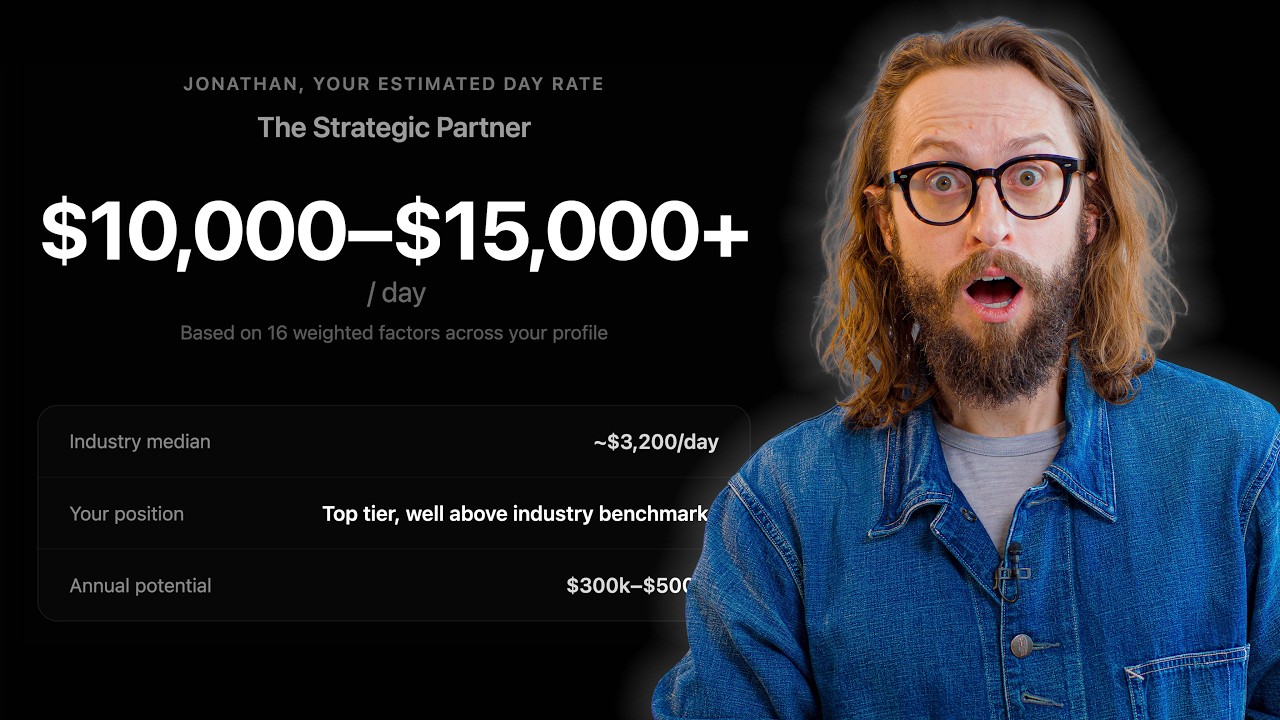
Moving up the ladder to mid-level and expert tiers, Jonathan reveals that strategic partners commanding day rates between $10,000 and $35,000 typically operate with a business model where only 10% of their time is spent on actual client work while the remaining 90% focuses on growth activities. He notes that reaching these top-tier earnings usually requires expanding beyond simple workshop facilitation to include pre-work preparation, post-event follow-ups, and executive alignment services, although he personally prefers a more focused approach without those additional layers. The video concludes by emphasizing realistic expectations regarding workload volume versus income potential, encouraging viewers to use the provided tool at quiz.facilitator.com to assess their own standing and define clear pathways for professional advancement in the facilitation industry.
Read the full video transcript
How much can you actually charge for
your facilitation work? Whether you're
running workshops for clients or running
workshops internally at a corporate or a
small business, it's really confusing.
Because if you look around the internet,
depending on which country you're in,
depending on which like niche of
facilitation you're in, depending on
what type of workshops you're running,
it's all over the place. So, what we've
done at facilitator.com is we've created
a really simple app which [music] asks
you a couple of questions and then shows
you exactly what day rate range that you
can expect to charge for exactly where
you are in your career. And in this
video, I'm going to show you what the
different ranges are for a beginner
facilitator, mid-level facilitator,
expert facilitator, also depending on
where you are, topics you're doing, the
group sizes, etc., etc. My name is
Jonathan. I've been a facilitator for 15
years.
>> [music]
>> I do everything from group facilitation
for companies to help them with their
strategic problems to large-scale
hackathons, talks, and facilitation
training. So, I do the entire gamut of
facilitation. I also run facilitator.com
[music] now. That was a very good domain
name to get back in the day. And because
I run facilitator.com, I've also been
working over the years with thousands of
professional facilitators who tell me
what they're doing, tell me how much
they're getting paid, and I've
correlated all of that data with the
public data we have out there from
things like the state of facilitation
survey so that I can show you exactly
>> [music]
>> how much you should be getting paid for
the facilitation work you're doing in
2026. This is only relevant for 2026. I
don't know if it's relevant for 2027,
but right now, as this is coming out at
the start of 2026, these numbers are
still accurate. And by the way, you can
also follow along and use this exact
tool that I'm using by going to
quiz.facilitator.com
or click the link down at the
description, and you can figure out your
day rate even if you don't want to watch
this video. You can also skip to the
relevant parts of this video that you
want, whether you're mid-level,
beginner, whatever, you can skip right
down below and see what those day rates
are. I'm not just going to be talking
about day rates, I'm also going to be
showing how to increase your day rate
and what the [music] opportunities are
for the specific levels to go from one
level to the next level. It's going to
be a lot of stuff. I hope you find it
useful. And please, if you do find it
useful, give it a like, give it a
comment. YouTube loves that. All right,
let's jump in. So, I'm [music] going to
start with the first version of this
being sort of a beginner facilitator.
So, this is someone who
>> [music]
>> maybe has a little bit of experience,
maybe isn't facilitating full-time, it's
just part of their job. [music] And
let's just say I'm an individual
consultant as well. So, let's try to see
what the price range of that would be.
First, I'm going to focus on me, but as
a beginner, and we're going to say,
"Okay, I'm going to be delivering
workshops in Western Europe, US, UK,
Canada." That's probably, even if I'm
doing remote, that's probably the major
places that I'll be delivering.
Although, actually, I do deliver [music]
in-person in major metro hubs as well,
so I'm going to click that. Um how long
have I been facilitating workshops
professionally? Now, because I want to
try uh test out like beginner mode here,
I'm going to say less than two years.
What's my professional background before
facilitation? I'm going to say I'm a
career changer, meaning that I was
working on something else, so UX design,
and now I'm sort of bringing this
facilitation stuff into [music] it. So,
how central is facilitation to my
business? Again, in this in this
scenario, I'm going to say it's part of
[music] my consulting mix. Um I'm also
going to say it's asking me, "Do I have
a specific niche?" I'm going to say I do
have deep domain expertise in UX design,
so I'm going to choose that one. Do I
have a defined uh facilitation
methodology? Okay, I'm using some of the
facilitator.com AJ and Smart
methodology, but I don't know too much
of it. Um I'm also going to say,
>> [music]
>> you know, do I pri- primarily deliver
workshops in-person, virtually, or both?
I'm going to say it's mostly virtual at
the moment. What group sizes do I tend
to facilitate? It's all over the place,
but right now again, since I'm a
beginner, [music]
I'm just going to say it's like small
teams. What does the typical engagement
include? This first run-through we're
going to go in detail. The next runs
we're just going to fly through it. So,
what what things do I actually end up
doing? Well, I'm going to say because
design sprints were sort of my main
thing that I did as a facilitator for a
very long time,
I'm going to say [music] that my focus
here is I do design and follow up with
the facilitation work. Who's usually in
the room? I'm going to say in this case
individual contributors, not a lot of
managers. What size companies typically
hire me? So, if I'm a beginner, I'm
going to say here that it's small
businesses and startups, and maybe I
haven't made my way to the Fortune 500
yet. What types of workshops do I run?
I'm going [music] to say it's mostly
product and innovation workshops in this
case,
because that's where again in this
scenario
Johnny Beginner was focused. Do I have
any formal facilitation certifications?
No.
Do I have recognizable client logos? No.
And how would I describe my current lead
flow? So, where are my clients coming
from? I'm just going to say I get
occasional word-of-mouth leads. And how
do I price my workshops? Finally, I'm
going to say I'm still a little bit
confused about this, but I charge like
an hourly rate. And so, now it's going
to calculate [music]
my day rate based on all of these
answers, and give me a clear answer and
recommendations on how to increase my
day rate. So, I'm going to enter my
email address here. This just means that
I'm going to get this as an email as
well, so I [music] can reference it
later. So, I'm going to blur this so you
guys don't see it, okay?
>> [snorts]
>> I'm going to put Jonathan, and I'm going
to put
my email address here, and then I'm
going to unlock my day rate. So, I'm
going to look at my day rate. You're
going to see the answer immediately when
you do the quiz. You don't have to wait
for any email. The email is just there
so that you can actually find it again
and never have to go back and do the
whole quiz again. So, let's have a look.
Okay, here we go.
So, this is my estimated day rate
between $2,505,000
per day. This is actually like
relatively mid-range even though I'm a
beginner and we'll see why in a second.
So, real quick, the industry median day
rate across all of the facilitation
surveys and across everything we have at
AJ&Smart in terms of our customer data
is around $3,200
per day. My position is
within that range. So, as a beginner
it's it's within that range. My annual
potential is between 100 and 200k. Gives
me some ideas here like a half-day
session, team offsite, strategy
workshop, you know, what I could charge
for those types of things. The strong my
strong points here are the fact that I
>> [music]
>> know how to do
specific type of niche workshops like
design sprints because that's what I
said I could do, that I have some sort
of methodology again in the in the
survey I said I had design sprints. And
my strongest point here,
the thing that's bringing up my day rate
the most [music] in this case, is the
fact that I'm specialized in product
design and that I'm adding facilitation
on top. And my weakest areas where I
have room to grow is that I don't have a
lot of social proof because I haven't
worked with a lot of clients. I'm still
unclear about my pricing and my group
size is very low. And so, if I'm able to
facilitate larger groups, for example,
like large group hackathons, I'll be
able to get my rates up. And so, here it
tells me what my biggest opportunity to
unlock my higher day rate is. And here
is the the what this is telling me is
that group size is the thing. Handling
[music] larger groups takes more skill,
more prep, and delivers more value. If
you can confidently facilitate 40 or
more people, you unlock a new tier of
engagements. Let me give you an example
for that. So, I've just been booked This
is real life Jonathan now, not fake
beginner Jonathan here. I've just been
booked to run a large-scale 2-day design
thinking workshop, which allows me to
facilitate a very large group of people,
[music] charge individually per person,
which brings my day rate up to around
$35,000.
And that's very hard to do when I'm only
facilitating about 10 people. Now, you
might be asking, do I have to have a
co-facilitator there with me to handle a
large group size? This is going to be
around 50 people. I actually don't.
Because of the way I've learned
facilitation, it doesn't matter for me
how large the group size is. It doesn't
[music] matter to me. It's all the same.
So, group size is one of the things here
that I can scale up if I'm a beginner
and I have these skills, and [music]
that would be my way to increase my day
rate. So, that's just a first quick
pass. This again is This is a beginner
who has already some sort of background
in a specific skill. [music] The day
rate would actually be lower if I didn't
enter a specific skill. So, let's do
like a fast-forwarded version, and let
me show you a day rate if I was a
beginner [music]
who didn't have a skill, and a beginner
who is really, really just starting out.
So, let's look at the absolute beginner
>> [music]
>> version of this. I'm going to go down to
the bottom. I'm going to say retake
quiz, and I'm going to do it again, but
we're just going to fly through this.
I'm entering my
email. So, this is going to be
Oh, why can't I even spell my own name?
Okay, so what I'm about to do now is
unlock the day rate of someone who's
really just starting out. When I say
really starting out, I don't mean that
you're just coming out of college,
you're like 20 years old, and just
absolutely starting from scratch. What I
am making the assumptions of here in
these results is that I am just starting
out as a facilitator, but maybe I do
have some background working in a
corporate or being a consultant. So,
>> [music]
>> in this case, just to be like super
clear, this is not straight out of
college day one. This is you're probably
in your mid-30s. You've already done
some stuff. You're early early to
mid-30s. You've already done some stuff,
[music] and you're adding facilitation
on as a skill, or you're already running
like design thinking workshops, et
cetera, but you're still sort of in the
starting mode. Maybe you're moving from
having a full-time job [music] to being
a consultant, and this is where you are.
We call it the emerging facilitator. So,
[music]
let's open this up. So, I am now down to
$1,000 to $2,000 per day. Just to
clarify here, this doesn't mean you're
booked every single day, right? If
you're looking at this and you're like,
"Amazing, because that would be $30,000
per month." No, you're not booked every
single day. You might have three to four
workshops per month. And you can see
here the annual potential of an absolute
beginner being between 50 and 100k. So,
you're not booked every single day. You
have to also work on your business, or
whether you're if you're in a corporate,
[music] you're not necessarily at the
super high level. So, this is again
beginner mode, and you can see, you
know, my strengths here is that I've
said I've got like I can go to all of
these very high value locations like San
Francisco and New York, et cetera. I
have a little bit of experience. Again,
the the tool here is like grasping for
straws to figure out where the strengths
are when you basically say you're just
beginning on everything, but the room to
grow here is focus pricing and groups.
Again, it in again in this case it's
using groups as the example as the
biggest opportunity in all of these
cases, but it's also saying, "Okay, you
don't really have any type of workshop
that you focus on. Your pricing you
haven't even started thinking about it."
And again, your group sizes are tiny and
in this case [music]
that's the biggest way to grow, but
actually there's a lot of room to grow
when you're just starting out. And by
the way, at the very end we also have a
how we can help
and how we can help this type of
facilitator is just watch our free
stuff, right? There's just go to our
YouTube channel and watch what you're
doing right now. So, we don't have
>> [music]
>> any like clear very beginner tools that
you can pay for at facilitator.com.
That's all free. So, we just want you
guys to be able to learn that stuff.
[music]
That's what this YouTube channel is
about. If you're finding this video
useful so far, by the way, please give
it a like. Please give it a comment
because YouTube actually takes that data
and then tells people, "Hey, this was
useful." So, it would be good to know if
you [music] think this video is useful.
And if I should do more tactical stuff
like this where we talk just about like
the business of being a consultant, the
business of being a consultant that does
facilitation. [music]
Okay, let's go to the high level. Let's
see what the high ranges are of [music]
facilitation pay. And let's imagine now
we're looking at you're [music] someone
who's, you know, either been in a
relatively high position or mid-level
position at a corporate or you've been
consulting for quite a few years. You
either are a facilitator already or
you've been adding [music] it into what
you're doing. You're running workshops.
You're doing a lot of stuff already. And
you're looking you're trying to figure
out like, "What are the day rate ranges?
What's the potential of someone who's a
professional facilitator whose job it is
to facilitate important projects?"
[music] So, let's take a look at that.
We're going to fly through it again. I
don't want you to have to watch me do
this quiz over and over again cuz you'll
just quit the video. You can do that
yourself, but I'm going to
smash through it and at the very end
you'll see the results of that. So,
Okay.
We're loading this one up. I hope I mean
I hope it actually lines up because
I've basically put in my answers.
Okay.
>> [music]
>> So, what it's telling me that I am is
the strategic partner.
Uh we're looking at 10,000 to 15,000 per
day, 15,000 plus.
And to be 100% transparent, my day rate
is 35,000. I do not get booked every
single day. This is important for you to
know. Like when someone says their day
rate is 35,000, it doesn't mean I'm
getting booked every day. Sometimes I'm
doing 1 day per month of facilitation,
but I don't need more than that at that
day rate. I'm trying to do like you
know, if you average out average this
out over the year, I'm trying to do one
to two days of facilitation per month.
All of the rest of the month I'm working
on promoting my business so that I can
get booked more often through doing
videos like this or or or podcasts, etc.
So, let's see. I'll tell you how
accurate this actually is.
Um [music]
it's pretty accurate. It's not going to
the high end, but I think what we also
wanted to do is keep it fairly like calm
[music] and realistic and not too crazy
and not like get people too excited. And
also,
this matches up pretty well with the
people in our uh facilitator pro
community and in our guides communities
who are doing the best, right? It's the
1%
of the audience is actually getting to
this level. So,
industry median, 3,000 200 a day. Again,
we're talking about facilitation in
general. This position is well above
industry benchmarks. Annual potential,
300 to 500k.
>> [music]
>> You know,
if you're watching this video and you're
based in the US, you're like, "Yeah,
that's fine. That's not a big deal." If
you're watching this video and you're
based in the EU or somewhere else, you
might be like, "Holy crap, that's a lot
of money." That's It's It really depends
on where you are and what the context
is. Um half-day session, team offsite.
Uh you can see that the most expensive
thing that I can deliver is executive
alignment and transformation. I don't do
transformation work at all because I
really don't like it, but I do alignment
work and offsites and things like this.
It's basically telling me that my
biggest opportunity to grow is expanding
my scope beyond just showing up to
facilitate. Okay, so the reason it's
saying this is because I don't do
pre-work and post-work. I actually don't
want to do that. I just like to go and
do the facilitation and then be done
with it. So, even though it's telling me
how I could make more money and how I
could grow this, I actually don't want
to do that. So, that piece of advice is
good. I just don't want to do it. And
so, that's another way you can use this
quiz is like, "Okay, I could grow in
that way, but I don't really I don't
want to. That doesn't align with my
personal goals." And that's the
limitation of this uh quiz as well. This
is just to give you a feeling for, "Hey,
am I in the range? Am I outside the
range?" Or especially if you're new to
facilitation, you're just wondering,
"How much does this make? Like, how much
can I actually make?" This will just
give you more detail than just Googling
it. So,
this is the top tier of facilitation
[music] between this 10,000 and 15,000
day rate. Like I said, my target is
always 35,000. And by the way, I didn't
come up with this tar- target myself. I
learned [music] it from another
facilitator who was charging that, and I
was like, "Okay, I'm going to try to
charge that, too."
And again, at these day rates, you're
not booked all the time,
>> [music]
>> but just one, two, three bookings, even
per quarter,
is enough to
take care of your entire [music] yearly
salary. And I think like the
one thing I want you guys to be
realistic about is the goal is not to
work every single day. And I'm not
talking about work-life balance here.
The goal is not to have be booked every
single day. 10% of your time is
delivering, so doing client work.
>> [music]
>> 90% of your time is working on your
business, trying to figure out how do I
increase the amount of people [music]
that
are contacting me for this work so that
I can pick and choose what type of work
I want. And so that's [music]
essentially about being able to market
yourself and to grow your business. So
if you go to quiz.thefacilitator.com,
you can take that quiz yourself. If you
have any questions, let me know in the
comments. If you want me to make any
more videos around this topic [music] of
how much you can get paid as a
facilitator, let me know. Other than
that,
I'm done with this video now.
See you.