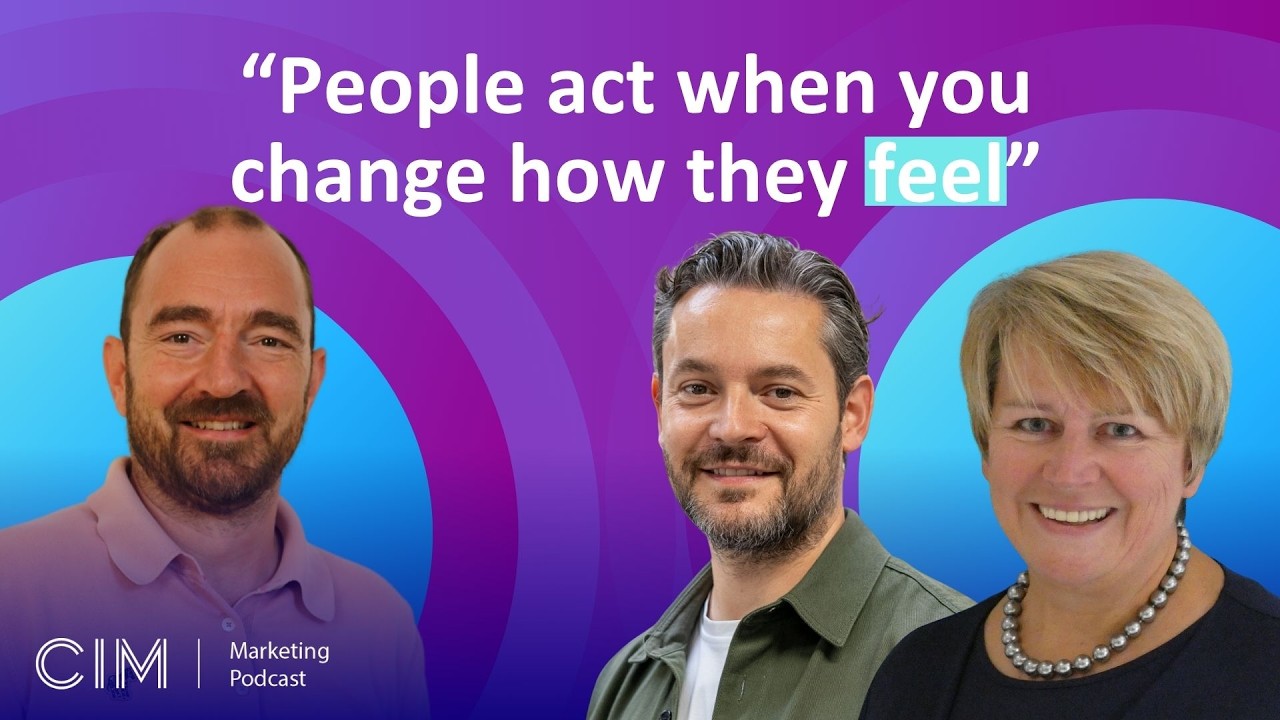
How marketing leaders are delivering social impact
Watch on YouTubeVideo summary
Marketing leaders can drive genuine social impact by identifying a strategic "sweet spot" where their core business activities naturally align with positive societal outcomes, rather than pursuing unrelated initiatives that risk appearing superficial. This approach relies on the principle of enlightened self-interest, ensuring that actions benefit both the organization and society simultaneously to maintain authenticity and sustainability. Experts like Caroline Taylor emphasize that purpose must be deeply rooted in an organization's strategy and avoid "purpose washing," noting that while charities operate with inherent purpose, commercial organizations must prove their motives are genuine to overcome skepticism. Jack Lohman further highlights that although corporate marketing often focuses on short-term profitability and internal metrics, social change work requires a long-term horizon aimed at external systemic shifts, necessitating flexible planning models like the "theory of change" rather than rigid adherence to annual budgets.
Despite these operational differences, fundamental marketing principles such as market orientation and segmentation remain essential for identifying patterns and opportunities within complex environments. The experts agree that while data is crucial for analysis, storytelling serves as the most powerful tactical tool for engaging people, building belief in solutions, and driving behavioral change. To be effective, leaders should blend data with human connection and prioritize shared values over divisive or self-centered messaging, a strategy illustrated by focusing on common beliefs like independence and control rather than polarizing specifics in welfare debates. By embedding purpose into daily work, leaders can help teams connect their routine tasks to broader goals without over-communicating, thereby fostering an environment of authenticity and ambition that resonates with diverse, multi-generational workforces.
Looking ahead, the success of these initiatives depends heavily on understanding external contexts such as political shifts and economic crises, requiring leaders to adapt through self-reflection and continuous upskilling. Caroline Taylor concludes that successful leadership is ultimately defined not by specific actions or words alone, but by how leaders make people feel, as emotional resonance is the key driver behind meaningful action. This human-centric approach ensures that marketing strategies remain relevant to products and services while avoiding random initiatives, creating a sustainable path where commercial success and social responsibility reinforce one another. Ultimately, the most impactful marketing leaders are those who can navigate the tension between short-term targets and long-term societal goals, using authentic storytelling to unite audiences around shared values and drive lasting positive change.
Read the full video transcript
Finding that sweet spot between what it
is your company does, your organization
does,
and how can you leverage that to have
positive impact in the world, and then
look for that sweet spot, those
opportunities where those things
coincide, where you can play that in
life light and self-interest card that
allows you to do something really
positive and great for your business at
the same time as having a positive
impact in society. And don't try and
make it something random and left field
that is nothing to do with what you do,
because it won't wash. Make it something
that's really pertinent to to the impact
that your product service offerings have
out there in the world. [music]
>> [music]
>> Hello everybody, and welcome to the CIM
Marketing Podcast. And you know, today
we're going to be looking at applying
marketing in new way into a new sphere.
Bit of a departure for the show, but an
exciting one. We're going to be looking
about how we can use
marketing activity to help us solve
systemic social problems, problems with
society,
uh sociological problems that we face as
a country and as a society. And we have
got some great guests with us today to
discuss this very important and
interesting issue. None other than
Caroline Taylor OBE. And Caroline has
you know, she's really lived the journey
going from corporate to the charitable
sector. She was actually CMO for IBM's
international business operations, but
she has now moved squarely into the
sphere of social change. She is chair of
the board of Oasis Community Learning,
which is a multi-academy trust that is
responsible for actually 56 primary and
secondary schools across the UK. And
she's a director and trustee of the
Oasis Charitable Trust. She is also a
long-standing advocate for human rights
and social justice.
Previously working as chair of the board
of trustees on an organization called
Stop the Traffic, which is a pioneering
charity working to prevent human
trafficking.
Caroline, welcome. How are you?
>> I'm great, thank you. I'm delighted to
be here.
>> It's great to have you on the show.
Fantastic to have you on the show. We
are also joined today by Mr. Jack
Lohman. Now, Jack is chief social change
officer of the disability charity Sense.
Many of you will know the charity, very
big charity in the world of disability.
Um he's also founder of future skills
trainer called Hack Yourself, which some
of you will know began life as a book of
the same name.
And I'm delighted to say he is a course
director at CIM. Great to have you on
the show.
Caroline, before we go too much further,
let's do a little bit of a pop profile
of each of you.
Uh
tell us a little bit about yourself. Um
I've given you a bit of a billing, but
there's quite an incredible CV you've
got. Can you tell us a little bit about
your background and history?
>> Sure. Um okay, well, so um studied life
sciences at uni. Um
fell into working in fine wine retail as
a result of a student job.
Um did that for a while, had a couple of
kids.
Um and was looking at going back to work
and
sort of through a set of coincidences
ended up working uh
uh still in marketing, but in the tech
industry. And I worked for several
smallish software companies um
uh and then I got acquired a couple of
times, as you do if you work in the
software industry. Um and then uh and
then the last one I got acquired was by
IBM. Uh didn't think I'd stay because
they were this huge behemoth and I'd
worked in these sort of smallish, much
more start-uppy environments and um
didn't didn't see how I could possibly
fit in there.
And then gave it a couple of years and
discovered, well, I'm not ever sure I
ever totally fit in, but but it was an
extraordinary organization with the
potential and the ability to do so much
and it was from the first moment, hello,
a very clearly a purpose-driven
organization and I found that super
attractive. So, for all the downside of
a very large organization with
everything that brings in terms of
bureaucracy, etc.,
it was making a real positive impact in
the world and had the potential to do
even more. So, I thought I'd stick
around and see what happens. So, I stuck
around and saw what happened and
I think more they didn't fire me than I
chose to stay, but um
it just sort of, yeah, it just sort of
worked and played out and got to work
with incredible people on amazingly
interesting stuff.
And yeah, and then this is sort of
sideline to that, got involved with Stop
the Traffic way back, I possibly nearly
20 years ago, I suppose, now.
And then IBM got involved with Stop the
Traffic, which is very exciting to have
them on board as well. So, they did some
amazing work together.
And and then as a result of, yeah, Stop
the Traffic then got involved with the
Oasis and then after I retired in 2020
was
asked if I'd be willing to join the
board and then become chair of the Oasis
Community Learning, which is the the
education portion of what Oasis does.
Which is a bit daunting cuz, you know,
I've been a user of education but never
been involved in it beyond that.
But it is amazing how you find that your
many years in the corporate world and
with all the complexities working in a
very big organization serve you very
well when you come come into that
sphere, particularly because a
multi-academy trust is, I mean, it's a
charity but um, highly regulated by the
government. Um, and so you have all of
the challenges of the Department of
Education, uh, both the civil servants
and the politicians. You have Ofsted,
blah, blah, blah, blah, blah. So, um,
turned out that a lot of my IBM training
stood me in very good stead in that in
that moment. And then when I'm not doing
all of that, I'm, uh, when I retired in
2020, in the midst of the pandemic, um,
with quite a limit on what one might do
with one's time, um, I took up wildlife
photography. So, that's the other thing
that sort of, um, fills my days. If
anybody ever sees me on, um,
uh, Teams or Zoom or whatever, you'll
find that, you know, I've walls of, uh,
of of my wildlife photos around me.
>> And you're being very modest because you
sometimes, I should say for the benefit
of the audience, you picked up some at
some point in that uh, long and, uh,
illustrious career, you picked up an
OBE.
>> Yes, wasn't that peculiar? Um, yes, as
it I mean, it is sort of embarrassing,
really, isn't it? Because you we all,
you know, whenever you whenever you're
recognized for a thing, most of us know
that there are far more deserving people
than you uh, are, but um, nevertheless,
uh, it would be rude to say no, thank
you. Um, and, um, no, so that was pretty
wonderful, um, and, um,
uh, I yeah, and it was the citation was
peculiar because it was for marketing
diversity and the prevention of human
trafficking, which is quite the
collection of things. Um, I think they
couldn't quite make their mind up which
one they wanted to stick on it, so they
stuck all three. Um, yes, that was very
wonderful and, um, and gave and gave me
my day at the palace, um, gave, uh, my
husband and my daughters their day at
the palace, um,
and, uh, and I got to meet the queen,
which was pretty awesome.
>> Uh, fant- fantastic, fantastic. That's
that's that's great and amazing and
amazing career well lived. Jack, you I
mentioned earlier, you're you're
slightly unusual in that you're the
founder of a company that started with a
book, which is the reverse of what
normally happens. You know, people
normally start a company and then they
write a book about, uh, their insights
from that company, but for you it went
in reverse. It It did. And it actually
probably started with more than an an an
idea, which was that um you know, the
world of work has changed considerably.
And with that comes a shift in how you
lead teams, how you run high-performing
teams.
Um and I guess the inquisitive part of
me was asking, well,
what practically do we do now to run
high-performing teams in a post-COVID
world?
Um and whilst that makes an interesting
read, what's the more interesting part
is actually in live scenarios with
companies learning how they're doing it.
And actually, I think I learn more
uh running those sessions than I than
the wisdom I impart, to be honest. And
um
I think it's as a general thing for
leaders more generally, I think one of
the best things you can do to get good
at your job is to teach. Because I think
it helps you
uh define your opinions. It helps you
consolidate your
your views. It and it helps you
understand
what you really think is effective.
Because you have to give it as a as
advice.
And that's just that process of of
refining your thinking I found really
helpful. Um
but yeah, that's kind of um
a part part work that I do. The other
The other part is um I think I've been
having an identity crisis recently
because I've taken on a job, which is
the first job in my career
where it doesn't have the word marketing
in the job title. And I think um
as marketers we we like to you know,
associate our job titles with our
identity. Uh
Although it's I've I've gone through
that and I'm on the other side. Um I
think there's something quite refreshing
actually having a job title like chief
social change officer because it talks
about the outcome as opposed to having a
word in the title that's more the the
process or the thing that you're doing.
Yeah, it's a whole different energy and
uh
feeling to it. So, I've I've gone
through the identity crisis and I'm
embracing this this world of social
change. Uh
which is now the the the name of the
directorate that I lead as as well. Um
I'm working on the OVE. Um so if you
have any contacts, Caroline, let me
know. Um although I did spend I've
probably spent the best part of a decade
working at Royal Charities, so you'd
think that I would have uh a better
chance than many at
>> You must be on the list, my friend.
>> One one day. Um yes, at the Prince's
Trust for a number of years. Um
So yeah, we're very lucky to work with
some really really great non profits and
private sector
uh work as well.
>> Indeed, and we'll dig into a little bit
about that idea about how outcomes
later. Very interesting point that you
made that your your job title is named
after its desired outcome rather than
the activity that gets us to that
outcome, which we'll dig into a little
bit later on. Um
Caroline, I'll come back to you to
start. You People were listening to your
potted history.
And they were thinking, "Goodness me,
this is a This is really is quite an
interesting segue this lady's made.
You've gone from, you know, one of the
world's biggest blue-chip companies in
the shape of IBM, international tech
major,
to running a charitable trust.
Um
Some people would think these two are
such chalk and cheese
that there's no natural progression from
one to the other. But presumably there
must be.
And uh if so, what is it?
>> Well, it's It's a really It's an
interesting question. I mean, I The
first thing is obviously once you So
you My role is a governance and
oversight role. I mean, this chair
rather the CEO um for which I'm grateful
every single day, I have to say, because
being the CEO is way, way harder. Um
I I I As I sort of said earlier, I do
think that that crazy corporate life has
been an amazing preparation. There are
so many There are so many moments um
uh in in what I do now that reflect I
reflect on what I did in the past. So,
you know, um in my latter years in IBM I
was responsible for all of marketing it
across and communications across our um
global business. So, China and you know,
Australia and and Romania and well,
everywhere. Um and and so and that and
how and having a deep respect for the
individuals who are doing the work in
those places and for their regional
expertise, not thinking you know best
because you've got the fancy job title.
Um and and that's really important now.
So, we have schools all over the
country. The principals and the staff in
those schools know their students and
they know their the families of their
students and they know the context that
those um children and young people come
from and they know the challenges. And
so so and I I have a, you know, um deep
deep
uh respect for that knowledge and to not
to never think that I'm going to know
better. So, it it I think what it what I
my training IBM trained me to really ask
lots of questions and not think I knew
the answer. And probably never think I
knew the answer. Always assume I don't
know the answer and therefore ask
question, listen, learn.
And and so I so it it's really
interesting. So, yes, it's nothing to do
with tech. And it's also all about
understanding your audience, you know,
understanding your stakeholders, let me
put it like that. Um
it you know, and and you can I mean,
I've never bought millions of pounds
worth of software or hardware or
technology services and yet I needed to
be in the midst of decision-making
around marketing uh investment and
campaigns that were going to target
people who did that every day.
And so again, you know, I'm I'm never
going to walk a mile in their shoes, but
but you can learn and you can really
learn about your audience and
what they care about and why they care
about it and what makes them tick and
that's that vital for marketing, but
it's vital for running an organization
that is a service to in our case 34,000
young people.
>> Well, yeah, what going to say, we're
talking this this show
you know, sort of using marketing to
drive societal change, you know, to to
improve society through marketing
activity.
Um, you know, we you get a lot of big
brands, small brands as well, but
certainly big brands sort of trying to
portray, trying to sell this idea that
they have this quote unquote purpose.
Um, you know,
every every organization nowadays
apparently has to have a purpose or has
to at least try to sell a purpose be on
profit, I'm sure.
IBM is no different. Um,
but how does that compare with sort of
trying to sell your IBM's customers a
purpose with something that you're doing
now which has a very obvious
purpose or at least it seems to be
obvious fairly more obvious to me.
>> Yeah, okay. Well, I think it's two big
things. The first one is if you're a
commercial organization like IBM or any
other, people are going to be very
skeptical at best and cynical at worst
that you're only interested in profit.
Okay?
Um, and uh,
but but the other thing is that you're
not really selling in that instance your
purpose to the your your purpose is what
drives your strategy. So, I would I
would say that um, and and so, just to
put this in context, um, IBM's a really
really old company. So, 15 years ago in
2011,
I was the CMO for IBM UK and Ireland and
we with all our colleagues around the
world were marking the 100th
uh, um, anniversary of the foundation of
IBM. So, 100 years as a company. Um, and
the thing that was interesting is that
the core purpose of the organization had
not changed in those 100 years. I would
suggest it probably still hasn't. Um,
but what it did and how it did it
changed all the time, you know, and had
to change all the time because the world
moves on. Um, you know, IBM uh,
essentially invented the personal
computer, ran a very successful
profitable that's the computer business,
but eventually moved away from it
because it was no longer Well, it was no
it would it was it had become such a
commodity to all of us that it no longer
met IBM's purpose. And their purpose,
they would have articulated it 100 plus
years ago is making the world work
better. But in those days, they made
bacon slices and and weighing machines
and stuff like that. So, your experience
in the in the in the town deli, not that
you would have called it that in those
days, but um when you were buying your
your your bits of ham uh was better as a
result of having a really eff- efficient
uh slicing machine. Um
So, so the purpose didn't really change,
but the how they how what they did and
how they did it did change. And so,
purpose is less about
is more about keeping um keeping you
focused on on what it is you're trying
to achieve out there.
And if you if your purpose is
just a very flimsy wrapper for making
shedloads of money and not much
interested in anything else, then
everybody eventually will find you out.
I mean, you might get away with it for
some of the time, but down down the
road, you you will trip up and you will
fall over. Because people
Human beings are pretty good at sniffing
out inauthentic stuff.
So, um so I think that that's the thing.
But, you know, if you're a if you're a
charity,
a multi-academy trust or, you know, the
broader Oasis, which um which uh you
know, works uh significantly in much
wider community transformation,
um
and people are much less skeptical about
your purpose because why else would you
do it except that you really care about
it? And then it's more about how
effective are you? Are you really able
to do this? And how are you doing it,
you know? Um if you're a donor or um or
a or a corporate organization that might
be considering partnering, you want to
know that your money is going to be
really, really well spent. You don't
think about that when you're a customer
of an organization buying a thing from
them. You want to think, am I getting
the best value? Am I getting the thing I
need that's going to deliver the outcome
I need, and am I getting it at the best
price I can get for me? Um so, it's so
it is it is both different and and quite
similar. But, having come from many,
many years in IBM, where purpose was a
really powerful motivator and a thing we
talked about a lot internally, it really
shaped how we developed the
organization. Um it it may may be that
shift into something that's overtly
purposeful. Uh my case, multi-academy
trust. Um make made that shift a little
easier.
>> It's interesting, isn't it, Jack, that
you
Paralyzed saying that you you need to
have a sort of authentic, almost
concrete purpose. But, does it always
necessarily translate into commercial
value if you have that strong sense of
purpose?
>> It would be a very sad state if we live
in a world where businesses give up on
purpose being part of of the mix. Um
I think this debate has gone has rolled
around, hasn't it, for a number of
years. I think in the early sort of 10,
15 years ago
it was fashionable and it and it was the
thing that organizations were quite
quick to put at the front of their
comms.
I think people then started to see
through the purpose washing and people
and
I think in in the FMCG world, we saw
that roll back a little bit, didn't we,
of of trying to force fit purpose in
into products.
And reorientate back to what the
customer wants or what the product needs
needs to deliver.
Um and I think, you know, sometimes you
do just want a washing powder that's a
good washing powder or a razor that's a
good razor.
Um that said, there are so many other
ways for businesses to deliver benefits
beyond profit to shareholders in the
world. I spent a couple years working
for Business in the Community, which is
a a nonprofit uh led by the then prince,
the now king um as founder and they work
they do amazing work with the with the
corporate sector
looking at all the different ways that
you can have an impact on society in
your local community. So, it doesn't
have to be the thing that's at the front
of columns. It can be the thing that's
helping equal pay or um it uh the the
the direct impact in in a kind of the
proximity to to where you are in the
community. So, purpose can have
different roots and it can have
different benefits. It doesn't have to
be the consumer-facing thing. Um that
said I think
if it has no uh if there is no financial
gain but there's no financial loss
what an amazing thing businesses can do
to help different communities and and
audiences feel seen, feel understood,
raise issues
build awarenesses of things that
actually can gain traction because of
that. So I think the strategic
conversation around purpose is really
interesting in the boardroom and what
what lens people look at it through.
Obviously, in the nonprofit sector, it's
non-negotiable. You need a purpose. At
Sense, we've just um revisited our
vision and our purpose. So, we're we're
just at our 70th anniversary and we're
looking at the next 70 years.
And actually, I think in the in the
charitable sector, it's how focused your
purpose is.
And then how well aligned your strategic
tactical plans are to to deliver that
which makes it successful or not. Not
whether you've got one or not, it's is
it is it really like razor sharp for
today and for the needs of um
a few audiences, particularly for
nonprofits that have been around for a
long while. Like, have you reorient it
back to the people you're here to
represent? Are they telling you what
they need and are you delivering that?
Is your purpose still fit for for
purpose?
So, there's there's different ways to
look at purpose
from a commercial point of view and from
a nonprofit. Either way, you've got to
get it right that works for you, that's
authentic for you and and um
isn't uh
false fitted uh because of a trend or uh
a particular um
uh reason that's superficial.
>> Yeah, I mean there clearly there are
there are some similarities between the
corporate world and the not-for-profit
charitable sector. There are some
commonalities. Uh but there are also
some differences of nuance. Presumably
when you shifted from one to the other,
you had to do some unlearning. There
were things that you had to unlearn in
order to be able to move to a to to to a
mainline charity.
What were they?
>> Working in in the private sector to to
nonprofit is obviously a big shift, but
also the shift working just running a
marketing comms team versus running a
social change team.
Uh the big shift for me is trying to
unlearn, to use your your word there,
Ben. Trying to unlearn that delivering
your plan is is success. So, I spent a
lot of many years leading marketing
comms teams where you you promise a plan
and a budget,
and you spend all year working to
deliver that because internal
stakeholders and reporting structures,
etc.
And that's good, and if that's
delivering organizational objectives,
that all feels quite sensible.
This move into social change is that
you're trying to impact something way
bigger than what sometimes your
organization can even define.
And so, delivering a plan that's been
defined 12 months prior isn't always
success as the external environment is
telling you that you need to do
something different.
There'll be factors that are beyond your
control. I mean, you need to pivot in
different directions.
And the leadership of a social change
function is actually about saying we
will do whatever it takes to create the
change that we need to create. And if
that means having to resell another plan
back to the the board, we'll have to do
that. If it means
uh negotiating for extra funds from
elsewhere to invest in certain areas,
we'll do that.
But it's being so on top of I'll be
focused on the right things.
Do we have a plan that's going to get us
to the end result? So not a deliverable
marketing plan,
but social change.
You know, and holding that
responsibility of those that we're here
to to represent and and support and work
alongside.
That's been really interesting for me.
That actually it's always both eyes on
the on the outcome. Um, it's what what's
fascinating is um,
the social change in our planning
process. We use theory of change as a
planning tool. So we look at what is the
change we want to see.
What are the outputs that come towards
that? And then what are the inputs?
What's the links in the chain almost
that would make that happen?
And then you devise your marketing and
comms like tactics and plans.
And as opposed to maybe taking a kind of
organizational objective and and and
creating a marketing and comms plan.
And with that it's uh,
the question you're always asking
yourself is are we on the right road to
get to the end of this theory of change?
Because if we're just busy, that busy
fools thing, if we're just busy,
um,
my job is to then stand up in front of
the board and tell them what change
we've
we've made
in 12 months. And if I can't do that,
by default, uh, I'm held responsible.
You know, my you'd be not called chief
social change officer
if um, if you're not making change
happen. No, it's actually you can go go
and kind of do another job elsewhere. So
it adds such responsibility, but that's
that's right. Accountability is great
and then I think the
the planning in social change adds that
accountability.
>> It's fascinating, isn't it, Caroline,
that you know, Jax describing a
difference between perhaps what you'd
have in the corporate world generally,
an internal target, improving the bottom
line, typically.
Um,
improving profitability or turnover or
whatnot.
With an external target, you know, he's
he he is targeting on changing society,
you know, no pressure. You're you're
you're you're not just changing your
organization, you're going to change
society for you to succeed. That's a
massive unlearning, presumably, when you
make that shift.
>> It it it it it absolutely is. I think
the thing I would, you know, the word
that sprang to my mind when you when you
asked the question was un to
unlearn impatience.
And it's not because and it isn't
because you can just sit back and it's
and the stakes aren't as high cuz
they're actually higher cuz these are
real human beings on the other end of
your success or failure.
But because the the goals tend to be a
much longer-term thing. Um whereas in
the corporate world, you you know, you
can have your three, five, 10-year
strategy, but my goodness, you are you
are held feet to the fire to the
quarterly outcomes.
And
which was always very frustrating. I
can't tell you the number of times that
one heard the expression, "You can't
turn a supertanker around that fast."
You know, if you were trying to change
the direction of a supertanker, it
doesn't happen instantly. It cuz we'll
we'll learn to be true.
Um so, it was always very frustrating
when there were market shifts or
whatever unless you were ahead of them
that you know, to if you're playing
catch-up. So, I think that you know,
trying to unlearn impatience and know
you have to keep your eye on the
milestones. I think Jack It's exactly
what you're talking about, isn't it?
Know that always checking are you on the
right trajectory to to deliver the
change you're committed to to
delivering. The other thing for me that
was a big shift, mostly because the
nature of my role has changed, because I
am in a non-exec role, um
a governance and an oversight role, I
I've had to learn to stay in my lane.
I would be a terrible coach. I do lots
of mentoring, but I'd be a terrible
coach because my instinct is to solve
problems. So, in any discussion, I
sometimes have to almost physically
restrain myself from leaping in with the
solution.
Um cuz that isn't what I'm there to do.
Um and of course it's there to support
and help and as well as well as the
government's native side responsibility,
but so that's that's been that's been
really interesting and again, people who
worked with in past will find know will
know how, you know, I always have to sit
on my hands and
>> [laughter]
>> um force myself not to step into that
role of the the executive.
>> You know, it is enough fascinating
fascinating. A bit of a learning to be
done to to to succeed when you make the
shift. Most of our audience, it has to
be said, will not have made that shift.
Some of them may be interested in making
the shift. Many of them are very happy
working in the corporate world or indeed
working for agent on agency side for
corporate brands, but nevertheless to
pick up on your point earlier, Jack,
lots of these brands genuinely and I do
believe genuinely do want to do
something which will help society, you
know, uh and not just for uh sort of
entirely self-serving reasons. There are
all good brands out there who do want to
do purpose-led activity to make a
societal shift.
Um
there's been a thing now which we hear
called purpose washing,
which is that um
sometimes brands are sort of almost
shying away from doing this stuff or
saying anything about their good work
that they're doing in the society or
community because they get accused of
this stuff.
>> [gasps]
>> Um and many people listening will be
interested in how they deliver this sort
of activity while avoiding
this pitfall about purpose washing, you
know, how we used the word earlier,
authenticity.
How that they can be seen to be
authentic in their
uh societal change gambit, if you like,
um doing it for altruistic reasons, not
for self-serving ones.
A big question perhaps, but um Carolyn,
how do they do it?
>> Well,
I'm going to I'm going to be a little
bit radical and say I think self-serving
is okay, but
I've been a really big fan from for a
couple a couple of decades at least of
the concept of enlightened
self-interest.
>> Mhm.
>> In the corporate world, because here's
the problem. If you have what they call
checkbook philanthropy where the CEO or
somebody very senior is a big fan of
this, that, or the other, has a personal
you know, interest and wants to help in
a
some societal issue challenge charity.
And when things are going well, they're
signing big checks and then isn't that
great? And of course it's great. We all
all charities need more funds we can do
more of the great work we do if we have
more money. Wonderful. But the reality
is it doesn't last. Enlightened
self-interest to me,
is all about finding that sweet spot
between the core business and the
and the objectives you have as a
business to grow, to to generate profit,
um,
you know,
all of that good stuff. And the impact
you can have on society. Let me give you
a couple of examples. I mentioned that
having got involved with Stop the
Traffik and then joined their board and
eventually chaired their board while I
was still at IBM. IBM then got involved
with Stop the Traffik and
provided an enormous amount of software
and the expertise free of charge to the
charity as they built this amazing thing
called the Traffic Analysis Hub. Nothing
to do with traffic as in roads, it's all
to do with human trafficking, modern
slavery. And actually built a platform,
a data sharing platform for big
corporates, big banks, and NGOs to put
their data in that allowed the use of
very smart analytics and AI to start
figuring out some of these patterns so
that you could actually identify where
the
where the trafficking itself of the
individual humans was happening and so
that law enforcement could get in there
and and do something about it. An
absolutely extraordinary thing. Did IBM
do that out of the goodness of their
heart? Nope. They did it because it gave
them an opportunity to showcase the
amazing power of the technology that
they were selling to their many, many
corporate clients. Um and so to me that
is enlightened self-interest. It had It
was enlightened because it had such a
such a great positive uh positive impact
um out there in the world, out there in
society in literally helping to break
down the criminal networks that are
selling human beings. But it was also
good for them. And I actually think that
to me feels really sustainable. So I
think that that, you know, that that
kind of thing works really well.
Similarly, um uh and I don't know if it
was It might probably before your time,
Jack, working for um Business in the
Community, but way back when in When am
I going back to? 2008, 2009, the then
Prince of Wales created this initiative
called Start. It's all about getting
people to take on board personal action
or companies to take on corporate-level
action to make us a more sustainable
nation. And IBM was one of the founding
partners. Again, it it was really
beneficial to us. We built new business
relationships with senior people in big
companies in the UK, which was very
beneficial to our organization. But at
the same time, we took that message out
there and engaged, you know, uh
thousands and thousands of people on how
they might think about making themselves
more sustainable. By the way, IBM had an
entire business consulting practice
about uh carbon management. And so, you
know, so I anyway, just a couple of
examples, but but there are many, many
ways. So if you are a marketer and you
you want to have societal impact, you've
got to find those sweet spots where what
you do anyway
can coincide with something in society
that will make a difference. And and if
it's a win-win, then it will survive, it
will thrive, and and it will do the job.
>> Yeah, interesting interesting, Jack.
Carolyn Taylor saying enlightened
self-interest is enlightened because
actually what it means is that these
good societal shifts that corporates can
do will be sustainable because frankly
there's something in it for them.
>> Yeah, I think you you you hit the nail
on the head talking about the sweet
spot. I think what's interesting is that
where that's where it originates from.
Where does the purpose originate from?
So if this originates from your
marketing agency or your comms team, I
think that's where the problem probably
it can be found. I think if this
originated from your origin story or
your founders or from a strategic
process,
it's it's very very different. I don't
think this is overly complicated. I
think Caroline articulated it really
well that the sort of model that that
you need to get to.
Um the other part of it then is just is
building the credibility, you know. If
it's surface level comms about purpose,
people will see through it.
If you've got a a process of how you
build credibility in that space,
then I don't think you need to worry,
which was your original question, Ben,
about the the backlash, if you like. Um
if there's credibility and if you're
asking in the boardroom the right
questions,
do you really believe in this? Are we
investing in it?
Is it influencing our decisions? Like
what's happening when it's inconvenient?
You know, there has to be a cost to
purpose, broadly. Um initially, it might
lead to future profits because of the
the benefits of that sweet spot, but
there's a cost. There's time, there's
investment, there's uh resource
redirected in in different different
places.
That's good. That's a sign that an
organization
is um
giving it weight to solve a problem.
That's fine. But I don't think it's
overly complicated that you'd find the
sweet spot, you'd build some
credibility, and you'd have a structure
in place in your governance to hold
yourselves accountable. Your colleagues
will believe in that, then your
investors will, your partners will, the
local community will.
Um I think we're in an era now where
perhaps we're overcomplicating it and we
need to get back to just being brave and
doing it and doing it really well.
>> Interesting. And there must be
differences in the activity one uses,
however, to market, let's say, a gadget,
a product versus marketing
a shift in societal
versus marketing a societal shift. You
know, uh, I realize in the business you
do, Jack, you're you're working to
change how people perceive
disability and how interact and how
people interact with disabled people.
You know, that's a massive
change that is required. How do you
market that change that you're being
made versus traditional marketing where
you're marketing a product or a service?
>> Yeah, it is chalk and cheese, um, if I'm
honest. Um, you know, the the product is
is is trying to change people's choices,
isn't it? Whereas
we're in the business of changing
systems, like this system level change.
Um, and with that comes a whole
different time scale. So, you mentioned
it earlier, Ben, that
we're working in a in a long time scale
here, often often years. And if you
think of campaigns around smoking, seat
belts,
drink driving, the recent social media
ban, these things are not happening by
quick paid ad campaign.
Uh, they're they're happening through
long-term influencing, movement
building, changes to societal uh,
beliefs,
uh, pressure that builds on the
government.
The government then to take some kind of
review or action which then moves
through into into law.
That's that's that's huge and and that
that unfortunately is a long game,
which is why
it is purpose-driven because you're
investing all of your kind of uh,
resource and energies into something
that's um,
might possibly never happen.
That's the really hard bit in non- in
nonprofits is that most of our visions,
every charity I've worked in, the vision
is have very difficult, if not
impossible, to to come true.
Um
however, you have some tactical plans
where you say, "Okay, what are the open
doors?" So, at the moment, the
government are reforming in pretty much
every single government department.
They're reforming the health system,
education, welfare.
And so, for us as a as a charity,
that's great news because there's lots
of open doors where we can go in and we
can help raise the voices of people
maybe affected by these reforms to try
and influence the decisions the
government make.
On the flip side,
there's reforms happening in every
single government all at once, and we
have a limited amount of resource, and
so
you have to pick your battles. You have
to be really smart about how you deploy
your resource.
Um you have to be really focused on what
are the most important things that
people here to serve are telling us they
need and want.
And that's where you go back to what's
similar to the
the the corporate sector in that you
it's market orientation, as you would
say in marketing jargon. It's it's but
marketing orientation that is
so hyper focused on what your audience
needs. What what's the property you're
trying to solve? What's the We call them
what the barriers.
What the barriers in society
that are so tall, so high, and so on
fire that are stopping people living the
lives that they want. What are those
barriers? And then what can we do
together to to to break them break them
down?
Because we'd only be doing is focusing
on the wrong barriers or
a barrier that's too small or one that's
never going to be removed because the
government is just not interested in it.
It's not even on their agenda. You have
to find the opportunities. So, it is
really different. There's learnings and
there's best practice, you know, I've
been on you know, the the the training
and the the marketing principles that
have been around the donkeys years, they
all still apply. That strategic
thinking,
the market orientation, segmentation,
targeting, positioning, all of that
stuff still applies.
It's just with social change, you're
looking at a system change as opposed to
product uh specific and it's different
different time scales, different
audiences, different degrees of
difficulty, hehe, which makes it
interesting.
>> You're nodding furiously, Caroline. I
was going to ask you, obviously there's
a longer-term change you're trying to
make, a societal shift.
Is there still some classic marketing
techniques which you deploy such as
deploying a simple message that everyone
can understand, that people who perhaps
don't know anything
uh about the issues with the disabled
community or whatever
um can understand?
>> Well, I I I think there is. I mean, I
think the the the sort of um
the preparation phase, if you like, you
know, that understanding your audience,
really understanding what it is they
want what it is they need, understanding
where they are on on a journey of
understanding.
I mean, you do that whatever you're
trying to sell or market, you that
that's a fundamental part of what we do
as marketers. Um in terms of um uh you
know, the tactics. So, yes, absolutely.
If you can if you can net it down to a
simple message, but sometimes these are
very very complex um
things that you're trying to address.
And there possibly is
there probably it possibly isn't one
single simple sentence, you know, there
isn't a phrase that you can you can
capture. However,
I do think that one
area of uh tactical activity that is
that works incredibly well in both
spaces, and that is storytelling.
So, you know, as a fundamental part of
your communication. So, if you can't net
it down to one single thing,
the storytelling the storytelling about
the impact, the storytelling about the
outcomes that I imagine that in in the
space you're working in the storytelling
around the the lived experience of of
people who who are you know on the wrong
side of those barriers. Um storytelling
I mean it's such a powerful thing, isn't
it? We know that it works in selling. We
know that it works in in in getting
people
on board, getting people to believe in a
thing cuz that's actually often you know
at the fundamental start point is you
can get people to believe that a thing
is wrong uh uh not fair. Um you can get
people to believe that it is possible to
fix it
um and that they might have a role and
they might be able to play their part in
fixing it. That's a big fundamental
piece of what we what we have to do.
>> Is it more important Is it more
important than data, do you think? Those
human stories, that storytelling piece,
is it more important than leaning into
the data to what the data says?
>> I I'm going to say I would say it's
both.
It's definitely both.
Sometimes the data If you talk to some
of the team from Stop the Traffic, what
they would tell you is the data the data
helps them find the stories that they
need to tell.
Um which is which is you know which is
important and and and helpful and
interesting, but ultimately
I mean I'm look I'm a very simple soul.
Ultimately
all marketing is about person A engaging
and communicaticating with person B.
Now, sure in marketing we do that at
scale sometimes. So, you know, you're
you're you're one person trying to
communicate to you know 10 million
individual human beings.
Um but still it is that ultimately it
comes down to that engagement and and
and interaction and communication. Um
and so and stories are what this how
it's how humanity has existed forever.
We tell each other stories in order to
help each other understand what it is
we're trying to say. Um,
and so so yeah, I it is data and
stories, but it absolutely comes down to
humanity and relationship and relational
um engagement,
I think.
>> Do you think storytelling or data where
where do you lie, Jack?
>> It's certainly both. Um, you know, in
terms of our media work,
we'd need both the data, the
the statistics um to to look at the how
compelling that that argument is, and
then we need the story to bring it to
life, the human interest.
In in terms of the messaging, you know,
that what we
what we would aim to find is what's the
common thing that we all believe in. So,
if we're trying to influence the general
public to back us on a campaign or
a particular government department to to
consider something differently.
In terms of our messaging, what you
don't want to be doing,
which is probably the case for all of
us, is talk too much about yourself. And
what you want to be thinking is
what is the intended target
think and feel, and where do we where's
the common ground in this? So,
you know, for example,
the government reviewing all the welfare
support at the moment.
Um, it's a very heated debate, and
there's lots of different perspectives
on it. Um,
but one question you can come at that
with is
do we all believe that everybody has
should have the opportunity to to to
live a life in
>> [snorts]
>> on equal terms?
Um, and those that are that have
significant complex needs that would
never work.
Um,
do we do we believe that we should
support them to live a life that's
independent where they feel in control,
where they feel involved and can make
decisions in in their in their life? And
if we believe that,
then we're on a mission to make sure
that can happen, and you can join us and
you can help us with that.
That's really different to to
talking about like the specifics of
something that's um
that can be interpreted in different
ways. So, it's finding the common
beliefs
um
which I guess from a you know, from a in
a commercial sense, that's where your
brand messaging might come into play
more than your product.
Um but it's really important. So, it's
the for me it's that mix of data,
storytelling, and the
the highest level of messaging that you
can get that would resonate with your
audience.
>> Fantastic. Remarkably, we are amazingly
close to the end of our time, which has
been a fascinating discussion. But let's
boil this down to some practical steps.
There will be lots of people listening
to this show. As I say, only a small
probably a relatively small proportion
of will be working in the charitable and
nonprofit sector. Most of them will be
working either client side or agency
side for companies. But nevertheless,
will be interested in embedding this
concept of purpose into their daily
working lives.
So, I'm going to ask for practical steps
that listeners can take to embed
purpose into their daily marketing
activity. I'll start with you, Caroline.
>> I mean, I think it is what we've spoken
about already, which is finding that
sweet spot between what it is your
company does, your organization does,
and how can you leverage that to have to
have positive impact in the world, and
then look for that sweet spot, those
opportunities where those things
coincide, where you can play that in
life light and self-interest card that
allows you to do something really
positive and great for your business at
the same time as having a positive
impact in society. And don't try and
make it something random and left field
that is nothing to do with what you do,
because it it won't wash.
Um make it something that's really
pertinent to to the impact that your
product service offerings have uh out
there in the world.
>> Very interesting. Great tip for your
sweet spot, Jack.
>> Yeah, I mean your question is about how
do you embed it
into people's daily activity and I think
I mean even in the non-profit sector,
it's it's not like we wake up every
single day
and we jump for joy that we are working
for a charity and uh that's got a
purpose. Uh
you know, it becomes it becomes the
everyday and uh you still have to help
your teams find meaning in their work,
believe it or not. As a as a leader of
of a large team,
you still have to help people find that
connection between what they're doing on
a daily basis to the overall goal.
Um so take that and move that into sort
of commercial sector where the purpose
isn't centered to all activity, that's
even harder
to help people daily feel like that
they're having a purpose in in their
work and
sometimes it's not not needed on a daily
basis. I think sometimes you can be
uh there's an unauthentic approach where
you're you're trying to make people feel
or do things that actually materially
are not needed.
Um but also the the the job of a good
leader is to bring meaning to people's
work, isn't it? And so I think for me
it's more
great leadership from from CEO downwards
in terms of what what they really care
about, what change are we hoping to see
in the next 12 months, non-profit or
not,
um and then helping people in their
roles understand what the thread is
between what they do on a daily basis to
to to get that outcome, but I don't
think
I don't think we need to overdo it. I
think we need to be true to ourselves,
be proportionate
in the amount of purpose comms that we
do,
um but at the same time be ambitious. I
think the corporate sector has an
amazing opportunity to
uh deliver purpose or actually to just
to financially support charities, their
communities to deliver it themselves.
You know, there's there's something that
actually they I need to be a month that
that do the doing. Uh you can use your
infrastructure, your resource, your
volunteers, your funds to make happen
elsewhere.
>> Any wild card tip from either of you?
>> I would just say if you're working for
an organization that truly their only
purpose is to make a lot of money for
their shareholders, maybe a good time to
start looking for a different job.
>> Great tip. And uh finally, let's look
into our crystal balls. This This tends
to be people's least favorite uh
the question because of course how can
you possibly know? But if you look ahead
for 5 years or to the future to the
nearish future in marketing and
marketing leadership, what do you think
and I'll start with you, Jack, will
distinguish those people who've
successfully brought about a societal
change
from those that have failed to do so.
>> I think at the moment it's having the
ability to understand the context that
we're working and the influence that
will have on how we
can deliver our plans. So, the political
context, uh the um the economic context,
the way um I guess if you look at the
way equality is being challenged at the
moment, human rights,
the role that charities play
when we're meant to be politically
neutral, but we're politically active is
difficult,
particularly in a world where the
political environment is increasingly
uh diverse and and and challenging. And
so,
I think to lead your charity through
those
examples, you need to be really
have a really good understanding of
what's going on. And uh interestingly
this morning,
um I brought together people who do my
job at executive level in uh
in charities across the UK. We brought
them together in a in a forum called the
Leaders of Change Forum. Um the idea was
to discuss things just like that. How
are we going to evolve our thinking to
navigate this because they're big
challenges that we haven't really faced
before.
Um so I think that's one is
understanding that external environment.
Um and the second is the internal in
that
there are about five generations working
in the workforce now. We work in
different ways. We work remotely. Uh
there's a cost of living crisis.
Different generations expect different
things of us as employers. As a leader,
how do you understand the modern
workforce, the modern way of working to
lead a modern organization?
And I think that takes some
self-reflection, self-awareness. It
takes upskilling. It takes accepting
that you don't know everything. And it
takes an appreciation that we're on a
bit of a journey together. I think you
need to do work as a leader on yourself
and the way you lead as well. I think we
can get those two things right. That's
got to help.
And this is the long to-do list. Uh you
know, back at work with all the things
we also have to do and deliver, meet
budget.
All those things. Um but they're
important as as well.
>> Caroline, uh the context of where
generationally aware marketer will be
the most successful in making change.
>> Um well, I'm going to cheat slightly if
I may um and share with you one of my
favorite quotes, but I think it's super
pertinent to your question. And it's
Maya Angelou when she said, "People will
forget what you said, and they will
forget what you did, but they will never
forget how you made them feel."
The reason I think that's pertinent to
your question is
successful leadership are going to make
people feel. And when people feel about
a thing, whatever the thing might be,
then they act.
And And if they act, if our audiences
take action on the back of feeling,
whatever the thing is, in whatever
sphere we're talking about, then we will
be successful as leaders.
There is way too much focus on what did
you do?
Irrelevant. Kind of irrelevant. Not
totally irrelevant, but quite
irrelevant. What do you say? Even more
irrelevant. What did you What did you
do? No, no. How did people feel as a
result of those things? And what did
they then do because of how you made
them feel? That would be the winning
ticket.
>> Caroline Taylor OBE and Jack Lohman,
thank you very much indeed.
>> Thanks, Ben.
>> Searching for a way to build your
organization's marketing capability?
CIM's Company Affiliate Programme
provides a simple, strategic route to a
more confident, high-performing
department. Get in touch [music] with
our experts today to discuss how we can
help you develop your talent and deliver
better commercial results. Head to
cim.co.uk
and search Company Affiliate.
The contents and views expressed by
individuals in this podcast are their
own and do not necessarily represent the
views of the Chartered Institute
Marketing or the companies they work
for.
>> [music]
[music]