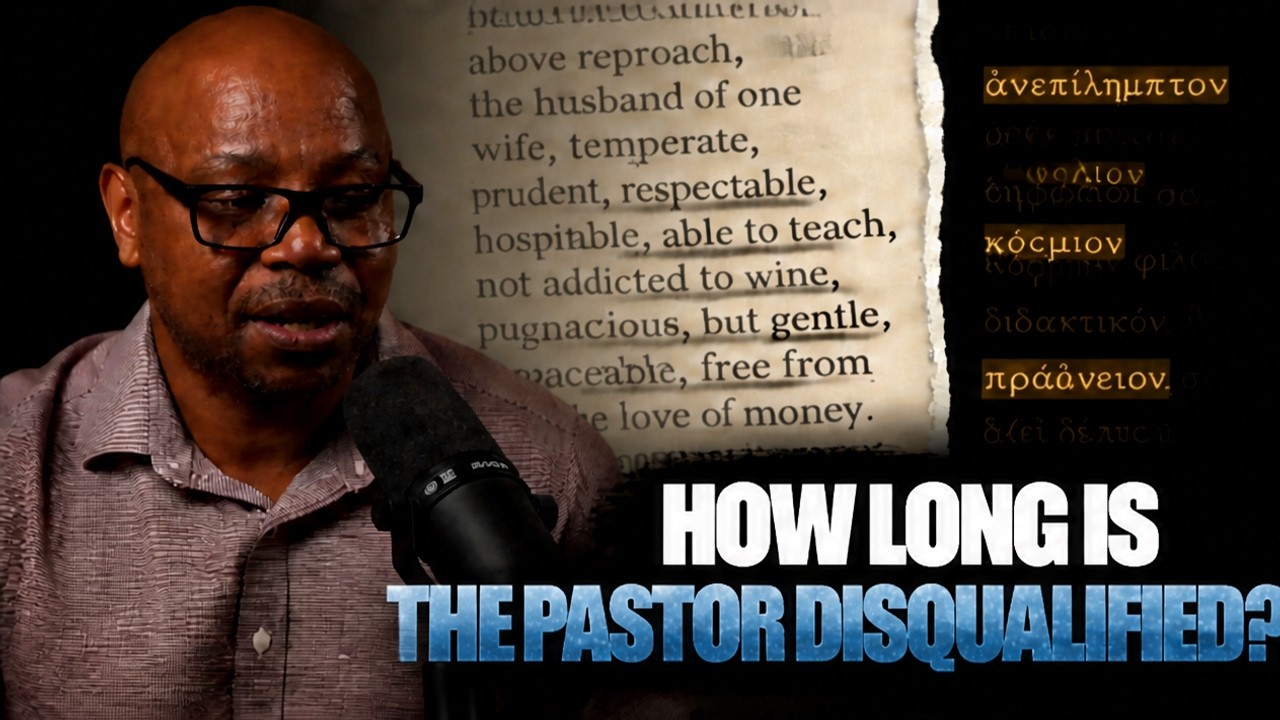
Video summary
The video addresses the complex question of how long a pastor should remain inactive or restricted after committing a sin, challenging the common assumption that any offense automatically leads to removal from ministry. The speaker argues that while biblical qualifications for leaders in 1 Timothy 3 and Titus 1 require them to be above reproach, temperate, and respectable, these standards are not meant to disqualify individuals based on temporary human failings or isolated incidents. He points out that even major figures like the Apostle Peter were rebuked by Paul for their sins yet continued to serve without being permanently removed, suggesting that a lapse in behavior does not necessarily mean a person's heart has changed or that they are unfit for leadership. The core argument is that the Bible provides no specific time frame for sitting down after an indiscretion, and therefore, there is no scriptural basis for a blanket rule regarding how long a leader must wait before returning to their duties.
The speaker emphasizes that the duration of a pastor's suspension depends entirely on whether they can once again meet the biblical requirement of being "above reproach" and having a good reputation among outsiders. If a leader is currently involved in a sin, hiding it, or has not yet addressed the accusation against them, they are disqualified according to scripture; however, once they have dealt with the issue and restored their character, they may be qualified again. The time this process takes varies greatly from person to person, ranging from a few months to decades, or potentially forever if the community cannot forget the sin. The speaker illustrates that two people committing the same offense might face different consequences based on how long it takes for the congregation to view them as respectable again, noting that some individuals may carry the stigma of their past actions indefinitely in the eyes of others.
Ultimately, the video concludes that while there is no zero-tolerance policy in the Bible, the bar for leadership is indeed high, requiring strict adherence to character qualifications rather than just a set timeline for punishment. The speaker criticizes those who claim a pastor is disqualified simply because they "think" so without citing specific scripture, urging believers to look for clear biblical evidence before making such judgments. He shares personal anecdotes about his own past struggles, including time in prison, to demonstrate that while others may remember his mistakes, he strives to live in a way that reflects a changed heart and restored integrity. The message is one of grace and restoration, asserting that as long as a leader can demonstrate they are no longer blameworthy for the specific sin and have regained respect within the church, they should not be permanently barred from serving.
Read the full video transcript
Uh, how long should a pastor sit down
after an indiscretion?
Uh, is any offense an automatic removal?
No, it's not. Let Let me say this, and
I'm going to upset some people,
especially a lot of my reformed
brethren.
We make it as though
some offenses or any offense
disqualifies you.
If you found out that your pastor did
something or said something racial,
would you think that that disqualifies
him?
You probably would, especially given our
time that we live in today.
Well, wouldn't that disqualify Peter?
What if someone is saying something
that's harsh? They have a bad day. They
say something mean to someone. They're
showing themselves not to be hospitable
or charitable.
So, if we go over to these
qualifications,
1 Timothy
3.
So, we go to the qualifications. By the
way, someone asked a question earlier,
if a pastor is
um
Can a pastor
desire to be the or are they called? We
don't see that a pastor is called. We
see that it's a desire. However, that
doesn't mean that a pastor is not going
to be equipped
from the Lord. So,
these are the qualifications. What
happens, and by the way, it says
um a pastor
a person desires this.
He must Look what it says. An overseer
then must be
It is necessary then for the episcopos
to be
above reproach. I mean, to be he must be
that.
Uh, the husband Now, by the way, this
This is going to refer to all of them.
He must be the husband of one wife.
He must be temperate,
prudent, respectable. What if one day
though he's not prudent?
What if by the way we never see people
being set down because the pastor spent
too much money and went over budget and
he he's now in debt.
We don't We don't do that, do we?
But he's This is what he has to be.
What if your pastor's lights get turned
off? Does that mean he can no longer be
the pastor?
We don't see people sitting pastors down
because the pastor is poor. Pastor's
poor and struggling.
He can't be a pastor now because he's
not managing his house well, at least
this month, at least financially.
He's This month or or last week he was
not hospitable. He was angry, upset.
Does he have to sit down?
Today he wasn't gentle.
No, no, no, he yelled at some folks
unnecessarily.
So, these qualifications
um
have to They're They're guides and
they're certainly more than guides, but
what if he violates one of those? Does
he have to sit down?
By the way, sometimes they are
indiscretions. Sometimes that's just who
he is, just a mean person.
The Bible does not give a time frame for
a pastor or elder or leader having to
sit down.
First of all, in the Bible there's no
example of anybody who's an elder having
to sit down. Do we think that none of
the leaders none of the apostles ever
sinned? Of course they did.
Of course, Paul's talking about his
struggles in Romans 7. We see Peter
in Galatians
and Paul rebuking him. Paul didn't take
time off from the ministry.
Why? Because that's not his heart.
So, if you make an indiscretion, if you
make us if you sin, but it's not your
heart and you can be judged by that by
the people around you, well then you're
fine.
You can make an error. But let's say the
error does rise to the to the to the
to the level that you need to be set
down. How long? Well, that goes back to
the word of God. It goes back to what
the qualifications are. First, he must
be above reproach.
So, he cannot be at this moment
blameworthy of a sin, involved in a sin,
hiding a sin, any of those things.
If someone is accusing him of a sin,
that doesn't mean that he's
disqualified.
He's If he is still being accused of a
sin and hasn't defended that sin, that
makes him disqualified. Well, then he is
disqualified according to Titus 1:6. He
has to at least address the sin.
We can't see this person as someone who
is not respectable. He Above reproach,
he must be Look at what the text says.
He must be respectable.
If I can't respect you,
you can't be my pastor, or anyone's
pastor.
And then verse seven, it says,
um and he must have a good reputation
amongst the outsiders. So, he has to be
respectful
inside and out.
Well, he committed a sin.
How long does he have to sin to stay
out? As long as it takes for him to
become now respectable
in the church, out of the church, and
not be blamed for a sin.
Now, that can be
a year.
It could be a few months.
It can be a few years. It can be 20
years, 30 years. It could be forever.
Maybe he can never get back to the point
to where
people will never see him without seeing
his sin.
If folks still see you and see your sin,
we got a problem. And And the problem is
And by the way, it's not even and fair
across the board.
Two people could commit the same sin,
and they be regarded differently
forever.
You don't get a chance to
determine what the consequences are.
So, sometimes it takes a long time.
Sometimes it takes forever. So, there's
no blanket statement. People have said,
"Well, Cory, you're inconsistent here."
No, I'm not. I'm being consistent. You
have to be before the people sing
differently. So, if someone hears and I
one of you know, one of the
favorite my favorite things that I see
that happens with me on YouTube, if I
tell someone that I was in prison and
how much time I was there, "What? You
were in prison?"
That means they don't see me that as
that kind of person.
Even the people who I've heard people
say, "Hey, you know what? I I actually
forgot that you was in prison. The only
time I remember is when you remind me."
Well, amen.
I need people to see me as someone who
was not that person.
So, could I be qualified now to to to be
in the pulpit? Yes. Now, there are some
people that hold a zero tolerance. The
Bible does not have a zero tolerance
policy. Now, the bar is high and there
are strict qualifications.
So,
that's why I've asked folks. I I tried
to give people intentionally the
opportunity to come and say, "Cory, you
yourself are disqualified. Show me how."
"Well, I just think." But, you don't
have a scripture and there because there
is no scripture.
And these are folks that love the
scriptures, love the Lord.
They are sola scriptura.
And I'm still friends with a lot of
those folks who
"Cory, I think you're disqualified." No
problem. No problem.
Tell me how. "Well, I just think."
What does the Bible say? So, was Peter
disqualified? Now, we're talking about
an actual elder. We know he's an elder
because in 1 Peter 5, he says, "As your
fellow elder."