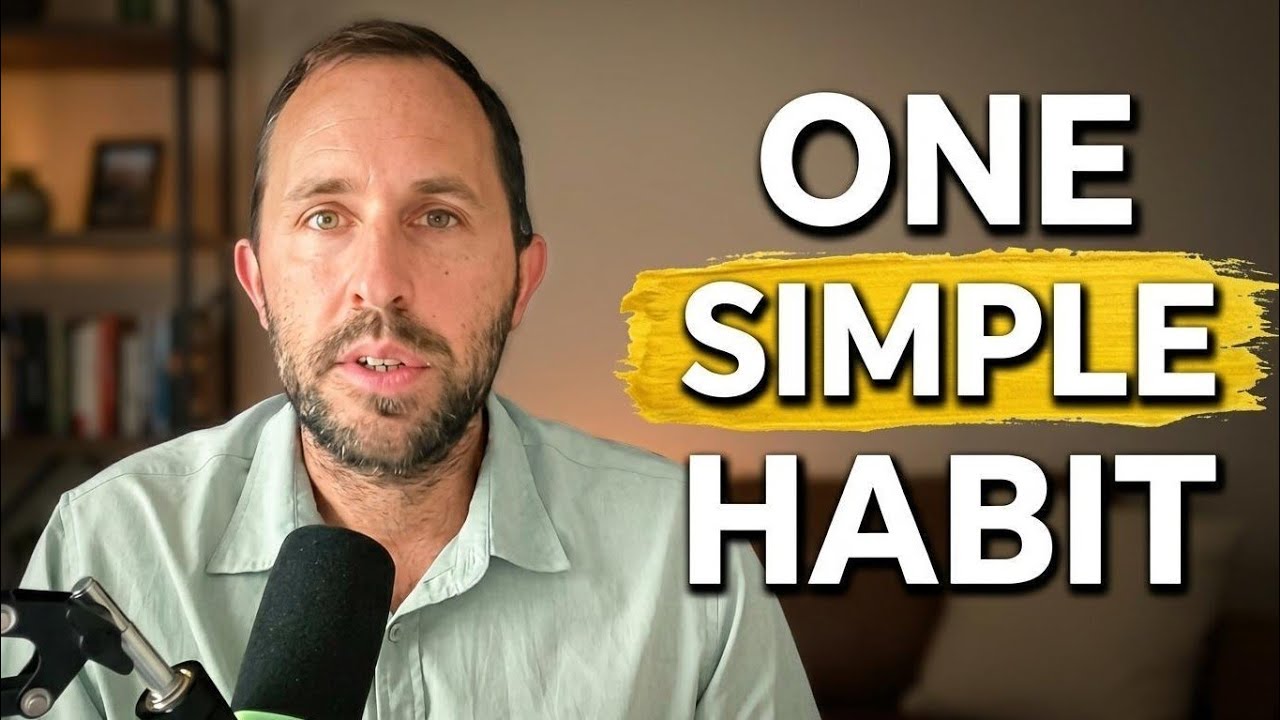
Video summary
Ben Neighbors explains that his long-term consistency as a business owner stems from an early realization that feelings and emotions must be separated from daily actions to succeed in self-employment. He admits that while he naturally felt fear and hesitation, especially regarding marketing himself or creating content, he learned that doing things despite not feeling like it creates a positive reinforcement loop where clients are acquired and the business grows. This mindset shift was crucial because many coaches operate only when they feel motivated by external factors like good weather or returning from vacation; Neighbors argues that relying on such fleeting emotions leads to failure, whereas committing to "boring work" day in and day out is essential for building a sustainable enterprise rather than just a short-term endeavor.
A second critical factor he identifies is the necessity of having absolute clarity regarding daily tasks instead of aimlessly trying to figure things out as they arise. Neighbors shares his past mistake of believing that working late into the night without direction was an advantage, only to realize later that this approach wasted time on low-impact activities or distractions like obsessing over new tools such as AI without measuring actual results. To combat this lack of direction and prevent breaking promises to himself, he adopted a strict scheduling habit using Google Calendar, which dictates his morning routine by listing specific tasks he must complete regardless of how much he wants them done. This system ensures that the most important business-driving activities are prioritized before any distractions can take hold, effectively removing the option to procrastinate or make excuses based on mood.
Finally, Neighbors emphasizes the importance of maintaining clear boundaries and knowing when to stop working to avoid burnout and preserve energy for high-quality output. He describes his own strict schedule where he stops work in the early afternoon to dedicate time exclusively to his family, noting that this separation is non-negotiable because it prevents him from dragging out days or losing focus due to exhaustion. While acknowledging that some people might not feel an intense fear of working for others like he does, he stresses that anyone wanting a lasting business career must cultivate the discipline to execute necessary tasks even when unmotivated and must also protect their personal life by setting limits on work hours. By combining this disciplined execution with defined rest periods, one can consistently perform well without burning out, ensuring longevity in the industry rather than relying on unsustainable hustle culture.
Read the full video transcript
Hey, what's going on coach? Welcome back
to the channel. If you don't know me, my
name is Ben Neighbors and I help private
sports coaches all over the world grow
and scale their businesses. And today
I'm going to be answering a question
from a coach that I work with yesterday
morning. I wanted to just make this
video because I know there's other
coaches that watch this channel and you
might have thought of this and I
hopefully this video can resonate with
you, right? But he asked me, he said,
"How have you stayed so consistent since
you started your business?" Over my
life, I have gone through phases and
stages of of my business that
unbelievably challenging, really, really
fun, really, really hard, really
frustrating, really rewarding, and
everything that you can think about in
between in terms of roller coaster of a
journey. What I want to try to lead with
in this video is I haven't been running
a business for like 6 months, right? I'm
about to be 39 years old. I've been
self-employed since I was 22.
Ultimately, I started doing stuff to
make money like when I was like a
teenager. Yeah, so I have always had
this sort of mindset of I don't want to
work for someone, I want to do my own
thing, I don't want a boss, I want to be
able to have freedom, and I want to be
able to have zero cap to the
opportunities that I pursue. And I've
always had that from a young age when I
started my business. I think the biggest
issue that I saw was I knew what I
wanted, but there was a disconnect. It
was like I knew I wanted to train kids,
I knew deep down in my heart that I
could really help kids, but I just
didn't really know how to
run the business. I didn't know how to
put myself out there and get new
families to join my program. So, back
then it was all about learning the
skills, actually like marketing myself
and putting myself out there. There were
a lot of fears around that, too, for me
because naturally I'm an introverted
person. I don't like to myself in
uncomfortable situations all the time.
But I learned early on it doesn't matter
how I feel, I'm going to have to go do
that. And if I go do that, there's this
like positive reinforcement loop. You go
out to the field, you meet parents, you
get phone numbers, you put together some
sort of offer, and then you get clients.
And then it was like the same sort of
thing over and over and over and over
again. I was like, the more I do stuff
that I don't feel like doing, the better
my business is going to do, and the more
kids ultimately that I get to help in my
business. And so that's when I learned
very early on, it doesn't matter how I
feel, I need to go do things that I need
to do, whether how if I feel great about
doing it, or if I don't feel good about
doing it. And I had to take my emotions
out of my business. And I learned that
very early on. Luckily I did, because I
see a lot of coaches that they're
terrified to go shoot like a 1-minute
social media video.
And they just like, we'll take 5 hours
to go do something, or they won't do it
at all because they're afraid of what
other people think. And so for you, if
you're watching this right now, like you
can learn from me for sure, you have to
be able to get out of your own way, but
you have to get to a point where you
realize it's not going to matter about
how you feel, you have to do the boring
work day in day out. If you're unable to
do that, you will not have a business,
and if you do have a business and you're
unable to do that, it's not going to be
a successful one. It's going to be
something you do for a short period of
time, all the decisions you make are
based on how you feel, it is not going
to work out for you. I've seen too many
good coaches that think that way, and
when they think that way, they go out of
business because they only work hard
when they decide to, when you know, it's
sunny outside,
or they just got back from a vacation.
We do not want to operate that way, all
right? So that's one of the keys that
has helped me sustain a career
ultimately in coaching is that type of
mindset. Now, the other thing that I
feel like that is really, really helped
me, especially in the last one or two
years, it is
just knowing and being very clear on
what to do. That is very different than
waking up and trying to figure the day
out and trying to figure out and find
things to do because a lot of people out
there that have their own business, they
don't have a sense of direction. They
just wake up, they
find things to do because they think,
oh, I'm working on my business or I'm
working on social media and they think
that is actually improving the quality
of their business, but it's not. There's
zero direction on what they're doing.
They're not measuring anything. They
can't look back 30 days later and say,
oh, my business has gotten better. It's
just wake up, try to figure it out and
it's just like this loop day in, day out
that a lot of coaches struggle with and
I know for me personally, I struggled
with that big time at the beginning of
my business and then I had a reality
check because I used to have this
mindset of I'm going to work really late
at night. Like I'm going to work on my
website. I'm going to work on this,
that, and the other. I'm going to go to
bed late and then I'm going to sleep in.
So, my advantage I convinced myself that
my advantage was no one's going to
outwork me.
>> [laughter]
>> Right? Such a silly mindset um that I
had when I was, you know, in my early
20s, but I had that mindset and it was
also like I'm never going to take a day
off. The reason why I'm not going to
take a day off is cuz I know that if I
don't take a day off, no one in my local
town is going to get ahead of me. And
also a very silly mindset because
if you don't take a day off, but you're
working on the wrong stuff, how does
that even matter?
Right? Doesn't matter. You're just
wasting time. Early on,
I realized, okay, I need to have a clear
sense of direction on what in the world
am I doing in the morning when I wake
up? What is the thing that's actually
driving this business? How can I keep my
customers? And I started to ask myself
like the real legit questions about how
is this thing going to actually work? If
I want to stay self-employed, how is
this going to work? Instead of beating
around the bush and finding things to go
work on to make myself feel better cuz I
know that's a thing for a lot of
coaches, especially now with AI. And I
made a video about this earlier today on
Instagram. A lot of coaches over the
last year have been up completely
obsessed with AI and I've been asking
everyone recently, "How much more money
are you making right now with the amount
of time you spend on AI versus last
year?" And there's only like one coach
that I've talked to out of like the last
100 that's like, "Yeah, I'm making more
right now because I did this." But the
other 99 are just like distracted with
AI. They're not doing the things that
are driving their business. They're
getting distracted by a tool that could
be helping them for sure, but they're
pretending like that's work. I got
caught up with that a lot in my early
20s. I had that reality check and then I
switched. I was like, "Wait a second. I
need to get more dialed in and have a
better sense of clarity and direction
with what I'm doing on a daily basis."
And the thing that has helped me, I'm
serious when I say this, this might
sound just overly simple, but the thing
that has helped me the absolute most is
having a Google Calendar. My Google
Calendar, when I wake up in the morning,
it literally tells me what to do. It is
not I wake up and I think that I'm this
entrepreneur that just do whatever he
wants all day. No, no. When I wake up, I
look at my calendar and I'm like, "Cool,
I'm going to go do that." And there are
things on there that ultimately I don't
want to do, but I need to do them. Those
are the things that drive my business
forward.
I've had that sort of habit for a very,
very long time and before I had Google
Calendar, I just had a journal and in my
journal, I'd just write down before I go
to bed, "Here's what I'm doing tomorrow.
At these times I'm doing this." And when
you live your life that way, you start
to not break promises with yourself
because at the end of the day, if I wake
up and I look at my Google Calendar, I'm
like, "Nah, I'm not going to do that."
It's like,
how disrespectful is that to the
customers that I'm working with or the
future customers that I could be working
or my family. Like if I'm trying to
provide for my family and I'm just like,
"Ah, I'm just going to blow it off today
just cuz, you know, I'm lazy or I don't
want to I don't feel like doing it." No.
And again, that comes back to the
mindset. Being organized, being clear,
knowing what to do, knowing when to do
it, these are the qualities that have
helped me so much and I would say the
last thing, and this is more of a
personal thing for me, and you know, you
might resonate with this, maybe you
don't. But, for me, it is I'm very, very
fearful. And this is just being
completely honest with you. And that
negative, it's almost like a negative
drive that I have, fuels me to get up
every day and go do the things that I
need to do. Whether I want to do it or
not, no matter how I feel, no matter how
stressed I am, or if something crazy
happened, even in my personal life, it's
like it doesn't matter. It's like, I'm
going to go do the thing that I need to
do, because I know in the back of my
mind, I would rather have a much more
stressful day in my business, have a
million bad things happen, than have to
wake up and be at someone's office at
8:00 a.m. and be told what to do, and be
told when I can go eat lunch, when I can
go to the bathroom. And all these things
makes me very anxious just thinking
about that. And I know some of you guys
are watching this, you are working for
someone, and maybe you don't have that
itch that I do. And that's fine. I don't
think you have to have that to be
successful. But at the end of the day,
if you want to have your own business,
and you want to be
in it for as long as I have, or longer
than me,
you have to have the mindset of I'm not
going to give up. I'm going to be doing
things whether I like it or not, and I'm
going to focus on the main things in my
business, and I'm not going to deviate
from that. Because it is physically
impossible to lose in your business if
you do the right things over and over.
It's very easy to lose in your business
when you do the wrong things over and
over, and you just pretend like you're
working hard. Right? So, the way that
I've been able to stay in business for
so long, the way I ran my training
business for I mean, I ran my training
business for like 13 years. I've been
helping coaches for 9, 10 years. The way
I've been able to do that for this long,
I've just been super consistent. My
track record speaks for itself. And
again, I'm not trying to pump myself up
here, cuz I don't need to do that, but
you can go look at my YouTube channel,
and you can see how consistent my
channel has been over the last 10, 11
years, and there's many times I've woken
up. I mean, it happened to me yesterday.
I woke up, I was like, "Dude, I don't
want to shoot a video today." It doesn't
matter. It was on my Google calendar.
I'm going to go do it. And I've built
that muscle over the past decade to
where it's like, it doesn't matter
what's going on in my life, I'm going to
not break promises to myself. And if
it's on my calendar, it's going to get
done. And saying that, last thing, it's
also good, and I've learned this more as
I've gotten older, it's also good to be
able to take time off. Legit have a
schedule time away from work. Have
clear-cut boundaries. For me right now,
I work from like 9:00 in the morning
until 3:00 or 4:00 in the afternoon. And
before 9:00 in the morning and after
4:00 in the afternoon, I'm not on my
phone. I'm not taking calls. I'm not
looking online. I'm not shooting videos.
I'm not doing anything. I am with my
daughter and my wife. Because I have
those clear-cut boundaries,
those are non-negotiables for me. If I
wanted to, yeah, I could work 13, 14
hours per day. It's like how I used to
do before I got married. I'm not going
to prioritize that. And my family's way
more important to me than my business
is. So, hopefully you can understand
that, too. You need to have some sort of
boundaries
that divide you from your business
because when you have that, you have way
more energy when you're working in or on
your business because you are way more
focused versus working all day, dragging
out the day, waking up trying to do the
same thing tomorrow. You have to be able
to give yourself time, in my opinion, if
you want to have a sense of being
recharged, a sense of not burning out.
So, that's also one of the final things
that I'll say here that has helped me a
ton. Now, if you watch this video,
you're looking to grow your business,
you know what to do. Go in the first
link of the description, book a call
with me. I'd love to chat with you and
see if I'm a good fit to actually help
you grow. Some coaches reach out to me,
I find out in 2 seconds that we're not a
fit. So, we don't even do the call.
Some coaches reach out, we find out
they're a great fit. Like James, the
coach that I showed you, he had that
call with me. This was like 2 years ago.
That guy has done very, very well since
he started working with me and he's been
super committed. So, I like working with
committed people. They are clear on what
they want. They want to coach kids. They
want to grow their business. They want
to have more impact in their local area.
That is who I specialize working with.
So, if that's you, go down, book the
call with me. See you later.