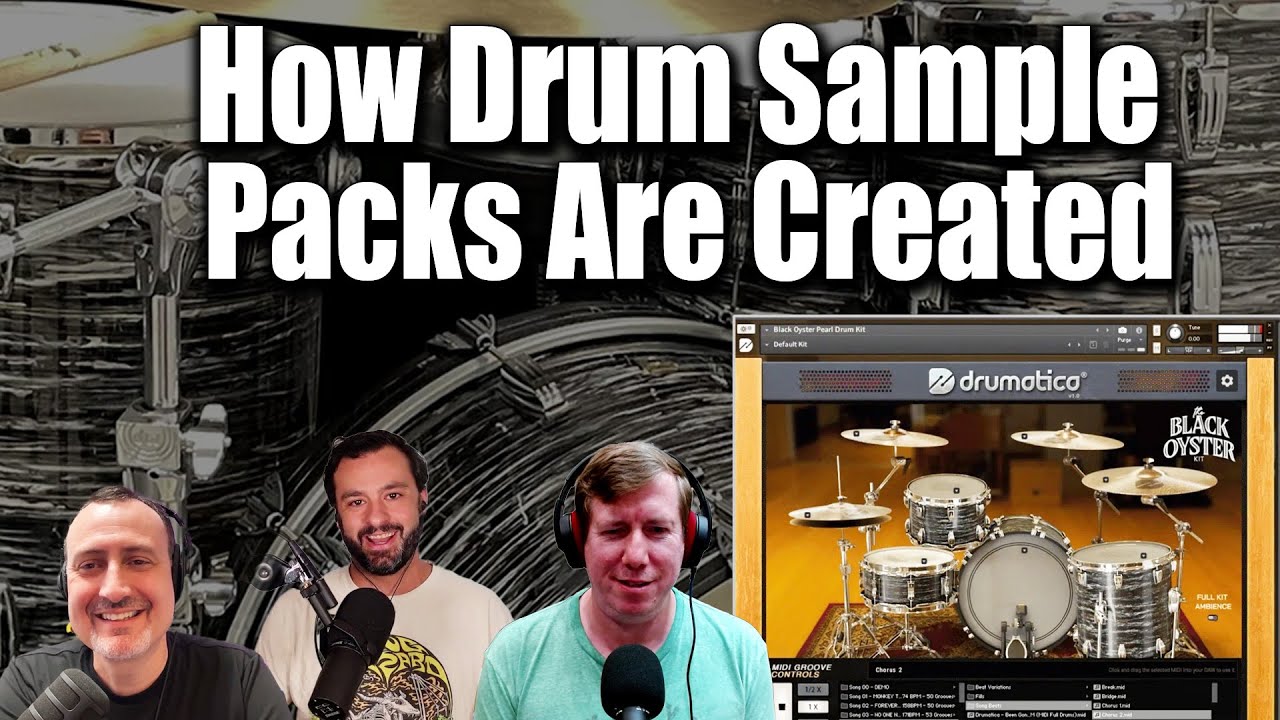
How Drum Sample Packs Are Created with Shawn Fields and Darrell Thorp
Watch on YouTubeVideo summary
Shawn Fields and Darrell Thorp delve into the intricate creation process behind their "Black Oyster Kit," a sample pack designed to emulate Ringo Starr's legendary L7g kit while adapting it for modern rock production. The project originated from Shawn's frustration in the mid-1990s with accessing high-quality live drum recordings, leading him to establish Dramatica and eventually transition into business after his tenure at Sweetwater. Recording took place using world-class facilities on their campus, where Darrell provided remote guidance via FaceTime regarding microphone placement for specific models like the AKG 4038, while Shawn managed the actual recording sessions with sales engineers who played extended sets to capture consistent tones despite physical fatigue.
The production philosophy prioritizes capturing tight, punchy sounds with natural tonality upfront rather than relying on heavy mixing adjustments later, ensuring a solid foundation for adding bass and guitars. This approach involves critical listening using reference tracks to identify issues like flabby kicks or choked snares before overdubbing, emphasizing that proper mic placement is more important than expensive gear. The final product offers versatility through various processing styles, ranging from natural sounds to compressed "rock" versions utilizing parallel compression, all delivered as individual stems and stereo mixes alongside a playable virtual instrument interface designed for ease of use.
Logistics surrounding the release ensure that samples are royalty-free for commercial projects by artists without requiring further payments back to Dramatica, though reselling derivative works or loops is prohibited. The duo also addresses the evolving role of artificial intelligence in music creation, acknowledging its prevalence in electronic genres while cautioning against over-reliance on automated tools that might lead to "fake" bands or unpaid labor issues. They view AI as a powerful efficiency tool similar to past innovations like multi-tracking, arguing it should aid creativity without replacing the essential human element entirely.
The discussion concludes with practical advice for producers and promotional details for those interested in their work. Shawn directs listeners to Dramatica's website and social media channels for products, while Darrell shares his personal site and Instagram handle, highlighting recent projects such as *Trolls World Tour* and a Minions short film. They encourage embracing new technologies that enhance the creative workflow rather than fearing them, noting that maintaining focus during long, labor-intensive sessions is crucial to overcoming common mistakes made by engineers or musicians alike.
Read the full video transcript
[Music]
Hello and welcome to the Drum History
podcast. I am your host Bart Vandery and
today we are very honored to be joined
by two incredible guys. We have Sean
Fields and Daryl Thorp. Guys, welcome to
the podcast.
>> Thanks, Mark. Good to be here.
>> Yeah. So, let me let me give a little
quick intro here and then you we could
talk for an hour about your guys'
backgrounds, but um correct me if I'm
wrong on anything. So Sean, um, you've
got a long background in marketing, but
for what's most applicable here, former
VP of marketing for a bit at Sweetwater,
which is super cool. Love Sweetwater.
Um, you've done some amazing stuff.
Looking at your your, you know, your
background,
>> a lot of early in the early 90s, 2000s
creating digital like like the when back
when bands had amazing websites, you won
a VMA for the best uh what was it? The
best band website or something like
that.
>> Yeah. nominated for this?
>> I did. We haven't talked about that.
>> We We haven't. Well, yeah. I'm not that
interesting compared to your bio, but
dude, come on.
>> Well, the the cool footnote to that is I
mean, it was only offered for the best
artist website one year. That was at the
the September 99 VMAs. So, didn't didn't
get the award, but we were nominated. I
think we were in uh for for the Smashing
Pumpkins website. And I think we were
in, you know, pretty good company. I
can't remember. Oh, actually, I do
remember. So I think the Chili Peppers
won that year.
>> Oh, cool.
>> Yeah. So the Chili Peppers website and
then I think Marilyn Manson was in the
mix which at that time haven't looked at
it recently was pretty damn cutting
edge.
>> Yeah.
>> Yeah. Yeah. And then you know I think
David Bowie was in the mix and you'll
have to look it up but uh definitely
some really heavyweights. Some big heavy
websites were like an experience and you
would go and it would be all kinds of
cool stuff. So anyway Sean, pleasure to
have you here. Darl, you you're a hard
man to follow. So, I did you last here
because you are 10 time Grammy winner.
Um, Beck, Radio Head, Foo Fighters, if
as an engineer,
>> but looking at your discoraphy, there's
so many more. Um, I loved your recent
Black Album video that you did uh with
Gunner Olsen, which was
>> Oh, thank you.
>> I'm I become friends with Gunner through
the show.
>> Um, which is amazing. um Navy veteran RC
helicopter enthusiast which little
footnote there which I love.
>> Hobbies.com people sorry
>> there you go a little plug. So anyway
all that being said we are here today to
talk about Dramatica which is an amazing
um drum sample experience library drum
pack um that Sean you are the founder of
and and I actually played drums in a
video with Jason Nicks for your website
a couple years ago. Um, but so first
off, explain what Dramatica is so people
don't know and maybe even the concept of
what drum samples and drum packs are
really because maybe people don't know.
>> Yeah. So maybe I can kind of frame that
uh around my sick obsession going back a
long time ago and just always feeling
like uh either I didn't have access to
great drummers or the great drummer I
did have access to was never available
cuz he literally played in like five
bands. So it was really difficult to get
them to, you know, to come rehearse and
and, you know, create new stuff with me.
So this idea for a dramatica or
automatic drums or automatic drummer
really started, you know, I don't want
to date myself, but probably in the mid
'9s, mid to late 90s. And so I started
capturing with that very same drummer I
just mentioned, but with other really
great drummers in my area, just kind of
sampling their kits, sampling, you know,
loops of them playing. And really just
started out, again, as I, you know, said
earlier, just as a way to uh to have as
loops and just sort of in my back pocket
as I was writing material for records
and stuff and a previous life. Um, and
then that sort of began the obsession of
just and I'm not a drummer. I'm a
guitarist and and singer, but that
really started the obsession of of
really just hyper sampling and and
that's just really recording every
nuance, every resonating piece in a drum
kit, every articulation that the drummer
plays. Um, and just going really head
first into that whole process. I mean,
it was a it continues to be a sick
obsession because it's like I'm I'm
chasing this elusive white buffalo. Um,
you know, the the best sounding kid or
the best drummer and there's always
great drummers and great drum kits to
explore out there. So, um, you know, I I
guess it started there and then over the
years again perfecting sort of my own
techniques and listening and buying all
of these other great libraries that
popped up in the early 2000s and just
comparing what I was doing really as a
benchmark to say, "Hey, these guys are
the gold standard or that loop pack or
that drum sample pack." And again, just
to continue on that path of, you know,
in my spare time, just, you know,
finding really cool studios, great
drummers, amazing, you know, vintage or
even modern kits and recording them.
>> So, about 3 years ago, so you'd
mentioned Sweetwater in my background.
Um, I left Sweetwater. I was there
almost what, two and a half, three
years. And that's when I, you know, I I
kind of synced up with Daryl along the
way. And I just thought, you know, I'm
going to turn this into, if I can, a
full-time obsession, a full-time
business where working with amazing
people like Daryl um and some other
folks that we're working with that we
can talk about later, but um and really
just kind of bringing some of the ideas
that I've had over the years um bringing
them to life and having again amazing
people like Daryl mix them, record them.
Um, which, you know, I look back and I
don't want to get too far off path here,
but I look back when I was, you know,
just starting out in bands, you know,
uh, even before I started sampling. I
think what I my mission and our mission
in Dramatica is to bring, you know, um,
these amazing mix ready drum samples,
instruments, so we're making virtual
instruments as well. bring them to, you
know, the 15-year-old that I was, you
know, alone in my bedroom and just
wishing that I had access to these
amazing sounds and listening to the
records that influenced me and thinking
one day, you know, I'll have a drummer
that sounds like that or I can go into a
studio um that sounds like that. So,
that's really at the core of what we do.
It's to bring these kinds of tools,
these virtual instruments and sample
packs to every 15-year-old out there
wishing and dreaming that one day
they'll get to that next level.
>> Well, I mean, perfectly that's very well
said. But I mean, you you and you
mentioned 15year-olds, like let's be
honest, as you know, engineers here,
like recording drums is difficult. It's
hard to mix. It's hard to mic
everything. it is quite possibly the
most difficult thing to actually capture
and sound good. So if you're starting at
a point uh of having a great recording
of a drummer, your song is, you know,
50% there, then the rest of it is is is
put laying it on on top of that with um
great instruments, which comes over to
Daryl. So Daryl, your background is like
I mean amazing albums, Taylor Hawkins,
great drummers.
>> Thank you. in the room. Yeah. Recording
them for albums. Yes. Did you have any
background in recording sample packs
before linking up with Sean?
>> Uh I've had one or two experiences where
uh I'm so sorry. I can't remember the uh
the pack that I did, but it it was
interesting because that pack was more
of a uh they were looking for loops more
than they were like oneot hit type
scenario. So, this was a little bit of a
this was a different approach for me.
>> Sure. Sure. And of course, I've always
made my own sample library that I've had
in my back pocket and not for
uh programming purposes, but more for
just mix enhancement situations and
>> sweetening kind of sweetening kind of
things. And then once in a blue moon,
you know, the the the client of mine is
is straight up, dude, that's the like
the kick drum is just that's all I had.
D feel free to replace it with something
cooler, you know? Okay. Y So
>> that's where my background is from
really.
>> Okay. I mean I um I didn't most people
on the show who know this know that I
worked as an audio engineer at a studio
here in Cincinnati for years. I did some
music. I did a lot more like movie, TV,
radio, commercial stuff, voices. But
when I worked on music, it would be like
and I'm I'm the drummer playing on stuff
a lot like a a jingle. I'd be like,
>> "Enhance that bass drum,
>> right?
>> Put a different snare drum in on the
chorus." Sure,
>> go for it. I think it became more
normalized and why not if there it's
like these perfect
>> recordings. Uh then why not beef it up a
little bit,
>> right?
>> Yeah, you can there. So, honestly, man,
there's two schools of thought. Uh there
are some clienteleels who are or some
clients that are purists
>> and they don't necessarily they they
don't mind spending the time because
that's really what it boils down to. It
is
>> it can be yeah like for example the Foo
Fighters first record that I did which
was Concrete and Gold. I I mean I
remember spending maybe a dayish on each
drum part and it was a combination of is
the snare right? Is the snare the wrong
pitch? Is the snare the right
instrument? Is the kick drum right? Is
it the right instrument? Is it the right
pitch? Is it the room situation? Does it
need to be roomier? It was like a
combination of all these things of the
drum, uh, the tuning of the drum, the
mic placement, where the drum was, and
that was a day and sometimes longer of
decision making. And then it was like,
okay, we have the sound, and now we're
going to actually start going for
>> for takes. That's a timeconsuming
process, which
>> some people don't want to spend time
like that. I completely It's like, no,
dude, I got the song in my head. I want
to record. I want to record. You know,
okay, I get that. Or it's uh they maybe
sometimes it can be a little bit of they
don't have the experience to know why
the kick drum sounds different when you
just do a quarter turn on all the the
lugs.
>> Yeah. Uh
>> was Taylor Hawkins picky about his drum
sounds or was he trusting you?
>> He It's funny, man. He wasn't. We we he
we tell him like, uh,
"Hey, Hawk, that snare is is not right
for this groove." Okay. And he'd go to
the lounge.
>> Yeah.
>> And chill.
>> Yeah. That's interesting.
>> Walk around the studio and talk to
everybody is what he'd really do.
>> Yeah. There's an episode that came out
right before this, the gear of Steve
Gad, which thank you to everyone for
watching. It's been it's been really
cool to see that. But but Paul Wells,
who is on that episode, talked about how
Steve would be like, I totally trust the
engineer. And he's one of the biggest
he's one of the biggest session
drummers, you know, performing session
live drummers in the world. He was like,
no, I trust the engineer. So that's got
to be, you know, nice to have Dr.
>> You know, it's usually I always I know
what I hear and I like, but at the same
token, I'm always referencing with what
the producer because ultimately it's the
it's the producer and the artist that
have usually had the conversation maybe
in the control room or at breakfast that
morning about what do we want this song
to be? And so sometimes the producer
will articulate to, hey, Darl, this is a
big live drum sound. Okay, but it's it's
can be as vague as that. So, is it a big
live drum sound with a piccolo snare or
a bell brass that's cranked to hell? So,
it's just like, you know,
>> Yeah.
>> cutting like a laser beam.
>> Are you a drummer, Darl, or are you just
a guy who knows? You're just an
allaround.
>> So, dude, honestly, the biggest I'll
I'll I'll throw him the biggest prop I
can. Um, my very good friend Joey Warer.
Joey
T started producing
artist bands
early 2000s.
He was trying to go he was trying to see
if and quite frankly he was very good at
it. But some of the projects he would
play drums on but then some of the
projects we did together they were
bands. So he was the producer
and watching him,
oh, I know what's wrong, and walk out
there, grab a tea towel, grab a
different snare, grab a key, drum key,
and do a little crank, crank crank, and
put it down there, and the drum would
sound drastically different.
>> Yeah.
>> I It was just like I was getting paid to
watch this and absorb all this in real
time.
>> Amazing. Yeah. And it's t I learned a
lot. And then I've learned a lot from
other drum techs
uh about tuning. I've learned a lot just
from drummers
watching them play, how they play, how
they hit, what tuning you can get away
with, uh what tuning you can't get away
with with to particular styles.
>> Sure. Because it's to me it's
I want the artist to be comfortable
first
and then I'll get what I can get
secondary.
>> Yeah. because you're gonna get the best
quality from a good
>> thinking about getting that mic which I
mean I usually do a mono overhead and I
try to go like Joey for example and then
my uh like my friend Victor and Drizzo
and uh Blair Cynth I can put a mic like
right here and it doesn't bother them.
>> Y
>> uh but like Taylor, he was
>> he's he was all over the place.
>> So he was like, "Dude, I don't want to
hit it." And I was like, "I don't want
you thinking about not hitting it. I
want you in the moment.
>> Yeah. Interesting. Well, your attention
to detention to detail, but it's also a
luxury working on such big albums to
have that kind.
>> I'm sure you know that. Yeah. Which is
great.
>> Lucky lucky lucky mofo here.
>> Yeah. But throwing it back over to Sean.
Obviously, the thing the the thing I
want to talk about with you guys to kind
of, you know, uh everything we're we've
mentioned so far, all this these skills
got put into your new project, the Black
Oyster Kit. So,
>> which is interesting, too, cuz this
whole thing I'm going to put it in the
frame of like drummers may not be the
audience who are going to go out and buy
the pack because they're drummers,
right?
>> So, I love going at this from an angle
of like
>> how would how is this made? How did drum
packs get created? How are they
recorded? What is it? What's the idea?
So, for starters, just tell us about it.
I think Black Oyster Kit, we all have
one drummer who comes to mind, Ringo
Star, but it's that 60s sound. So, tell
us about the Black Oyster Kit.
>> So, the Black Oyster Kit, um, maybe just
going back a bit, the the idea that kind
of sparked this was I mean, actually, if
you're not familiar with Sweetwater,
which is again where I worked for a
couple of years, it has an amazing
campus. So, it's a music retailer. If
you're not familiar, you should be
because they have amazing, you know, an
amazing selection, amazing service, and
um at their core, they're just, you
know, they started out small and grew to
this huge I think they're number one, I
think they're the biggest North American
online music retailer. So, they're huge
and they treat every c, you know, it's
not a plug for Sweetwater, but they do
treat every customer, you know, very
special and they take care of you. Um,
so anyway, while I was working there,
um, the campus is like a destination.
It's like a Disney World for musicians.
And Darl, I think you've been there
before, haven't you?
>> Uh, yes. I've been to Sweetwater several
times. It's It's an amazing campus.
>> It's a great campus. And so, all of that
said, there is uh a really cool studio,
worldass studio there. So, I would
literally while I was there just spend
my evenings instead of getting into
trouble, which I would admit probably
the first year I was there, I was
probably getting into trouble and doing
stupid stuff. Um, but I'm joking. Um, I
just kind of realized, you know, my
second year there, I'm like, you know
what? I've got access to an amazing
studio and great people that work there
and great equipment, vintage and modern
equipment. So, why don't I just, you
know, again, continue to pursue this
obsession and see what we can do with
it. So, um, there was a modern Lwig uh,
Black Oyster kit available to me one
particular evening. And, uh, so I just,
you know, I brought it into the studio
and brought a a whole slew of
complimentary add-on pieces, which is
what we offer in the um, the commercial
piece, the instrument, and the sample
pack. and we just recorded it, like I
said, with using, you know, the process
that I I typically utilize. And so Daryl
wasn't there for the recording of that.
But what was interesting, I'll go back
to what he was saying earlier about the
setup and and all that. I literally had
Daryl on a couple of uh FaceTime calls
where I'm showing him the drummer and
the kit. And Daryl is actually placing
microphones and saying, you know, here's
the poke mic. you should put it here and
you should
>> we had a Kohl's 4038 and he was like
yeah we'll put it here and just adjust
it you know and so totally tapped into
his expertise you know what four five
600 miles away maybe even that where we
were but so that's where the idea
started so we had um you know this
amazing kit with you know such uh you
know a rich history as you mentioned I
think most people do identify that kit
with uh with Ringo the star. It was a
smaller kit back then, so the modern
versions are a little a little bigger.
And so, you know, kind of to wrap it all
up, uh I wanted to kind of hear this kit
through like sort of modern ears and
what a modern audience, um guitar
players, singer, songwriters, even some
drummers too would want to hear this
kit. So, that doesn't mean you can't
play, you know, a traditional 60s
Beatles kind of backbeat on it. In fact,
you can. But there was a lot of emphasis
and I know and Daryl can speak to his
mixing approach to it as well when he
and I started talking about it. Really
wanted this to be a rocking drum kit.
And not only for myself, I wanted to use
it and enjoy it. But you know lastly I
think there is an amazing amount of
tools in the market for those
15year-olds or 25 year olds or 30
whatever for musicians these days to
choose from. There are a lot of heavy
metal drum libraries as you probably
have seen and you know there's just a
lot of choices. What I wanted to do is
kind of cut through that and say, "Hey,
if you just want an honest rock and roll
drum kit that really sounds amazing."
>> Yeah,
>> this is the kit. This week's episode is
brought to you by Claw. How many times
have you looked down midset and realized
your bass drum slid forward 6 in? It's
frustrating, right? That's why there's
Claw, the small but mighty kick drum
anchor that keeps your bass drum exactly
where it should be. Here's how it works.
Claw's backward-facing spikes dig into
your drum rug every time you kick,
locking your drum solidly into place. No
Velcro, no special rug, no hassle. It's
tiny, about the size of a deck of cards,
so it fits right in your gig bag or
stick bag. Setup takes just seconds. You
just slip it right in front of your bass
drum, then grip it and rip it. It's made
from durable, shockproof ABS plastic.
Claw can take a beating without budging,
no matter how hard or fast you play. And
thanks to its premium TPU top layer,
it'll never leave a mark on your drum.
Claw is simple, tough, and totally
invisible once it's set up, but you'll
know it's there every time you kick your
drum, and it stays perfectly locked in.
Head to claw.com. That's klaw.com,
where you can purchase it for only $29
on Amazon. And if you use promo code KL
AW15
off, that's claw 15 off, you get an
additional 15% off when you're checking
out on Amazon. Get the claw and never
chase your bass drum again. I look at it
too and I know your marketing background
and I now, you know, for the last couple
years have pivoted from production to
working in marketing.
>> Yeah. selling a kit like a a pack that
is the Black Oyster kit that is
connected with one of the most iconic
drummers drum sets eras in rock and roll
history.
It that's smart and as opposed to you
know Lwig rock and roll drum kit. It's
like, no, it's the finish is just
absolutely iconic of these drums and it
it gets you
>> it it's there's good pictures. There's
it's it's well produced everything about
it. So, from a Well, that's your
background, though, is creating like
user interfaces and experiences.
>> So, I think you've you've really brought
everything uh into one project.
>> Well, I appreciate that. I I do want
Darl to talk about sort of his his
process and and um and mixing this.
Well, I'll just say just lastly, again,
I keep saying that, but when you
mentioned guey in that experience,
so we have two experiences that users
can, you know, can check out. There's
the virtual instrument, which is a
totally playable kit. So, you can play
that on ekit, you can play it on drum
pads, you can play it on your keyboard
keys, however you want to play it. Um,
and then there's the, um, the special
edition sample pack, which doesn't have
as many of the, you know, add-on pieces
and such, but for all intents and
purposes, it's that kit. It's the same
set of samples that Daryl mixed, right?
So, you have the individual microphones
that you can adjust. You hear the sound
of Sweetwater Studio A, you hear that
room and it's great. Um, but the guey
itself in in the uh virtual instrument
was designed very intentionally to be
easy to use. So a guy like Daryl gets
around these huge multi-channel consoles
every day and he knows them inside and
out
>> for most users, you know, and at least
with some of the research that we did
sort of formally and informally at
Sweetwater, I know that users want
particularly a certain type of user,
they want something easy. I think most
people just want easy, right? I don't
want to have to work for something. I
just want to create.
>> So, you'll see in our in our interface
and Bart, I'll send you if you haven't
seen it or I'll send you some
screenshots of
>> Yeah, I'm looking it on on the website
dramatica.com and then products. You'll
see it. There's a Steve Albini one which
another conversation for another day.
But that's then if you scroll down a
little bit, you'll see it. Uh,
beautiful. Yeah,
>> thank you. Yeah, we just made it easy as
possible and that was that was the key.
So instead of multiple screens just to
get to, you know, that channel or this
channel, it's all right within the kit
piece itself. So the kick and snare
share a screen and the toms have their
own. So so on and so forth. Yeah.
>> Amazing. And then just so terminology,
gooey, cuz people might not know that
graphical user interface. Correct.
People might be like,
>> are we talking gooey? Like there's slime
on this thing or something. No, I just
figured someone out there might be like,
what the hell is guey?
>> Absolutely,
>> Darl. So, okay, let's take it. So, so
it's recorded. This Black Oyster kit is
recorded at Sweetwater Studios. You've
assisted kind of virtually, you know, a
tea, your tea engineering,
>> you get all of the files. Let's start
there. How many tracks and record I
mean, what did this look like when it
came to you and what did you do from
there?
>> Well, it wasn't a I it wasn't that many
tracks. It was kind of like just your
more of a typical rock, I guess,
recording drum setup. Kick in, kick out,
snare top. Might have been two instances
of snare drum, like snare top, excuse
me, snare bottom.
>> Yep.
>> Hat, toms, overheads, mono overhead,
stereo, and then room. And I think there
was most of the time, wasn't there was a
close room and a far room, I think,
Sean. Right. Yeah, that's right.
>> So then it was just a conversation with
Sean about, okay, I got all these mics,
but then how
how much am I
stemming down to deliver to you or am I
keeping it all separate? So, I I
developed a like a routing system where
I could mix each individual mic
as I would a a multi-track
song,
but also be able to stem these downs
into just kick in and snare top where
the all the mics would be summed
>> and or have the option of when Sean
would call and go, "Hey, I need this
separated." Okay. So, that I can rerun
it. that kind of thing.
>> And then the processing would be done on
kick in, kick out and not and you'd have
it. I feel like working smart and not
working smarter not harder is
>> it was a little bit. I mean, it's almost
like I was trying to think about it as
as uh cuz I've done many projects before
where this is for
like the Foo Fighters. I get calls once
or twice a year where they're doing some
sort of production thing and the the
people are demanding that I deliver a
stereo mix and stems because they're
either going to split it out into a a 51
thing or they need stems because they
need to do edits for picture or or just
in that aspect. So, uh, I'm pretty
familiar with my workflow of thinking,
okay, that I should just treat this as a
>> yeah,
>> more like a a I'm mixing for film in a
weird way because I want to give Sean
like, oh, I just want to edit the kick.
Okay, he's got both kick and in and out
available. That's process. That's my
processing.
>> Yeah.
>> And then at the same token, he had a
stereo of everything. That was my
processing.
>> Got it. interesting.
>> So we could pick and choose depending on
what cuz because there was a lot of
conversations going back and forth my
first I think me being the first of all
full disclosure I am not a programmer by
any means of that and nor am I a
songwriter
>> it's a different
>> it's a different brain it's a different
mindset I have a bunch of friends that
are programmers and or songwriters types
uh they either make their living as
producer songwriter uh types and I know
uh you know a few of them off the top of
my head they have just gigs and gigs and
gigs of stuff they they pull from
>> Yeah. which oh god just just
>> tools tools in their tool belt
>> tools in their toolbox that
>> um and so the more conversations I had
with Sean about because I was just
thinking about this as a very
one-dimensional like oh you're just
doing sample hits you know and he was
like no I'm trying to program a whole
thing for as a a drum package for
songwriting
>> yeah and you want but like production
>> looking at the um like the interface the
guey if if you will. Um, on the website
here, you also want to give the, you
know, the programmer, the musician, the
person in the doll
>> chair,
>> in the chair a lot of control.
>> Yes. Which Sean, I talked about that a
lot with Sean, mind you, I was just
throwing ideas at him, not as a not as a
programmer, not as a songwriter. I was
throwing ideas at him. I was like,
"Well, when I'm mixing multi-track
drums, I need this,
>> right?
>> I want that." And he was like, "Oh, good
idea. We can do that."
>> Yeah.
>> And then he would share with me
iterations of the
>> the the process of how it was coming
along. And um uh it it was it was kind
of crazy to see it all in one big fancy
freaking Christmas package at the end of
the day. Quite frankly, like seen the
light of it.
>> Yeah. I mean, you know, it's like, "Oh
I didn't realize this is what
you're doing." Okay, sorry, dude. No
wonder you don't answer my email for two
days.
>> Well, see, that's the thing. If I can
jump in like these,
>> and I know Darl and by the way, you
know, I mentioned earlier that working
with some amazing um other amazing
amazing producers and engineers. And
Brendan Dora is another engineer that's
a friend of Daryl's, has amazing
pedigree. Uh you can look up his bio. He
is definitely a talented guy. and we
have some new projects coming up before
the end of the year as well. So, I want
to give a plug and a shout out to
Brendan as well. But, um, but that's the
thing both with Brendan and Daryl kind
of reached out to them around the same
time. I think I reached out a little
earlier to to Darl before Brendan, but
regardless, I think that was my original
intent and I think these guys, thank God
they've been patient with me because the
original intent was just a a sample pack
and right and I I wanted to go as I
heard these mixes from both guys
actually in different projects. I'm
like, "This thing deserves to be a
playable instrument." And when Daryl was
sending back these ideas, I just want to
again call out like we're talking about
parallel compression and doing all of
these other little things that again are
coming directly from Darl or from
Brendan.
>> And then these premixed, as he
mentioned, the stereo renders, these are
presets. I don't know how else to call
them, right? not only in the snapshots
or presets that you can get um within
the kit itself, but the sample pack has
these pre-balanced, premixed stereo
versions of how Daryl and Brendan as
well and his own kit how they would hear
a mix. So, they're putting all of the
room mics and all of the direct mics
together as they would hear it. And we
have both a natural and a rock version.
So again, you can expect a rock version
to sound a little louder. It has more
compression or whatever all those mix
ingredients are that Daryl sprink
sprinkles in. But I just wanted to call
that out because Daryl Daryl went that
extra, right, to use and you're going to
hear that and again in both the sample
pack and the kit. So there are these
other little mix ingredients that are
really cool and unique.
>> Yeah, absolutely. Um, this is like on
topic but off topic, but I just have to
ask. So Darl,
I think it applies to this too. If you
had to think of maybe top two, three,
four things that you would recommend to
drummers who are mixing their who who
are a lot of people now are
drummers/engineers
doing everything.
>> It's just like an allin-one thing.
>> It's all in one. Let's say a couple your
top three things that people can do
today to make their drums sound better
in the studio. And that could be mic
level, performance level, that could be
mix level. Just like what is the basic
stuff that you're like, "Stop doing
this. Start doing that and you'll sound
10% better right away."
>> Tuning.
>> Take some extra time in tune.
>> Uh it's called a drum bot.
>> Yep. Yep. Yep. And drum dial, which is
the old more like the kind of the the um
analog version. But yeah, you think you
think that really
>> Well, so okay.
such a vague statement but uh first of
all
>> it's a vague question
>> not yes and no okay there because there
is the the the device the drum bot which
is very inexpensive for what it is and
you they give you an app to sort of
figure out what you're looking for with
uh the sound of your the sound you want
your drums to be
which it works really well. The problem
is with experience unfortunately and
over time
I've realized that some instruments
don't want to be
like
hey I'm not going to say it's not
impossible but it's pretty hard to make
a jazz kit sound like a Gretch
powerstroke kit.
>> Yeah. But it's important for the kit to
be in tune with itself.
>> With itself.
>> Yes.
>> Yeah.
>> So if all you have is a jazz kit and
you're trying to get a big rock drum
sound, then maybe it's it's a couple of
tweaks with a tunebot to get the kit to
be as best as you possibly can. Then it
comes down to placement,
mic placement with the drums.
Um, and some of that I think is
technique and some of that is taste.
>> Mhm.
>> So, it's really hard to say there. uh
you know I've I not just myself but
there's so many tutorials out there that
are some are free some are paid for with
uh engineers
uh who are at the top of their game that
have drum micing
tutorials uh
>> through
>> uh mix like a pro or produce like a or
sorry uh pure mix uh mix with a masters
produce like a pro excuse me I biffed
all that up Sorry guys.
You know, it's some of the stuff is free
on YouTube and some of the stuff is is
uh paid for. So, it just depends on what
your your budget situation is. I think
that's a big key of of
then third I think if you are really
trying to work at something you if you
do those first two things first then
play a beat down through the whole song
or a couple of sections of the song like
the verse and the chorus whatever you
want it to be then come back into your
control room and your listening
environment and listen to it. How does
it sound? Does it sound dark? Is there
too much symbols? Is the kick flabby?
Does it need to be tightened? Is the
kick too punchy? Does it need more
extended low end? Does it need Does the
snare need more crack? Is the snare
choked? Are the toms ringing out too
much when you play just a simple beat?
Is it literally
>> Yeah. Yeah.
>> Which is an internal sign that the toms
are not tuned correctly most likely. it.
Now, once again, that's a taste thing
because
like huge rock
drum, like I'm talking like metal, it's
usually there's more of an open tuning
on the tom. So, they ring
[Music]
>> and it's a part of it.
>> Yes, that's part of the tone.
>> Uh, but however, I've seen situations
where that is a acceptable
overtone in the the entire mix of the
kit.
uh put your headphones on, listen to it,
just make a stereo bounce of that in the
car and see how it hits you. And then if
something's bothering you about it,
whether it be one of those scenarios,
then do a little research or maybe or
just start or uh take a snapshot of
where you at in some way, shape, or
form. That's the cool thing about a
Tunebot is you can find a a pitch of a
snare drum that you like, "Oh my god,
this snare sounds so good right now."
You can take a snapshot of where it's
sitting in tune.
>> Yeah.
>> And if Oh, I broke a head. Okay. You put
a new head on and you crank it back up
and you tune it to the same exact pit
and you crack it again. It's like
>> cuz once again, some instruments don't
want to live in certain tunings. They
just it's it's like taking a guitar and
dropping it down to
>> C. It's just it the intonation goes out
of whack. It's the same variable.
>> I think in general that's those are
three amazing points. I think in general
too being in a studio having a reference
either be it a drum set that you like a
snare that you like a full track that
you like having reference tracks that
you can AB
>> is enormously important and I didn't
know that for years until I started
pulling in tracks and realizing I am
nowhere near this and then you could
>> mold it to be closer cuz if you're going
for something then go for it.
>> I'm all about if you're going for
something go for it. if you don't quite
know and you you're not quite
comfortable about making that decision
right then and there or sort of
committing to yourself um you know about
the the choice of what type of drums are
we going for in this song starting
process then you know then okay then
make the drums as good as you can
without really
>> cornering yourself into a corner but at
the same token I've also worked in
schools of thought where I I remember
specifically Ally one day on the Foo
Fighters. It was it was uh medicine at
midnight. We spent the same thing a day
on the drums and started cutting drums
and did all the takes and da da da and I
comped it and we did it to tape and
dumped it in and blah blah blah and I
was all this work and suffering and then
somebody goes I think I think Dave said
I think the pattern's wrong
>> and and I was in my mind I was kind of
like oh crap
>> but
>> that's the foundation. So you have to
redo it because you're building on it.
>> Taylor was like, "I'll replay it."
>> Yeah.
>> Like nobody was like, "Oh my god, we
have to replay." It was just like, "I'll
replay it."
>> Yeah.
>> But see, if you you know, if you're I
mean, it's excellent points. If you're
making a sample pack, correct?
>> And you want to do your own sample pack,
you'll know that. So you were talking
about the reference hits. Darl will tell
you in our sessions, we always start out
with those. What's a great center snare
hit, right? Center of tom. And we start
there because, you know, you've got a
drummer that's going to be sitting
behind the kit for hours, you know,
hours just on the snare drum.
>> So, and they're just constantly and the
harder they hit. And again, if it's a a
harder hitting sample pack where you
want it more rock or metal,
>> you can expect that that snare drum to
go out of tune multiple times through
through the three hours that you're
doing that. So,
>> didn't think of that. The logistics of
>> All right. Now, I do have to ask about
logistics stuff on that note with like
>> um
>> well, first the I've always wondered
this. So, Sean, how does this work with
sample packs
loops and beats legality and licensing
and all that? I mean, how does that how
does that work? If this is if this ends
up on a Taylor Swift song with the, you
know, album that just came out, how does
that work?
>> Well, we get to say, "Hey guys, we did
that, right? That's it. That's about
it." because, you know, we want to make
these sounds royalty-free. So, now
obviously other commercial providers
can't use those sounds to to benefit off
of, you know, those sounds and then, you
know, recreate or make derivative works.
That's kind of the legal ease stuff. But
artists are free to use those sounds.
Again, that's why we make these things.
That's why other companies make these
sample packs and loop packs. It's to to
foster that creation and and spark that
creation. So, it's royalty-free. So, if
you've got a chart, you know, a
best-selling song as a result of Daryl's
stuff on the Black Oyster, then let us
know cuz obviously we're proud of that.
But otherwise, we're not getting a
royalty.
>> Please let us know. Please.
>> Yeah. But I wonder there's got to be
something to it of like if it's a little
bit recognizable beat as opposed to like
a two four, you know, money beat where
like then the first one to use it and
blow up using that that sample then it's
like
>> it becomes known as that
>> if that makes sense like when the levy
breaks kind of it's like
>> well that's the loop part of it and I
wouldn't claim um obviously to be an
attorney and know that sort of copyright
law. I know it from a 20,000 foot up and
I know that you have a little bit more
freedom in doing that. Obviously, you
can't create a loop and say this is the
that loop because then you get into song
title copyrights and stuff like that,
but the beats themselves as I understand
it
>> in the US about that. Yeah. So, um yeah,
it's
it is an interesting uh topic to to talk
about and think about the whatifs. What
if that particular I mean I think we've
all done that at least people who have
used loops. I I started back in the day,
if you guys remember, there was a
company called Sonic Foundry that did
acid loops. And I think they created
that whole format of wave files that
were stretchable and you could kind of,
you know, stretch to a tempo without
much degradation. And this is like in
the late 90s. They were pretty kind of
cutting edge for the time. And anyway, I
remember, you know, me and all of my
friends couldn't wait to get our our
hands on their latest sample pack. And
they had some really really good ones.
And it was funny because within about
two or three years after they came out,
they had multiple libraries, I could
just listen to, you know, other people's
music, you know, at least on the local
level, and I would hear these same
blues, right? Because, you know, if
they're good, people want to use them. I
guess that's the point. I think it's, as
an artist, I don't want to get too far
off topic, but as an artist, I think
it's up to the artist. That's the
artist's challenge is to take that that
we know is going to be used by others
and make it our own. So, it's the um you
know the all the extra things we can do
to that beat to make it unique.
>> Yeah. Yeah.
>> Well, uh I mean I think the the BeeGees
did it three times. Same drum loop and
same drum loop.
>> Yeah, that's right. I I remember
watching that documentary and kind of
hear wasn't it Staying Alive?
>> Staying Alive was the same loop as uh
shoot
>> Night Fever.
>> Night Fever. It's just a different
tempo.
>> That's right.
>> Cuz they didn't want to like let have
their long time drummer
>> had to leave. he had some sort of uh
family emergency or family thing going
on that was well known. So they had him
just play
>> a couple of random grooves because they
haven't gotten to the song yet.
>> Um and then then Okay, so rabbit hole to
even the crazier story is is Toto was in
Florida working next door and you've got
Jeff freaking Picaro. Why does Jeff
Picaro need to do a drum loop? He
doesn't. But they were hearing what was
coming out of Deiji's room with the drum
loop thing and the just the way it made
a song feel. So Africa is a drum loop.
>> Wow.
>> Wow. I didn't know that.
>> There is a bit of a robotic
>> but the loop itself is a loop but then
overdubbed the
you know that's where it makes it go oh
my god it's maybe this isn't a loop.
Maybe it's just Picaro is Picaro. sign
of the times though where they're like
well this is popular now so Jeff Bricaro
you're doing a drum loop even though
you're literally
>> idea
>> yeah ex like
>> which is band going
>> why
>> I don't know
>> why do you know who you are
>> yeah do you know who you are
>> um how does this all work like are we
allowed to know who the drummer was
playing on the kit for the recording or
is that like a we don't talk about it
kind of thing
>> we used um a couple couple of different
session players and the session players
were sales engineers actually or sales
reps at Sweetwater. So those were the
guys that were in the trenches and they
were the ones that you know Daryl thinks
that I've tortured him over the course
of three years in this I tortured the
drummers. It was the drummers who took
it. Um, and look, they were troopers,
but those were the guys that were there,
you know, usually night sessions, right?
And we would go six, seven, eight hours,
sometimes just on the on the snare.
>> Yeah. So,
>> there's a lot of wax in one.
>> There are a lot for sure.
>> Session,
>> sales engineers. I love my Ryan Clapper
is my Sweetwater sales engineer where
it's like I I know you know these guys,
>> I'm like friends with them. Yeah,
>> those those guys are all amazing
musicians. It's, you know, again, we'll
talk about Sweet Water.
>> Like a frustrated drummer trying to sell
you a Lon audio microphone,
>> right?
>> You're going to buy this, Mike.
>> I've been up all night with Sean
recording one snare hit. I'm tired.
>> Well, they can probably blame me for
those call-ins the next morning. Yeah.
>> But it was funny though at the end of
every session, and I would always I
would always record it as well, but at
the end of every 3 hours of whack, whack
whack.
>> Yeah.
>> Finally, you hear, "Okay, I think we got
And then they go
>> and yeah, they're like exploding.
>> Second win.
>> Wow. So that's what it is though is I
mean you're just Sean, you must have to
have some uh a lot of patience. Um well,
so do they they so does everyone
involved need to paint dry.
>> But you're going for like perfection.
Well, that's you know they joke the um
the session engineers the tracking
engineers would joke because I let them
I you know after a few sessions they
were like we know exactly what you need
right and so we always and again this is
kind of a a blueprint if you want to do
your own you always have to start with a
sheet right that you distribute in the
studio and obviously the drummers have
to know how many hits of this and how
many hits of that. So I have all of that
again organized. So you have to always
come into the to those kinds of sessions
if you're wanting.
>> So you were counting the hits.
>> We count the hits, you know, depending
on what articulation it might be 50 or
75 of just one velocity and there might
be five velocities or even more in a
snare. Um times more than that, but
>> I'll be out about I'll be outside
watching snow melt. Thank you.
>> It's it is it is literally like watching
paint dry but more boring. But can say
is when I was printing this stuff, I'd
be like, "Dude, I'm so glad I'm not
chopping this shit."
>> Yeah. Right.
>> Wow.
>> Well, I mean, yeah, the engineers would
joke because I would, you know, I'd be
just kind of looking down, reading,
looking at my phone or whatever, and
they were the ones on top of that, but
if there was one, I would hear
everything. If there was one weird whack
or something, I need to do that again,
or I need five more of that.
>> Right. Right. Right. That happens all
the time.
>> Yeah.
>> Yeah. I had um in my engineering days,
like I said, doing voice stuff, it was
uh not drum related, but I would record
probably recorded seven or eight audio
books, four days, 8 hour sessions.
>> I had to redo a whole chapter cuz
someone was had their arm up and their
watch was ticking in the U87 and it
picked it up. So, we redid a whole
chapter. Um, but the the the similar to
this, it sounds like the whole the
really really really really hard part
was not losing your focus after 6 hours,
right? And not falling asleep and
keeping your little marker on your pen
and um so kudos to everyone involved
because
>> yeah, and for that matter for anyone uh
whatever their role is in in recording a
loop package or a sample package or an
album like Daryl does all the time. I
mean, it's just a lot of work. Yeah.
Yeah. And I don't think we give we don't
give those guys in the studio and the
Daryls and the and the engineers and
producers enough credit because it can
be laborious. It is laborious. Uh my my
take on that though is a little bit is
uh my problem is is I work with really
good musicians and the amount of times
that I've been in the studio and I've
pressed record on a drummer uh and and
thinking of a couple of friends of mine
and they've m literally made a mistake.
I've screwed some file thing up 10 times
more than they've did a bad drum hit.
>> Yeah. It's, you know, and even then it's
it's they've they've done a full take of
a song that's four minutes long and
they're like, "Darl, I screwed up on the
second bar of the second chorus."
>> Oh, did you?
>> Yeah. Well, I forgot to hit record, so I
screwed up even more.
>> Yeah. Well, I mean, Darl, do you It's
got to be kind of a fun working on these
with Sean on your end of being in, let's
say, in the studio and in your mixing,
you know, you're mixing it. It's got to
be a bit of a nice change from gigantic
huge Radio Head, Beck, like all these
huge albums. Is it a nice change to kind
of just work on one instrument and then
be done with it?
>> Uh, yes and no. Well, honestly, yes and
no. It's a little uh uh sometimes it
gets a little monotonous and a little
tedious in that aspect because I it it's
it's funny because I think I think part
of the process of what I enjoy doing the
most and what I love to do is just the
fact that I like to work on really good
music and whether or not I think that
it's going to be commercially successful
or not, that's that equation is out of
my mind because it just doesn't matter
really.
>> Sure. It's more about the fact that I'm
I'm happy to be working on good music
and uh and so uh but at the same token
here's as as a engineer even tracking
and or mixing I'm always looking at the
sort of the big picture of a song
and the it's it's basically I look at a
song as a big big painting and So, how
many strokes of colors can I get away
with before the drums sound, you know,
like diminishing returns? Like you've
gone too far with it. That's once again,
that's taste.
>> Yep.
>> So, I'm always uh well, I get the drums
sounding good, then I put the bass in,
and then because I put the bass in, now
I got to make the kick a little bit
bigger. And now I've got the kick big a
little bit bigger. Now, the bass is
sounding small. So, I got to turn the
bass up a little bit. But now I added
like two guitars. Now I'm adding two
guitars, but then the snare is getting
smaller. So now I got to beef the snare
up. But then I beef the snare up, it's
louder, so I got to turn it down a
little bit. Then I add the vocal. It's
that it's that game of building blocks
or painting on a a landscape. So with
the sample packs, it was a little bit
more of
I sort of thought about and we talked
Sean mentioned the natural and the sort
of mixed tonality where I I thought
about more of a a simplistic approach
where I would just get really good drum
sounds. They were nice and tight and
punchy. There was no kind of frequencies
in the in the in the the makeup of the
kit itself that was bothering me. And I
would control all that versus EQ or
compression or whatever the case may be.
>> And I would just think about the fact
that well, if I started add bass and or
a couple of guitars, I'd be in a pretty
good spot. I know I'd make adjustments.
>> And so then the conversation came up
with, well, let's let's do a more of a a
mixed thing where it's like, I'm going
to make the drums as big as I possibly
can and as punchy, loud, bright, maybe
even too bright. quite frankly.
>> Sure. But they can pull the whole idea
is people can eat later or if it's hey
man that like once again the drums to me
the drums and the bass are such a
foundational
focal point of a song. If your drums and
your bass are small then your song's
going to be small. And I'm not saying
that as a bad thing because that becomes
a taste thing. Is it really is it about
you know do you want the song to be big?
Well, if you really really are striving
and you're working hard to making the
song big and your drums and bass are
small, your song's never going to feel
big. But if you're working in the aspect
of like, no, I want this like small kind
of tiny garage
>> sounding thing like everything's
supposed to be kind of then it's like,
okay, well then then go with the concept
of like making your foundation smaller.
>> Yeah.
>> And then raw
>> or raw. And then once again, if you're
you get to the end road and you're like,
h this isn't working for me, you can go
backwards and change all that.
>> Uh you know, the other thing to to to
throw it into caveat, I'm seeing people
you and dude,
>> uh there is no right or wrongs and
there's no right or wrongs in song
making. There's no right or wrongs in
artistry. That's the cool thing about
what we do. It's always about personal
taste and it's always about your
workflow and what makes you feel happy
with how your things progressing with
your your song. You're producing a song
or writing a song. But I am seeing a
trend with more and more people where uh
let's say the drummer is in the studio
with the band and the drummer might not
be the engineer but the band is sort of
self-producing themselves. I'm seeing
instances where
they are saying, "Let's grab a sample
pack like Dramatica
with the guitar player who might be the
cordal or musical songwriter of the band
and they're writing parts together and
programming all the everything."
>> Oh yeah.
>> And then once it's like that feels
freaking great, the arrangement feels
great, da da da, then the guitars come
in and start laying down.
bass,
>> maybe start singing on top of it.
>> Dude, this is feeling so good. We just
like the arrangement. We like the
length. We like the groove of the drums,
how they're like the the actual uh part
of the drums. Okay, now you get to go in
the studio and just play it.
>> Yeah. Or they say, "Screw Jerry. He's
kicked out of the band. We love
dramatica. We have demoitis and we don't
need a drummer anymore." It's a scenario
of you you mute the the program drums
and you go out and you play a real kit
because you have something sonically in
mind.
>> Yeah.
>> And you do it and you perform it and it
sounds good and it feels good, but it's
like, you know what, man? I don't know
if that's the the kick might be a little
bit too tiny for what we're trying to do
here.
>> Yeah.
>> But the kick and the dramatica thing was
actually feeling really Well, let's lay
them together. Okay. And
>> as long as the drummer is good on a
click, then Yeah.
>> There you go.
>> Yeah. Well said. Yeah.
Um, all right guys, as we get close to
wrapping up, I have, you know, one or
two more final questions. Actually, this
will go to both of you guys, but I want
to start with Sean because yours is more
drum sample pack related, and then Darl,
I want to get your take on this, uh, for
the the broad music industry,
engineering, recording, uh, world, but
do you see AI being involved in sample
packs? Um, just like plugins, all this
kind of stuff in the future, how do you
see that, you know, where is that going
from here? Absolutely. Yeah, it is. It's
it's beyond a buzzword. It's it's real
world right now because there are a few
apps out there already that are are
helping people write songs and some of
it's really convincing. I think if so my
opinion about this is that I it's still
a ways to go. We're actually
incorporating some of that in nextgen
dramatica stuff.
>> We we would be foolish if we didn't.
>> Correct. Um, sure.
>> I think the vast majority of the AI that
I've seen for music creation, it doesn't
mean all, is primarily kind of leaning
into more electronic music. So, you've
got the 808 kicks and the 909 snares.
And that's fairly, and I say this air
quotes, fairly easy to kind of generate.
I think what the challenge is on the
acoustic drum side is can you generate
an AI acoustic kit that's convincing?
And again, there have been some strides
in that direction from some companies.
>> Um, I think it's going to get there.
It's not going away. And I actually
think it's a fantastic, you know,
development over the past few years in
music creation. And I'm, as a musician
myself or a wannabe musician, I'm really
looking forward to seeing what that
nextgen looks like. Yeah.
>> Yeah. It's uh interesting because
there's a fine line of like like a band
putting out a poster for a upcoming
concert. People are like, "You better
not make it AI, but like you're
encouraged in like in work and jobs and
different things to use AI to make
things easier." So, it's like it's this
kind of like use it, but don't use it,
but don't tell us about it. But, but we
hate AI music, but actually that song's
really good. I mean, Darl, what what do
you think, man? I mean, you're you're in
the thick of all this. What's your
thoughts?
I once again I think everything's a
tool. Um
I I can't say who, why, where, why, but
uh there was an instance uh was it last
Yeah, it was last year. I had to think
about the timeline of things. Last year
I was working on a project and the
project was uh funny enough is was the
decision was made that nobody comes in
with songs written.
Okay. Sure.
Um, not my way to work, but okay, we
were there.
>> But one of the band members had had
spent some time dorking around in AI and
came up with a couple of cool quarter
crushing ideas and a cool drum pattern
idea and you know, we just sat there and
listened to it and mapped it out in real
time and then the band went and played
it. Came up with an arrangement in the
studio and then and a couple hours later
it was a song.
>> Yeah.
>> Okay. I can see
>> interesting technique. AI to real.
>> AI to Yeah. AI AI to real. Um I think
that you know um
hey man honest once again I'm not a
programmer. I can I figure it out? Sure.
Do I need some time to figure it out?
Yes. But if I could open up the next
version of Dramatica with cuz I have an
artist sitting right here next to me and
I'm working on her new record, but yet
the band isn't in because it's like she
has the songs. She's written the songs.
Now it's just time for her and I just
hash out some ideas about arrangement
stuff and then the band's going to come
in in a couple of days. Then, hey, if I
could go,
>> "Hey, uh, Siri, can you tell Dramatica
to play
>> uh, I don't know,
some Beatles drum beat, I don't know."
>> Yeah. Blah, blah, blah. And then it just
programs it for automatically. And then
it asks me, "What tempo would you like
it?" And I want 110.
>> I don't know. You know what I mean?
>> Yeah. I get the um the other side of it
with like I mean, I am a big AI user and
the tools and making everything easier.
I see the other side where it's the
whole Spotify
problems with songs and bands that
aren't even real and they're getting a
ton like the no one's getting paid
anything. It's it's a slippery slope,
but as a as a tool, you're spot on there
where it's a tool to make, you know,
you're going to get left behind if you
don't use it at some point.
>> Yeah. And there's more and more to to
the flip side of the coin. I'm Isotope
has never said this to me and I'll just
say it publicly because I I think I can,
but they've been using AI in their
software for
years now. They're just
>> I've used the RX stuff for years and
it's amazing.
>> Talking about it, but there's something
going on behind the scenes of the engine
when you click
look from noisy stuff.
>> Yeah.
>> Oh, I found it. What do you mean you
found it? My voice as as people are
listening now once this is mixed has
RX10 on it.
>> Exactly. Exactly. Yeah.
>> Yeah.
>> Yeah. The description of this YouTube if
you're watching this on YouTube the
description for this and the timestamps
will have been created with AI because
it saves me
>> Yeah. 40 minutes of just going through
another friend of mine is a you is a
YouTuber as well for different reasons.
But uh he was I was like how do you
reach you know um the the AI of uh uh uh
uh transcribing for different languages.
>> Oh yeah
>> in real time. I was like what? Oh dude
>> crazy.
>> Yeah
>> crazy powerful tools.
>> Crazy stuff.
>> Yeah. Um
>> so the tools themselves are you know
obviously amazing and spark that that
creation and inspiration right. I think
what's fascinating to me what Daryl said
is that you whatever that engine is that
you can tell it what you want exactly
and again some of that's already here
the voice ability that I'm hearing just
within you know six months of each other
where I sing a song but I'm using one of
these apps to create a female version of
what I've sung is is is getting better
and better just absolutely convincing.
>> Yeah.
>> Totally. rebranding. You know, it's it's
back to the the BeeGees thing for a
minute.
>> The reason Staying Alive came to life is
because Barry was writing ts for
females,
>> pop singers,
>> right? Right.
>> So, think about that in the aspect of
using that
myself. Sean, I'm sure you're a tener as
well. like, you know, singing in a tenor
as a tenor uh key, but then thinking
about writing a song for Taylor Swift or
something where it would just be
>> Absolutely.
>> Yeah. You can't even get the idea
outright.
>> Well, you can't even get But but then
again, is that going to is that going to
start a whole new genre of musicality
next week because we did something
stupid like that?
>> Mhm. Well, you know, again, going down a
rabbit hole and Bart, maybe you guys
have talked about this before. I mean,
you could do a whole 10 episodes on Mut
Lang and some of the things that he was
doing. We talk a lot about his his drum
work and his drum production and those
innovations, but a lot of people don't
talk about some of the background vocals
beginning with, I believe, the Cars and,
you know, on Heartbeat City, I think,
the name of that record, and some of
the, you know, other artists he's worked
with. Well, they'll come out. Well,
they'll say, "Well, that's mut on the
background." And you hear that and you
go, and this was 20, 30 years ago, and
you go, "That is smooth and processed."
And what the hell was he using? Cuz it
wasn't just his voice. It was his bag of
tricks that almost sound AI. So, if we
were okay with that 20, 30 years ago,
why is it why is it wrong to do it with
our own voices now where we're just
using that as another instrument? We
might sing it one way and it's heard
another,
>> right?
>> People get scared of the future. It's
like Les Paul creating multi-track
recording and playing it back and
recording over it. And it's just like,
>> you know, people are scared of uh, you
know, TV because it's replacing radio
and radio's replacing the newspaper and
everyone old man, you know, shaking fist
at the sun like
>> Well, it's a little bit, you know, maybe
it's a little bit more personal, Bart,
because
the internet came online.
>> Yeah.
And all of a sudden within a pretty
several years the music business changed
dramatically.
>> Sure.
>> Yeah.
>> And so I think that's a little bit of
the fear is
>> I think you're right
>> is AI coming in and changing it again.
>> Yeah. Napster to I mean you know it
could have been handled maybe a little
bit differently but the Lars situation
was like he was he was he kind of called
it. Um,
>> yeah,
>> but didn't quite help the reputation
there from the way it was handled. But,
um,
>> anyway, fellas. Okay. Well, good good
discussion on on everything here. Um,
Sean, as we wrap up, why don't you tell
people where they can find, um,
Dramatica, social media, all that, and
then we'll and then Daryl, we'll hop
over to you and we'll wrap things up.
>> Yeah, you can go directly to
dramatica.com,
and that's going to have all of our
products. We're working with um other
retailers right now um to offer the
virtual instrument and probably some um
sample packs as well, but go to
dramatica.com. That's going to have
everything. There's a really cool Q&A,
by the way, with with Daryl, so you can
check that out as well. Um yeah, so
that's that's where people can find it.
As far as the socials, um I don't even
know half of the names, but I think uh
it's it's mostly uh at Dramatica Drums.
if you go to piece of
>> paper. Yeah, I think just start there.
We we've got a uh a bunch of videos that
we need to upload to our YouTube
channel. So, we're really just getting
started. So, apologies if you search for
us on socials. You're really not going
to find a lot for now, but we do intend
to add more content soon. So,
>> cool. And it's d r u m a t i ca
dramatica.
>> Dramatica. Y
>> highly recommend it. Darl, where can
people find you? And you know,
>> best place to find me is if you just
want simple information about myself.
It's my website is darylthorp.com. There
is a askdaryl button to reach out to me.
It does go directly to me and not my
team of people because I don't have a
team. And uh I am on Instagram if you
want to see me fly helicopters upside
down. Uh that's RC helicopters upside
down. It's uh dforp is my Instagram
handle. Plus I do post about stuff that
I can share. It's hard for an engineer
to uh I can't walk into a studio and
make a new record with
>> the Beatles and go, "Hey guys, I'm with
the Beatles right now." Like they
>> Yeah. "Hey, look at this." You know,
check me out.
>> No, not until it's out later and then
>> Yeah. So, it's kind of like I have to
take photos and sometimes I don't think
about it. I have to take photos and then
I can, oh yeah, I worked on this.
>> Yeah. I worked on a Trolls movie and it
was when my kids are really, really
little. The Trolls World Tour and it
came out three and a half years later.
Holy crap.
>> Wow.
>> Like 2017 is when I recorded it.
Whatever it was, it was 3 years later
and it was like I forgot about this.
>> My son could care less about the stuff
that I've worked on except for I told
him that I worked on the music for a
Minions short.
>> Oh, there you Okay, that's cool, Dad.
>> Okay, that's cool. Forget about Radio
Head.
>> Kids, they don't understand.
>> Don't understand.
>> All right, guys. This has been
absolutely incredible. I've had a huge
pleasure here. Um, again I for this is
you know dramatica check it out but
separately though I will put the link in
it. The black album video that Daryl did
with Gunnar is fantastic. I will put
that in the description.
>> That was a big big big learning
experience for me.
>> Yeah. Yeah. Huge. And you
>> Yeah. We did I did a uh two three
multi-part series on the gear of Lars
with Chris Russio and that came up
>> at some point in it I believe or we also
did one where it was
>> did we find L some guy came forward and
was like I have Lars's stolen drum set
and it turned out to not be it at all
but
>> uh it was fun. We had fun. So
>> yeah. See that's I forgot about that one
man. That's a good
>> That's kind of a crazy source of
information for
>> just drum.
>> Once again, it is not because I'm in it.
It's more about that
>> cuz they they cornered Ross from Drum
Doctors who owns the kit and talks about
tuning and stuff like that. So, there
was a lot of info in there about
recording.
>> Yeah, for sure.
>> Yeah. Great for drummers, great for
engineers, great for drummer engineers.
Um, so
>> and music historians, too. and music.
It's great for every aspect of sitting
behind that kit, you know.
>> That's right.
>> That's what turned me on to metal was
that drum kit.
>> Oh, yeah.
>> It's incredible.
>> Crazy.
>> Changed the game.
>> All right, gentlemen. Thank you so much
for your time and I really appreciate it
and I hope to see you guys around. Thank
you,
>> man. Party on.
>> See you.
[Applause]
[Music]
[Applause]