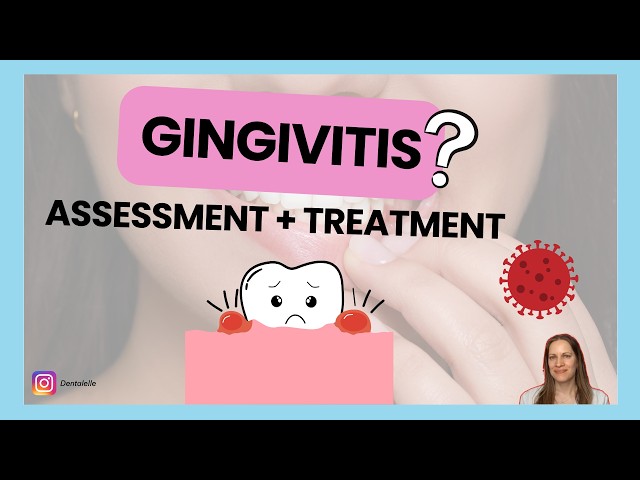
How Do I Assess Gingivitis? At Every Appointment AND Time Saving Tips
Watch on YouTubeVideo summary
The video emphasizes that a comprehensive assessment of gum disease must go beyond simple periodontal probing to include a detailed visual inspection of the gums at every appointment. The speaker argues that while dental professionals often notice visual cues such as gum color, texture, and swelling, these observations are frequently not recorded in patient charts or discussed with the patient. Instead of treating visits as routine cleanings where minor plaque issues are dismissed with a quick recommendation to return in six months, practitioners should conduct a full evaluation that considers factors like plaque distribution, recession patterns, and whether redness is localized or generalized. This thorough approach ensures that patients understand the specific nature of their condition rather than receiving vague advice that fails to address the root causes or progression of the disease.
To facilitate this detailed assessment, the speaker shares personal practices involving the use of intraoral cameras to record videos of all four quadrants before cleaning begins. These recordings serve two critical purposes: they allow for the detection of minute details like tiny black spots or subtle discolorations that might be missed by the naked eye, and they provide a visual record to compare against future visits. Since human memory is fallible, especially when seeing many patients daily, documenting findings with videos and notes ensures continuity of care. The speaker also demonstrates how to verbally communicate these findings in real-time during the cleaning process, calling out tooth numbers and specific conditions like heavy plaque or gingival recession so that patients can hear and understand their oral health status immediately, rather than waiting until after the procedure is complete.
Effective communication with patients involves explaining the clinical diagnosis using both technical terms and simple language to ensure they grasp the severity and reversibility of their condition. The speaker illustrates how to differentiate between localized and generalized gingivitis, showing patients visual evidence via intraoral cameras to make abstract concepts concrete. For instance, if a patient has dry mouth due to medication or poor hygiene leading to red, shiny gums, the practitioner should explain that while some conditions may be manageable but not curable, active gingivitis is reversible with improved brushing habits and regular maintenance. By presenting solutions alongside the diagnosis—such as recommending salt water rinses, adjusting toothpaste types, or scheduling three-month recalls instead of six—the provider empowers patients to take action before the disease spreads and becomes painful.
Ultimately, the video concludes that taking the extra time to perform a full assessment and engage in meaningful dialogue during every appointment is essential for providing high-quality dental care. Although working in a busy office setting may make it challenging to extend appointment times, practitioners should utilize their existing time efficiently by integrating education and explanation into the cleaning process rather than reserving it for a post-procedure chat. This method not only prevents wasted time but also significantly enhances patient trust and satisfaction, as patients appreciate feeling cared for and informed about their specific oral health needs. By consistently documenting changes, explaining diagnoses clearly, and offering tailored treatment plans, dental professionals can effectively manage gum disease and foster long-term oral health for their patients.
Read the full video transcript
[music]
Let's go over all about gum disease
today. What we're looking for in our
patients mouth, how do we talk to our
patients about what type of gum disease
they have, how are we going to treat it,
and the importance of the assessment.
So, I'm not just talking about the
periodontal probing here and how
important it is to check the pockets
because otherwise, how do we know if
there's bone loss? How do we know if
there's periodontal disease? But I'm
talking about all the different
assessments. Quite often I find dental
professionals aren't just going back to
square one. They're not going back to
stage one. And that's looking at the
gums. What color are they? Are they
pink, red? Are the gums bulbous? Are
they shiny? Is the inter dental pill
stippled? Is it going to be swollen? So
all of that I find dental professionals
are seeing that. We know it's there, but
nobody's writing it in the chart. So
when we're talking to our patients, it
needs to be so much more than you're in
for a teeth cleaning today. Um, let's
get started. And then after the teeth
cleaning, say there was a little more
plaque than usual. Okay, here's a new
toothbrush. We'll see you in 6 months or
we'll see you in 3 months. It needs to
be so much more than that. what I do
personally in my own practice. So, I'm a
mobile dental hygienist that goes into
nursing homes, but I also see all types
of patients in their own homes. They
don't have to have a mobility issue, but
it could be a family with four kids that
likes to be seen in their home, so they
don't have to go into a dental office
and wait one by one for everybody to
finish. So, I see all kinds of people,
young, old, middle-ag, I see everybody.
And what I personally do is I do the
full assessment at every single
appointment. And I explain everything to
the patient at every single appointment.
My teeth cleaning appointments aren't 30
minutes. They're going to be at least an
hour, if not two hours, depending if
it's a new patient or not. And that's
not including my setup time and cleanup
time. Being a mobile dental hygienist,
we do have to set up everything in the
patient's home. So, what I want you all
to do when you're looking at gum
disease, first and foremost, we can't
tell the patient what type of gum
disease they have until we look inside
the mouth and we do the assessment. The
first thing that I notice are the plaque
and calculus levels. Do they have a lot
of plaque? Do they have just a little
bit of plaque? I'm going to make a note
of that. Is it a little bit of plaque
everywhere or is it more localized to
the right hand side because maybe
they're not brushing the right hand side
as best as they could because they're
right-handed and you tend to brush
better on the left hand side, right? So,
I'm going to be looking at all of that.
But then after I look at the buildup,
I'm going to look at how do the gums
look. Are they a nice healthy pink color
or a nice healthy pigmented color? or
are the gums red along the margins only
where there's plaque? Is it red
everywhere? Does the patient suffer from
dry mouth that's making the gums red and
shiny? Not a nice healthy color, not a
nice stippled inter dental pill. Is the
inter dental pill missing because the
patient has generalized severe
recession? So notice how all of these
things are different and all of these
things I make note of. So what I do
first when I see a patient is I take out
my intraoral camera and I'm going to do
a full video inside the mouth. I start
with quad one, quad 2, quad 3, quad 4
and then I check along the buckles
again. Quad 1, quad 2, quad 3, quad 4.
And then I check along the along the
linguals. I do this for two reasons.
Number one, because there's a magnifier
at the end of my intraoral camera, so I
can see things really well. Even before
I just look inside the mouth, I can see
that tiniest black spot that might be on
the distal of the of the wisdom tooth
there that I might not have noticed
right away just looking inside the mouth
with my own eyes. But then another
reason is I take a video so I can look
at that again after the appointment
because maybe once I'm writing down the
notes I think, oh yeah, that upper left
moler, let me look at that again. I
don't really remember what I was looking
at there. I thought there was a little
spot, but maybe it was a tooth in front
of it. I go back and look at the video
every single time. I save the video so I
can compare them at the next visit. If
I'm watching a little suspected cavity
there, well, I'm going to take another
video at the next appointment and see if
it's getting worse. We like to think we
can remember everything, but we can't.
And I'm the first one to say, "My memor
is horrible. I need to write things down
because I see so many patients there's
no way I'd be able to remember
everything. So I take the intraoral
video first. I take some pictures and
then I just simply look inside the
mouth. This is well before I'm even
starting the cleaning. So I look inside
the mo um mouth and I take notes. I
don't have an assistant. I have my own
practice but as I mentioned I go mobile.
So I I don't have my own assistant. So,
what I do is I'm going to record my
notes and I let the patient know I'm
going to record some notes. I'm not
going to make any sense. I'm talking in
a dental language, but I will explain
things afterwards. I explain things
afterwards while I'm cleaning the teeth.
So, see how I'm doing two things at
once. I'm not wasting time. But I call
out the tooth numbers. I call out
everything that I see on every single
tooth, whether that be heavy plaque,
light plaque. Um, the gums probably
aren't bleeding yet, so that's not
something I'm going to count out yet.
But I'm going to mark down if there's a
little black spot, if there's
gingerville recession. I mark everything
down for every single tooth. If a tooth
is more stained than another one, if the
tooth is tipped lingually or buckly, I
mark it down. I do this at every single
appointment, not just the new patient
exam, every single appointment. Because
how do you know if things have changed
unless you take notes and then compare
the notes from last time? You don't. You
might think you do, but you're not going
to remember. We are doing a disservice
to our patients if we're not doing
everything we can at every single
appointment. I wish doctors did this. We
would all be so much healthier if
doctors had the time to pay attention
and not just ask us one little problem
per appointment, but they go over
everything in general. quickly, of
course, but going over everything. Diet,
exercise, this hurts, that hurts. You
get the idea, right? So, I'm going to
call out the notes and then this way
too, the patient can hear me. The
patient can hear me say light plaque,
generalized, there's been an improvement
since last time, or moderate generalized
plaque, there's food debris, the lower
left hand side, lingual. Um, there's
gingerville, there's severe gingerville
recession from quad to this, quad to
that. There's attrition, there's
abrasion. They can hear me say this.
They might be like, "Oh my goodness, I
have a lot of stuff in my mouth." But
they hear you and they see you're paying
attention. They can see you're working
hard to look inside the mouth. There's
nothing worse than a dental professional
coming in saying hello, cleaning the
teeth, and then giving you a toothbrush,
and saying goodbye, and you have no idea
how the mouth looked. Everybody kind of
has an idea because as we're cleaning
the teeth, of course, if we're spending
more time on this side, well, there's
more plaque there. So, everybody does
have an idea, but it's better to explain
these things to patients. So, after I
take my notes, I call out the tooth
numbers. Um, I record all of this and
then I listen to it again when I go home
and I make sure to write everything
down. But then I pick up my scalers and
I'm going to scale and then polish oral
irrigation if needed. You know, anything
that's needed, that's what I start to
do. And while I'm doing the hand
scaling, I'm going to talk to my patient
about what I saw inside the mouth. So,
as I'm cleaning the teeth, I can be
saying, "Okay, so checking your notes
from last time, you do have more plaque
on the left hand side, but you have less
plaque the upper preolar there, which is
what we were focusing on last time." Um,
plus you have this, you have gingerville
recession. Remember that happens when
and I explain everything as I'm cleaning
the teeth. If I'm using a paso scaler,
it's kind of loud with my compressor.
So, I might wait to do the explaining
for me to pick up the hand scalers
afterwards, but that's easy. They can
hear me and I'm still getting work done.
But what I'm also letting them know is,
but the gums are quite red, especially
the bottom teeth. They are very shiny
and that's not a normal appearance for
healthy gums. But I might say, but due
to the medications you are on, you are
on a lot of medications that cause dry
mouth. But how does the mouth feel? Does
it feel okay to you? Okay. So, I let
them know their gingervel condition. I
might even throw out some big words like
you have gingivitis. You have
periodontal disease because of your four
and 5 millimeter pockets. So, I'm going
to explain it in easy terms, but then
I'm also going to use the big words
because big words make people pay
attention. It's true. If you say, "The
gums are kind of red. I'm not really
worried about it." Or if you say you
have localized gingivitis, that is a gum
disease inside the mouth. Both mean the
same thing. Localized means they have
gingivitis to only certain areas of the
mouth. A little bit of gingivitis. The
gums are a little bit red. But doesn't
the gingivitis term sound so much like,
wait, what do I have? They'll pay
attention. They'll listen. But you can't
just tell them or you can't just lecture
them. You have to offer them solutions.
So, this happened to me today where I do
have a patient with very dry mouth. I
would say severe dry mouth, but it
doesn't bother her. She's a she's an
older lady. She's in a nursing home, but
it doesn't bother her. Um,
unfortunately, I've tried to give her um
biotin mouthwash, biotin toothpaste, but
it literally goes missing. So, the
nursing home has said not to bring it
because they don't know if the residents
are swallowing the mouthwash or
whatever. So they just unfortunately we
can only do so much and we can't take
her off of the medication. So I do let
her know this is your condition. Drink
lots of water. That will help. Let me
know if anything starts to feel
uncomfortable. Okay? So you kind of work
with what you got at the same time.
Right? But for another patient, let's
say the gums are red all along the
margins here because for whatever reason
on the bottom there's more plaque,
there's more calculus. Take a picture.
Show them with your intraoral camera.
Show them the difference between
healthier up here and not so healthy
down here. And then explain the process
to them. Say you have moderate gum
disease. Generalized. Cuz it's all along
the bottom. That is generalized. If the
gum disease gets worse, it can spread
and it can get worse making things
uncomfortable, making things painful. We
need to nip this in the bud. Now, um,
look at the red gums here. See? See how
it's red along the margins? Look at all
the plaque that I'm taking off with my
instrument. But the good news is gum
disease, um, gingivitis means the same
thing. It is reversible. If you start
brushing, not even just twice a day,
three times a day, that will help to get
the plaque out of there. I also would
like to start seeing you every three
months because of the gingivitis,
because the gums are red, because the
gums are bleeding. I want to see you
every three months because that's how
long it takes for that nasty bacteria
causing the disease to get worse. So,
let's say I see you in 6 months and that
bacteria is getting worse and worse and
worse. By the time I see you, the
gingivitis, the gum disease has already
spread. So, we want to stop it from
spreading. So, see how I'm making things
sounds sound very serious, but then I'm
throwing in there, but don't worry, it's
reversible. We can fix this for you.
This is how we're going to help. You're
going to brush three times a day for me
cuz I can't do that for you. But I can
make sure to come in every 3 months and
give those teeth a good cleaning. When I
come in 3 months, I will let you know if
things are improving or not improving.
Let's say things for some reason are
getting worse because you weren't able
to brush three times a day like I'm
suggesting. I'm going to give you even a
different toothpaste, a different
mouthwash to really get in there and
cleanse the gums and start to heal them
up. Even today, I'm going to recommend a
salt water rinsing because I want you to
get in there after every meal. Brush
after every meal with the salt water.
You don't have to do this forever. But
the gums are not in good shape. It is
reversible. They can get better. You
don't have to do all of this forever,
but if it can get better. When I see you
in 3 months, we're back to normal again.
Brushing twice a day, seeing you every 6
months. So you guys, you see what I did
there? I'm explaining everything. I'm
showing them everything. I'm showing
them with the intraoral camera. I'm
explaining how I can help, what they
need to do to make things better. I'm
not just cleaning the teeth and then
saying to them, "Okay, you have more
plaque than usual. You have moderate
gingivitis.
Not good. You need to brush more. Okay,
I'll see you in 3 months cuz let's do
the 3 months. Bye for now." See how
those are so different, right? And trust
me, the patient will appreciate you. You
will leave that appointment and they
will say, "Wow, she or he was very
thorough. That was amazing. I've never
had somebody care so much. I've never
had somebody pay so much attention. This
is fantastic." So, this is you being
that better dental professional. You are
doing what you can. You're using your
skills. What's the point of learning
about gum disease and perio if we're not
taking those assessments and then
talking to our patients? So, start
tomorrow. Start doing everything a
little bit more. It's going to take you
longer. Especially if you work in a
dental office. I get it. You don't have
two hours per appointment like I can,
but utilize your time well. Okay? When
you're inside the mouth, this is when
you're talking to the patient. Like when
you're cleaning the teeth or doing
whatever, this is when you're talking to
the patient about their plaque, about
their calculus, about their gingivitis,
about them needing to see you every 3
months. That is while you're doing the
cleaning, not after the cleaning. and
then you sit back and talk to them for
10 minutes. That's just wasting time.
Think about it and do it all during the
cleaning. Okay, so let me know if you
need any help and I am always here for
you. Comment, let me know. Thank you for
watching and I'll see you guys in the
next one. [music]