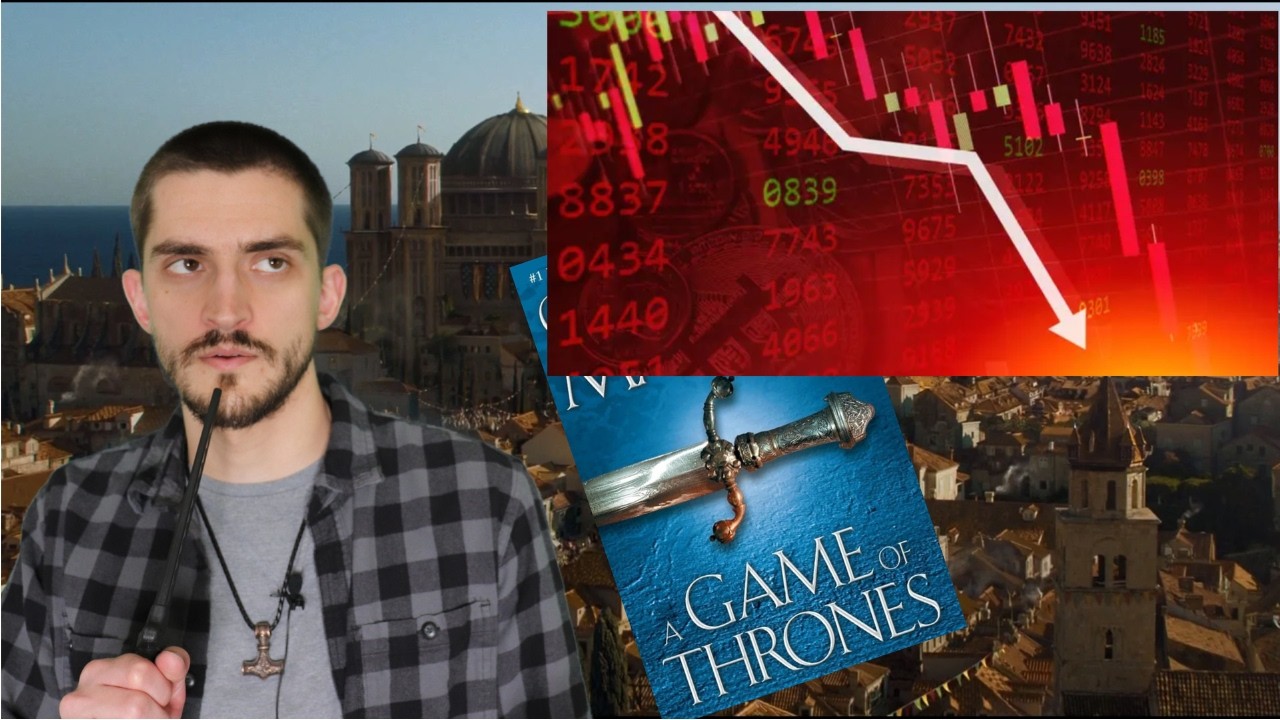
Video summary
The video explores the dire economic state of Westeros by analyzing how centuries of constant warfare have devastated its infrastructure and financial stability. The narrator argues that unlike modern economies, which can manage inflation through fiat currency, Westeros relies on precious metals like gold and silver whose value is subject to different forces. A primary driver of this instability has been massive inflation caused by the Lannister family's extensive mining operations in Casterly Rock. As they extracted vast amounts of gold without a corresponding increase in goods or population due to slow growth, an influx of money chased too few resources, causing prices for essentials like wine and food to skyrocket across the Seven Kingdoms.
This economic collapse is further exacerbated by severe supply chain disruptions resulting from decades of civil war. The transcript details how armies historically stripped regions bare of food and even seeds needed for future harvests, leading to widespread famine and depopulation. With half the countryside ravaged, banditry rampant, and transport routes dangerous due to pillaging, the cost of moving goods became exorbitant. Consequently, a single gold dragon in Westeros holds significantly less purchasing power than it did three centuries ago; items that once bought years of sustenance now require fortunes spent on wine or prostitutes within mere months, indicating an economy that has been systematically eroded without any chance to recover between conflicts.
Despite these catastrophic conditions, the video suggests there are potential pathways for recovery under King Bran's leadership if he can implement specific policies. The proposed solution involves redistributing surplus food from stable regions like the Reach to war-torn areas, resettling people onto abandoned fertile lands, and establishing a public health system using maesters trained specifically in medicine rather than general knowledge. By securing safe trade routes through military action against bandits and leveraging advanced sailing technology for efficient transport, King Bran could mitigate famine and plague which historically kill more people than starvation itself. Furthermore, the forfeiture of titles from lords who died or committed crimes during the wars would provide a massive land base that could be managed directly by the crown to generate revenue needed for these reconstruction efforts.
Ultimately, while the economic foundations of Westeros appear broken beyond repair due to centuries of instability and foreign rule, there is hope if decisive reforms are enacted immediately. The video concludes that fixing inflation requires stopping the unchecked influx of gold from Lannister mines or managing its impact carefully, alongside rebuilding agricultural output through population redistribution. If King Bran can successfully stabilize the realm by addressing banditry, ensuring food security, improving public health, and centralizing land ownership to fund these projects, he might prevent further societal collapse. However, even with perfect execution, this recovery would be a lifetime's work given that every generation since Aegon's Conquest has been subjected to war before the economy could ever fully stabilize again.
Read the full video transcript
You know the funny thing about wars?
A lot of people die fighting them.
You know the funny thing about Westeros?
They fight a lot of wars there. The lore
of the Targaryen dynasty is basically
just them burning down half a continent
and then putting down a series of
rebellions from people who didn't like
them doing that until they were finally
overthrown.
And a lot of sibling love. Then the new
king was such a monumental failure that
there were two more major rebellions
during his reign, one of which got him
assassinated by his own wife and
spiraled into a multifaceted civil war
wherein five different men declared
themselves to be king and then they
ravaged the countryside and the whole
fiasco took over seven seasons to
finally come to an end. But that's not
important. The really important thing to
wonder is how much did this damage the
economy? With cities being sacked and
hamlets being burned down left, right,
and center, the market must be in a real
tizzy. Investments are up in flames, tax
revenue is in free fall, and who knows
how everyone's 401K is doing after the
Night King forced half the north into an
early retirement. Things are terrible
and they will continue to be terrible
for the foreseeable future.
Make that my campaign slogan. War isn't
the only issue though. The Seven
Kingdoms were kind of set up to fail
what with their feudal rent-seeking. And
now that Bran the Broken is king, he has
a very long and difficult road ahead of
him. Speaking of which, let's have a
word from this video's sponsor, Hungry
Minds. Do you like books? You're
watching my channel so you probably do.
So today I'm here to tell you about a
very special book. It's called The Book,
The Ultimate Guide to Rebuilding
Civilization. This isn't a regular book.
This is a captivating illustrated
encyclopedia of humanity's greatest
discoveries and inventions. It's the
size of my torso and over 400 pages
long. It covers everything from medicine
to sailing to electricity and military
matters. Every page is full of beautiful
artwork and fascinating information
about the world. No matter what topics
interest you, you'll find something to
like about this. It's not just a history
or a science book. It's a magnificent
and aesthetically pleasing work of art.
There's even an ARG in there, a real
treasure hunt with clues hidden in the
book, and you're just going to have to
read it yourself if you want to find out
what I mean by that. I'll give you a
single hint though.
Look for the symbols. Check out The Book
here for 10% off using this link. The
Book, The Ultimate Guide to Rebuilding
Civilization by Hungry Minds is a luxury
coffee table book packed with handmade
illustrations and mind-expanding ideas.
If you're into unique gifts, premium
books, or just love going down rabbit
holes, this one's for you. So, the first
hint that something is wrong in Westeros
is their money. According to Ser Duncan
the Tall, around the time of the hedge
knight, three gold dragons is enough for
a common person to live a good life for
about 1 year. And that gives us a
general idea for how much their money is
worth. In the United States, in order to
be considered solidly middle class, you
have to have a household income of about
$56,000 per year. Although this number
does change a lot depending on how you
measure it. Please note that a peasant
in a pseudo-medieval setting would have
fewer things to pay for than a modern
person. They would have to pay for food,
shelter, and vengeance on their enemies,
but they weren't shelling out for a
Netflix subscription. So, three gold
dragons a year is probably less than
$56,000 per year. But in Game of
Thrones, which takes place around 90
years later, Sandor Clegane wins 40,000
gold dragons in a single tournament, and
he spends pretty much all of it on wine
and
ladies of the evening. So, all that
money is gone only about a year and a
half later. Did he really spend enough
money to live a good life for 13,000
years in only 18 months?
How did he do that? But it gets even
stranger. At the same tourney, Petyr
Baelish makes a bet with Renly for 100
gold dragons. And he says for 100 gold
dragons, he could buy a dozen barrels of
Dornish wine or a night with an
expensive prostitute from Lys.
>> Now, what will I buy with 100 gold
dragons?
A dozen barrels of Dornish wine or a
girl from the pleasure houses of Lys.
>> One night with a high-class lady costs
enough for a person to live a good life
for over 30 years.
Based on previous estimates, that would
be around 1.6 million dollars. Even a
wealthy nobleman couldn't pay that much.
The only way that would make sense is if
there had been some sort of massive
inflation over the past 90 years. And
some of you may be thinking, James, my
guy, George R.R. Martin doesn't mean all
of this literally. As an author, he
frequently uses dramatic irony and
unreliable narrators as a storytelling
tool. So, many aspects of the story and
setting are up to interpretation.
Expecting the numbers to add up is a
fool's errand. Just go off of vibes and
you'll be much happier. To them I say,
shut up, normie. This video is for
pedantic nerds.
So, if the currency is less valuable
than it used to be, why is that? One
possible explanation is that the
currency has been debased, meaning that
there's less gold in them than there
used to be. It might be because there
are other metals being mixed in with the
gold or maybe the coins themselves are
just smaller than they used to be. This
is possible, but I can't find any
evidence in the text to support this.
So, the explanation would seem to just
be straight-up inflation, something that
absolutely none of us are familiar with.
In the modern world, we have what's
called fiat currency, which isn't
attached to anything. Central banks can,
in theory, print as much or as little as
they need to to maintain a healthy
economy. When things are slow, they
print more. When things are heating up
too much, they print less to avoid high
inflation. Currency in Westeros is coins
of precious metal, silver, gold, and
copper. Inflation and deflation do exist
for currencies of precious metals, it
just works differently than it does for
fiat currency. The value of gold and
silver does go up and down, their values
are just subject to different forces.
Broadly speaking, capitalist economies
are designed to grow and expand
constantly, like a cancer cell. And as
the economy grows, the supply of money
needs to grow as well in order to
facilitate more transactions. If the
economy grows faster than the supply of
money, then the value of money goes up
and you get deflation. Deflation means
that the value of the currency is going
up and that means that prices go down.
In the short term, deflation is good for
consumers because it means that the
value of their wages is going up.
However, this encourages them to save
money instead of spending it, which
means businesses aren't making any
money. In other words, it slows the
entire economy. And given time, that
causes depression, and then everyone
loses their jobs,
which causes a different kind of
depression. If the opposite happens,
where the supply of money grows faster
than the economy, you get inflation. The
advantage of gold is that there's a
finite supply of it. You don't need to
worry about a central bank printing too
much money and devaluing it.
Right? There is more gold constantly
entering the Westerosi economy though,
from the Westerlands, the holdings of
the Lannisters. The Lannisters have been
in charge of the Westerlands for
thousands of years and they've been
mining gold and silver the entire time,
making them very wealthy. As they mine
more and more gold, the supply of
currency gets larger. There aren't more
goods and services to spend that money
on though, and since population growth
is glacial in a world without modern
medicine, there aren't more people
spending it. This means that there's
more money chasing after the same amount
of goods and services, which means that
the cost of those goods and services is
going to rise. This happened to Spain in
the 16th century. They conquered most of
the Americas, then they mined a bunch of
gold and silver very cheaply and brought
it over to Europe.
All the people who used to own that gold
and silver just handed it over.
That was nice of them. This expansion of
the money supply caused inflation and
raised the price of basically all goods
and services, which made things like war
much more expensive. The Spanish crown
had to take out massive loans at very
high interest rates and eventually it
was unable to fulfill its obligations
and it went bankrupt. This got so bad
that Emperor Charles V abdicated the
throne and let everyone else deal with
the consequences of his bad decisions.
What a nice guy. This contagion spread
to the rest of Western Europe, too.
Inflation was everywhere. Although in
their defense, they didn't really
understand economics the way we do
today, nor did they have the proper
tools to deal with it. The point is a
sudden influx of wealth can,
paradoxically, crash the economy if it's
not handled correctly. The Lannisters'
source of wealth, the mines of Casterly
Rock, is slowly strangling the rest of
the continent. Somehow they managed to
print more money without a money
printer. And during the reign of King
Robert, the realm was put into serious
debt, around 6 million dragons worth. So
he was bringing in a lot of money from
outside places and spending it mostly in
King's Landing and the Crownlands. That
means inflation was probably worse there
than it was in the rest of the country.
So when Petyr Baelish says that 100 gold
dragons buys a lot less than it used to,
he might only be referring to the
capital region. The problem might not be
as bad elsewhere. In fact, based on what
we see in the books, that's exactly what
happened. Salladhor Saan charges Stannis
Baratheon 30,000 dragons per month to
hire his 24 ships, meaning 30,000
dragons is enough to pay for hundreds of
sailors as well as all their provisions
and have some profit left over for Saan
himself afterwards. I guess gold just
has more value in Essos than it does in
Westeros. Remember, international trade
in this world is very limited. The only
things that Westeros would be buying
from abroad would be luxury goods for
some of the nobility and the occasional
sellsword, which means most of the gold
being mined at Casterly Rock is not
leaving the domestic economy. Whatever
the reasons for it, there does appear to
be very bad inflation throughout the
Seven Kingdoms. However, according to
Tywin Lannister in season 4 episode 5 of
the TV show, the Lannisters' last gold
mine has run dry.
>> Our last working mine run dry 3 years
ago.
>> This is bad for the Lannisters, but good
for everybody else. Could the problem
sort itself out in time?
I doubt it. Let's look at Sandor
Clegane's budget for his 40,000 dragons.
Could he really have spent all that
money in so little time? King's Landing
is the largest city in the Seven
Kingdoms and something of a hub for
international trade. So, if you want to
buy something, it can probably be found
there. There are probably ladies of the
evening that cost to the equivalent of
several thousand dollars per night. I am
not going to research that for a YouTube
video, though.
My browser history is suspicious enough
as it is. I'm just I'm just going off of
vibes and guesswork here. So, let's just
say that if Clegane spent money on that
every day for 18 months, he could
probably spend about 6,000 dragons on
it. Again, I'm just going on vibes here.
He would still have 34,000 gold dragons
left, enough to hire 24 ships for an
entire month, apparently. If 100 gold
dragons buys a dozen barrels of Dornish
wine, then that means each barrel costs
approximately 8.33 gold dragons, which
means that the Hound's remaining 34,000
dragons would buy 4,081
barrels of wine. So, unless he was
drinking 7.44 barrels of wine a day, he
must have spent that money on something
else.
Or, the prices went substantially higher
during the War of Five Kings, and that's
the most likely explanation. But, why
did the prices go so high? In a word,
shortages. Supply and demand are the
ultimate drivers of price in any sort of
market. When there's less of something,
but the demand stays the same, the price
will go up. Everything in a feudal
economy ultimately derives from the
labor of the common folk. With half the
country on fire, peasants are producing
fewer things like, you know,
food. They're also producing fewer
luxury goods like Dornish wine. This
means that the price of all those goods
is going to go up. And with bandits
everywhere, transporting these goods is
also going to become a lot more
difficult and dangerous and therefore
more expensive. Robert's Rebellion, in
which the Targaryen dynasty was
overthrown, took place approximately 17
years before the War of Five Kings
began, and that was a big war. Look at
this map that shows how spread out the
notable battles were geographically.
They were fought in the veil, the
riverlands, the stormlands, and the
crownlands. Every single one of those
battles involved thousands of soldiers
who, in addition to killing each other,
engaged in more than a little rape and
pillage of the countryside. Every
peasant they killed was one less person
that could grow food. Every farm they
damaged would produce fewer crops. Every
village they depopulated would cease to
pay taxes. Every time people are killed,
the economy loses the value of their
labor,
which is definitely the biggest tragedy
of war.
And those were just the big decisive
battles. Gods know how many smaller
skirmishes happened or sieges or raids
on lightly defended areas. The damage
would have been widespread, to say the
least. Armies in Westeros are
logistically a mess, as well as being
very, very undisciplined on average.
When they march through an area, they
strip it bare of everything, most
notably food. Historically, this is
accurate. Before modern transportation
and preservation techniques were
invented, food couldn't be transported
very far from where it was produced.
When armies marched, they not only took
food, but if things were bad enough,
they took the seeds that farmers were
going to plant for next year. Meaning
that the next year's harvest would be
smaller and more people would starve.
And since armies came from all over
Westeros, all corners of Westeros would
be affected during the rebellion. It
would probably take at least an entire
generation for things to stabilize and
get back to where they were before.
Again, this is definitely the biggest
tragedy of the situation. Then there was
Greyjoy's rebellion only six years
later, which ravaged the coastline of
the Westerlands and the Riverlands.
And the Iron Islands, but those were
terrible already. What I'm saying is the
War of Five Kings would have kickstarted
another famine before the realm even had
a chance to recover from previous wars.
Even before the Mad King Aerys decided
to test if Rickard Stark was fireproof,
there were a ludicrous number of
rebellions and civil wars against
Targaryen overlordship. And these wars
weren't relegated to a single region.
They were widespread all across the
Seven Kingdoms. If someone was born in
the Seven Kingdoms anytime after Aegon's
conquest and managed to live to be
elderly, they'd probably have witnessed
or been party to warfare in the area
they lived in. They'd also spend plenty
of time hearing about wars elsewhere in
the country. Based on all this, it seems
like ever since Aegon's conquest 300
years ago, the foundations of Westerosi
society have been broken down over and
over again without ever getting a chance
to properly recover. The economic
foundations of their lives have been
eroding for centuries and no one has
made any effort to restore them. If I
had to hazard a guess, I'd say that
compared to 300 years ago, Westeros has
fewer people, fewer populated villages,
more wilderness, and less fertile land
being cultivated. That makes sense when
you remember that winters last for
multiple years there. The people don't
have a chance to save or build up any
sort of wealth to save for an emergency,
which might be fine if there weren't so
many damn emergencies coming from all
these wars. Maybe a small foreign
dynasty that imposed itself on a large,
geographically and culturally divided
region through blatant force of arms was
never going to be beloved. Maybe
emphasizing how foreign they were drove
a wedge between them and everyone else.
Maybe feudalism is an extremely
decentralized form of political
organization that lends itself to
underlings growing too powerful to
effectively control and therefore to
civil wars. That could go some way to
explaining why the small folk hate the
Targaryens so much.
>> They're incestuous aliens, don't care.
Blood magic isn't tyrants who have
burned our lands, enslaved our people.
The only honorable thing a Targaryen can
do for this realm is finish on his
wife's tits.
>> So, King Bran the Broken has a lot to
fix as Lord of these seven, sorry, six
kingdoms. He's going to have to deal
with large-scale banditry and
small-scale rebellions. He's going to
have to rebuild the crown's ability to
collect taxes. He's going to have to
reestablish the state's monopoly on
violence and let people go back to
living their boring, unexciting lives.
That's a lot. That's a lot of difficult
tasks to complete.
What's the good news though? What does
Bran have going for him? The kingdoms
seem to have decent roads, at least
between major population centers.
That'll facilitate trade.
Their sailing technology is pretty
advanced, too. They can move around
very, very quickly. They don't need to
worry about any outside invasions
anytime soon. The wildlings are pretty
much shattered and the dragon queen who
hates slavery and love slavers is dead.
At the beginning of season 2, Petyr
Baelish says that they have enough grain
for a winter that lasts 5 years. Based
on that, we can assume that they have
some way to preserve food far longer
than medieval Europeans could. This
means that they can store it for a long
time, but they can also transport it a
long way. So, they can take food from
safer regions and take it to more
war-ravaged ones. The Reach is the most
populous and fertile region of Westeros
and it avoided the worst of the
fighting. There will need to be some
rebuilding there, but the biggest source
of food is secure. King Bran could set
up a distribution network to bring food
from areas like the Reach to places
where the inevitable famine is far
worse, such as the Riverlands. In
medieval Europe, the price of grain
doubled for roughly every 50 miles that
it was transported. In Westeros, the
price increase should be far less acute.
Remember, famine isn't what happens when
there isn't enough food to go around.
Famine is what happens when there are
large numbers of people who are unable
to procure enough food. Famous famines
like the Holodomor and the Irish Potato
Famine occurred in areas that were
exporting food as their population
starved. The lack of calories wasn't the
issue. Economic forces and government
policies were the issue. And
Phytophthora infestans. Can't forget
that. If he's smart about it, King Bran
can resettle people from overpopulated
regions like King's Landing to places
that were depopulated during the war and
get those places making food again.
Obviously, they would need oversight and
teachers to make sure they didn't screw
this up, but it could be done. And even
if agricultural land needs to be
repaired and recultivated, the oceans
should be fine. In coastal regions,
people will have to devote more time and
labor to fishing for their caloric
needs. In some areas, that will make up
for the lack of crops. In other areas,
that will just lessen the severity of
the shortages. Either way, it helps. If
Bran can manage all this properly, then
the famine in the south should go from
catastrophic to merely severe in a
single harvest. Remember, the north
declared independence, so Bran doesn't
need to worry about feeding them.
They're on their own.
Good [ __ ] luck, Sansa. And here's
another fun idea to help repair the
economy. Universal health care.
No, really. Downstream of famine is
large-scale malnutrition, which makes
populations more susceptible to disease
and then plagues start. During the Irish
Potato Famine, far more people died of
famine-related diseases than of
starvation. According to some estimates,
hard numbers are difficult to come by
with this sort of thing. The point is,
plenty of Bran's subjects will be in
need of medical care. The maesters all
receive advanced medical training, which
is one reason that every lord in
Westeros keeps a few close by. But,
maesters receive training and education
in a wide variety of different areas,
which is why it takes them so long to
earn their chains. If someone studied at
the Citadel learning only medical stuff,
they could, theoretically, learn their
trade much quicker. My proposal for King
Bran, educate a few hundred boys and
girls in medicine and then send them to
the areas most affected by disease
outbreaks. They can educate peasants on
ways to prevent infectious diseases from
spreading, as well as provide treatment
for those who need it. Their knowledge
of medicine seems to be way more
advanced than real-world medieval
Europe's was, so they could do a lot of
good this way. This might cause some
problems, but it would help to stabilize
things and endear the king to the
peasantry. It would be the first time
most of them had a leader who even
pretended to give a [ __ ] about them, and
that would give him more of a support
base from which to govern from. So, here
is my list of policies for King Bran to
implement to fix the Westerosi economy.
One, send in his armies to take care of
the bandit problem and make travel safe
again. Two, redistribute food from areas
with a surplus to areas with a shortage.
Three, resettle abandoned land to grow
more food. And four, fund the creation
of maesters to act as public doctors and
prevent the spread of diseases. If all
goes well, famine and plague will be
fixed, the crown's position will be more
secure than it was before the war
started, and commerce will be thriving.
Or at least not actively being murdered.
The problem is that all of this is going
to be expensive. Like, stupid expensive.
Luckily, so many lords died during the
war or committed crimes that could see
them stripped of their titles that there
will be tons of land up for grabs. And
in feudal systems, when that happens,
that land usually reverts to the
ownership of the king. Bran could
personally hold onto that land and use
the revenue it produces to fund all of
these big projects. The land would be
spread out across the six kingdoms,
though, so Bran would be unable to run
it himself and would have to assign it
to someone else. Ideally, someone
progressive-minded and willing to help
him with his reforms. If Bran is smart
about this, he could expand the power of
the throne substantially, which would
lead to rebellions being less common,
which would lead to greater stability
overall, which would then lead to a
healthier and more robust economy for
generations to come.
Aegon V basically tried to do the same
thing before he died in a dragon-related
fire. Even if everything goes perfectly,
though, this would be a lifetime's work.
Luckily, King's Landing avoided the
worst of the fighting in the last war,
and things should be stable there for
the time being. It could serve as a
bastion of stability for Oh, holy [ __ ]
Yeah, maybe everyone is just sort of
screwed.
Oh, well. Thanks again to Hungry Minds
for sponsoring this video.
Don't forget to like, comment, and
subscribe. Aloha. Thanks to everybody
who watched this far. Do you see all
these names here? I mean, if you're only
listening in another tab and not
watching, you probably don't see them.
But, if you are watching, you see all
these names here. These are my patrons,
and I want to give a special shout out
to them as well as my $10 and up
patrons. Three Cat Day, Arthur D
Gonzalez Martin, Carolina Clay, Chaotic
Entity One, Chris Gold App, Hey It's
Haley, Lexi Delorme, Lord Tiebreaker,
Psych XS, Toa Michael, and Yunha Park.
All of these people,
their support means the world to me. And
if you watch this at all, your support
means the world to me, too. If you want
to help grow the channel and help
support me further, so I can keep doing
this, don't forget to rate the video,
comment, and subscribe if you haven't
already. Or, you can, you know, become a
patron or a channel member. You know,
you get early access to videos and bonus
content. Starts at $1 a month. But, you
know, if you don't feel like doing that,
no hard feelings, I guess. I just won't
be able to eat without you.
Or something like that. I don't know.
Whatever. Have a nice day. Bye.