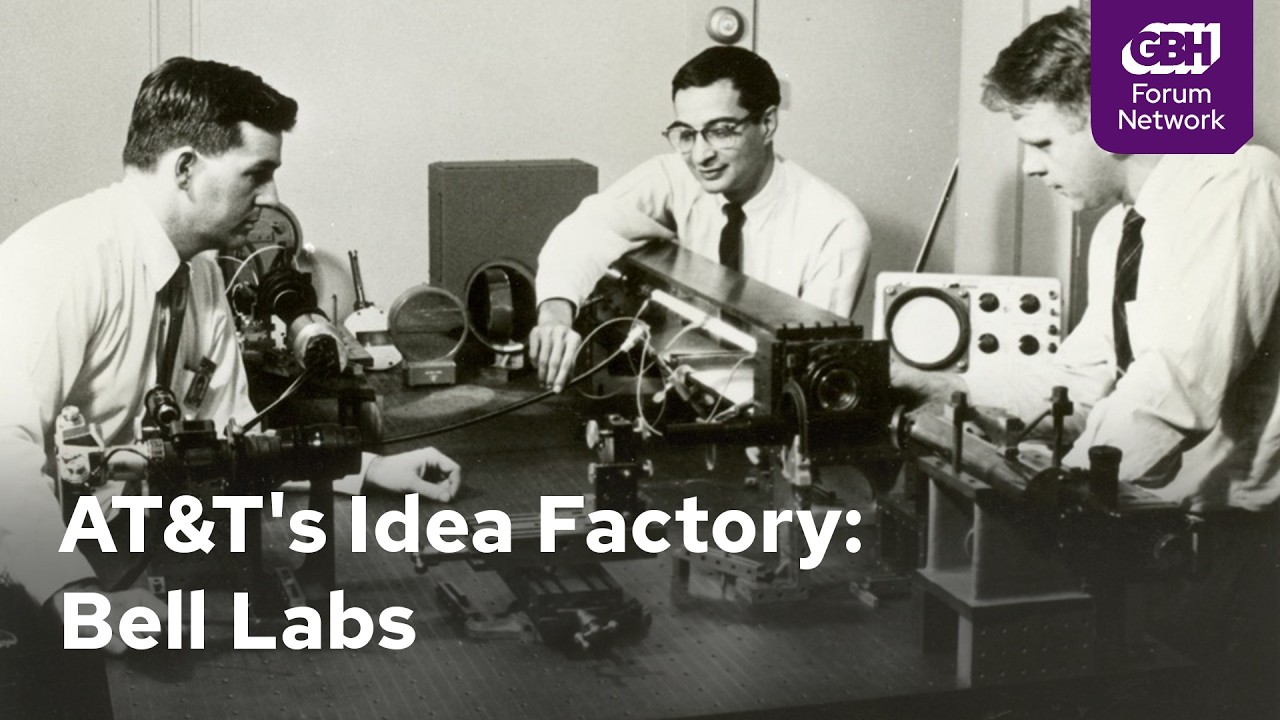
Video summary
The presentation by John Gertner at the Charles River Museum explores how Bell Laboratories, established in 1925 under AT&T's monopoly, became a unique engine for American innovation through centralized research and development. Unlike earlier laboratories that focused solely on incremental improvements to telephone service quality or cost reduction, Bell Labs was structured to produce "discontinuous innovations" such as the transistor, silicon solar cells, lasers, Unix, C++, CCDs, and communication satellites. These technologies eventually reshaped the global economy far beyond their original utility for building phone infrastructure. The lab's success was rooted in a deliberate structural approach led by figures like M.Vin Kelly after World War II, which involved moving the main campus to Murray Hill, New Jersey, to foster interdisciplinary collaboration while avoiding urban distractions. This environment encouraged diverse teams comprising engineers, physicists, and chemists who operated with significant autonomy, allowing them to pursue problems for years without immediate results or rigid formulas dictating their path.
The culture of open inquiry at Bell Labs was further nurtured through an "open-door" policy, long hallways that facilitated spontaneous interactions, lecture series, and a tolerance for failure where mistakes were viewed as part of the experimental process rather than grounds for punishment. This approach yielded legendary successes like the 1947 invention of the transistor by Walter Brattain, John Bardeen, and William Shockley after years of failed experiments, which enabled miniaturization and massive scalability in electronics. Similarly, the accidental development of solar panels by Gerald Pearson, Daryl Chapin, and Calvin Fuller demonstrated how materials intended for other purposes could lead to breakthroughs that took decades to achieve global scale and affordability. Even premature failures, such as betting on picture phones at the 1939 World's Fair due to high costs and lack of infrastructure, were accepted as valuable learning experiences within a system fueled by endless practical problems tied to constructing a robust global communications network.
Following AT&T's breakup in 1983 due to antitrust rulings, Bell Labs gradually transitioned from a broad research entity focused on future communications into smaller units concentrated on telecommunications and manufacturing by the late 1980s and 1990s. Despite this contraction, the legacy of its unique financial structure—which required cost growth to maintain fixed profit margins—had historically funded extensive R&D that prioritized long-term investment in people over short-term profits. This stood in stark contrast to modern tech giants like Apple or Google, which often emphasize product-driven cultures with high employee turnover; Bell Labs instead utilized programs like "Kelly College" and teamwork training to retain talent for years while managing complex projects such as fiber optics. The lab's progressive stance on diversity under leaders like William Baker also paved the way for early inclusion of women in mathematics and recognized contributions from African-American scientists despite societal barriers, creating a collaborative model that influenced other innovation hubs like Xerox PARC even after its corporate parent changed course.
Read the full video transcript
They made sure that that that scientists
had their office and their lab in
different places so they would sort of
have to go travel amongst other people.
They created these long hallways so
people would bump into each other. They
created a kind of um regular lecture
series so people would all congregate
and hear the newest ideas. So creating
this kind of intellectual atmosphere,
intellectual format was very important
to him. Um he came to believe you didn't
there wasn't one right way to innovate.
Hi everyone, thanks for coming tonight.
My name is Steve Guerrero and I am the
director of education here at the
Charles River Museum of Industry and
Innovation in Waltham, Massachusetts.
You are sitting at the place where the
industrial revolution scaled in America.
Francis Katel Mills, the Waltham Lel
system of mass manufacturing, it all
started right here. Well, not actually
right here, a little bit closer to the
river. Uh we are sitting in what was a
1911 power plant uh run by the Boston
Manufacturing Company. Our museum tells
the story of 200 years of American
industry and innovation and the
industrial workers that built our modern
economy. Upstairs above me we have
another exhibit to the Waltham watch
factory. Walam watch was the first to do
precision machining at factory scale.
It's not an accident that uh robotics
firms and high-tech electronics firms
are along 128. They are all descendants
of companies like Waltham Watch. John
Girtner, he is a longtime journalist uh
in the science and tech space. He has
written for the New York Times magazine
for a long time. And uh he's here
because I found him through his book um
The Idea Factory, Bell Labs and the
Great Age of American Innovation. What
better place to talk about that than the
Museum of Industry and Innovation.
That's enough from me and I would love
to have up Jonathan. We'll have
questions and answers at the end. Uh,
John.
Uh, thanks everybody. Can everybody hear
me? Okay, this is good. Okay. I I'm not
sure I can compete with the invention of
rum, but I will uh I will do my best.
Um, thank you Steve and it's really nice
to be here and I I you know, if you
haven't I I hadn't been here before, so
I got a chance to sort of walk around a
little bit and um what a cool cool
space. cool stuff. I I feel like I'm a
chronicler of of 20th century mid 20th
century American technology. So all of
this is so new to me and so interesting
and and you know the anticedants of of
how we got to where we got I think are
are right here in these rooms which is
really cool. So um in a moment I'm going
to talk about the the phone company and
its com it's it's its uh fundamental
component for me which was Bell Labs the
R&D lab. Um, you know, one thing that I
think is is is kind of apppropo is that,
you know, behind this talk, I think, and
I've been mentioning this lately when I
talk to audiences is that, you know, a
big part of our lives involves the phone
company in ways, I think, that go beyond
just the engineers who designed the
switching systems and the PhDs and and
people who came up with breakthrough
technologies that I'll talk about in a
second. Um, you know, it's it's also,
you know, this this occurred to me when
I went to a a museum exhibit in New
Jersey, um, last year that kind of
chronicled how many people worked for
the phone system. And it really just
struck me, you know, the tens of
thousands, really the hundreds of
thousands of people who were working as
linemen, who were working in Western
Electric factories, who were working in
um, you know, and I get emails from
these people all the time still. and you
know their livelihoods depended on the
innovations that in many ways came out
of Bell Labs um which I think it's
really you know how how in New Jersey
and Massachusetts how parents and
grandparents afforded houses and paid
for college and groceries um which I
think my larger point being that I talk
a lot about technology and innovation
but I think really the the the larger
idea is what technology and innovation
can do and um what they can do not just
to make our lives is g- whiz and
futuristic but what they can really do
in terms of economic impacts which I
think as we can see in some stories I'll
tell today the um economic impact of
what came out of Bell Labs is is huge um
immense almost immeasurable so um you
know an important point I think um and I
think it it also resonates in some ways
with some of these discussions that are
going on with artificial intelligence
today which is sort of the flip side of
what's happening here we have a company
that built innovations that created uh
thousands if out millions of jobs and
what will AI do and it's a it's a really
important discussion.
Um so this probably should lead us to a
question. There are some younger people
here who probably didn't grow up with a
a landline maybe. Um so you know what
was this company and what made it so
influential? Um I think those of us who
remember it know but but let's go back
to the beginning. Um if we go back
before the telephone, we'd have to go
back to the telegraph. And the telegraph
was a was a a sort of great innovation
of the 1800s. It allowed for for
communications over long distances. Um
it allowed us to send messages around
the country. Once they worked out the
kinks of undersea cables, they could
send it all around the world. Um but the
telegraph had limitations. Uh it didn't
allow for personal persontoperson
exchanges or of course voices. It didn't
allow for emotion. It didn't allow for a
rich a richer exchange of information.
So the telephone, the invention of the
telephone by Alexander Graanbell, what
it did was it, you know, transformed the
the the sound waves coming from our our
vocal cords into electrical waves. Later
on, we turn that digitally into ones and
zeros. But this really um altered the
way we communicate, altered the way I
think in a sense that that that humans
could connect um in a very especially
over long distances. And the company in
the United States that capitalized on
this great invention was American
Telephone and Telegraph. Um, for those
of you who who aren't aware of its
anticedants, um, AT&T was a very
different company than the AT&T of
today. And AT&T was effectively granted
a kind of monopoly by the United States
government in the early 1900s. Um, its
patent had been given to Alexander
Graanbell. Um but its CEO Theodore Vale
was a kind of visionary who understood
how to consolidate different parts of
this kind of naent communications empire
into one large company and the monopoly
paid huge dividends. AT&T was
effectively in control of all the
telephone communications in the United
States and by 1925 AT&T was the larger
largest company in the world. Uh it was
the largest company in the world by
revenue. It was the largest company in
the world by number of employees and it
was the largest company in the world by
stock valuation. Um, and it wasn't
really just one company. AT&T was a kind
of umbrella that covered many different
companies. Um, it owned either all or
part of many of the lo all of the local
operating companies in the United
States. Um, New Jersey Bell, New York
Telephone, um, Pacific Bell,
Southwestern Bell. What was
Massachusetts? Was it
Thank you. Um, and that was the
connection with the consumer and or the
subscriber because you didn't really buy
your phone in those days. Of course, you
just kind of subscribe to it and the
phone company let you use it. Um, and of
course, it also um to tap into the long
distance lines. It had a division, a hu
huge division called AT&T long lines,
and you would go through your local
operator and tap into the long distance
system, and that's how your call would
get um sent to San Francisco or later to
London or farther a field. Um it also
controlled one a company that was the
what standalone would have been one of
the largest companies in the world which
was western electric its manufacturing
arm. In later years AT&T would have been
described as having both um vertical
integration and horizontal integration.
horizontal because it covered uh the
United States in its various business
empires, but vertical because it
controlled all the production, all the
all the processes by which any part of
the phone company um came to existence,
whether it was telephone lines,
telephone poles, uh operator headsets,
vast switching centers, the smallest
component to the largest was built at
Western Electric. So um
one thing about the company in the early
1920s was that engineers and scientists
were spread about in different
divisions. AT&T had its own engineering
staff um as did Western Electric. And
the people managing the phone company
decided that it would be good to
consolidate its scientific and
engineering staff into one entity, a new
R&D lab. And in January, January 1st,
actually, 1925, Bell Laborator, Bell
Telephone Laboratories opened for
business in downtown Manhattan. And Bell
Labs, as it came to be called, was this
really taking the idea of an R&D lab to
a sort of newer, larger scale. The idea
of an R&D lab had been um it wasn't a
new thing. Um the German pharmaceutical
companies had R&D labs in the late
1800s. Um, General Electric's uh, R&D
lab actually predated Bell Labs by a few
years, but Bell Labs was different in a
couple ways. One was its size, its
scale, um, thousands, I think 5,000s to
6,000 people at the start of it. Um, it
was solving near-term problems. Better
cables, um, faster connections, better
fidelity, um, better phones, better
better even better telephone poles. They
would kind of experiment in these empty
lots in New Jersey to try and figure out
what fungicides were better for
telephone poles. And they would do these
20-year experiments to get the best
telephone poles. But it also created a
core of researchers and they went they
began going around the country hiring
young physicists and chemists and
engineers to create a research
department. And this was something
different because these were people who
were going to actually think about the
future of communications. If Bellabs was
a monopoly tasked with really the
communications infrastructure or
building this new communications
infrastructure of the country, um these
engineers and scientists in the research
department were going to focus on the
longer term thinking of knowledge
production and some of them were
mathematicians. Um but I think what was
what was you had a lab that was
essentially tasked as I said with
inventing the future of communications
and that itself was rather new.
So let's just take a a quick look. I'm
going to tell a few stories and and and
and in a second but um for those of you
who don't know Bell Labs very well um
the quick list um the hit list the
greatest hits of Bell Labs is is is
rather incredible. what came out of the
R&D center really just in the first 50
years 40 years of its existence. Um
there were a huge number of practical
improvements and um these are not really
in my book. They might have be like a a
kind of new casing for wire or some kind
of new steel cable or an incremental
improvement to a a switching um
apparatus something like that. But those
were fundamental to improve
incrementally improve constantly improve
the phone system. This was a regulated
utility. They had to constantly go to
hearings to sort of prove that their
investments and their investments in R&D
were actually paying off for the
consumer. And the mantra at least
amongst Bell Labs visionaries or leaders
was that they had to keep making the
system better or cheaper or better and
cheaper and that became a kind of
shortorthhand for the sort of innovative
focus of the lab. Now also at Bell Labs
beginning I would say in the 1930s late
1930s there were these big innovations
these novel technologies that made the
lab famous forever um and change the
course I'd say of human history. It was
um you know scholars of innovation
sometimes call these discontinuous
innovations or disruptive innovations.
they might take the path of technology
to a very different level all of a
sudden either because it's hit some kind
of roadblock with incrementally
improving something or somebody comes up
with a genius idea and you know at Bell
Labs these included the transistor um
the silicon solar cell um communication
satellites uh the las the theory of the
laser came out of Bell Labs and some of
the earliest lasers came out of Bell
Labs the Unix operating system um C++
uh computer language um and other things
that other also won Nobel prizes like
the charge couple devices which was
wonderful for high resolution digital
imaging. So there were also ideas,
people like Claude Shannon who was a
mathematician in the department who was
coming up with a way to sort of use
digital information to send messages or
an idea or blueprint for how digital
messages could go from one place to
another in the future without errors and
that kind of thing. Or radio astronomy
actually was was discovered, I guess you
could say, rather than invented at Bell
Labs by a scientist named Carl Jansky.
Um, some of these had no real practical
payoff to the phone system. Um, but they
came out of there and they were
bestowed, I guess you could say, as part
of the monopoly, the the the uh the the
windfall or the the the the um the the
the inheritance, I guess, of Bell Labs
came to the rest of us that way. So, you
know, I think this kind of question,
well, why does innovation matter sort
of, you know, comes through with with
some of these breakthroughs. Um, they're
different a lot of these than a new
iteration of like an iPhone. Um and you
know ultimately I think they drove the
impact of AT&T and its parent company um
and on the world economy.
So um you know why did this happen at
Bell Labs? Actually somebody just before
said like I hope you can explain why it
was Bell Labs and I I I think I can. So
let's say you're working at the phone
company and you're working at Bell
Laboratories in the R&D lab. Um you're
working in lower Manhattan. Your job is
to help create a flawless system that
serves hundreds of millions of callers
per day, but you have to plan on how
have it constantly increase in capacity
in the future. So, you know, how do you
do it? You have to keep making it
better. You have to make it better in
quality. You have to make it cheaper in
prices. These company mantras and um the
first thing is that there were, you
know, all these brilliant people working
in the phone company and they had
millions of interesting ideas. But at
Bell Labs in particular, at the R&D lab,
you know, there were tons of ideas and
they stopped I I not stopped being
interested in ideas, but they were very
focused on good problems. And the phone
company had no kind of end to good
problems. They were building a kind of
new infrastructure that had never really
existed before. Not just in the United
States to get phone calls across the
country or to every subscriber, to
connect everyone to everyone else, but
also to get them under the oceans, to
get them to Europe. And again with a
system that was growing and growing. So
you had to kind of creep keep increasing
capacity and keep um lowering or at
least maintaining prices. And that's a
very difficult balance. And it fell to
these scientists and engineers.
So
with these two I think there's there's
two stories I'm going to tell that that
kind of illustrate like how they came to
identify a really good problem and how
they solved it and what the impacts of
it were. Um, if we go back to to Bell
Lab's kind of early days, this guy Mvin
Kelly, this was taken late in his life
when he was the president of Bell Labs.
But Mvin Kelly joined AT&T as a young
man, I think in 1916, 1915. Um, he was a
physicist trained in the Midwest um, at
the University of Chicago. But, um, he
came to work for AT&T and he joined Bell
Labs, was recruited into Bell Labs when
it was established in 1925.
And in 1925, Mvin Kelly was the foreman,
he was in charge, the manager of
something I think we would c call today
craft manufacturing. Um, he was
overseeing a group of people, a group of
skilled technicians about 75 and all,
working, I think, pretty much in a room
almost like this, not the high ceilings,
but a a large room in lower Manhattan.
And they were making this. They were
making the 101D. Um, it's about the size
of an regular incandescent bulb. And
this was known in the phone company as a
repeater tube. And it was a vacuum tube.
It had a complex inner architecture. It
was more complex than an incandescent
bulb. But Mvin Kelly saw these as the
great innovation of his era. Um what
they did was they allowed for long
distances, long-distance communications
to really flourish and exist. And the
reason for the phone company in that era
was that phone signals were weak and
over long distances they would
attenuate. So you needed to feed them
through a repeater station every 100 or
150 miles. And in the repeater station
there would be a a set of repeater
tubes, these 101Ds, and they would
amplify the phone call, hopefully
preserving as much of its its um quality
as possible, and then it would get moved
down across the field. This was what
allowed for uh a call to go from New
York to San Francisco. Eventually, it
allowed for calls to go to New York to
London. They put the variation of these
tubes deep in the undersea cable. If
you've ever seen pictures of it, the
undersea cable would swell out like a
snake that had just swallowed something
where the repeater was and then come
back in. Um, and they had to be very
longived and because if they were under
sea, you couldn't actually service them.
But even on on land, the idea for Kelly
making these things was make them
better, make them cheaper, make them
last longer.
Um, Kelly was really good at what he
did. Um, but he actually saw these as a
flawed technology even as he saw them as
a key to the phone system. Um, he
thought they were they were big. They
used enormous amounts of electricity.
They had to be on all the time. Um, they
were very hard to make. Um, even as he
got better and better making them. And
he wondered if there was something that
could be more efficient, smaller in
size, longer lived that could actually
work better in the phone system. there
was nothing in the technology in the
pipeline technology pipeline at the time
at Bell Labs. And this idea that Kelly
had that there should be something kind
of I guess you could say fizzled except
in his head. Um and Kelly went on to
other jobs. He moved up the ranks at
Bell Labs. Uh he became the head of
research in the 1930s. As I said, he
eventually became the president. But um
by the mid1 1930s he had money to hire
researchers and scientists some of the
best in the country during an era when
not a lot of people had money. I mean
this was the depths of the great
depression. Universities weren't really
hiring physicists and engineers and
chemists. Um, Bell Labs uh provided
Kelly with some money to snap up some of
the best people he could and he would go
around the country interviewing
different people um and try and get them
to come over to Bell Labs and work for
the phone company. Now, one of the
people um that that Kelly hired was
William Shockley here at MIT. Um
brilliant physicist and hired him in the
mid 1930s.
And by 1937, Shockley is working at Bell
Labs. And the story begins with in 1937
MVN Kelly goes down the hall at Bell
Labs um in Manhattan to go visit a
friend of his. He's his best friend at
Bell Labs is this guy Clinton Davidson.
He's a physicist. He actually won the
Nobel Prize in physics. Um he's a quiet
man. He's not a manager. He's just a
kind of he he was the guy you would go
to if you had a question nobody else
could answer. And for whatever reason,
Davidson is not in his office that day.
But Shockley, who's sharing an office
provisionally with Davidson, is there
and he knew Kelly because Kelly had
hired him. And Shockley will remember
this day for the rest of his life
because Dr. Kelly gives him a talk about
getting two essential components out of
the phone system. He talks about tubes
and wonders if there's some kind of way
Shockley or his staff on and research
can work on some kind of amplifier that
would be more efficient, that would be
better for the phone system. And the
other thing he talks about is getting
all the switches out of the system. Um,
if amplifiers were crucial to
longdistance systems, these vast
switching centers in really every town
and city in the country were the
essential component of connecting
everyone with everyone else. In fact,
Bell Labs sometimes thought of its work
in terms of transmission and in terms of
switching. And switching kind of
depended on these small electromagnetic
switches that clicked open and clicked
closed. And Kelly saw them as slow,
expensive, breakable. Um, there were
millions and millions of them in the
phone system. And looking ahead, he
actually wondered if based on the growth
of the phone system and communications,
if the switching centers could even
connect everyone to everyone else into a
future that he saw. um he didn't have an
answer of how to do this but shockly and
in the air at Bell Labs um it was it was
thought that you could maybe make some
progress on these ideas by looking at a
new kind of material they were working
at Bell Labs um called semiconductors
and we know silicon we know germanmanium
some of us um Shockley started working
on copper oxide and um for those here
who know you know engineering um he was
working on like these breadboards trying
to feed signals through uh copper oxide
um devices to see if he could get an
amplifi amplification effect. And um
Shockley um one of Shockley's problems,
Shockley had a lot of problems for those
who know his his his biography. One of
Shockley's problems is he was a
brilliant um theoretician, but he was a
terrible experimentalist. So he brought
other experimentalists in to help him
and they tried and tried and didn't
really get anywhere.
And the reason he stopped was not that
he quit and thought it was impossible.
The reason he stopped was because the
World War II came along. And for World
War II, it brought a lot of people at
Bell Labs into the war work. Almost
everybody in fact, especially especially
some of the best engineers. Shockley
actually went down to Washington and
began to work on operations on how you
drop bombs on submarines to get the
optimum effect on the enemy. Um, other
people went to work on tank-totank
communications or on battlefield
communications. But one of the most
crucial things that Bellabs did was it
helped with the radar work which was
also done here at MIT at the RAD lab and
the other half was done by Bell Labs in
Manhattan. And um the radars the early
radar work depended on semiconductors
also these semiconducting crystals um
that they were using silicon crystals
and germanmanium crystals and Kelly was
played an in important part um as
managing this kind of war work for Bell
Labs.
By the mid1940s, as the war is winding
down, um Kelly can foresee the end of
the war, believes that there's this
incredible future for electronics and
that Bell Labs can play a part, perhaps
the most crucial part in this. And he
starts making plans and writing memos
for what Bell Labs should do in its
post-war work. And one thing he decides,
well, two things he decides is that one,
they should really look deeper into the
nature of semiconducting materials. he
saw what they could use them for in
radar. Um he thought they would have
some very good use in the phone company.
The second thing is that he saw how
teams worked during the war. Um it it
sounds kind of silly, but he understood
based on the war work, especially the
radar work, that you don't want
like-minded people sitting in a room
trying to solve a very difficult
problem. You wanted to get engineers and
physicists and chemists and circuitry
experts and material scientists. Again
sounds obvious in today but he came to
believe very su soon after the war that
actually new knowledge comes out of the
complimentary nature of teams but
sometimes also the friction between them
and how they look at problems
differently. So immediately after the
war in 1945, he asks Shockley, Kelly
asks Shockley to set up a team to work
on the nature of semiconductors. And
this also is is a a big moment for Bell
Labs. It moves out of Manhattan. It
moves to the New Jersey suburbs to a
kind of campus uh where near where I
grew up actually. And um I I used to
wonder when I was doing the research for
the book why they moved to New Jersey.
And you know, there's lots of memos
saying that New York had these
vibrations from the subway and it was
hard to do acoustical research, but
really the executives all live nearby.
So I think they just they bought this
plot of land and they had a really good
commute to to Velas. But it was it was a
beautiful place and this idea of a
campus for for um for R&D was really,
you know, in its heyday back then.
The semiconductor group became known as
the solid state group. Uh Shockley was
one of the heads of it. Um there were
about a dozen people in all and they
started working on trying to understand
silicon and germanmanium better. Um what
usually happens with innovation and what
happened to this group is that they
failed. So really all through 1945 you
can read memos and journal entries. They
all had their lab notebooks and they
were getting nowhere with experiment
after experiment. And 1946 was pretty
much the same thing. In fact, um uh one
of them, one of the people on the team
while um said just felt like we were
just groping in the dark. But in 1947,
they started making headway and really
at the very end of the year um Walter
Bratton and John Bardin, two physicists
on the group in the group came up with
this and um I has anyone ever seen the
actual list? Yeah. Yeah. Okay. A couple
people. It's very small. As you can see,
it's about a quarter the size of a
penny. Um the transistor is is under
that arrow head. It's a slightly impure
slice of germanmanium. Um there are two
wires going down each side of that arrow
head and they are piercing just the
surface of that germanmanium slab. And
what Bardin and Bratton found when they
demonstrated it um at the end of
December actually almost on Christmas
Eve on December 23rd 1947 was you could
run a signal through this Germanmanium.
It didn't have the name of a transistor
at the point that came from a contest a
few months later, but you could amplify
a signal very effectively. I think it
was 13 times, sometimes 16 times. Um, so
they seem to have found a new amplifier.
And they also found that you could
switch it on and off instantly. So maybe
this was a new switch as well or
something for that. So there's this
great question I think that did they
know what they had found? And I think
the answer is kind of. First, they
understood that, you know, the the power
requirements for this thing were tiny. I
mean, this was like a millionth of a
watt compared to the the hundred or
hundreds of watts that would require be
required for vacuum tubes. Um, they
understood there were no moving parts.
It wasn't going to really wear out
conceivably. Um, and they could see
right away that it was a replacement for
the vacuum tube. Maybe it could be a
replacement for some kind of switch. Um,
and they could see it hearkened in an
era of miniaturaturization. They could
not see that you could fit a billion or
five on a chip. They could not see this
age of computing. But Kelly could see
this new age of miniaturaturization that
would come out. Um, what happened right
after the invention of the transistor
was was actually kind of nothing. Um, it
it actually was really hard to build
these like if it was a humid day or if a
door slammed nearby or some general was
coming for a presentation and they were
fussing over it and it wasn't working.
Uh, it was very stressful for them and
they had to really figure out how do you
make these and then how do you make them
in great quantity and that actually took
really years to figure out. Um it wasn't
until the early 1950s that they had
started putting them into hearing aids
which were the first application and the
military started using them because they
used so little power and they were so
tiny that they had great value in
applications in planes and ships and
submarines especially.
But um in terms of their kind of general
application um an invent an innovation
as I I think I talked about in the book
is something that has impact and scale.
It's different than this. This is an
invention. And to get it to impact and
scale, they had to build a factory in
Allentown to get into those transistor
radios in the late 1950s when it really
kind of hit the world hard that this was
a very different kind of device. Um,
really took years. And I think it's
interesting just for a second to think
about it that you know this was a device
that was kind of in a vague way on Mvin
Kelly's mind in the mid1 1920s and then
22 years later was invented but probably
wasn't 20 till 22 years after this that
we started to see its real impact on the
world. So we get to see that kind of
long time frame. I think we're used to
like, oh, let's just roll out a new
iteration of software. But, you know,
sometimes with these kinds of
innovations, hardware especially, it
really we we see how long it can take
from ideiation to actually scaling up.
Um, now in the same lab actually where
the transistor was made, um, these guys
are working on a totally different
technology, but they're also using um,
semiconducting materials. So, um, that's
Gerald Pearson. He's a physicist on the
left. He was actually on the transistor
team, too. He was the one who said they
were groping in the dark. And the guy on
the right, also on the transistor team,
was a guy named Cal Fuller, and he's a
chemist. And together, Pearson and
Fuller were working on this product
called a silicon power rectifier. But
the important thing is that Fuller was
making in his lab, he was actually
baking in his lab, these kinds of pieces
of silicon with a very, very fine
impurity on top. And the way they were
coming out, Pearson had noticed that you
could shine a light on them and they
would generate an enormously um
impressive photoelectric electric
effect. Um larger than anything actually
that they had seen before. Now what was
also striking is that Pearson had an old
college friend um Daryl Chapen who
worked in a different building and was
had nothing to do with their work at
all. And one day, Chapen and Fuller are
talking. I'm sorry. Chapen and Pearson
are talking, excuse me. And Chapen
explains to to to Pearson that he's been
asked to come up with power sources for
remote repeater stations. So, remember I
talked about those repeaters tubes that
were in the repeater stations to get a
long-distance phone call across the
country. Um, some of these repeater
stations that would amplify
long-distance phone calls were in pretty
remote places and they depended on
backup generators for when the power
went out, but that wasn't ideal. Um,
Chapen was actually looking into wind
power. He was looking at these kind of
very primitive nuclear batteries. And
Pearson said, "We have these these
silicon chips. Maybe we can use actually
sun power to do it." And together the
men got together sort of as we might say
serendipitously and started working I
think finally with their boss's
permission on creating a solar battery
as they called it at the time. And um
within a year they came up I think it's
1954 I think I have this slide wrong.
The first um solar panel installation at
a remote repeater station in Americus
Georgia. It actually worked really
splendidly. It had other problems of
economics that I'll talk about in a
second. But this was the um this is
really the the the the the grandfather
of all solar panels in the world today.
And it came out of the labs from this
kind of collaboration um between three
guys working kind of um and meeting and
just benefiting from the fact that they
were in the right place at the right
time with I think the right problem.
So what do we learn from these
instances? You know, what are what are
some things you can think about on the
on the way home as you're talking about
animation? I'm sure. Um, you know, one
thing I think is that, um, I'll talk a
little bit about, I won't get too wonky.
Um, sometimes I talk to audiences and
they really want the wonk, but um, you
know, you can tell me if I'm too in the
weeds, but, um, Mvin Kelly didn't have a
creative formula. He had a a kind of
creative structure, I think, for how he
wanted or thought innovation can work.
Um, I didn't get really too deep into
the Murray Hill lab that that that
campus-like lab, but you know, they
spent years trying to design this place
to kind of foster an innovative
atmosphere. And just to use an example,
they made sure that that that scientists
had their office and their lab in
different places. So, they would sort of
have to go travel amongst other people.
They created these long hallways so
people would bump into each other. they
created a kind of um regular lecture
series so people would all congregate
and hear the newest ideas. So creating
this kind of intellectual atmosphere,
intellectual format was very important
to him. Um he came to believe you didn't
there wasn't one right way to innovate.
And in fact if we look at the transistor
which was this handpicked team of people
by Kelly it was very very different from
the silicon solar cell which was a a
completely different approach that
happened without really any kind of
management at all. So, um, I think
they're both viable and Kelly saw them
as both viable, but you had to have the
right place at the right time with the
right people and the right set of
problems. Um, Bell Labs gave people,
especially in its research department,
great autonomy and patience. Sometimes
you could work for a couple years on a
problem. Um, sometimes that was it
became a joke at Bell Labs. Uh, you were
working too long and not showing any
kind of um um um product from it. But it
did pay off with the transistor team for
instance as I talked about those years
of failure that preceded the
breakthrough. Um I talked about Kelly's
interdisciplinary mixes and
architecture. Um Bellabs was a place of
great expertise but it was also a place
where people would come straight out of
college and there was a kind of culture
at Bellabs that you were never to refuse
answering anyone a question. In fact you
were never to keep your door closed in
that era. Um the only person who kept
his door closed was um Claude Shannon
who was a mathematician and he was sort
of special and private and people let
him do it. But otherwise anybody um from
the lowest person on could approach a
Nobel Prize winner and say I have this
question and they were by culture you
were you were obligated to answer it. Um
in my book I talk a little bit about
different archetypes at Bell Labs types
of people. I mean there were great
managers like Kelly and there were
geniuses like Claude Shannon or um
William Shockley. Um there were also
people who were I think like instigators
um people like John uh uh Pierce for
instance who came up with communication
satellites who were great at like
walking into a room and saying why don't
you do something on cellular phones and
then walking out. Um and in n and in the
1950s um the patent department wanted to
figure out why do some people at Bellabs
have more patents than others. And they
tried to create this this sort of um
interview process. And what they learned
actually was the people with the most
patents either had breakfast or lunch
with this guy Harry Nyquist. And Nyquist
was an older engineer. He'd had a great
career earlier on. But he would just sit
with people and try and help them
separate good ideas from bad ideas. Um,
in that sense he was an instigator in
that he wasn't making something himself,
but he was getting other people to be
their best, I think. Um, and that was, I
think, crucial. It's very hard to
measure if you're a manager. What are
these people doing? How do I how do I
value them, I think. But I think they
were a kind of hidden hidden um, uh,
value of Bell Labs that that often goes
under underappreciated.
Um, there were manufacturing links by
being connected to the largest company
in the world. You're also connected to
one of the largest manufacturing
companies in the world. Um, I think when
you're making something, you're always
trying to make it better. You're
learning about how to make it better.
You're learning how to make it better
and cheaper. And I think those were
crucial. There were feedback loops that
I won't go into, but there were there
was there was information coming from
the factories back to Bell Labs.
Sometimes there were engineers and
scientists from Bell Labs put in Western
Electric factories so that information
could actually improve the process of
what they're making. and the products
too.
Um,
best ideas come from anywhere there. I
mean, I think you know that early laser
team here, they just decided to set up
and they'd heard about a laser that was
built on the West Coast and they said,
"Why don't why don't we build one?" Um,
and they did. Um,
um, again with the silicon solar cell, I
think that's a good a good example, too,
that sometimes they're just going to
bubble up those ideas at Bell Labs. And
the idea was you didn't have to tell
your boss, but if you told your boss,
you could still maybe do it anyway. And
some people did it on the slide if they
really had an idea that they wanted to
do. Um I think, you know, sometimes when
I give talks or talk to people, you
know, at least in Silicon Valley,
there's this kind of small is beautiful,
um idea, small teams, um startups. And I
I kind of wonder if that distinction is
sort of false in some ways that um you
know Bellabs sometimes had very small
teams within a larger kind of
infrastructure. And I think that was
kind of key to their success. Um for
instance, the transistor team was sort
of small. It was 12 people. But it would
never have succeeded if it didn't have
this group of of kind of brilliant
material scientists and metallurgists
who were working in South Jersey to
actually create these impurities um what
we call doping now down in um in in in
the Germanmanium and in the silicon that
they were experimenting with up in um
Murray Hill. Um and again small teams
sometimes worked at Bell Labs by being
taking the initiative on a product
project. There are also big teams trying
to implement big switching centers for
instance. So it worked both ways at Bell
Labs and um it didn't always work which
I'll talk about later but it it did work
in that um John Pierce was the guy who
would walk into a room say Leah let's do
something on mobile phones and then walk
out because Pierce actually believed
that he shouldn't be in put in charge of
the actual project because he would
screw it up but he was great at coming
up with the big idea. Um so I came
across like late in life this this this
list he had made. it was in the Stanford
um archives and um he believed that this
was kind of why Bellab's research worked
so well that that the managers really
understood what people under them were
doing um that they didn't raise funds.
They didn't have to apply for grants.
They for instance the laser team could
just actually just get the money or the
the actual equipment uh quickly if they
had an idea and they could make it
happen very fast. Um research on a topic
or system could be supported for years.
I think there's another way of saying
you could fail. You were going to fail
and that had to be understood and that
was understood there. And that when a
time came when you actually had hit the
end and you had failed so much that you
were ready to stop um that research
could end without necessarily damning
you. You had exhausted some avenue. Um
and then you had found the end.
Um I'll add a couple things. I think I
talked about problems. I mean there was
no end of problems. This was an
organization again that was trying to
build infrastructure that had never
existed before and those necessitated
solutions. Um Arnold Penszius who won a
Nobel Prize for for uh discovering the
background um radiation from the big
bang uh told me you know he said you
have to understand it was this
problemrich environment and to to Pensas
that was that was the key thing um that
size and quality of that
interdisciplinary staff a circumscribed
freedom. Um what does that mean? That
means that um these people had a
mission. and they were going to figure
out the future of communications and
that had such a wide area by which they
could do research. But they understood
too that if they found something useful
for the phone system, it would actually
have some very practical use whether it
was transistor or laser or any kind of
um actually more mathematical theory too
for instance for queuing for how to
manage traffic on the system. All of
that was practical. Um I might just add
that money was really important. they
were being they were connected to the
largest company in the world. They had
enormous budgets um and they had steady
budgets and they could think long term
on problems that would sometimes take
decades and that was essential too. Um
the way they could invest in R&D in a
way they could actually focus on
long-term solution is something that's
actually quite rare. Um I don't think
corporations any corporations maybe
Google for a while had that kind of um
length of of of uh of vision but um you
know quarterly profits and that kind of
um accounting doesn't allow for it in
the same way.
Um just some final lessons. Um so what
can we learn? Um Bellabs made mistakes.
They thought the picture phone debuted
at the New York World's Fair was the
future of communications. Um they were
both right and wrong. um you know being
early for an innovator can be tantamount
to being wrong and you know the system
at the time did not really allow for for
adequate fidelity and proper
transmission but the price of these
things was really high and and for me to
talk to someone by picture phone they
had to have picture phone too so it was
very different from laptops and
internets it was the wrong technology at
the wrong time and it would became this
sort of big half billion dollar belly
flop which I haven't put that into
today's dollars But um the future does
come out differently I think. Um also
that we're not good at predicting the
future impact or economics of even these
earthshaking you know innovations. I
talked a little bit about the you know I
talked a lot about excuse me the the
transistor and the and the solar cell.
When the transistor was unveiled you
know it really made a very small splash.
Um you know this was the New York Times.
It was buried in the back on page 46 in
the news of radio and they said, you
know, that there was a there was a news
conference to unveil the transistor, but
basically they said, "Oh, it's a
substitution or it's a maybe a
replacement for a vacuum tube, but the
impact wasn't really seen." Um, and it
really wasn't seen by that many people
outside of Bell Labs. I came across in
the archives um some letters to Bell
Labs from one professor in particular
from MIT saying can you give me a couple
transistor samples I think they have
some application in this computer I'm
building and this would have been 1948
um and um but that was very very rare
and really it was not seen until much
later what kind of impact it would have
now on the other hand the s silicon
solar cell um was seen as a miracle
right away now the interesting ing thing
I think is that the silicon solar cell
has really taken decades and decades and
decades to really reach this kind of
scale and impact to where it's really
changing the world every day I think. Um
but the transistor really had this rapid
ascendancy and I think the economics and
the applications for the transistor were
there very fast and you know you could
as you know we could fit billions on a
chip and all of a sudden the cost of a
transistor went down to like a fraction
of a fraction of a penny and you know
the solar cell was was a much much
slower kind of uh reduction in price. In
fact, when it was debuted, I think Daryl
Chapen, one of the inventors of the
solar panel, I think he thought it would
cost him like a million dollars to to
actually power his house with enough
solar panels. So, it was not um
practiceable um at at the beginning at
the beginning, but um but as we know
now, these these these innovations kind
of move on different tracks. And I mean,
some people talk about how innovation in
energy is different from innovation in
hardware. Um, it's a very interesting
conversation, but I think we see it here
in particular. Um, so sometimes they got
it wrong, but often they got it right.
Um, it has changed the world. Um, and I
guess I guess the final takeaway is it's
hard to see the future, but but these
people actually saw it better than than
almost anyone. Um, thank you very much.
>> Hi. A wonderful talk. Um, was the
breakup of AT&T was that when Bell Labs
ceased to exist or started to fail? And
also, was there any time when Bell Labs
was still really strong that it had have
been able to incorporate women and
minorities?
>> Yeah, those are great questions. Um so
the first question is yes Bellabs was
actually very more progressive I would
say with women than minorities but they
did um super famous um Bell Lab
scientist and engineer Jim Bell um came
up with the Electrat microphone which is
one of the great innovations at Bell
Labs um who is African-American and and
actually some people said would
sometimes get pulled over by local
policemen when he was driving which
tells you about that era but um Bellabs
was pretty progressive especially under
William Baker who took over Bell Labs in
the 70s. Um but even in the 50s women
first entered Bell Labs in the
mathematics department and they were you
know I don't I physicists are very um
masculine the physicists were not
actually open to having women in there
but women um began working at Bell Labs
first in mathematics um then in um
chemistry and eventually in physics as
for Bellab's um demise if we might call
it that I mean the the company Um AT&T
was split apart in a 1983
um following a judge's orders to to to
actually um break up the monopoly.
Um Bell Labs parts of Bell Labs went
with different parts of the company. So
essentially Bellab stayed um and it
stayed as an R&D lab but it kept getting
smaller and smaller and it's it's
actually remitt got smaller as it kind
of worked um with different focus on
telecom for instance and
telecommunications vendors and wireless
um but that kind of grand sweep as sort
of anything planning the future of
communications um by I would say by the
mid to late 1980s even though they were
doing really good work and they still
had researchers who whose work I think
won the Nobell priz's latest work from
the 80s and 90s. Um, but it kept getting
smaller and smaller and their vision,
their their accomplishments, I guess you
might say, got smaller, too.
>> Yeah. Sure.
>> Question.
>> I uh I actually um did my first 20 years
at Bell Lab. So, I was Bell Lab
supervisor
>> and I'm 65.
>> Oh, okay.
>> So, um but one thing
>> You look great.
>> Thanks. So, one thing I'll say is that I
thought Bell Labs was really good about
uh bringing in um you know, blacks and
minorities. Um I got a full scholarship
to go to, you know, school and you join
Bell Labs and all that kind of stuff
because they were fairly progressive on
that. Yeah.
>> So, um I appreciated that. Um the other
thing I was going to say too is I I
worked on a lot of different things
computers uh wireless and voiceover IP a
lot of technologies but uh one
interesting thing about Bell Labs is
that um I mentioned became a director.
the the uh structure the financial
structure for Bell the Bell system was
really set up for innovation because um
the agreement with the United States was
that we would only have 6% in um profits
>> uh for the company. And so the only way
you could grow um profits was to grow
your costs. And so uh you needed to
always increase your cost so that you
can maintain that 6%. So as a result uh
I used to be in part of the business
units they used to be like you got to
you got to tax the R&D tax and so a lot
of money went to R&D just because you
know that was a cost that didn't
generate more revenue and so it was kind
of a nice arrangement that kind of
forced a lot of innovation.
>> Yeah. No no thank you for that. Um it
right the accounting I I often get the
accounting question and whenever I write
um but you've explained it in a really
really nicely too in a way that's very
simple um and the the cost plus
questions and and uh the the the fact is
that that you know phone subscribers
were were paying for some of that
innovation and it went back into it.
Yeah. Um in answering her question about
um about minorities about labs I I was
thinking more of the 70s and the 60s
even before that. Yeah.
>> Yeah. Yeah. Yeah.
>> Um would you say there were uh what
other comparable companies were there at
the time period that had a a very
developed innovation department and what
would you say are companies existing
today that are similar in structure if
if any? Yeah, I mean I think Bell Labs
when one way to answer that question is
that when they were competing for PhDs
for instance, I think they saw General
Electric and IBM as their competition
and they both had you know very large
but I mean that would have been just a
uh IBM would have been just a little bit
later maybe. Um and actually Mvin Kelly
went to work for IBM after he retired
from Bell Labs as a consultant. Um, so
those would probably be the two examples
during that heyday of Bell Labs. Um,
today I think it's pretty tough. I mean
I I think
I think when we look at companies like
Apple and Google, um, Facebook, I mean,
OpenAI and Anthropic, those are
different kinds of companies. They're
they're narrower companies. I mean,
they're not looking, you know, they
don't they're not imbued with figuring
out the the sort of broad future.
They're not regulated. they're not kind
of investing the same amounts in in in
sort of innovation and and certainly
they're I I'm not um I'm not making a
kind of moral or ethical point, but
they're very focused on profits and
return on investment and in in a way um
that's I think different than Bell Labs
in terms of like funding scientists for
instance that were winning Nobel prizes
and just creating trade patents. So um
there's there's some element I think
Google labs for instance really took a a
cue from Bell Labs and sort of giving
some of their scientists and engineers
free time to kind of find things that
that they're interested in or 20% time
to kind of pursue their passion. But I
think it's a it's a different kind of
company. Um that's not a judgment. I
think it's just a fact. It's a it's a
different kind of company with a sort of
more focused um product driven culture.
And as a Waltham museum, I would love to
mention, you know, the fact that we have
GTE and Rathon both represented locally
here.
>> Yeah. So I had a comment and a question.
So I worked at Bell Labs for 40 years
from mid70s to mid 2017
>> and I was a vice president at the end of
it at Bell Labs all at Bell Labs. But
one thing I will I wanted you to sort of
comment on is they had the quality of
people individuals when they came there
>> right
>> from all over the world but also the
focus on training.
>> Yeah.
>> And management the best managers the
best people how to extract the maximum
from teams.
>> Yeah. the kind of innovations that were
done on teamwork and networking
>> and the power of weak links and all
these big topics
>> were innovations at the lab so I don't
know if you when you did your research
felt
>> that how the whole thing was being
leveraged was different from how Google
is doing it and how all these companies
are doing where a person comes in you
expect them to stay for two or three
years and leave
>> so you don't invest in people
>> so what is your sense of of investment
and management.
>> Yeah, I it changed over time. Um it
became much more of a focus. I mean um
it's a great point early on at Bell
Labs. Um for instance, Mvin Kelly, one
of his I don't know if I'd call it an
innovation, but one of his great um sort
of insights was that people were coming
out of college and working at Bell Labs
and they weren't really able to kind of
work within the culture of the phone
company. So he created sort of a
continuing education class that
everybody had to take. They called it
Kelly College and that set and everybody
was was taking and it was sort of like
well you know you're smart you know your
math you know your engineering but you
don't know what the phone company is and
you don't know how to work for it or how
to innovate within it and it became this
sort of ongoing thing and I think that
set a template for later years but yeah
there was there was enormous amounts of
research on how teams work I mean and
probably you by the by the time you know
it had evolved into the 80s and 90s I'm
trying to think during my research, I
probably was going down that a little
bit. I mean, I talked about today like
leaving people alone. Sometimes they
would leave people alone, but the idea
of how to make a team actually work
together or how to structure certainly
like the fiber optic effort, things like
that were really really um complex
affairs that were given great amounts of
thought. Um, I might also say that, you
know, some of these also branched off
into like quality control and how to
make factories work better and how, you
know, there there were so many kind of
tentacles reaching out from Bell Labs to
kind of manage how to make things
better. Um, and and teamwork and
managing people. Um, continuing
education was part of that. Um,
improving factories, improving how
people work at factories was part of
that, too. Improving products. But yeah,
it's a it's a great point. Um, there's a
lot there. I'd have to think deeply
because this goes back about a decade my
research on that of like where I found
it. But but it's it's it's really it's
really crucial point.
Um yeah, sure. Whoever whoever has a mic
I I don't Oh, he has a mic. Okay.
>> Um first, uh thanks. It's one of my
favorite books of the past 20 years. Um
>> Oh, wow. not only studying R&D, which
I'm in, but uh learned some family
stories from someone you covered in the
book, uh John Pierce.
>> Oh.
>> So, um are you still collecting stories
is one question because you know, you
wrote the book a little while ago.
>> Yeah, sure. Yeah, I I I am actually
somebody Yeah. Are you going to tell a
story or are you going to send me a
>> Well, I I can now tell it a little
better. Um so, my grandfather took his
brother-in-law, John, to a vacuum show
and um the way my mother told it was
wrong. you corrected it for me, but um
it was a show with vacuum tubes and my
grandfather didn't understand this. So
he goes there, he realizes this is
entirely different from what he was
expecting. So he's trying to explain to
John is like, "Oh well, this is, you
know, how it works and everything, not
understanding at all his connection,
John's connections to this and
satellites and the transistor and so
on."
>> So and there more stories, but my uh
cousin JJ's son will be really happy to
hear about this event, sending him
pictures.
>> That's great.
>> So
>> thank you.
Um, so
interestingly enough, as you as I went
through the book, the the most I say the
most comparative company I thought of
from reading about history was Xerox
Park.
>> Yeah.
>> And basically Xerx Park was the AT Bell
Labs of the West Coast effectively. And
I think a lot of the management
innovation inside that company was based
upon what they had read about at uh the
structure of AT&T Bell Labs.
>> Yeah. No, I think it that's a fair
point. Yeah.
>> Right. Yeah.
>> Yeah. And and that really interesting
history. It was and of course it was
separate from the corporate entity that
didn't really understand it very well
and and culturally distinct and that
created problems too. Right. Thank you.
>> That will be the conclusion of our
formal part. Thank you very much. Thank
you.