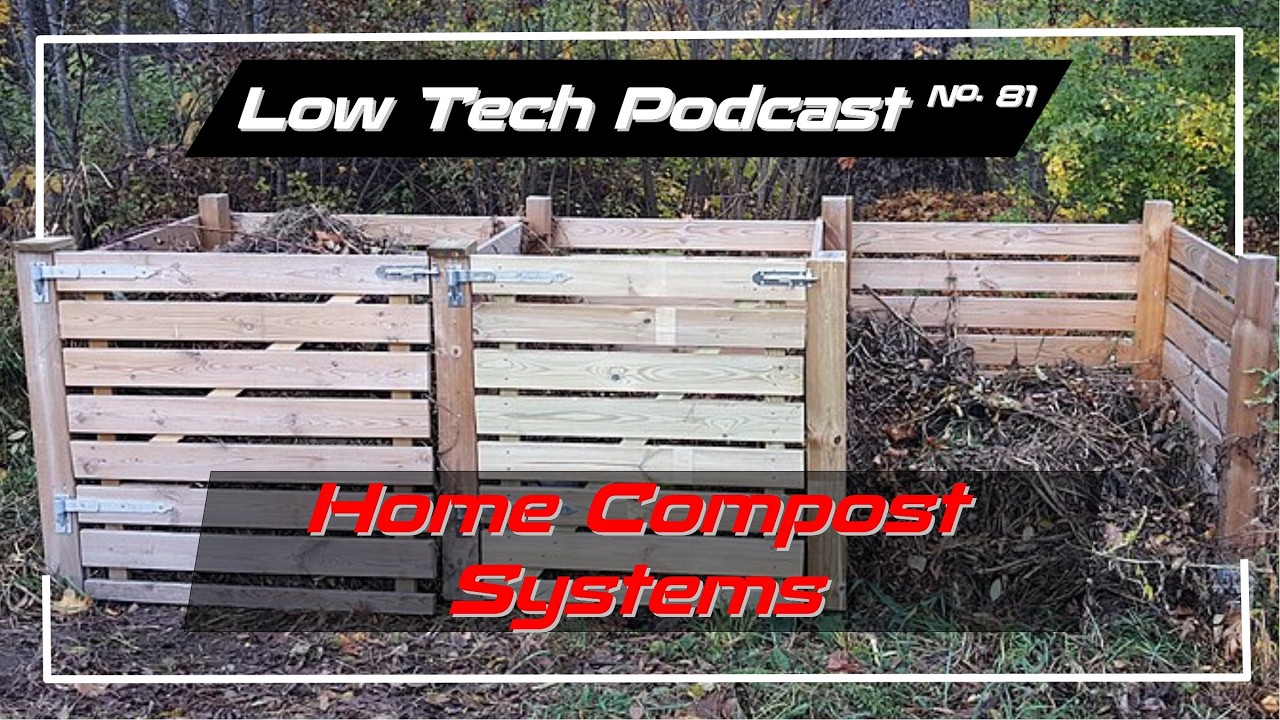
Video summary
Scott Johnson from the Low Technology Institute presents a seminar at the Wisconsin Gardening and Green Living Expo that advocates for returning to circular nitrogen economies as an alternative to fossil fuel-intensive synthetic fertilizers, which often cause environmental issues like algae blooms in the Gulf of Mexico. The core philosophy emphasizes treating soil as a living organism by utilizing microorganisms such as bacteria and fungi alongside macroorganisms like earthworms to improve fertility, enhance the microbiome, aerate the ground, and reduce organic waste sent to landfills. True composting is defined by managing natural decomposition processes that require specific inputs including carbon-rich greens, nitrogen-rich browns, oxygen, moisture, heat, and time, distinguishing these aerobic systems from countertop dehydrators or anaerobic methods like Bokashi fermentation which merely ferment waste without reaching the high temperatures needed for sanitation.
For those with limited space or budget, Johnson outlines several low-cost options such as direct soil incorporation by burying scraps, ground bins constructed from heat-treated pallets marked "HT," wire mesh, cinder blocks, or cardboard liners to retain moisture while warning against galvanized metal due to potential lead content and noting that piles smaller than one cubic yard struggle to generate necessary heat. Apartment dwellers can utilize vermicomposting with Red Wigglers in bins filled with a 1:1 carbon-to-nitrogen mix of bedding like shredded paper, avoiding meat, dairy, onions, and avocado pits while producing nutrient-rich worm tea, whereas the Japanese Bokashi method uses specific bacteria to ferment waste anaerobically for two weeks before finishing outdoors. Medium-scale setups often employ three-bin systems that allow for a systematic rotation between active decomposition, cooling down, and finished compost zones, ensuring proper thermal cycling without requiring constant manual moving of materials.
As operations scale up or space permits larger static piles suitable for chickens, the presentation suggests building pens where birds can scratch through active material into an enclosed area to turn waste daily as they eat scraps and worms before scooping it back into the main pile. While commercial vertical conveyor belt bins exist, Johnson notes that a single large mass composts better than separate stages using the "one room schoolhouse" analogy, though having multiple systems allows for rotating piles to manage different decomposition stages effectively; similarly, windrows involve moving long lines of material across space by hand or tractor to aerate and mature over time. The speaker's preferred method for larger operations is an aerated static pile utilizing perforated pipes similar to septic drain fields with wood chips to distribute air pushed by electric blowers, which minimizes turning needs but requires careful moisture management checked via thermometers and squeeze tests of handfuls.
Key considerations for successful composting include selecting appropriate feedstock such as horse manure due to its balanced carbon-to-nitrogen ratio compared to chicken or cow manures, while avoiding rabbit and dog/cat manure because of pathogen risks; urine can be composted if diluted 10:1 after six months based on studies showing it does not harm plants when properly processed. Practical tips involve ensuring adequate volume for winter insulation using straw covers rather than relying on sunlight which mainly affects drying rather than temperature, maintaining correct moisture levels throughout the process, and understanding that decomposition takes time regardless of external conditions. The segment concludes by highlighting resources available online, inviting listener feedback, and promoting related local initiatives such as those from the Historic Cooksville Trust focused on bees and prairies to support broader green living efforts.
Read the full video transcript
[music]
Sorry for the delay. We are prepping for
the garden expo in Madison. So today
I'll [music] be bringing you a recording
of a presentation I gave there on
choosing a home compost system. This is
the low tech [music] podcast.
Hello and welcome. I'm Scott Johnson
from the Low Technology Institute, your
host for podcast number 81 on February
20th, 2026. I'm coming to you out of the
Lowtech recording room in Cooksville,
Wisconsin, where my neighbors are having
their well drilled, so you might hear
some background noises. Um, thanks for
joining us. Uh, today we're listening in
on a seminar I led on home composting at
the Wisconsin [music] Gardening and
Green Living Expo in Madison, Wisconsin
last weekend. And we'll get back to our
regularly scheduled visit to the year
2100 in a few episodes.
Do you want to hear your voice on the
podcast? At the expo, we interviewed a
half dozen people about what they would
like to see in the year 2100. Here's a
quick sneak peek of that.
Tell me your name, where you're from,
and if you jumped in a time machine and
went to the year 2100, what would you
like to see the world looking like? And
leave modern politics out of it because
it's 75 years from now. So,
>> right. I'm Reed. I'm originally from
Arkansas, but now I live in Madison,
Wisconsin. And the world 2100. What I
would like to see is I would like to see
a world where we are giving back to the
local ecology more than we're taking or
at least as much. uh would like to see a
world where we are
living in a way that is
more more sustainable that's you know
not predicated on endless growth and
more about satisfying our immediate
needs than
>> you know going and trying to
>> make everything uh immediately
accessible and easy and frictionless all
the time.
>> Yeah.
>> Cool. Well, thank you.
>> Of course. Yeah,
>> thank you.
>> Yeah, first one. Yay.
>> All right.
>> We're going to be featuring all these
voices on an upcoming episode. So, if
you'd like to add your voice to this
discussion, please send me a voice note
with your name, location, and what you'd
like to see if you stepped out of a time
machine in the year 2100. You can send
that to scottlinstitute.org.
[music]
Um, and please send that in by the end
of February.
And don't forget to follow us on
Twitter. Oh, just kidding. We're not on
Twitter anymore. Like us on Facebook,
find us on Instagram, subscribe to us on
YouTube, and check out our website,
which is low techchinstitute.org.
There you can find both of our podcasts,
as well as information about joining and
supporting the institute and its
research. Also, some podcast
distributors put ads on podcasts. Unless
you hear me doing the ad, someone else
is making money on that advertising. So,
while all of our podcasts, videos, and
other information are given freely, they
do take resources to make. If you're in
a position to help support our work and
be part of this community, please
consider becoming a monthly supporter
for as little as $3 a month through our
Patreon page, and that's
patreon.com/lotchinstitute.
If you'd like to sponsor an episode
directly, please get in touch with us
through our website, which again is
lowcinstitute.org.
And hey, monetary support is great,
[music] but sharing our podcast or
engaging with us on social media also
helps. So, thank you for those of you
that do that.
And now with only a little further ado,
here's the recording. The sound quality
is a little less than usual. But the big
problem was that the projector was not
working until halfway through. So you
might hear some cheers as that um gets
working. [music] Please bear with us for
the on the-fly troubleshooting,
including when the presentation from the
next room on hummingbirds appeared on
the screen in our room for some reason.
Yeah, got to roll with it. So, here we
go.
>> So, today uh we're going to be talking
about home compost systems and uh my
name is Scott Johnson. I run the low
technology institute. We are a 501c3
research and uh educational nonprofit
and we like to think about how are
people going to live uh in the future.
And we're talking far in the future. And
uh we talk a lot about things like
localism, which means getting most of
what you need to survive and live uh
comfortably from your local environment
and from your local region. Um which
solves a lot of sustainability and other
problems we'll get into another time. Um
but basically compost is really
important because if you think about it,
um before World War II, uh well actually
before the 1800s, uh a lot of
agriculture was a circular system,
right? They were bringing in nitrogen,
which is the limiting factor, uh from a
variety of sources. is they were
fighting wars over nitrogen. Um, which
is kind of crazy to think about now. And
then in the 1800s, the harbor brush
process was invented where they take
atmospheric nitrogen, compress it to 400
atmospheres and they can get soluble
nitrogen out of it. Uh, just takes a lot
of energy to do it. And uh then people
stopped fighting about nitrogen because
they can make it. And we started using
fossil fuels to do that. Um and then we
went through a couple world wars and
after the second world war they had all
this extrogen nitrogen uh production
capacity because they also makes really
good bombs which is why you hear about
fertilizer plants blowing up or people
buying nitrogen fertilizer to make
bombs. Not that I would No, we're not
getting that's that's my later
presentation. [laughter]
No, no, no. If the NSA is listening,
that was a joke. Okay. Um [laughter]
so anyway, uh they had all this excess
nitrogen fertilizer after World War II.
So, they said, "Oh, you should have
clover, no clover in your lawn. You
should buy fertilizer, stuff like that."
And so, we've made a one-way street with
nitrogen. Um, I'm just kind of harping
on nitrogen since that was the limiting
factor. And it goes from the factory to
us, uh, and then down the waist stream
it goes into the Gulf of Mexico making
giant algae blooms and things like that,
right? We all know this probably if
we're here. So, what we're talking about
now is create going back to more of a
circular nitrogen economy and not
throwing our nitrogen down the uh, tubes
literally. So, uh, one of those ways you
can do that is with a home composting
system. Are we going to solve all
problems with home composting? Yeah. No,
I'm just kidding. [laughter]
I used to have a composting system that
was so robust it could, uh, both smother
and, uh, completely eat a human body in
under a month. So, I used to tell
people, "Don't mess with me or I'll put
you in my composter." But, [laughter] I
decommissioned that one. So, okay. We're
not going to talk about a system quite
that big today. But, um, so today we're
going to talk about home composting
systems. We'll start Okay, we'll start
uh with why do we compost? If you're
here, you probably have some good
reasons to compost already, so I'm not
going to dwell on that very long. Uh,
we'll talk about what compost is. We
will talk about uh how to compost really
briefly. This is not a how-to compost.
It's about uh what would be a good
system for you uh in your current
situation. So, we'll talk about uh that
really briefly just so that we have the
basic nuts and bolts down because that
kind of informs what kind of system you
might want to install. And then we'll
talk about a variety of compost systems,
starting with the smaller, working up to
larger, talking about how price
intensive they are, um, and what sorts
of considerations you might want to have
when making that decision. So, why would
we want to compost? It'll come up
someday. I my slides aren't that
exciting. Um, number one, it improves
soil fertility, right? It's a source of
NPK, which is not the only only thing
that we need to put into our soil, but
it has those. Um, it also improves the
soil microbiome because the same things
that are decomposing everything in the
compost are really great to have in your
soil to feed your plants um and to
support all the other things that are in
your soil that also support the the
plants. Right? 10 years ago, if I said
soil microbiome, some people would know
what that is. But today, raise your hand
if you know what the soil microbiome is.
Most people. So if you don't know the
soil microbiome, uh it is a shift that
has happened in the last decade of
viewing soil not so much as a sponge for
holding nitrogen, potassium um and other
chemicals that the plant eats like a you
know just some inert sponge. It's
looking at it as a living organism.
We've heard the you know how many
billions of tiny microorganisms are in a
cup of soil, right? Uh these things all
work together symbiotically hopefully um
and they make these nutrients more micro
available to the plants. There's all
kinds of great things that are going on,
the fungi, everything. It just all works
together, which makes total sense. I
mean, all these plants evolved on this
planet with that micro with a microbiome
in the soil, right? Um, take it had to
take a breath. Okay. Uh, so, uh, it
conditions and builds the soil. It
airrates and adds organic matter. Um, it
reduces waste. Um, I have a really cool
chart here that shows that about 70% of
what goes into our waist stream could be
theoretically composted. Uh now, are we
really going to compost the 70% of our
waist stream? No. Uh because, you know,
it's going to have treated wood and
stuff like that that you definitely
wouldn't want to put into your um
compost. Uh but there has the potential
for a lot of organic matter that's going
now into waist streams, which is why if
you drive uh from here towards Milwaukee
and you see the old uh landfill that has
been covered and there's pipes coming
up, that's to release methane and stuff.
Uh it's uh there's a lot of organic
material that's not being reused, right?
It's that one-way nitrogen street that I
was talking. Um and also if you're just
a dollar and cents person, having your
own making your own fertilizer is one
less thing you have to buy. Things are
only getting cheaper. So you know um
especially [clears throat] especially
nitrogen fertilizer you know as uh maybe
not today or tomorrow but you know in a
couple decades as uh as energy becomes
potentially more dear uh perhaps
nitrogen fertilizer will become more
expensive. Um okay so now we're moving
to what is compost. I'm so sorry that
this is not working. Um
>> they're not on at all. Yeah. So um so
what is compost? Well, if you think
about it, we're really just managing the
natural process of decomposition. So,
decomposition is going to happen no
matter what. Uh if you have an organic
material, eventually it's given oxygen,
uh it's going to or even not in some
cases, uh it's going to decompose. Um
but if we manage a few inputs, we can
kind of hypercharge that or supercharge
that, right? And we can speed up the
process. And all of us would love to
have um what do you call it? a compost
system that would, you know, you put in
your banana peel today and tomorrow it's
usable soil. Unfortunately, even ah
shoot, have you, if you listen to
podcasts like I do, you've probably
heard of something called mill or you've
seen it on the internet. They're like
these little countertop things and you
put your food in there and it makes
compost. I'm not going to talk about
those today. Um, basically
[clears throat]
those are supposed to do supercharging
like that. And from what I've seen, I
don't have one, although if they want to
send me one, I will test it and give it
an honest review. Um, they don't really,
um, compost. What they do is they
dehydrate and grind up so that when you
put it in the soil, it then
[clears throat] composts itself in the
soil later. Um, but really without micro
b without microorganisms breaking it
down and going through the heat and the
cold cycle or the the heating up cycle,
it's it's not true compost. It's a way
though to reduce food waste in this
waist stream. And if people did that,
that's great. I'm all for reducing food
waste in the waist stream uh and just
throwing away nitrogen. But there's ways
that don't take a lot of electricity.
Those take electricity, too. So, yeah.
I'm not going to get into those, but
they're kind of it's an interesting
idea. If only worms were so popular. All
right. It's a little more uh I'll talk
about worms later. I used to give a for
the last five years I've been giving a
vermma compost uh talk here but not this
year unfortunately. My worms are happily
at home. Um so we have uh a couple of
biological processes going on here right
so we have microorganisms like f mold
fungi and bacteria uh breaking down food
or breaking down our our compost feed
stock fancy uh on the microscopic level.
And then we have macroorganisms like oh
potworms, ants, pseudoc scorpions,
portood, millipedes, centipedes, mold
mites, soil flatworms, springtails, and
sometimes actual earthworms. Um, and I
have a really cool chart that I'll show
you because it's so cool. Uh, once I
think we're getting closer to having
maybe closer to having Okay, we got
fingers crossed. That's on our way.
Okay. Uh, but I will briefly go back
through these things once we get it back
up. Um, once we get it up and running.
Sorry, everybody.
I know. But still, um, I can only dance
so much and I can't really do a potworm
and separate that out from a millipede.
I It's not It's not quite the same.
All right. Well, what's this one? No, I
don't know. Okay. Uh, [laughter]
[snorts]
so, uh, I try. Uh, so there are just
like building a fire, right? What do we
need for a fire? Everyone knows if you
know you need your fuel, you need your
oxygen, and you need your heat. Same
kind of thing really. Um, I kind of got
to thinking about my compost as a really
slow lower low burning fire because it
needs kind of the same stuff. It needs
um oxygen because there are ways to do
anorobic composting and I'll talk about
them um in a little bit, but um for the
most part we're going to be dealing with
aerobic oxygen uh consuming uh
composting systems. It needs carbon and
it needs nitrogen. And both of these do
different things. So the carbon, we'll
talk about the carbon and nitrogen mix
in a minute, but carbon is brown dry
organic material and it is food for
microbes and cells are about 50% carbon.
So they need a fair amount of carbon to
split and divide and eat more stuff,
right? So having carbon is important and
nitrogen that's your greens and your
moist materials and that al provides
other things for the cell like uh
proteins, amino acids, enzymes and other
cellular building blocks. So it needs
both. You can't just have nitrogen. You
can't just have carbon, which probably
no. And the last thing that I feel like
gets neglected perhaps the most is uh
moisture. And maybe not neglected the
most, but uh often uh problems with
composting piles are either the nitrogen
or carbon mixture and or they get too
dried out or both uh cuz then moisture
can go uh through pretty quickly. Um
microbial activity happens on a film of
um of moisture around uh around any
particular piece of of feed stock,
right? And so if you have too much
water, uh there's no oxygen exchange. If
you don't have enough water, there's no
moisture to uh for the bacteria and
things to be active in that moisture
film. So you got to have the right
amount of moisture. All right. Um again,
really like the most amazing slides. Oh,
hey. He's a long-term
um he's usually in the other room doing
demos, but he's here now, so I'm glad to
have him. All right. Uh so inputs
process. Okay. So regardless of what
type of compost system you Hey,
now
please pause and contemplate the All
right. So I plugged in
>> [laughter]
>> That's the presentation next door.
>> It is. [laughter]
>> That's next door's presentation.
[laughter]
>> These are my friends Lisa and Frank.
>> All right.
>> How much you know about hummingbirds? Uh
>> compost their food
>> if you can catch it. Um
>> I know. Oh, I know that they like uh
tobacco plants cuz we have tobacco out
where I live and the really beautiful
trumpet. Uh and they're great attractors
for So if you're interested in a plant
that might attract hummingbirds, maybe
ornamental [clears throat] tobacco,
that's end of lesson on hummingbirds.
Okay. Um so process because I only have
so much time. So as Brian endeavors
here. All right. Um, so you're
regardless of the process you're using,
unless it's vermic compost or another
one I'll mention later. Um, basically
what you're doing, uh, you have your day
one, right, where you're putting most of
as much feed stock as you can all at
once. Sometimes it's not possible and
you're feeding over a period of time.
That's fine. But it's nice if you can
start with a big glut of material. Um,
everything's at ambient temperature and
microbes are just starting to get
activated. Um, and then for the first
couple of days, if everything's going
right and you have enough irration,
meaning oxygen, enough moisture, carbon
and um, nitrogen, you're going to get
some initial warming, this is the
messilic, which means like middle heat
uh, period, and the bacteria start to
break down uh, and oxidize organic
materials. It starts to warm up. This is
up to about 120° and then you have your
peak days from about day 5 to 20 if this
is ideal. Um, and there you're reaching
temperatures up to 150 um, over that
even sometimes, but that starts to kill
off the uh, bacteria that you want. So,
this is the thermopilic. So, that the
high heat loving bacteria are really
going um, they become active and they
take over and continue to break down
organics, but they start to die off when
it gets too hot. This is really
important to reach these peak
temperatures because that kills off
pathogens. Excuse me. [clears throat]
Kills off pathogens and also weed seeds
because I certainly have been guilty of
spreading my weed seeds by because some
people uh choose not to compost their
weeds uh if they have any sort of seed
head on them because if you don't reach
these temperatures, you're just
spreading more weed seeds on your garden
which is you know kind of usually
counterproductive. Um, so if unless
you're confident of reaching those, you
might consider composting your weed
seeds uh in a different way or uh
heading. Anyway, uh after day 20, as
things start to cool down and I have all
these really great temperature curves to
show you in theory, uh we can all cra
behind me here and look on my laptop.
Should I plug in?
>> Yeah.
>> All right, let's see.
>> Keep. So, um but my presentation has
disappeared up here. So, when it shows
up there, [laughter]
it's okay. I can go on. It's fine. It's
better that we get this connected. So,
all right. Uh, it's just it's on some
screen. So, it's reading somewhere. It's
It's reading a second screen.
>> Oh, that would be hilarious if I keep
taking over the one next door.
[laughter]
>> It wouldn't be, but it cuz it's it's
definitely reading a second screen here.
Sorry. One second, folks. I'm going to
pull up my my display. I'm so sorry. Oh,
it pulled it up on the others. Oh, there
it is. Yeah, I have two screens right
now. There's a second and a first. Okay.
Fun times. All right. Okay. So anyway,
um after the as after after the
temperatures start to come down and
we've been turning it to get the heat
get the oxygen in there and all that. Um
we have cooling days. So from day 20 to
40 plus, we're letting it cool down.
Some messilic bacteria come back and
finish off the compost. Um and this
helps condition the compost so that it's
nice to go in your garden and not going
to burn anything by having too much
nitrogen left over. Um or too much
carbon left over, which could also sap
nitrogen out of your out of your
existing soil. Um finishing days. Um
right. So, what do you get out of this?
And again, this is not a how-to compost,
so I'm just kind of breezing through
this. Uh there almost certainly uh
composting uh information in the vendor
room and also other presentations. Um
>> Oh, yeah. Thank you. Thank you. All
right. Now, can I
>> I've got one more.
>> I'll take it. Now, can I drag Oops. Can
I do this without Sorry, everybody. It's
like patting my head. And now, can I go
full screen presentation, please?
Okay. Cross your fingers everybody.
Slideshow. Slideshow. Hope. Hope. Are we
at the beginning? Yes.
>> Um that QR code uh is a link to our blog
post from today on our website and it
has the slide deck on it. If you want
it, it's there. Uh also are the other uh
presentations that I'm giving this
weekend. Um so
>> put it up again.
>> It'll be up at the end again.
Absolutely. And hopefully it'll be on
both. That's my great hope. All right.
So why Okay. So now we get to catch up.
Benefits of applying compost, soil
benefits, water benefits. I know, deja
vu. Um, anyho, so uh I know I apologize
for having to skip through this, but
let's get to where we were.
Decomposition,
micro and macro. See, this is the cool
slide I was referring to where I was
doing the interpretive dance being the
millipede, centipede. There's a lot
going on. Uh, ingredients here we have
our moisture, oxygen. Haven't talked
about particle size yet, but I will. um
inputs and outputs. So, we're getting
close to where I was. So, here's uh
yeah, some again, this is not a how-to,
uh which is lucky because there's a lot
of good information. All right, this was
the temperature curve where we had the
initiation phase, the heat, sanitation,
and seed killing phase, and then the
maturations, right? Black go Texas. Uh
not quite. All right. And so, here's
another temperature, a longer uh
temperature, and each one of these uh
arrows represents a turning event. Get
tickets for that. um where you're uh
turning over your compost pile. Uh
anyone here ever forget to turn over
their compost? I Yeah. All right. So, we
are almost Where was I almost there? I
jumped ahead. Okay. So, man, uh finish
compost and distribute compost. I'm
sorry. Oh, no.
>> All right.
>> So, now we come to the actual meat of
what we want to talk about. Uh I
apologize for folks over there. Uh so
before you choose a home composting
system, uh your major questions at least
in my oh oh in my uh
>> thank you tech wizards. All right,
there's a who came up there's someone uh
who came up with the idea that basically
any technology that is so complicated
that to to function or to understand
that it's essentially magic. Yay. Uh,
all right. So, uh, how much space do you
have is for me the where I would start,
right? Are you in an apartment? There
are certainly ways you can compost in an
apartment. Um, you may have to not tell
your landlord. No, it'd be fine. Uh,
there are certainly ways you can compost
in a apartment that don't smell um and
are small spaced. Um, how much and what
types of organic waste do you have? I
live on a larger not large we have an
acre and a half and so I have as much
weeds as I want [laughter] or more weeds
than I want let's put it that way but if
you live again in an apartment maybe
you're just dealing with uh food scraps
uh largely that's fine too um and how
much time effort and money do you have
to invest because I will tell you on the
money aspect you can go no there is no
end I'm sure William Sonoma has some
sort of composter system that's $1,000
[laughter] you make it yourself for less
probably all Right? Time, effort, and
money are always something to consider
because if it's a lot of uh time and
effort, it might be fun to start it. Uh
even if it's the cheapest option, but if
it's going to be a lot of time and
effort and you let the system break down
and it doesn't do what it needs to do,
and you have a big stinky mess, you got
to know yourself. So, here's a fancy
flowchart that we're not going to go all
the way through, but it is one way to
think about it. And if you want, uh I'll
leave that up for a minute. Um but yeah,
so for uh most of us, I think we're how
how small should I put there? I'm sorry.
All right. So, let's talk about some of
the small systems. These are the and
we'll start with least money intensive
and then we'll move to more money
inensive or complicated flex like that.
So, um but also I will say the more to a
point the more complex you get the
better your results the more you can do
and then there's a law of diminishing
return right once you get comp. Um so
soil incorporation this cost you just
about nothing. Um, some folks uh will
just go out and dig a trench and
literally just put kitchen scraps right
in the ground. There's nothing wrong
with that uh necessarily, especially if
you're putting in a fair amount of
nitrogen heavy stuff and if you're
taking it out of your kitchen, you're
probably pretty nitrogenheavy. Um, if
you were to bury lots of carbon, say I
did this same Oops. And I apologize. I
could see the picture. You couldn't uh
for my fault now this time. Okay. Um, if
you're doing kitchen scraps, you're
putting a lot of nitrogen directly in
the soil. It's going to take a little
while to break down. Um, but it will
break down. Um, and you're not going to
get the hot and cold. So, make sure
you're not putting seeds and stuff like
that, right? So, like you have peppers
or tomatoes or things like that or
potato ends. You're not going to put
those in there. If it's going to
>> get potatoes,
>> then you get potatoes. [laughter]
Who likes potatoes? No,
>> we we have
>> I
thank you for bringing up potatoes
because I'm a potato evangelist. I need
to have a spangel I need a good name for
it. But I will push potatoes on any
presentation that I can. I did for years
a presentation that I wasn't even joking
about potatoes saving humanity, which I
would do every time if they'd let me. I
asked, "Can I do the potatoes again?"
They're like, "You did it last." Okay.
Anyway, uh so yeah, don't put viable
seeds in the ground. If I did the same
thing with wood chips, it would suck
nitrogen out of the soil because wood
chips are basically just large carbon
chunks and it would suck uh nitrogen out
of the soil around it. This would add
soil to or nitrogen to the soil. Cheap,
easy. If you got a garden and it's
doesn't smell, I mean, it's a quick and
easy way to do it. Um, if you do it a
lot and you don't bury it, you know, a
bit, uh, you might get raccoons coming
and smelling it and digging it up.
That's a possibility. So, something to
think about. Um, the next thing, these
are probably the most common. Who's had
a ground bin? Like a Yeah, bins on the
ground where you put stuff in. Yeah,
that's they're simple and they can be
super cheap. Um, you can do them out of
pallets. Uh, you can do them out of uh
wire. You can do them out of uh cinder
blocks. If you do pallets, here's my
public service announcement. Make sure
that you get a heat treated pallet, not
a chemical treated palette. There's
different designations. Um but they'll
have something like you see my I can see
mine. Are there is there a pointer? I
didn't see it. Usually there's like a
pointer or something. Okay. So over
here, um we have these different symbols
and this heat treated one is usually the
best. That just means they heated up the
wood to kill pathogens and stuff in it
and to keep it slightly longer. uh from
disintegrating, but it's essentially
untreated with chemicals. So, make sure
you're getting heat treated, which I've
only ever seen chemically treated ones
every once in a while. I will also
mention, and this is completely
anecdotal, and I mentioned it just
because it was pretty nasty. A friend of
mine will not use pallets at all. Won't
even touch them because her daughter got
a sliver from a palette and got a fungal
infection that nearly took off her arm.
>> So, wear gloves. I still use I still use
the pallets but you don't these come
from all over the world and you're you
know you might get some not to pick on
Somatra but I'm going to pick on Somatra
Somatan born fungus that a doctor in
Madison Wisconsin has never seen because
we don't deal with funguses from Somatra
very often that's not where it was from
but just picking on it. Uh so heat
treated is the way to go if you're going
to use pallets. Uh but yeah, you can use
wires. Um you might stay away from
galvanized because there's a bit of tiny
bit of lead that could but it's pretty
minimal. Uh, something to think about.
All right. Uh, where am I? Bins. Ground
bins. Um, and if you do, you can do a
single ground bin. That's okay if that's
all you have the space for. We'll talk
about triple bins in a little bit
because those are preferable if you have
the space. Um, these can be
[sighs and gasps] these can be small.
Bear with you. Uh, these can be small,
but really you want to be like 3 feet on
a side so you get a yard at a time. Um,
a cubic uh yard at a time because if you
get smaller than that, it's really hard
for it to heat up and cool down
properly. If you have less than a yard,
uh, we can talk about even smaller
systems. Yeah, they're stamped right on
there. Yeah, all of these, all of the
pallets have to have stamps on them that
says, you know, where they're from, all
kinds of stuff like that. But look for
the HT. Sometimes it's not in a circle,
but yeah, HT is what you'd be looking.
So, yeah, approximately like any if you
take three pallets and knock them
together like and stake them to the
ground, those are that's [clears throat]
perfectly fine. or across the front like
that, you know, any configuration, but
approximately a yard is the rule of
thumb. Probably also because pallets
come in basically 3x3. They come in
different sizes, too. Um, so that's
that's the most basic, the easiest one.
You can probably get free pallets around
Madison. Uh,
so, uh, you can use bins. So, this is a
just a wire four 4 inch by 2 in wire
mesh looped around. I do this with my
leaves. Um, these are very open and they
lose moisture really fast, which is
fine. You could uh line that with a
cardboard if you can get like a
refrigerator box or something like that.
[clears throat] Um you can just throw a
layer of cardboard around there and then
pack in there and that'll keep the
moisture in a little better. Uh but
maybe you have really wet uh materials
going in anyway. So you don't
necessarily need to do that. But uh
excuse me. All right. I will say for
legal purposes that you should not
compost human or uh pet manure because
uh outside of an approved system for
doing that because there is there's
possibility for pathogens. There are
ways to compost human manure uh that I'm
not going to get into today, but they
involve letting it sit for two years to
make sure that it's completely free of
that being said. That being said, in
theory, if someone wanted to, against my
advice, which I legally have said, do
not do it. Uh, if if it reaches the high
temperature and it's your own poop,
you're not going to give yourself
anything that you don't already have.
Just saying. But I I'm for legal
purposes, I'm [clears throat] saying use
approved like a composting toilet.
That'll do that. Um, and it gives you
finished compost right out of the bin.
and it's approved by uh the by a couple
different foundations to do or by a
couple different ways to do that. So,
I'm not gonna talk about composting
toilets today, although I'll have one at
my house here shortly, much to the
chagrin of some members of my family.
All right. Uh
anyway, [snorts] you're taking the
composting too far. Um cinder blocks
also makes a reasonable way to do it. Uh
they're configurable. [clears throat]
You can use uh they have wooden stakes
here driven in through the voids to help
hold it together. Uh you don't even need
to learn how to do masonry. uh to lay
them together time. Oh, good. Start at
quarter past the hour. Good. Excellent.
Um so, vermma compost. Vermmaic compost
is Oh, yeah. Question. Underneath the
blocks or on the ground?
>> That's all dirt.
>> Uh yes and no. Well, so it's on the
ground because then it lets microbes
come up from the soil, which is fine.
That's true. Uh because compost is uh
when you put on feeds, are you putting
on like a I know for me when I mow the
lawn, which I do infrequently and so I
have large piles of grass that I'm
putting on there. Uh the next day it's
half the size and the day after that
it's quarter the size because it's
moisture. It's giving off moisture real
fast. So you're largely losing water
weight. So it's a poor dieting uh
method, but it works. Uh but yeah, so
it's it's largely water weight that
you're losing and carbon dioxide and uh
hopefully not methane, carbon dioxide.
So it yeah, it's true. Uh but if that's
not because the bottom isn't there, it's
because compost is breaking down
significantly to like a tenth of its
size often depending it depends what's
what you put in. So uh it depends on uh
the feed stock. So yes, it certainly
will reduce in size. Um vermma compost.
So this is for you apartment dwellers.
Um, vermic compost uses worms and it
does not heat up. This is a completely
different system. This is basically
feeding worms and then using worm poop
which looks a lot like soil because well
worms live in soil and their poop is
indistinguishable uh other than it has
lots of great stuff in it. But it's not
the same biological process. If you heat
this up to 150° you will have uh compost
full of dead worms.
So you don't want it to heat up. But
they will take fresh scraps out of your
kitchen. I did I've done a lot of
presentations on this. You can find them
on our website um uh and podcasts and
things like that. So, you can want to
listen to it. But basically, um you're
putting in fresh uh food scraps other
than not meat, not dairy. Um and a
couple other things they don't like to
eat like they're they don't like onions
or uh they won't break down a avocado um
pit or skin, stuff like that. So, a
little idiosyncratic, but you can put
pretty much everything in there. Uh they
like bread, no Atkins for them. Um and
they will How old am I? Uh [laughter]
so, yeah. Uh, and they make worm tea,
which is the liquid that squeezes out of
it. They live in the top 8 in. So, you
just keep adding to the top and they
work their way up and then the bottom.
So, there's a lot of nice bin systems
that are super cheap. If you were very
resourceful, you could probably do it
for practically nothing other than
buying the worms, which are going
continue to go up in price. Um,
>> is that shredded?
>> So, [clears throat] yeah, you can put
shredded paper in there. It helps. Uh,
so you want a one to one nitrogen to
carbon mix in this because you're not
depending on the microorganisms.
Although they are working, the worms are
doing the majority of the work. Carbon
in this instance is a water uh it
absorb. Yeah, it retains water, but it
also [clears throat] lets water out. So,
it it regulates the amount of water
because why do earthworms come to the
surface when it rains? They can't
breathe. They breathe through their skin
and they need some oxygen air contact.
And so, um same thing here. If it's too
wet, they're unhappy. If it's too dry,
they're unhappy. Uh, but these can live
in your apartment. And, uh, the only
word of warning is get red wiglers to do
it. Do not dig worms out of your garden
and do this. Unless your garden's full
of red wiglers, which probably not. Um,
because you will come home from a long
3-day weekend and you will find a whole
bunch of dead worms on your kitchen
floor and your wife will get upset with
you. Not that that's happened to me.
[snorts]
[laughter]
So, then we got red wiglers. I said,
"This is why I need to invest in the red
wiglers, honey." And she said, "Okay,
fine." And then now we haven't had any
runaway worms in a decade. So um get the
right worms that like to live in
containment. They're perfectly happy
eating and reproducing for years. All
right. Uh so vermma compost one good
option. The other one um is vocashi and
this is a Japanese anorobic uh bucket
composting system. So this one is kind
of out there. It's if you like fermented
food, this is the composting system for
you because it is fermented compost. Uh,
it's an anorobic bucket and it uses a
bacteria, a little magic dust, uh, not
really, it's bacteria, uh, that you
sprinkle on it, and it breaks down
organics. It's bacteria that like to
live in anorobic or oxygen-free
environments. So, you fill up a bucket,
you put the lid on it with the magic
dust bacteria. [clears throat] Um, and
when it's full, it sits for 2 weeks,
they basically ferment. It gets really
sour uh, smelling uh, in the bucket,
right? Not in your apartment. Well,
unless you leave the lid off, but then
it would be organic, so it wouldn't work
or or uh oxygenated, right? So, leave
the lid on, keep it, tell your uh tell
your significant other and people in the
house, don't open that bucket. Um I
mean, my kids wouldn't listen. They
would open it and then they would learn
not to open it. Okay. Um it does you can
get special buckets. You can see uh
sorry, you can see in the next uh slide
here, there's a little it looks like a
coffee uh coffee urn. Don't drink it. Uh
but it does create a liquid that you can
pour off and pour right into your house
plants or other plants. Um so it makes a
tea just like uh vermma compost does. Uh
and after 2 weeks you can finish it off
in an open air environment outside. Um
and it's a little more acidic uh than
regular compost. So if you're growing
like blueberries and you need some
acidic uh need some acids for your soil,
this might be something for you.
apartment again. But it does cost it
does cost a little more because uh both
with the worms and with the picashi
you're getting um you're having to buy
you can get the buckets and you can use
regular buckets, but uh you'll need you
probably want to buy the uh anorobic
bacteria because they're not usually
just floating out and about in the
environment because it's aerobic. All
right, so those are some of the smaller
options going from cheapest and easiest
to slightly more labor intensive. Uh
moving on to medium systems questions.
I'm so sorry. Yes. Yeah,
>> sure. Good question. Sure. Good
question. So, the question was um what
if you're feeding uh only or what if you
only have uh feed stock uh episodically
and a lot of it that's easier for
composting I think generally other than
for the vermma compost. The vermma
compost the worms need to be fed
regularly just like your you know dog or
cat. Uh like once once a week that's how
often you feed a dog and cat. Um
[laughter] but if you feed the worms
once a week they're they're okay. Um the
bokashi would be good for that because
you could have four or five buckets that
are empty just stacked and then when
you're do you're process I imagine
you're processing stuff out of the
garden and you have a whole bunch of
stuff then you fill up a bucket put the
stuff in let it sit for two weeks good
to go. Yeah. internet the internet any
reputable you know uh garden or
composting website uh you know uh if it
looks like it was made in geo cities in
the 90s probably not you know um I'm
sure I didn't look on Amazon but I'm
sure uh okay um the other question but
yeah the other systems like I like
putting everything in a bin all at once
and letting it go rather than adding a
little bit at a time although that
doesn't always work for me either so
medium bin system so three bin setup so
if you have space for one pallet bin
really consider if you can ek out the
space for three bins because um if
you're continually adding to one, how do
you go through that nice curve to heat
up and cool down your compost and have
finished compost? If you're always
adding, it might stall out high. It
might never get hot if you're not adding
enough all at once. So, it it's it's
nice to have three bins. Um because you
can have here's how I usually do it. I
have one first bin, that's my active
bin. I'm throwing actively throwing
stuff in there and then I'll be taking
out of the last bin and I use a shovel
to move things along from one bin to the
other. Uh, you know, once a week I'll
dig out uh or once a two weeks, you
know, I might fluff them up every couple
of days to get air into the first two
especially and the third one as well.
But then as they start to finish and you
start to get an eye for it's like, oh
yeah, this is getting towards this is
cooling down below 100. So now it's
going to move into the final stage to
finish off. I see your hand with you.
Um, and then so you can have different
zones basically of compost and you can
move things through a little more
systematically. Um, you can also, and
this is another way to do the three bin.
Um, you can just use bin number one,
fill it up, keep airrating it, making
sure that that goes, and then when that
one's cooling down, you just leave
everything there. Then you don't have to
move it. And use bin number two as your
active one and fluff that up. Make sure
it's busy um getting enough oxygen. Um,
and then when that one is starting to
cool off, then you start to use bin
number three, right? So you could, and
then by the time bin number three is
just about full and done, uh, you can
empty bin number one. So you can do
that, too. That's slightly less
shoveling, uh, but it doesn't airate as
well. Usually [clears throat]
different ways to do it. I'm sorry,
there's a question. Yeah,
>> you can do it either like an assembly
line like I described or you can do one
bin, three bins next to each other
essentially, independent bins, right?
But then they have a moment to cool off
before you are adding. Yeah. Yes, you
can pump air into it. That's called a
airrated static pile. Well, there's
there's an airrated static pile and then
there's a more of a passive airrated
static pile. So, what you could do um
get PVC pipes and cut a whole bunch of
uh drill a whole bunch of holes in them
and then you put those maybe five for a
bin like that, five inch and a half
pipes with a lot of holes in them uh
into them as you fill them. And that
allows air to come in and out of the
middle and you have to turn it less. you
should still monitor it and it doesn't
work perfectly. Um, but I'll talk about
an arrated static pile on the next one
because usually you want to be a little
bigger than this for a air area. I would
call that a larger system rather than a
medium, but we'll get to it. Uh, good
question. Um, the other thing to mention
here, uh, what was the other thing to
mention? Oh, one thing if you have
chickens,
uh, one thing I've done is in front of
these, I'll make I I make a something
that fits on it. That's basically I
should have taken the picture of course.
uh like uh those boards, but I make a
little pen in front of it, and then I
close off the inactive ones and the one
that I'm actively adding to. I'll let my
chickens in it, and they'll go up and
they'll scratch down in the in the bin
and scratch everything out into the
little fouryard that I've made with
walls to keep it from going too far. You
don't really need to do the walls. It's
just slightly less messy. If you've had
chickens, you can imagine. Um and then
at, you know, every day or two, I'll
scoop everything back into the pile and
then they'll go back in and take it all
down. And then that really turns
everything around. They eat a lot of
scraps out of there. They pick out worms
and stuff, so they get to eat. There's
actually a woman in Maine, and I cannot
find the I cannot find the business for
the life of me, but I read about it. It
was amazing. She had a larger system
that we'll talk about Windows later, but
she would have uh she had contracts with
restaurants. She would pick up their
scraps so they could say, "We compost
all our scraps." She'd bring them to her
facility. She'd lay them down in
Windows. She had tons of chickens. The
chickens would eat through all the
scraps, pooping on everything, turning
it all over, com helping with the
composting, and then she would sell eggs
and meat back to the restaurants, and
then she sold the compost to gardening
places. So, it was like just a big old
cycle spitting money out. Like, it was
really amazing. So, but that's slightly
beyond the home composting system that I
think we're all here. But, I mean, I
would I'll take a 5% fee if anyone comes
up with that in the next year or two.
I'll be I'll be knocking on your door
for 5%. Uh trash bins are perfectly
fine. They make trash bins that are set
up for compost. Um where these are kind
of like a vertical conveyor belt a lot
of times where you're adding in the top
and it's uh working its and it's more uh
finished compost at the bottom, medium
compost in the middle, and then fresh
compost feed stock in the top is the
ideal. Does that really work very well?
I I haven't I haven't had a lot of
success with that because it it's best
when it's one big mass and it goes
through that whole thing together.
>> It's like a gra, you know, like a
graduating class going through school
together. Uh rather than like the one
room schoolhouse where you have like the
seniors and the first graders. It's a
little more complicated with the for the
teaching and also for the biology,
right? So, um so that's why you might
want to get three of those. That's why I
have them in the medium systems. Um
where you have one that's active, one
that's less I find them hard to turn and
airate and all these things. Um but some
people have with them. They're clean.
They're nice. Uh, so, uh, manufacturers
will have lots of instructions on use
these. I have not had luck, so I'm not
going to go too deep into them. Um,
yeah, an ice augur.
>> Ah, excellent. Thank you.
>> You have to cut.
>> Okay. So, if you couldn't hear, he's
saying, "Yeah, he uses an ice augur to
do this." Do you? So, now I can tell my
wife I need to get the powered ice
auger.
[laughter]
That's a That's a great idea. Thank you.
>> Drill a
>> drill augur. Yeah. Yeah. Maybe one of
those. I wonder if you could do it with
one of those paint uh augur type things.
>> Uh rotating drums. Everyone's Who's had
a rotating drum? Everyone loves a
rotating drum. Um
>> great idea. Everyone loves the idea of a
rotating drum. How about that? Um yeah.
So yeah, I just heard someone say it
doesn't work. Uh that's true of all
compost systems depending on conditions.
I've done a lot of different composting
systems. I've had worms on the floor.
I've had, you know, all kinds of things
go wrong. Um, but yeah, rotating drums.
Uh, the nice thing is they're easy.
They're probably the easiest to turn
because they're designed to turn. So,
that's nice. I think the problem is
similarly people will get one and then
they put things in over like 3 months
constantly expecting it to turn into
complete all compost when really you
have the one room schoolhouse situation
where you have the 12th graders and the
first graders in terms of composition uh
decomposition uh in your in your drum.
So, it's never going to be finished
quote unquote. That's why you know two
maybe three better and you have one
active one and you turn them all and
then you will get finished compost out
of it. But yeah, having three of those
is a bit more of an investment. That's
why I had them um on the end. Oh, so
this is the first time I've given this
pres. So the chicken composting uh I
used to say chicken composting and
people are like why would you compost
your chickens? [laughter]
>> No, the chickens are for eggs and
heating. Uh the compost is Yes, they
help with the compost. So, this is one
way. Uh, I would actually open up the
side of that and let them spill it all
out, but yeah, it's a I went through it
already. So, this is a new presentation
this year, so um I don't have it all
down. All right. Large systems. So, if
you are blessed with a little extra
space and maybe a lot of uh feed stock,
you could do something as simple as wind
row. Windows are uh long piles. And
basically if you had, let's say we had
this room and we wanted to turn this
lovely indoor space into a outdoor
smelling space, [clears throat] um you
would just pile compost in a line over
there and then when that h gets high and
big enough then you would come in and
move it over into a pile next to it or
into a a row next to where you
previously had the pile. You can do that
with a tractor. You can do it with
special attachments that pull behind a
tractor. You can do it by hand. Um I
don't know, force labor your children to
do it. Uh that's the one I recommend.
All right. Not my children, your
children. Okay. [laughter]
And then in the space where that first
wind row wind row was, you add the next
one. And by moving it, you're uh
airrating it. And uh so eventually you
would, you know, get it all the way
across the room and you'd have rows from
most metriculated compost to least,
right? Um and then you'd scoot that up
and use it. Very efficient for large
spaces. If you have like a some
equipment to move it, you can do it on a
smaller scale, but again, you want to
have a yard, one cubic yard at a time
sort of as your minimum. So, you could
do a small wind row system. That'd be
possible. Um, airrated static pile.
Woohoo. All right. This is my favorite.
So, so an airrated static pile pushes
air. Uh, this is the active version. It
pushes air up through the pile and so
it's providing the oxygen for the price
of a bit of electricity and a uh and I
swear the the industry standard is uh
bouncy house blowers. I've got two of
them uh because this was the system that
could eat a person um because I put a
bladder over it like a a big tarp that
was water tight and airtight and uh I
was harvesting that carbon dioxide into
pipes and pushing it under uh grow beds.
Uh, and it was I had to measure it each
year uh and or each week and it was over
10,000 parts per million uh carbon
dioxide. So it was like well beyond what
would you know you would suffocate
immediately. Um so and it was hot and it
would break down uh organic matter like
that. So there wouldn't be much left. Uh
but basically what it is is it's a
plenum which means the pipes with the um
with holes drilled in it. You can use
the 4-in um septic system, drainage
system uh pipes that are 4 in with uh
pre-drilled holes, perforated perforated
uh pipes, and then you put uh some wood
chips on there to further help
distribute the air. And then you pile on
your feed stock and you don't really
have to turn it as long as everything is
going well. Um and so you can So these
are built on top of a concrete slab, but
you could put the pipes in the concrete
slab and then you could use a skid
loader to load in and out. I mean, if
you have if you want to like people um
these are really popular with people
with horses because you can compost a
lot of dung. [laughter]
This is that's what I use as feed stock
because horse manure is 25 to1 carbon
and nitrogen. It's the correct mixture
right out of the the horse. Uh because
they have they have less efficient
digestion than uh cows which chew their
cud. Horses there's a lot of a lot of
carbon left and nitrogen in there. Yeah,
chicken manure is hot. You could
certainly do this with chicken manure.
Um, I do it with mine. I have a smaller
system now. My big system for the
testing. Oh. Uh, the aesthetic airated
pile. Oh, yeah. For sure. You can go
down to I mean, if you're going to
invest this much in it, I would do two,
you know, uh, two yards by two yards and
maybe three bins. That's what I have.
You could do it with one yard. You can
do smaller systems. Yeah. Um, but then
you have to get a smaller blower. And
the blowers like I have the smallest
blower they have. Mhm. You could do a
three bin system with a static area
piled beneath it. ratio of so for
example I do for my chicken manure and
there's calculators online and at the
last slide I have a list of resources
and a couple of those have u calculators
where you can put in your feed stock and
how much of it and it'll tell you your
ratio so you so I have a giant pile of
wood chips which is my carbon and then I
have a chicken house with 11 chickens in
it and so I will do if I remember
correctly two wheelbarrelfuls of chicken
poop and scratch uh or uh litter right
now with two two or three barrel
barrels. I have to double check my math
of of wood chips and that's the correct
carbon nitrogen mix for mine. But you
can always tell uh
>> Yep. Because the chicken manure is very
very uh nitrogenheavy and the wood chips
are practically just carbon. Yeah. I
mean if it's from start to finish from
when I take it out of the it's 60 to 80
days usually and it's been rained on and
wet and so that takes a lot of the year
away. But I I use ura on uh on my uh
tomatoes. I mean, tomato food is ura.
Um, but you can compost urine. Most
people, if you're just saving urine, I
know it's
[laughter]
welcome to my life. My my spouse is very
understanding. Uh, but like 6 months, if
you compost it for 6 months and then you
dilute it 10 to one, it won't burn the
plants either. At least that's what uh a
Finnish study finish I think it was a
Finnish study showed. Um, and that's
what I've been doing for years. Um, you
know, I'll come over and eat some
delicious tomatoes. Um,
>> [laughter]
>> That was the finished study. It was does
do you uh transmit anything from the
urine to the the tomatoes? And they had
like a blind taste test. And there was
like and they also did like they sent
off the tomatoes like is there E.coli?
Is there all these things? And as long
as you don't splash them with fresh
urine, which you're not going to do, uh
don't [clears throat] pee on your that
that's too hot. you need unless you are
drinking so much water that your urine
is diluted to onetenth of usual strength
in which case you're probably going to
have we've gotten way off track here.
Okay,
sorry.
>> Um but actually surprisingly the third
most popular page on our website is uh
tomato urine uh tomato fertilizer out of
urine. Um and we're going to do a USD
well okay we were going to do a USDA
funded study on um using urine at
different dilutions or not different
dilutions but different um application
rates to tomatoes. Um but we're uh the
grant we applied to was the sustainable
sustainable agriculture research and
education and we're going to have to
rejigger that to be more in line with
what gets funded nowadays. I mean it's
just a different um
>> yeah so uh so here are some excellent
resources uh again um on the next slide
I'll have the QR code again so you can
scan and have this whole thing um but
basically we have five minutes for
questions or discussions if you've had a
system that I didn't show that you'd
like to plug and has worked well for you
love to hear about and add to this.
Yeah, go ahead. Ah so question was uh
good question for any of these. Um does
it need to be in a sunny spot? I was
listening to a podcast today and he
said, "Oh, my compost pile didn't work
because it was in the sun." And then he
said he gave it to his neighbor who put
it in the shade and it didn't work
either. So, uh, this the main thing that
putting it in the sun will do is dry it
out faster. It's not going to a bit of
sun isn't going to bring it up ne it'll
be negligible and only on the outside is
it going to bring it up a few degrees
here or there. So, shade, sun doesn't
matter except for it'll dry out faster.
That's the main thing. So, I keep mine
shaded just to keep the moisture in. Uh,
yeah. You had a question.
>> Yeah. Oh, rabbit. If No, you should not
compost your rabbit manure. In fact, you
should put it in a bag and give it to
me.
Yeah. Yeah. Uh rabbit rabbit's good. Uh
sheep, goats, that sort of thing are
fine. Um and honestly, dog and cat.
Yeah. It's because they're meat eaters
and because they might have pathogens
and blah blah blah. So, yeah. Uh don't
compost your uh dog and manure just
because Yeah. Don't legal reasons. Yes.
No. Come over there. Yeah. Go ahead,
please. So, if uh when do you turn your
compost? Excellent question. Uh, do you
have a compost thermometer? Compost
thermometer is your next purchase. I bet
you can get one here. Uh, I don't sell
them, unfortunately. I wish I actually
uh uh because what you do is you just
check it each day and as long as the
temperature is going up or stable,
you're good. Once it starts falling,
maybe give it one more day and then turn
it and it'll you'll see it go back up.
So, uh, it's just it's running out of o
as the temperature comes down, it's
either running out of nutrient uh,
nutrients, nutrients, what is that? uh
nutrients, water or oxygen. And so as
you turn it, you can see if it's dry. Uh
you want to be able to squeeze it and
maybe a drop falls out. If a lot of
drops come out, it's too wet. If not, if
it feels dry, add water. Um so mix it up
a bit. Um so yeah, that it'll be needing
water or oxygen. Uh so turning it will
help you figure that out. Eventually it
will go down no matter what because it's
eaten everything. Yes, ma'am. Oh, and
then I'll come over there. Sorry. Yeah,
go ahead. Sure. Great. Yeah, you can
vermma comp. Can you vermma compost
right in the garden? Absolutely. Uh they
can go away. Um but uh yeah, I mean I
was highlighting it today, but some
people buy and throw it right into their
compost and they'll migrate away from
the heat and they'll live and then when
it cools down they'll come back up. Some
people will dig down trenches and put
down um Okay. So you're letting them in.
I'm saying if you want to keep them
captive. Oh, that's nice. Free range
worms.
Um [laughter] so
>> I'm more of a warden. I would do I would
dig down because they only go down up to
a foot or so. I would dig down and make
like a a foundation type out of bricks
or cement blocks and then fill that in
with soil, put the worms in there,
compost on top. They'll stay within
there and then I could always go in and
dig out and throw shovel fulls across my
garden and let them out in controlled
fashion rather than let them free range.
Although that's that's good, too. Yeah.
Um yes,
>> it's good to monitor the moisture. If
you're turning it enough, you'll
monitor. I usually just water when I
turn. I say, "Oh, it's a little dry. Oh,
it's a little wet. If it's a little wet,
you can always add uh a bit of like wood
chips or carbon. Um something dry to dry
to or leaves or things to try and soak
up some of that moisture. Like I said,
if you take a handful and squeeze it, if
there's a drop or two coming out, you're
probably good. If it's dripping out,
it's too wet. If it feels dry and no
drops are coming out at all, then it's
probably a little dry. Usually, mine
tend to get dry, but mine are covered.
If yours are in the rain, they might get
wet. So, you might think about putting a
piece of cardboard over it just to kind
of reduce some of if they're getting
over wet, stuff like that.
>> Oh, okay. Okay. Keeps the critters out.
Yeah. Oh, nice.
>> Mhm.
>> The plate. Yeah, that's possible. And
also, it might be too small of a volume
to really heat up, which is Oh, it's for
the worms to competent in. Oh, nice. Oh,
you more freerange worms. Yes. Behind
you. And then you
>> What is the best way to recycle?
>> Good question. Um there there are some
places I don't know if Madison is one of
them that does take comp manure or
animal manure to compost it properly
under supervised conditions but I don't
know unfortunately I wish I knew. Yes.
[cough]
>> Well [clears throat]
uh you could so how the question was how
do you keep it warm during the winter?
Um you can make more insulate you can
put straw on top of it. You could put uh
you can insulate the sides. Make sure
the wind's not blowing through it.
That's one of the even my airrated
static pile was pulling in really cold
air um in the middle of it was running
in the middle of winter like it would be
10 degrees and I would be shoveling in a
yard of horse manure and shoveling out
another yard and it would be 10° and it
would be hot. It would be 90s 100 120 uh
because it's just they insul it's
self-insulating. So also volume if
you're in the winter you need a bit more
volume a lot more volume. Okay we're
running out of time.
So on Thank you. All right. Last thing.
Uh thank you on the low tech website.
It's on the blog. It's the top post on
the blog right [music] now.
[music]
Thank you so much for listening and
remember to send in your thoughts on
what you'd like to see in the year 2100
to scottloinstitute.org
by the end of the month.
And if you're in the Cooksville area and
interested in learning about bees and
pollinators or putting in your own
prairie, check out our neighbors, the
Historic Cooksville Trust, which has two
programs coming up here in Cooksville.
You can find out more information on
their programming at
historiccooksvilletrust.org. [music]
That's it for this week. The LOTE
podcast is put out by the Low Technology
Institute. [music] The show is hosted,
edited, and produced by me, Scott
Johnson. This episode was recorded in
the Low Technology Institute recording
room. Subscribe to the podcast on
iTunes, Spotify, Google Play, YouTube,
and elsewhere. We hope you enjoy this
free podcast. If you'd like to join the
community and help support the work we
do, please consider going to
patreon.com/lotchinstitute
[music] and signing up. Thank you to our
Forester and Land Stewart level members,
uh, Marilyn Scarpon and the Hamases for
their support. The LOTE Institute is a
501c3 research organization supported by
members, grants, and underwriting. You
can find out more information about the
Low Technology Institute membership and
underwriting at lowcinstitute.org.
Find us on social media and reach me
directly at scottlotchinstitute.org.
[music]
Our intro music today was Swinging in
the Seventh off the album Songs for
Paris by Dana Boule. That song is under
the creative comments [music]
non-commercial attribution license. And
this podcast is under the creative
comments attribution and share license,
meaning you're free [music] to use and
share it as long as you give us credit.
Thanks so much and take care.