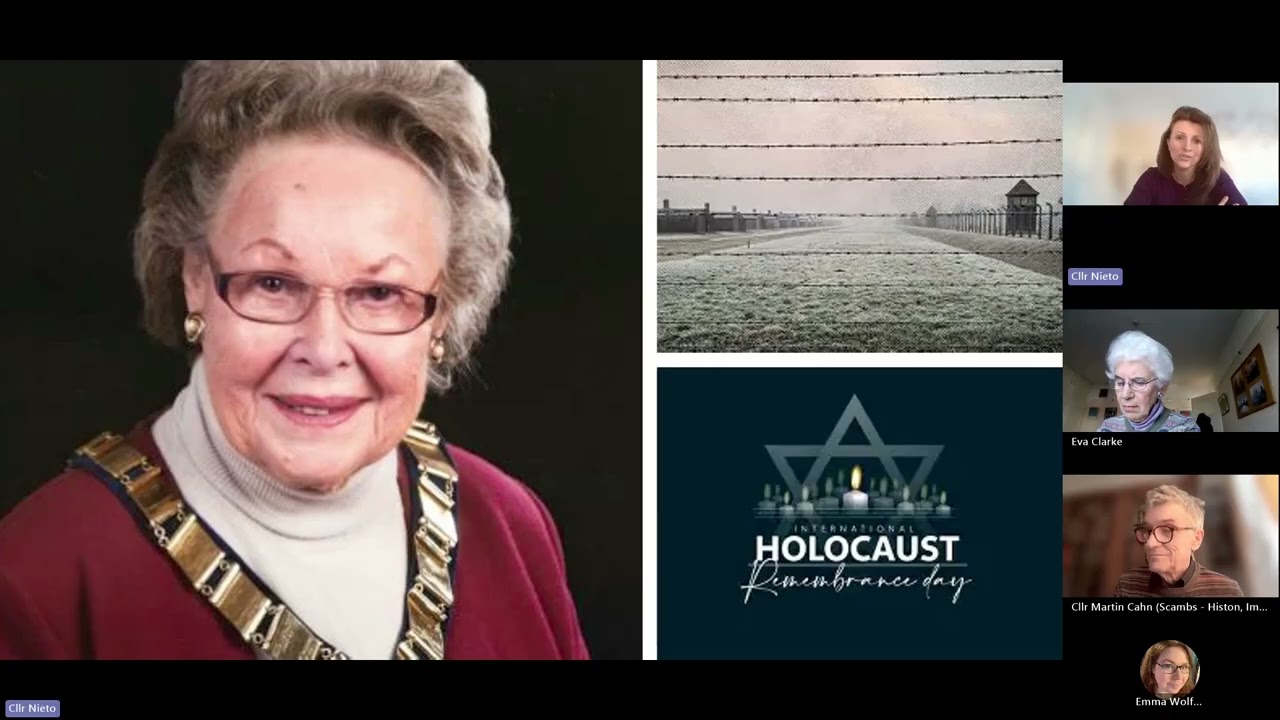
Video summary
The video commemorates Holocaust Memorial Day on January 27th, marking the liberation of Auschwitz and Birkenau in 1945, a date chosen to honor six million Jewish victims and millions others targeted by genocide. The event is framed not as a celebration but as a solemn day for remembrance, reflection, and responsibility, emphasizing that hatred must never be allowed to grow unchecked. Speakers highlight how the Holocaust began with dehumanizing words and labels rather than immediate camps, illustrating the dangerous erosion of empathy when people are treated as less than human or ignored by society. The narrative underscores that survival during this period was often a matter of sheer chance or miracle, relying on fragile threads of kindness from individuals like Paulina in Warsaw who risked their lives to hide families and smuggle children across borders.
A central theme explored through personal testimonies is the transformative power of choosing compassion after experiencing profound cruelty. Counselor Lina shares the story of Ruth Clapman, a survivor born in Vienna whose family faced persecution under Nazi rule before she eventually settled in Britain as a dedicated community leader. Despite enduring imprisonment and forced labor, Ruth chose to build bridges rather than walls, serving as mayor, working with charities, and dedicating her life to service after surviving the Holocaust. Her legacy demonstrates that even after witnessing division and injustice, individuals can actively choose empathy, rebuild communities, and turn trauma into a force for good, proving that kindness is not merely a soft value but an essential one holding societies together against rising prejudice.
The video also features harrowing accounts from survivors who describe their narrow escapes through the lens of luck and human intervention. One speaker recounts her desperate journey to save her parents by bribing officials and hiding in attics while others were sent directly to gas chambers, illustrating how a single wrong decision or moment of hesitation could mean death for an entire family. Another survivor details being born inside Auschwitz on April 29th, just days after the Nazis ran out of Zyklon B gas and before American troops liberated the camp; her survival depended entirely on timing, Allied bombing raids that confused German guards, and a doctor who cut the umbilical cord despite the chaos surrounding them. These stories reveal how genocide was not inevitable but resulted from specific choices made by individuals to look away or act with indifference, reinforcing why remembering these events matters for preventing future atrocities.
Ultimately, the message conveyed is that remembrance must shape present actions rather than becoming a routine ritual disconnected from daily life. The speakers urge viewers to reflect on their own roles in fostering inclusion and speaking out against stereotypes before they escalate into violence, noting that silence often feels easier but leads to catastrophic consequences when hatred goes unchallenged. By honoring survivors like Ruth Clapman and the countless unnamed victims who perished, the community is called upon to make humanity visible through tangible acts of care rather than abstract ideals alone. The conclusion emphasizes that while history cannot be changed, each person holds agency in choosing how they treat others today, ensuring that lessons from the past continue to protect vulnerable populations against new forms of discrimination and cruelty emerging around the world.
Read the full video transcript
for
me.
I can hear
Winding.
Don, don't
d
on a wagon
bound for market.
There's a C with a mournful eye.
High above him, there's a swow
wing swiftly through the sky.
Now the winds are laughing.
They laugh with all their mind.
Laugh and laugh the whole day through
and half the summer's night.
Donna, don.
Stop complaining,
said the farmer. Who told you
to be? Why don't you have wings to fly
with? Like the swallow, proud and free.
How the winds are laughing.
They laugh with all their mind.
Laugh and laugh the whole day through
and half the summer's night.
Dona, don
cause are easily bound and slaughtered,
never knowing the reason why.
But whoever
treasures freedom like the swallow will
learn to fly. How the winds are
laughing.
They laugh with all the might.
Laugh and laugh the whole day through
and half the summer's night.
Dona, don
is the Holocaust Memorial Day uh
commemoration. We've got two counselors
and Eva here who are going to be talking
us through certain parts. Please
introduce yourselves.
>> Councelor K.
Sorry. The uh theme that I'm going to be
doing today is about about the the
briefness the the chance the sheer
chance of survival during the Holocaust.
And um I'm going to talk start off with
a a poem which is by uh Lotty Kramer
survivor um from who lives in Peterbr um
about her experience um after the war
which emphasizes this.
Then came the news from France of who'd
survived. From all the family just one
or two by a mere thread or miracle
returned from hell to shadow th those
whose names caused too much pain
remembering. Then when we met again for
the first time below the joy were tales
untold or only hinted at. They'd walk on
quicksand through a human lie. We could
not know a fraction of their fears. Our
trauma trauma had been statelessness and
war that branded us as aliens in those
years when we were allies really from
before hostilities.
Our lives could not compare with those
dark memories that they could not share.
>> Thank you councelor Niete.
>> Hi. Thank you so much Emma. I'm
councelor Lina representing um Hardwick
and Taft. I would like to um briefly
I'll share my screen and I'll briefly
talk about uh Ruth Clapman who used to
um live in our within our community. Um
so I'm just going to tell a little bit
of her her story and the reason why
we're here today.
So um Holocaust Memorial Day is observed
on on this day on 27th of January. The
date in 1945 when Otvitz and Vir Canal
the largest Nazi concentration and
extermination camp was liberated. This
day is not a celebration. It is a day of
remembrance, reflection and
responsibility.
We remember the 6 million Jewish men,
women, and children murder in the
Holocaust and the millions of fathers
who were targeted and killed. We also
remember the victims of later genocides
and we reflect on what happens when
hatred is allowed to grow. But Holocaust
Memorial Day is not only about history.
It is about human choices. I want to
speak today not only as a counselor but
as a person who believes deeply that
kindness and compassion are not soft
values. They are essential ones. They
are what hold communities together. And
history shows us painfully clearly what
happens when those values are stripped
away. The Holocaust did not begin with
camps. began with words, with labels,
with the slow erosion of empathy, with
people being treated as less than human,
and with others being persuaded to look
away. That is why days like today
matter. They remind us of where the
indifference can lead and they remind us
why the story of someone from an from
our own community like Ruth Kaplan
remains so powerful. Many here will
remember Ruth as a former mayor of
Sanats, a town and district counselor,
and a tireless charity worker. But
before she became a respected local
figure, she was a child growing up in
Vienna, Austria, under the rising Nazi
regime. Her family was persecuted. Her
father was imprisoned before escaping.
Her mother was forced into labor. Ruth's
early life was shaped by fear,
uncertainty, and injustice. Yet, even in
those circumstances, her determination
shown through. She taught herself
English from American and British
soldiers. A small detail perhaps, but
one that speaks volumes about her will
to survive, to connect, and to build a
future beyond what she had known. Years
later, she came to Britain. She married
her husband Adrian and eventually
settled in Huntington Share where she
raised her family and immersed herself
in a community life. And what moves me
most about Ruth's story is not only what
she lived through, but what she chose to
do with her life. After experiencing
cruelty, she chose kindness. After
seeing division, she built community.
After surviving persecution, she
dedicated herself to service.
Ruth served for many years as a
counselor. She became mayor of sne from
1990 to 1991. She shared housing at
Huntington District Council and worked
extensively with the British Red Cross.
She helped support the development of
Hinchinbrook Hospital, blood transf
transfusion services, and countless
local councils. In 1990, she was awarded
an MBE for political and public service.
But title only tells part of the story.
Her real legacy lies in the lives she
touched, the people she helped, and the
compassion she showed daily after day.
She never forgot where she came from.
She was proud of her Austrian heritage,
but she also carried with her the
understanding of what happens when
prejudice goes in challenge and when
humanity is denied.
Her life stands as a powerful response
to the hatred that shaped her childhood.
It shows us that even after the worst of
human cruelty, it is possible to choose
empathy, service, and hope. Holocaust
Memorial Day challenges each of us to
reflect on our own choices. Because
genocide is not only a crime of the
past. It is a warning. A warning about
what can happen when we allow people to
be reduced to stereotypes. When cruelty
becomes normalized. When compassion is
dismissed as weakness. When silence
feels easier than speaking out, my hope
is that remembrance never becomes
routine. That we don't only recall the
past, but let it shape how we live now,
in how we speak about others, how we
respond to difference, and how we look
after the most vulnerable in our
communities.
As a counselor and as someone who cares
deeply about the future of this
community, I hope we continue to build a
place where kindness and compassion are
visible, not abstract, where people feel
they belong, where hatred finds no easy
home. Today, we remember the victims of
the Holocaust and of later genocides. We
honor survivors and those who resisted.
And we remember Ruth Clappen not only
for what she endured, but for what she
became. Let us honor them all, not just
with words, but with the way that we
treat one another, because remembrance
is not only about the past, it is about
the future we choose.
>> Khan, you've got your section on the
memoir.
Um many years ago uh I was doing
research about uh to to explain a
booklet which I found in a small uh
table which my father had bought in
London in 1971
and the booklet was of a produced by a
poet who died in the Holocaust um while
in hiding in Warsaw. Um I was
researching it and uh his sister-in-law
was still alive in Warsaw. Um I went to
interview her. She actually had produced
a book about her memoirs which is
virtually unknown. It's not you won't
find it online at anywhere. Um it was
produced in it was produced originally
in Polish. It was translated to French
and I've got a copy of the French book
book here um which was um produced by a
small um publisher in the in the in Le
in Northern France. But it's a very
interesting book because it explains she
describes her escape from the ghetto and
it emphasizes something which I wanted
to emphasize is the fragility of
survival. How everybody who survived
during the Holocaust had to go through
many many different close shaves to
escape. Um so I I will describe it
because I think it's um I'll read a
section of the memoirs because I think
it's a really interesting experience and
emphasizes this.
One day they let me know that my parents
had been rounded up and that they were
already want waiting to be taken away to
such and such a place. Paulina um the
mother of Joanna had managed to get them
to go work in a depo. She had an
enormous number of friends and many of
them were part of the underground army.
Paulina was a very generous woman,
courageous woman. She bought
Clandiststein newspapers into the
ghetto. She enabled escapees to attain
nonofficial papers. She found
accommodation for those in hiding. By
chance, one of those close to her, Paul,
managed a warehouse which provided aid
for Jews and Poles. I telephoned
straight away to Pelina, and she
promised to intervene on part behalf of
my parents.
Without worrying about the danger, I ran
to this place. They had lined out the
Jews around the periphery with the
Germans in the center. I saw my family
in the distance. Then I rushed up to one
of the soldiers and assured him that my
parents had been liberated. he could
check this. The idea that they would
fire on me or deport me had never even
come to my head. I was thinking only of
those near and dear to me. However, I
had to go to work. That evening, I ran
to my parents' apartment. My heart was
beating. I rang the bell. My mother
opened it. I remember that I allowed
myself to fall to the ground and I
kissed her knees. God, I was happy. Both
of them were there and they hadn't been
taken from me. Since my parents worked
in the warehouse, um they were not at
risk from deportation. But I decided to
get my son Carol to the Aron side, as
well as Wonder, the daughter of my
sister, Rita. Through a Jewish policeman
as intermediary, I contacted a Polish
policeman, and for a bribe, they took
the children over to the Aron side where
Paulina received them. At first, my
sister Rita refused to separate herself
from the little one. I pleaded with her.
I told her that the infants would be
safe, that it would have a chance to
survive. If they sent her to work in
Germany without a daughter, this would
be easier. We didn't then imagine that
they would send us from the ghetto to
not to work, but rather to the gas
chambers. In the end, she gave way.
When I got the news that the children
had arrived at Paulina, I gave out a
sigh of relief. One day at the
instigation of Pina, the actress Yanina
Martini arrived in the ghetto by the
car, accompanied by a German. A forest's
house had been rented for my parents
where they could hide. My father had
decided to leave, but he asked them to
come back in two days because he had
some preparations to make. They tried to
persuade him not to delay until later,
to take the indispensable items and to
follow them. However, he didn't change
his mind. They agreed to meet in 48
hours.
The following day in the morning, I was
at my parents. Suddenly, the place
echoed with cries in German. Soldiers
blocked off the road. They gave the
order to leave the apartment. All
disobedience will be punishable by
death. In our flat, they had organized a
hiding place, a niche behind the
wardrobe. My parents hid there with
Krisha's parents. But my mother didn't
hurry, and today I still cannot forgive
myself for having asked her, stressed
and with a pretty high voice, to hurry
up
myself. I hurried out of the house, and
running along a road full of clamor, I
managed to extract myself from this
crush and to rush to my my place. Then,
too stressed to rest where I was,
desperate and in tears, I went to Basha
Palatinska, who was my friend during my
time in the ghetto.
That afternoon, my husband returned with
the news that he had seen my family from
afar, standing in the blocked off road,
and even seen my father approach a
German to show him his workers's card.
This one had hit him on the face with
his whip, splitting open his cheek. As I
learned later, my friend Mitches, who
was also there, he held in his hand his
little girl and begged each Jewish
policeman who passed by to take his
child to my house, but nobody would risk
it.
I ran straight away to the apartment of
my parents, hoping that perhaps they had
in the end been released. I found the
door open, a cup of tea on the table
that had not been drunk, and on the
floor my mother's slippers abandoned in
haste. I sat petrified. The road was
empty without people. It was necessary
to actuously for the for them I could
unfortunately do nothing more.
My father had said that in the flower
pot on the balcony, he had buried 20
2,000 gold dollars. The jewels and the
rest of the money my mother carried
sewed into her belt. I searched
therefore and took the coins from the
wall. I took only one little photo of my
nephew. In reality, I don't know why I
took it and what pushed me to this
gesture. Then, without making myself
noticeable, I returned bowled over,
deeply unhappy, thrown into confusion,
to the house. Once I had returned, I
suddenly heard my name being called from
the bottom of the courtyard. I looked
out. Trisha was standing there, and she
said, "Throw me some money for the car."
I threw her some straight away. My
cousin entered in the apartment. She had
escaped at the flag plats. At first, she
had refused to abandon her parents, but
they had begged her to try to escape
from death. In fact, a Jewish policeman
from their friends was useful. He
succeeded in getting her out of the plat
to find her a car. A very short time
after, a Jewish policeman came to my
place with two Germans. They cried out
there was a Jewish lady there who had
escaped from Munchle Plats. Putting
myself in front of the door which hid
Krisha, I replied that there was no one
in the apartment, but I could show them
where they where they they must have run
out. And leading them out onto the
landing, I showed them the stairs which
led to the attic and onto the roof.
Trisha stayed with me for several days
and afterwards she led left for some
friends and I didn't see her again until
after the war.
Maria and her husband decided to get a
number for life. it would cost $100.
They were rounded up and the number of a
red on a red piece of paper was pinned
on their clothes.
The policeman shouted, "All to the left
except those with a number go who should
go to the right
at Jesse Street. The the Gustaf were
waiting. They let us enter in order to
count us. They hit everyone with a whip.
We found ourselves in a line in a
courtyard. In front of me was a doctor
friend carrying a bag which he carried
in which he carried a very small child.
He halfoped it so the baby fainting
could get a bit of air. It noisily came
out that there would be a search.
Terrified, I wanted to throw away my pin
cushions containing my dollars that be
because I was terribly frightened that
they would be found and I would be
beaten. My aranged husband, very
annoyed, held me firmly by the hand and
didn't permit me to get rid of them, but
he didn't change his bag with mine.
The Germans started to to review our our
ranks, but didn't search us. Arriving by
us, one of the two pierced the bag with
his bayonet. Blood flowed from it. Then
the Germans left, and we waited for ages
in the court, not knowing what would
become of us. In the evening, with more
crap till the whip, they made us go out
and told us to return to our homes. When
I got back to our house, a nightmare was
a nightmare was presented before us. The
apartment doors were left open. In some,
I saw people shot. In others, people lay
there poisoned. There was a deadly
silence everywhere, and there was blood
everywhere.
A few days afterwards, the occasion
presented itself to use the services of
a policeman who we knew to be honest and
willing.
I sent some dollars to Paulina for the
care of our children and also for the
care of Joanna who was living
permanently with her husband on the
Ariel side. I had no one here any
longer. My parents, my sister Rita, the
other members of my family had all been
deported by the Germans. Henrik, my
first husband, was of no importance to
me. I had provided him with a number for
life, and what followed was his
business.
I therefore decided to escape from the
ghetto. I telephoned to Paulina to
inform her of my intention to ask for
her help on the day when once on the
Aryan side I would telephone her again.
She promised to help me.
I learned that on the corner of Lesnar
Street and Zelashnner Street there was a
passage to the other side guided by
Germans German police. The surviving
Jews there still lived in the ghetto
lined up and they would be taken to the
work outside.
Are you also that the German who had to
monitor the convoy the next day like
silver 20 slotty coins?
At the start of the day, therefore,
dress dressed in a poor coat and big
boots in order to look like the others,
and without carrying anything apart from
a little empty handbag in which I put
one of these coins, I took my place in
the line, which was already waiting.
They were unhappy people, completely
exhausted, and having difficulty
standing on their legs. Each one of them
hid in his breast some pillowcases or a
sheet. They hoped to exchange these on
the Aryan side against potatoes or a
piece of bread.
The Germans started to count the people,
taking from them their last little
treasure, throwing it on the pavement
all the time, hitting each each drew
with beats of the whip. When my turn
came, the German in charge of the convoy
asked me what I had on me. I replied
nothing. But opening my bag, I took the
coin and slipped it into his hand. I
remember his teeth which came forward in
a horrible manner when he smiled putting
the money in his pocket. He tapped my
arm and went on further.
Our line went forward to a they took us
to a suitcase factory where the whose
owner let me telephone. I told Paulina
the address and implored her to save me.
She assured me that she would send
someone immediately to fetch me. And
indeed a little time afterwards a woman
arrived and told me to follow her. I saw
her and replied, "No, ask Madame Paulina
to come and take me in person." Was if I
had a presentiment
after having given service to my friend,
this Polish lady will prefer to turn
lucrative to lucrative activities.
She would become an informer and would
send me a blackmailer, a schmaltzovnik
or pickates.
Paulina was soon there. She carried a
hat which was intended to provide some
covering to my eyes full of fear and
also her shoes too big for me by several
sizes because my boots would have drawn
attention.
Having told the story to the owner of
the FA factory, she asked me to
accompany her. We went down a stairway,
my knees coming through my clothes and
my feet coming out of my shoes. My eyes,
like a mad woman, were in part hidden by
locks of hair which with which she had
covered my forehead.
A limousine stood in front of the
doorway with a German captain at the
wheel. Paulina opened the door and
pushed me inside the car. At this very
moment, the people who stood in front of
the entrance cried to the driver,
pointing at me, "It's a Jews."
The German, very annoyed, lowered the
window and cried out, "I know very very
well that it is a Jews. I'm taking her
away to work and quickly he started off.
I went with Pina to the marketplace of
the old town. The captain stayed in the
car. My protector led me to her
apartment. Then she went to find the
German again. In fact, he was an old
friend from St. Petersburg. She met him
during the occupation in Warsaw. He was
in the Vermacht, but he gave many
services that helped to save Jews.
>> Thank you.
Eva, I'll just spotlight you.
>> Right.
Oh, it's it's so moving hearing these
various accounts. Um, and also I I also
remember Ruth very clearly.
Um, right. Well, I'm here today. I've
been asked I've been invited to tell you
about my story, about my family. Uh, I
am a survivor of the Holocaust, but only
just because I was born in a
concentration camp right at the very end
of the Second World War, but that comes
right at the end of this piece. Uh, my
mother was Czech, my father was German,
German Jewish, and he had escaped from
Germany in 1933,
and he'd made his way to Prague, the
capital of Czechlovakia. He thought that
was far enough to be safe. if it wasn't,
but if he hadn't have come to Prague, he
wouldn't have met my mother and I would
not be talking to you today.
He had been an architect and interior
designer and initially he was employed
by a furniture manufacturer actually to
build film sets at the brand of film
studios which are still there. My mother
had been a law student at the Charles
University but when the Germans invaded
they closed all the Czech universities
and nobody was allowed to study. So she
decided she was going to try to find a
job that had more sort of immediate
practical use. And she decided to become
apprentice to an aunt who happened to be
a millinina, a hat maker. And as I
always try to explain to students, um it
might sound like an odd occupation, but
in the 1940s, everybody wore hats. And
it was the same in this country as well.
My parents um they married in May of
1940 which was already under Nazi
occupation. Uh and in November December
of 1941 that is when they were deported
to Derisin Dian the first uh the camp in
Czechlovakia which was about 40 miles
north of Prague
and my parents were sent there. They
were amongst the first um groups to be
sent there because they were both young,
strong and well able to work. And when
people arrived in Theazine, that is the
first time that they families would have
been split up. So men were sent to one
part, women to another part, elderly
people to another part, and children to
yet another part. They were able to meet
up sometimes during the day, but to a
large extent they led separate lives.
And my parents were to remain in
Terrazine for a remarkably long very
unusually long period of time, three
years. And as I've already mentioned, it
was because they were both strong and
able to work. But my mother also said
that luck had an awful lot to do with
it. And she constantly repeated that
luck featured very highly in her whole
story of survival.
Now during the 3 years that they were
there and with um you know the sexes
being segregated, nevertheless my mother
actually became pregnant in 1943.
And when the Germans discovered this, uh
they made my parents and for the couples
who were also pregnant sign a document
that said that when the babies were
born, they would have to be handed over
to be killed. Except they didn't use the
word killed. They used the word
euthanasia. My mother never heard the
word euthanasia. She had to go and ask
somebody what it meant. In the event the
other four babies were born. We don't
actually know what happened to those
families. We assumed they all perished
in Awitz.
When my brother Yi Yi means George, he
was born in February of 1944. He was not
taken away from my parents, but he
actually died of pneumonia two months
later. and his death meant my life and
my mother's life which is a very strange
thing to say but true because had my
mother arrived in the Avitz Birkana
death camp holding my brother in her
arms they would have both been sent
straight to the gas chambers but because
she arrived in Awitz not holding my
brother and although she was pregnant
again this time with me nobody knew she
knew and he didn't show because it was
very very early on so again she lived to
see another day.
My mother, yeah, as I said, the my
mother always maintained that it was
luck that kept them going. Well, at the
end of September of 1944, their luck ran
out because it was on that day that my
father was sent to Awitz. And
incredibly, my mother actually
volunteered to follow him the very next
day. And the reason she volunteered to
follow him was because she had no idea
where he'd been sent. And being the
eternal optimist, she thought, well, as
they had survived three years up to that
point, she thought, well, nothing could
get any worse. Little did she know, but
she thought nothing could get any worse.
They would survive. But in fact, she
never ever saw my father again. and she
heard from an eyewitness um quite soon
after the end of the war, a friend that
my father had actually been shot dead on
a death march near Ashitz on the 18th of
January 1945. And as you know, Ashitz is
liberated by the Russian army on the
27th of January 1945, which is why we
commemorate Holocaust Memorial Day on
the 27th.
Now because my mother was still strong
enough for work, she was actually sent
out of Ashvitz. She was sent to a slave
labor camp to an ars factory in a place
called Fryberg in Germany in Saxony near
Dresden
where she was to remain for 6 months
becoming progressively more and more
starved and more and more obviously
pregnant which was very very dangerous
for her. But fortunately, the Germans
only realized she was pregnant when it
was too late to send her back to Awitz
to be killed because Awitz had been
liberated.
And during the 6 months that my mother
was in Fryberg, that is when the Allied
bombing raids of Dresden took place. I
know there's been a lot of controversy
about those raids since, but I'm hopeful
that you will appreciate that I'm
talking to you from my mother's very
personal perspective and from her
perspective. The raids were just
fantastic.
When the raid started, the Germans
locked all the prisoners in the factory
and they went to the air rather. And the
prisoners, even though they knew the
next bomb could fall on them and kill a
lot of them, nevertheless, they were
very pleased because they realized it
was the allies and they hoped and prayed
that it wouldn't be too much longer
before they were actually rescued.
Now, at the end of March, the beginning
of April 45, this is when the Germans,
realizing they were losing the war, this
is when they began to evacuate the
camps. They were trying to empty the
camps of living witnesses as to what had
been going on inside them. And this is
when the notorious death marches
happened. My mother wasn't on a death
march, but she was put on yet another
train. But this time it didn't consist
of cattle trucks. This time it consisted
of coal workers open to the skies and
filthy. And my mother was on a train
like this for 17 days with about 2,000
other prisoners.
And this was this nightmare of a journey
was 17 days without any food and hardly
any water.
And at the end of the war when similar
trains were discovered, they were
discovered to just have piles of corpses
in them. And at the end of this dreadful
journey, the train actually arrived in
this place called Mountousen. Mount
Housen itself is a beautiful village on
the banks of the Danube in Austria near
Lintz. The concentration camp was up the
steep hill behind the village. And when
my mother saw the name Mountousen at the
station, she had such a shock because as
opposed to when she'd arrived in Aitz,
not knowing what that was, this time she
knew because she had heard about this
appalling place from very early on in
the war. And she said the shock was so
great that she always assumed that it
pro provoked or possibly provoked the
onset of her labor. and she started to
give birth to me on that coal worker.
She had to climb off the coal wagon
unaded. She had to climb onto a cart
because the prisoners who were not
strong enough to walk up the steep hills
of the camp, they had to get onto carts
and they were pulled up by others.
She had people lying all over people
with typhus and typhoid fever. And there
was a Nazi officer who saw that she was
in the midst of child labor and he said
to her, "Dance shrine," which means you
can carry on screaming because
presumably she had been. And she always
thought that she was screaming not
because she was in labor but because she
thought this was her very last minute on
this earth. But we both survived the
experience. I was born. I didn't move. I
didn't breathe.
Incredibly, the Germans allowed a doctor
to come to my mother, a doctor who was
also a prisoner. And presumably, they
allowed it because they could hear the
guns in the distance. And the doctor cut
the umbilical cord and he smacked me to
make me cry, to make me breathe. And
there are three reasons why we survived.
And the first is a very chilling one. On
the 28th of April 1945,
the Nazis had run out of gas for the gas
chamber. My birthday is the 29th. So
presumably had the train arrived on the
26th or 27th again, I wouldn't be here
today. The second indirect reason why we
survived was because on the 30th of
April, Hitler committed suicide. But the
last and the best reason why we survived
was because on the 5th of May, the
American army liberated the camp. My
mother reckoned she wouldn't have lasted
much longer. At the time of my birth,
she weighed apparently about five stone,
35 kgs. And I weighed uh about three
pounds.
And when the Americans arrived, they had
food and they had medicine. But I'm sure
most of you will know that it's very
dangerous to give staff people food
because their bodies just cannot take
it. And my mother spoke fluent English
and she tried to tell as many people as
possible who didn't what the Americans
were saying. And they were saying to eat
very very slowly and very small amounts.
But you can imagine, can't you, that if
you've been starved for months and years
and suddenly you're handed an American
chocolate Hershey bar, well, you tend to
scoffed a lot and an awful lot of people
at that stage collapsed and died. But
one hopes that perhaps some of them, a
few of them might have realized that
they were actually free.
After about three weeks, when my mother
was strong enough to travel, the
Americans asked her if she wanted to be
repatriated to Prague. She did. And so
we were put on yet another train, an
ordinary train this time. We arrived
back in Prague. It was at night and it
was dark. And my mother said that was
the worst moment of her three and a half
years incarceration in camps because up
to that moment she'd never allowed
herself to think as to what had probably
happened to all the rest of the family.
She just never let herself think about
it. But you know, arriving at your home
station, you wonder if there might be
anybody there to meet you. And of
course, there wasn't. But nevertheless,
she still had a vestage of optimism at
the back of her mind. And she thought
that perhaps one of her cousins might
have survived. And indeed that lady had.
And my mother found her and uh this lady
very kindly um gave us a home for 3
years. And we had come from a very large
extended family. And this uh cousin of
my mother's her sister and one or two
other members were the only members of
the family who had survived. My father
had been killed. um my three of my
grandparents and all the other members
of the extended family
and because my mother was given closure
quite soon after the end of the war. So
three years later she was able to
consider a new life and a new marriage
and this is where my stepfather comes
into the story. My stepfather Carol
Bergman he was Czech and he was Jewish
but he'd escaped in 39. He got to the UK
he joined the RAF and after the war he
came back to Prague to pick up the
pieces of his family. most of whom had
also been killed in Avitz. And he met my
mother whom he had known as a family
friend before the war. And they decided
to get married and they also decided to
leave because this was 1948 and that is
when the communists took over and they
did not want to live under a communist
regime. And so we came to this country
and I usually like to stress at this
point that we might although we came
legally, we might have come as refugees.
We might have come as asylum seekers. We
might have come as migrants.
My stepfather uh was fortunate he
managed to get a job in South Wales. And
as a result, I grew up in Cardiff and
that is also where I met my husband
Malcolm uh who also came from South
Wales. And the reason I live in
Cambridge is because he was an academic.
So I'm very lucky to be here by proxy.
That is my story.
Then I'd rush home at night and look for
mail from Europe via the Red Cross.
Maybe to say my parents had been traced,
though frail and ill, but are still
alive, a dream for me, and many others.
The sterile makebelief that led to
nightmares split my mind. The days were
filled with slogging work. I buried
grief, hunted for rations, joined banana
cues.
Now looking back from years they never
reached. I wonder who she was. This
person I who rushed up the bare
stairboards that we shared with other
tenants in the house. I tried pursuing
her into our two room flat and will not
find that letter on the mat.
No pain on me.
My
ador
might
as
be
fork.
Oh,
I knew
Fore!
Foreign! Foreign!
Le
me
It all it all
it
all
is my son.
for
amen.