Hiring Is Changing: Why Human Judgment Still Matters in the AI Era: ManpowerGroup
Watch on YouTubeVideo summary
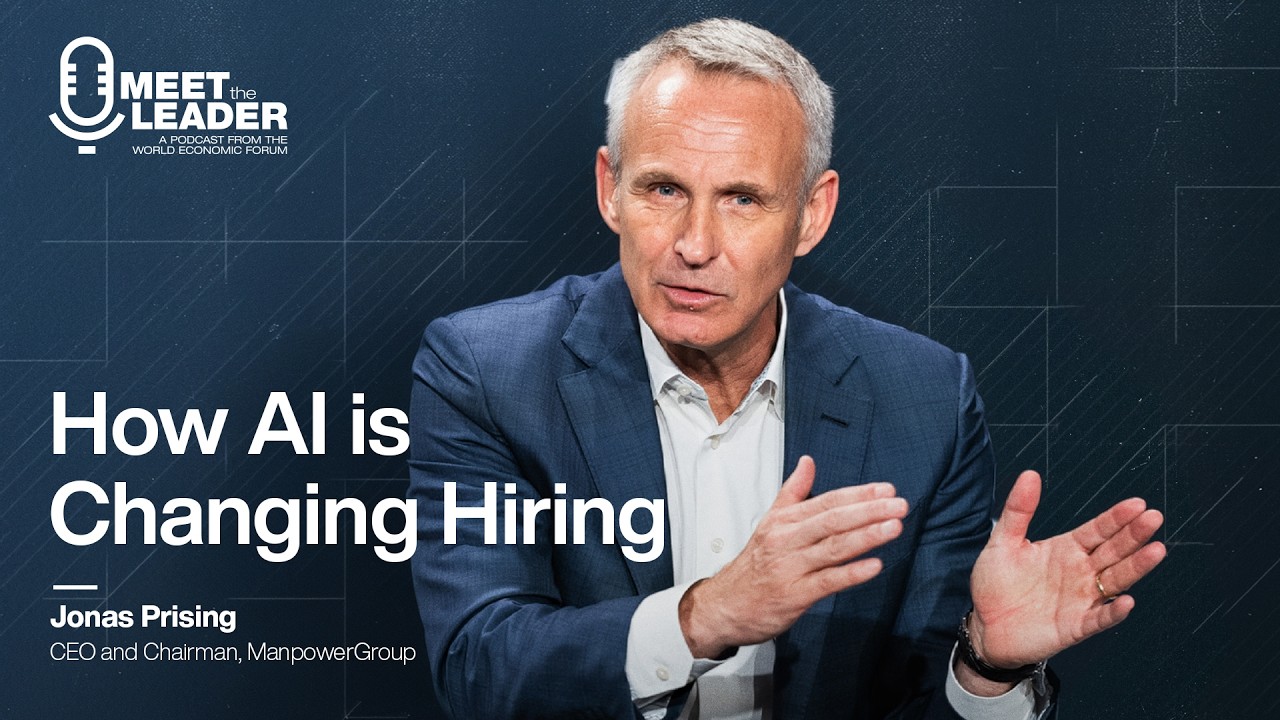
The defining challenge over the next five years, according to Jonas Prising of Manpower Group, is redesigning work so that people can grow alongside technological advancements rather than being left behind. While organizations are often mesmerized by the rapid pace of AI innovation, Prising argues that true value depends on human adoption and a fundamental transformation of end-to-end value creation processes. Currently, AI is largely bolted onto existing workplaces as a tool for specific tasks, but the future requires a shift where technology augments human capabilities rather than replacing them. This transition demands significant investment in both technological infrastructure and change management to ensure that employees understand how these tools benefit their specific roles, allowing them to focus more on activities they enjoy while automating repetitive or undesirable tasks.
A critical aspect of this evolution is the necessity for leadership to rebuild trust by clearly articulating the strategic benefits of AI for both the company and its workers. Prising emphasizes that a negative narrative suggesting mass job losses is inaccurate; instead, the goal is to find the right balance where technology improves organizational performance while simultaneously enhancing employee value. In the hiring process specifically, human judgment remains superior because it addresses the limitations of current AI-driven applications, which often lead to uniformity and an unpleasant experience for job seekers. By using AI to automate transactional tasks like resume screening, recruiters can focus on meaningful conversations that assess cultural fit, critical thinking, and soft skills—areas where machines struggle. Ultimately, the final hiring decision must rest with humans to ensure ethical outcomes and to reassure candidates that their applications are evaluated by people who understand the nuances of the role.
As global demographics shift toward population decline in many nations, leaders must rethink traditional reliance on workforce growth as a driver of prosperity. This reality forces organizations to unlock human potential from previously overlooked talent pools, such as women facing barriers due to childcare responsibilities, long-term unemployed individuals, and youth struggling with entry-level roles. While AI can impact specific sectors like coding, Prising notes that broader youth unemployment is currently more driven by economic cycles and employer caution than by structural changes caused by technology. Furthermore, geopolitical tensions and restrictive immigration policies are complicating cross-border hiring, yet the global need for skilled talent will likely compel countries to moderate these hardline policies in the future. The path forward involves integrating diverse talent groups into the new technological landscape to ensure sustainable employment and continued economic growth for communities worldwide.
Read the full video transcript
I think we've done a poor job so far as
leaders of articulating how is this
technology going to help the company
from a strategy perspective?
How is this going to benefit our
workers, our employees? What
specifically should they expect to see
in terms of their work lives and the the
part that's going to be impactful for
them in a positive way? [music]
So articulating that with clarity and
confidence is absent in today's
conversation and frankly in many
organizations.
>> Welcome to Meet the Leader, the podcast
from the World Economic Forum that
speaks to the top leaders who share how
they're tackling the world's biggest
challenges. In this episode, I'm talking
to Jonas Prising, the chair and CEO of
Manpower Group. I'm Robin Pomeroy at the
World Economic Forum and this is Meet
the Leader. Jonas Prising, how are you?
>> I'm excellent. Thanks, Robin.
>> You wrote an article on Forum Stories on
the World Economic Forum's website.
Over the next five years, the defining
challenge will be redesigning work so
people can grow with it. What did you
mean?
>> Well, we talk a lot about and are
frankly mesmerized by the speed of the
technological evolution and the speed of
that innovation. What we forget is the
human aspect of how work gets done. In
our experience working across 80
countries globally with millions of
workers deployed across hundreds of
thousands of companies, what we know is
that technological innovation really
depends on human adoption. And as we
think about the work and how work will
be need to be redesigned around AI,
that's how we can see the evolution
accelerating from what today is really
AI being used in pretty narrow use cases
as tool versus a transformational change
of end-to-end value creation processes
where work will change dramatically and
fundamentally
as we look into the future.
>> So, what we're seeing is AI kind of
bolted onto the existing workplace. What
you're saying is that existing workplace
is going to change. Can Can you think
think of some examples, or is it too
early to tell what that redesign will
look like?
>> Well, it's a little bit early to tell,
but I think we can see the early usage
of AI is as tools on specific use cases
and tasks. So, if you think about a job
a job consists of maybe 18 to 25 tasks.
Today, companies are deploying AI to
solve a specific problem within a task.
And so, as we see the narrative evolving
around the speed of technology is moving
very quickly and adoption is slow,
it's because it's only being deployed in
specific tasks and use cases. And over
time, to see the true value of AI, we
believe organizations will have to
rethink how work gets done
across their entire value creation.
That, of course, is a transformation
that takes time,
requires significant investments both in
technology infrastructure and frankly
into change management. Because
ultimately, what's going to be very
important is going to be for workers and
employees to understand what benefit
does this have for myself, and how is
this going to benefit the activity that
I enjoy doing today, so that I can do
more of it and less of it to the things
that I don't enjoy doing as much.
>> Cuz a lot of those workers will be
concerned that the transformation from
AI in the workplace is to get rid of all
the human jobs. You don't believe that's
right.
>> No, I don't believe that's right. You
listen to the technology companies, they
will say, you know, job losses of X% of
the workforce is what's to be expected,
so brace yourselves. So, frankly, a very
negative narrative. From our experience,
that's not how this technological
innovation and revolution will play out.
We'll eventually find the right mix
between what the technology can do to
improve the performance of the
organization and the performance and the
value for employees as well. Based on
the narrative today, it feels as if
everything is going to change tomorrow.
We think it's going to take time because
it involves process change, change
management, and it involves trust. And
today we can see
people aren't that optimistic about the
impact of AI to their jobs and to
themselves in their professional lives.
>> I wonder what needs to happen to change
that trust. And maybe you're seeing
organizations where they're doing a good
job in bringing the workforce with them.
>> Well, I think a lot of it will depend on
on the leadership. So, I think we've
done a poor job so far as leaders
of articulating how is this technology
going to help the company from a
strategy perspective?
How is this going to benefit our
workers, our employees? What
specifically should they expect to see
in terms of their work lives and the the
part that's going to be impactful for
them in a positive way
and generate that trust in the future
and the confidence that proceeding along
this route is ultimately going to be
beneficial for myself and for the
organization that I work in. So,
articulating that with clarity and
confidence is absent in today's
conversation and frankly in many
organizations as well.
>> [snorts]
>> We've gone We've gotten way ahead of our
skis
in terms of the innovation driven by the
speed of technology and we're forgetting
that the actual adoption and the
implementation depends on people's trust
and confidence that this will do really
good things for them in their working
lives.
>> Your research finds that a human
reviewing resumes remains the best
hiring resource
because those of us who've looked for
jobs,
we fear it's an AI that's going to
decide whether or not our resume is good
enough to get us an interview. I mean,
what
Why why are human What are humans doing
better
at this kind of looking at a resume,
deciding maybe this is a candidate for a
job?
>> Well, the some of the unintended
consequences that we're seeing, you
know, with the adoption of AI is not
only the companies adopt AI, individuals
are adopting AI as well. And frankly,
the hiring experience today for many job
seekers is inherently very unpleasant
and unsatisfying. The sad you know,
unsatisfactory.
Because they they are sending out
applications to a faceless recipient,
not getting a response, any feedback
that is useful to them, and sending
these uh missives out into, you know,
the dark space.
So, the job seeker experience, frankly,
with the technology has not gotten
better. It's gotten worse. From an
organizational perspective, there's been
a massive increase in applications to
any particular job posting. And that's
because job seekers are deploying
agentic AI and AI to automate their job
applications. They match those job
applications and those resumes to search
words that they are seeing in the job
ads. So, what we're seeing at Manpower,
a tremendous increase of applications
and a tremendous uniformity applications
because everyone is using the same large
language models to optimize their
resumes on digital media to look as if
they're suitable for the job.
So, what that all ends up doing is that
the human judgment and the conversation
that we have as recruiters with the
candidates that we are talking to
becomes the most important hiring tool
uh that we have. So, paradoxically, the
technology may increase the speed, but
at this point doesn't increase the
accuracy. And that human element really
is the great benefit that we can provide
both to the candidate and to the
employers that are looking for the
talent because we have a lot of
experience. We can judge, you know, this
uh in in a way that it truly adds value
to both stakeholders. And you know,
we've been very purposeful in designing
ethical AI inside our company so that
any decision, the ultimate hiring
decision or recommendation alm- always
lies with the human. And so, a lot of
the transactional work that we used to
do, we don't do anymore. So, we do more
of the judgment, the interviews, the
interaction between the candidates to
find out what the perfect fit for that
individual would be.
>> How do you hire? Imagine we're in a job
interview and I I'm applying for a job
job for one of your clients.
What kind of questions would you ask me?
What would you want to hear from me to
convince you that to go through to the
next round or to give me the job?
>> And it's a great question. And frankly,
we would do this as we've done with
other technological evolutions. We'd ask
you, Robin, you know, so what would do
you use AI in in any aspect of your
life? Are you familiar with various
large language models? What are you
using it for? Why do you find it useful?
What do you not find it useful for? What
are your experiences where you really
disappointed when you were leveraging
this tool? What were you really
positively surprised about? And how do
you think that can apply in the future
as you come and explore work
opportunities at Manpower?
>> But also, crucially, you said in those
questions, what disappointed you? What
is it not good at? So, if you had a
candidate come in and say, "Yeah, it's
great. ChatGPT does all my work for me
now. I'm going to come in and I'll be
done by lunchtime."
You want some critical thinking there.
>> Yeah, no. and I think critical thinking
is another element of exactly that. What
is What is it that it does well and what
does it not do well? In our own
organization, we try to be very clear
and be very explicit around, you know,
what can go wrong and why we want human
judgment and assessment at the end to be
the determining factor whether a
candidate moves forward, you know, from
a for from a hiring
opportunity perspective. Uh because
there are many things, you know, that
can go absolutely wrong if you blindly
trust the technology.
>> Do you think I mean, we could put a
a phone here now, record our interview
our job interview
>> Yeah.
>> and when the candidate's left the room
say, "Okay, Claude,
yes or no to this one." Would you say
that's a good I mean, then you could you
could do that and choose not to. Would
Would you do that, do you think?
>> Yeah, we wouldn't do that. Ultimately,
whether you or I fit into an
organization is so much more than the
technical background than the factual
background is is is does Robin fit into
the culture here in this office? Would
he or she would he interact well with
his boss or not? Does the culture
conducive to his personality?
You know, with job seekers, for
instance, it's very important to tell
them that, you know, ultimately, the
assessment that I make of your
qualifications will be by myself. I will
be aided by technology, so I've gotten
some good information, but the decision
will be made by myself or my colleagues.
So, to be very explicit and up front,
you know, because I think a lot of job
seekers and individuals at large will be
disappointed if they think that, you
know, we're having this conversation,
but ultimately, the decision's already
been made by a machine. And that doesn't
feel very good and, you know, it's also
potentially really not guaranteeing a
very good outcome.
>> A lot of countries are seeing population
decline.
>> Mhm.
>> What
do leaders of companies need to be
thinking about and leaders maybe of
governments as well and other
organizations
to to handle what could be really
fundamental change over the next 5, 10,
20 years?
>> Well, I think the good news
is that there are people
and human potential that we can unlock
in new ways.
This forces us to unlock that human
potential.
And you know, we're not relying anymore
on population growth providing us with
you know, a new flow of workforce.
Because there are pockets of our
societies where people haven't been able
to participate either in globalization
and presumably in aspects of this new
technology innovation.
There is then the pressure of trying to
make sure that we bring in talent pools
that have been previously overlooked or
had had difficulties getting into the
workforce.
Now making extra efforts and
understanding how we can bring them in
because we need them so that we can
continue to grow the prosperity of a
community, an organization or a nation.
So the negative aspects of slowing
population growth, which of course
historically has always been key,
population growth drives prosperity
growth
along with productivity improvement. So
the fact that we're now coming into a
situation where a lot of nations are no
longer having the population growth as a
driver of economic growth is a big
change. And I think both the promise of
the technology evolution that we're
living through right now and the
opportunity to tap into the talent pools
that haven't had the
the the same opportunities to
participate forces us to make greater
effort to integrate them into this uh,
this evolution so that they can also
have, you know, meaningful and
sustainable employment.
>> What what kind of parts of society
you're talking about?
>> Well, first of all, you know, the most
underutilized resource a resource in our
workforce is female participation in the
workforce, high in some places, mostly
much much lower than the 50% of the
population that it represents all over
the world. So, the female participation
rate is a tremendous opportunity for us
to bring in skilled, motivated, and
engaged talent. Of course, we have to,
you know, facilitate their uh, that
participation uh, more than what we are
doing today, be it through child care,
um, after-school uh, care, um,
flexibility so that women can
participate and they still carry a lot
more of the burden. But, then you also
have other uh, aspects of the
population, long-term unemployed
individuals who have had great
difficulty getting back into the
workforce. We need to redouble our
efforts and bring them in and of course
also youth unemployment, which tends to
be at twice the average unemployment
rate in any industrialized country and
in emerging markets many many times more
higher unemployment than that. And
that's is a key opportunity that we have
to ensure that we bring in young people
in early so that they can contribute and
feel the the benefits of uh, employment
or work.
>> And that's another challenge that might
be exacerbated
if we do AI wrong. There's
research suggesting already those early
careers, those early roles, those jobs
are being done by AI and there may
there's a risk of a a generation of
people
missing out on those early roles. So,
that youth unemployment could even be
exacerbated if if we're not handling AI
right.
>> It could and I've read these reports and
the studies. Our own data, however,
would indicate that at this point we
think that increase in youth
unemployment and the difficulty of
finding employment for college graduates
and high school graduates is more
related to the economic cycle than it is
to the structural change. Of course,
you'll always be able to find certain
pockets,
say, young coders with no experience
having difficult more difficulty now
than being hired because we can see
coding is one area where AI is having an
impact in demand, although it's still,
in most countries, one of the top three
or four roles that companies are looking
for. So, less intense demand, but still
very high demand. But, aside from those
pockets, we think this has much more to
do with economic cycle. Employer
confidence is low. Economic uncertainty
is high. Geopolitical tensions are high.
That means employers pull back. Who are
they hiring in times like this?
Individuals, talent that have the
requisite skills to become immediately
productive and contribute to the areas
that they want to accelerate. They are
less likely, today as in the past, to
hire younger people that don't have the
experience and they cannot be as
productive as quickly as they want uh
the talent they bring in today in this
environment. So, we think this is more
of a cyclical issue, an economic cycle
issue, an employer confidence issue than
any impact of AI. So, it may have an
impact over time,
uh but as with any prediction of what's
going to happen with AI in the labor
markets, I think it's way early to call
and whoever makes those calls today is
going to be mostly wrong.
>> The World Economic Forum did a Chief
People Officers Outlook report that
finds that geopolitical forces,
something you just mentioned, uh
directly shaping talent strategy with
knock-on effects to migration and visa
restrictions, localization policies,
cybersecurity. So, there are certain
things
There are certain policies
maybe that are making it
difficult to maybe hire across borders.
Are are you seeing that? What do you
think of that finding?
>> Yeah, no, I think that what the World
Economic uh Forum's uh research is
showing is clearly reflected in reality.
So, companies are much more cautious
about cross-border hiring at this point
in terms of knowing whether the person
that is on the other side of the digital
screen is actually Robin or is it
somebody else or a AI reflection of uh
Robin trying to find employment on
behalf of somebody completely different
for non-nefarious or nefarious uses.
>> That's already happening.
>> That's already happening and uh I have
seen those attempts with my own
likeness,
my own voice that has been used from
interviews like these
to have actual conversations with my
colleagues and the only reason they can
determine that it's not me
is that I normally don't wear a tie and
this person wore a tie.
>> You're wearing a tie right now.
>> And I'm wearing a tie right now, but
normally I don't and that's how they
picked it up and they said, "Well, can
we just go back to our normal chat
channel?" And then of course the whole
fraud scheme fell apart. So, it's become
very, very sophisticated and you know,
no doubt uh the uh multipolar world and
the increasing restrictions around
immigration policies is having an impact
very clearly visible uh in the country
where I work and live in the US.
Immigration policies have become much
more restrictive and uh that is clearly
visible both in labor market data and in
opportunities uh for individuals to come
to the US, but the same is true in many
other parts of the world as well.
>> Is that going to change, do you think,
or is that the future we're looking at?
>> It's hard to say, but of course with the
demographic changes that we know are
happening, most countries need
uh an influx of skilled capable talent.
And so how and what shape that takes,
frankly from my own perspective, we
believe will become a uh known uh need
and as such countries we expect are
going to moderate the current, you know,
more hardline policies and facilitate
migration of the skill sets that they
are looking for into their countries
because it's going to be vital for their
economic growth and prosperity.
>> So this is Meet the Leader, this
podcast. We like to
hear
how you've developed as a leader.
All of us have experiences working for
people.
We've We've had good bosses and bad
bosses, but what was something that you
thought
maybe in retrospect that that person
really got it right. I really benefited
working for that person.
>> Yes, very early on in my career I had
some really interesting job
opportunities which I thought translated
in a straight line acceleration even
further.
And you know, my my boss at the time was
very frank and said, "No, I think you're
forgetting that in this particular job
you're advising, you are uh
participating, but you're not leading
and you're not managing a team."
"This is about you as an individual
contributor in today's job. That does
not translate into you as a team leader
helping your people grow and deliver
results as a team."
And I was baffled. I said, "How can that
be? I'm I'm very successful at what I'm
doing." He said, "Well, how about How
about you take the small team and let's
see what you can do in this in this
division. Let's see if you can manage
this business
together with your team members. And
this is this is the first of many, you
know, sleepless nights episodes as I
experience both the responsibilities of
guiding an organization, very small,
helping people be successful, helping
guide them, and realizing that it's not
about an individual. Organizations are
the ultimate team sport, and you have to
get people to work together towards a
common objective. And how to do that can
induce many frustrations, concerns, and
anxieties. I was fortunate this was an
early career example of one of my bosses
giving me frank and
clear advice on what what I needed to
focus on to be successful, and that I
shouldn't conflate it with past
successes in different roles that didn't
really have the skill sets. And and he
was right. I made lots of mistakes in
that experience, and I learned a lot,
and hopefully it helped shape the leader
that I am today and things that I try to
deploy when we work with our teams
today.
>> Is there a book you'd recommend?
>> I
have truly loved reading True North,
which is a business book that was
written many years ago.
And it goes something like this, and it
it's a lot about leadership in general.
It's the author is Bill George. He used
to be the CEO of Medtronic. He works at
Harvard Business School today, and you
know, he talks about the importance of
value-based leadership.
And what he's taught me in in the
moments that I've had the opportunity
not only to read his book, but interact
with him as well,
is that truly great leadership, of
course,
necessitates capable leadership. So, you
have to know what you're doing.
You have to have a bias for action. So,
without, you know, knowing what you're
doing but not doing anything is not
going to help. So, those are sort of
foundational elements that are extremely
important.
The clear moral compass,
knowing right from wrong,
is what people expect from leaders
so they can trust what comes out and
others before self.
So, our job as leaders is to enable
future generations and the entire
organization and team to be more
successful. If that happens, the leader
itself will become more successful also.
But, it's not about the leader as a
person. It is about how the leader can
really engage and motivate and develop
the organization and the team. That will
drive sustainable long-term results. And
those are the four elements that that I
always think about
trying to adhere to in my own
leadership. That that is, you know,
very, very important aspect.
>> So, the book is True North.
>> True North by Bill George.
>> Great. Can I Can we do a rapid response
round?
I'm going to say
a statement about the future
and you'll say whether it will happen or
not.
>> I'm ready.
>> These are future scenarios. We'll
finally get a four-day week.
>> Will happen.
>> When will it happen?
>> Oh, that we don't know.
>> Where will it happen? Which sectors will
it happen? I'm getting out of the quick
fire mode here, but I don't I want to
know
in which areas of work do you think
we'll have the four-day week?
>> And the reason I think it's going to
happen is that it's happened in the
past.
You know, when [snorts] we were an
agrarian society, the work week
consisted of not a work week really. It
was just work all the time, you know,
60, 70, 80, 90 days a week with no
vacation. Vacation is unheard of.
Weekends didn't exist. And here we are,
you know, a number of decades later and
it's a 40-day week. And I think the big
challenge is this notion of
we can have a 4-day week when
productivity improves with a
commensurate amount. The difficulty in
the experiments that have been done in a
number of countries is to implement
35-hour hour weeks for instance in
France, you know, 10 or 12 years ago
when the work that needed to get done
still required 40 hours. So then it
becomes a, you know, a very difficult
equation. So when productivity
improvements happen that free us up
the desire of workers to have more free
time is evident already today. So it's a
question of when that productivity
improvement happens, I have no doubt
that it will translate into fewer
working days or I could be very wrong
and that all that it translates into is
much greater flexibility to mold your
life, your working life at different
points in your in your week or during
your day. Today it's still relatively
rigid. That might be, you know, the way
the way it evolves but to the same
effect.
>> I'll get back to the
>> quick fire style now.
In the future, we'll all work for an AI
agent.
>> No, I can't see that.
>> Specialists rather than generalists will
be kings in the AI era.
>> I think both specialists in specific
areas but yet generalists that have a
much broader view of the context will
also be valuable. We are very focused
right now on the specialist skills that
are required to accelerate the evolution
of AI but I think in the practical
application more broad-based at scale,
generalists will still be a very very
important role.
>> I think we know the answer to the next
one. The face-to-face interview is more
important than ever.
>> Agreed.
>> We finally in the future fix the skills
mismatch.
>> That would be the ambition and truly the
vision of how we can see tremendous
improvements in education and in really
getting a more skilled workforce up
faster. The biggest shortfall of
globalization, changing skill sets,
paying attention to it. We now have the
opportunity to get it right. And I think
this could definitely be one of the big
achievements of the new technology.
>> Jonas Prising, thanks for joining us on
Meet the Leader.
>> Thank you, Robin.
>> That was Jonas Prising, chair and CEO of
Manpower Group. If you enjoyed this
episode and know someone else who might
enjoy it, please send it their way and
leave us a rating or review wherever
you're listening to this. Meet the
Leader is available on all podcast apps
as are the forum's other podcasts, Radio
Davos [music]
and Agenda Dialogues and you can find
them all at wef.ch/podcasts.
I'm Robin Pomeroy at the World Economic
Forum. Thanks for joining us on Meet the
Leader.
>> [music]