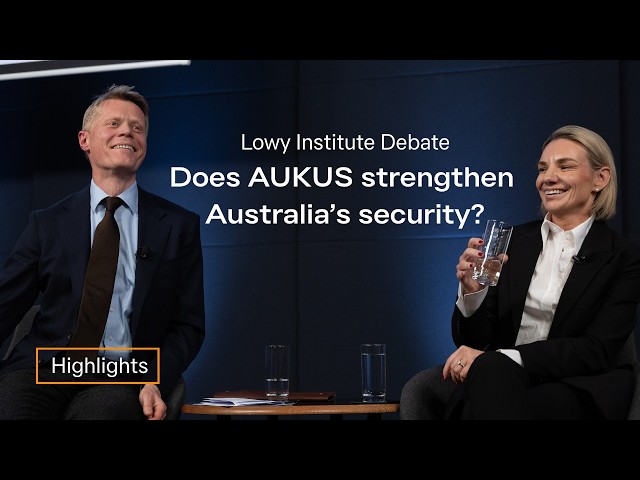
Video summary
The video transcript centers on a heated debate regarding the AUKUS partnership, specifically focusing on whether Australia should proceed with acquiring nuclear-powered submarines to replace its existing fleet. The discussion highlights that since the program's announcement five years ago, it has become the cornerstone of Australia's military planning and foreign policy, drawing intense scrutiny from politicians, engineers, and independent inquiries. While proponents argue that these submarines offer unparalleled stealth and endurance, allowing for persistent maritime operations that conventional vessels cannot match, critics question the strategic necessity of such a massive investment. They contend that the primary arguments often mask deeper ideological commitments rather than addressing practical defense needs, raising concerns about whether the United States is a truly reliable ally capable of delivering on its promises amidst changing geopolitical landscapes.
A significant portion of the debate addresses the risks associated with dependence on American technology and political will. Critics point out that relying on US-built nuclear submarines exposes Australia to delivery delays, political shifts in Washington, and potential coercion, suggesting that this reliance reveals a timidity in Australia's national identity. In contrast, supporters emphasize that defending an island nation requires a potent maritime capability to protect trade routes and deter aggression from great powers like China. They argue that geography alone is insufficient for modern security, as the distance between Australia and China does not guarantee safety against advanced missile systems or naval task groups. Consequently, they assert that without a high-end deterrent like nuclear submarines, Australia risks being unable to defend its interests independently if it were to lose US support in a crisis.
The conversation also delves into the financial and opportunity costs of the submarine program, with skeptics arguing that the budget allocated for AUKUS could be better spent on a diversified mix of capabilities, including aircraft, land-based missiles, surface ships, diesel submarines, and unmanned drone vessels. These alternative methods are presented as cost-effective ways to achieve similar strategic objectives without disfiguring the rest of the defense budget or sacrificing other critical areas. The debate further explores the concept of deterrence, noting that while nuclear submarines provide a formidable capability, their effectiveness is also tied to political credibility and communication strategies that may not align with Australia's interests in Southeast Asia. Ultimately, the transcript reveals a fundamental disagreement on whether the program represents strength and independence or merely subordination to American strategic priorities.
In conclusion, the debate leaves the question of AUKUS unresolved, highlighting the tension between ideological convictions and pragmatic risk assessment. One side views the submarine program as essential for maintaining Australia's status as a maritime nation capable of protecting its trade and sovereignty in an increasingly conflict-prone world, while the other sees it as an expensive gamble that undermines national autonomy. The speakers agree that open debate is crucial for understanding the complex strategic circumstances Australia faces since World War II, but they fundamentally disagree on the path forward. Whether the program strengthens security depends largely on one's assessment of US reliability, the viability of alternative defense strategies, and the definition of what it means for Australia to be a truly independent and strong nation in the twenty-first century.
Read the full video transcript
5 years ago next month, Scott Morrison,
Boris Johnson, and Joe Biden appeared
together on a video link to announce a
new partnership between Australia, the
United Kingdom, and the United States.
The centerpiece was a fleet of
nuclearpowered submarines.
Since Orcus was announced, the program
has become central to Australia's
military planning, our foreign policy,
and our defense industrial strategy. In
Russell, Osborne, Henderson, and
elsewhere, an industry of officials and
engineers works to keep the program
moving. When Australian ministers meet
with their American counterparts, Orcus
is at the top of their talking points.
In those five years, the program has
been picked over in Parliament, in a
Pentagon review, in an independently
funded inquiry led by Peter Garrett, and
around dining room tables, particularly
here in CRA.
The disagreements run deep. Are these
the right submarines for the way wars
are now fought? Will the Americans and
the British actually deliver them? And
what else does the defense force give up
to pay for them? All of it comes back to
one question. Does Orcus strengthen
Australia's security? Now, I have some
fundamental differences with the process
position. Orcus ultimately depends on
whether you think the US is a reliable
ally and can defeat China in a war. I
don't think it is and I don't think it
can. Every time you hear the case for
Orcus, ask yourself, am I really hearing
an argument specifically for
nuclearpowered submarines? So, for
instance, you might hear that we need
Orcus to protect us against the threat
from China. But is that really an
argument for nuclearpowered sub
submarines or just for having a strong
defense force? Do you still need to
think about how the proaucus side deals
with the problem of delivery? And really
nothing else matters in this debate.
Everything I've mentioned up to now is
irrelevant. I would urge you don't take
my word on this subject. Take it from
senior Australian political figures who
belong to the party that conceived this
plan in the first place. Alexander
Downer, Senator James Patterson, Joe
Hockey, Christopher Pine, all have
expressed doubt about whether the
submarines can be delivered on time. You
know, the Americans once built a place
called Las Vegas, an entire city in the
Mojave Desert dedicated to fleecing
gamblers. If AUS reminds us of anything,
it's that the United States hasn't lost
its talent for separating fools from
their money.
>> A nuclearpowered submarine is not just a
vehicle or a transport mechanism. is a
very potent capability that is
exceptionally hard to detect. And how do
I know that? Because my specialtity
isn't sitting here on stage and talking
about things or writing books or
teaching. My specialtity is hunting
submarines. And I can tell you right
now, hunting a nuclearpowered submarine
and the speed that it can escape you is
incredibly challenging. And that's why
it's an important capability for the
Royal Australian Navy, for the
Australian Defense Force, and the
defense of an island nation. So the
world is changing and we are an island
nation and we need to be able to protect
that. To be able to protect an island
nation, you need a powerful maritime
capability. When we talk about this,
this is not about ideology. It's not
about the world the way it was in the
'9s. It's not about procers or
anti-orcas. It is about the fact that
when we say we're in our most
significant strategic circumstances
since World War II, we are comparing
ourselves to a period where Sydney
Harour was attacked, where Darwin was
attacked, where Katherine was attacked,
and many Australians lost their lives.
And that is a significant conversation
that deserves to be treated with the
weight that we will hopefully afford it
tonight.
>> So, a question for you, Sam. You have
accepted that nuclearpowered submarines
are formidable machines. Your words. So
put the case for what Australia's
submarine force actually needs to
achieve and tell us which parts of the
job can be done another way.
>> The main job of submarines is to sink
ships and sink other submarines. Uh and
there are many many ways to do that. Uh
you could use aircraft to do it. Uh that
that fire missiles. You can fire
missiles from land which is something
we're embarking the ADF is embarking on
now. Um, you can use surface ships,
which is a business that the ADF that
the Australian Navy has long been in,
and you can also use diesel submarines,
and increasingly you can use uh
uncrrewed submarines, drone vessels. So
my view is that we need a combination of
all of those to do the kind of job that
uh a nuclear sub nuclearpowered
submarine could also do, but at much
much greater expense. uh and in fact at
the expense of at the moment completely
disfiguring the rest of the defense
budget.
>> If you wanted to sail from HMA Sterling
to Sydney in a conventional submarine,
it's going to take you 9 days. You're
going to have to come up uh charge your
batteries a number of times, which means
that you are more susceptible to
detection by an MPA, maritime patrol
aircraft or something like that. A
nuclear powered submarine sterling, so
birth to Sydney, less than 4 days. It's
about persistence and endurance. If you
have a naval task group that you are
sending to interdict shipping across an
ocean, you will not sail that naval task
group if you think for a second there is
a nuclearpowered submarine there. That
is a fact. And if you doubt that fact,
have a look at what happened to the
IRI's Dena on the 4th of March, the sad
loss of Iranian sailors. And I feel very
sorry for those sailors and for those
families. But if you want to understand
the pot of a nuclearpowered submarine,
just look at that.
>> This is not just an arms deal. Uh this
is not just buying another squadron of
F-35s. When you have three national
leaders appearing on a stage together in
San Diego and announcing the the optimal
pathway, it can't help but be political
and it has a uh a strategic subtext or
in Jen, you might say in Jen's terms an
ideological subtext. I think that's
absolutely unavoidable.
>> When I say ideology, it's when people
hang on to these deep beliefs despite
the facts being put in front of them.
And I'm not going to get into that, but
I think that there is some evidence of
that. Conversations around use corollas
versus most capable nuclear powered
submarine in the world. Um, yes, in the
statement around August in uh September
2021, three key leaders, I don't see
that as political. I see that as
communications. And if you think about
deterrence theory, three key pillars of
deterrence, capability, credibility, and
communications. And that was sending a
message. You know, we can debate whether
that was the best way to send the
message, uh, especially if you're in
Southeast Asia, but that was sending a
message.
>> This deal does, I think, say some things
about uh, Australia's conception of
itself, about its its identity, its
political and national identity, that I
think are not that flattering about
modern Australia, at least or at least
about our political class. Uh, I think
it it reveals a certain timidity in
Australia that that I'm not proud of and
that I'm not happy about. We have to
really think very deeply about whether
the Americans are as committed to us as
we appear to be dependent on them. And I
think there's serious questions to be
asked about whether that's the case.
>> Defending Australia is not defending the
continent. It is defending our national
interest which includes our access to
the maritime domain and trade and a
stable region. We do not currently have
the capabilities to do that. If you
turned around to the US tomorrow and
said get out of here, you would be
subjecting yourself to coercion in the
region. Okay? And that is a trend across
the region. I gave that example my
experiences in South China Sea because
that is real. That is what is happening.
We have become too dependent on our
ally. This is one of the things that my
paper will will talk about. Um and in
fact our ally is telling us you have
become too dependent on us. Do more.
>> Staying on you, Jen. Where is the line?
So for a capability this important, how
much delivery risk and how much
dependence on another country's
decisions is acceptable? Has that made
change moved us closer to that line?
It's not that there's no risk with
orcus. Of course there is risk with
orcus. We hear them every day in the
media. The question is do we know what
the risks are? And I think we largely do
and are we taking actions to mitigate
the risk? And I think that when you look
at what has been achieved in nearly five
years, I think the answer is yes, we are
taking actions to mitigate those risks.
Now, what is the biggest risk? Of
course, political risk. When you think
about political risk, we've had changes
in government uh in all of the key
nations and all of the key principles,
presidents, prime ministers have come
out after that change in government and
supported all and not because of some
hundred years of mathip or values-based
relationships because all of those
countries see for their own national
interests that it is in their interest.
So I think that that is being mitigated.
When you think about risk, okay, we are
in our most significant strategic
circumstances since World War II. We are
talking about the prospect of conflict.
Not because we want conflict, but
because the world is changing, more
state-on-state conflict in 2024 than any
other time in this world.
>> Sam, I'm going to have to keep you at
two minutes because I want to give you a
chance to get your closing statements
in.
>> The question for you is you've said that
Australia can afford this and that cost
is not your real objection. So, what is
the objection that remains when the
money is set aside?
Australia is incredibly lucky and by any
reasonable international standard, this
country is not that hard to defend. The
the the task is actually pretty
straightforward and it was uh it was
pretty well
uh developed in in the 1970s and then
consecrated in our defense doctrine in
the 1980s.
You focus on the air and maritime
approaches to Australia's north and you
make it inordinately difficult and
expensive for any adversary to try to
send ships or aircraft or missiles
through our northern sea air gap. That
is an achievable mission for Australia,
even against a great power like China
because we are blessed by geography.
We're a huge continent and we are very
far away from China. I mean, it's
routinely forgotten in this debate, but
you know, Beijing's closer to Berlin
than it is to Sydney. For me, the object
of Australian strategy should be to
exploit the distance between Australia
and China. If they ever want to make
trouble for us, let them bridge that
distance. There's no need for us to do
it. So, uh, I would be trying to exploit
Australian geography instead of spending
hundreds of billions of dollars trying
to overcome it.
>> I'm going to ask each of the
participants to give us one minute each.
>> Would we do that right at the end? You
want to do that before the audience
questions?
>> Yeah, let's do that.
>> No, no, no. We're going to we're going
to do it now.
>> Sorry. Okay.
>> What is this?
>> Sorry.
>> It's a democracy.
>> It's certainly That's right. So,
[laughter]
>> Jen, closing statement from you then.
Sam, you better get yours ready if
you're going to wake up.
>> No, I'm ready. I'm ready.
>> Right. I think that having debates about
this is critical. It is important that
we go eyes open into the world that we
are facing. But we cannot get uh caught
up in ideology. We cannot get caught up
in misinterpreting the facts to support
our argument. The fact is we are a
maritime nation. We do need access to
the sea and we do need to be able to
protect maritime trade. And the only way
to achieve that is through a potent
maritime capability. And if we want less
dependence on the US and I think we both
agreed here that we are too dependent on
the US then we need to increase our
capability and nuclearpowered submarines
is a critical way to do that. I want to
put aside the strategic debates for a
moment that we've had here tonight and
just ask yourself what kind of country
do you want to live in to be truly
independent. It seems to me Australia
does need to be stronger and that
includes military strength. But to me,
AUS doesn't represent strength. It
represents subordination.
It's the act, as I said before, of a
timid nation. Like a a sucker fish
eating parasites off a shark as we swim
close alongside looking for protection.
I think Australia's better than that.
>> Ladies and gentlemen, I don't think
we've settled it tonight, and I hope
nobody came here expecting that we
would, but thank you for joining us for
what has been an Olympian standard
debate about Orcus. Not all parts of it,
granted. Um, and thank you for your
questions. Let me thank Jen and Sam for
participating in this evening's debate.
You've both been willing to be to to be
pinned down and to to answer the tough
questions, and that is rarer than it
should be. Um, so please join me in
thanking Jennifer Parker and Sam
Rogavin. [applause]