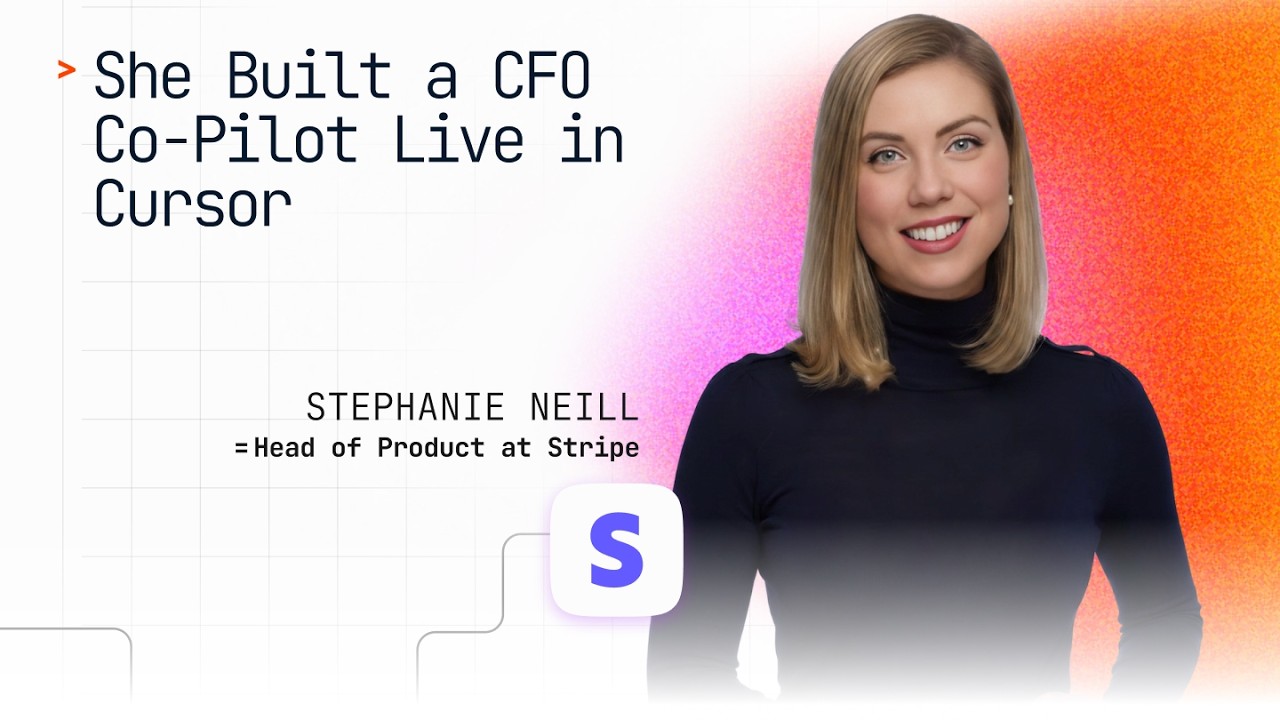
Head of Product at Stripe | Framework for Building AI Products Users Can Trust
Watch on YouTubeVideo summary
The video features Stephanie Neil, Head of Product at Stripe, who outlines a framework specifically designed for building AI products that users can trust within enterprise environments. Unlike consumer-facing applications where engagement and novelty are often prioritized, the focus here is on high-stakes scenarios involving financial reporting and auditing, exemplified by a fictional CFO named Sandy. For professionals like Sandy, whose decisions impact millions of dollars and must withstand rigorous audits, an AI product cannot afford to be merely "mostly right"; it must be 100% accurate because any error could have severe consequences. Consequently, the development process begins not with coding, but with deeply understanding the user persona, their specific pain points, and the critical need for certainty, accountability, and risk mitigation in every interaction.
To transform a generic chatbot into a reliable tool for Sandy's needs, the presenter demonstrates an iterative building process that integrates Retrieval Augmented Generation (RAG) to ground AI responses in company-specific policies rather than broad internet knowledge. The initial prototype connects to a general language model but quickly proves insufficient because it lacks context about the specific business rules and financial regulations relevant to the CFO. By instructing the system to first read internal documents like "company policy.md" before formulating answers, the product shifts from providing generic information to delivering defensible insights that align with actual organizational constraints. This step is crucial for ensuring that every answer provided by the AI can be traced back to a specific source within the company's knowledge base, thereby addressing the user's need for provability and explainability.
As the prototype evolves, additional features are introduced to further enhance trust and safety, such as confidence scoring and human-in-the-loop mechanisms. The system is programmed to output a confidence level between 0% and 100%, accompanied by color-coded indicators—green for high confidence, yellow for moderate uncertainty, and red for low confidence where the AI admits it lacks sufficient context or evidence. When the model's confidence drops below a certain threshold, such as when asked about non-existent Martian taxes, the interface explicitly flags the response as requiring human review instead of hallucinating an answer. This design philosophy ensures that computers handle tasks they excel at by processing vast amounts of data quickly, while reserving complex value judgments and final approvals for humans who possess the necessary context and responsibility to make critical decisions.
Ultimately, the video concludes with a strong argument that building trustworthy AI requires a deliberate shift away from generic capabilities toward specialized accuracy tailored to specific enterprise needs. The presenter emphasizes that while consumer products can thrive on curiosity and flashy features, tools like this CFO copilot must prioritize precision over speed or engagement metrics. By combining advanced language models with strict adherence to internal documentation and clear indicators of uncertainty, organizations can scale AI adoption without compromising integrity. This approach not only solves immediate problems for users preparing quarterly reports but also establishes a sustainable model where machines augment human capabilities rather than replacing the essential judgment required in high-risk professional environments.
Read the full video transcript
Hi everyone. I am Stephanie Neil and I'm
really excited to build with you today.
Um we are I guess maybe actually a quick
intro and then we're pretty much just
going to jump right into it. Um so I'm
Stephanie as I said. I am currently with
Stripe as a head of product but
previously um VP of
monetization product at
Amazon's Twitch and before that I was an
executive director
for the United States Digital Service.
If you've never heard of that, you
should Google it. It's a really awesome
public service outfit. Um that really
needs great digital talent.
So
Um all right. So today we are going to
build
and we are going to build for a persona
that
um
I don't think everyone thinks about. I
think there's a lot of thought about
sort of consumer um building consumer
products with AI but you know what?
There are people within enterprise
environments or internal environments
that also could really benefit from
great AI products. So we're going to
focus today
or actually
I guess I'm going to give a spiel even
though the fun is in the actual like
typing and prompting and building.
I'm going to give a spiel because as
product managers AI might be changing
our ability to code with plain English.
Uh with these awesome tools but it is
actually not changing the most important
things which is like defining who are
you building for um and what are you
building for them and why is it
important to them? What's the problem
that it's really solving? So we are
going to still start with that. Um uh
cuz that still is
you know the PM's the the PM's unique
value.
>> [clears throat]
>> Uh so we are going to build to for Sandy
a CFO. We're going to build an
enterprise AI product. Um and I'm going
to tell you about Sandy. She is
a CFO at a
$500 million
a year software company.
She is preparing to close her books for
the quarter.
Investors are waiting and auditors,
they're always around the corner.
They're going to arrive next week to
audit her work and make sure she she's
accurate
and can explain her numbers
and she can prove her numbers. These are
really critical for her.
And so every answer that the AI that
we're about to build, the AI product
we're about to build,
gives
could show up in the company's financial
statements.
So,
we
will start to build for Sarah. So first,
who?
Sarah, CFO at
a $500 million company.
And
she cares about things like certainty,
like accountability.
She makes million-dollar
decisions.
And it has to be defensible and she
cares a lot about risk.
The way I like to think about this
persona is if your product isn't 100%
right, it is 100% wrong.
So it is very black and white for her.
Cool.
So, why don't we now get into get into
the excitement of actually building?
So today we're going to build Sarah a
copilot.
So I will start by asking Cursor to
>> [clears throat]
>> build a
clean web app
called compliant. Actually,
let's not call it compliant copilot. It
is really for our CFO.
This page must have and then we spec out
a simple
uh uh, basically what we're expecting to
see in the product um, just like we
would spec out for a cool engineer.
Um, so one text box where the user
um, can ask a compliance question.
Uh, a submit button.
An empty results
um, area below.
Uh, and I'd like you uh, to use a clean
modern
design. Everything clean. Oh, actually
pet peeve.
Hate it when I forget. Um,
uh, when I hit enter
um, it should take the same action as
uh, hitting submit.
I hate it when I have to actually click
a button.
Um, cool.
So, while this builds,
uh,
>> [sighs]
>> yeah, this should all be super familiar
to you guys. Um,
that was obviously a very simple sort of
spec, but um, this is not different than
um, explaining a PRD uh, or explaining
what you're building in a PRD.
Um,
here we go.
CFO copilot writing enter. Excelente.
We'll wait for this to roll. Um,
it's taking its sweet time. Maybe I can
talk a bit more about um,
about our
about our um,
our user. So,
right now when she uses the product
after we build it, it'll be 5:42 on the
last day of the quarter.
Um, she's just closed a $12 million
contract.
Uh, CEO wants to announce the revenue
the next morning and she just needs to
know can I recognize this revenue today?
She has 2 minutes, so she oops, needs
needs some actual help. Here we go. All
right, um,
excellent.
So here we have our first version.
Um,
and so we have, let's see, where are we?
Um,
so we have the brain here.
Um, this is connected to the to cursors.
I guess it's Grok is the model.
Um, so let's ask it a question.
Um,
what is VAT?
This is a fun, oops.
Sorry, one sec.
Uh, okay. So I have to actually add the
arms. Hold on one second.
One second. My little notes
are
giving me trouble.
do do do
All right, here we go. This is what I
forgot to do. Here we go.
Getting ahead of myself. Um, okay, so
now we need to I'm going to ask cursor
to
uh, connect this application to open AI
uh, using the responses, oops, responses
API.
Um, and then when the user presses
submit
or hits enter,
Uh
send the question to GPT and display the
response. Hello.
There we go.
So we have a nice little
uh
Why? But that is not the important part.
There we go. Hopefully this is good.
So zoomed as it goes.
All right.
Here we go.
Uh
again
It's fun at uh at Stripe we have um a
lot of internal tools that are super
powerful and uh
they don't have sort of like standard
um
you know, uh
thinking or you know, it's it's like
undulating or um you know, uh
uh
dancing along to the music or yeah,
makes it kind of fun while you wait.
>> [laughter]
>> Here we go.
All right, excellent. So now let's try a
question here. So now what is that?
Let's see.
It's thinking.
And it tells us what that is.
Uh which is value-added tax. It's uh any
uh
form of tax uh consumption tax, sales
tax or otherwise known as indirect.
Um so while this answer is plenty fine
for a person like Sarah, um
this actually would be a dangerous
product because it is using general chat
uh chat GPT as uh as the brain. It is
not tailored to the business. It doesn't
understand the nuances of Sarah's
business
um and any sort of answer that it's
giving is obviously going to be rather
generic.
So, what we want to do is add rag, um,
which is basically asking it, uh, we're
going to ask our tool to get company
specific context and then fold that in,
um, to all the answers. So, search our
documents, take the relevant
information, and then give that to the
GPT and create a more specific and more
accurate,
uh, answer.
So, now, uh, we're going to build the
rag.
Give me a moment while I find
um, company policy. Oops.
So, I've created a little
doc called, a markdown file called
company policy.
It has all the important things,
um, about my business, I should say.
Should say Sandy a signal.
Um, and, uh, it's basically different
policies and other critical, uh,
critical knowledge.
So, now I'm going to ask
Cursor to please,
um, instead of answering from general
knowledge,
uh, first read company, oops, uh,
policy.md.
Include
that content,
uh,
in,
um, in the prompt.
Um,
before asking GPT.
Let's do, let's see [sighs] how that
works.
Do do do
>> So now
um
So now as the CFO
you you're really not placing your trust
in broad AI. You're trusting that it is
capable of understanding your critical
context that you have input.
Um and this allows efficiency and scale
as well as um effectiveness.
Perfect.
All right, let's see.
All right. Now I'm going to ask a
question which is
um
do do do
can I recognize revenue before
implementation
is complete.
Submit.
Okay, according according to my
company's policy, revenue revenue
revenue is recognized when the company
satisfies its performance obligation. So
no, um so we would have to wait till the
subscription period ends. Um so that is
definitely uh what's not making the
model smarter, it's it's just making the
answers more accurate because of the
context.
All right. So now
um
let's see. I want to
uh I actually want the more proof though
because as my questions get more
complex, uh I'm going to want to
understand if the model is drifting um
or if it's really leveraging what I have
in my context. So after every answer
uh include the exact section of company
policy.md
uh that supports the answer.
Please.
>> [sighs]
>> Um
I guess
bring in tokens with that, please. But,
it's fine.
Um okay.
>> [clears throat]
>> Uh let's see. Um
while this works through
basically, we're just making sure our
instructions
aka our prompts just get better and
better
more precise
again around the things that our persona
cares about. So, accuracy, provability,
explainability.
Um cuz Sandy's the person who's going to
get called on the carpet
um if you get audited
or when they get audited.
All right. So,
um
there we go.
Let's ask another question.
Um
let's ask another question.
Actually, maybe before we do that, let's
go ahead and let's make it I feel like
we need something to indicate how
confident it is in its response because
we may not have given it all the context
that it needs to be confident. So,
before we ask another
another question,
>> [clears throat]
>> I'm actually going to add another
feature
um which is uh confidence scale. So,
similar to a human being able to say,
"Mhm, I'm 90% sure."
Um
so, ask GPT
to return answer confidence from 0 to
100.
Um
uh with an explanation.
What was the other thing we had? With an
explanation and the source section.
>> [clears throat]
>> There we go.
Had to remember.
All right. So, we'll wait for this to
roll through.
>> [sighs]
>> Do do do.
And as I'm thinking, so I asked for a 0
to 100, but I'm also I mean
Sandy's paid on time, so maybe color
coding is just a nice and helpful
feature.
So, why don't we go ahead and actually
ask one more thing if confidence
is above 90,
uh show green.
If it is between 70
and 90,
show yellow.
And if below 70,
show red.
Cool.
So, that's going to work through.
And probably actually the last thing
that I will add for real, I think the
last.
Um
I think that we should
have a flag to queue out
basically things that need human review.
Um so,
let's see. Uh
um
uh
if confidence
is below 70,
so red, instead of giving
me an answer,
>> [clears throat]
>> display
human needs review.
Or needs human review.
>> [laughter]
>> I'm one of my own machine. Needs human
review. There we
Cool.
Amazing.
There we go. And [clears throat] so now
uh
let's ask an actual question
here.
Uh so I'll refresh just in case. And
then let's see. Um
can we
ooh recognize revenue
before signing
a contract?
I think we humans know the answer to
this silly question.
But confidence 90%. Oh, my context is
bad.
>> [laughter]
>> Okay. Okay. Okay. Why don't
Why don't I ask
a sillier question?
Um
uh
how do Martian taxes work?
Let's see.
Oh, I need to even review.
Uh
all right. No evidence is found. It gave
us 0% on this silly question. Um clearly
I need to improve my context file
because um
yeah, candidly, that uh that that would
did not work.
Um but yeah, so I think
I think the critical piece here to sort
of lay out is um you know, we went from
uh a product that could answer a
question by just pulling from this like
broad pool of knowledge through ChatGPT.
Um but we've now done a simple sort of
design of
asking the question,
pulling from our company knowledge,
formulating uh
you know, reasoning through with the
GPT, the big brain,
uh and then giving us confidence, giving
us evidence,
and then pulling out the things that
actually need human. There's a saying
ever since I started working on products
with machine learning,
you know, or just in like actually just
building digital product product
products in general,
you always want to find like what are
the things that computers are good at
and just have computers do all the
computer things.
And then what are the things computers
are bad at and like like humans are good
at and the humans should do. So it
really should be this like make the
machines do all the things that a
machine can do
and just reserve the value judgment
of a human at the top and that's true
for this, you know, CFO copilot
is true for product management in
general is true for true for products
today and as as these things get smarter
they should take on more and more for
us.
And then I want to kind of like point
out the obvious which is with certain
personas and certain needs like trust is
paramount.
I I think for a lot of consumer products
curiosity and splash and bang is like
fun and it can generate a lot of
engagement but for products like these
it's it's about the accuracy, it's about
the provability, it's about the
explainability and it's about just
building trust and that is much harder.
It is
it is one in inches and lost in buckets
or whatever the saying is.
Um
So yeah, so I think that that's our
little product for today.
I hope you guys had some fun and thank
you so much for having me product
school.