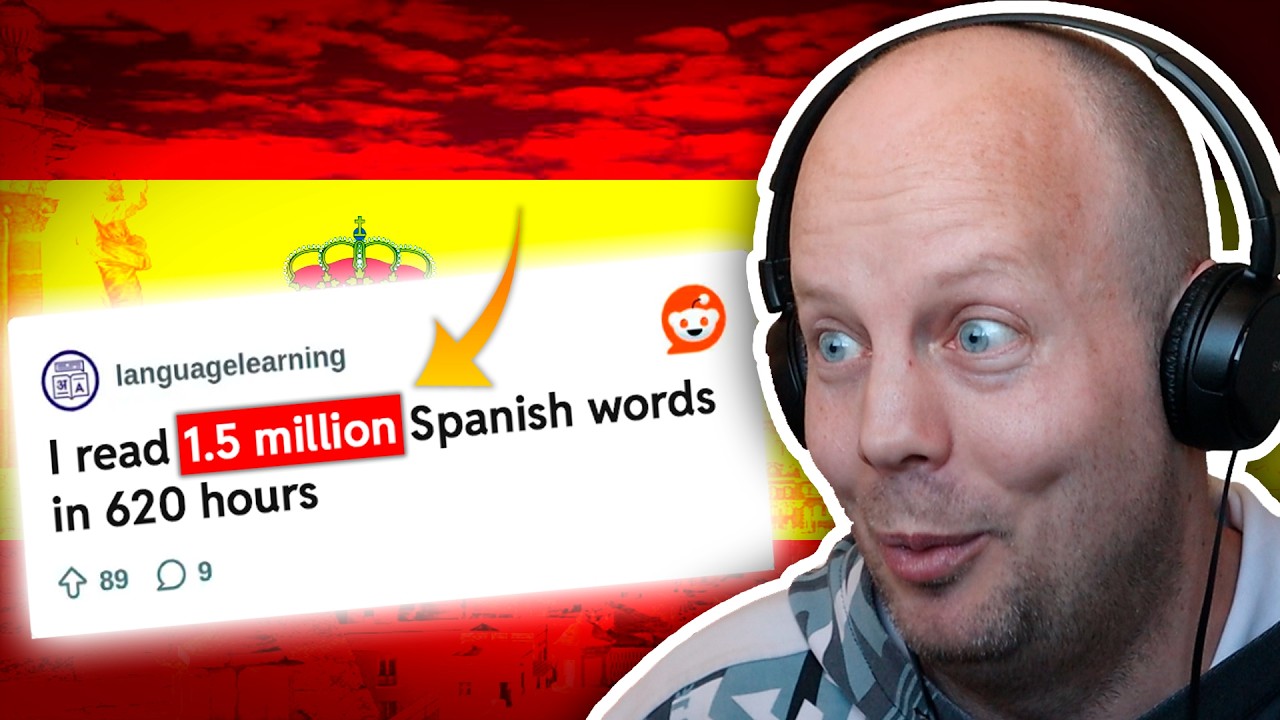
Video summary
The video features a detailed review of a Reddit post documenting a massive language learning challenge where the author read 1.5 million words in Spanish over 620 hours. The creator, who admits to not being a natural reader, analyzes the poster's progress which included extensive reading, listening, grammar study, and vocabulary building. A significant portion of the original experiment was complicated by the author taking medication that severely impacted his cognitive function, causing his reading stamina and listening comprehension to crash temporarily. Despite this setback, he managed to recover and eventually surpassed his previous milestones, demonstrating that a heavy focus on reading can significantly accelerate overall language acquisition compared to listening-only methods.
The core argument presented is that while the poster achieved fluency in understanding native content like movies and TV shows relatively quickly after reaching a high reading level, the creator's own experience suggests there are limits to how much progress can be made through listening alone without a strong foundation in phoneme perception and grammar. The video explores the concept of "sandwich listening," a technique where learners alternate between listening with and without subtitles to improve comprehension, and contrasts this with the poster's massive word count. The creator notes that while he could follow the plots of many shows, his ability to understand complex nuances and specific vocabulary remained limited, highlighting the difference between general comprehension and true fluency.
In addition to analyzing the reading challenge, the video discusses the creator's personal experiments with Rosetta Stone and grammar study to fill gaps in his knowledge that input-heavy methods had missed. He reflects on how understanding grammatical patterns and verb conjugations through structured exercises helped him automate language processing, allowing him to focus more on abstract narrative tracking rather than decoding basic sentence structures. The conclusion emphasizes that while reading a million words is an impressive feat that can jumpstart fluency, it does not guarantee native-like accent or perfect command of all linguistic subtleties, and the best approach likely involves a balanced mix of massive input, targeted grammar study, and active speaking practice.
Read the full video transcript
What's up grinders? Welcome back to the
channel. So today we're going to be
checking out another Reddit post. This
one is apparently a reading first
language challenge 620 hour update and
apparently I get a mention in here. So
let's see how this one goes. But this
would be the first time I'm actually
checking out a reading only challenge
because as you guys know I've mentioned
on this channel many times before. I'm
not like a big reader. I go through
periods of time where you know,
sometimes I like reading, sometimes I
don't but it's like it's not my main
way of enjoying input or content I guess
overall. But anyway, let's read this
one. So the reading first language
learning challenge and as you can see
this one is quite beefy. Before I get
into this and we we go through it.
There was a couple of comments in here.
So I just wanted to check the the first
comment is actually it's a full on
screenshot. This is becoming a meme at
this point. Whenever someone sees like a
good Reddit post, they knows probably
just going to randomly get deleted. They
take a screenshot of it just in case
like I react to it later. And what's
this? These two don't want to interfere
with actual high quality content it
seems or interface sorry. I interfere
interface whatever.
Too long didn't read please the
conclusion gave me nothing.
You you got to read a post about a
reading challenge and then apparently
it's too much to read.
>> [laughter]
>> Ah people. Humans man, humans. Okay,
let's go through this one. So they've
done a 50 hour update, 125 hour update
and a 300 hour update and this is the
620 hour update.
How's this work? You got 50, 125. What's
the math behind that?
Maybe this is whenever they feel like
it. I've been learning a language to
test what happens when you neglect
listening practice in favor of reading
then try to catch up listening when you
have a relatively high level in reading.
The experiment was originally inspired
by several reports of people reaching a
fairly strong reading level in Spanish
and then finding that their listening
caught up to the point of being able to
watch movies and such after only 100
hours of listening practice. I can kind
of believe this because when you're
reading you have time to actually go
through every single word that you're
processing. I'm curious to see if this
is like a stop and reflect and look up
words type of challenge or a straight-up
C I challenge. I wanted to test the idea
that listening practice would be
radically more effective once you've
attained a high level of reading. My
original plan was to focus on reading
until I was comfortable reading
uh learn natively content around the
early C1 level then begin the listening
phase. I documented this reading phase
more thoroughly in the 300-hour update.
Okay, so if they're already C1 level 620
hours.
>> [laughter]
>> Okay, if you don't understand why I'm
crying go watch my Spanish review
series. Unfortunately, not long after
the 300-hour update I titrated to a
higher dose of CNS depressant medication
titrated. We're going to learn English,
boys. Substance was measured or adjusted
gradually in small precise amounts until
a specific goal.
>> Titrated.
>> Titrated?
I prefer my pronunciation. No, it's it's
titrated. We're going with titrated.
>> Titrate.
>> God damn it. To higher dose of CNS
depressant medication uh de- depress-
ant medication. [laughter] And this
resulted in the collapse of my reading
stamina and speed. Bro, just introducing
these words resulted in the collapse of
my reading stamina and speed as well as
my listening level. Uh this didn't
resolve after a few weeks and didn't
want to abandon Spanish but the validity
of the whole experiment is obviously
badly undermined by the sole subject
being added by drugs. Okay, grinders,
let me know down in the comment section.
Should we do a drug-induced reading
language challenge.
1,000 hours of OF RUSSIAN ON ECSTASY.
NO, I'm just joking. Let's not do that.
In the end, I decided to continue doing
whatever I could without maintaining the
experiment. And whatever I could
initially turned out to mean exclusively
watching Easy Dreaming Spanish content.
You could regard this as triggering the
listening phase early. Ooh, okay. So,
what's he done? He's got interactive
reading
289. See you guys? See, he's counting by
hours. He's counting by hours. Everyone
who says I should count reading by
words, there is someone else out there
who's counting by hours. And just you
watch. I swear to God, I'm going to
scroll down and he's going to have word
count, isn't he? He's going to do word
count, isn't he? I'm just scrolling. I'm
just scrolling. We're just We're just
looking. God damn it, he counted words.
Okay.
>> [laughter]
>> Uh okay. So, I guess if I ever did a
reading challenge, I'd have to do word
count. Everyone wants word count. Okay,
free-flow listening, free-flow reading,
Anki, grammar study. Wow, this guy
really broke it out. Shadowing.
Ooh, okay. So, he did do some shadowing.
Okay. Pronunciation practice, 3.2 hours.
Sound study, intensive listening,
flashcard creation. So, he's done some
Anki in there by the looks of it or at
least some other SRS type of program.
Sentence mining while reading. Okay, so
this is I guess this is a reading-heavy
challenge with a whole heap of other
stuff added on top. So, it's probably
quite a healthy way to do things. Total
time spent reading is 302 hours. Total
time spent listening is 243 hours
excluding shadowing, reading aloud, etc.
and counting reading while listening as
listening. At the previous update, I had
done 50 hours of listening. So, since
then, I've done around 194 hours.
Everything else accounts for 73.8 hours
and about 12% of my time. So,
realistically,
he's done just slightly more reading
than listening. Okay. Listening. At my
300-hour update with 50 hours of
listening. Okay, so he's done all the
listening as of recently, which is, you
know, in reference to the drug um
bender that he went on. My comprehension
level was around 65 on Dreaming Spanish
and I was mainly watching easy native
travel content on YouTube. Okay, so he
was like right at the beginning stage of
listening back at the
the 300 hour update of of reading. Okay,
I feel like the more I read this post
the more depressed I'm going to get as I
realize he's probably like light years
ahead of me. However, my listening
although relatively advanced was also
relatively mentally taxing mentally
taxing wait
advanced how's it advanced only after
that anyway when the drugs reduced my
working memory and processing speed my
listening level crashed. I started
listening mainly to easy DS content
around level 50 55. Previously I had
difficulty consuming DS content because
I found it slow and boring. Welcome to
the club.
>> [laughter]
>> It is at that level it is slow and
boring but I found it was actually much
more acceptable while on drugs.
>> [laughter]
>> Could you imagine that this is like the
new DS method of advertising. Look guys,
we know our content is slow and boring
but if you do drugs trust me boys it's
way more acceptable.
I'm not trying to diss DS it's just
funny how this reads and started
spending around two hours a day of free
flow listening. You know, when I hear
free flow listening I just imagine like
there's a dude he's kind of like
chilling. He's like having a party.
Maybe he's like
he's got [snorts] a good [ __ ] I don't
know he's he's a reefer in his mouth
he's like
that's right Augustina.
That's where they keep the aliens.
You know, like that's what I imagine.
Okay, the original hypothesis was that
it would take around 100 hours from the
start of listening phase to reach the
point of being able to understand movies
and TV shows. Obviously we have a big
confounding factor and I hadn't reached
the target reading level I wanted but
still did I get there? In a word no.
Okay, listening gradually became less
tiring. My level increased and I resumed
listening to native content over the
course of 100 hours. However, even by
the end, the range of things I could
understand was quite similar to 300 hour
mark. My ease of depth of understanding
was greater, but nothing new had really
opened up. Movies were just a blur.
Okay, so this is at 300 hours of
listening on top of his
Wait, 300 hours on top of
his reading already? No, because this is
where he's at. So, this must be just in
total. This seemed to be mainly due to
the phenom perception Right, phoneme.
Phoneme. Why am I saying phenom?
Man, why is English so hard? I hate this
language. Hearing the sounds of the
language, clear standard speech was
relatively okay, but anything more
naturalistic was immediately a problem.
But, this is weird because I definitely
made steady um progress and phoneme
perception over my first 50 hours doing
10 minutes a day. Why would I make
almost none in the next 100 doing hours
a day? I'll talk about it later. Okay.
Once I reached around the 100 hour mark,
my stamina was returning and I decided
to add some targeted practice to improve
my phonological perception. A technique
I used for this uh before is intensive
listening. Isn't that just listening?
Or is that like listening as in you
listen to the sounds over and over and
maybe use like pairs of sounds that are
similar. He does include a link.
Let me just quickly go open that link
up. I want to double-check. Okay, so
this is from the Refold method. Okay.
Intensive listening is a style of
interactive listening where you listen
to content without text, pausing
frequently, check whether you
understood, and using subtitles as a
fallback when you're stuck. Uh okay, so
that's what it is. Which is very
effective and very tiring, but which for
reason uh variety of reasons, I've never
managed to turn into a habit. Instead, I
decided to use a technique I haven't
tried before, which while is certainly
um been described, it doesn't seem to
have an accepted name. I'm going to call
it sandwich listening. It works like
this.
If this is anything like sandwiching
back when I was in school where you're
in the back of the bus and you're trying
to squish someone between you. Listen to
a short piece of audio. I normally use 1
to 2 minutes that's fairly difficult.
Re-listen with subtitles looking up the
words or expressions if necessary.
Listen again without subs. If necessary,
repeat two and three. Okay, I would just
See, this is what I would call intensive
listening. This is basically just a an
exercise where you do exactly this. You
listen, you try to understand, you read
the subs or like you read through all
the words and then you've kind of primed
your brain for it so you listen again.
Your brain's kind of knows what to
accept. It doesn't have to try to figure
out as much, you know, it doesn't have
such a high cognitive load as
everything's been thrown at it. It kind
of knows what to expect and the more
times you do that over and over it gets
to the point where you can literally
understand everything in a small segment
but it's it's good for like narrowing
down your understanding of words when
you're hearing them. I started spending
around 15 minutes doing sandwich
listening most days mainly with TV
series and news shorts from RTVE
Noticias. Okay, so guys, let me know
what you would call this. I've never
heard this term sandwich listening
before. I don't think I've given a term
to this before. So like I don't know.
After that I saw a pretty rapid
expansion in the type of content I could
understand with RTVE Noticias being one
of the biggest gainers but also mumbly
content with background music like the
YouTube channel Kibana and dubbed TV and
anime also began to open up. The recent
content I've been watching has mainly
been adventure travel UBX. Okay, so
these are channels. Okay, so let's go
have a look.
>> [music]
>> Okay, I got to pause that cuz there's
literally music in there but I was
getting about Yeah, you know, like 60 to
70% of that. Okay, and then Science
General from here. I don't recognize any
of these channels. Uh for YouTube
content with one person in studio
talking to a camera almost always have
good comprehension. A major exception
being Tur who talks like an insane
person. I got to go check out this
person now. We need to know who Tora is.
>> [music]
>> Wait, that was pretty comprehensible.
Wait, she's actually more comprehensible
than the other girl. What's going on
here? I don't know. I just seem fine to
me. That's an insane person, probably
more I'd watch. New special reports from
channels like El Confidencial, DW
Español, BBC. Yeah, I'm not too
interested in all of this type of stuff.
I'm more interested in
I get comparing my listening
comprehension with my old standard
candle, Evil Deer.
That's me, guys. In the 1,050 hour
Pimsleur Dreaming Spanish update,
there's a clear difference. I have
better comprehension of all the clips
that he tried to translate. In fact,
effectively full comprehension.
[laughter]
Okay. Although I had to guess the
Spanish term for enlightenment from
context, I do think Evil Deer's
comprehension is affected by how
disgusted and checked out he is
[laughter] at
this point, though. No. Okay, well, I'm
definitely checked out now. I'm I'm
checked out of the DS method. But, bros,
we're we're going hard. We're we're
going we're going to go hard. We're
going to we're we're flipping the ship,
okay. But, what I'm thinking
is because
and this is going to be a little bit of
a side quest. I'm going to talk about
what I'm going to be doing right now cuz
I actually haven't spoken about it right
now. I actually have a lifetime
membership to Rosetta Stone, and I went
and did the first lesson Was it first or
the first three lessons? I can't
remember. I did them like yesterday,
okay. And, bros,
like brain-blowing how much Spanish
grammar that's literally just teaching
me. And the funny thing is Rosetta Stone
doesn't actually teach you grammar. It
just teaches you patterns. So, it's
basically direct method, okay. And I was
watching it and I was going through and
I was clicking on the pictures and
stuff. I did not realize that verbs in
Spanish, okay, you add an N on them
to indicate that the subject is plural.
I wasn't even aware that verbs were
doing that. Like maybe I was. I heard an
encantan encan- encan-
Like I'd heard the like the n sound on
the end of verbs before, but like
I never made that connection that that
meant the subject was plural. And with
from one lesson of Rosetta Stone, I was
like
Oh.
Oh. So, it's you know, los hombres
comen.
Or you know, um
What what's another one? Uh
I'm trying to think of like a las niñas
nadan. You know, like these are just
like I I didn't realize that I like if I
was speaking Spanish before in my
crosstalk sessions, I would have said
something along the lines of las niñas
nadan.
Actually, I would have never said nada
because I wouldn't have known the word.
I probably would have said something
like nade. Something, you know,
something random. Um but it's it's good.
Rosetta Stone is good if you've done
what I've done. I would not recommend
this as like the general direction most
people would take, but it's good because
I literally understand everything. And
now I get to see why it works the way it
is. And I get lots of speaking practice.
So, I'm going to do that. I don't know
how long. I might actually just do a
full Rosetta Stone review series uh just
because I actually haven't seen any good
ones on YouTube. And lots of people
search up Rosetta Stone, so it'll be
[ __ ] great for the clicks type of
thing. But it is 300 hours, I think. But
by the end of that, because I spoke with
AI, cuz you know, me and AI we're best
buds, okay? Based on the patterns of
that, I should understand most grammar
in Spanish except for um subjunctive and
may- maybe some subjunctive, but like I
should understand most grammar based on
my background. So, it's like
that would be a heavy listening
approach. It teaches grammar via the
language. It kind of falls more in line
with what I was doing with the the the
challenge of being like very input
heavy. So, I think I think it's probably
a it's a good way to go, but we shall
see. But what about native movies and TV
series, which was the original question?
Although I hadn't checked in about a
month, I expected to have to report that
I still had no real comprehension. Then,
I turned to La Casa de las Flores as a
test and realized that although my
understanding was quite imperfect, I was
actually following the plot in spite of
the section I watched being largely
dialogue with minimal visual context.
Testing more shows around level 27 and
on Learn Natively, it looks like I have
a similar comprehension of around half
of them. I don't even know what this
Learn Natively is. Let's go find out.
Natively is a website dedicated to
helping language learners engage with
content in their target language. While
there's no shortage of sites that focus
on teaching grammar and vocab, we feel
learners are almost left to themselves
when transitioning into native content.
This can be terribly daunting and often
dejecting experience. It shouldn't have
to be. You can tell this is This is
written by people who love reading.
Like, look at this. They're using big
words like dejecting. How dare they?
Daunting. Daunting's not big, but it
feels big. Uh we aspire to make this
transition easier. What languages do
they have? Spanish, German, English,
French, Korean,
and Japanese, I'm assuming? Or is that
the translation of the website? Okay, so
it looks like a reading website. I don't
want to over hype this. My comprehension
on most series is still below what I
want from CI and say I understand them,
that ridiculously binary word would be a
stretch. But, it's good enough that I
could enjoy watching a range of movies
and TV shows. Well, based on what you've
just told me, bro, you're at 620 hours
and you're better than me. You're better
than me. So, [ __ ] you. [ __ ] you. No, I'm
joking. It just goes to show that, you
know,
straight up reading from the beginning
helps you get better at listening than
just straight up listening all the way
through. Okay, but for real, why was my
listening progress so slow for the first
100 hours? I'm guessing it's because
your brain just not used to the sounds
of language. That'd be it. The obvious
answer is that I was, well, drugged.
That might contribute a little bit, I
guess. But, here's the odd thing. I've
been studying Mandarin parallel with
Spanish.
Is everyone studying Mandarin What's his
Mandarin level at? I need to know. And
at the same time as ramping up my
Spanish consumption, I reduced my
Mandarin consumption dramatically from
several hours a day down to two uh
sorry, down to 10-20 minutes plus some
audio flashcards. I expect to see a near
total slow down of the improvement in my
Mandarin phoneme perception, but as far
as I can tell, I didn't see a slow down.
Tones are much sharper and clearer now,
and when I recently put on C-drama I
struggled with before, I was surprised
to realize I could follow it quite well.
Wow, that implies his Mandarin is
actually quite good. If you're actually
following a C-drama,
your Mandarin is pretty good. Put these
things together and one hypothesis jumps
out. Could there be a daily limit to
phoneme perception progress? Don't know.
Never done that test. Perhaps some kind
of mechanism that only accepts one
update to a particular phoneme per day.
I don't know. It's probably the drugs,
bro. I think it's the drugs. I thought
it was pretty silly sounding, but I did
some digging. Nothing in the SLA
literature touches this topic, but this
is very interesting paper on auditory
discrimination of frequencies. How dare
they discriminate against a man? That's
racist. Improvement of frequency
discrimination required 360 trials of
training per day while learning on uh
temporal interval discrimination
occurred with 360 training trials per
day, and additional daily practice did
not increase the amount of improvement.
It therefore appears that the
accumulation of improvement over days on
auditory discrimination
discrimina- I I keep I swear to god I'm
not reading that word right, but it is
right. Tasks may require some critical
amount of training per day. The training
uh beyond that critical amount yields no
additional learning on trained Okay, so
basically, this is scientist speak for
if you do too much of a good thing, you
make no progress. And I think that's
pretty much the same with like literally
anything. You do too much of something,
your brain just gets cooked. Okay? Your
brain's cooked, it's like, "No, I don't
want to." Okay? Like, you don't need a a
a big fancy schmancy scientist to tell
you that. This is pretty much the effect
I'd imagine applied to a closely related
phoneme. And if this is so, then it
could also explain the people reporting
understanding movies after a hundreds of
hours of listening practice. See, this
is the thing. I understand movies, but I
don't understand movies. Like, I can
follow along. See, whenever someone
says, "Oh, I I can follow along with a
movie." What does that mean?
Because I can do it, no problem in
Spanish. But, if you ask me to give a
rundown of the specifics of the
conversations these people are having,
it's going to be very birds-eye view.
Let's conceptually separate listening
into three sub-abilities. The general
language model that's shared between
reading and listening, phoneme
perception, and what I'll call listening
fluency, which does the stuff like
resolving difficult sound-word mappings
and some chunking that's done visually
when reading. Listening fluency is the
bit that can be compensated for with
working memory and processing speed, and
was exactly the bottleneck for me at 50
hours of listening. However, movies put
a very low demands on listening fluency.
There are few complex sentences, and the
lines of dialogue are usually followed
by a pause. Instead, they stress mainly
phoneme perception and general model.
Yeah, I would say movies uh this is
true. Obviously, complexity of dialogue
really depends on the the genre. Like,
for example, if you're watching sci-fi
[ __ ] like I like to watch, it can get a
little bit complex. However, the issue
is your brain needs to sort out the
sounds of the language from the sounds
of the background. And figuring out, you
know, what is actually relevant to
understanding and what is just
background blur. So, if we really have a
docile before phonological update,
someone could reach a high level on
reading, then do a small amount of
high-quality daily listening amounting
to about 100 hours spread over, say, 18
months, and reach the point of
understanding movies. In reality, with
pretty wonky, effortful comprehension,
but enough to justify to themselves
while still having very weak listening
fluency. And that would explain the
exact form of the claim that keeps
popping up, 100 hours, because 18 months
sounds lame and can understand movies a
a leading. Man, I hate readers. Readers
love to use big words.
>> elided
>> eliding
So, it is actually true. The evidence
here is pretty thin and circumstantial
and largely dependent on my memories and
impressions, which may be fallible. And
you were on drugs. Okay? I wouldn't put
a lot of weight on it. And although
sleep consoli- consolidation effects are
well known, bro, this guy's pushing me
to the limits of my English. Blo- Why?
It's odd if it is true and no one
noticed, but it would be very
interesting to see if tested.
Do I sense a new test coming up? A new
challenge. Reading to fluency and then
see if 100 hours is all you need to
convert that to listening fluency. That
is actually a very interesting
challenge. I'm not a big reader,
but maybe this would help me become a
better reader and a better evil deer
overall.
And maybe maybe by doing this I can
finally push my English to the C1 level.
>> [laughter]
>> You know, the funny thing is I've
probably done more reading in Esperanto
than I than I have in English. Actually,
I'm almost certain I have. Cuz like when
I read in English, it's usually stuff
like this, in all honesty. And like
Wikipedia articles and stuff, but like I
don't read books really in English much.
I haven't since I was like my teens. So,
my English reading's probably decrea-
No, it in fact it has. I'm reading using
Kindle with Merriam-Webster's Spanish
translation dictionary still for lookups
and long proce- and long press. They're
doing literally dictionary lookups as
they're reading.
Makes sense. You know, I've actually got
a Kindle,
but the problem was with it feels so
artificial when you're reading and
you're trying to like swipe the screen
then you see
as it moves across the page. Like
it doesn't have the same And also when
you complete a book, it doesn't have the
same feeling of like success, at least
for me,
as compared to having something physical
and holding it and going, "You know
what? You know what? I read this. I read
this. I'm going to put this on my red
pile, which in consists of one book."
You know, like I don't know. Maybe
that's just me. Maybe that's just me. I
probably should fire up my Kindle, you
know, charge it up, do a reading
challenge. Maybe Japanese reading
challenge, but then my Japanese would
probably sound freaking atrocious. I
generally read material that's at an
easy level for me, but usually read in
the intensive style, looking up almost
all words that I don't know or can't
infer, and trying to get a full
understanding of the text. I don't I
don't get I documented the observations
that led me to the strategy in the last
update. Okay, so here is all the things
that they read. I'm actually
1.5 million words. They are at fluent.
This is what I was saying my Dreaming
Spanish challenge, okay. When I was
doing it, I was saying the fact that
Dreaming Spanish says you need to read
1.5 to 3 million words
in order for you to get to that, you
know, that 1,500 hour milestone. You
don't need any of that 1,500 hours,
apparently. You could just do the one
point, you know, the 1.5 million words,
which and then a couple hundred hours of
listening,
and that's what, 620
hours and you're ahead of me. Ahead of
me quite a bit. That just goes to show
that is like the
man, I'm still pissed about that. I'm
pissed because it's almost like a hidden
way to get like, let's say with AOG,
you're not quite there. You start
reading, you read 1.5 to 3 million
words. Doesn't matter what method you
do. 1.5 to 3 million words, you're
probably going to reach fluency anyway.
So, it's like then they can claim that
as a success and say, "See? See?
All you had to do was finish reading."
Bro, I spoke about this before. In the
language community, they talk about
reading that many words, 1.5 to 2 3
million words, in order to reach fluency
via reading. That annoys me. Forgatos um
Casilleros
Casilleros. In early books, the word
counts were mainly drawn from the web.
For the later books, they're now mostly
drawn from Corvo with a few estimated
based on number of pages and words per
page. Although immediately after 300
hour update, my reading ability was
wrecked. Overtime, my stamina returned
and eventually I continued with El Alma
uh del Brujo. Since then, my reading
stamina has improved steadily and has my
reading speed. In spite of my relatively
narrow approach to reading 45% of the
words read are from books about witches.
That's all right. I love like [ __ ]
video games. So like a lot of my vocab
comes from video games. Vocabulary no
longer seems to be the bottleneck in
reading books. As an example, I sampled
two random pages from a few different
books El Infinito and Un
Hunso? Hunso?
Hunso?
I don't know what that is. And in each
case I have 98% of higher lexical
coverage doing more explicit vocabulary
study would have been a mistake I think.
Obviously cognates are doing a lot of
work here. I doubt this would replicate
in Chinese or even German. I do fall
below this coverage on some topics when
reading news with the main example being
the current corruption scandal in Spain.
I've read relatively little news so this
would probably be an easy fix. Currently
my main blocker on reading more
difficult books is my difficulty in
tracking more complex narratives with
multiple threads and indirect
implications. I suspect that tracking
this comes down to better automating
what I can already do. Freeing up some
working memory for more abstraction.
Like the way this guy talks is somewhere
between a programmer
and like a hardcore reader. Like
somewhere between those two. Because
like the way some of this terminology is
used is exactly how a programmer would
talk. Like literally freeing up some
working memory for more abstraction.
This that sounds like it's straight out
of a programmer's handbook. In which
case perhaps at this point it would
actually make sense to start reading
some books more extensively. Output.
Although I would have linked liked to
have been speaking at some point due to
issues with my throat and tongue I'm
still not able to speak for very long.
Don't know what's going on there. I
There was no mention. Maybe some health
issue. I've spent a few hours thinking
in the language and done a small amount
of writing practice. However, I have as
much for physical therapy as for
language learning have been spending a
small amount of time each day practicing
shadowing and similar activities mainly
by blind shadowing German Spanish
videos. I haven't really noticed any
improvement in my accent from doing
this. That's an interesting observation.
Usually when people talk about doing
shadowing, after doing it for I'm not
sure how long did he say? He only did a
few hours, okay? A few hours you don't
really get much. I've heard from people
after they've done it for like, you
know, 10 plus hours, they start feeling
like a difference. So, here are their
updates. Here are accent samples for
each. Oh, okay.
>> [snorts]
>> It's I would say he's Okay, so he seems
to have a
I'm I'm just going to throw this out
there, pretty heavy accent, okay? But I
could be completely wrong in that
regard. Don't know. Um let me know down
in the comment section. But he seems to
be able to put like if this is not
scripted and this is just straight off
the top of his head,
he's probably conversationally more
fluent than me.
Okay, so this is all present tense,
basically. So, did I ruin my accent by
reading earlier as people warned me?
Possibly yes. However, accent quality
seems to have an enormous amount of
individual variation, so I don't think
we can conclude much from my end of one.
Most probably a major factor is simply
my being a terrible mimic as well as
some uh psychological resistance. Yeah,
so that's what I was saying, like if
you're going to do a like a straight-up
reading challenge, oh god damn I just
banged my freaking knee. I would
probably just start with like some
like mentoring, or maybe not mentoring,
tutoring at the start with the sounds,
like reading a page with someone.
Obviously depends on the script of the
language. If it's a Latin script, you
could probably figure it out pretty
quickly. As long as it is like it's a
logical script. Like Spanish, it's you
know, written Spanish sounds like spoken
Spanish for the most part, okay? If this
was English, good luck on that one.
Could you imagine if you learned English
just from reading? Bro, your accent
would be cooked. Not just your accent,
your literally comprehension. Next, I'm
going to try uh some other methods to
see if I can make my accent more native
like. My current plan is to record
myself saying various individual words
and compare to a reference and to focus
on perfecting one passage from an
audiobook. Anki, previously I did the
Refold 1K deck and a little sentence
mining, but I deleted all my Spanish
Anki cards shortly after 300-hour update
since they were mainly mature cards and
at that point I was struggling uh with
keeping up with Anki reviews. I did
eventually start using Anki for grammar
as I described in the next section. Ooh,
okay, let's
let's see. Let's see how he did this.
I've been studying Collins Spanish
Grammar on and off, mostly off, if we're
being honest, which is straightforward
grammar reference that covers up to B1.
I read the explanations and examples.
Then, if it seems like something I
couldn't produce, I select a few
examples and create N L uh so, native
language to target language translation
cards for them. If the example is
complex and contains multiple things
that I haven't automated yet, then I add
more cards with sub-expressions. I only
use examples that I have already
understood or I already understand.
Otherwise, the card becomes drastically
harder to remember. For learning to
produce conjugations, earlier I tried
the typical close exercise methods with
various resources. Okay, so, close is
something I like to recommend. This took
a generally unreasonable amount of
effort and the conjugation still don't
seem to be available when I'm trying to
output. That was obvious from the
speaking example because he was
literally speaking just in like
first-person present tense. More
surprisingly, conjugations that I could
produce without thinking were not even
reliably available when doing the close
exercises. I gave up on this approach.
Instead, I've been uh creating native
language to target language translation
Anki cards for simple sentences that
demonstrate the use of irregular verbs
that seems less time-consuming and more
effective. This kind of takes me back to
while I was doing Rosetta Stone because
I already understand probably up to, you
know, like a B2 level in Spanish, maybe.
Like like if we're being you know, kind.
I understand up to a B2 level, which
means that all I have to do now is to
recognize how the the patterns of the
language fit together and then practice
them. And Rosetta Stone is actually
pretty good for that. It shows you the
patterns and then there's this lots of
speaking practice. That's pretty much
it. So, I'm thinking I will possibly go
do the entire Rosetta Stone course, make
a video series about it, and then after
that I'll return to Worlds Across and
then I'll just do a [ __ ] ton of speaking
practice. I know a bunch of you guys
actually asked me to do language
transfer and I did 30 minutes. I don't
think it's a good idea for me to do it
at this
Actually, I don't think it's a good idea
for me to do it for Spanish because it
assumes that you don't already
understand in Spanish and it teaches you
in a way
which kind of like it adds all these
intermediate trees which I don't need
because I already understand the
language.
So, all I need to do is practice like to
become aware of the rules, the grammar
rules, practice them, automate them,
and then that's it. That's That's what I
need to do. I realistically like the
biggest just downside of my entire AOG
experiment I was doing was just the fact
that
I was unaware of the the grammar rules
or the patterns that underpin the
language and how to utilize them and I I
feel like once I know how to utilize
them, I'll make much better progress.
I'll be able to return to Worlds Across.
I'll be able to do speaking and then
I'll be able to more comfortably, you
know, continue on reading. For a
favorite language, I'd ideally do the
same thing but start it earlier.
Conclusion: The net result of all this
craziness is that my level is pretty
much where you'd expect it given the
work I put in. The one possible casualty
of this approach was accent. This
doesn't matter a a for me personally,
although it will to some people. I plan
to continue with Spanish for the time
being and I might do another update to
the series if circumstances allow me to
start speaking the language. Otherwise,
thanks for reading. That was very
fascinating. You know, there's so many
challenges that I want to do, which
realistically I don't have time to do
because, you know, I work full-time.
Like, I would like to do a challenge
where it's just pure Anki. Literally no
nothing external to Anki. Never like and
see how far I can get doing that.
Don't recommend it, by the way, guys.
Don't
I recommend it because, well, one, I've
never done it and I've never seen anyone
do it. It'd be absolutely bonkers
insane, but it'd be funny as [ __ ] Uh
the second one is like a pure reading
challenge and see
cuz like
based on this, in half the time he's
better than me.
So, that just shows that a reading input
heavy approach with obviously look-ups
and, you know, some grammar study is
better than a input heavy approach with
no grammar look-ups and stuff like that.
So, that's it seems pretty definitive to
me at this point, okay?
So, yeah, there's just so many
challenges I'd like to do.
Maybe one day when this YouTube channel,
you know, gets big enough and I can make
money off of it, I can make it literally
my job just to be a [ __ ] guinea pig.
But anyway, I hope you guys have enjoyed
this video. Let me know down in the
comment section. I'll see you all in the
next video and if you're not there,
well, then I will look for your Reddit
post that mentions me.
And I will end you.